6 min read

Israel Loathed the Manna on Edom's Long Road

Merchants opened baskets of fruit from the Land in front of that generation and men died looking at it. The fruit was not poison. The sentence was.

Curated by Arthur · Told by Maggid ·
Table of Contents
  1. The Generation That Could Not Be Satisfied
  2. A King With Two Fields
  3. Up the Mountain Without the Ark
  4. They Came Down Like Bees
  5. The Basket That Could Kill Them

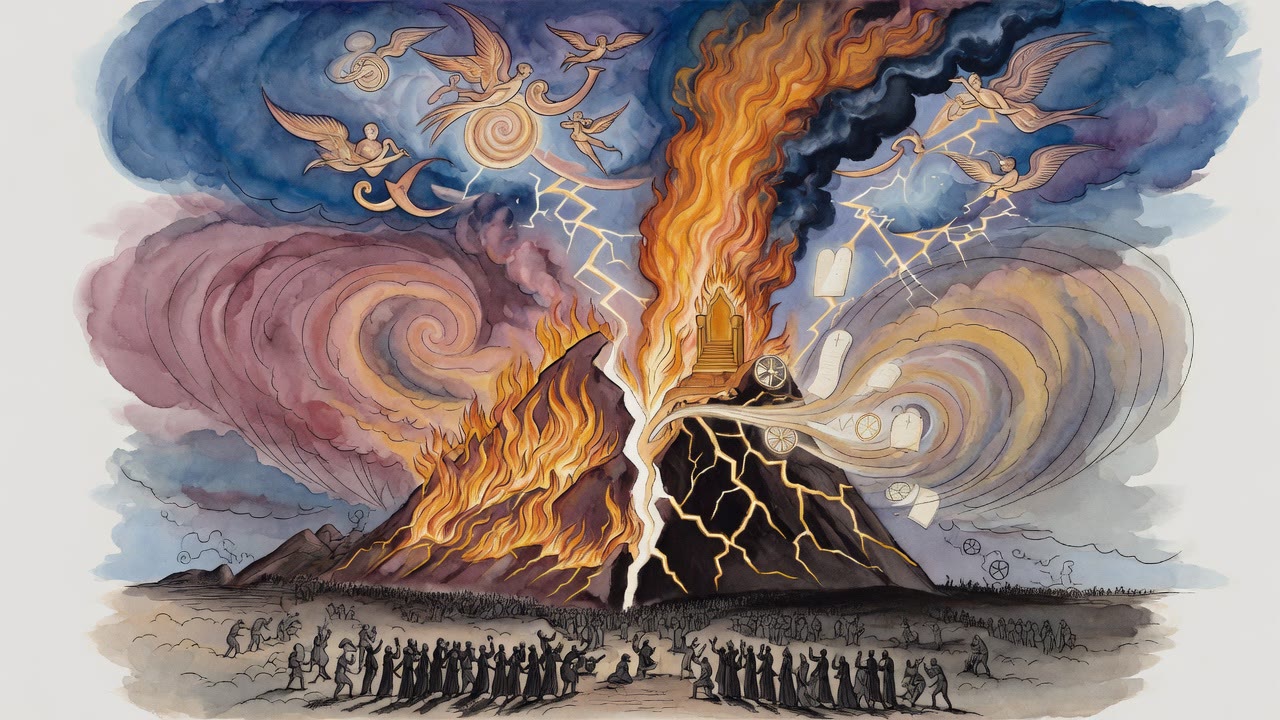
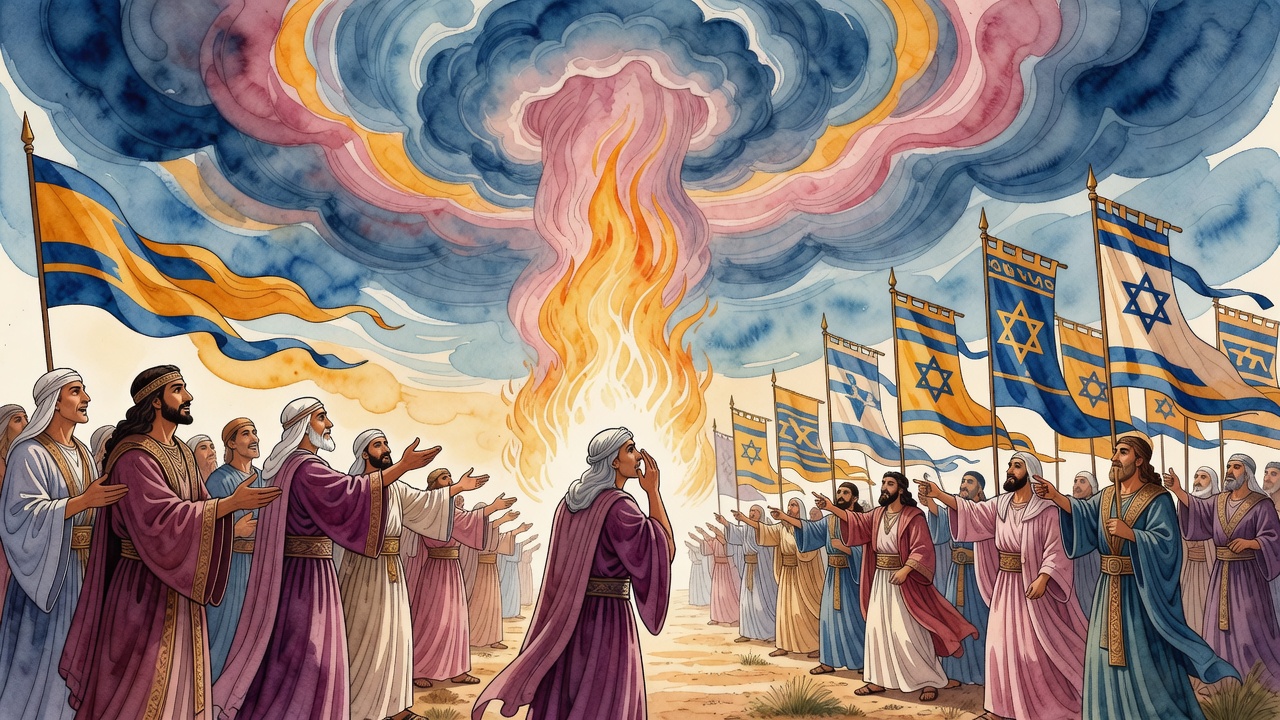
The column turned south from Mount Hor to go the long way around Edom, because Edom would not let them through, and somewhere on that road the people's patience ran out.
Israel Loathed the Manna on Edom's Long Road Click for full size

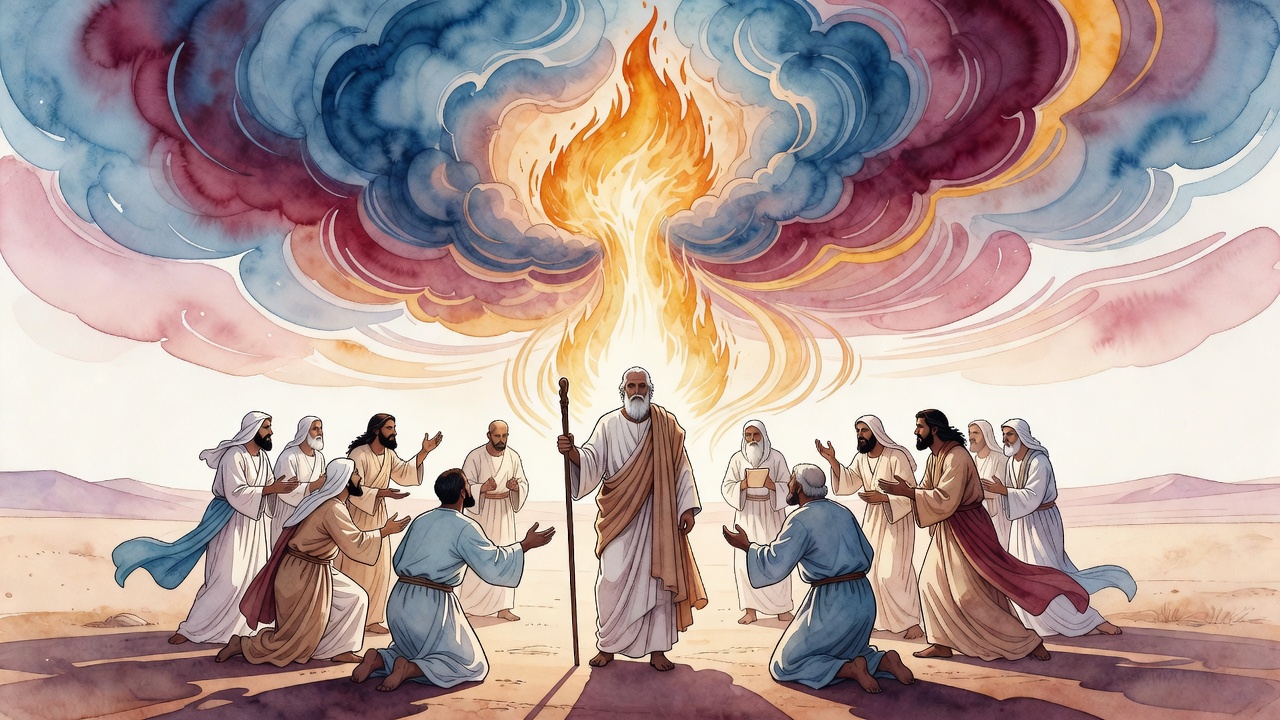
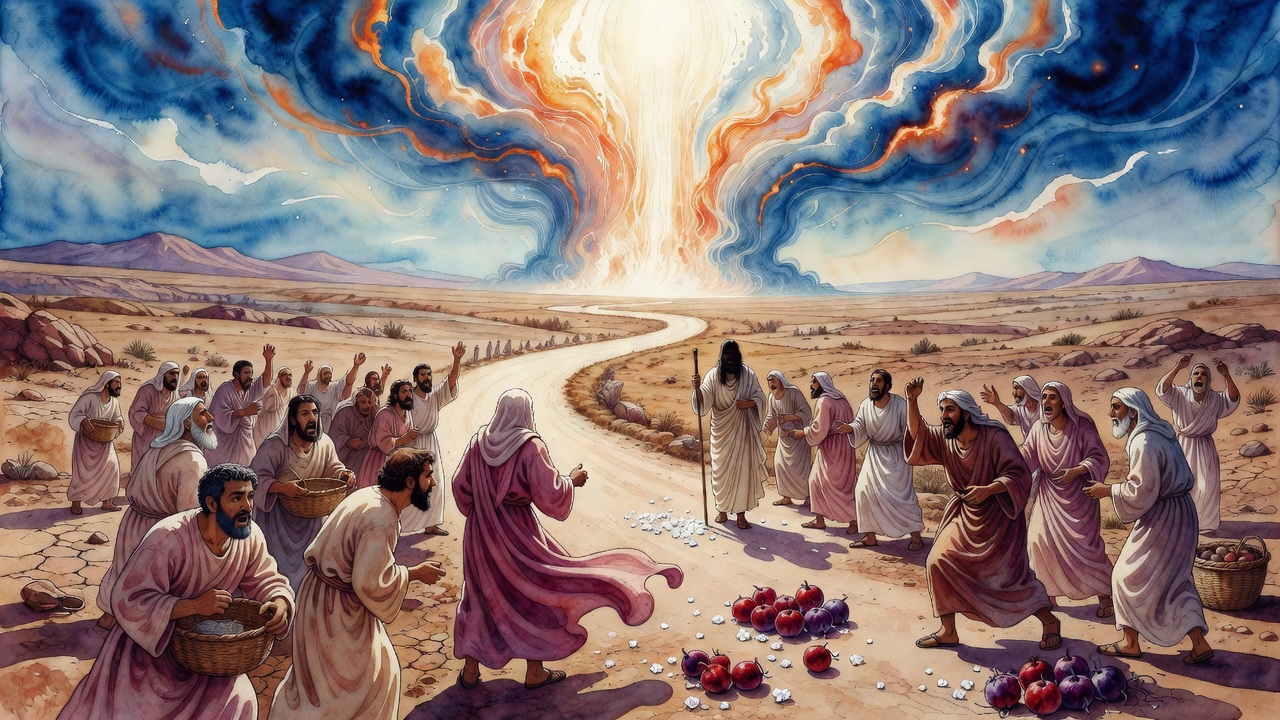
Manna lay on the ground in the morning the way it had lain for years. Somebody looked at it and called it nothing. "Our soul loathes this insubstantial bread."

They had said something worse in the same breath. They spoke against God and against Moses in one sentence, setting the servant beside his Maker as though the two were the same size.

The Generation That Could Not Be Satisfied

There is a reason this camp in particular could not be fed.

Death had been decreed on every adult in it who had walked out of Egypt. Their children would find rest in the wilderness and cross over. These would not. Every morning a hand fed them, and it was the same hand that had already struck their names off the roll of the Land, and they knew it. A man in that position tastes nothing. Bread from heaven arrives on his tongue as sand.

A King With Two Fields

Years earlier, when the sentence was still new, they had worked out an argument for it and told it to each other in their tents.

A king has two sons and two fields. One field drinks from a channel and fills whenever the gate is opened. The other lies there and waits for rain. Which field does a king give the son he loves, and which does he give the other one?

Egypt drank from a channel. Canaan waits for rain. He brought us out of the first and is walking us toward the second. That, they said, is what it looks like when the Lord hates you.

They said it in the hearing of a God who had just told them He loved them.

Up the Mountain Without the Ark

The next morning they buckled on their weapons, every man of them, and turned toward the high ground.

Moses stood in front of them. "He said do not go up and do not fight, because I am not among you. You told me yourselves that our brothers melted your hearts. You said the people up there are taller and the cities are walled. You said it. Now you want to climb?"

They went anyway. They fastened themselves together like men strapped into one belt, and they had a proverb ready for that too: drop by drop the measure fills. The Ark of the Covenant did not move from the middle of the camp. Moses did not move either. They walked up the mountain and left behind them on the ground the only thing that had ever won them anything.

They Came Down Like Bees

The Amorites came out of the towns above.

A bee dies the moment it strikes. It went that way on the slope: one of them would touch a man and a soul would leave on the spot. And they flew. They were above the column, dropping onto men who had spent the whole morning climbing to reach them.

There had been a time when these nations heard the name of this people and came apart. Peoples heard and shook. The inhabitants of Canaan melted where they stood. That was before. Now they chased Israel down the mountain and beat them along the road.

The survivors came back and wept in front of the Lord, and the Lord did not listen to their voice. They had leaned so hard on justice that there was nothing left for mercy to stand on.

The Basket That Could Kill Them

After that came the years of walking, and then the long way around Edom.

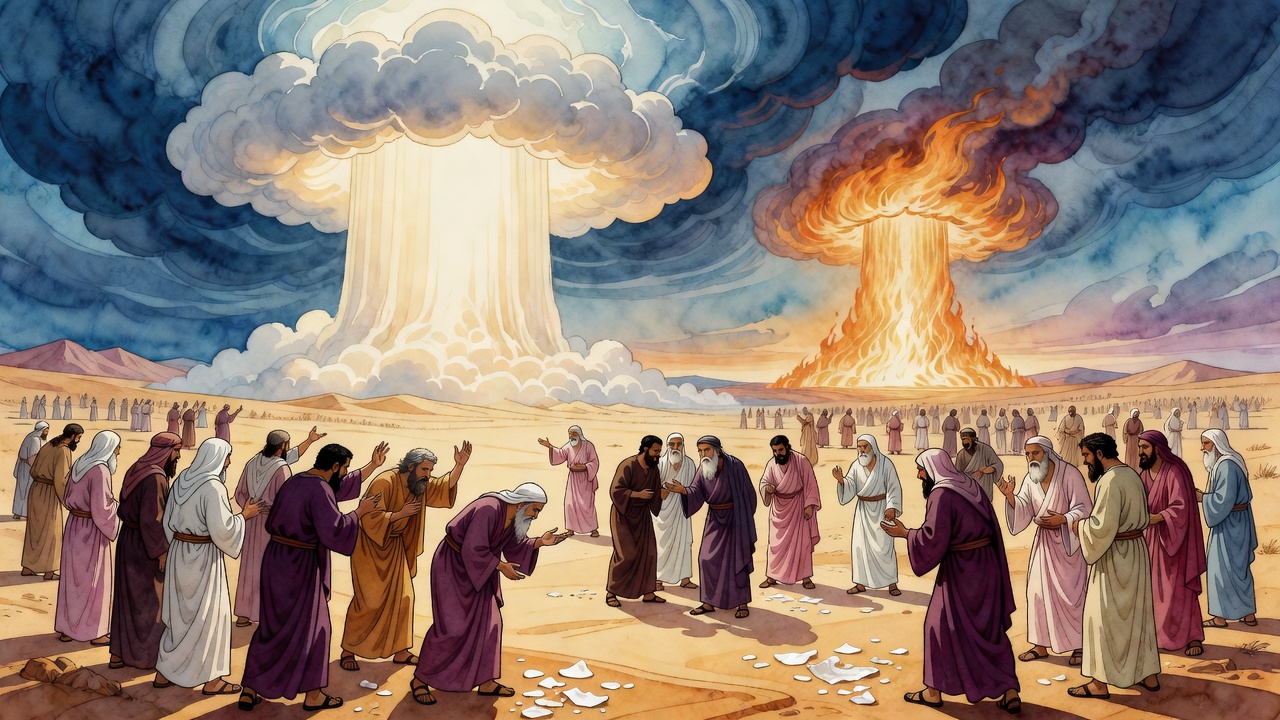
Merchants came out to the camp with produce. Someone would open a basket of fruit from the Land in front of that generation, and men would die looking at it. Not one man of this evil generation shall see the good land. The fruit was not poison. The sentence was. They had been barred from the country so completely that its harvest was fatal at the length of an arm.

That is the camp that looked down at the manna and called it nothing.

The country was already deeded, and they had asked about it once. Why does He keep calling it the land of your dwelling instead of the land of Canaan? Because I gave it to Abraham, to Isaac, and to Jacob, He answered, all three of them, and it is written down. Canaan's name sat on the map only because Canaan had packed up and left when he heard Israel was coming, and he was given a country of his own for the courtesy.

God is not a man, that He should deceive. When He says He will do good He does not hold it back, not even from a generation that has earned worse. When He says He will bring evil, the evil can still be pulled off the table, the way Moses stood in the road at the calf and made Him reconsider. He told Abraham four hundred years of servitude and the servitude ran two hundred and ten. He told Abraham to count the stars, and the count came in.

So the parents went the long way around Edom, loathing their bread, dying at the sight of grapes. Their children crossed.


← All myths
From the tradition

Sources

3 sources

The texts behind this telling. Some cards carry a translation of the source; others are our own retelling of it, and each card says which. Every card links out to the original.

Bamidbar Rabbah 19:21Bamidbar Rabbah

Retold in our words. Read the original at the link below.The Sefaria Midrash Rabbah, 2022 · CC-BY

The Israelites, fresh out of Egypt, certainly did.

We find ourselves in the book of Numbers, Bamidbar in Hebrew, specifically chapter 21, verse 4: “They traveled from Hor Mountain via the Red Sea, to circumvent the land of Edom, and the soul of the people grew restive on the way.” It's a verse pregnant with meaning, a snapshot of a people at a breaking point. But what does it really mean to be "restive"?

Bamidbar Rabbah 19, our source for today's story, explores this verse, unpacking the layers of discontent. The text asks a pointed question: How can the people be restive when (Nehemiah 9:20) tells us, "You gave Your benevolent spirit to educate them"? Shouldn't they be grateful?

The answer, according to the Midrash (rabbinic interpretive commentary), is that this “benevolent spirit” wasn’t felt equally. Those who’d left Egypt, the generation destined to die in the wilderness, just couldn't find satisfaction. They were, in a sense, already living on borrowed time, their fate sealed. As (Numbers 14:33) says, "Your children will be wandering in the wilderness.” But the Midrash cleverly interprets the Hebrew word for "wandering," ro'im, connecting it to the Aramaic raava, meaning "satisfaction." So it wasn't all the children, but rather the children of those destined to die, who experienced true satisfaction. The original generation? Not so much.

This sets the stage for the next verse: "The people spoke against God and against Moses: Why did you bring us up from Egypt to die in the wilderness; for there is no bread and there is no water, and our soul loathes this insubstantial bread" (Numbers 21:5). Talk about ungrateful! They’re complaining about the very manna that miraculously sustained them!

Bamidbar Rabbah highlights the audacity of their complaint: "They drew a parallel between the servant and his Maker." In other words, they were equating Moses with God, diminishing the divine miracle of their liberation.

But it gets even more poignant. "Our soul loathes this insubstantial bread," they whine. The Midrash sees this as more than just a complaint about the food. It suggests that this generation was spiritually unable to appreciate the blessings, particularly the promise of the Land of Israel.

Rabbi Akiva, a towering figure in Jewish tradition, offers a particularly stark interpretation. He says that when merchants showed them baskets of fruit from the Land of Israel, the very sight of it caused them to die! As (Deuteronomy 1:35) states, "If any man among these men, this wicked generation, will see [the good land].." Rabbi Akiva sees this as a blanket denial of any good coming from the Land to this specific generation.

So, "the soul of the people grew restive," because they were incapable of appreciating the present and unable to envision a future of abundance and fulfillment. They were trapped in a cycle of dissatisfaction, blinded to the blessings around them.

How often do we, like the Israelites in the desert, focus on what we lack, rather than appreciating what we have? How often does our own "restlessness" prevent us from seeing the good that surrounds us, the potential for joy and satisfaction in the journey itself?

Full source
Bamidbar Rabbah 17:3Bamidbar Rabbah

Retold in our words. Read the original at the link below.The Sefaria Midrash Rabbah, 2022 · CC-BY

Rabbi Zakai of She'av offers a beautiful insight. He imagines the Israelites asking God: "Master of the universe, everywhere else You call it the land of Canaan, but here, ‘the land of your dwelling’?" God's response? It's a powerful reminder of the covenant. "As you live," God says, "I gave it to Abraham, Isaac, and Jacob. That is why it is ‘the land of your dwelling.’" We see this promise echoed throughout the Torah, in (Genesis 15:7), (Genesis 26:3), and (Genesis 28:13). It's a land promised to the patriarchs, a place where their descendants could truly make their home.

What about Canaan? Why is the land even called Canaan in the first place? Bamidbar Rabbah offers an interesting perspective: Canaan earned this distinction because he evacuated the land when he heard Israel was coming. The Holy One, blessed be He, said to him: "You evacuated the place; the land will be called by your name. And I will give you a land as fine as your land." And what land was that? Africa. A reward for stepping aside, for making way.

The text then shifts to the infamous episode of the spies. Remember when they "defiantly [vayapilu] ascended to the mountaintop" (Numbers 14:44)? Bamidbar Rabbah connects this act to a sense of darkness, saying they "brought blackness upon its inhabitants." Why? Because "the Ark of the Covenant of the Lord, and Moses, did not move from the midst of the camp" (Numbers 14:44). They went against divine instruction.

Moses, trying to dissuade them, reminds them of God’s words: "Do not ascend and do not wage war, as I am not in your midst" (Deuteronomy 1:42). But they were afraid, saying: "Our brethren have melted [hemasu] our hearts, [saying: A people greater and taller than we, cities great and fortified…]" (Deuteronomy 1:28). The Rabbis even connect the word hemasu, "melted," to a specific measurement, the point when pomegranates are half-ripe [misheyimasu], as discussed in Yerushalmi, Ma’asrot 1:2. It's a clever connection, linking fear and doubt to the physical world.

The text goes on to highlight the people's rebellious attitude, their murmuring and questioning of God's love. "I have loved you" (Malachi 1:2), God says, and they respond, "In the Lord’s hatred of us?" Bamidbar Rabbah paints a vivid picture of their distorted perception, using the analogy of a king favoring the land watered by irrigation over the land watered by rain. They saw Egypt, with its irrigation, as favored, and Canaan, watered by rain, as a sign of God's disfavor.

Despite God's warning, they stubbornly "girded [vataḥgeru]" themselves for war, becoming "as one," as if fastened together by a belt [ḥagora]. They thought they could prevail through sheer effort, filling the hin (a measure of volume) "from drop to drop." But their efforts were in vain. They "sinned [Vatazidu]" (Deuteronomy 1:43), mocking the encampments of the Holy One, blessed be He.

The consequences were swift and harsh. "The Emorites…emerged [against you and pursued you as do the bees]" (Deuteronomy 1:43-44). And just like a bee dies after stinging, so too would the Israelites fall easily in battle. "You returned and wept before the Lord, but the Lord did not heed" (Deuteronomy 1:45).

Rabbi Shmuel bar Naḥmani offers a sobering reflection: "Woe unto the wicked, as they render the attribute of justice as though it were cruel." They pushed God's patience too far, tipping the scales from mercy to judgment. God's final instruction? "Rise, go on a journey" (Deuteronomy 10:11), not to conquer in judgment, but to prepare the way for future generations to inherit the land.

So, what does all this tell us? It's a reminder that the land of Israel isn't just a place; it's a promise, a covenant, a dwelling place built on faith and obedience. And when we stray from that path, when we let fear and doubt cloud our vision, we risk losing sight of the very thing we seek. The story of Bamidbar Rabbah is a powerful lesson about the importance of trust, humility, and the enduring power of God's love, even when we struggle to see it.

Full source
Bamidbar Rabbah 23:8Bamidbar Rabbah

Retold in our words. Read the original at the link below.The Sefaria Midrash Rabbah, 2022 · CC-BY

The Torah is full of promises, both of blessings and of curses. And sometimes, it seems like things don't quite line up.

In Bamidbar Rabbah, a collection of rabbinic teachings on the Book of Numbers, we find a fascinating exploration of this very question. It all centers around the verse: "God is not a man, that He will deceive" (Numbers 23:19). But what does that really mean?

One interpretation offered is this: "Does man not cause God to deceive? The text even brings up Moses, the son of Amram, suggesting he somehow made God reconsider a decision. The passage references (Deuteronomy 9:14), where God says, “Let Me be, and I will destroy them.” But Moses intercedes, and "The Lord reconsidered the evil" (Exodus 32:14). So, did Moses trick God? Of course not. Rather, Moses, through his fervent prayer and advocacy for the Israelites, created a situation where a different outcome became possible.

Another explanation focuses on the nature of God's promises themselves. Bamidbar Rabbah suggests that when God promises good, He never delays in fulfilling it, even if the people are undeserving. But when He threatens evil, He has the capacity to retract it. Is this a get-out-of-jail-free card? Not exactly. It reflects the idea that God's mercy and compassion can override even the most severe decrees.

Then, the text brings up the famous covenant with Abraham. God promised him that his descendants would be as numerous as the stars (Genesis 15:5), and, (Deuteronomy 1:10) states, "The Lord your God has multiplied you, and, behold, you are today as the stars of the heavens in abundance." So far, so good.

But what about the prophecy that Abraham's descendants would be enslaved for four hundred years (Genesis 15:13)? According to Bamidbar Rabbah, they were only enslaved for two hundred and ten years. "God is not a man, that He will deceive," the text reiterates, "for good." In other words, God doesn't deceive when it comes to promises of good. However, regarding evil, "will He say and not perform?" The Hebrew phrasing here is particularly interesting because it can also be interpreted as a statement: "That One said and did not perform."

The passage goes on to cite (Hosea 1:9), where God declares, "For you are not My people," only to later say, "I will say to Not My People: You are My people" (Hosea 2:25). This illustrates God's capacity to change course, to offer redemption and reconciliation even after pronouncements of rejection.

Finally, Bamidbar Rabbah circles back to the original point, referencing God's promise to Abraham to give the land of Canaan to him and his descendants (Genesis 26:3). This promise was kept, as evidenced by the Israelites entering the land.

So, what are we to make of all this? It seems that God's promises are not always straightforward, black-and-white pronouncements. They are subject to the complexities of human action, divine mercy, and the unfolding of history. Perhaps the most important takeaway is that God's word is ultimately evidence of hope and redemption, even when things seem bleak. It is not a rigid contract, but a dynamic relationship.

Next time you read a promise in the Torah, consider it not as a simple guarantee, but as an invitation to participate in the ongoing story of our relationship with the Divine. Maybe, just maybe, we even have a small part to play in how those promises unfold.

Full source