Parshat Beshalach5 min read

Israel Sang That God Will Reign, and That Future Tense Let Empires Rule

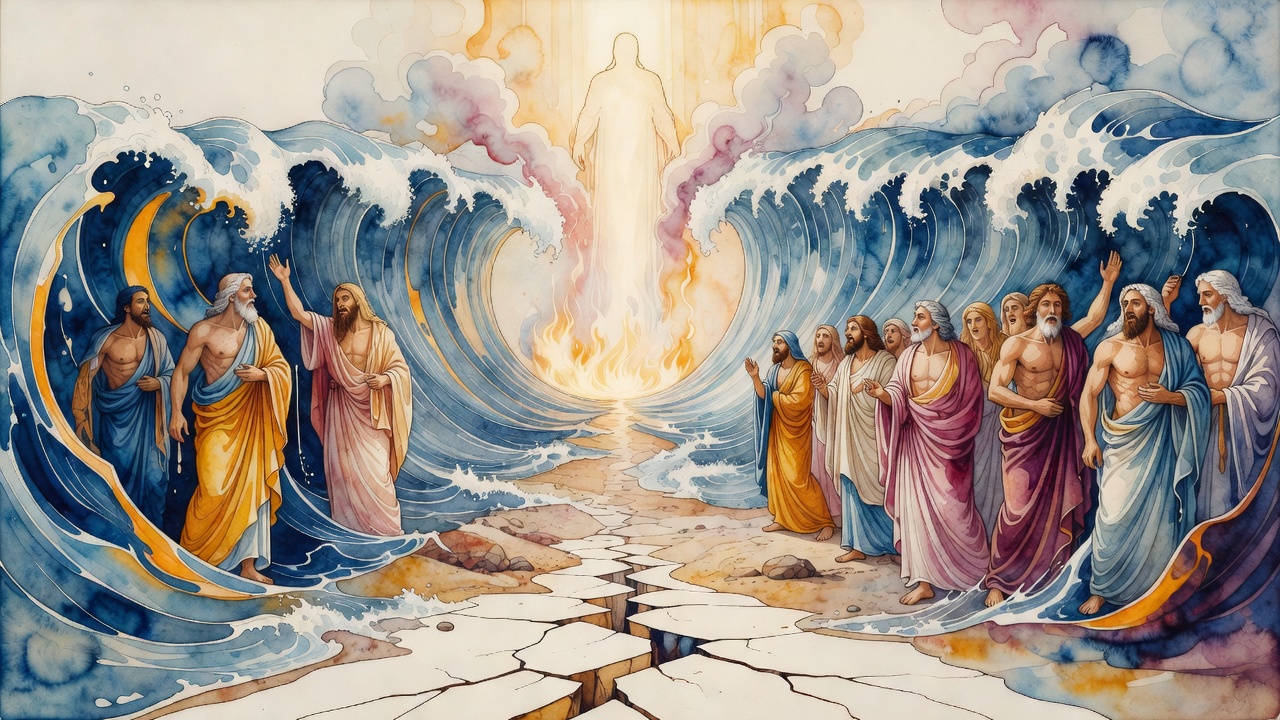
Serah bat Asher stood at the edge of the water and saw angels massed above the crossing. Everyone else saw walls of water and a dry path.

Curated by Arthur · Told by Maggid ·
Table of Contents
  1. One Verb on a Wet Shore
  2. What Serah Saw Between the Walls
  3. Joseph's Merit Under the Water
  4. After the Crack

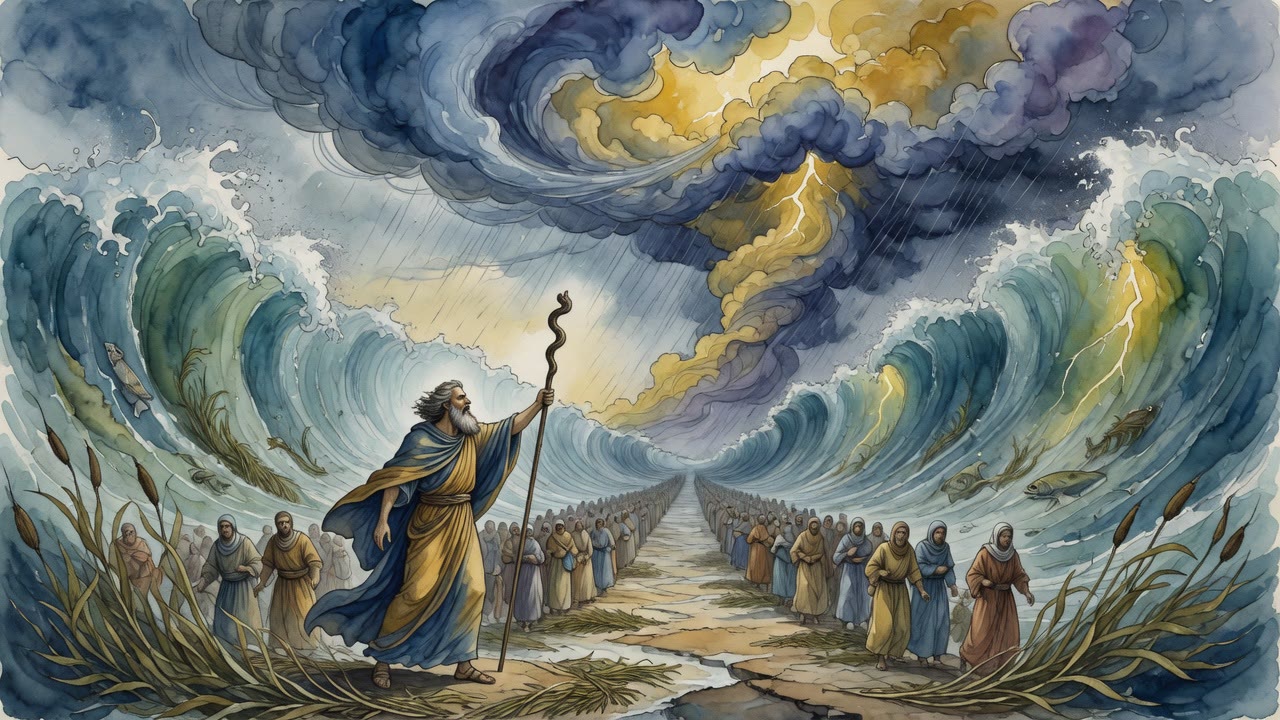
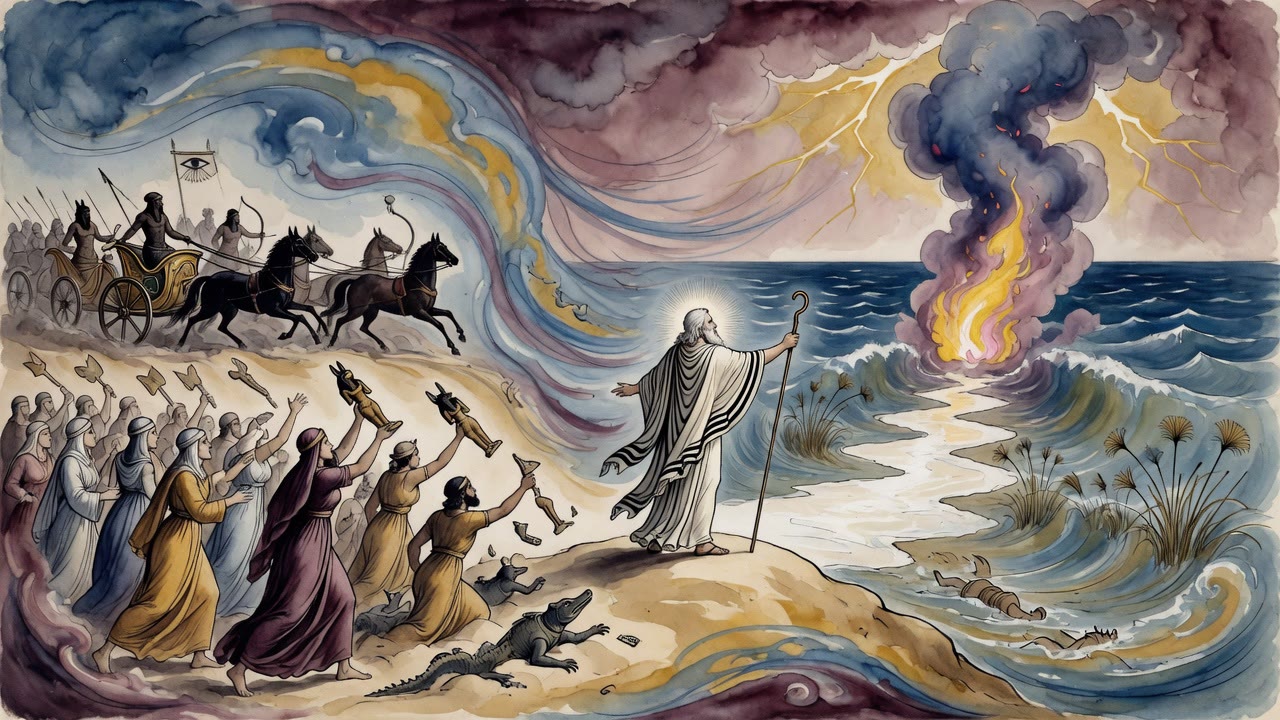
Salt water still ran from hair and hems when the song began. Behind them the Sea of Reeds closed over chariots. Ahead lay a desert without maps. Between those two edges, Israel opened its mouth and chose a verb.
Israel Sang That God Will Reign, and That Future Tense Let Empires Rule Click for full size

"The Lord will reign for ever and ever," they sang (Exodus 15:18). Future tense. Not yet the full present claim.

One Verb on a Wet Shore

Rabbi Yossi Haglili heard the cost inside that grammar. Had they sung "the Lord reigns for ever and ever," no people and no tongue would ever have ruled them. The present tense would have sealed sovereignty as already complete. The future tense left a crack, honest as a scar, through which later nations could push dominion across the centuries.

The midrash does not scold them as cowards. It places them where their feet actually stood: former slaves, lungs full of miracle and terror, watching Egyptian bodies wash onto sand. They had seen power. They trusted the reign still unfolding. They had not yet lived long enough as free people to speak the present as if it could never be interrupted.

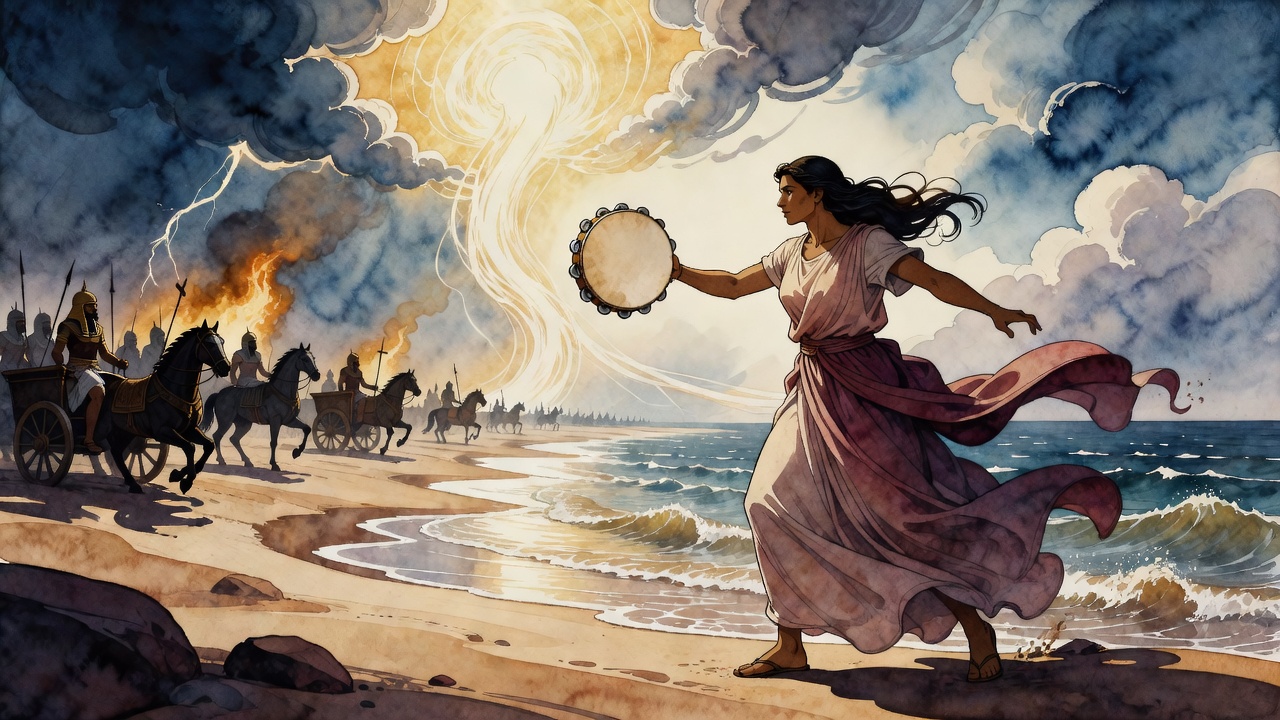
Moses led the men. Miriam took a drum and drew the women into dance. The Song of the Sea rose in two lines of sound, wet and raw. The grammar of forever was still learning how to fit inside human throats.

What Serah Saw Between the Walls

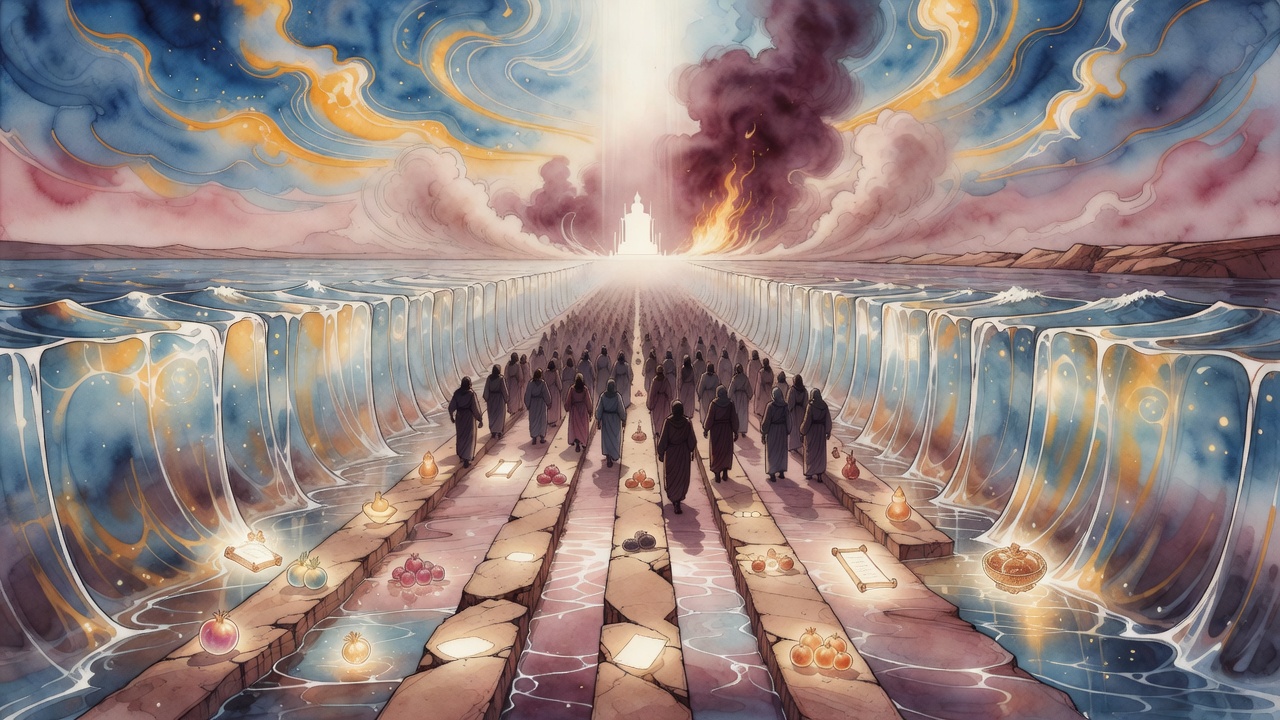
Not every eye on that shore saw the same height. Serah bat Asher, the long-lived daughter who had once told Jacob that Joseph lived, stood at the water's edge and saw more than split waves. Tradition says she saw angels massed to watch the crossing, a heavenly host leaning toward the drama of slaves made free.

She saw the Shechinah (שכינה), the divine presence, descend among the singers while Miriam's tambourine marked time. The ordinary Israelite saw walls of water and a dry path. Serah saw court and choir layered over the miracle, as if the sea had opened a window upward as well as a road forward.

That doubled vision does not erase the tense of the song. It deepens it. Even with angels present, the people still sang will reign. Sight of glory and speech of glory are not always the same act. Serah's eyes climbed. Israel's mouth stayed one step short of the sealed present.

Joseph's Merit Under the Water

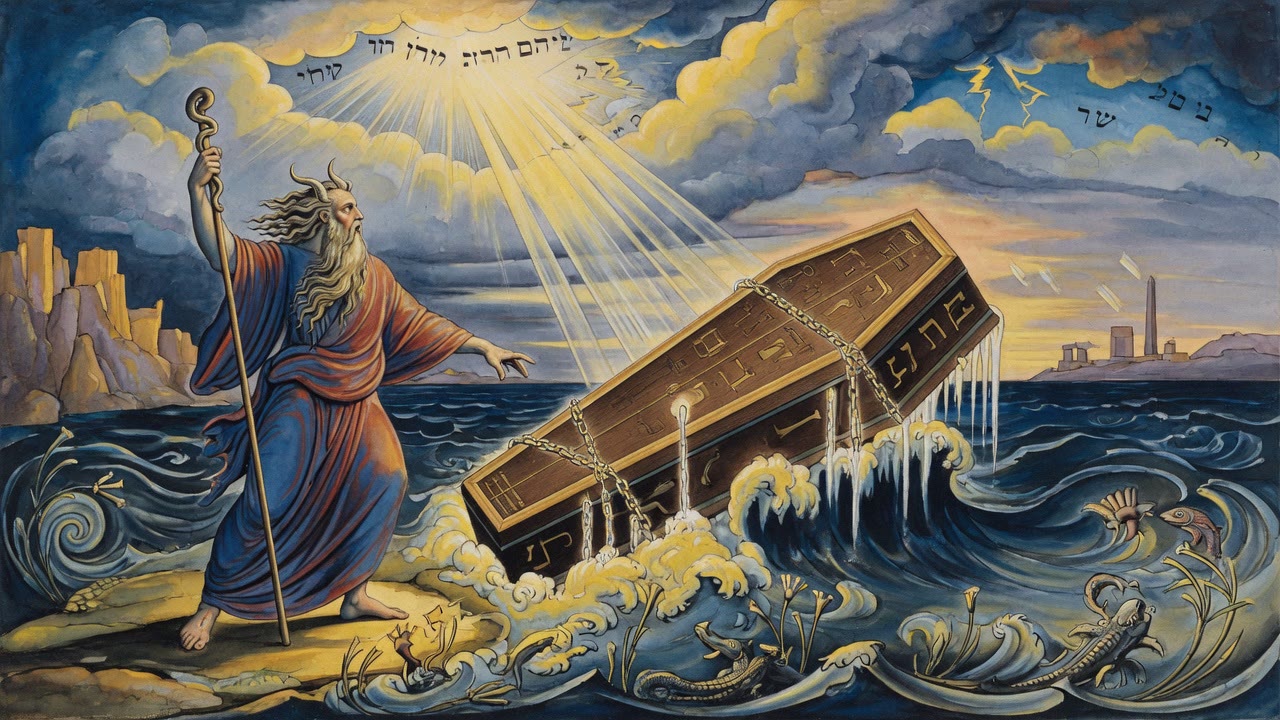
Another current ran under the miracle. Legends gather that the sea split in Joseph's merit as well as in Moses' staff. Joseph had suffered Egypt and still refused to become Egypt. His bones waited for the day the oath would lift them from a foreign riverbed. The road through water was, in part, a road earned by a brother's integrity generations earlier.

So the song rose over a floor of stories: Jacob's long wait, Joseph's cup and coffin still somewhere behind them in the land they fled, Serah's old news that once made an old man believe again. The future-tense reign was not empty faith. It was faith standing on a chain of kept promises, still unfinished.

When the last note faded, the desert wind took the wetness from their clothes. The crack in the verb remained, invisible, portable. Empires would later walk through it. So would recovery after empires. The song never claimed the work was already done.

After the Crack

Yossi Haglili's reading turns a single line into a map of Jewish history. Present-tense sovereignty would have been a fortress no empire could enter. Future-tense sovereignty is a road that must be walked, generation after generation, with the sea still sounding in memory.

On that first morning of freedom the people did not know Babylon or Rome by name. They knew only that the God who split water had not finished reigning in their bones. They sang the truth they could carry. Later ages would learn how wide a crack one verb can open, and how stubbornly a people can keep singing through it.

Miriam's drum dried in the sun. Moses turned his face toward the wilderness. Serah carried her private vision in silence. Somewhere far behind, Joseph's oath still waited for feet that would not leave Egypt without bones. The sea closed. The future tense walked on.

The shore stank of seaweed and ended war. Children tasted salt and laughed without understanding. Old men who had built for Pharaoh sat down hard, as if free legs did not yet know their job. Into that mess of relief the future tense entered like a careful guest.

Moses did not stop the song to correct the grammar. The Mekhilta's later ear would hear what the moment could not fix. A people mid-miracle is allowed an incomplete sentence about forever. The danger is only that incomplete forever becomes a habit, a way of postponing the present reign into an always-coming day that never quite arrives in the bones.

Serah kept her vision mostly to herself. Angels do not always want publicity. Joseph's merit, if it underwrote the path, asked for no verse in the Song. The loud music belonged to the living. The quiet credits belonged to the dead and the long-lived woman who still remembered how to tell hard news gently.

Years later, under foreign kings, Israel would open the Song again and flinch at Yossi Haglili's reading. The crack was real. So was the sea. Both remained true at once.


← All myths
From the tradition

Sources

3 sources

The texts behind this telling. Some cards carry a translation of the source; others are our own retelling of it, and each card says which. Every card links out to the original.

Mekhilta Tractate Shirah 10:10Mekhilta DeRabbi Yishmael

Retold in our words. Read the original at the link below.Mechilta, translated by Rabbi Shraga Silverstein · CC-BY

Rabbi Yossi Haglili makes one of the most poignant observations in all of rabbinic literature. When Israel stood at the Red Sea and sang, they used the future tense: "The Lord will reign for ever and ever." Had they used the present tense, "The Lord reigns for ever and ever", no people or tongue could ever have dominated them. That single verb tense made all the difference.

The distinction is theological, not grammatical. By saying "will reign," Israel expressed faith in God's future sovereignty rather than declaring His sovereignty as an accomplished, permanent fact. That tiny gap between present and future left an opening, a crack in the declaration through which the nations of the world could squeeze their dominion over Israel in the centuries to come.

The midrash (rabbinic interpretive commentary) does not treat this as a failure. It treats it as an honest expression of where Israel stood in that moment. They were former slaves, still dripping with seawater, watching the bodies of their oppressors wash up on the shore. They could see God's power. They could trust in God's future. But declaring absolute, unqualified, present-tense sovereignty? That required a level of certainty they had not yet reached.

The passage then turns tender, listing all of Israel's names: the flock of Your grazing, the seed of Abraham Your loved one, the children of Israel Your only one, the congregation of Jacob Your first-born, the vine nurtured from Egypt. These are love-names, spoken to a God whose reign is coming, even if it has not yet fully arrived.

Full source
Legends of the Jews 3:11-13Legends of the Jews

Retold in our words. Read the original at the link below.The Legends of the Jews by Louis Ginzberg (1909) · Public Domain

The familiar story is this: Moses, the parting of the waters, a miraculous escape. But what if there was someone else there, seeing even more than meets the eye?

That someone was Serah bat Asher.

The story goes that when Serah stood with the children of Israel at the edge of the Yam Suf, the Sea of Reeds (what readers often call the Red Sea), she experienced a vision unlike any other. While everyone else saw the parted waters, Serah saw… well, everything.

The tradition says Serah saw the countless angels who had gathered to witness this incredible event. Imagine, a heavenly host cheering on the Israelites! But it didn't stop there. She also saw the Shekhinah, the Divine Presence itself, descending among them as Miriam, Moses' sister, led the women in joyous song and dance, playing her tambourine and singing the "Song of the Sea." Can you picture it? The energy, the relief, the sheer awe of that moment?

But the most extraordinary part of Serah's vision? She saw God. She saw the Holy One, blessed be He, commanding the waters to part. Now, that's a powerful image. The story emphasizes that, besides Moses, Serah was uniquely qualified to witness this. She was the only other person alive at that moment who could gaze upon the face of God and live.

This brings up an interesting point: what did the Israelites see at the Red Sea? There are different perspectives in our tradition. Some say that even a simple maidservant witnessed things at the sea that even the greatest prophets, like Isaiah and Ezekiel, never experienced. As it says in the Book of Ezekiel (1:1), "The heavens were opened and I saw visions of God." The implication is that the collective experience at the Red Sea was so potent, so filled with divine revelation, that it surpassed even the visions granted to the prophets.

However, there's also a tradition that paints a different picture of Serah's status. The Pesikta de-Rav Kahana recounts that when the Israelites first came down into Egypt, Serah was enslaved and forced into hard labor, grinding grain at a mill. This raises a question: How could someone who was enslaved and subjected to such harsh conditions possess such a profound spiritual vision?

Perhaps the answer lies in the idea that divinity can be found in the most unexpected places and in the most unlikely people. Maybe it was Serah's humility, her resilience in the face of adversity, that allowed her to see beyond the physical and into the spiritual realm. Or maybe it was simply her inherent connection to the divine, regardless of her social standing. The Zohar, a central text of Kabbalah, often emphasizes that everyone has a spark of the divine within them, waiting to be ignited.

Whatever the reason, Serah bat Asher's vision at the Red Sea serves as a powerful reminder that miracles aren't just about grand, sweeping events. They're also about the individual moments of revelation, the personal connections to the divine that can transform our understanding of the world. And sometimes, the most profound visions are granted to those who are often overlooked.

Full source
Legends of the Jews 1:3Legends of the Jews

Retold in our words. Read the original at the link below.The Legends of the Jews by Louis Ginzberg (1909) · Public Domain

It's far more than just a tale of sibling rivalry and Egyptian intrigue. According to the Legends of the Jews, compiled by Rabbi Louis Ginzberg, Jacob endured the hardships of his time with Laban solely for Joseph's sake.

The text goes on to say that Jacob's blessing – a full quiver of children – stemmed from Joseph’s merits. And get this: the splitting of the Red Sea and the Jordan River for the Israelites? That, too, was a reward for Joseph's piety. It sounds unbelievable, but that's how powerful his legacy was considered.

Why this special status? Well, Joseph physically resembled his father more than any of his brothers. More importantly, Jacob passed down to Joseph the wisdom he'd received from his teachers, Shem and Eber – figures reaching all the way back to the earliest generations after the Flood.

What’s really fascinating is how Joseph’s life mirrors Jacob’s in so many ways. Ginzberg paints them as echoes of one another. Jacob’s mother, Rebekah, struggled to conceive for a long time, and so did Joseph’s mother, Rachel. Rebekah had a difficult childbirth with Jacob; Rachel did with Joseph. Both mothers bore two sons. And in a rather unusual detail, both Jacob and Joseph were said to be born circumcised.

The parallels continue! Jacob was a shepherd, and so was Joseph. Jacob served for a woman – remember his years working for Laban for Rachel and Leah? – and Joseph served under a woman, Potiphar’s wife (though under very different circumstances, of course!).

Both Jacob and Joseph, in a sense, usurped their older brother’s birthright. Both were hated by their brothers, and were their father's favorite. Both lived in a foreign land. Both became servants to a master. The master whom each served was blessed because of them. Angels accompanied both. Both married outside the Holy Land.

The blessings didn’t stop there. Both father and son were blessed with wealth. Great things were revealed to them in dreams. As Jacob went to Egypt and ended a famine, so did Joseph. The Zohar, the central text of Kabbalah (Jewish mysticism), even explores the mystical significance of Joseph's dreams and their connection to the divine plan.

And even in death, the mirroring continues. Both father and son exacted a promise from their sons to bury them in the Holy Land. Both died in Egypt, and both were embalmed. Their remains were carried back to the land of Israel for burial.

There's a final, poignant symmetry: Jacob provided for Joseph for seventeen years, and Joseph, in turn, provided for Jacob for seventeen years. A beautiful, balanced exchange between father and son.

So, what are we to make of all this? Is it simply a literary device to emphasize Joseph’s importance? Or is it suggesting something deeper – a cyclical pattern of destiny, perhaps? Maybe the stories of our ancestors aren’t just tales of the past, but blueprints for our own lives, echoing through time.

Full source