Parshat Beshalach6 min read

Moses Raised Joseph's Coffin From the Nile

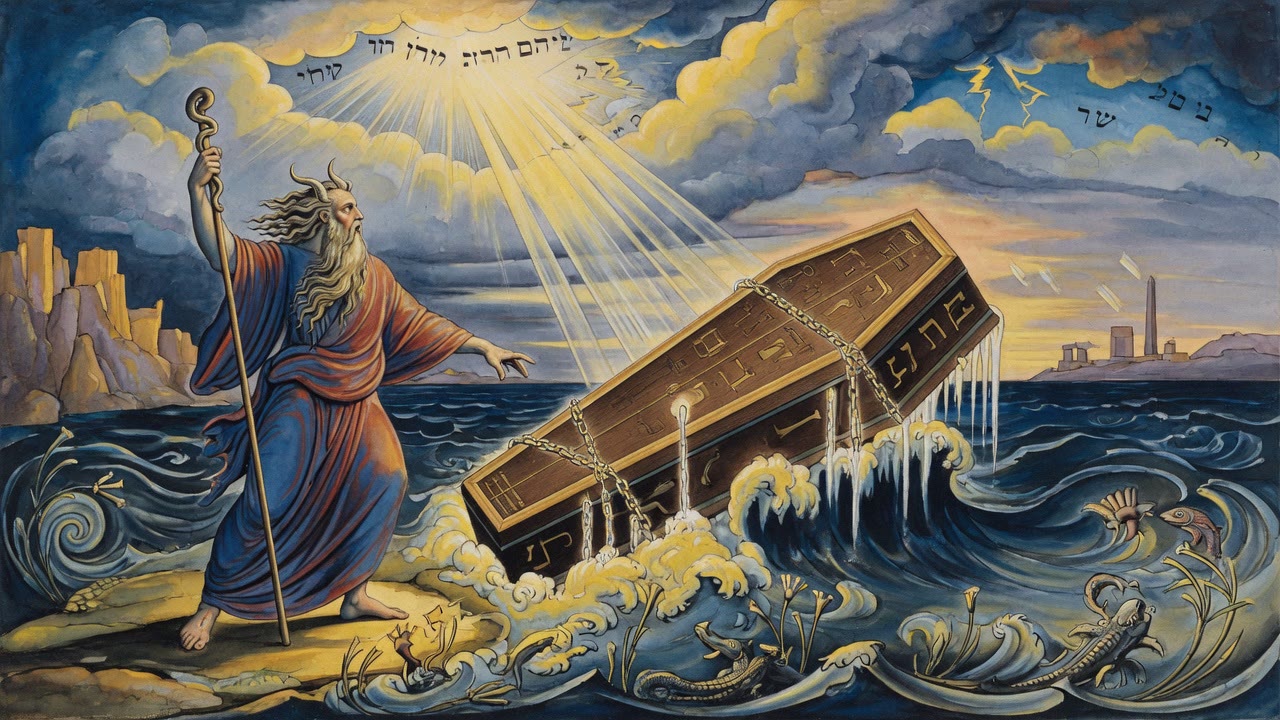
While Israel grabbed Egyptian gold, Moses spent three days hunting Joseph's sunken coffin until Serah bat Asher led him to the river's secret.

Curated by Arthur · Told by Maggid ·
Table of Contents
  1. Gold in Every Arm but One
  2. Three Days Against a River
  3. Joseph, Joseph, the Hour Has Come
  4. A Midnight Cut Like a Hair
  5. Two Arks in the Wilderness
  6. The Cargo That Could Not Be Spent
Moses Raised Joseph's Coffin From the Nile Click for full size

Gold in Every Arm but One

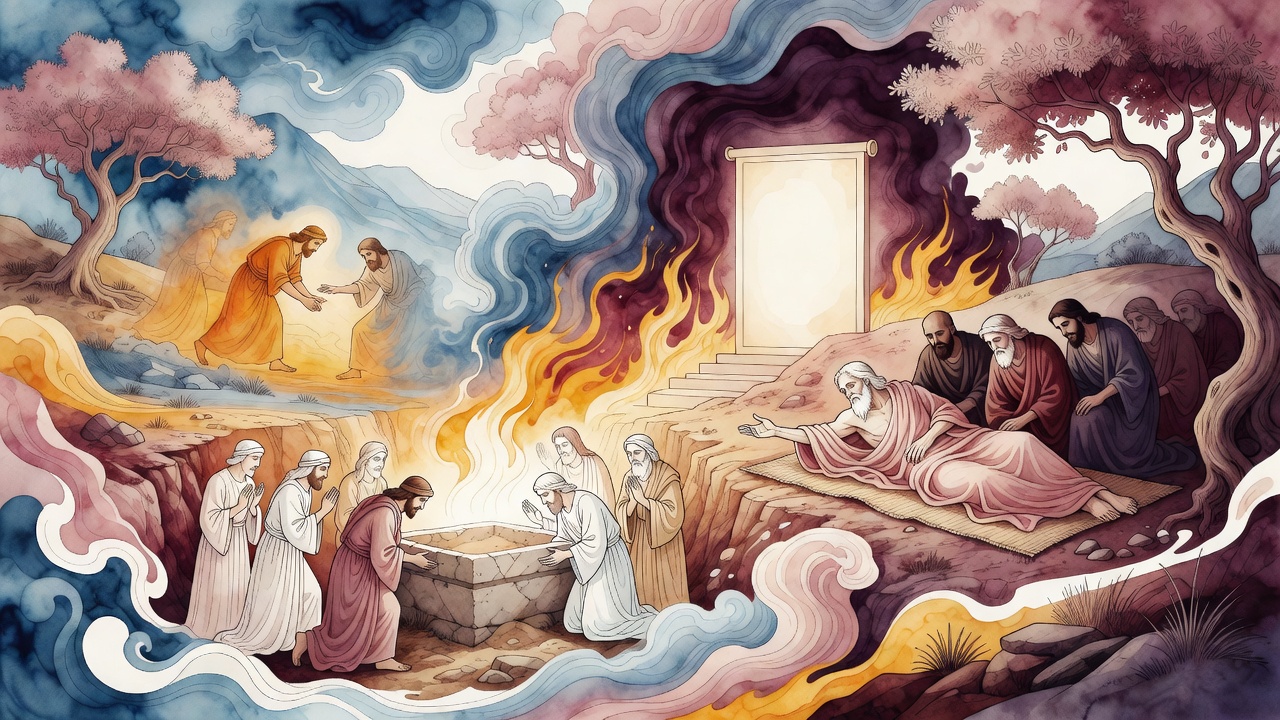
The night of leaving had already begun in the streets. Gold and silver changed hands, dough that would not have time to rise sat in bundles, and Israel moved like a river toward the door of Egypt. Moses was not at the plunder. He was hunting a coffin.

Centuries earlier Joseph had made his brothers swear. God will surely remember you, he said, and you shall carry my bones up from this land (Genesis 50:25). Freedom without that cargo would be a broken promise at the root. The Exodus could not be clean while the man who had fed Egypt lay under foreign water.

Three Days Against a River

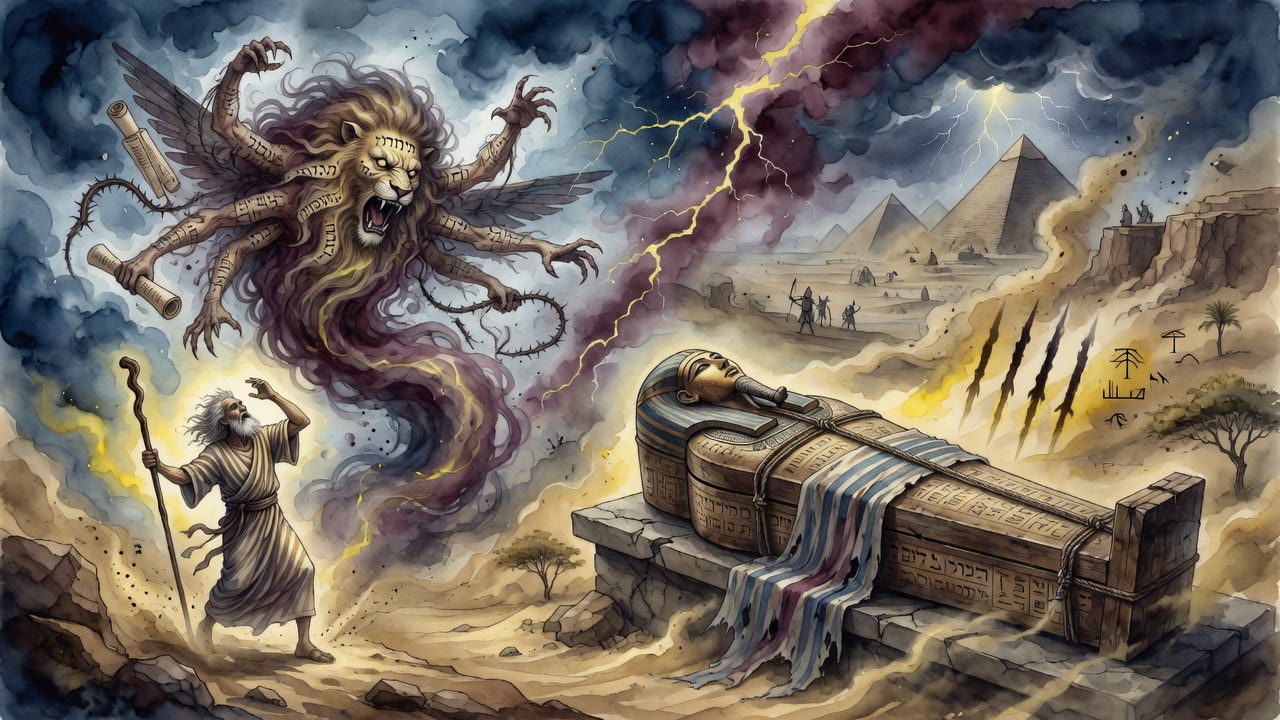
Moses searched three days and three nights and found only mud and rumor. The Egyptians had hidden Joseph well, and not carelessly. Their magicians had sealed the governor of Egypt in a metal coffin and sunk it in the Nile, some said to chain Israel to an oath they could never keep, others said because a righteous man's merit blesses whatever holds him, and they wanted the river fat and Egypt wet. The river that had once swallowed Hebrew boys now held a Hebrew ruler who had saved the land from famine. The Nile held more than fish. It held a veto.

Despair almost won. Then Serah bat Asher found Moses in his distress, the same woman who had once sung Jacob's grief open with a harp, the one soul old enough to remember both ages. She asked what was wrong. He told her. She knew the secret the searchers did not, and she led him to the place on the bank where the water kept its dead.

Joseph, Joseph, the Hour Has Come

Moses stood where the reeds whispered and called into the water. "Joseph, Joseph, the hour of redemption has come. The Shekhinah, the presence of God, lingers here only for thy sake, and the clouds of glory wait for thy coming. If thou wilt show thyself, well and good. If not, we are clear of our oath."

In one telling the river answered the call alone, and metal that had learned the dark of mud learned air again. In another the summons needed engraving. Moses took a plate for each face of the heavenly chariot, lion, eagle, bull, and man, and gave them to the water one by one. The lion sank in silence. The eagle sank. The bull sank. At the face of a man, the human face among the four, the coffin broke the surface, water sheeting off the lid, a dead governor of Egypt answering a living shepherd of slaves without opening his mouth.

Somewhere behind him someone shouted about gold. Moses did not turn. He took the weight of Joseph onto his own shoulders while a nation loaded treasure, one man's empty hands full of a different wealth.

A Midnight Cut Like a Hair

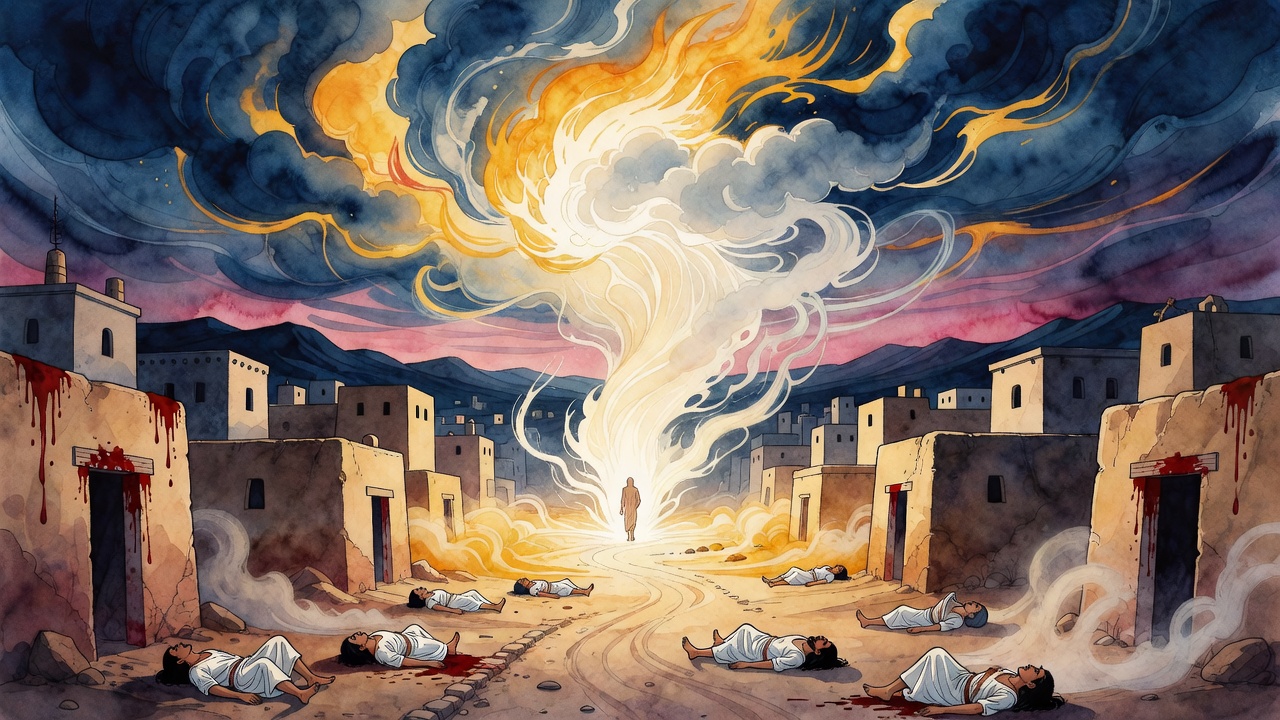
That same night's hinge was a timing only heaven could hold. Moses had told Pharaoh the blow would fall "about midnight," leaving the edges blurred, because a mortal cannot mark the instant when one day tips into the next, and Egypt's astrologers were watching for a slip they could call a lie. Scripture says it happened "at midnight," exactly, because the One who set time in motion sits at the stone of the hours and aims judgment to a hairsbreadth, so that no kingdom's downfall bleeds into another's.

The vagueness toward Israel was its own mercy. Had Moses named the precise minute, they might have sat counting, whispering that the hour had passed and they were still slaves. And midnight was already the family hour. At midnight the covenant was cut between the pieces with Abraham. At midnight Isaac was born. At midnight the firstborn of Egypt fell. When the Torah says all the hosts of the Lord went out of Egypt, the sages hear more than Israel in the words. The armies of heaven had shared the affliction, "in all their affliction He was afflicted," and when the people walked free, heaven walked out with them, a procession too large for any Egyptian census.

Two Arks in the Wilderness

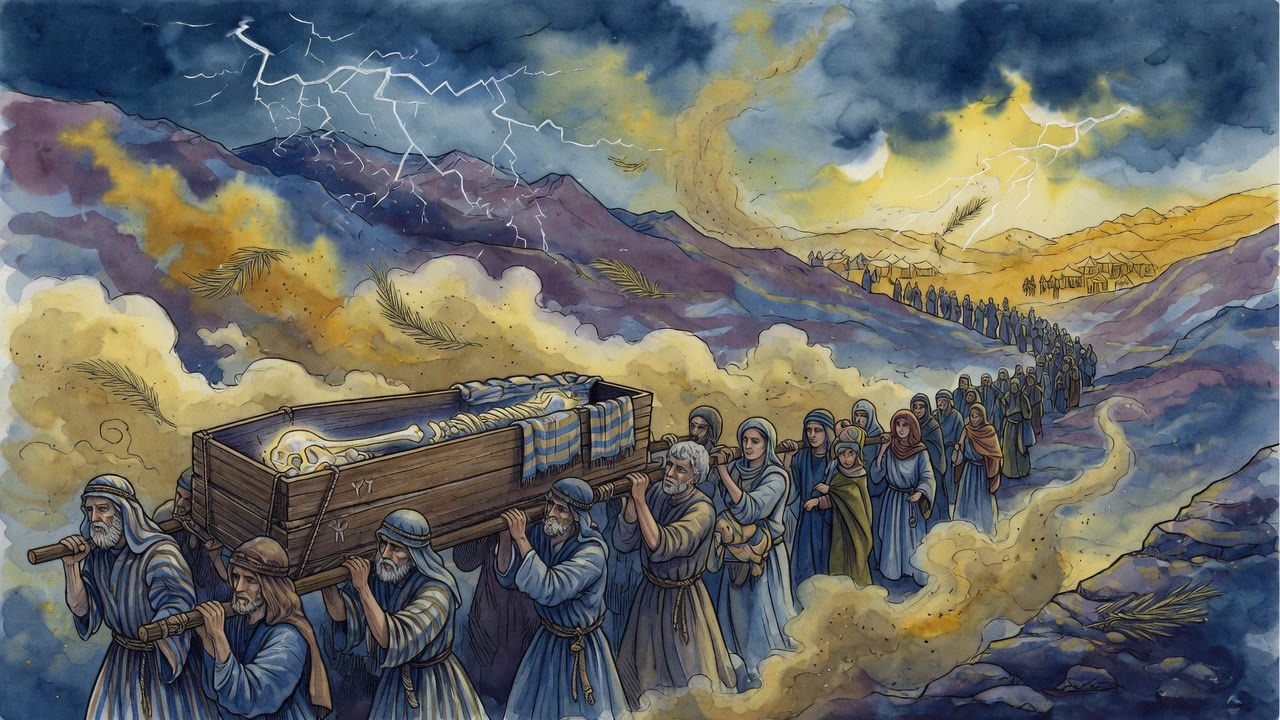
For forty years two chests traveled side by side, the Ark of the Divine Presence and the coffin of a man. Travelers were scandalized. How could a corpse march beside the living God? The answer outlasted every scandalized traveler. The man in this coffin kept every word written in that one. Joseph refused idolatry, refused murder, refused adultery, refused theft and false witness, honored his father, guarded the Sabbath table. He lived the commandments before Sinai spoke them, so he was fit to travel beside the One who would speak them.

At the sea, when the walls of water stood, the coffin went through on the dry path with the living, and some traditions say the sea split in Joseph's merit as much as at Moses' raised hand. The man thrown into a pit by his brothers helped open a road for their children's children.

The Cargo That Could Not Be Spent

The gold would be spent, melted, or regretted. The coffin was still going home. Some in the camp grumbled that bones slow a march. Moses adjusted the poles and kept walking, bent under a burden that glittered less than the new treasure and weighed more than all of it. Serah stepped back once her part was done, as she had stepped back in Canaan after the harp. She specialized in true speech at the right hour. The living walked beside the proof that God remembers in installments, and Egypt kept an empty hollow in the river mud where a veto used to lie.


← All myths
From the tradition

Sources

6 sources

The texts behind this telling. Some cards carry a translation of the source; others are our own retelling of it, and each card says which. Every card links out to the original.

Legends of the Jews 1:493Legends of the Jews

Retold in our words. Read the original at the link below.The Legends of the Jews by Louis Ginzberg (1909) · Public Domain

Legends of the Jews turns to Moses Searched Three Days for Joseph's Sunken Coffin.

Moses knew something crucial: the Israelites couldn't truly be free until they fulfilled the oath they’d made to Joseph so long ago. That oath? To take his bones with them when they finally left Egypt for the Promised Land. (Genesis 50:25) But there was a problem. A big one.

For three whole days and three nights, Moses, the man who would lead his people out of bondage, searched high and low across the land of Egypt. He was desperately seeking Joseph’s coffin. According to Ginzberg’s retelling in Legends of the Jews, Moses knew that the Exodus couldn't happen without it. But it was nowhere to be found!

Can you picture Moses, exhausted, weary, his hope dwindling with each passing hour? Then, in his despair, he meets Serah, the daughter of Asher. She sees his distress and asks what troubles him. He tells her of his fruitless quest, his inability to locate Joseph's final resting place.

And here’s where the story takes a fascinating turn. Serah knows the secret. She leads Moses to the Nile River. There, she reveals that the Egyptians, in a desperate attempt to keep the Israelites from leaving, had sunk Joseph’s leaden coffin in the river.

But why the Nile? Why hide a coffin there?

Well, the Egyptians didn't act alone. They were aided and abetted by their magicians, those practitioners of ancient arts and secret knowledge. These magicians knew the power of Joseph's oath. They understood that the Israelites were bound to it. So, they used their magic – their kishuf, as it might have been called – to hide the coffin in a place where it seemed impossible to retrieve. They sealed the coffin on all sides and sank it deep within the river.

It’s a cunning plan. Trap the Israelites with their own promise. Keep them bound to Egypt forever. But as we know, the story doesn’t end there. How Moses manages to retrieve the coffin from the depths of the Nile is a story for another time! But the very fact that the Egyptians went to such lengths shows just how powerful a simple promise can be.

What does this tell us? Perhaps that even in the face of seemingly insurmountable obstacles, even when magic and power conspire against us, the bonds of faith and the weight of our promises can lead us on a quest, a search for something essential to our freedom. And sometimes, just sometimes, we need a little help from an unexpected source to find what we're looking for.

Full source
Legends of the Jews 1:494Legends of the Jews

Retold in our words. Read the original at the link below.The Legends of the Jews by Louis Ginzberg (1909) · Public Domain

That feeling of responsibility, that weight of expectation... it's woven deep into the fabric of Jewish history. And no story embodies that more poignantly than the tale of Moses and Joseph's coffin.

The Israelites are finally on the verge of leaving Egypt, after centuries of enslavement. But there's a problem. A big one. They made a solemn oath, generations ago, to carry Joseph's bones with them when they left. Where is he? They need to find his coffin.

In Ginzberg's retelling in, Legends of the Jews, it was Moses who took on the daunting task. And how does he go about finding this ancient, hidden coffin? It's not what you might expect.

He takes Joseph's cup – yes, that cup, the one from the famous story in Genesis – and cuts it into four pieces. On each piece, he engraves a symbol: a lion, an eagle, a bull, and a human figure. Sound familiar? These are the four faces of the Merkabah, the divine chariot Ezekiel saw in his vision (Ezekiel 1). These symbols are deeply connected to Jewish mystical thought, representing different aspects of God's presence in the world.

Then, Moses throws each piece, one by one, into the Nile. With the first piece, the one bearing the lion, he cries out, "Joseph, Joseph, the hour for the redemption of Israel has arrived! The Shekinah (the Divine Presence) lingers here only for thy sake; the clouds of glory await thy coming. If thou wilt show thyself, well and good; if not, then we are clear from our oath."

The Shekinah, that divine presence, is said to be waiting specifically for Joseph. The clouds of glory, the protective presence of God that accompanied the Israelites, are ready to move on. But Joseph is holding them back.

Think about the weight of that moment. Moses is invoking ancient promises, appealing to Joseph's sense of duty, even hinting at a release from their obligation. It’s a powerful, almost desperate plea. But... nothing happens. The coffin doesn’t appear.

What does this say about the power of oaths, the responsibility to the past, and the complex relationship between the living and the dead in Jewish tradition? It’s a reminder that redemption isn't just about physical freedom; it's about honoring our commitments, even across generations. And sometimes, it requires a little divine intervention – or, in this case, a cup, some engravings, and a whole lot of faith.

The story continues, of course. But this initial moment, this seemingly failed attempt, speaks volumes about the burdens we carry, the promises we keep, and the enduring power of memory.

Full source
Legends of the Jews 1:495Legends of the Jews

Retold in our words. Read the original at the link below.The Legends of the Jews by Louis Ginzberg (1909) · Public Domain

The story of Joseph, his coffin, and Moses is one such tale.

The scene: The Israelites are finally leaving Egypt, laden with riches they've received from their former oppressors. Gold, silver… a whirlwind of activity as they prepare for their long-awaited exodus. But amidst this frenzy, Moses has something else on his mind. Something incredibly important.

Joseph, centuries before, had made his brothers swear an oath. He knew his bones didn't belong in Egypt. “God will surely remember you,” he told them, “and carry you out of this land to the land which He swore to Abraham, to Isaac, and to Jacob.” (Genesis 50:25). He wanted to be buried in the Promised Land. This was no small request; it was a sacred trust.

So, how do you find a coffin lost in the vastness of the Nile? Well, according to the legends, it wasn't easy. The Zohar, that foundational text of Jewish mysticism, hints at the magical means employed. Moses didn't just stumble upon it. He had to work for it.

The story goes that Moses fashioned several golden plates, each bearing a different symbol. The first had the figure of an eagle. He threw it into the water, calling upon Joseph to rise. Nothing. Then a plate with the figure of a bull. Again, silence. A third plate followed. Still, the coffin remained stubbornly submerged.

It wasn't until the fourth plate, the one bearing the image of a human, that something finally happened. With this plate and the fourth invocation, Joseph’s coffin floated to the surface! Moses, overcome with joy, seized it. Ginzberg, in his Legends of the Jews, tells us that while the rest of Israel were busy gathering their newfound wealth, Moses was solely focused on fulfilling Joseph’s wish.

Why this elaborate ritual? Why these specific symbols? We can only speculate. Perhaps the symbols represented different aspects of the Egyptian world, and only the human symbol resonated with Joseph's spirit, his connection to his people. Or maybe, as we find in Midrash Rabbah, it was a test of Moses's faith and dedication.

The tale emphasizes a powerful message: Keeping promises, especially to the deceased, is a sacred act. It speaks to the enduring power of memory, loyalty, and the importance of honoring our commitments, no matter the obstacles.

What promises are we holding onto? What commitments are we striving to fulfill, even when they seem difficult or inconvenient? Perhaps the story of Moses and Joseph’s coffin can inspire us to reflect on the enduring power of our word.

Full source
Mekhilta DeRabbi Shimon Ben Yochai 13:18Mekhilta DeRabbi Shimon Ben Yochai

Translation of the source text.Mechilta de-Rabbi Simon b. Jochai, ed. D. Hoffmann, Frankfurt 1905 · Public Domain

"And Moses took the bones of Joseph with him" (Exodus 13:19). Come and see how beloved the commandments were to Moses our teacher: all Israel were busy with the spoil of Egypt, while Moses was busy with a commandment. And of him it is said, "The wise in heart will take commandments" (Proverbs 10:8).

And from where did Moses our teacher know where Joseph was buried? They said: Serach the daughter of Asher remained from that generation. Moses went to her and said, "Where is Joseph buried?" She said to him, "The Egyptians made a metal coffin for him and set it in the Nile river so that its waters would be blessed." Moses went and stood on the bank of the Nile and said, "Joseph, Joseph, the time has come that the Holy One, blessed be He, swore to Israel to redeem them, and the time has come for the oath that you made Israel swear. Now, listen, for Israel are detained because of you. If you reveal yourself, well and good; and if not, we are clear of your oath." Immediately Joseph's coffin floated up.

Rabbi Nathan says: Joseph was buried in the mausoleum of the kings. Moses went and stood over the mausoleum of the kings and said, "Joseph, Joseph!" Immediately Joseph's coffin shook. Moses went and took it and brought it with him. Therefore it is said, "And Moses took the bones of Joseph with him."

What is "with him"? Within the camp of the Levites. From here they said: one defiled by a corpse is permitted to enter the Temple Mount, and even the corpse itself, as it is said, "And Moses took the bones of Joseph with him" [meaning] with him within the camp of the Levites.

All those forty years that Israel were walking in the wilderness, the Ark of the Divine Presence and Joseph's coffin traveled side by side. Passersby would say, "What is the nature of these two arks?" They would answer them, "One is of the Divine Presence and one is of a dead man." "And is it possible for a dead man to travel with the Divine Presence?" They said, "This one fulfilled what is written in that one." On the tablets is written, "I am the LORD your God" (Exodus 20:2), and of Joseph it is written, "Am I in the place of God?" (Genesis 50:19). On this one is written, "You shall have no other gods" (Exodus 20:3), and of Joseph it is written, "I fear God" (Genesis 42:18). On this one is written, "You shall not take up the name in vain" (Exodus 20:7), and of Joseph it is written, "By the life of Pharaoh, you shall not leave from here" (Genesis 42:15). On this one is written, "Remember the Sabbath day" (Exodus 20:8), and of Joseph it is written, "And slaughter an animal and prepare it" (Genesis 43:16), and "prepare" means only for the need of the Sabbath. On this one is written, "Honor [your father]" (Exodus 20:12), and of Joseph it is written, "And Joseph sustained his father" (Genesis 47:12). On this one is written, "You shall not murder" (Exodus 20:13), and of Joseph it is written, "How can I do this great evil and sin against God?" (Genesis 39:9). He said to her: it is not enough that I should be counted with adulterers, but also with murderers? On this one is written, "You shall not commit adultery" (Exodus 20:13), and of Joseph it is written, "And he did not listen to her, to lie beside her or to be with her" (Genesis 39:10). On this one is written, "You shall not steal" (Exodus 20:14), and of Joseph it is written, "And Joseph gathered up all the money, and Joseph brought the money into Pharaoh's house" (Genesis 47:14). On this one is written, "You shall not bear false witness" (Exodus 20:14), and of Joseph it is written, "And Joseph brought their bad report" (Genesis 37:2). It is not written "Joseph took out a report" but rather "brought." On this one is written, "You shall not covet" (Exodus 20:16), and of Joseph it is written, "But he refused, and said to his master's wife" (Genesis 39:5).

"For he had firmly sworn the children of Israel." Rabbi Nathan says: why did he make his brothers swear and not make his own sons swear? He said: if I make my sons swear, the Egyptians will not allow them to bring me up; they will say, "Their father brought up his father." But they will say to them, "Your father was a king." Therefore he did not make his sons swear.

"He firmly swore [hashbea hishbia]": he made them swear, and their sons their sons. "Surely visiting [pakod yifkod]": two visitations, one in Tishrei and one in Nisan. In Tishrei they ceased from the labor, and in Nisan they were redeemed. Another interpretation: "surely visiting": He visited in Egypt, He will visit at the sea; He visited in the wilderness, He will visit at the brooks of Arnon; He visited in this world, He will visit in the world to come.

"And you shall bring up my bones." He said to them: I, who am a king, brought up my father whole, but you, bring me up even as bones. And when you bring me up, bury me anywhere you wish, for I have received a tradition that I do not enter the burial place of my fathers, for none enter the grave of the fathers except three fathers and three mothers, as it is said, "There they buried Abraham" (Genesis 49:31), and it says, "In my grave which I have dug for myself" (Genesis 50:5).

"And you shall bring up my bones." I might hear immediately; the verse therefore teaches, "with you." Rabbi Shimon ben Elazar says: from where do we learn that the bones of all the tribes went up with him? The verse teaches, "And you shall bring up my bones", from this, "with you."

I might think that had Moses not occupied himself with him, Israel would not have occupied themselves with him; the verse therefore teaches, "And the bones of Joseph, which the children of Israel brought up from Egypt, they buried in Shechem" (Joshua 24:32). This teaches that it was in their hearts to bring him up, but once Israel saw that Moses was occupying himself with him, they said, "Leave it to him; his honor is greater with the great than with the small." I might think that had Moses and Israel not occupied themselves with him, his sons would not have occupied themselves with him; the verse therefore teaches, "And they became the inheritance of the sons of Joseph" (Joshua 24:32). But once his sons saw that Moses and Israel were occupying themselves with him, they said, "Leave it to him; his honor is greater with the many than with the few."

Full source
Mekhilta DeRabbi Shimon Ben Yochai 12:29Mekhilta DeRabbi Shimon Ben Yochai

Translation of the source text.Mechilta de-Rabbi Simon b. Jochai, ed. D. Hoffmann, Frankfurt 1905 · Public Domain

"And it came to pass at midnight" (Exodus 12:29). Rabbi Shimon ben Yochai says: Moses, who does not know the night's appointed times, its moments, and its exact hours, said "about midnight" (Exodus 11:4); but the Holy One, blessed be He, who knows the night's appointed times, its moments, and its exact hours, said "And it came to pass at midnight."

Another interpretation: Moses said to Israel, "And I will pass through the land of Egypt in this night" (Exodus 12:12), and he did not fix for them a precise time, so that they would not sit and brood with evil thoughts, saying, "The hour has already arrived and we have not been redeemed." But when Moses spoke to Pharaoh, what does he say? "Thus says the LORD: About midnight" (Exodus 11:4), meaning, the matter hangs in the balance; when the night is halved, whether a hairsbreadth above or a hairsbreadth below. But the Holy One, blessed be He, said "And it came to pass at midnight," for He sits upon the stone of the hours and aims at the hour to a hairsbreadth, so that no kingdom encroaches upon its fellow even by the breadth of a thread; rather, when the time of a kingdom has come to fall, if by day, it falls by day; if by night, it falls by night. And so it says, "And at Noph there shall be distress by day" (Ezekiel 30:16), and it says, "At Tehaphnehes the day shall be darkened" (Ezekiel 30:18), and it says, "In that night Belshazzar the king was slain" (Daniel 5:30). And even when the time of our fathers came to fall, what is said of them? "Woe to us, for the day declines, for the shadows of evening lengthen" (Jeremiah 6:4).

"And the LORD struck every firstborn in the land of Egypt" (Exodus 12:29), and not by an agent. "From the firstborn of Pharaoh", I might hear that this means his son. When it says "who sat upon his throne," his son is already mentioned; what then does "from the firstborn of Pharaoh" teach? It teaches that Pharaoh the wicked one was himself a firstborn, and yet the punishment did not touch him. Why so? In order to seduce the hearts of the Egyptians, so that they would say, "Pharaoh is mighty, for the punishment did not touch him." Of him it says, "He misleads the nations and destroys them" (Job 12:23). And so it says, "And against all the gods of Egypt I will execute judgments; I am the LORD" (Exodus 12:12). Was not Baal-zephon among the gods of Egypt? Why did the punishment not touch it? In order to seduce the hearts of the Egyptians, so that they would say, "Mighty is Pharaoh, that the punishment did not touch him; mighty is Baal-zephon, that the punishment did not touch it." Of this it says, "He misleads the nations and destroys them." But in the end, what does it say? "The waters covered their adversaries; not one of them was left" (Psalms 106:11), teaching that even Baal-zephon was ground to pieces.

"Unto the firstborn of the captive" (Exodus 12:29), and elsewhere it says, "unto the firstborn of the maidservant" (Exodus 11:5), teaching that by this measure they had enslaved Israel. "The firstborn of the captive", this is the one placed in a dungeon. "Who was in the prison-house", this is the one bound in the house of confinement. "The pit", this is the one placed in a deep cell. Why were they struck along with the Egyptians? Because they would say, "Our god will exact vengeance for us from the Egyptians who enslave us." Rabbi Eliezer son of Rabbi Yose the Galilean says: Why were they struck along with them? Because they would say, "It is our wish that we remain in our enslavement [of Israel], that Israel remain enslaved." "Unto the firstborn of the captive", teaching that they had taken them captive. "Unto the firstborn of the maidservant", teaching that they had subjugated them as male and female slaves. "Who is behind the millstones", teaching that they crushed them with hard labor. "And every firstborn of beast", if man sinned, what did the beast sin? Rather, woe to the wicked, and woe to those attached to them.

Full source
Mekhilta DeRabbi Shimon Ben Yochai 12:41Mekhilta DeRabbi Shimon Ben Yochai

Translation of the source text.Mechilta de-Rabbi Simon b. Jochai, ed. D. Hoffmann, Frankfurt 1905 · Public Domain

At midnight it was spoken with our father Abraham at the covenant between the pieces; at midnight Isaac was born; and at midnight the firstborn were smitten, as it is said, "And it came to pass at the end" (Exodus 12:41), one single end for them all.

"Four hundred and thirty years." What is the nature of these thirty years? From when it was spoken with our father Abraham at the covenant between the pieces until Isaac was born was thirty years, and from when Isaac was born until Israel went out of Egypt was four hundred years.

"And it came to pass on that very day, that all the hosts of the LORD went out from the land of Egypt." This teaches that even the hosts of the Omnipresent were with Israel in their distress, as it is said, "In all their affliction He was afflicted" (Isaiah 63:9); and it says, "I will be with him in trouble" (Psalms 91:15); and it says, "whom You redeemed to You from Egypt, the nations and their gods" (2 Samuel 7:23).

Full source