5 min read

Joseph Swore to Carry Jacob Out of Egypt

Jacob wanted a hand on the mark of the covenant and a formal oath. Joseph balked; a son's word should not need that. He swore anyway, and Pharaoh let him go.

Curated by Arthur · Told by Maggid ·
Table of Contents
  1. The Hand That Would Not Rest on the Mark
  2. Permission From Pharaoh
  3. The Bones That Must Wait Longer
  4. Two Oaths, One Direction
  5. What a Dead Man Still Commands
Joseph Swore to Carry Jacob Out of Egypt Click for full size

The Hand That Would Not Rest on the Mark

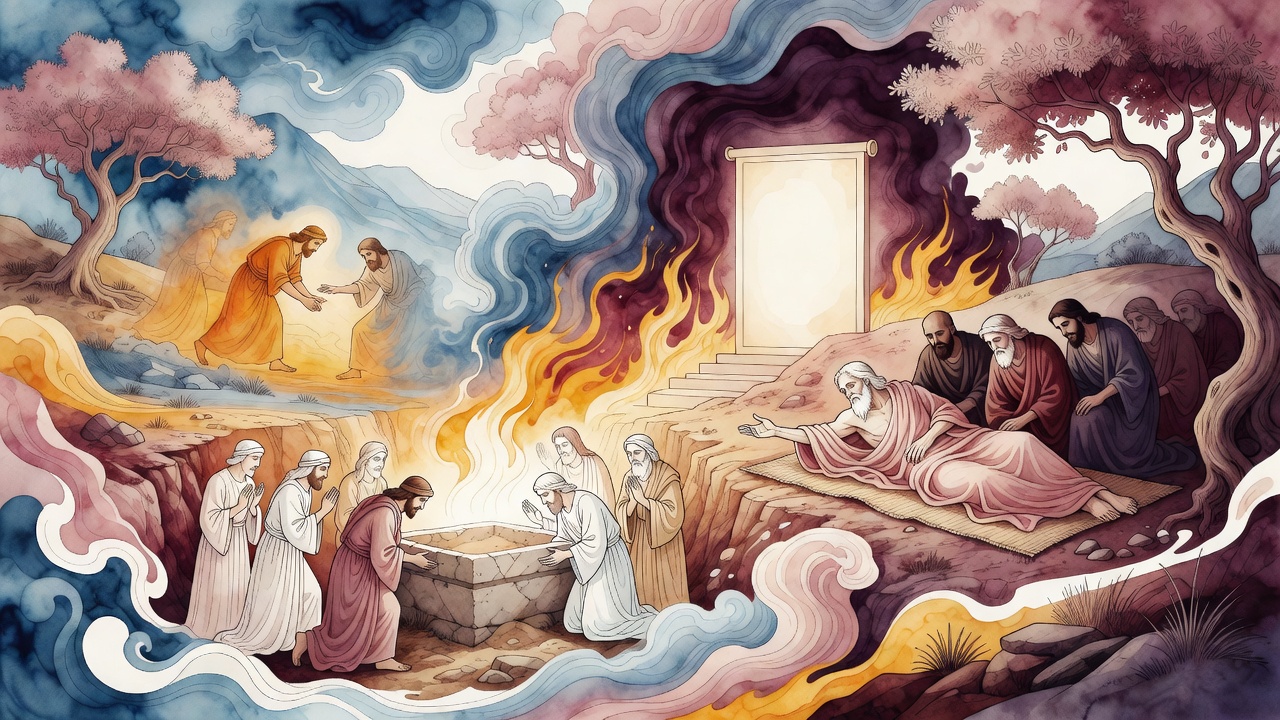
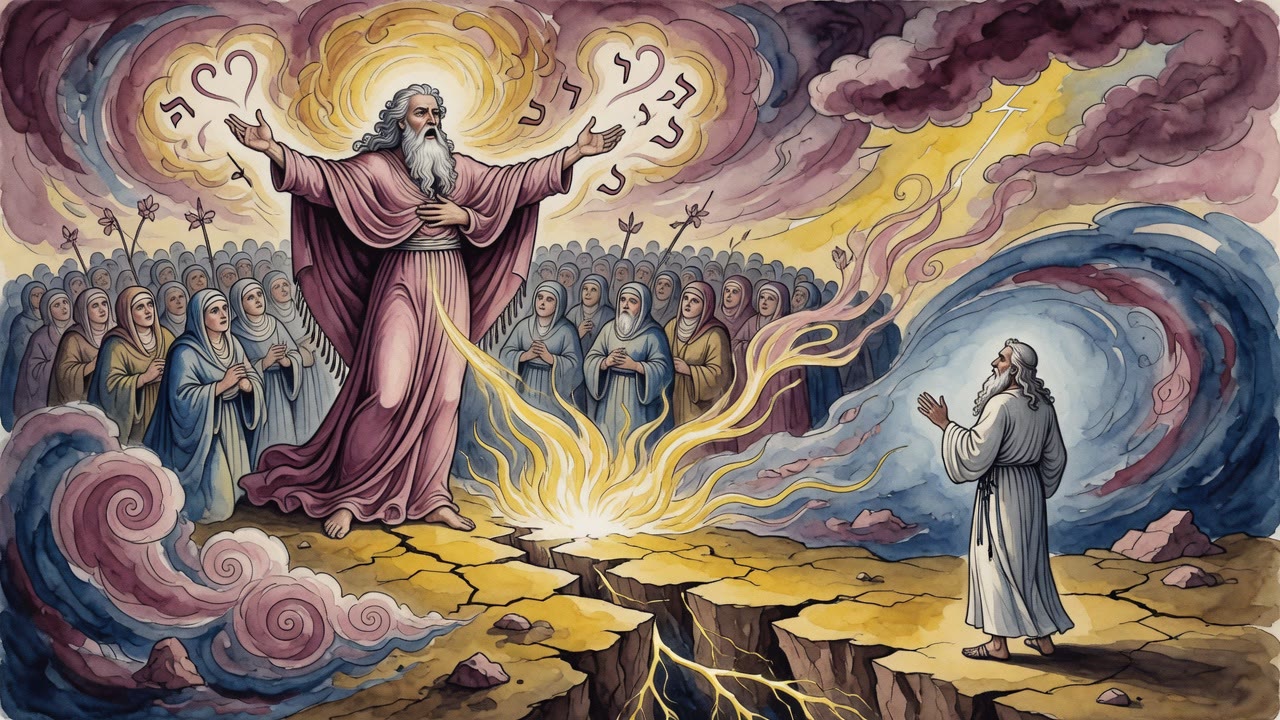
Jacob was dying in Egypt and refused to leave his bones there. He asked Joseph to place a hand on the mark of the covenant and swear to bury him in the sepulchre prepared in the land of Canaan. The request was not sentimental. It was a border drawn against assimilation even in death.

Joseph answered with a subtlety the Targum refuses to skip. Because he was his son, he did not put his hand that way. A son's word should not need the full theater of an oath between strangers. He said he would do it. The father pressed for the formal vow anyway, because fathers know how courts and kings later read informal love.

Permission From Pharaoh

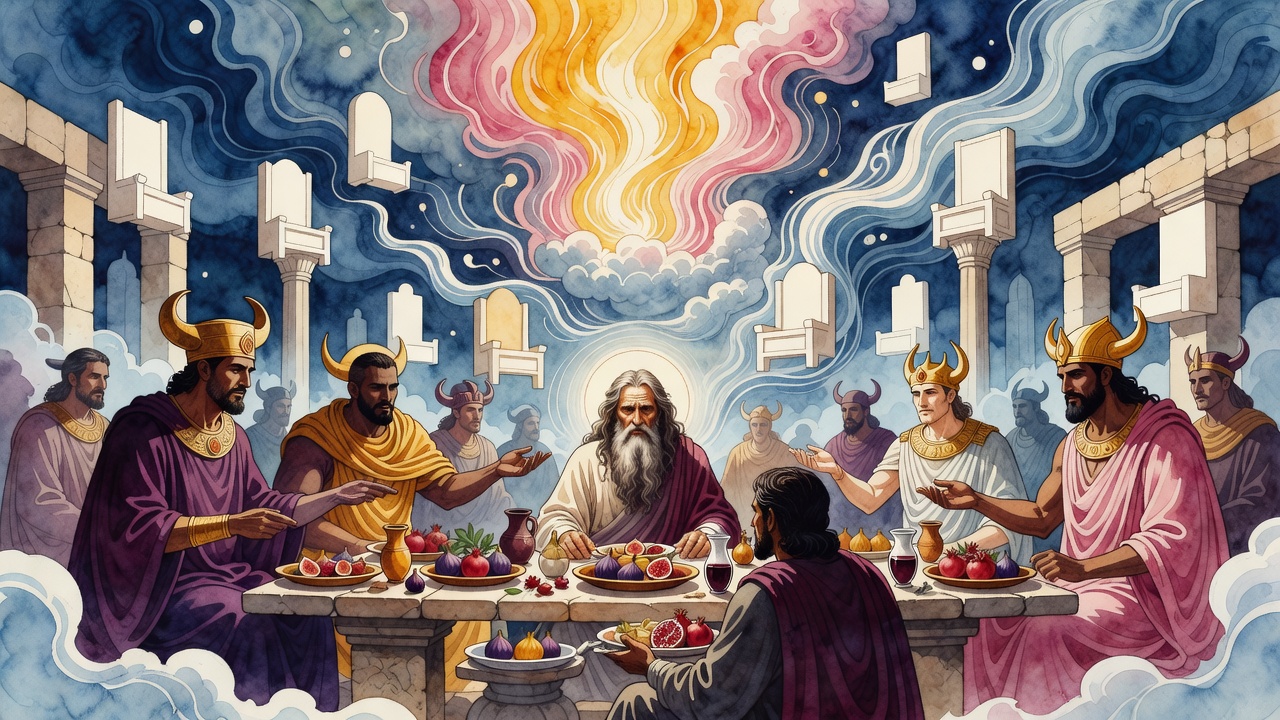
When the time came, Joseph stood before Pharaoh with the vow as his only passport. "My father made me swear, saying, Behold, I die, in the sepulchre which I have prepared for me in the land of Canaan there shalt thou bury me. And now let me go up and bury my father, and I will return" (Genesis 50:5).

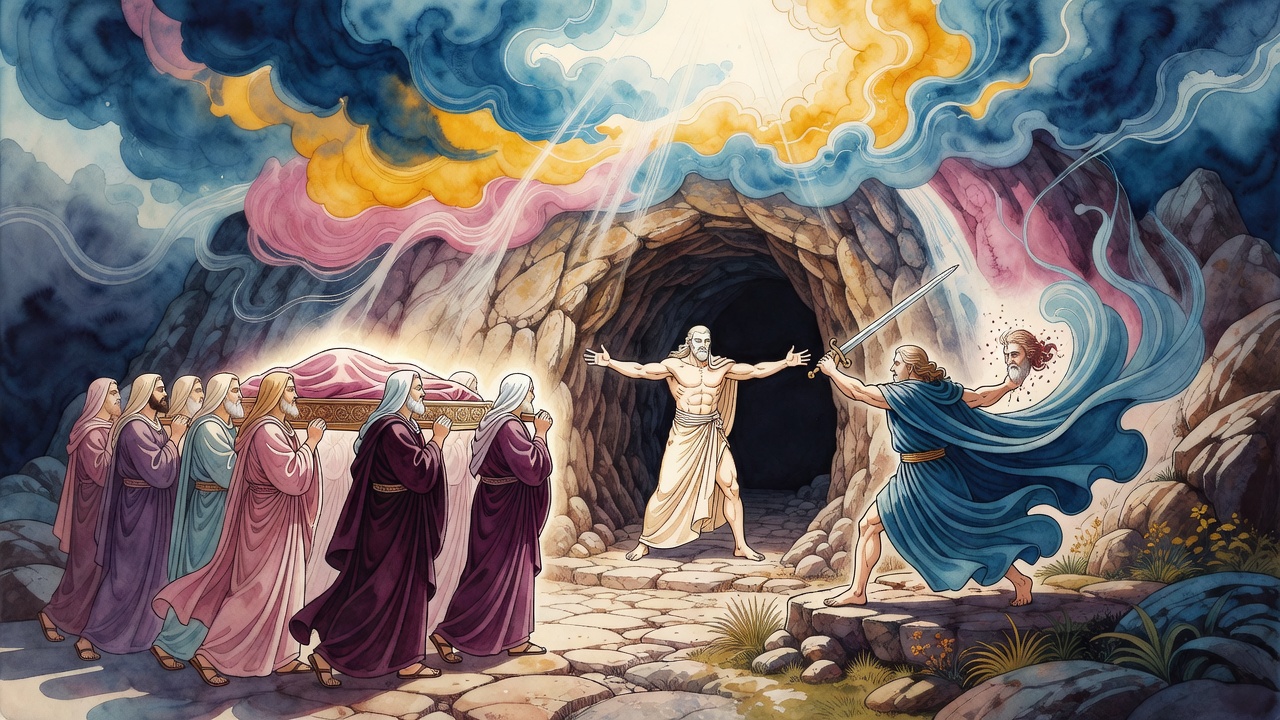
He did not ask as vizier. He asked as a man trapped between two loyalties, and he used the oath as a third party Pharaoh could respect. The funeral procession left Egypt heavy with chariots and grief, and returned, as promised, because Joseph had bound his honor in both directions.

The Bones That Must Wait Longer

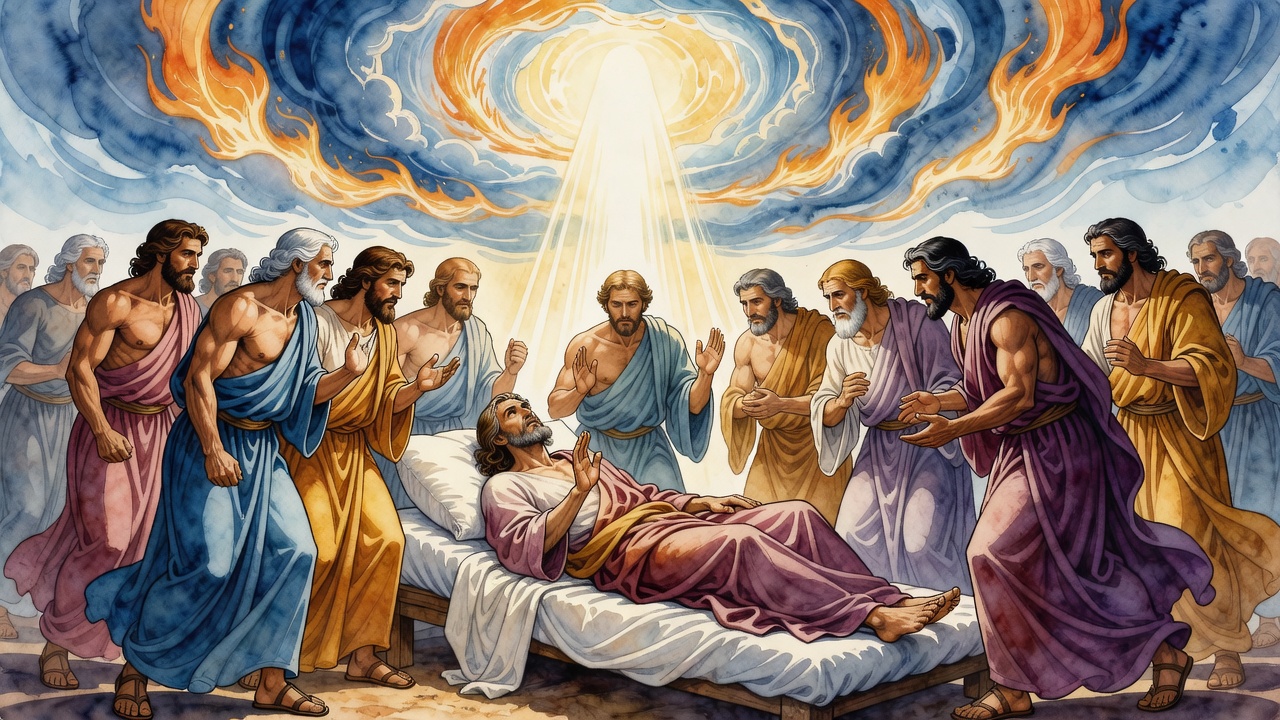
Years later Joseph himself was dying. He gathered what remained of his brothers around the bed and spoke words that would hang over four hundred years like a lamp in a long corridor. "Behold, I die; but the Lord remembering will remember you and will bring you up from this land, into the land which He sware to Abraham, to Isaac, and to Jacob."

He made them swear about his bones the way Jacob had made him swear about Jacob's. One generation's burial becomes the next generation's portable hope. Egypt could hold the body for a while. It could not keep the promise.

Two Oaths, One Direction

Jacob's oath pointed west and north out of the Nile's soft grip. Joseph's oath pointed the same way and added time. The Lord will remember. The remembering is not God's recovery of a misplaced note. It is the covenant clock striking when affliction has filled its measure. Joseph, who once refused to treat a son's promise as casual, now refuses to treat the family's future as a closed Egyptian story.

The brothers listen. Some of them sold him. All of them need him now as a prophet of exit. He does not rehearse the pit. He rehearses the road.

What a Dead Man Still Commands

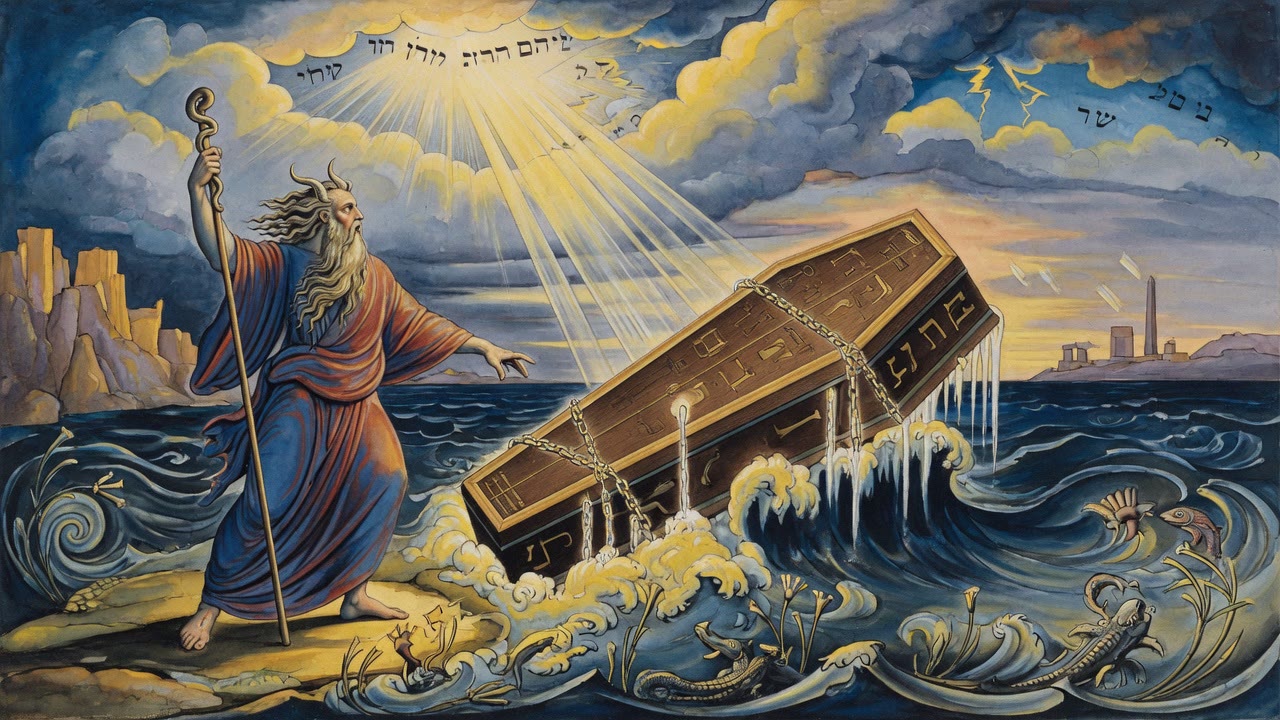
When Moses finally rises, Joseph's bones will rise with the people, a coffin that votes with its silence for Canaan over Goshen. The first refusal, not to swear lightly as a son, and the last command, to carry the bones when God remembers, are the same instinct. Do not let Egypt write the last line of a Hebrew life.

Jacob rests in the cave he chose. Joseph waits in a box that will move when the sea opens. Between them the oath-language of the family becomes the spine of Exodus.

The bed chamber smelled of age and oils. Jacob's legs had already been arranged as if for travel he would not walk. Joseph bent close enough to hear the exact geography of the cave, the field Abraham bought for full silver, the place where Sarah and Abraham already waited. Egypt had palaces. Canaan had a deed.

Refusing the hand-on-covenant gesture as a son was not disrespect. It was a claim that blood should make the vow redundant. Jacob knew better about empires. Pharaohs forget sons. They remember oaths spoken in forms their courts can file. So the formal swear happened, and later the formal request happened, and the chariots rolled north with a coffin that voted against the Nile.

Joseph's own deathbed was quieter and larger. Four hundred years is a sentence you can only speak if you trust a clock you will not see. He looked at brothers who had once stripped him and made them guardians of his bones. The irony was not wasted on anyone in the room. The men who sold him into Egypt would now be bound to get him out.

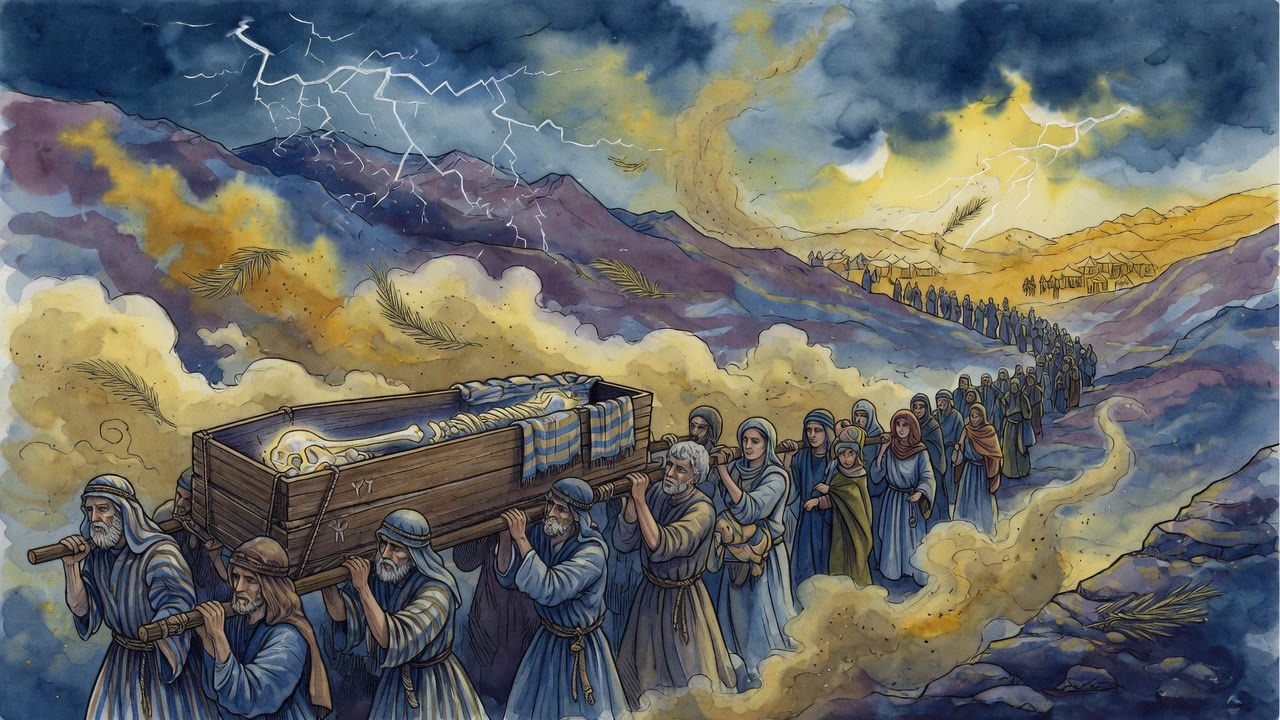
In the long middle centuries, midwives and slaves would tell children about a coffin waiting for the day the Lord remembers. Memory became portable property. When the Exodus finally moved, Moses took the bones the way a man takes a contract still in force. The coffin rode between the banners, a quiet passenger who had already crossed one empire and would not stay for another. Jacob's oath and Joseph's oath were two signatures on the same exit visa.


← All myths
From the tradition

Sources

3 sources

The texts behind this telling. Some cards carry a translation of the source; others are our own retelling of it, and each card says which. Every card links out to the original.

Targum Pseudo-Jonathan on Genesis 50:5Targum Pseudo-Jonathan on Genesis

Retold in our words. Read the original at the link below.The Targum of Jonathan ben Uzziel, trans. J. W. Etheridge, London, 1862 · Public Domain

Joseph's request to Pharaoh hinges on a vow he cannot break. Targum Pseudo-Jonathan renders it simply. "My father made me swear, saying, Behold, I die, in the sepulchre which I have prepared for me in the land of Kenaan there shalt thou bury me. And now let me go up and bury my father, and I will return" (Genesis 50:5).

A Jewish oath is not a casual promise. Joseph had placed his hand under Jacob's thigh (Genesis 47:29), an ancient gesture of solemn vow-taking associated with the covenant of circumcision. To break it would be to desecrate not only his father's wish but the covenant itself. Joseph tells Pharaoh, in effect: I must go. I am bound by a sacred oath.

Pharaoh understood the weight of sworn things. Egyptian religion was built on oaths to gods and kings. But the Targum is also telling its Jewish audience something about kibbud av, honoring one's father, which rises here almost to the level of a commandment. Jacob had prepared a tomb, had chosen a place, had bound his son. Joseph, at the height of his power, lays down his scepter for a week to carry his father home. The Aramaic closes with a reassurance to Pharaoh: "and I will return." Joseph is loyal to both fathers, his own, and the empire that raised him.

Full source
Targum Pseudo-Jonathan on Genesis 47:30Targum Pseudo-Jonathan on Genesis

Retold in our words. Read the original at the link below.The Targum of Jonathan ben Uzziel, trans. J. W. Etheridge, London, 1862 · Public Domain

In a moment easy to skip, the Targum Pseudo-Jonathan on (Genesis 47:30) flags a subtle refusal. Jacob had asked Joseph to place his hand on the mark of the covenant and swear to bury him in Canaan. The Targum reports Joseph's response with one crucial detail: "because he was his son he did not so put his hand; but said, I will do according to thy word."

Joseph answered yes with his mouth but did not answer yes with the gesture Jacob had requested.

A Father, a Son, and a Line of Honor

Why the refusal? Not defiance, the Targum says Joseph agreed to the request. The refusal was about honor. To place his hand on his father's brit, Joseph would have had to look at his father's body in a way a son is traditionally not supposed to. Abraham's servant Eliezer could do it (Genesis 24:2) because he was not a son. Joseph could not, precisely because he was.

The rabbinic sensitivity here is exquisite. A Jewish son owes his father honor (kibud av) at every moment of the relationship, including the moments when his father is old, frail, and asking things of him. To expose even the covenantal sign of the father's body, even at the father's own request, was something Joseph would not do.

Word Without Gesture

So Joseph substituted a verbal oath for the physical one. "I will do according to thy word." In Jewish law, a spoken commitment from a righteous person carries the same weight as the formal oath-gesture. Devaro shel tzaddik, the word of a tzaddik, is enforceable.

And yet Jacob was not satisfied. The next verse has him saying, "Swear to me." Joseph then swore, presumably with his hand still kept at a respectful distance. The Targum, and Midrash Rabbah at Bereishit Rabbah 96, preserve the exchange as a lesson in how to say yes to a parent without crossing the boundary that sonhood itself draws.

The Ethics Hidden in a Gesture

The Targum Pseudo-Jonathan, whose final form emerged between the 4th and 8th centuries CE, often uses such small physical details to teach enormous ethical lessons. Here the lesson is this: there are commitments you can make and still remain a son, and commitments that cost you your sonhood to make. Joseph found the line and walked along it. He gave his father the promise he wanted in the form a son could give it.

The takeaway is a practice, not a theory. When someone you love asks you for something that almost fits the relationship. But not quite, you can answer by doing the spirit of what was asked, without doing the form. Joseph buried his father in Hebron. He did it without ever forgetting that he was Jacob's son.

Full source
Targum Pseudo-Jonathan on Genesis 50:24Targum Pseudo-Jonathan on Genesis

Retold in our words. Read the original at the link below.The Targum of Jonathan ben Uzziel, trans. J. W. Etheridge, London, 1862 · Public Domain

Joseph is dying. He gathers his brothers, what is left of them, around the bed and speaks words that will hover over the next four hundred years like a lamp burning in a long corridor.

"Behold, I die; but the Lord remembering will remember you and will bring you up from this land, into the land which He sware to Abraham, to Izhak, and to Jakob."

The Targum Pseudo-Jonathan on Genesis (50:24) preserves the doubled verb the Hebrew insists on: pakod yifkod, remembering, He will remember. In the Targum's Aramaic, this doubling signals something the sages would later exploit as a secret password. When a redeemer came claiming to be sent by the God of the patriarchs, Israel would listen for this exact phrase. Generations later, in the expansion at (Exodus 3:16), the doubled verb returns. And becomes the proof that Moses has been truly sent.

What is remarkable in Pseudo-Jonathan's Joseph is the timing of the promise. He is dying in the palace of Mizraim, in a nation that has just honored him beyond measure. He does not say "stay here where we are safe." He says, essentially, "this is not home." The grain-storing viceroy of Egypt, about to be embalmed with royal honors, tells his family that the real address is somewhere else.

The takeaway burns: the more comfortable exile becomes, the more urgently we must name it exile. Joseph did. And he planted a password inside his own funeral.

Full source