5 min read

The Red Sea Split Into Twelve Roads for Israel

At the Red Sea, Israel received twelve roads, glasslike walls, dry ground, drinkable water, and gifts no nation could steal.

Curated by Arthur · Told by Maggid ·
Table of Contents
  1. The Rod Rose Over the Water
  2. Twelve Roads Under One Vault
  3. Dry Earth for One People
  4. Water That Would Not Be Stolen
  5. The Desert Kept the Secret

The sea did not split into a hallway. It broke into twelve roads.
Behind Israel, Egypt came with horses, chariots, iron, shouting, and the old claim that slaves do not get to walk away. In front of them, the Yam Suf rolled and struck the shore. Two tribes had already pushed into the waves. The people stood between a master who wanted them back and a sea that had not yet learned mercy.

The Rod Rose Over the Water

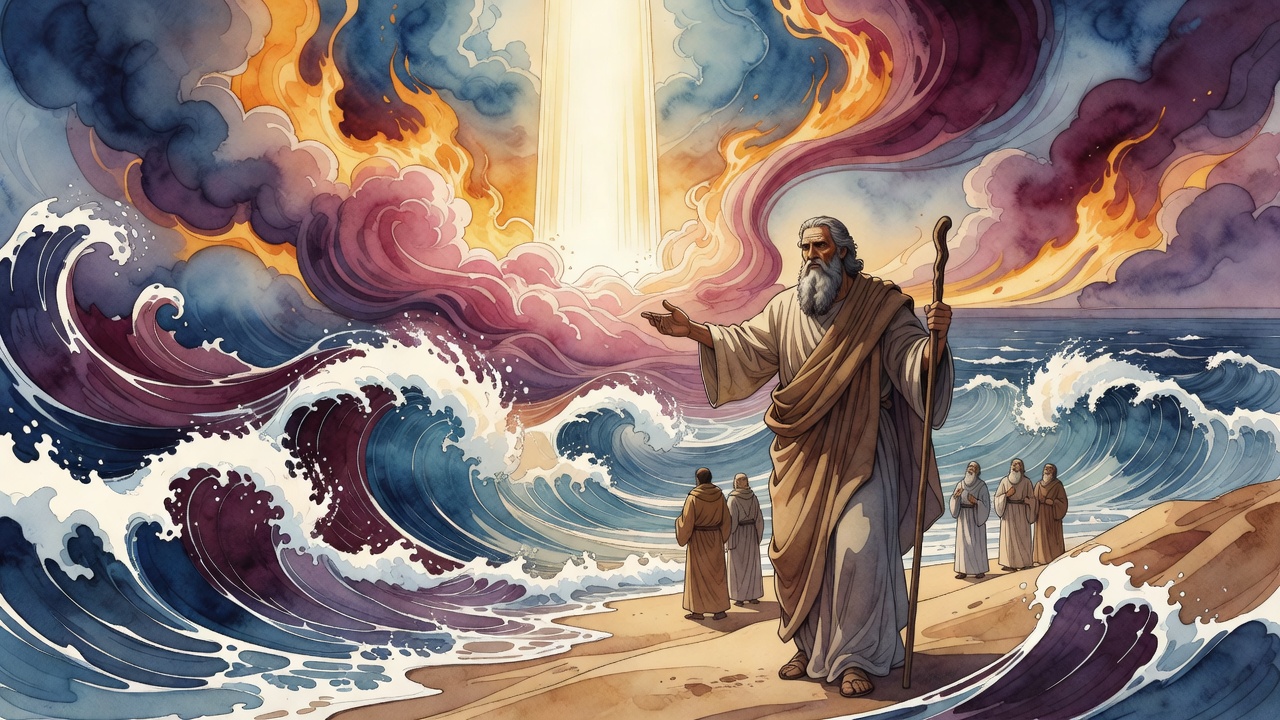
God turned to Moses with no patience for delay. Beloved ones were in danger of drowning, and Moses was still praying. The hour for prayer had narrowed into the hour for motion. Lift the rod. Divide the water. Tell Israel to move.

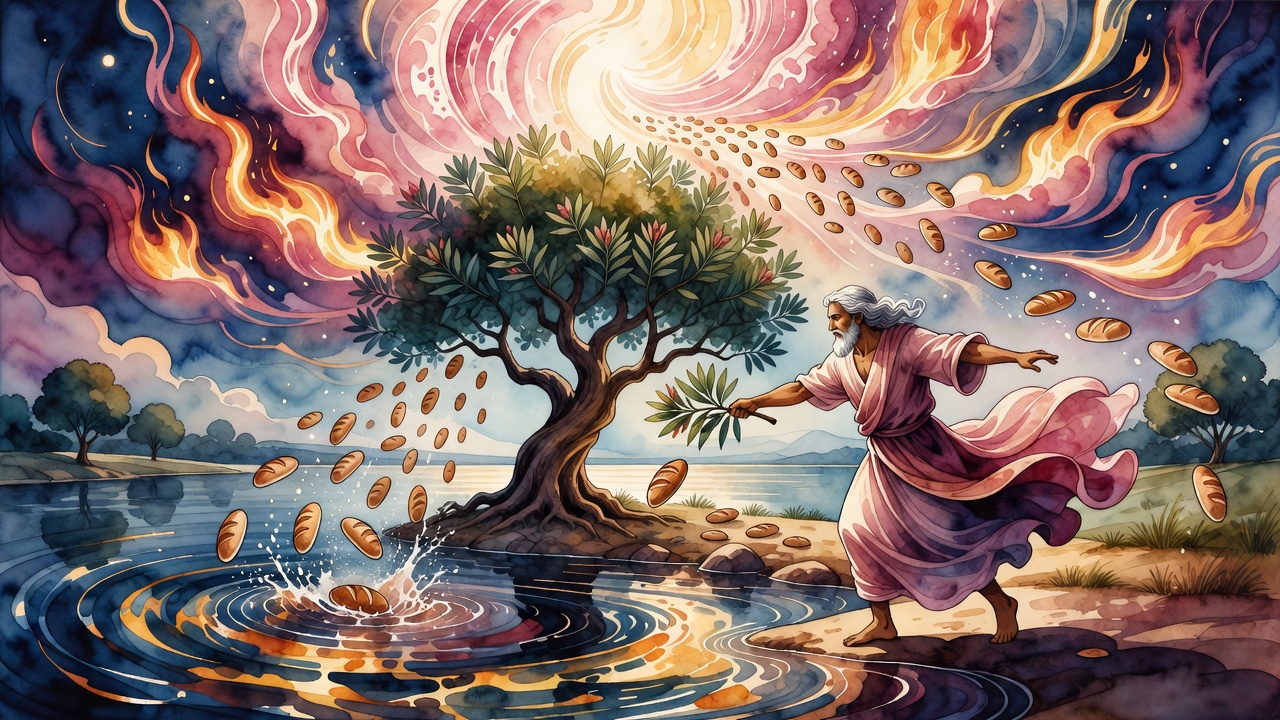
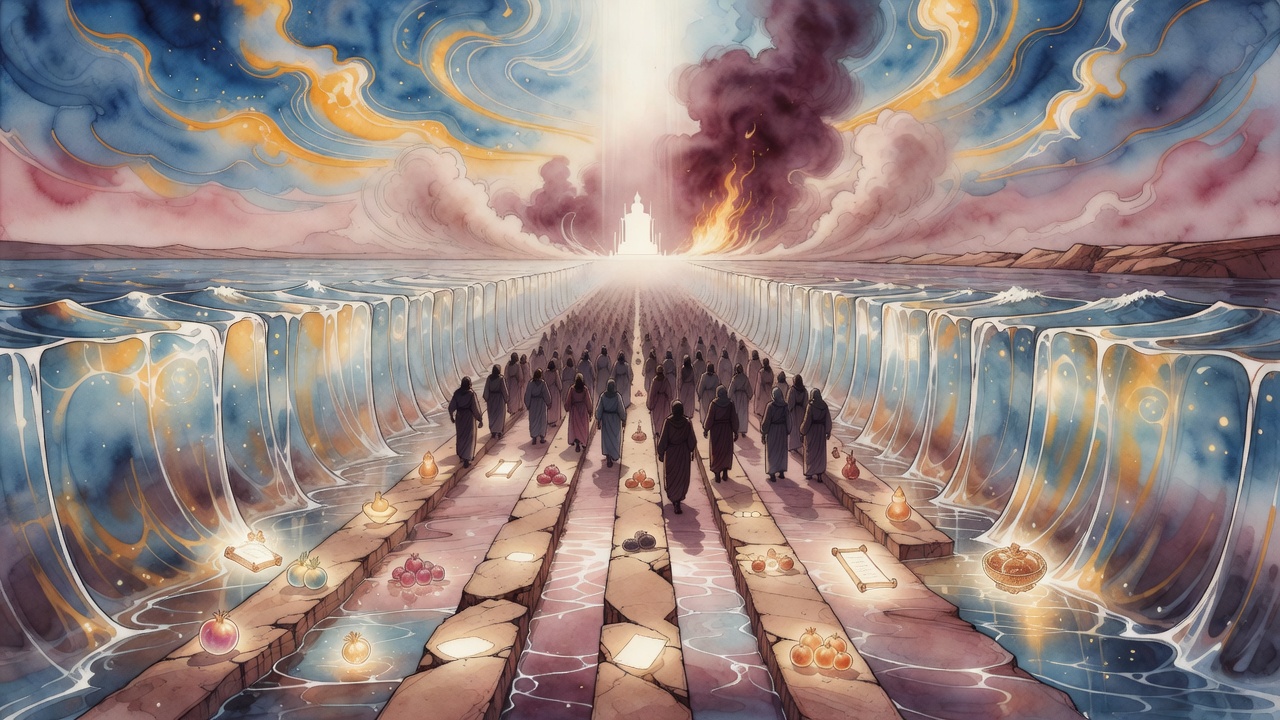
The rod rose. The sea pulled away from itself. Water climbed like walls, then bent overhead until the fugitives walked beneath a vault that should have crushed them. The air smelled of salt and panic. Children gripped sleeves. Parents carried bundles that still smelled of Egypt. Behind them, the wheels of the chariots struck the wet edge.

Twelve Roads Under One Vault

One road would have saved them. God gave twelve.

Each tribe entered its own corridor, not swallowed into the crowd, not lost in the terror of the mass. Reuben had a path. Judah had a path. Benjamin had a path. The families who had camped together and quarreled together now crossed as distinct houses under one impossible roof of water.

The walls did not hide them from one another. They turned clear as glass. A mother on one path could look through the standing sea and find another tribe moving beside her. A child could press close to the wet shine and know that Israel had not been broken into fragments. Twelve roads, one people. Separate enough to breathe. Visible enough not to be abandoned.

Dry Earth for One People

The floor under Israel hardened into dry ground. Sand held. Feet did not sink. The people who had made bricks without straw crossed the sea without mud on their ankles.

Then Egypt entered the same place, and the ground changed its mind. The dry floor thickened into clay. Wheels dragged. Hooves plunged. The chariots that had thundered across flat land now lurched and stuck as if the sea had fingers beneath the soil. The path that opened for Israel became a trap for the pursuer.

The walls changed too. Against Israel, they stood like shelter. Against Egypt, they hardened into stone. Bodies slammed against what had been water. The sea had not become neutral territory. It knew the difference between the chased and the chaser.

Water That Would Not Be Stolen

Inside the crossing, thirst rose. Freedom did not remove the taste of salt from the mouth or the heat from the throat. The same sea that made a road now gave drink. Israel bent toward the water and lived.

Then, as soon as the thirst was satisfied, the drinking water congealed in the heart of the sea. It withdrew into hardness. Egypt could chase the bodies of Israel, but it could not steal the cup placed at Israel's lips. The gift arrived for the needy and closed against the violent.

The people came out carrying more than rescued skin. They carried the memory of a world that could become exact. Water could be wall, roof, glass, stone, road, cup, and closed door. The same creation could open in one direction and refuse in another.

The Desert Kept the Secret

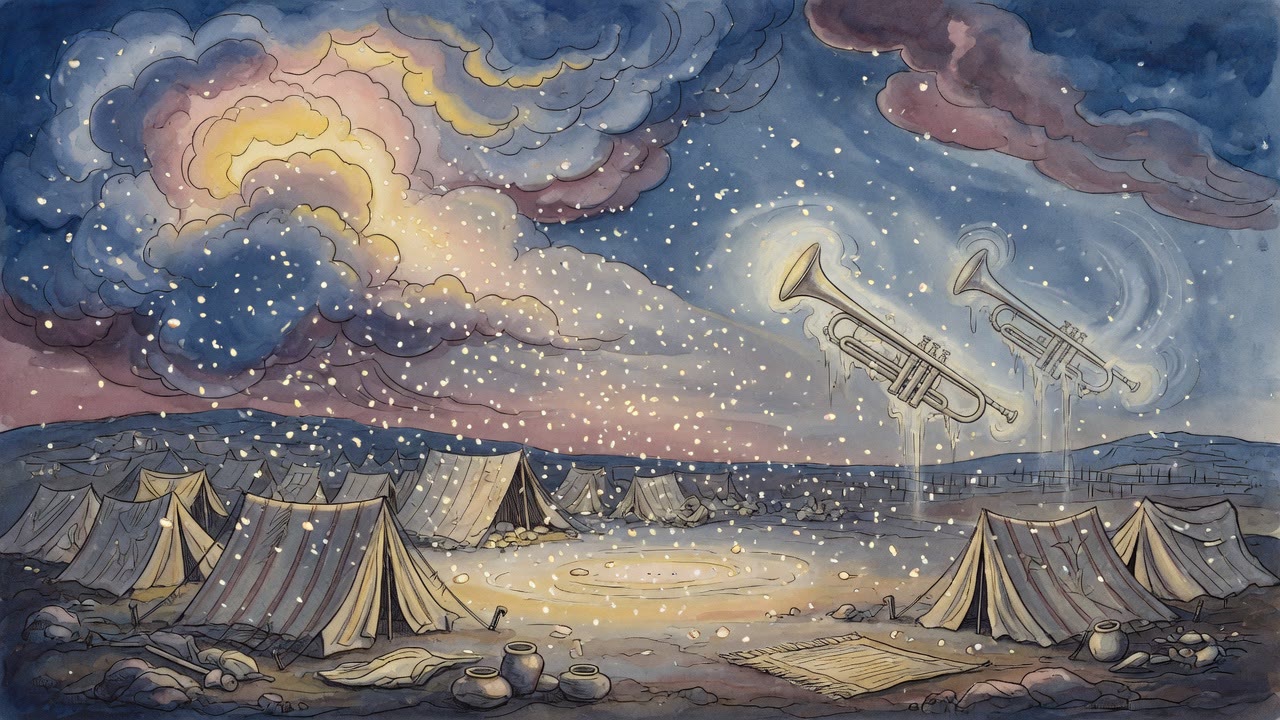
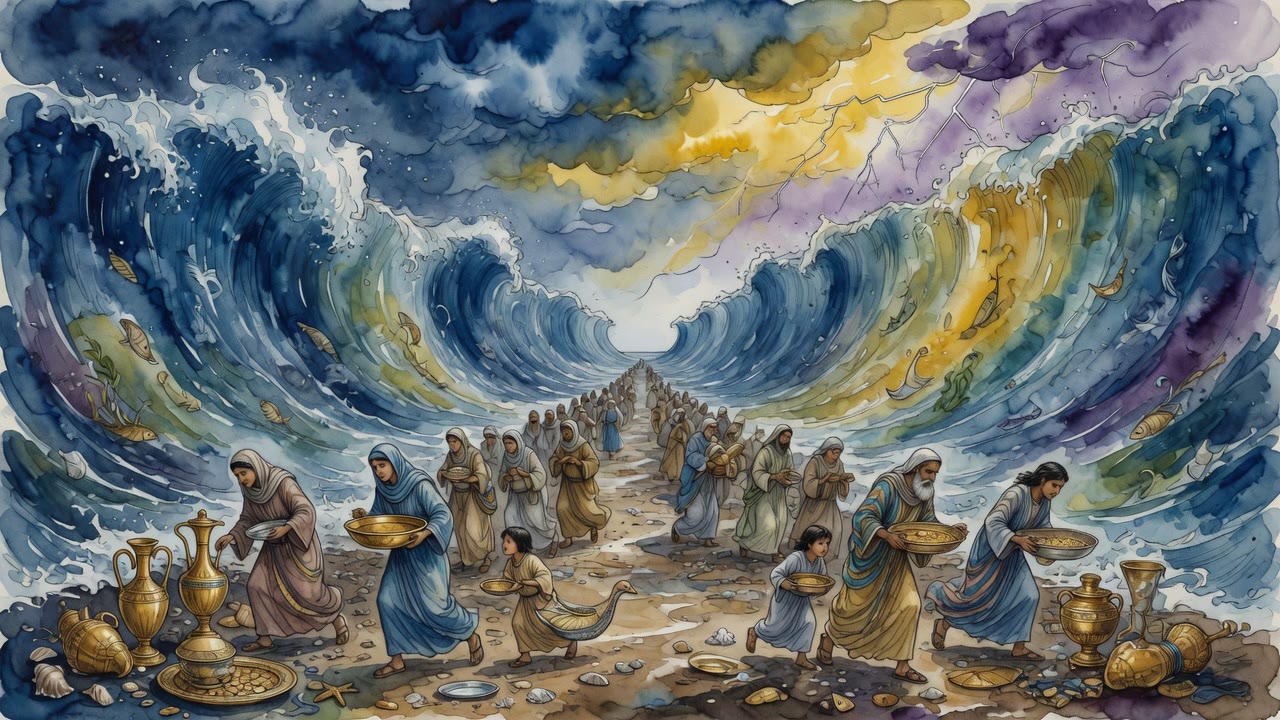
The desert kept teaching the same lesson. Morning after morning, manna fell for Israel. Vessels filled. Families ate. Hunger did not get the last word.

Other nations reached for the bread and found nothing. Hands stretched out toward heaven's food and closed around emptiness. When they came to the well, their jars found no answer. The water that sustained Israel would not become common plunder. Miriam's Well gave drink to the camp, but not to every hand that tried to make the gift its own.

The wilderness was not generous in a vague way. It was intimate. It protected Israel like the pupil of an eye, quick to close against harm, quick to guard the most exposed place. The same God who led them into a desert land did not leave them there as a crowd of mouths. Bread fell where it was meant to fall. Water rose where it was meant to rise. The sea had already taught them the shape of such care.

Behind them, Egypt sank. Ahead of them, the desert waited with bread no thief could gather and water no stranger could draw.


← All myths
From the tradition

Sources

2 sources

The texts this telling draws on, in full. Open a card to read inline, or expand it for a wider, quieter read.

Legends of the Jews 1:36Legends of the Jews

For the Israelites fleeing Egypt, this wasn't fiction – it was reality, or at least, that's how the legends tell it.

The moment God saw His people struggling, caught between the pursuing Egyptian army and the churning sea, He turned to Moses. "My beloved are in danger of drowning, and thou standest by and prayest?" He asked, according to Legends of the Jews. It was time for action, not just prayer. God commanded Moses to bid Israel to go forward, to raise his rod, and to divide the sea. And so, it happened. The waters parted, creating a path to freedom.

The miracle of the splitting of the Red Sea – or the Sea of Reeds, the Yam Suf, as it's known in Hebrew – wasn't just a single event. The legends, beautifully compiled by Louis Ginzberg, paint a picture of not one, but ten miracles all woven together!

First, imagine the waters uniting above the Israelites' heads, forming a protective vault. Then, picture not just one path, but twelve, one for each of the tribes of Israel! According to tradition, each tribe marched through its own separate corridor. And what if the water wasn’t just parted, but became transparent as glass? The legends say that each tribe could see the others, offering reassurance and connection in that perilous moment.

The ground beneath their feet was also miraculous. It was dry for the Israelites, but as soon as the Egyptians stepped onto it, it turned into thick, clinging clay, bogging down their chariots and horses. Talk about divine intervention!

And that’s not all. The walls of water transformed into jagged rocks to torment the Egyptians. The very walls of water that protected the Israelites became instruments of divine justice for their enemies.

Finally, as Legends of the Jews recounts, the Israelites found water to drink. The sea itself provided refreshment. Yet, the tenth and final wonder was perhaps the strangest of all: as soon as they had quenched their thirst, the water congealed in the heart of the sea, a evidence of God’s power and control.

These aren’t just stories; they're powerful metaphors. They speak of courage in the face of impossible odds, of faith when all seems lost, and of the extraordinary potential that lies within the ordinary when we align ourselves with something greater than ourselves. What do these legends of the Sea of Reeds awaken in you?

Full source
Sifrei Devarim 313:14Sifrei Devarim

It's all tucked away in a short but potent verse from Sifrei Devarim 313, a midrashic (rabbinic interpretive commentary) text on the Book of Deuteronomy.

The verse says, "He built them up," and it's explained as referring to "two gifts." What gifts, you ask? Manna and water! Now, that may sound simple enough, but the Sifrei goes on to tell us something truly remarkable: when other nations tried to partake of the manna, that heavenly bread, or to draw water from Miriam's Well, they found nothing. It was only for the Israelites, a sign of God's exclusive care and provision for them. God's gifts, freely given to one people, were inaccessible to others. This wasn't about exclusion, but about a unique and intimate bond. It speaks to a level of care so specific, so tailored, that it couldn't be replicated or shared in the same way with anyone else. It's like a parent knowing exactly what their child needs, even before they ask.

The verse continues, "He protected them like the pupil of His eye." This image! Can you imagine anything more precious, more vulnerable, than the pupil of your eye? It's the most sensitive part, the one you instinctively shield. And that's how God protected the Israelites.

We see this echoed in (Numbers 10:35), where we find the plea, "Arise, O L-rd, and let Your foes be scattered, and let your foes flee before You!" This isn’t just a call for divine intervention; it's a evidence of the constant, vigilant protection God provided, always ready to defend His people.

And finally, the verse reminds us, "He found them in a desert land." But it wasn't just any desert. As we read in Hoshea 2:16, God says, "Behold, I will entice her and lead her into the wilderness." The desert wasn't just a geographical location; it was a place of intimacy, a place where the Israelites could be alone with God, away from the distractions and temptations of the world. It was a place where God could woo them, get their attention, and remind them of their special relationship.

The midrash (rabbinic commentary) highlights that this wasn't just about physical sustenance or protection. It was about a deep, abiding love and commitment. God didn't just provide for the Israelites; He nurtured them, cherished them, and protected them with fierce devotion.

So, what can we learn from this ancient text about building our own relationships? Perhaps it's this: true connection requires a willingness to be vulnerable, to offer unique gifts, and to protect one another with the same fierce love and devotion that God showed His people in the desert. Maybe it's about finding our own "desert land," a space where we can truly connect, without distractions, and nurture the bonds that matter most.

Full source