Parshat Vayishlach5 min read

Jacob Climbed Bethel to Close an Open Vow

Jacob's unpaid vow opened his account book. Esau, a wrestling angel, Dinah's grief, and Rachel's death pressed him back to Bethel's altar.

Curated by Arthur · Told by Maggid ·
Table of Contents
  1. The Account Book Opens
  2. Strike the Clogged Sieve
  3. Three Fears, Three Blows
  4. Household, March
  5. Oil on the Old Stone
  6. What Delay Buys and Costs
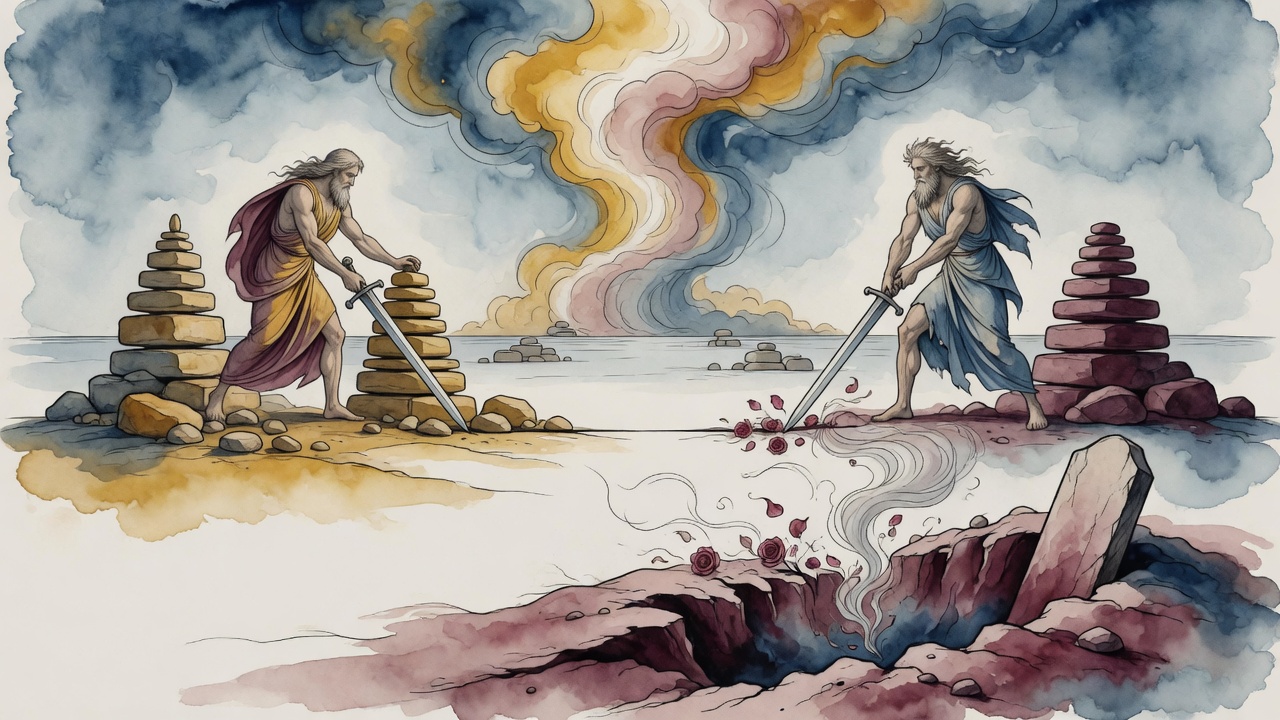
Jacob Climbed Bethel to Close an Open Vow Click for full size

The Account Book Opens

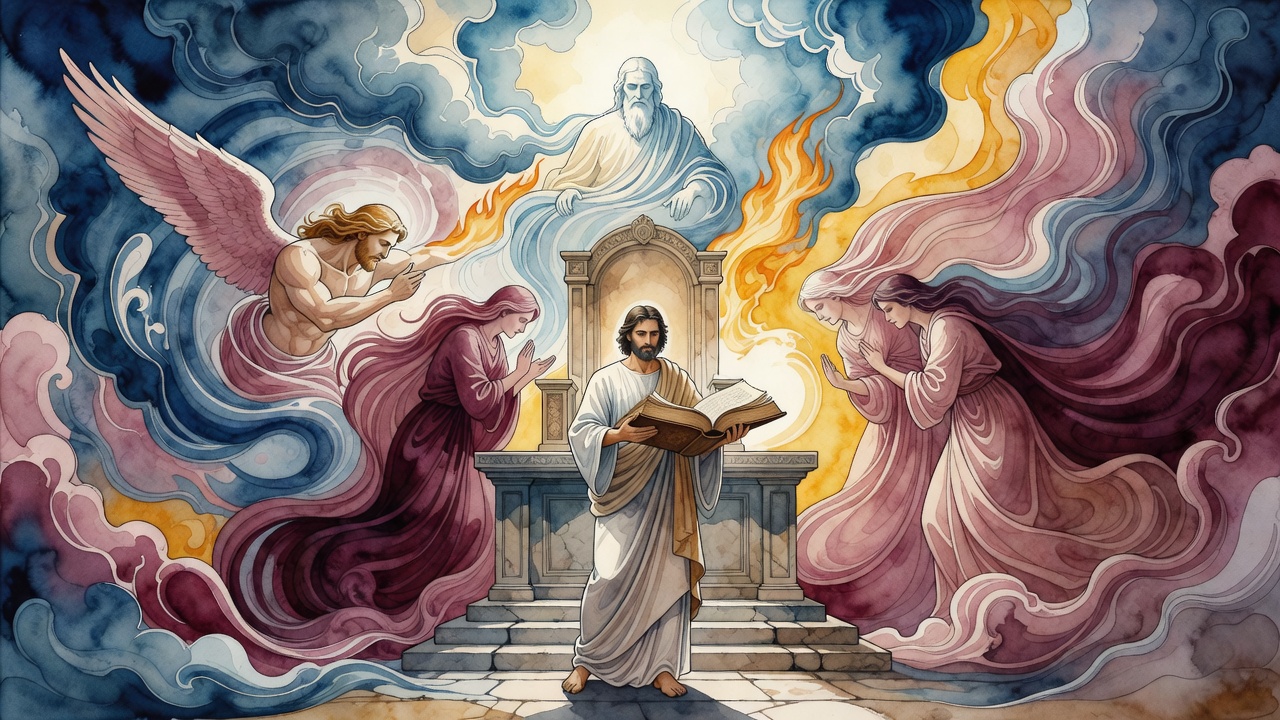
Jacob had wealth, wives, sons, and a limp earned in the dark. He did not yet have a paid vow. On the road from Aram he had said, "If God be with me..." and named terms heaven still held in ink (Genesis 28:20).

The masters count three times a man's account book opens: when he travels alone on a highway, when he lives in a ruined house, and when he vows and fails to fulfill. Jacob's delay stacked the third opening on top of every mile home.

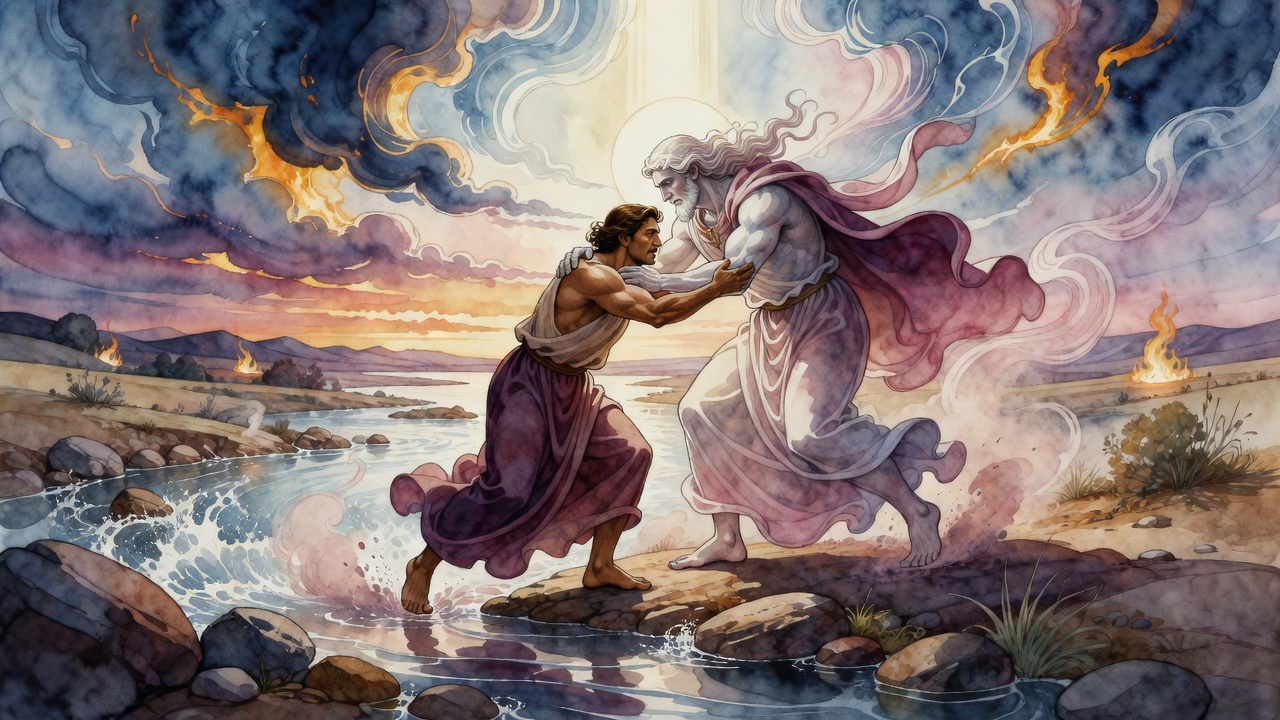
God turned Esau against him. Esau took flocks. Jacob still did not climb to Bethel. An angel wrestled him until the hip socket slipped; Samael, guardian of Esau, sought his life in that grip. Jacob still delayed. Dinah went out. Blood followed in Shechem. Rachel died on the road and was buried where the vow still waited unpaid.

Strike the Clogged Sieve

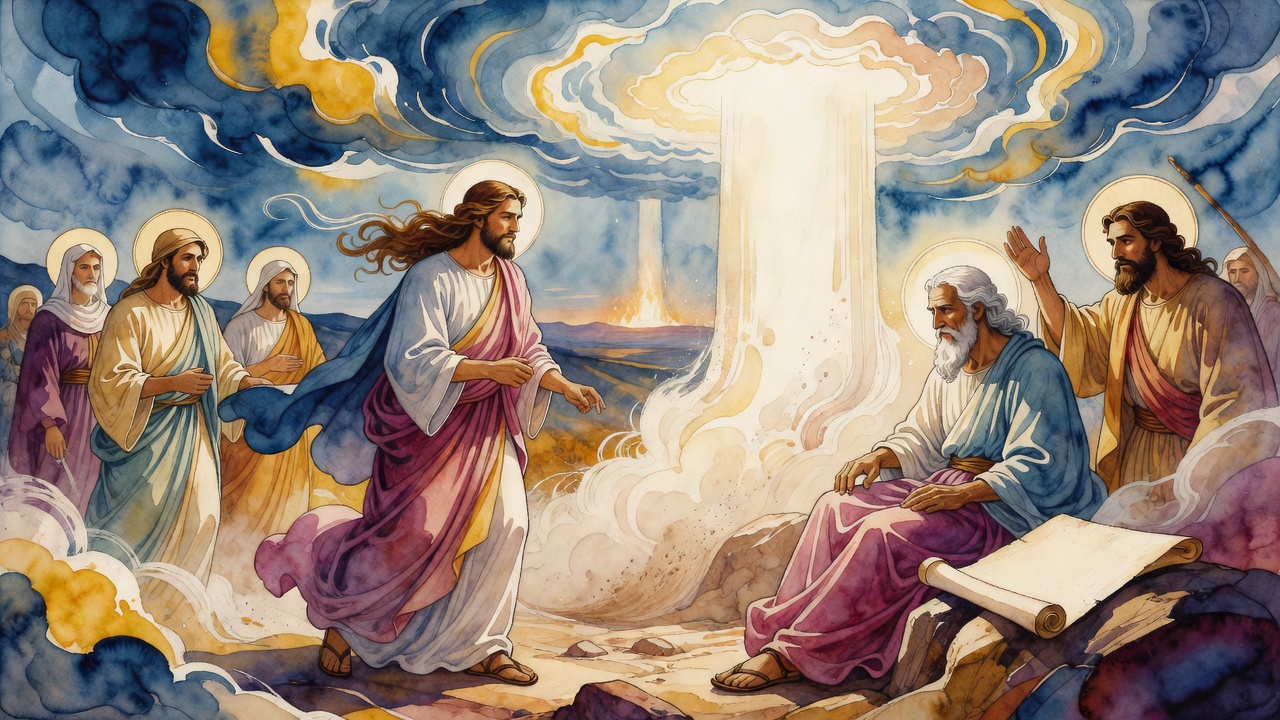
"How long shall this righteous man be punished without knowing why?" Heaven spoke as if tired of subtlety. "Arise, go up to Beth-El, and dwell there" (Genesis 35:1). R. Aibu said: when your sieve is clogged, strike it. The trials were the striking. The altar at the old pillar was the clearing.

"I am the God of Beth-El, where thou didst anoint a pillar, where thou didst vow a vow unto Me." Difficulty had made the vow easy to speak. Ease had made it easy to forget.

Three Fears, Three Blows

What had Jacob asked for? That God be with him so he would not go after idolatry; that he be kept from lewdness; that he be kept from bloodshed. Because he delayed the payment, he tasted all three. Strange gods had to be put away from his camp. Dinah's shame and the swords of Simeon and Levi filled the middle and the last.

Procrastination on a vow, the Tanchuma teaches, is graver than each wound alone, because it invites the set.

Household, March

Jacob turned to his household. "Let us arise, and go up to Beth-El." He ordered foreign gods buried. He moved the camp toward the place where a stone had once been oil-wet under a ladder of angels. The return was not nostalgia. It was collection day.

Vayikra Rabbah lines the same road with later voices. Better not to vow than to vow and not pay. A man who delayed and sailed the sea saw his ship sink. Another teaching ties delay to a wife's death, reading Rachel's burial as the bed taken from under the debtor. Reward doubles for vow and payment together. Demand, when it comes, is exacted from the person, not only from the purse.

Oil on the Old Stone

At Bethel Jacob built what he had promised. The account book that opens for unfinished speech closed one page. The limp remained. The graves remained. The God who refuses to forget a midnight bargain remained too, less as a threat than as a creditor who finally received what fear had signed and comfort had postponed.

What Delay Buys and Costs

Between Bethel's first oil and Bethel's second altar stretched years of Laban's contracts, striped flocks, and a night when a man who would not give his name wrenched Jacob's hip. Each crisis looked like the main story. The unpaid vow looked like paperwork. Heaven treated the paperwork as the spine.

Esau's four hundred men were not random weather. Dinah's outing was not random weather. Rachel's last breath on the road was not, in the Tanchuma's reading, random weather. A man who borrows from God and postpones payment finds collectors who do not accept explanations about busy seasons.

When Jacob finally ordered the foreign gods buried, he was not inventing piety. He was removing the evidence of the first fear he had named in the vow: idolatry in the camp. The march to Bethel was a family turning itself inside out to match a sentence spoken when he had only a stone for a pillow.

Vayikra Rabbah's ship that sinks under an unpaid vow is the same lesson in another sea. The double reward for vow and payment is the other face of the coin. Jacob climbed because the alternative was another page opening in the account book while he still pretended ease had canceled the debt.

He arrived at the old place with a limp and a household scrubbed of foreign gods. The pillar that once held oil waited like a creditor who had been patient past politeness. Jacob built and named and stood under the same sky that had shown him angels on a ladder when he owned nothing but a stone. Payment does not erase the years of delay. It only stops the next page of the book from opening while he is looking elsewhere.


← All myths
From the tradition

Sources

2 sources

The texts behind this telling. Some cards carry a translation of the source; others are our own retelling of it, and each card says which. Every card links out to the original.

Midrash Tanchuma, Vayishlach 8Midrash Tanchuma

Retold in our words. Read the original at the link below.Townsend 1989 translation of Midrash Tanhuma, S. Buber Recension · CC-BY

And God said unto Jacob: “Arise, go up to Beth-El” (Gen. 35:1). May our master teach us: How many times is a man’s “account book” open? Thus did our masters teach us: A man’s account book is opened three times: when he journeys alone upon a highway; when he resides in a dilapidated house; when he vows and fails to fulfill. R. Aha the son of Jacob deduced the first statement from the biblical verse If harm befall him by the way (Gen. 42:3). R. Eliezer the son of R. Yosé the Galilean stated: If you should discover that a righteous man is setting out on a journey, leave even three days earlier or three days later in order to travel with him. But if you should see a wicked man setting out on a journey, leave three days earlier or three days later in order not to go with him, as it is said: Set thou a wicked man over him; and let an adversary stand at his right hand (Ps. 109:6). A righteous man, however, is accompanied by angels of peace, as it is said: For He will give his angels charge over thee (ibid. 91:11).

The opinion that Satan denounces any man who dwells in a dilapidated house, and that his account book is opened when he does so, is derived from the Mishnah (the earliest code of rabbinic law). How do we know about the man who vows and does not pay? It is written in Scripture: When thou shall vow a vow unto the Lord thy God, thou shalt not be slack to pay it (Deut. 23:22), and it is written elsewhere: It is a snare to a man rashly to say: “Holy,” and after vows to make inquiry (Prov. 20:25). The words after vows to make inquiry signify that a man’s account book is opened and that angels testify against him by enumerating his sins. R. Samuel the son of Nahman stated: Everyone who borrows and fails to repay brings about the death of his wife, as it is said: If thou hast not wherewith to pay, why should he take away thy bed from under thee? (ibid. 22:27). Moses warned Israel about this, as is written: When thou shalt vow a vow unto the Lord thy God, thou shalt not be slack to pay it; for the Lord thy God will surely require it of thee (Deut. 23:22). Why is the word require repeated in this verse (i.e., written in the intensive form, darash yidreshenu)? It teaches us that He will require (i.e. inquire) of him with regard to what he has borrowed, and He will (also) require concerning his other sins, as it says: And after vows to make inquiry (Prov. 20:25).

R. Yannai asserted: The account book of the man who makes a vow which he fails to fulfill is examined in the presence of the Holy One, blessed be He. He asks: Where is that person who made a vow on a certain day? Observe that it is written concerning the time that Jacob went to Aram-naharaim: And Jacob vowed a vow, saying: “If God be with me” (Gen. 28:20). At first He granted his every request. He went there and became wealthy, but when he returned without fulfilling his vow, He turned Esau against him, and Esau sought to kill him. And though Esau took the two hundred she-goats from him, Jacob did not trouble to perform his vow. Whereupon He turned the angel against him and they wrestled together, but still he did not take note, as it is said: And Jacob was left alone; and there wrestled a man with him (ibid. 32:26). It was Samael (the angel of death), Esau’s guardian angel, who wanted to kill him, as is said: When he saw that he prevailed not against him, he touched the hollow of his thigh (ibid., v. 27). When he still was not persuaded to fulfill his vow, the anguish occasioned by Dinah’s experience befell him, as is said: And Dinah went out. When he continued to refrain from carrying out his vow, the tragedy of Rachel’s death occurred, as it is said And Rachel died and was buried (ibid. 35:19). This confirms the opinion of R. Samuel the son of Nahman that one who vows and fails to fulfill his vow brings about the death of his wife, as it is said: If thou hast not wherewith to pay, why should he take away thy bed from under thee? (Prov. 22:27).

The Holy One, blessed be He, declared: How long shall this righteous man continue to be punished without comprehending the sin for which he is being afflicted? i will inform him. And it is written: God said unto Jacob: “Arise, go up to Beth-El, and dwell there” (Gen. 35:1). R. Aibu said: When your sieve is clogged, strike it. The Holy One, blessed be He, told him: These trials have befallen you only because you have not fulfilled your vow. If you do not wish to experience other afflictions, Arise, go up to Beth-El, dwell there, and erect an altar, at the very place at which you made your vow. I am the God of Beth-El, where thou didst anoint a pillar, where thou didst vow a vow unto Me (ibid. 31:13). R. Abba the son of Kahana stated: The Holy One, blessed be He, said to Jacob: When a man has problems he will make a vow, but when he is enjoying ease and comfort he will quickly disregard his vow. When you were in difficulty you made a vow, but after you attained security you forgot it. Then Jacob said unto his household, and to all that were with him: “Let us arise, and go up to Beth-El” (ibid. 35:2–3).

What did he say when he made his vow? If God will be with me (ibid. 28:20); that is, so that I shall not go astray after idolatry; and will keep me (ibid.), from committing acts of lewdness; in this way (ibid.), from being guilty of spilling blood. Because he delayed fulfilling his vow, he was smitten by all three. How do we know about idolatry? It is written: Put away the strange gods (ibid. 35:2). We know about lewdness from the episode of Dinah, and about bloodshed from the fact that they killed all the males. This teaches us that procrastination in the fulfillment of a vow is the most serious of all three. Because he neglected to fulfill his vow he experienced all three.

Better is it that thou shouldst not vow, than that thou shouldst vow and not pay (Eccles. 5:4). R. Meir maintained: Better than either of these is that one should not vow at all. A man should bring his lamb to the Temple court and sacrifice it instead. R. Judah was of the opinion that to make a vow and fulfill it was preferable to the other two, since it is said: Vow, and pay unto the Lord your God (Ps. 76:12). He who makes a vow and performs it is rewarded both for the vow and its fulfillment.

R. Huna said: It is told that a certain man made a vow which he failed to keep, and as a result, when he set out to cross the sea, the ship he was sailing in sank and he perished. R. Ammi explained: Anyone who fails to keep a vow that he has made is responsible for his own death, as it is said: The Lord thy God will surely require it of thee (Deut. 23:22). That is, the Holy One, blessed be He, will exact retribution from that person and not from his possessions. Ben Sira taught: Before you make a vow, consider that vow carefully lest you go astray. Suffer not thy mouth to bring thy flesh into guilt, neither say thou before the messenger, that it was an error; wherefore should God be angry at thy voice, and destroy the work of thy hands? (Eccles. 5:5). R. Aha explained this verse as follows: Suffer not thy mouth to bring thy flesh into guilt refers to the one who makes a vow; neither say thou before the messenger, that it was an error indicates that one must not say to the sexton: “I did not intend to vow at all”; wherefore should God be angry at thy voice and destroy the work of thy hands? alludes to the lesser commandments you fulfilled and the good deeds you performed.

Full source
Vayikra Rabbah 37:1Vayikra Rabbah

Retold in our words. Read the original at the link below.The Sefaria Midrash Rabbah, 2022 · CC-BY

Vayikra Rabbah turns Jacob's delayed vow at Bethel into a warning about promises made before God.

Our starting point is (Leviticus 27:2): “Speak to the children of Israel, and say to them: If a man articulates a vow in accordance with the valuation of persons to the Lord…” Seems straightforward enough. But this verse opens up a much bigger conversation about the nature of vows, promises, and our responsibilities to keep them.

The text immediately jumps to (Ecclesiastes 5:4): “It is preferable that you do not vow than if you vow and do not pay.” This sets the stage for a debate between Rabbi Meir and Rabbi Yehuda. Rabbi Meir argues that while it's better not to vow at all, someone who does vow and then fulfills that vow is even better. He even finds support in (Psalms 76:12): “Vow and pay to the Lord your God.”

Rabbi Yehuda takes a stricter stance. He believes that not vowing at all is the best option of all! Better than vowing and paying, even better than vowing and not paying. He suggests that instead of making a grand pronouncement, you should simply bring your offering – say, a lamb – to the Temple, consecrate it, and be done with it. This echoes (Deuteronomy 23:23): “If you refrain from vowing, there will be no sin in you.” It's almost as if Rabbi Yehuda is saying, "Keep it simple! Actions speak louder than words."

So what's the big deal about delaying a vow? Rav Huna tells a chilling story: A man made a vow, didn’t fulfill it, and then set sail on the Mediterranean Sea. His ship sank, and he perished. Coincidence? Perhaps. But the rabbis saw a connection.

Rabbi Shmuel bar Naḥman goes even further, suggesting that delaying the fulfillment of a vow can lead to much worse things: idol worship, forbidden sexual relations, bloodshed, and slander. Strong words. Where does he get this idea? He points to Jacob.

Remember Jacob, from the Book of Genesis? He made a vow (Genesis 28:20–22), and the Midrash suggests he was a bit slow in fulfilling it when he returned to the Land of Israel. Rabbi Shmuel bar Naḥman connects this delay to a series of unfortunate events in Jacob's life: his family getting involved with idol worship (Genesis 35:2), the tragic story of Dina (Genesis 34), the violent actions of Simeon and Levi (Genesis 34:25), and even the slander Jacob heard from Laban's sons (Genesis 31). It's a powerful, if somewhat dramatic, connection.

The Rabbis add another layer, claiming that delaying a vow can even lead to the death of one's wife. They cite (Genesis 48:7): “And as for me, when I came from Padan, Rachel died on me.” Talk about a heavy consequence!

But there's also good news! Rabbi Shmuel bar Rav Yitzḥak says that someone who vows and pays receives reward for both the vow itself and the act of fulfilling it. Again, he points to (Psalms 76:12): “Vow and pay to the Lord your God.” It’s a double mitzvah!

However, Rabbi Shmuel also cautions that delaying a vow can lead to one's own death, referencing (Deuteronomy 23:22): “As the Lord your God will demand it from you” – implying that payment is exacted from you, not just your possessions. Yikes!

Rabbi Ami adds a philosophical layer, stating that there is no death without sin and no suffering without iniquity. He quotes (Ezekiel 18:4): “The soul that sins, it will die,” and (Psalms 89:33): “I will punish their transgression with a rod, and their iniquity with plague.” It's a reminder that our actions have consequences.

Finally, Rabbi Shimon ben Yoḥai draws a parallel between vows and arkhin (valuations), a concept outlined in Leviticus. Just as there are prohibitions against profaning or delaying vows (Numbers 30:3, (Deuteronomy 23:2)3), so too are there similar restrictions regarding valuations. This is why Moses, in (Leviticus 27:2), connects the idea of vows to valuations. It is a reminder that the same level of seriousness and commitment should be applied to both.

So, what's the takeaway from all of this? It seems the rabbis are urging us to be mindful of our promises. Think before you vow. And if you do vow, make every effort to fulfill it promptly. Because, as we've seen, the consequences of not doing so can be… well, let's just say they're not ideal. Perhaps the best approach is to be honest with ourselves, and with others, about what we can truly commit to. Better to under-promise and over-deliver than the other way around.

Full source