Parshat Vayechi4 min read

Jacob Cursed Their Anger, Not Simeon and Levi

On his deathbed Jacob stripped Reuben of three crowns, spared Shechem's killers by cursing only rage, and made Dan a lone serpent like Samson.

Curated by Arthur · Told by Maggid ·
Table of Contents
  1. Water Leaves Nothing in the Flask
  2. Curse the Anger, Spare the Men
  3. Dan the Lone Serpent and a Cry for Salvation
  4. Seven Days, Crowns of Thorns, and a Pit Blessed Later

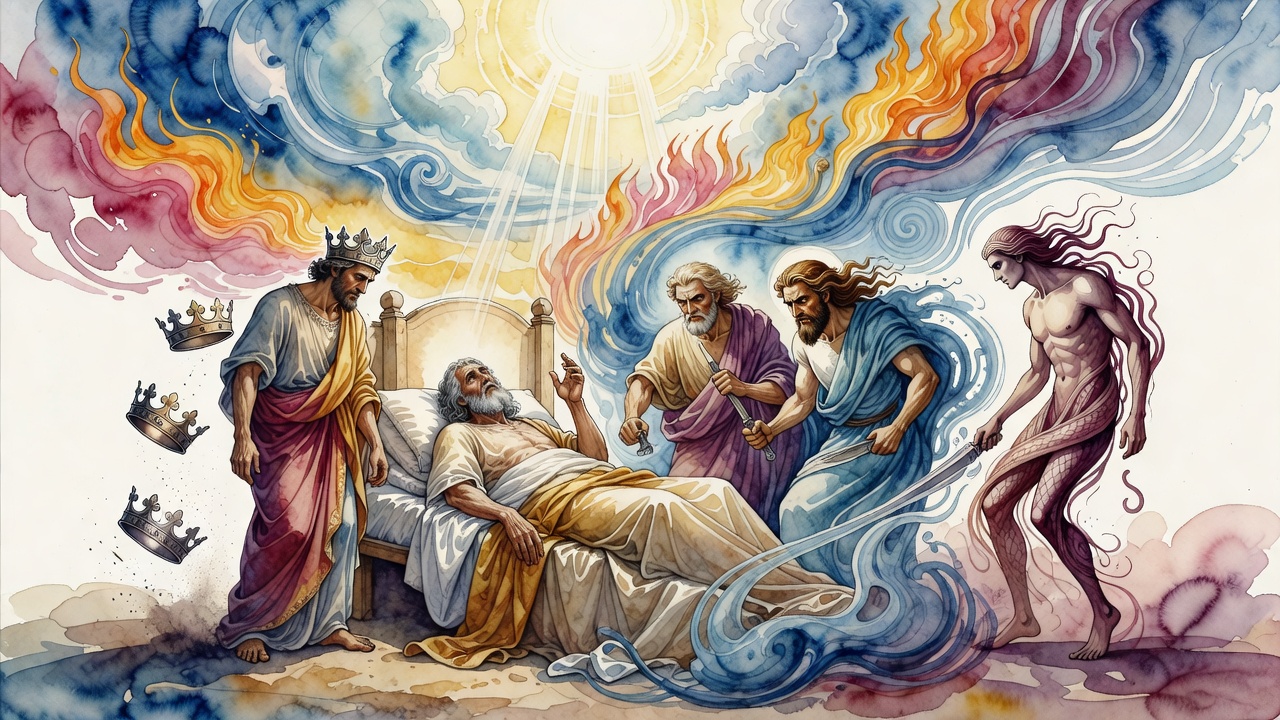
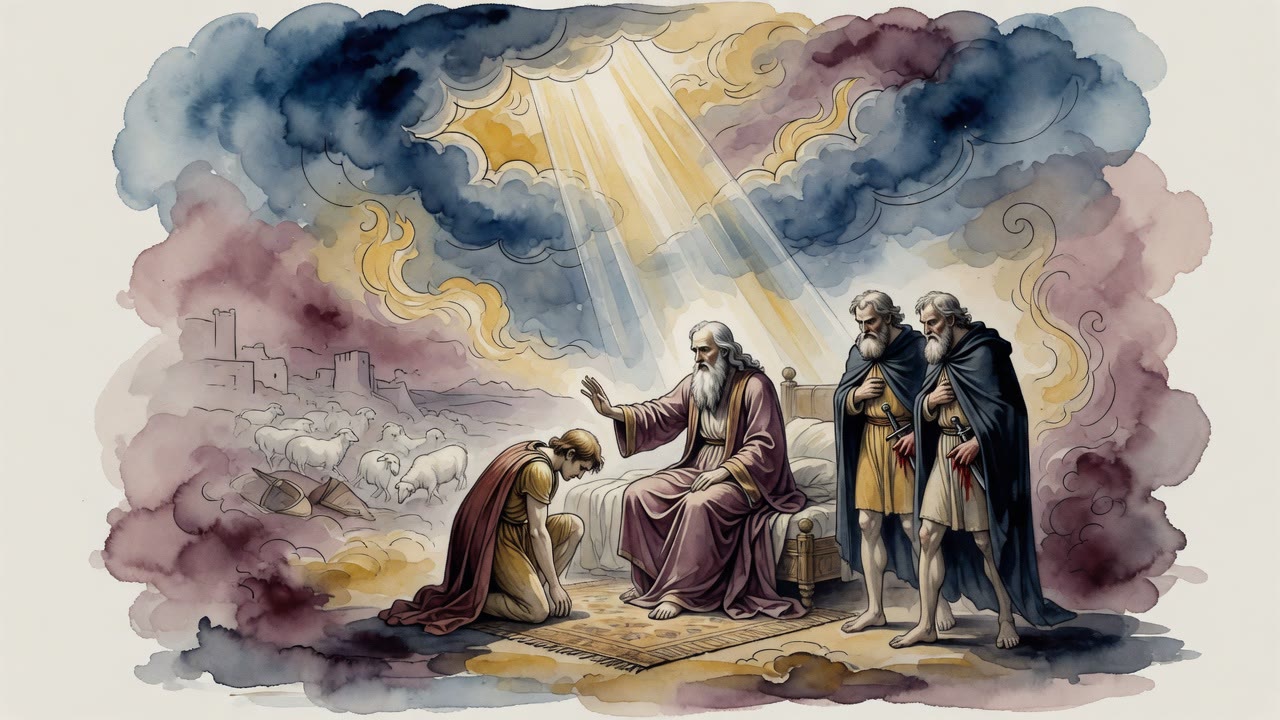
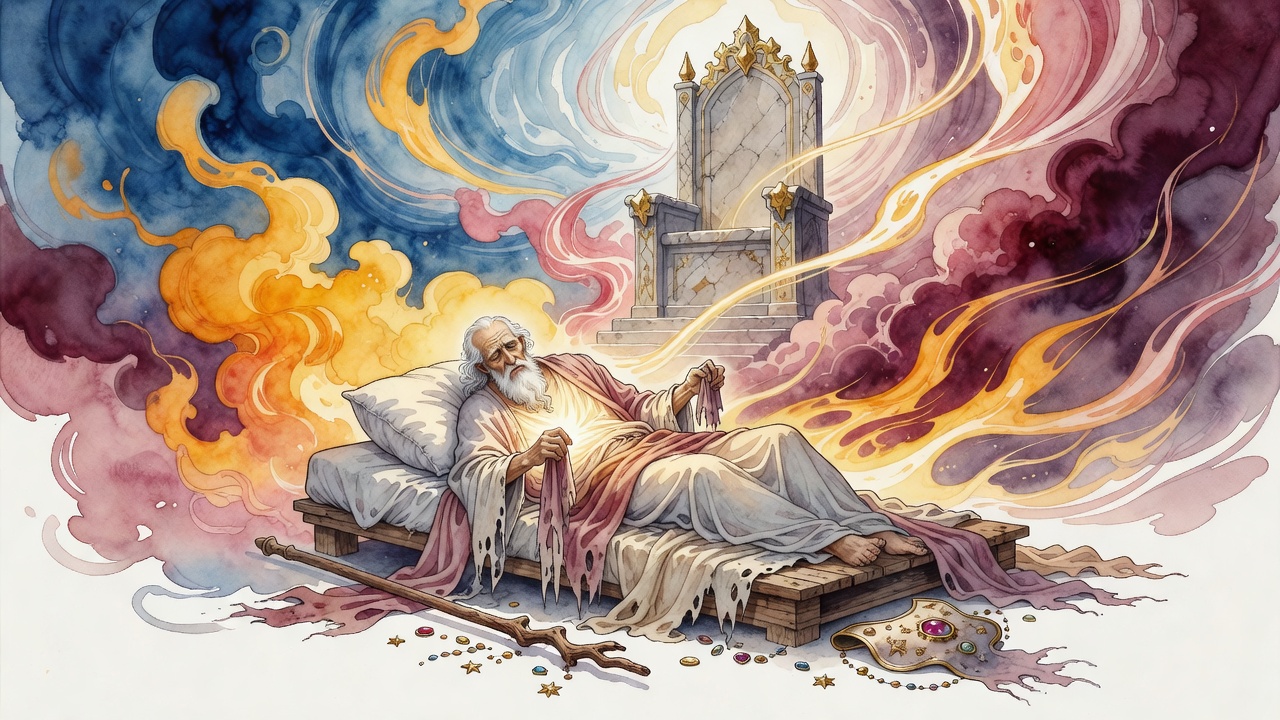
Jacob called his sons when the bed was already a border. "Gather yourselves together, that I may tell you that which shall befall you in the last days" (Genesis 49:1). The room filled with twelve futures and one man who could still refuse a name.

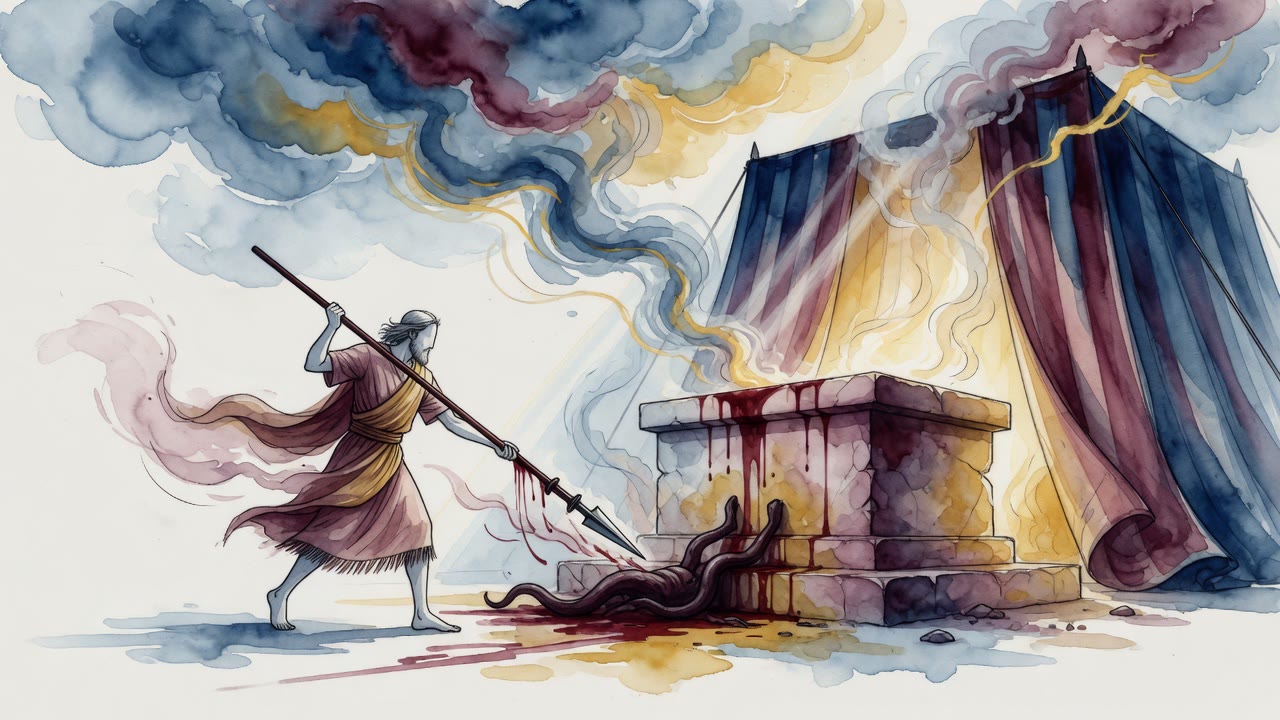
Jacob Cursed Their Anger, Not Simeon and Levi Click for full size

"Reuben, thou art my firstborn, my might and the first fruits of my strength" (Genesis 49:3). The first drop after eighty years. Three crowns waited: priesthood, kingship, and the double portion. All three slid off a single word. Pahaz. Unstable as water.

Water Leaves Nothing in the Flask

If a man pours water from a flask, nothing remains. Oil leaves a film. Reuben poured like water. R. Eliezer read pahaz as overweening, sinning, adultery. R. Joshua heard recoil and a cast-off yoke. R. Levi rearranged letters until the sin flew and trembling remained.

"Because thou wentest up to thy father's bed" (Genesis 49:4). The mandrakes quarrel. Bilhah's couch. Reuben would wait for Moses to climb Sinai and plead, "Let Reuben live, and not die" (Deuteronomy 33:6). Joseph would take the double portion. Levi the altar. Judah the scepter. Reuben kept the listing and lost the load.

Curse the Anger, Spare the Men

"Let my soul not come into their council" (Genesis 49:6). Jacob looked past Shechem to Zimri and Cozbi, and past them to Korah. Simeon's name would be circumscribed after Shittim. Levi's line would be named without Jacob until priests stood at the altar.

"Cursed be their anger, for it was fierce" (Genesis 49:7). Only the anger. That narrow curse became a shield. Balaam later asked how he could curse whom God had not cursed. "I will divide them in Jacob." Twenty-four thousand of Simeon fell with Zimri. Widows divided among tribes. Levi would beg at threshing floors, but with a lawful tithe portion.

Simeon and Levi left with blanched faces. Then Judah was called, and the room learned that a curse aimed at rage can still leave a path for kings.

Dan the Lone Serpent and a Cry for Salvation

"Dan shall judge his people like one of the tribes of Israel" (Genesis 49:16). Like Judah in distinction. Like the Unique One who needs no help in battle. Samson would need no army when a jawbone finished a thousand. Animals travel in pairs. The serpent goes alone.

When Jacob saw that future he cried, "I wait for Thy salvation, O Lord" (Genesis 49:18). Gad would troop at the end. Elijah, on the midrash's map, would come before the great day. The deathbed was a timetable for redeemers and loners.

Seven Days, Crowns of Thorns, and a Pit Blessed Later

"I am to be gathered unto my people" (Genesis 49:29). Be worthy and stay linked to my name. They embalmed him and carried him. At the threshing floor of thorns Canaanites set crowns about the bier. Egypt mourned seven days, grief answering the seven of feasting.

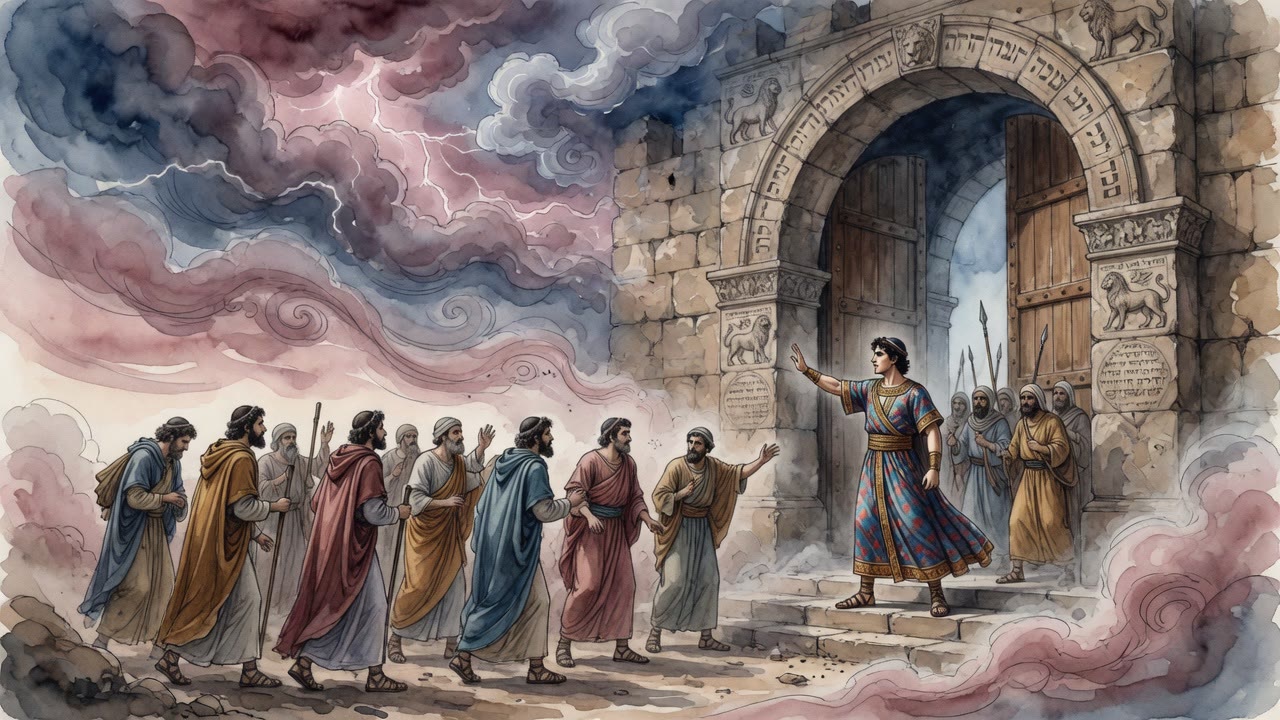
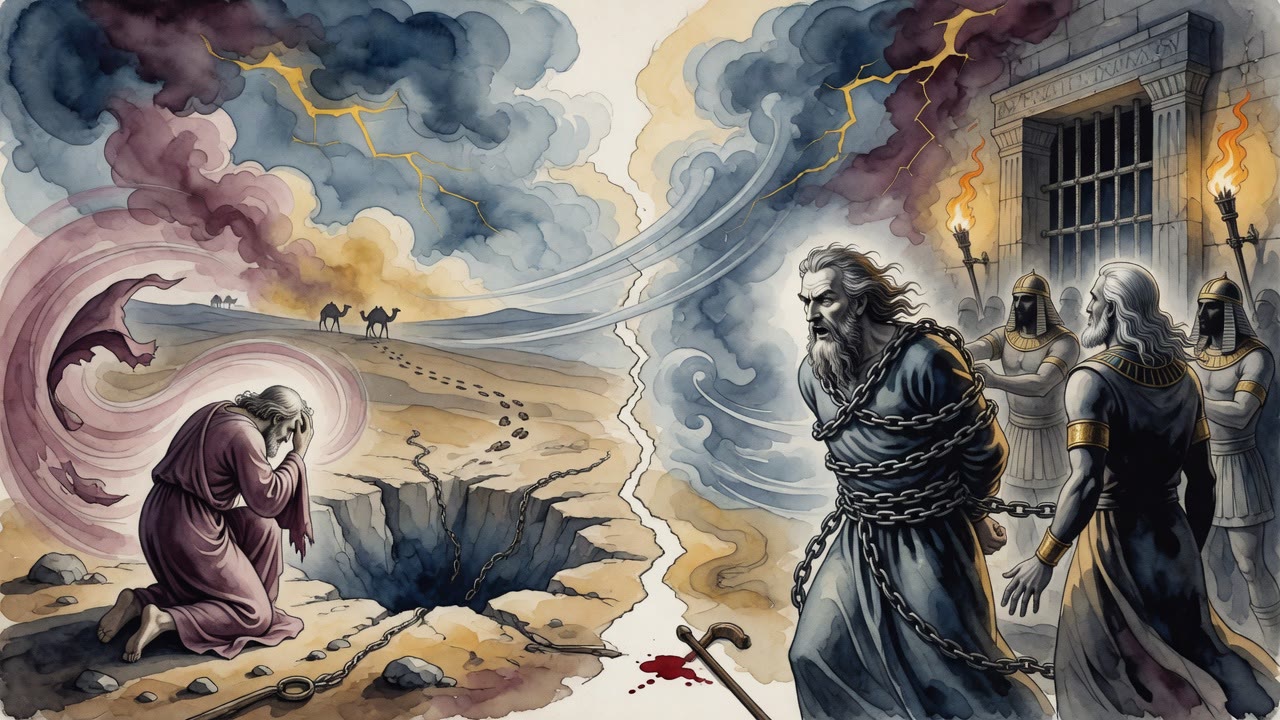
After burial the brothers watched Joseph bless the pit that once held him. "Blessed be the place where He performed a miracle for me." Fear returned. Mercy can look like a trap to men who still wear the shoes of a sale.

Jacob had cursed anger and not bloodlines. He had poured water out of Reuben's flask and left oil enough for Moses to plead. The bed emptied. The words stayed sharper than any knife left in Egypt.

Reuben would live, Moses would one day insist, but the three crowns would not return to his head in the same form. Kingship would settle on Judah. Priesthood on Levi under a different logic than rage. The double portion on Joseph's sons.

The brothers who feared Joseph after the pit-blessing were still living inside the old sale. Jacob's precision about anger had not yet taught them precision about mercy.


← All myths

From the tradition

Sources

4 sources

The texts behind this telling. Some cards carry a translation of the source; others are our own retelling of it, and each card says which. Every card links out to the original.

Midrash Tanchuma, Vayechi 9Midrash Tanchuma

Translation of the source text.Midrash Tanchuma -- Torat Emet · Public Domain

"Reuben, you are my firstborn" (Genesis 49:3). You are my firstborn, my first drop, for I lived eighty years and never even saw an emission. "You are my firstborn," resembling me. "The excellence of dignity and the excellence of strength" (Genesis 49:3): three crowns were in your hand, priesthood, kingship, and birthright. "Dignity (se'et)," this is the priesthood, as it is said: "And Aaron lifted up (va-yisa) his hands" (Leviticus 9:22). "Strength (oz)," this is the kingship, as it is said: "And He will give strength (oz) to His king" (I Samuel 2:10). "Excellence (yeter)," this is the birthright, which is a double portion, as it is said: "To give him a double portion" (Deuteronomy 21:17). And you lost them. Who caused this for you? "Unstable as water" (Genesis 49:4). Therefore, "you shall not have the excellence."

What is the meaning of "pachaz" (unstable)? It is an acronym. Rabbi Eliezer says: You were unstable (pachazta), you sinned (chatata), you fornicated (zanita). Rabbi Yehoshua says: You were unstable (pachazta), you withheld (chasakhta) the yoke from your neck, you trembled (za'ta) away from the sin.

Rabbi Yehudah transposes the word: You trembled (za'ta), you were terrified (charadta), your sin flew away (parach). Another interpretation: "pachaz" means: you stepped over (pasata) the law, you profaned (chillalta) your birthright, you became a stranger (zar na'aseta). "As water (ka-mayim)," what is the meaning of "as water"? If a person has in his hand a jug of water and it is spilled, nothing remains in it. But if there is oil or honey in it, some remains in it. Therefore it is said, "As water, you shall not have the excellence."

"Because you went up to your father's beds" (Genesis 49:4): you went up to your father's beds. When? At the matter of the mandrakes: "Is it a small matter that you have taken my husband, etc.? Therefore he shall lie with you" (Genesis 30:15).

"Then you defiled my couch." He went up, so he will be set apart until Moses comes, of whom it is written: "And Moses went up to God" (Exodus 19:3), and he will draw you near and say to you: "Let Reuben live and not die" (Deuteronomy 33:6). Reuben went out with his ears drooping. He began to call to Simeon and Levi "brothers"; brothers of Dinah, but not brothers of Joseph, for they had sold him.

Rabbi Samlai said: Concerning Reuben it is written: "In order to deliver him from their hands" (Genesis 37:22). Behold, you learn that he had no part in the selling of Joseph. And Judah too said to them: "What profit is it if we slay our brother?" (Genesis 37:26). And these four were the eldest. You thus learn that Simeon and Levi sold him. For at the time they went down to Egypt, Joseph set his eyes upon Simeon, as it is said: "And he took Simeon from them and bound him" (Genesis 42:24). Therefore he called the two of them together with one expression: "Simeon and Levi are brothers" (Genesis 49:5).

"Weapons of violence (chamas)." He said to them: The weapons that are in your hands are taken by violence, stolen from Esau, of whom it was said: "And by your sword you shall live" (Genesis 27:40), weapons of violence. And "chamas" refers only to Esau, as it is said: "For the violence (chamas) done to your brother Jacob, shame shall cover you" (Obadiah 1:10).

"Mekheroteihem" (Genesis 49:5): it is a Greek term, for they call swords "makhairin." And there are those who say: "Mekheroteihem" means their dwellings, as you say: "Your origins (mekhorotayikh) and your births" (Ezekiel 16:3).

Full source
Midrash Tanchuma, Vayechi 10Midrash Tanchuma

Retold in our words. Read the original at the link below.Townsend 1989 translation of Midrash Tanhuma, S. Buber Recension · CC-BY

Let my soul not come into their council (Gen. 49:6). This relates to when Zimri came and had intercourse with Cozbi. Let my soul not be mentioned in reference to them. And that is why it is said: Now the name of the man of Israel that was slain … was Zimri the son of Salu, a prince of a father’s house among the Simeonites (Num. 25:14). His name and the name of his father were henceforth circumscribed, and were not employed again in Israel.

Unto their assembly let my glory not be invited (Gen. 49:6). When Korah assembled the people to oppose Moses, Let my glory not be invited. That is to say, let my glory not be associated with them. Hence the verse stated: The sons of Korah, the son of Kohath, the son of Levi (Num. 16:1), but the text does not say “son of Jacob.” When shall my name be mentioned? By the priests at the altar, as it is written: The son of Izhar, the son of Kohath, the son of Levi, the son of Israel (I Chron. 6:22–23).

For in their anger they slew a man (Gen. 49:6). Did they slay only one man? Is it not written: And they came upon the city unawares, and they slew all the males (ibid. 34:25)? The fact is that they were all considered by the Holy One, blessed be He, and by them as one man, as Scripture states: And thou shalt smite the Midianites as one man (Judg. 6:16). Similarly, it states: The horse and its rider hath He thrown into the sea (Exod. 15:1).

Cursed be their anger, for it was fierce (Gen. 49:7). Since He cursed only their anger, Balaam said: How shall I curse whom God hath not cursed? (Num. 23:8). That is to say, inasmuch as He cursed their anger alone, at a time when He was sorely displeased with them, how am I able to curse them?

I will divide them in Jacob (Gen. 49:7). Twenty-four thousand men of the tribe of Simeon perished because of the act of Zimri. He apportioned their twenty-four thousand widows, two thousand to each tribe, as it is said: I will divide them in Jacob. Every one who is forced to go from door to door will be of the tribe of Simeon. The Holy One, blessed be He, said: But surely the descendants of Levi will also go about begging? What did He do about it? He caused them to obtain their food honorably. He thus fulfilled Jacob’s prophecy by permitting him (the priest) to receive one of the tithes. He would go about at threshing time, saying: “Give me my portion.” Therefore he said: I will divide them in Jacob. Thus Simeon and Levi went out with blanched faces.

Next he began to call out: Judah, thee shall thy brothers praise (Gen. 49:8). Because you acknowledged your guilt concerning what happened to Tamar, your brothers will acknowledge you as king over them.

Thy hand shall be upon the neck of thine enemies (ibid.). This refers to David, who would descend from him: Thou hast made mine enemies turn their backs unto me (II Sam. 22:41).

Thy father’s sons shall bow down before thee (Gen. 49:8). Isaac had said to Jacob: Thy mother’s son shall bow down (ibid. 27:29) because he had only one wife. However, since Jacob had many wives, he said to Judah: Thy father’s sons shall bow before thee.

Judah is a lion’s whelp; from the prey, my son, thou art gone up (ibid. 49:9). That is, you escaped being struck down by the sons of Joseph because you did say: What profit is it if we slay our brother? (ibid. 37:26).

Another comment on From the prey, my son, thou art gone up. That is, as a consequence of the episode of Tamar, you have saved four souls from death: Tamar, her two sons, and yourself.

The Holy One, blessed be He, said: You saved four lives from fire and death when you ignored the command: Bring her forth, and let her be burned (ibid. 38:24). Therefore, I will rescue four of your descendants, Daniel, Hananiah, Mishael, and Azariah form the furnace and the lion’s den. He called Judah by four different names: a lion, a whelp, and he lay down as a lion, and as a lioness (Num. 24:9).

The scepter shall not depart from Judah (Gen. 49:10). This alludes to the scepter of kingship, as it is said: The throne given of God is forever and ever; a scepter of equity is the scepter of Thy kingdom (Ps. 45:7).

Nor the ruler’s staff from between his feet (Gen. 49:10). When the king will come to whom kingship belongs (i.e., the Messiah), and concerning whom it is written: The crown of pride of the drunkards of Ephraim shall be trodden underfoot (Isa. 28:3).

Until Shiloh come (Gen. 49:10), for the kingdom is his.

And unto him shall the obedience of the peoples be (ibid.). This refers to the one who will shatter the teeth (break the power) of the nations (i.e. the Messiah), as it is said: The nations shall see and be put to shame for all their might; they shall lay their hands upon their mouth, their ears shall be deaf (Micah 7:16).

Another comment on And unto him shall be obedience of the peoples be (Gen. 49:10): He is the one for whom the peoples will assemble, as is said: The root of Jesse, that standeth for an ensign of the peoples, unto him shall the nations seek (Isa. 11:10).

Binding his foal unto the vine, and his ass’s colt unto the choice vine (Gen. 49:11). Vine refers to Israel, as is said: Thou didst pluck up a vine out of Egypt (Ps. 80:9). Binding his foal (‘iroh) alludes to the Holy City (‘ir ha-kodesh). Unto the choice vine refers to Israel, as is said: Yes, I have planted thee a choice vine (Jer. 2:11). And his ass’s colt implies that they will build a gate for the temple.

Another explanation of ass’s colt. Even upon a colt, the foal of asses (Zech. 9:9).

He washes his garments in wine (Gen. 49:11) because of the abundance of wine.

His vesture in the blood of grapes (ibid.). Sutah (“vesture”) means “to err”, as it is said: If thy brother … cause thee to err (Deut. 13:7). When they err in the law, it shall be cleansed (atoned for) in his territory.

Wine alludes only to Torah, as it is said: For thy love is better than wine (Song 1:2), and He hath brought me to the banqueting-house, and his hammer over me is love (Song 2:4).

His eyes shall be red with wine (Gen. 49:12). You learn from this verse that he devoted himself to the study of the Torah. The word hakhlili (red) should be read as hekh li li (“it is tasty to me”), that is, the wine of the Torah is sweet to me. And His teeth white with milk (ibid.). That is, if they should sin, they shall be made as white as snow, because of the Torah (they study).

Full source
Midrash Tanchuma, Vayechi 12Midrash Tanchuma

Retold in our words. Read the original at the link below.Townsend 1989 translation of Midrash Tanhuma, S. Buber Recension · CC-BY

Dan shall judge his people like one of the tribes of Israel (Gen. 49:16). Like one signifies that like Judah, he was one of the most distinguished of the tribes. Another explanation of like one of the tribes of Israel. He was like the Unique One of the world, who requires no assistance in battle, as it is said: I have trod the wine press alone (Isa. 43:3). Samson, who descended from Dan, needed no assistance from others, as is said: With the jawbone of an ass have I smitten a thousand men (Judg. 15:16).

Dan shall be a serpent on the way (Gen. 49:16). All animals travel about in pairs, but the serpent goes about alone. And just as the serpent is vengeful so too was Samson, as is said: I may be this once avenged of the Philistines for my two eyes (Judg. 16:18). When Jacob saw him he exclaimed: I wait for Thy salvation, O Lord (Gen. 49:18).

Gad, a troop shall troop upon him; but he shall troop at the end (Gen. 49:19). That is to say, the redeemer who will come at the end of days will descend from Gad, for he was one of the last to come: Behold, I will send you Elijah the prophet before the coming of the great and terrible day of the Lord (Mal. 3:23). And Elijah descended from Gad. Hence it is said: But he shall troop in the end.

Full source
Midrash Tanchuma, Vayechi 17Midrash Tanchuma

Retold in our words. Read the original at the link below.Townsend 1989 translation of Midrash Tanhuma, S. Buber Recension · CC-BY

Another comment on This is it that their father spoke unto them. and he charged them, and said unto them: “I am to be gathered unto my people” (Gen. 49:28–29). He said to them: If you are worthy, you will be inextricably linked to me (i.e.. they will be called the sons of Jacob), but if not, when I depart from this world, I will ascend to my fathers. Immediately upon his passing, His sons did unto him as he had commanded them (Gen. 50:12). What did they do? They embalmed him and carried him away. What is written there? And they came to the threshing floor of thorns (ibid., v. 10). Is there such a thing as a threshing floor of thorns? This verse alludes to the Canaanites, who took crowns and placed them about Jacob’s bier. What is more, when they saw Jacob’s bier they removed their girdles and paid homage to him.

R. Samuel the son of Nahman said: They undid their shoulder knots; and Rabbi declared: They pointed to the coffin with their fingers and exclaimed: This is a grievous mourning to the Egyptians (ibid., v. 11). Therefore the Holy One, blessed be He, gave them a circle within the threshing floor of thorns.

And he made a mourning for his father seven days (ibid., v. 10). How do we know that mourning lasts seven days? Our sages stated: We know it from the verse And ye shall not go out from the door of the tent of meeting for seven days (Lev. 8:33). Why are there seven days of mourning? To correspond to the seven days of feasting.

The Holy One, blessed be He, said: In this world you grieved for this righteous man for seven days, but in the world-to-come I will turn their mourning into joy, and will comfort them, and make them rejoice from their sorrow (Jer. 31:13). And I will comfort Zion and its vast places, as it is said: For the Lord hath comforted Zion; He hath comforted all her waste places and hath made her wilderness like Eden, and her desert like the garden of the Lord; joy and gladness shall be found therein, thanksgiving and the voice of melody (Isa. 51:3).

And when Joseph’s brethren saw that their father was dead, etc. (Gen. 50:15). What did they see that frightened them? As they were returning from the burial of their father, they saw their brother go to the pit into which they had hurled him, in order to bless it. He blessed the pit with the benediction “Blessed be the place where He performed a miracle for me,” just as any man is required to pronounce a blessing at the place where a miracle had been performed in his behalf. When they beheld this they cried out: Now that our father is dead, Joseph will hate us and will fully requite us for all the evil which we did unto him. And they sent a message unto Joseph, saying: Thy father did command … “So shall ye say unto Joseph: Forgive” (Gen. 50:15–16). We have searched the entire Scripture and are unable to find any place where Jacob uttered this remark. This statement is introduced to teach us the importance of peace. The Holy One, blessed be He, wrote these words in the Torah for the sake of peace alone.

Full source