Jacob Turned Laban's Troughs Into a Miracle of Patience
At Laban's troughs with a knife and three kinds of wood, Jacob turns twenty years of cheated wages into the beginning of Israel's herds.
Table of Contents
 Click for full size
A Man at a Trough with a Knife
Jacob had been working for Laban for fourteen years when he finally asked to leave. Laban said: name your wages and stay. The conversation had all the warmth of a transaction between two men who both understood exactly how much the other had already taken. Jacob named his wages in the only language Laban respected, the language of the flock itself: the speckled and spotted animals, the dark-colored lambs. The unusual ones, the animals that stood out from the plain. Laban looked at this proposal and agreed, because he thought he had left Jacob with almost nothing.
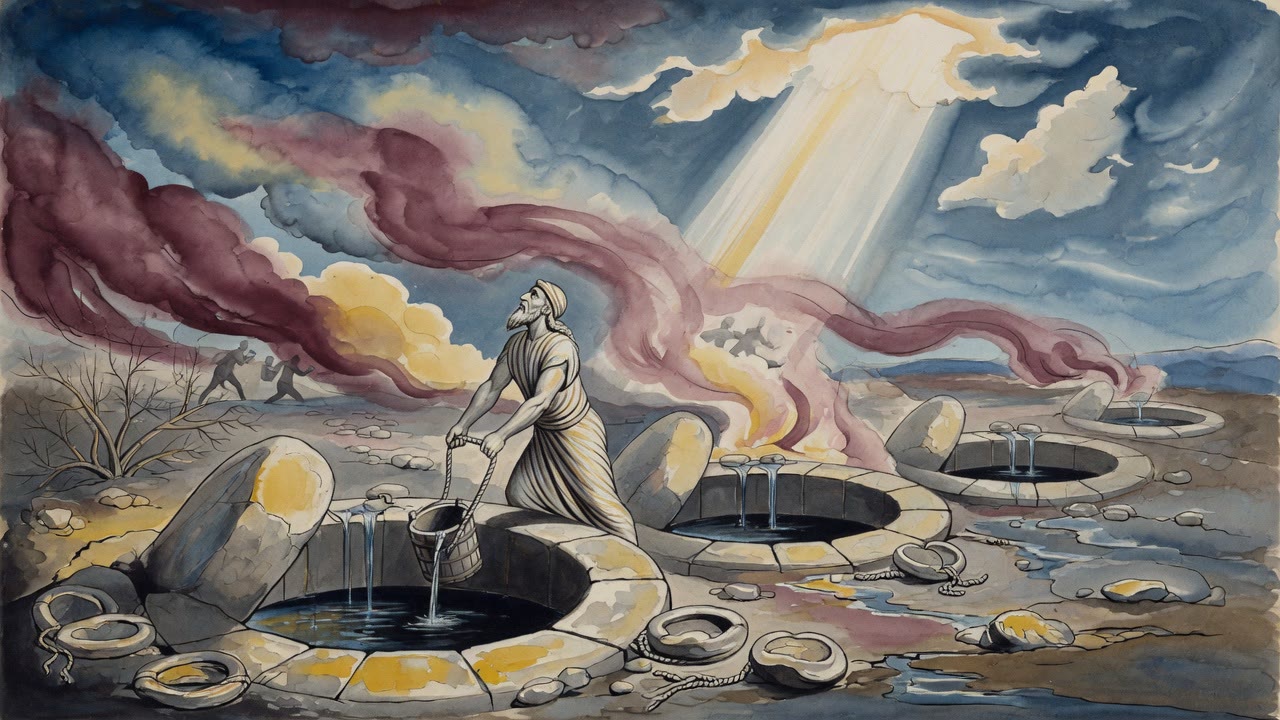
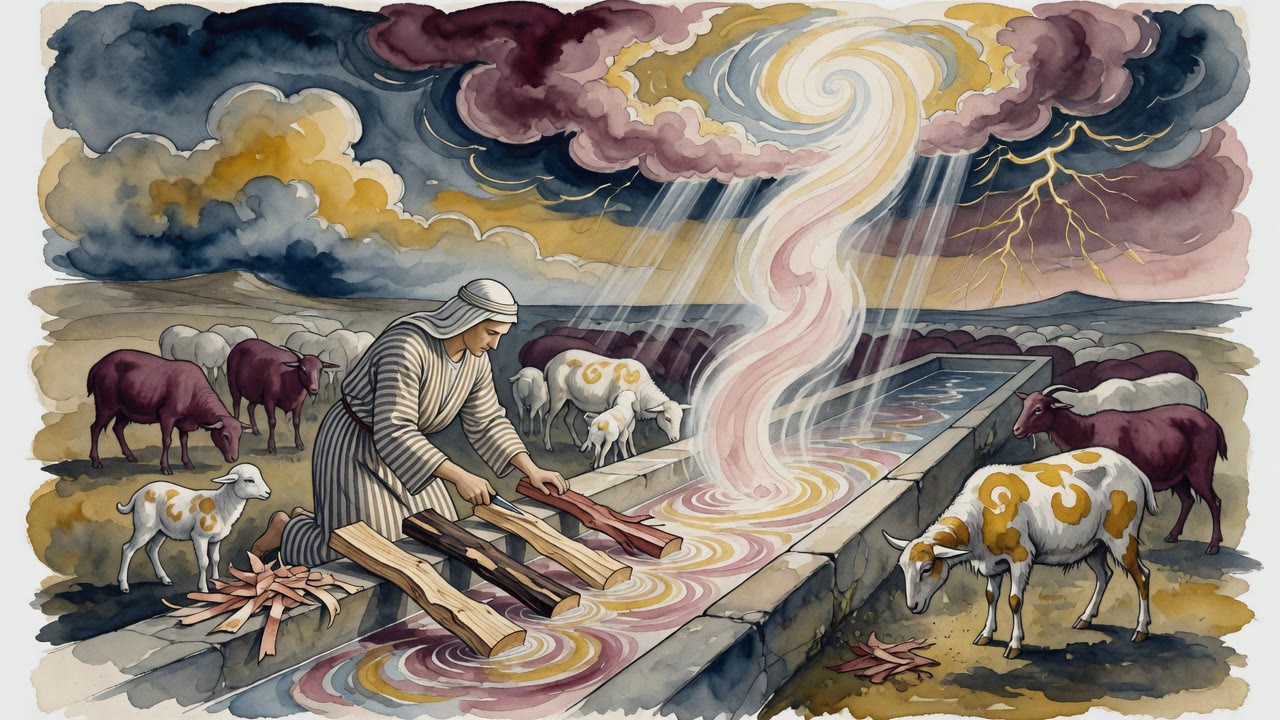
Then Jacob walked to the troughs with a knife in his hand and three kinds of wood.
Targum Pseudo-Jonathan, the Aramaic Torah translation that preserves late antique and early medieval layers of midrashic reading, slows this scene down until every detail carries weight. The poplar rod. The almond rod. The plane tree rod. Three woods, three textures, three quiet objects in a man's hands at a watering trough in Aram, where a cheat thought he had just won.
Jacob Chose Three Branches
The poplar tree (the white poplar, the one with bark that peels away to pale wood beneath) was chosen first. Then the almond, bitter and aromatic and difficult to split. Then the plane tree, smooth and durable, the kind of wood that takes a cut cleanly. Jacob was not gathering fuel. He was choosing materials for a specific effect.
He peeled white strips into the bark of each rod. Not stripping the bark entirely. Cutting the dark surface away in bands, so the pale wood showed through in streaks. Stripe against stripe. Light against dark. The finished rods looked like the animals he had named as his wages: spotted, speckled, irregular. Jacob had carved his contract into wood and set it in the troughs where the flocks came to drink.
The Targum notes that he set the rods in the channels of the watering troughs, in the troughs before the flock, facing the flock as they came to drink. The rods were not decoration. They were positioned in the animals' line of sight at the moment of greatest vulnerability, the moment of conception.
The Water and the Wages
The strong animals conceived before the rods. The weaker ones did not. Jacob sorted the outcome further by facing the rods toward the stronger flocks and withdrawing them when the weaker came. Over time, the spotted and speckled animals multiplied in Jacob's portion of the flock, and the plain animals went to Laban.
Targum Pseudo-Jonathan presents this not as a livestock management technique but as an act at the intersection of human craft and divine justice. Jacob had worked fourteen years for two wives and another six years for the right to build his own household. Laban had changed his wages ten times, each change designed to prevent Jacob from ever accumulating enough to leave. The rods in the troughs were Jacob's counter-move, not a fraud but a claim: the covenant work deserves its wages, and if the employer will not pay them honestly, the covenant-keeper will find a way to collect them.
The Targum understands the rods as more than clever genetics. They were Jacob's act of faithful patience after years of systematic theft. He did not steal from Laban's flock. He positioned himself at the troughs with his knife and his three kinds of wood and let the natural process, guided by his craft and blessed by God's justice, produce what twenty years of service had earned.
What the Flock Became
The flocks grew very large. The Targum on Genesis 30 describes their accumulation: cattle, donkeys, servants, camels. The animals born speckled and spotted from those troughs became the foundation of a household that could travel. When Jacob finally left Laban, he did not leave as a man who had barely survived. He left as a man whose six additional years at the troughs had produced what twenty years of honest wages should have produced from the start.
Laban's sons noticed. They said: Jacob has taken everything that was our father's, and from our father's property he has made all this wealth. They were not entirely wrong about the direction of movement. What had been Laban's was becoming Jacob's. But they were completely wrong about the mechanism. Jacob had not taken anything. He had waited, and worked, and placed three rods in a watering trough, and let the justice built into the covenant do the collecting.
The miracle at the troughs was not the spotted sheep. It was the patience. Twenty years of watching wages change, promises dissolve, and gratitude curdle into manipulation, followed by six more years of standing at the troughs with a knife and three kinds of wood, carving the contract into bark one careful strip at a time. The speckled lambs were the visible proof of something invisible: that faithfulness, sustained long enough against systematic opposition, eventually produces its wages.
← All myths