5 min read

Jacob Widens the Road and Angels Meet Him

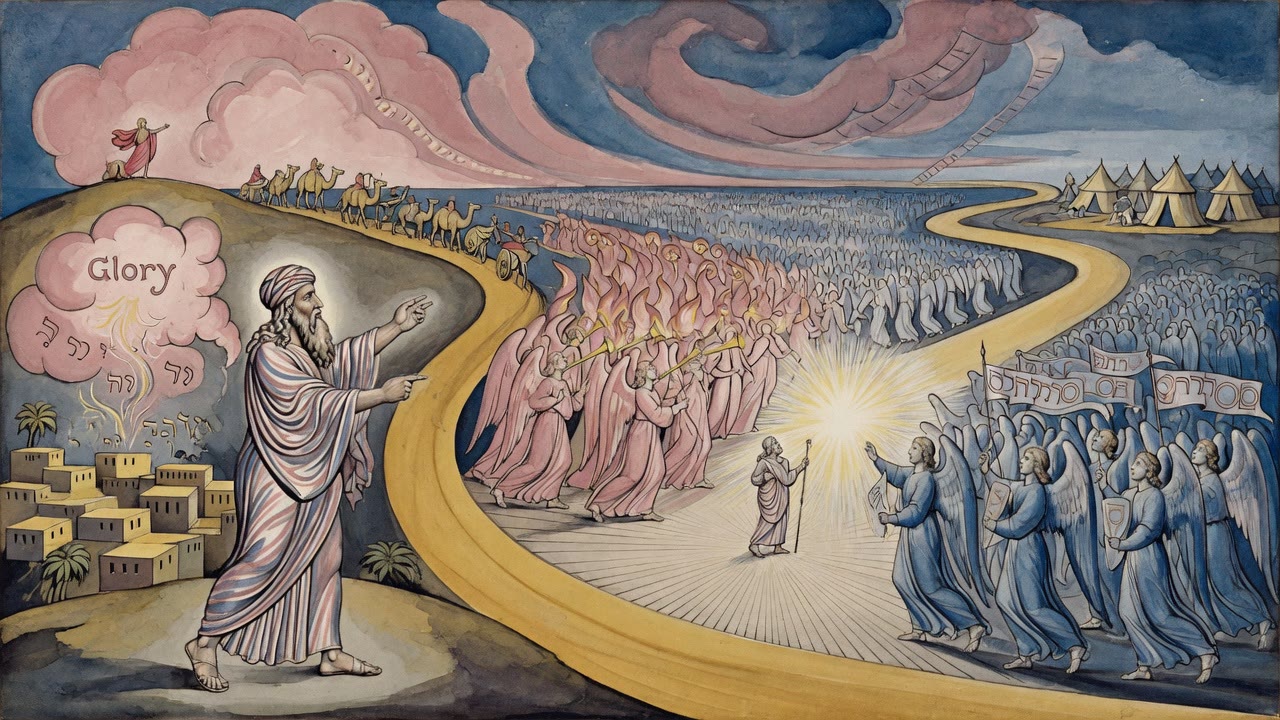
Jacob tells Esau he is coming to Seir, then turns toward Succoth. Glory leaves Beersheba with him, and at Mahanaim two camps of angels fill the road.

Curated by Arthur · Told by Maggid ·
Table of Contents
  1. Glory Leaves With the Walker
  2. Widen the Road
  3. Laban's Heap and the Word Afflict
  4. Two Camps on the Road
  5. What the Feet Knew
Jacob Widens the Road and Angels Meet Him Click for full size

Glory Leaves With the Walker

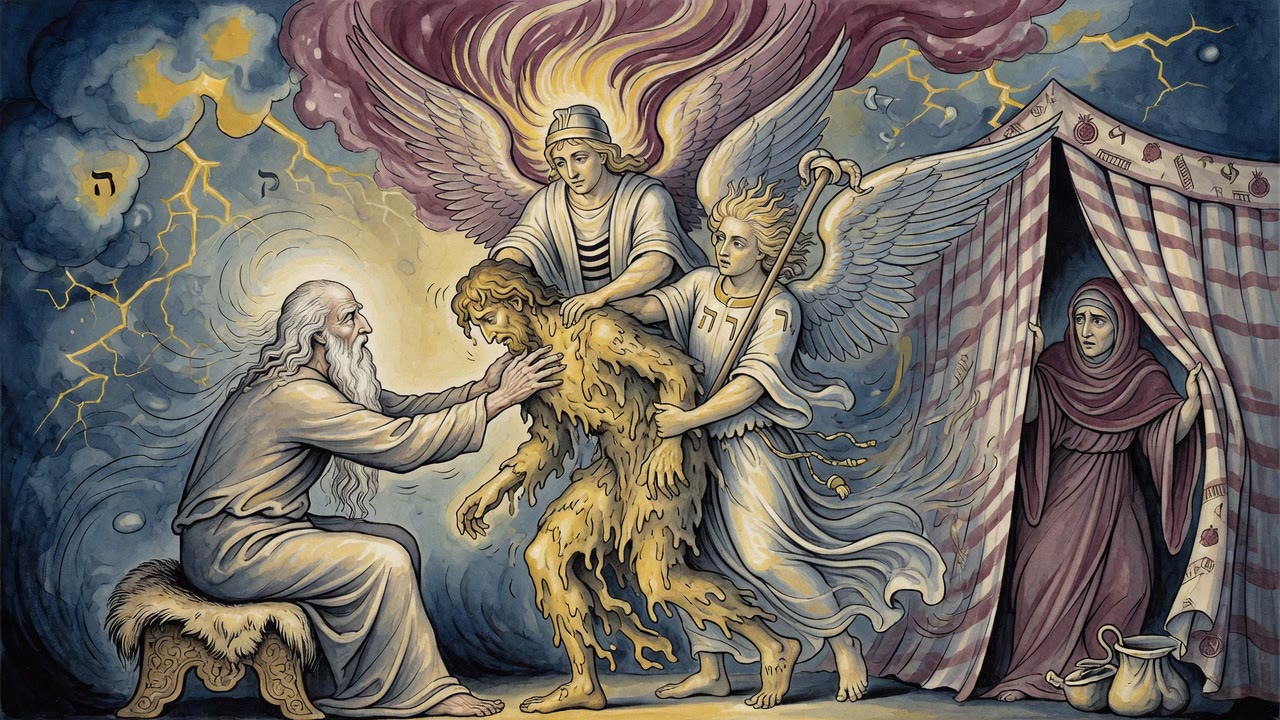
Jacob walked out of Beersheba, and the city's glory dimmed behind him even though Isaac and Rebecca still lived there. The merit of one righteous person is not the same as the merit of two. When the righteous leave, the light they carried leaves with them, and the remaining righteous ones do not automatically refill the room.

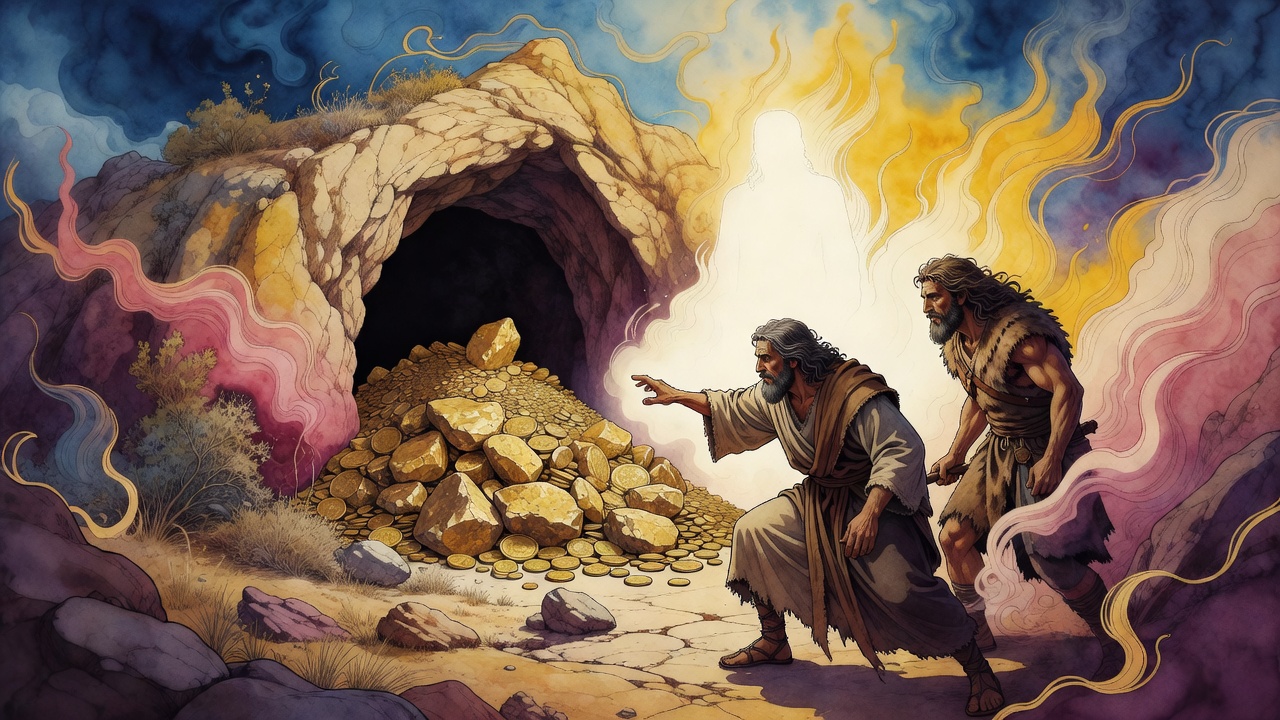
He had reason to fear. Esau had seized the escort sent with him. Eliezer once courted Rebecca with ten laden camels and a show of wealth. Jacob arrived toward Haran stripped of even a ring. Still he lifted his feet when good news settled his heart, as if the heart now carried the legs. A man does not usually carry his feet. His feet carry him. Relief can reverse the order until the body feels light enough to be borne by hope.

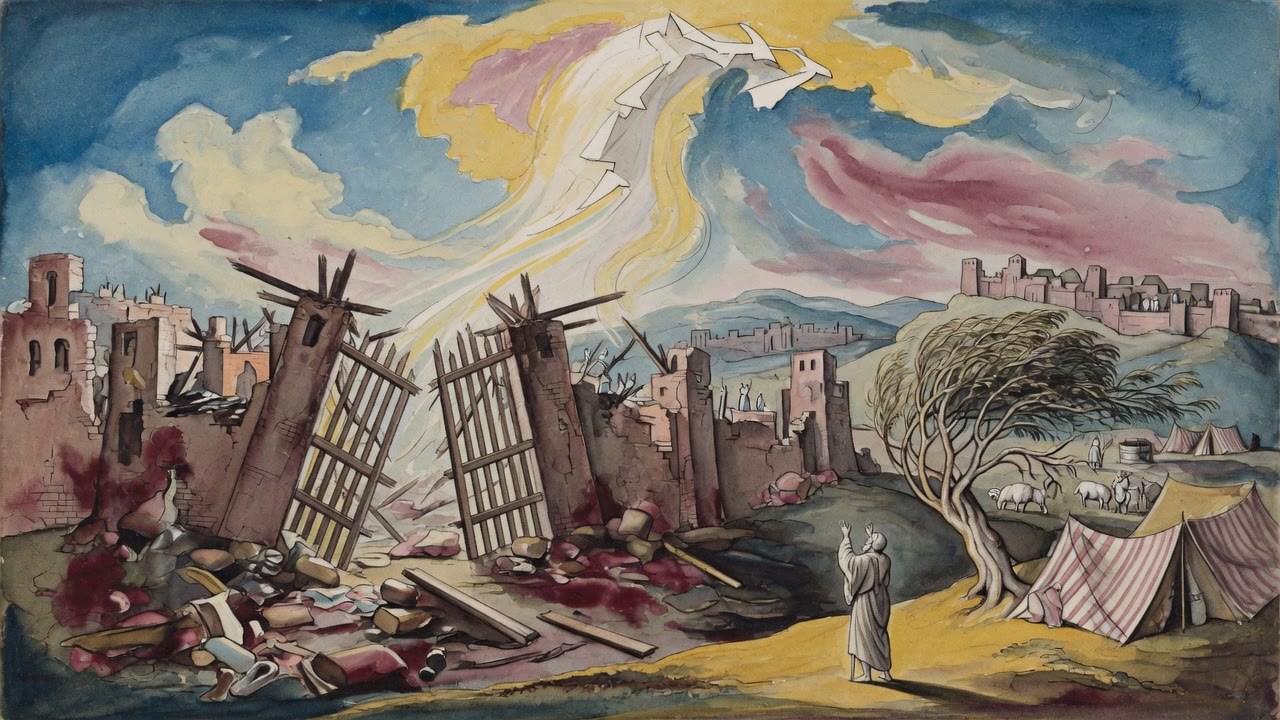
Beersheba was well of oath, well of birthright, well of blessing. A dangerous place for a man whose life had just turned on all three. If Esau forced another swear there over the blessing, Rebecca's labor might collapse in a single forced vow. So Jacob fled the place of oaths, and exile began with a step that dimmed a city.

Widen the Road

On the later road, facing Esau again, Jacob practiced a hard courtesy. When a dangerous man asks where you are going, do not name your true destination. Widen the road for him. Jacob said he would follow to Seir, then quietly turned aside toward Succoth (Genesis 33:14-17). The mouth gave Seir. The feet gave safety.

Students of Rabbi Akiva told bandits they were bound for Acco, then slipped away at Keziv. The bandits, far from angry, blessed the teacher for raising pupils no evil man could harm. Another company of thieves cursed a rabbi who misled them; he placed them under a ban, and for twenty-two years their thieving came to nothing, until all but one stubborn weaver begged release. The weaver who would not bend was left to a lion. From him the folk saying grew about pride that will not lower its head.

Caution is not cowardice when the road holds a brother with four hundred men. Come and see the difference, the sages said, between thieves of Babylonia and bandits of the Land of Israel. Even criminals of the holy land could carry a rough respect their foreign counterparts lacked.

Laban's Heap and the Word Afflict

Behind him, Laban had forced a covenant at a heap of stones and a pillar. If you afflict my daughters, the warning ran, and the rabbis heard two harms inside the word: neglect in the bedroom and rival wives pushed into the home. Honest trade might cross the boundary. Harm might not. Laban swore by the God of Abraham and the god of Nahor in one breath; Abraham's God is holy, Nahor's is profane, and only Jacob kept the sacred Name pure in his own mouth.

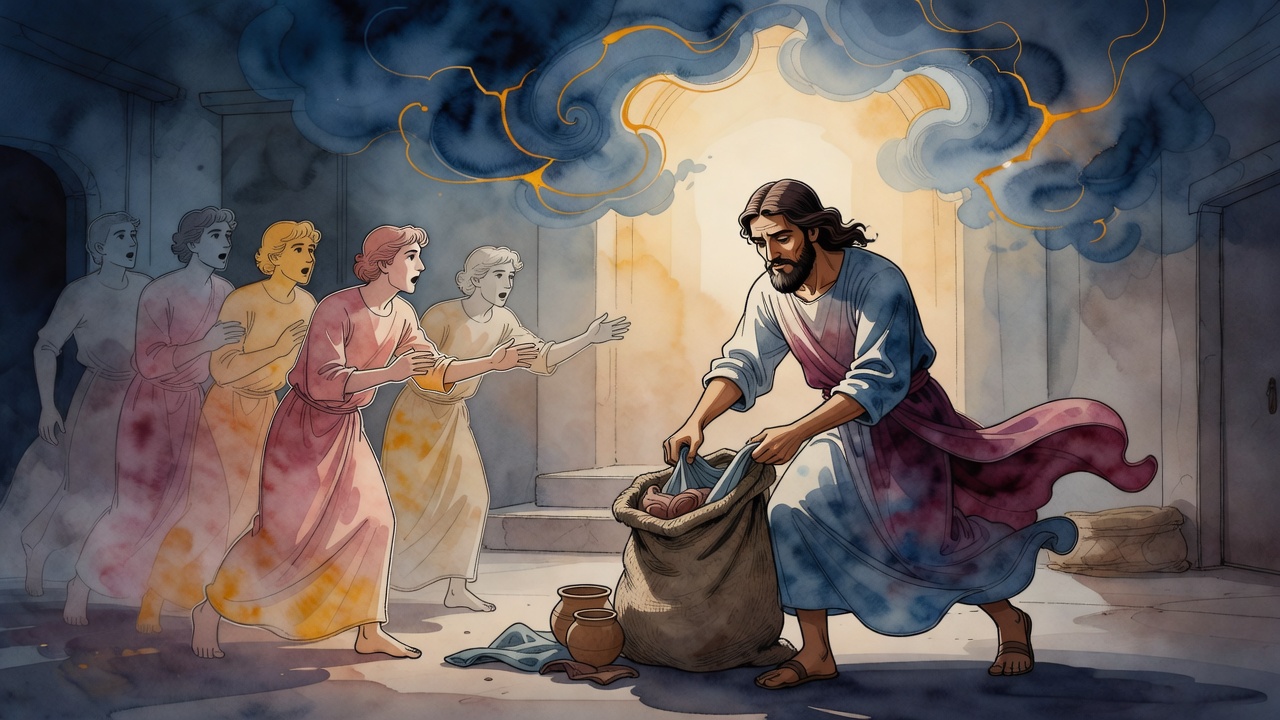
Laban went home and robbers tore through his house all night, braying and clamoring until the man who had chased Jacob for idols and wages tasted the chaos he had sown. Jacob walked into glory on the other side of the same week.

Two Camps on the Road

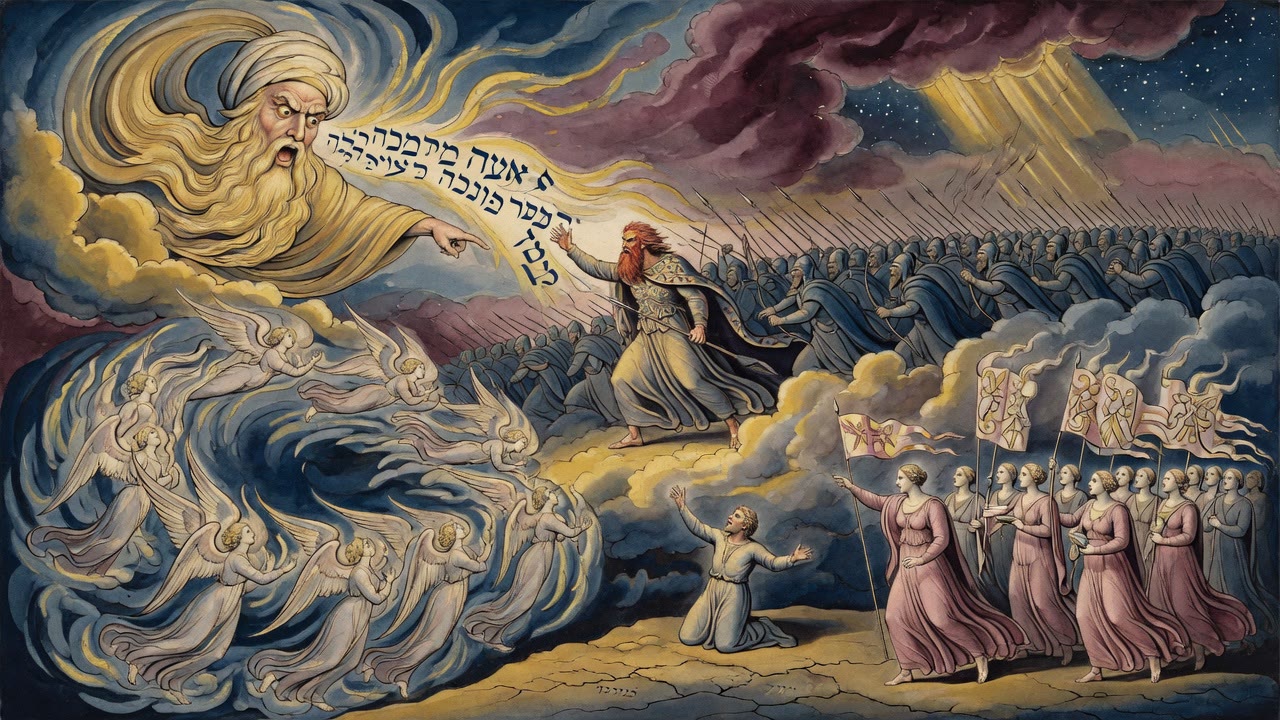
An escort of angels met him, six hundred thousand by one count, enough for the Divine Presence to rest, and some said twice that number. He named the place Mahanaim, two camps (Genesis 32:2). Rabbi Eibo pictured him taking messengers from both hosts and sending them ahead like a royal vanguard, so that even the road before his face was already occupied by fire Esau could not see.

The man who widened the road for Esau also walked a road crowded with an army of another kind. Exile had not emptied the path. It had filled it with a second camp. When good news had once carried his feet out of Beersheba, angels now carried the point of his column toward the meeting that still terrified him.

He would bow. He would speak carefully. He would not sleep without a strategy. And still the unseen camp walked with him, two hosts where a lonely fugitive had expected one dusty road.

What the Feet Knew

Good news had once made Jacob's feet light enough to feel carried. Fear made them careful enough to lie about Seir. Both states are true in one life. A man can be borne by hope toward Haran and still, years later, widen a road with his mouth while his household turns toward Succoth with his real intent.

The angels at Mahanaim did not cancel the need for strategy. They flanked it. Six hundred thousand, or twice that, still left Jacob arranging gifts in waves and dividing camps of wives and children. Vision without tactics is a dream. Tactics without vision is only panic. He walked with both, and named the place for the double camp so that memory would not reduce the night to a clever speech about destinations.

Beersheba's glory had left with him. Mahanaim's glory met him. Between those two lights ran the long road of a man who knew when to flee a place of oaths and when to misname a destination to a brother who hunted with hands.


← All myths
From the tradition

Sources

4 sources

The texts behind this telling. Some cards carry a translation of the source; others are our own retelling of it, and each card says which. Every card links out to the original.

Yalkut Shimoni on Torah 133:24Yalkut Shimoni on Torah

Translation of the source text.Torat Emet (Yalkut Shimoni) · CC-BY-NC

Our Rabbis taught: An Israelite who chances upon a Samaritan on the road should keep him at his right hand. Rabbi Ishmael, son of Rabbi Yochanan ben Beroka, says: if the man carries a sword, keep him at the right hand; if a staff, at the left. When going uphill or downhill, let it not be that the Israelite is below and the Samaritan above; rather the Israelite above and the Samaritan below, and let him not bend down before him, lest the other crush his skull. If he asks, Where are you going?, widen the road for him in his answer, just as Jacob widened the road for Esau, as it is written, "until I come to my lord, to Seir" (Genesis 33:14), while it is written (below, verse 17), "And Jacob journeyed to Succoth."

And there is the case of Rabbi Akiva's students who were walking to Keziv, and bandits met them and asked, Where are you going? They said, To Acco. When they reached Keziv, they turned aside. The bandits asked, Whose students are you? They said, Students of Rabbi Akiva. The bandits said, Happy is Rabbi Akiva and his students, for no evil person has ever met them.

Rabbi Menashya was going to Bei Torta, and thieves met him and asked, Where are you headed? He said, To Pumbedita. When he reached Bei Torta, he turned aside. They said to him, You are the student of Judah the swindler! He said, You know him? May those men be under a ban. They went and practiced thievery twenty-two years and did not succeed. They all sought release from their ban; one weaver who did not come to be released was eaten by a lion. This is what people say: A weaver who is not pliant, his ban is poorer than [worse than] his years. Come and see the difference between the thieves of Babylonia and the bandits of the Land of Israel.

Full source
Yalkut Shimoni on Torah 130:16Yalkut Shimoni on Torah

Translation of the source text.Torat Emet (Yalkut Shimoni) · CC-BY-NC

(Genesis 31:50) "If you afflict my daughters" -- that is two; "and if you take wives in addition to my daughters" -- that is two; they were all his daughters. From where do we learn that marital relations are called "affliction"? As it is written, "if you afflict my daughters," from marital relations. "And if you take wives" and so on -- from rival wives. But say both are about rival wives? Is it written "if you take" and "if you take"? It is written "if you take" [once]. But say both are about rival wives -- one his own rivals and one brought from outside? Is it written "if you take" and "if you afflict"? Say "affliction" means excessive relations, since relations themselves are an affliction, as it is written "and he lay with her and afflicted her" -- there it means he afflicted her through additional acts.

(Genesis 31:51) "Behold this heap... which I have cast [yariti]." Like one who hurls a spear. (Genesis 31:52) "This heap is a witness and the pillar is a witness": for harm you shall not pass over to me, but you may pass for commerce. (Genesis 31:53) "The God of Abraham and the god of Nahor shall judge between us": "the God of Abraham" is holy; "and the god of Nahor" is profane; "and the God of their father" serves both holy and profane.

(Genesis 32:1) "And he kissed his sons and his daughters and blessed them." They were grieved and afflicted, and could bless only with the mouth. "And Laban went and returned to his place" -- he returned to his wretchedness; this teaches that robbers entered his house and made an uproar in it all night.

(Genesis 32:2-3) "And Jacob went on his way." How many angels accompanied Jacob? Six hundred thousand. This is what is written: "And Jacob said when he saw them, This is God's camp," and the Divine Presence does not rest on fewer than six hundred thousand. The Rabbis say: one million two hundred thousand. "And he called the name of that place Mahanaim [two camps]." Rabbi Eibo said: he took from these and from those and sent an escort before him.

Full source
Yalkut Shimoni on Torah 117:1Yalkut Shimoni on Torah

Translation of the source text.Torat Emet (Yalkut Shimoni) · CC-BY-NC

Portion of Vayetze (Genesis 28:10-11). Rabbi Pinchas opened: "Then you shall walk securely on your way" (Proverbs 3:23): this is Jacob, as it is written, "And Jacob went out." "If you lie down, you shall not be afraid" (Proverbs 3:24): of Laban and of Esau. "And you shall lie down, and your sleep shall be sweet" (Proverbs 3:24): "and he lay down in that place" (Genesis 28:11). Rabbi Shmuel bar Nachman opened: "I lift up my eyes to the mountains" (Psalms 121:1) - to the parents who taught me and made me. "From where shall my help come?" When Eliezer, Abraham's servant, went to bring Rebecca, what is written of him? "The servant took ten camels" (Genesis 24:10). But I have not one bracelet and not one ring. Rabbi Eliezer says: a troop was sent with him. Rabbi Yehoshua ben Levi said: Isaac sent one with him, but Esau came and took it from him. Jacob said: Shall I lose my hope in my Creator? Rather, "My help is from the LORD, maker of heaven and earth. He will not let your foot slip; your Guardian will not slumber. Behold, the Guardian of Israel neither slumbers nor sleeps" (Psalms 121:2-4). "The LORD shall guard you from all evil" (Psalms 121:7): from Esau and from Laban. "He shall guard your soul" (Psalms 121:7): from the Angel of Death. "The LORD shall guard your going out" (Psalms 121:8): "And Jacob went out from Beersheba" (Genesis 28:10). Rabbi Yudan said in the name of Rabbi Simon, opening: "God settles the solitary in a house" (Psalms 68:7). A noblewoman asked Rabbi Yose: In how many days did the Holy One, blessed be He, create His world? He said to her: In six, as it is written, "For in six days the LORD made" (Exodus 20:11). From that hour until now, what is He occupied with? He said to her: He sits and pairs matches, man to woman and woman to man, as the matter is lengthened in Midrash Rabbah. Some go to their match, and some have their match come to them. Isaac's match came to him, as it is written, "He lifted his eyes and saw, and behold, camels were coming" (Genesis 24:63). Jacob went to his match, as it is written, "And Jacob went out from Beersheba" (Genesis 28:10). Hezekiah said: Jacob our father was sixty-three years old when he took the blessings. He then spent fourteen years hidden in the land, serving Eber, and seven years with the matriarchs; he was found to marry at eighty-four. Esau married at forty. We learn that the Holy One, blessed be He, advances matters for the wicked and delays matters for the righteous.

Rabbi Yehoshua said: It is already written, "And Jacob obeyed his father" (Genesis 28:7). What does Scripture teach by saying, "And Jacob went out from Beersheba"? Jacob said: When my father sought permission to leave the Land, from where was he permitted if not from Beersheba? I too will go to Beersheba; if He gives me permission, I will leave, and if not, I will not leave. Therefore Scripture needed to say, "And Jacob went out from Beersheba." "And Jacob went out" - did only he go out? How many donkey-drivers went out, and how many camel-drivers went out, yet you say, "And he went out"? Rather, as long as the righteous one is in the city, he is its splendor, he is its praise, he is its glory. When he departs from there, its splendor departs, its praise departs, its glory departs. Similarly, "And she went out from the place where she had been" (Ruth 1:7). Did only she go out? Many donkey-drivers and camel-drivers went out. There it is understandable, for only that righteous woman was there. But here, were Isaac and Rebecca not there? The merit of one righteous person is not like the merit of two righteous people. "From Beersheba." Rabbi Yudan said: from the well of oath, so Abimelech would not stand over me and say, Swear to me as your grandfather swore to me, and I would be found delaying the joy of my children seven generations. Rabbi said: from the well of the birthright, so Esau would not stand over me and say, This is how you deceived me and took my birthright, and I would be found losing that oath, as it is said, "Swear to me this day" (Genesis 25:33). Rabbi Berekhiah says: from the well of blessing, so Esau would not stand over me and say, This is how you deceived me and took my blessing, and I would be found losing the labor that my mother labored over me.

"And he went to Haran" (Genesis 28:10): on the very day he set out. Rabbi Berekhiah said in the name of Rabbi Yitzchak: in human speech, a person says, So-and-so went to Caesarea, even while he is still on his provisions. "To Haran" [Charanah]: it is taught that any word that needs a lamed at the beginning is given a heh at the end, as in Sodomah, Mitzraymah, Seirah, Charanah. They objected: But it is written, "The wicked shall return to Sheolah" (Psalms 9:18). The answer: to the lowest level of Sheol. "And Jacob went out from Beersheba" - was he not in Hebron, as it is said, "which is Hebron, where Abraham and Isaac sojourned" (Genesis 35:27)? Rather, he went out from the place designated for oaths. Abraham: "Now therefore swear to me by God" (Genesis 21:23), and "therefore he called that place Beersheba" (Genesis 21:31). Isaac: "he called it Shibah" (Genesis 26:33). So too Esau, when he sold his birthright: "Jacob said, Swear to me" (Genesis 25:33). Jacob thought in his heart: If Esau comes and says, Swear to me that you did not take the blessings, since this place is designated for oaths, I will leave from here. So it says: "And Jacob fled" (Hosea 12:13).

Full source
Yalkut Shimoni on Torah 123:2Yalkut Shimoni on Torah

Translation of the source text.Torat Emet (Yalkut Shimoni) · CC-BY-NC

"And Jacob lifted up his feet" (Genesis 29:1). "A tranquil heart is the life of the flesh" (Proverbs 14:30). Once he was told good tidings, his heart carried his feet. This is what people say: the belly carries the feet.

"And he looked, and behold" (Genesis 29:2-3). Rabbi Hama bar Hanina expounded it in six ways. "And he looked, and behold a well in the field" this is the well [of Miriam in the wilderness]. "And behold, three flocks of sheep lying beside it" these are Moses, Aaron, and Miriam. "For out of that well they watered the flocks" for from there each one drew for his tribe, his banner, and his family. "And the stone on the mouth of the well was great" it held about the measure of a small sieve's opening. "And all the flocks were gathered there" at the time of encampments. "And they rolled the stone from the mouth of the well and watered the sheep" for from there each one drew for his tribe, his banner, and his family. "And they put the stone back on the mouth of the well in its place" at the time of the journeys.

Full source