Parshat Vayishlach5 min read

Jacob Wrestled the Endless Flock at the Yabbok

Alone at the Yabbok, Jacob ferried a flock that never shrank, until fire burst from the earth and a night-long wrestle left him limping with a new name.

Curated by Arthur · Told by Maggid ·
Table of Contents
  1. Four Hundred Men Before the River
  2. The Shepherd Whose Flock Would Not End
  3. Fire, Thigh, and a Name
  4. Toward the Dust of Four Hundred
Jacob Wrestled the Endless Flock at the Yabbok Click for full size

Four Hundred Men Before the River

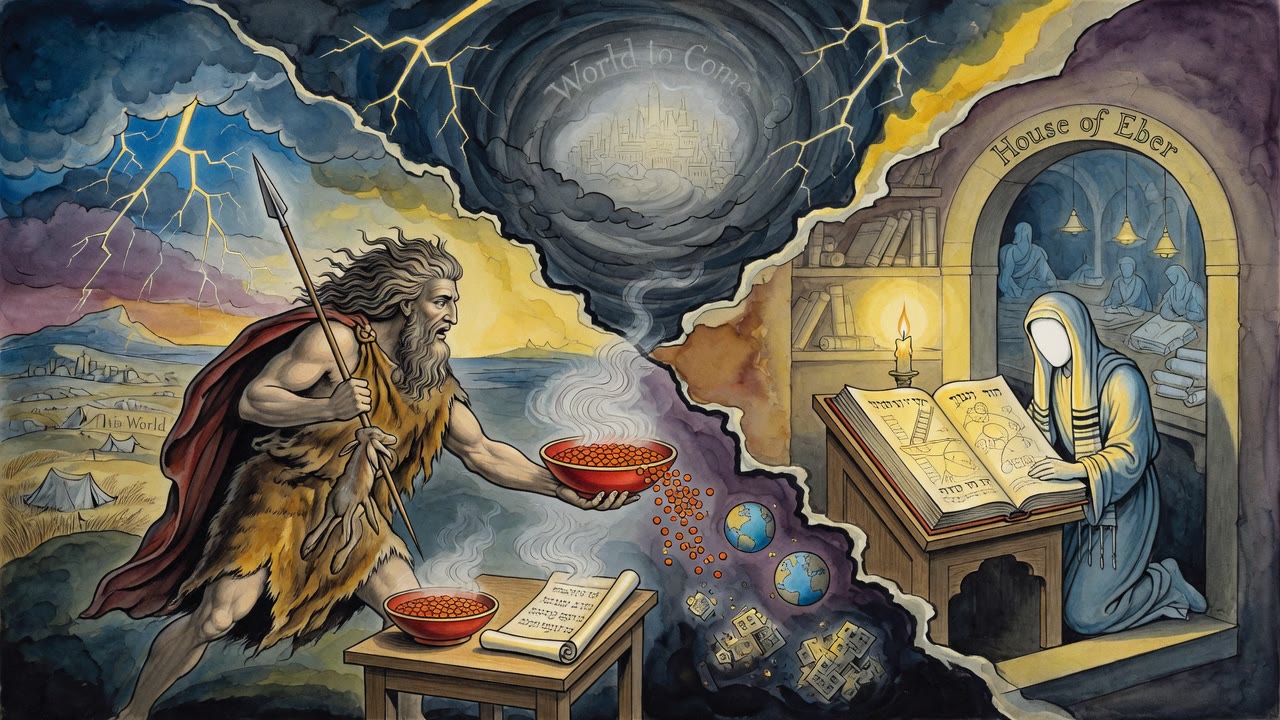
Messengers came back to Jacob with dust on their tongues and numbers that would not sit still. Esau was marching. Not with a hunting party. With four hundred commanders, each said to lead four hundred more. The men who reported it tried to soften nothing. "You treat him like a brother," they said, "but remember, he is Esau."
Jacob had God's promise of a peaceful return to his father's house, and still his knees felt the old weakness. A promise is not a shield a man can polish and forget. One small sin, one hidden failure, and the road home might already be canceled. He also feared the reverse of defeat. If he won and his brother died under his hand, fratricide would sit in his mouth for the rest of his life. He even wondered whether Isaac still lived. Would Esau ride this hard if their father still breathed?

He sent his household across the Yabbok first. Wives, children, servants, animals. The water took them. Then the bank held only one man and the night that had not yet decided what to do with him.

The Shepherd Whose Flock Would Not End

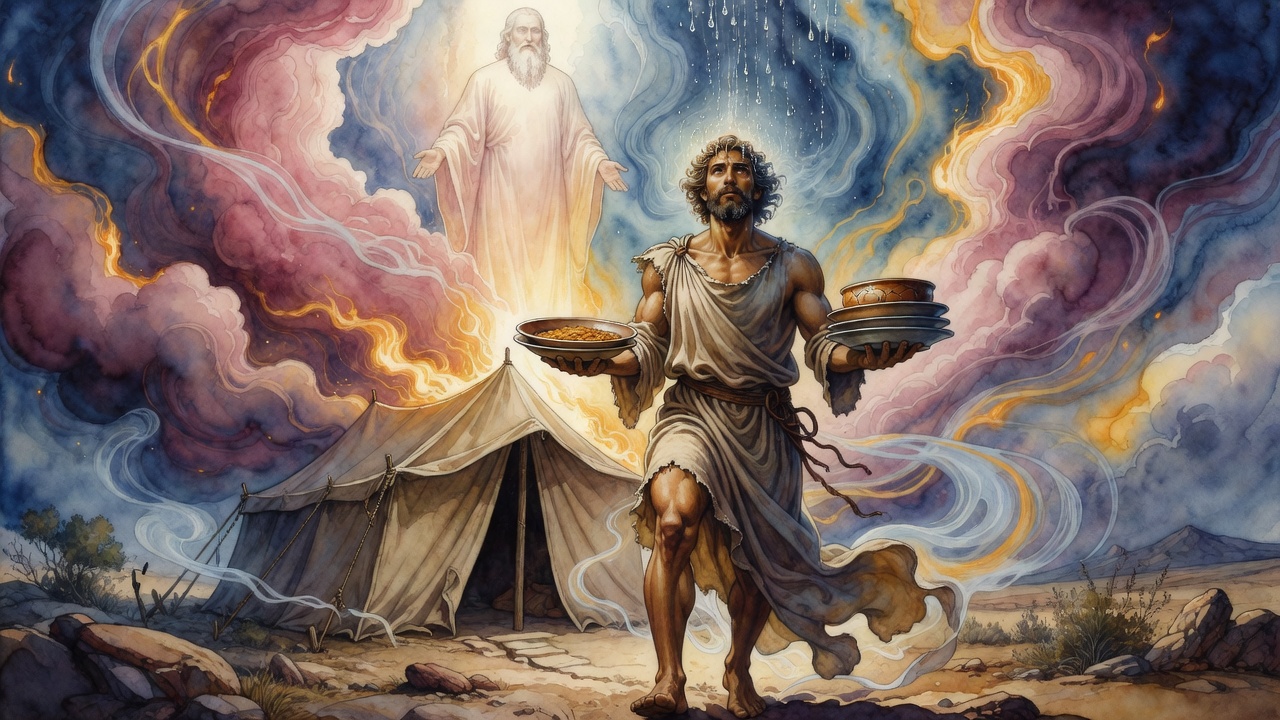
A shepherd appeared with flocks of his own and proposed a simple trade. He would help Jacob move his animals across. Jacob would return the favor. Fair is fair. Jacob agreed.

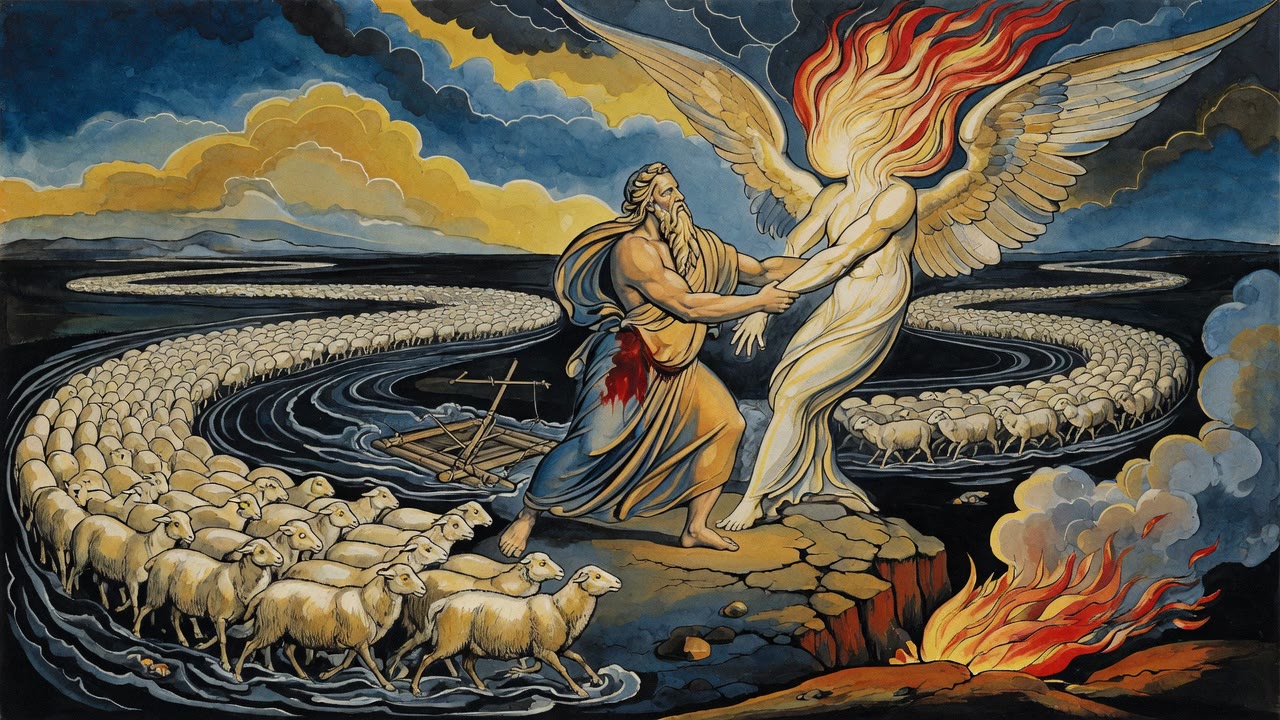
In a blink the stranger had Jacob's whole flock on the far side. Speed like that should have been a blessing. It became a trap when Jacob's turn came. He began ferrying the shepherd's animals two by two, diligent as a hired hand who still believes work ends. Hour after hour the bank on the far side filled, and the near bank did not empty. The flock stretched toward the horizon and kept growing as if earth itself were calving sheep.

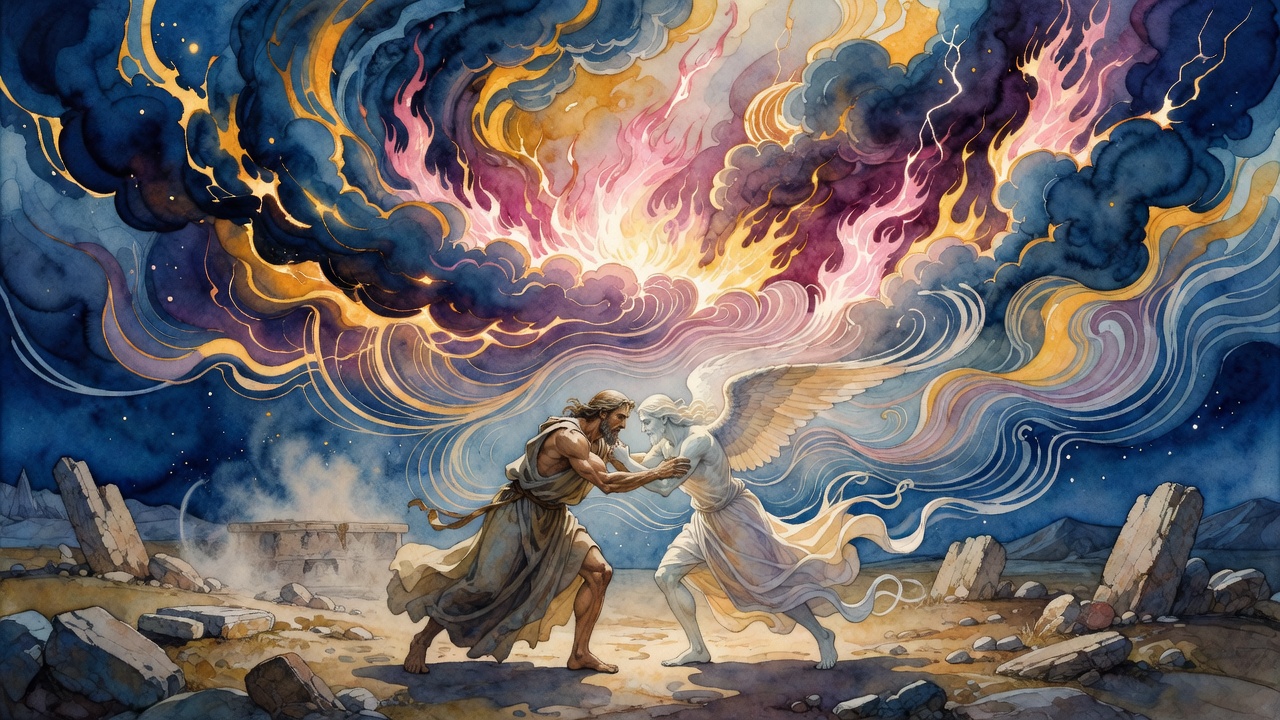
Dusk arrived. Jacob understood. This was no ordinary shepherd. Illusion. Enchantment. A magician's herd meant to exhaust a man who had already fled Laban and was about to face a brother with an army. Fury rose. Jacob accused the stranger of deceit. The shepherd answered by touching a finger to the earth, and fire burst from the ground.

Jacob did not run.

Fire, Thigh, and a Name

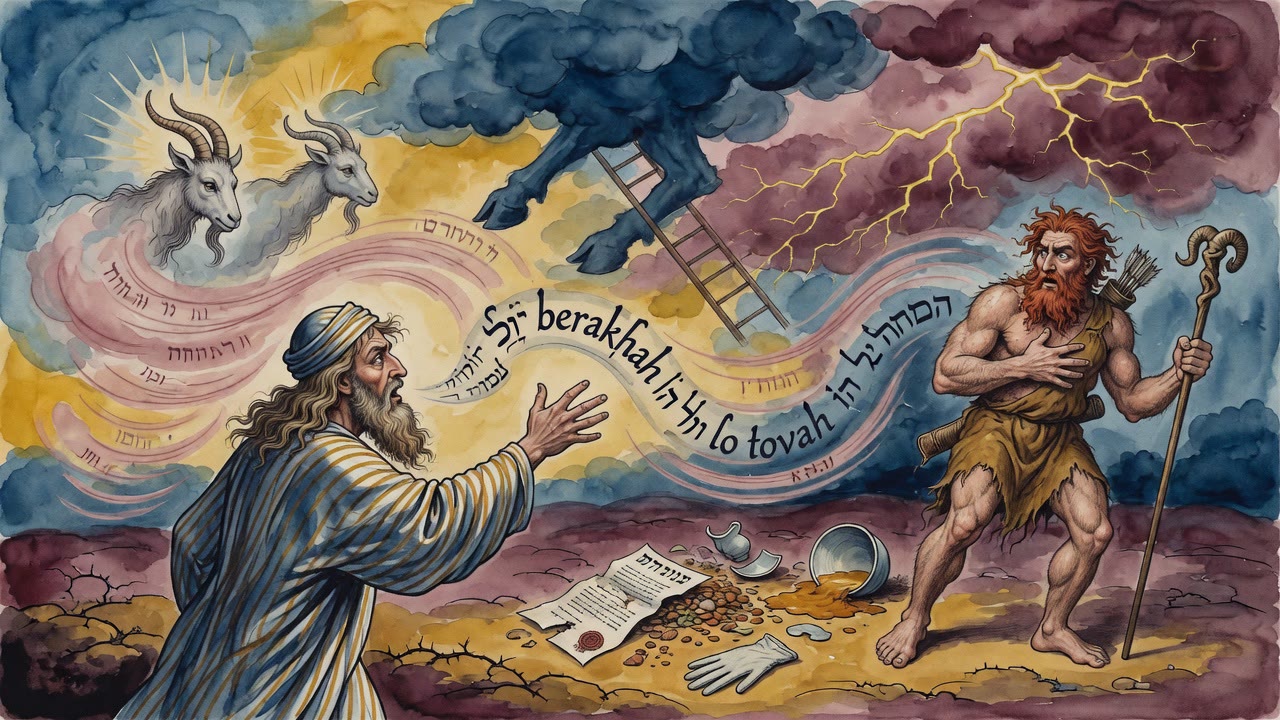
They locked together and wrestled through the night. The fire did not end the fight. The hours did not end it. At some point the stranger wounded Jacob in the thigh, and still Jacob held. When dawn began to gray the river, the other sought to leave. Jacob refused. A blessing first. A name first. Something that would outlast the bruise.

The blessing came. The new name came. Israel. The man who had sent his family across first so he could rest alone did not rest. He limped into the morning with a hip that would remember the night every time he walked toward Esau's dust.

Some say the shepherd was Samael, guardian of Esau, sent to weaken Jacob before the brothers met. Some say he was Michael, sent so Jacob would learn he could stand among beings of fire and still not burn. Either way the river had stopped being a crossing and become a court.

Toward the Dust of Four Hundred

After that night Jacob did not approach Esau with pride. He bowed seven times. Esau ran, and the arms that might have held a sword held a brother instead. The endless flock had been a trick of power. The real herd, the one that mattered, was the family already waiting on the far bank while one man finished a fight heaven had scheduled for him alone.

Behind the limp lived the older fear the messengers had planted. Even after a blessing, Esau's four hundred commanders were still a fact of the road. Peace, when it came, arrived after a body had already paid for it in muscle and joint. Jacob crossed the last stretch knowing that prophecy and terror can share the same limp.

The Yabbok kept its water. The fire went out. The name remained.

While he ferried animals that would not thin, Jacob's mind kept returning to the messengers' arithmetic. Four hundred commanders. If each truly led four hundred, the field ahead was not a family quarrel. It was a mobile city of blades. He had divided camps once already in his plans. He had stacked gifts in waves so Esau would meet generosity before faces. None of that helped when the near bank kept birthing sheep that should not exist.

The fire from the ground lit the stranger's outline and left Jacob's doubt nowhere to hide. A man who flees one father-in-law does not expect to wrestle a second authority before dawn. Still he gripped. Cloth tore. Breath burned. The thigh wound arrived like a signature, and Jacob understood that whoever won the blessing would leave marked. Dawn was not mercy. Dawn was a deadline the stranger tried to meet by leaving, and Jacob turned the deadline into a ransom.

When the name Israel settled on him, the limp became a walking argument against despair. He could face Esau without pretending the night had been a dream. The endless flock vanished into whatever realm illusion uses for storage. The real animals waited with the real children. The brother with the army was still a day away, and the man who limped toward him was no longer only Jacob the bargainer. He was also the one who had held fire and not let go.


← All myths

From the tradition

Sources

2 sources

The texts behind this telling. Some cards carry a translation of the source; others are our own retelling of it, and each card says which. Every card links out to the original.

Bereshit Rabbah 77:2Bereshit Rabbah

Translation of the source text.Midrash Rabbah -- TE · Public Domain

Rabbi Hunya said: He appeared to him in the form of a shepherd. This one had a flock and that one had a flock; this one had camels and that one had camels. He said to him: Take your flock across first, and afterward I will take mine across. Our father Jacob took his across. He said: Let us go back and see, lest we have forgotten anything. When he went back: "And a man wrestled with him" (Genesis 32:25).

And the Rabbis said: He appeared to him as a chief bandit. This one had a flock and that one had a flock; this one had camels and that one had camels. He said to him: Take mine across, and I will take yours across. The angel took our father Jacob's possessions across in the blink of an eye, and our father Jacob would take them across and come back and find them again, take them across and come back and find them again, all night long.

Rav Huna said: In the end the angel said, I will let him know with whom he is dealing. What did he do? He put his finger on the ground, and the ground began to seethe with fire. Jacob said to him: With this you frighten me? I am wholly of it. This is what is written: "And the house of Jacob shall be a fire" (Obadiah 1:18).

Full source
Legends of the Jews 6:175Legends of the Jews

Retold in our words. Read the original at the link below.The Legends of the Jews by Louis Ginzberg (1909) · Public Domain

His messengers return with chilling news. They deliver Esau's message, but it's not exactly a warm welcome. They also warn Jacob that Esau is marching toward him with an army, four hundred leaders, each commanding four hundred men. That's quite a welcoming committee! "You treat him like a brother," the messengers tell Jacob, "but remember, he is Esau. Don't forget his wicked nature."

Jacob remembered God's promise: that he would return to his father's house in peace. But this news from Esau? It shakes him to his core. As Ginzberg retells it in Legends of the Jews, even the most pious among us can't simply rely on divine promises as if they were guarantees for earthly success. Jacob understood a profound truth: even the smallest sin, the tiniest misstep, could potentially nullify that promise. Maybe, just maybe, he'd unknowingly done something to jeopardize his safe return.

That’s not all that worried him. As we see in the Zohar, Jacob was also concerned that Esau might actually be favored by God at this moment. Why? Because for the past twenty years, Esau had been fulfilling two important commandments that Jacob had been unable to keep. Esau had been living in the Holy Land, while Jacob was in exile. Esau had been attending to his parents, while Jacob was far away.

Jacob was stuck between a rock and a hard place. He feared defeat, of course. But, believe it or not, he also dreaded the possibility of victory. The thought of overcoming Esau, or worse, actually killing his own brother? That was almost as terrifying as being killed himself. As we find in Midrash Rabbah, fratricide is a heavy burden to bear, no matter the circumstances.

And if all that wasn't enough to keep him up at night, Jacob was also nagged by a terrible suspicion: had his father, Isaac, already passed away? He reasoned that Esau wouldn't be making such aggressively hostile moves against his own brother if their father were still alive. The respect for a parent, especially in that time, would have held him back.

So, what do you do when you're facing an army, questioning your worthiness, and fearing the worst? We'll see what Jacob does next, and it might just give us a little insight into how we can face our own battles, big and small. Because sometimes, the greatest battles aren't fought on the battlefield, but within our own hearts.

Full source