7 min read

Jethro Spoke Up in Pharaoh's Court and Paid for It

Jethro sat in Pharaoh's council and spoke up for the slaves. Banished for it, he rebuilt his life in Midian and waited decades to see if he was right.

Curated by Arthur · Told by Maggid ·
Table of Contents
  1. The Counsel That Ended His Career
  2. What the Other Two Men Earned
  3. The Morning His Daughters Came Home Early
  4. The Oath and the Wait
  5. The Day the Camp Came Into View

The summons came at dawn, when Pharaoh's hall still smelled of lamp oil and the night's incense. Jethro had answered such summons before. He had served the crown long enough to know that a man of standing is useful right up until the moment he says something inconvenient, and then he is useful no longer.
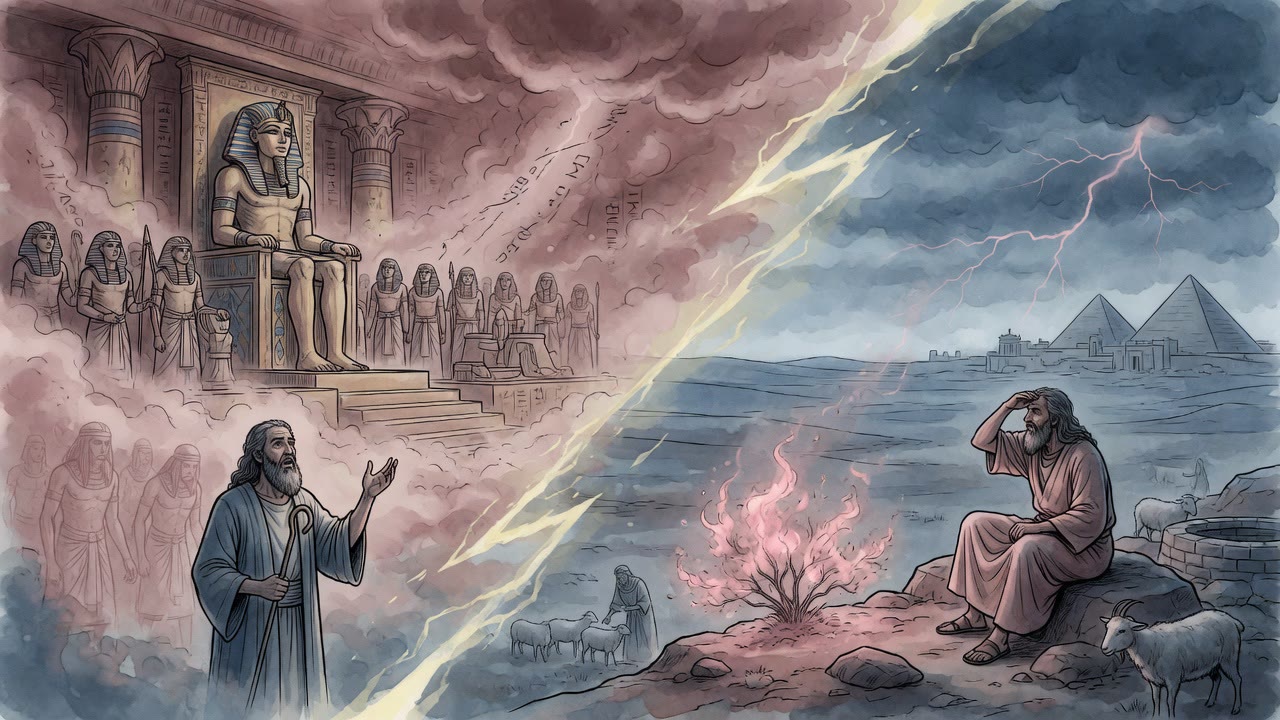
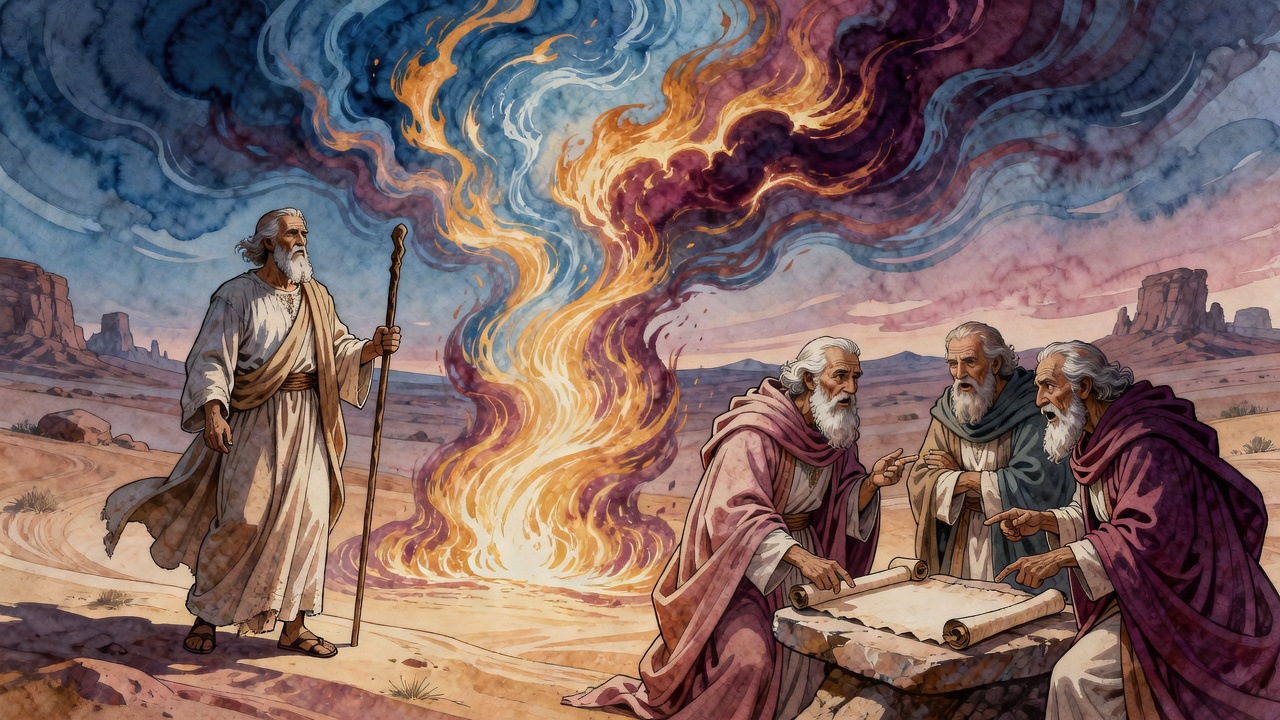
Pharaoh sat in the high seat with the empire's anxiety on his face. The Hebrews were multiplying. Something had to be done. He had called three men to advise him: Jethro, Balaam, and Job. Three men of different temperaments, different gods, different calculations. Pharaoh wanted to know: what should be done with the Hebrews?

The Counsel That Ended His Career

Balaam spoke first, or perhaps last, the order hardly matters against what he said. He pressed for blood. Kill the males at birth and the threat dissolves. The suggestion settled into the room with a comfortable finality, the way cruelty always sounds reasonable when it is someone else's children.

Job said nothing. Not nothing in the way of a man without an opinion, but nothing in the way of a man who has decided his opinion is not worth the cost of speaking it. He looked at Pharaoh and said in effect: whatever the king judges best. He was washing his hands in real time, in front of witnesses, and calling it wisdom.

Jethro spoke against it.

He did not have a sophisticated argument. The Hebrews had done nothing. They were slaves building cities. To slaughter their sons was wrong, and he said so. Pharaoh was exceedingly angry with him. Jethro was dismissed from his position in disgrace and told to leave.

He left. He had said the right thing at the wrong moment, or perhaps the right thing and the right moment, just not the right place. He crossed the desert and arrived in Midian with his principles intact and his career in ruins.

What the Other Two Men Earned

Balaam went on serving. He was useful to powers that needed someone who could speak and curse and advise without inconvenient objections. His usefulness lasted until the Israelites met the Midianites in war, and then a sword found him (Numbers 31:8). The advisor who recommended infant slaughter died by the sword of the very nation he had targeted. It is the kind of accounting that history sometimes, not always, keeps.

Job kept his silence and received suffering so profound that it became its own scripture (Job 1). Whether the suffering was punishment or something else entirely is a question that tormented him through the longest speeches in all of ancient literature. He never got a clean answer. He survived, but he survived knowing he had been quiet in the room when something irreversible was being decided.

Jethro arrived in Midian with nothing but the consequence of having said something true. He became a priest. He raised daughters. He tended flocks in the desert near Horeb, the kind of work that leaves a man alone with his thoughts for long stretches of silent years.

The Morning His Daughters Came Home Early

He knew something unusual had happened the moment they walked through the door before midday. His daughters went to the well each morning and were usually delayed, driven off by the local shepherds who considered the troughs theirs by right of presence and size. On this morning his daughters were home early and their jars were full.

They told him about an Egyptian who had driven the shepherds off and drawn water for their flocks.

Jethro felt something move in him that had not moved in a long time. He asked where the man was. His daughters had left him at the well. Jethro sent them back. He had been a man who recognized what mattered and acted on it even when the cost was high, and he had not lost the habit entirely. "Why did you leave the man there?" he said. "Go and call him."

The man they brought home was Moses. A fugitive from Egypt. A killer of an overseer, a defender of the beaten, a man who had also done the right thing at the wrong moment and ended up in the desert with his principles and nowhere else to go.

Jethro gave him his daughter Zipporah. He gave him his flocks to tend. He made him swear, as a man who had been left before, not to leave without consent. Moses swore and stayed.

The Oath and the Wait

Jethro had extracted a memory from his own history and applied it to this stranger. He had seen how Jacob had taken his wives and daughters of Laban and walked out of that house without permission. He was a man who had lived near power long enough to know that people leave when something better calls, and he had already lost enough without losing his grandchildren's father to a sudden calling in the night.

Moses tended the flocks for years. The burning bush had not yet happened. The plagues were not yet imagined. The sea had not yet parted. Jethro lived in Midian with his flocks and his daughters and his son-in-law and waited in the ordinary way, not knowing what was coming.

The Day the Camp Came Into View

When the news reached Midian that Moses had led the Hebrews out of Egypt, that Pharaoh's army had drowned and the people were camped in the wilderness, Jethro gathered Zipporah and Moses's sons and walked out to find the camp.

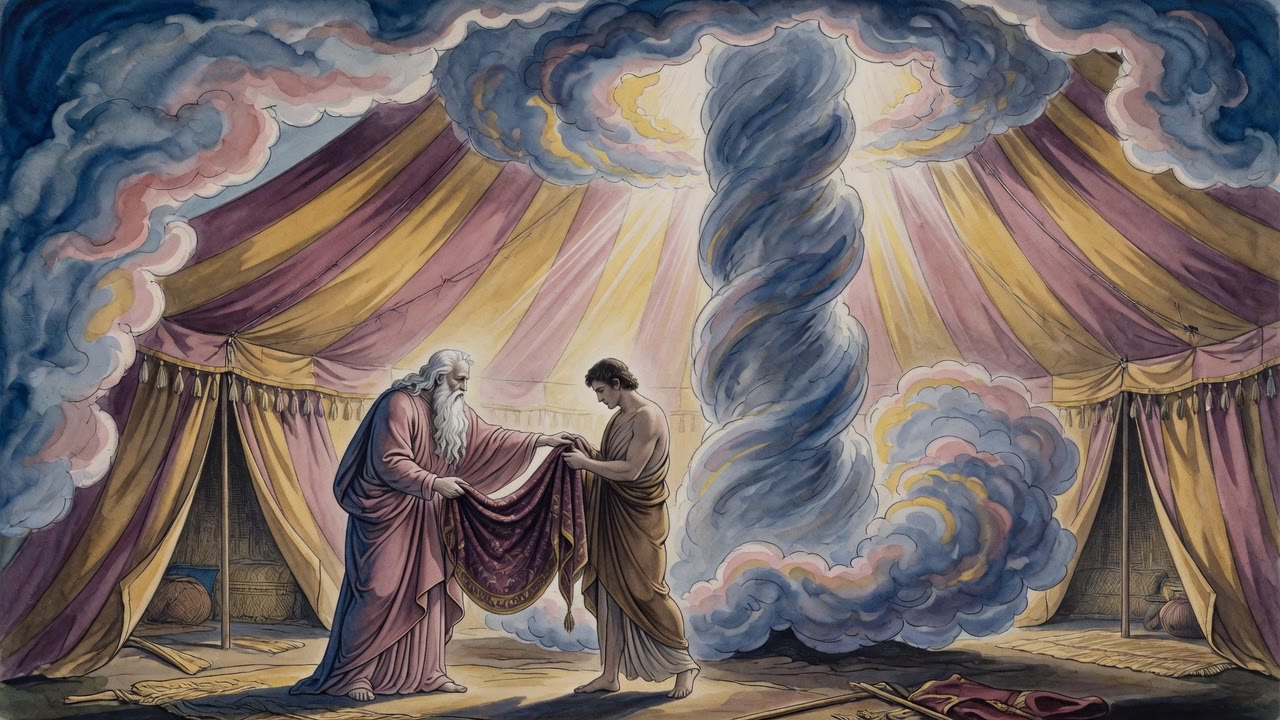
Moses came out to meet him. They bowed to each other and embraced and went inside the tent. Moses told him everything: the plagues, the sea, the water from the rock, the bread that fell each morning. Jethro listened and then said what he had waited decades to say out loud: blessed is the Lord (Exodus 18:10). He had spoken against Pharaoh and lost his position. Now he stood in the camp of the people he had defended, and the man who had freed them was his son-in-law.

The next morning he watched Moses sit from dawn to dusk while hundreds of Israelites lined up with their disputes and their questions and their needs. By evening Jethro had seen enough. He told Moses what anyone who had run a large operation would tell a man managing alone: "This is not sustainable. Appoint judges. Delegate the smaller cases. Keep only the hardest ones for yourself. You will last longer and the people will be served faster" (Exodus 18:17-23).

Moses listened. He restructured the courts of Israel based on the advice of the man who had been banished from Pharaoh's court for telling the truth. The people who had been the cause of his exile became the people whose justice he helped organize. Jethro returned to Midian after that, his own man, his own priest, his flocks his own. He had said what needed to be said, both times, and he had been right both times, and he went home.


← All myths

From the tradition

Sources

3 sources

The texts this telling draws on, in full. Open a card to read inline, or expand it for a wider, quieter read.

Legends of the Jews 4:29Legends of the Jews

It’s a scene ripe with drama, intrigue, and conflicting advice.

The story begins, as many of the best stories do, with a betrayal. Jethro, also known as Reuel, later to become Moses' father-in-law, dared to speak out against Pharaoh’s growing hostility towards the Hebrews. That Pharaoh was "exceedingly wroth with him," and Jethro was promptly dismissed from his position in disgrace, forced to flee to Midian. Ouch. Imagine the courage it took to stand up to a king, especially one as powerful as Pharaoh!

Left without Jethro's counsel, Pharaoh turned to other advisors, seeking their opinions on how to deal with the growing "problem" of the Hebrew population. First up was Job. Yes, that Job, the one of immense suffering and unwavering faith. And what was his advice? Well, not much, actually. As the text recounts, Job essentially washed his hands of the situation, saying, "Behold, all the inhabitants of the land are in thy power. Let the king do as seemeth good in his eyes." It's a bit disappointing, isn't it? Especially coming from someone known for his moral fortitude.

Finally, Pharaoh called upon Balaam. Balaam, a fascinating and complex figure, was a non-Israelite prophet known for his powerful blessings and curses (Numbers 22-24). Now, Balaam's advice is where things get really interesting. According to Ginzberg's retelling in Legends of the Jews, Balaam essentially warned Pharaoh that any attempt to destroy the Hebrews through methods that had challenged their forefathers would fail. "From all that the king may devise against the Hebrews, they will be delivered," Balaam declared.

He reminded Pharaoh that the Hebrews’ God had saved Abraham from the fiery furnace, as we see in the Book of Genesis and elaborated upon in various Midrashic (rabbinic interpretive commentary) traditions. "If thou thinkest to diminish them by the flaming fire, thou wilt not prevail over them, for their God delivered Abraham their father from the furnace." He further pointed out that Isaac had been spared from sacrifice, referencing the binding of Isaac (Akeidah) in Genesis 22. "Perhaps thou thinkest to destroy them with a sword, but their father Isaac was delivered from being slaughtered by the sword.” And, he added, even the back-breaking labor that Jacob endured while working for Laban couldn't break the Hebrews. "And if thou thinkest to reduce them through hard and rigorous labor, thou wilt also not prevail, for their father Jacob served Laban in all manner of hard work, and yet he prospered.”

So, what WAS Balaam's advice? His suggestion was chilling: target the newborn male children by throwing them into the Nile. "If it please the king, let him order all the male children that shall be born in Israel from this day forward to be thrown into the water. Thereby canst thou wipe out their name, for neither any of them nor any of their fathers was tried in this way.”

This was a tactic that hadn’t been used before, a way to circumvent the protective hand that had guided the patriarchs. A truly horrific suggestion! It’s a stark reminder of the depths of cruelty to which fear and prejudice can lead. We read in (Exodus 1:22), "Then Pharaoh commanded all his people, ‘Every boy that is born to the Hebrews you shall throw into the Nile, but you shall let every girl live.’"

What's so fascinating about this whole episode is the way it highlights the power of memory and the weight of history. Pharaoh and his advisors weren't just dealing with a present-day population; they were confronting a people deeply connected to their past, a past filled with divine interventions and miraculous escapes. Did Pharaoh truly believe he could outsmart the God of Abraham, Isaac, and Jacob? Maybe. Or perhaps he was simply blinded by fear and a desperate desire to maintain control. It makes you wonder: what "advice" are we listening to today that might lead us down a similarly dark path?

Full source
Legends of the Jews 4:127Legends of the Jews

Legends of the Jews turns to Jethro Was Amazed When His Daughters Came Home Early.

Jethro, Zipporah’s father, a priest of Midian (some traditions even identify him with Reuel), was quite surprised to see his daughters back so early. Usually, they were delayed by the, shall we say, less-than-gentlemanly behavior of the local shepherds. They’d get held up at the watering troughs. But on this day they arrived home quickly.

Jethro's surprise when he heard their story! They told him about the "wonder-working Egyptian" who had come to their rescue. Jethro's immediate reaction is fascinating. He exclaims, "Mayhap he is one of the descendants of Abraham, from whom issueth blessing for the whole world!" The potential link to Abraham clearly impresses him.

Then, Jethro, being the hospitable man he is, gives his daughters a bit of a scolding. "Why didn't you invite this stranger, who did you such a valuable service, to come into our home?" He then promptly orders them to go and fetch Moses.

Why? Well, Jethro hopes that Moses might just take one of his daughters to wife. A practical reason, perhaps, but also a reflection of Jethro's wisdom in recognizing a good man when he sees one (or, in this case, hears about one!). He understood the importance of chesed (Lovingkindness), loving-kindness.

It's a beautiful example of how even seemingly small acts of kindness and hospitality can lead to significant events in the unfolding of history. This meeting, spurred by a simple act of helping someone at a well, would eventually lead to Moses marrying Zipporah and becoming part of Jethro's family. And that, of course, is just the beginning of a much larger story. What if the daughters had not returned home quickly? What if Jethro had not sent them back to invite Moses? What unexpected twists of fate are yet to come?

Full source
Legends of the Jews 4:150Legends of the Jews

The story of Moses gives us a profound glimpse into that very question.

The familiar version gives us Moses as Moshe Rabbenu, "Moses our Teacher," the one who led the Israelites out of Egypt and received the Torah on Mount Sinai. But before all that, he was just a shepherd. And that's where our story begins.

When Jethro, the priest of Midian, gave his daughter Zipporah to Moses in marriage, he wasn't just handing over his daughter. He was making a deal, a pact almost. As Ginzberg recounts in Legends of the Jews, Jethro, remembering how Jacob had left Laban with his daughters, wanted to protect himself. He said to Moses, "I know that thy father Jacob took his wives, the daughters of Laban, and went away with them against their father's will. Now take an oath that thou wilt not do the same unto me."

Moses, understanding Jethro’s concerns, swore not to leave him without his consent. And so, he stayed with Jethro, becoming a shepherd of his flocks. The future leader of a nation, tending sheep in the desert. It seems almost… humble, doesn’t it?

But it was in this very act of shepherding that God saw something special in Moses. As the text says, God never gives an exalted office to a man until He has tested him in little things. It’s a powerful idea, isn’t it? That the way we handle the small, seemingly insignificant tasks in our lives is a reflection of our capacity for greater responsibility.

Moses wasn't alone in this. David, too, was a shepherd before he became king. As the text points out, "Thus Moses and David were tried as shepherds of flocks, and only after they had proved their ability as such, He gave them dominion over men."

What does this tell us? It tells us that leadership isn't about grand gestures or innate authority. It's about caring. About responsibility. About demonstrating a capacity for empathy and diligence even when no one is watching. How you treat those you lead matters to God and to your worthiness to be a leader.

It’s a comforting thought, in a way. It means that each of us, in our own small way, is being tested, being prepared for whatever role we might be called to play. So, the next time you find yourself facing a seemingly mundane task, remember Moses and David. Remember that even in the most ordinary of circumstances, we have the opportunity to demonstrate the qualities that make a true leader. Because who knows? You might just be shepherding your way to greatness.

Full source