Parshat Yitro5 min read

Jethro Walked Out of Comfort Into Moses Camp

Jethro left settled glory for empty sand to stand near Moses, while Aaron leaned toward every word as if God Himself still spoke through his brother mouth.

Curated by Arthur · Told by Maggid ·
Table of Contents
  1. A Message That Sounded Like God
  2. What Marriage Counsel Heard
  3. When Aaron Listened as if From God
  4. Two Ways of Drawing Near

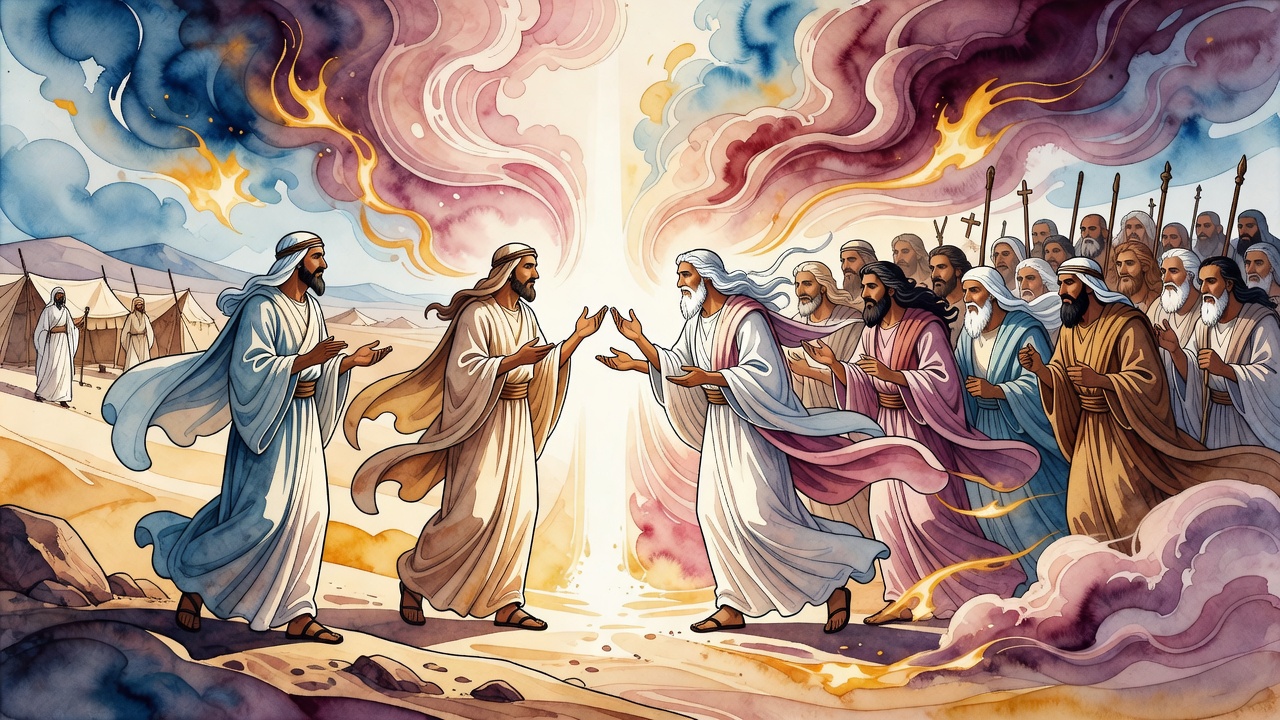
Jethro packed what a priest of Midian packs when he has decided the settled world is no longer the center. Comfort stayed behind. Reputation stayed behind. The inhabited places kept their shade and their markets. He walked toward a wilderness that offered neither, because Moses was camped there, and nearness to a righteous man outweighed the furniture of a known life.

Jethro Walked Out of Comfort Into Moses Camp Click for full size

Heaven, which reads hearts the way others read faces, took note. Houses of study would never disappear from Jethro's line, the promise ran, because he came out to honor a man who carried God's work in calloused hands.

A Message That Sounded Like God

Word went ahead of him: come out for my sake, or for my children's, or for your wife's. The rabbis heard the Holy One's own habit inside that appeal. I am the One who draws people near and does not shove the sincere away. Push off with the left hand if you must test, but pull close with the right. Moses modeled the pull. He went out to greet his father-in-law with Aaron, the elders, and all Israel, and the humble Moses bowed and kissed first.

They walked into the tent, which the midrash hears as the house of study. Moses told the Exodus, the sea, Amalek. Jethro rejoiced over manna, well, and promised land, then opened his mouth and blessed the LORD. A man who had known many altars chose this Name with a full voice and became one with Israel in that blessing.

What Marriage Counsel Heard

From Jethro's walk the sages drew hard counsel that still stings polite families. Give a daughter to a Torah scholar even if it costs everything. Marry into a scholar's house even at the price of wealth, because children take the shape of the table they grow beside. Grapes of one vine with grapes of another. Jethro had not come for a wedding contract that day, yet his choice of company became a map for choosing company forever.

The wilderness looked empty to anyone counting cities. To Heaven it looked full of a decision. Leaving glory for sand, when the sand holds a teacher, is not poverty of ambition. It is ambition aimed at the right fire.

When Aaron Listened as if From God

Elsewhere the verse pairs Moses and Aaron in the work of speaking to all Israel, though only Moses receives the command in other places. Were both men talking at once? One tender answer refuses the tangle. When Moses spoke, Aaron leaned in with such reverence that Scripture treats him as hearing the words from God. The student's awe became its own kind of authority.

Another picture sets Aaron and his sons flanking Moses while the divine word seemed to rise from between them. Warmest of all, the brothers kept deferring. Each said to the other, "You teach," until the teaching could not be owned as private property. Leadership in that camp was not a microphone fight. It was a leaning in so complete that the listener shared the weight of the speech.

Two Ways of Drawing Near

Jethro drew near by walking out of comfort. Aaron drew near by listening as if the bush still burned in his brother's mouth. One was a guest becoming family. One was a brother refusing to treat prophecy as ordinary noise. Between them the camp learned that honor is a motion of feet and of ears.

Moses stood in the middle, greeting and speaking, never too proud to bow to a father-in-law, never too rushed to let Aaron's reverence complete the circuit of the word. The wilderness held all three, and the houses of study promised to Jethro's children began in that dust where a Midianite priest said the blessing that sealed his turn.

Dust clung to Jethro's robe the way city perfume never had. Moses' camp smelled of manna and animals and legal arguments beginning to form. The Midianite priest listened until blessing broke out of him, not as politeness but as surrender to a story larger than his former altars. Aaron at Moses' side showed another surrender: ears that refuse to treat prophecy as background noise.

Together they taught the camp that honor is not a title. It is travel toward a teacher and attention that makes speech land. Converts and brothers both have to choose nearness. Jethro chose with his feet. Aaron chose with his lean. Moses held the center without hoarding either gift.

When the tent flap closed on their talk, the camp outside still needed judges and water and someone to greet the next stranger who might become family. Jethro blessing did not end the wilderness. It renamed it as a place worth entering. Aaron listening did not end the need for Moses to speak. It made the speaking land in more than one heart at once.


← All myths
From the tradition

Sources

2 sources

The texts behind this telling. Some cards carry a translation of the source; others are our own retelling of it, and each card says which. Every card links out to the original.

Yalkut Shimoni on Torah 268:6Yalkut Shimoni on Torah

Translation of the source text.Torat Emet (Yalkut Shimoni) · CC-BY-NC

(Exodus 18:5-7) "And Jethro, Moses' father-in-law, came, with his sons and his wife." But has it not already been said, "and your wife and her two sons with her"? I might hear that her sons were from another man; therefore Scripture says, "and his sons and his wife to Moses": they were Moses' sons, not her sons from another man. "To the wilderness where he was encamped": here Scripture expresses wonder at him, that he was dwelling within the glory of the world and sought to go out to the wilderness, a place of emptiness that has nothing in it; therefore it is said, "to the wilderness."

"I, your father-in-law Jethro, am coming to you." The Holy One, blessed be He, who tests hearts and kidneys, said to him, "Jethro, you have come to greet that righteous man; may houses of study never cease from your seed forever," as it is said, "Strong is your dwelling, and set your nest in the rock" (Numbers 24:21). From here they said: a man should give his daughter to a Torah scholar even if he must buy him with money, and a man should marry the daughter of a Torah scholar even if he gives all his wealth. If a man marries the daughter of an ignorant person, in the end his children will be ignorant; if a man marries the daughter of a Torah scholar, in the end his children will be Torah scholars. They told a parable: grapes of the vine with grapes of the vine.

"And he said to Moses, I, your father-in-law Jethro." Rabbi Yehoshua says: he wrote to him in a letter. Rabbi Elazar of Modi'in says: he sent to him by a messenger and said, "Act for my sake; and if you will not act for my sake, act for the sake of your sons; and if you will not act for the sake of your sons, act for the sake of your wife." Rabbi Eliezer says: "and he said to Moses, I," the Holy One, blessed be He, said, "I am the LORD who spoke and the world came into being; I am the One who draws near and not the One who pushes away, as it is said, 'Am I a God near at hand and not a God far off?' (Jeremiah 23:23). I am the One who drew Jethro near and did not push him away. And you too, when a person comes to you to convert and comes only for the sake of Heaven, you too draw him near and do not push him away." From here you learn that a person should push away with the left hand and draw near with the right, not as Elisha did to Gehazi, whom he pushed away forever.

"And Moses went out to meet his father-in-law." They said: Moses went out, and Aaron, Nadab, and Abihu, and the seventy elders of Israel, and after them all Israel; and some say even the Divine Presence went out with them. "And he bowed and kissed him." I do not know who bowed to whom, or who kissed whom; when it says, "and they asked each other of their welfare," who is called "man"? You must say this is Moses, as it is said, "and the man Moses was very humble" (Numbers 12:3). Thus it was none but Moses who bowed and kissed his father-in-law; from here they said that a man should conduct himself with honor toward his father-in-law. "And they came to the tent": this is the house of study. (Exodus 18:8) "And Moses recounted to his father-in-law": to draw him near, to bring him close to the Torah. "All that the LORD had done": that He gave the Torah to His people Israel. "All the hardship that had befallen them": at the sea. "On the way": this is the war with Amalek. "And the LORD delivered them": the Omnipresent delivered them from everything.

(Exodus 18:9) "And Jethro rejoiced over all the good" and so on. Rabbi Yehoshua says: Scripture speaks of the goodness of the manna. He said, "This manna the Omnipresent gave us, we taste in it the taste of bread, the taste of meat, the taste of fish, the taste of locusts, the taste of every delicacy in the world," for it says, "good, the good, all the good, over all the good." Rabbi Elazar of Modi'in says: Scripture speaks of the goodness of the well. He said, "This well the Omnipresent gave us, we taste in it the taste of new wine, the taste of aged wine, the taste of milk, the taste of honey, the taste of every sweetness in the world." Rabbi Eliezer says: Scripture speaks of the goodness of the Land of Israel. He said, "The Omnipresent is destined to give us six good measures: the Land of Israel, the world to come, the new world, the kingdom of the house of David, priesthood, and Levitehood," therefore it says, "good, the good, all the good, over all the good." At once he opened and said, "Blessed is the LORD." "And Jethro rejoiced": that he proclaimed the oneness of the name of the Holy One, blessed be He; another interpretation: that he became a Jew.

Full source
Yalkut Shimoni on Torah 191:4Yalkut Shimoni on Torah

Translation of the source text.Torat Emet (Yalkut Shimoni) · CC-BY-NC

"Speak to all the congregation of Israel" (Exodus 12:3). Rabbi Ishmael says: Were the two of them speaking together? Is it not already said, "You shall speak all that I command you" (Exodus 7:2 ["you shall speak all that I command you"])? Then what does Scripture teach by saying "Speak" [in the plural]? Rather, when Moses was speaking, Aaron would incline his ears to listen in awe, and Scripture credits him as though he were hearing from the mouth of the Holy One, blessed be He. Rabbi Ami bar Yoshiyah says: Were the two of them speaking? Is it not already said, "you" and so forth? Rather, [when Moses was speaking, Aaron stood at his right and Elazar at his left and Itamar at Aaron's right, and the word went forth from between the two of them. Rabbi Shimon ben Yochai says:] Moses would show honor to Aaron and say to him, "Teach me," and Aaron would show honor to Moses and say, "Teach me," and the word went forth from between them as though both of them were speaking.

"Speak to all the congregation of Israel, saying, on the tenth of the month" (Exodus 12:3). The speaking was on the New Moon, and the taking from the tenth, and the slaughtering on the fourteenth. Or perhaps the speaking and the taking were from the tenth and the slaughtering on the fourteenth? Scripture says, "This month shall be for you" (Exodus 12:2); "speak", when was the speaking? On the New Moon. Rabbi Acha bar Yoshiyah says: Or perhaps the speaking and the taking were on the New Moon and the slaughtering on the fourteenth? Scripture says, "Speak to all the congregation of Israel, saying." Scripture need not say "saying" except to interrupt the matter: the speaking on the New Moon, the taking on the tenth, and the slaughtering on the fourteenth. Rabbi Yose the Galilean says: Or perhaps the speaking was on the New Moon and the taking and slaughtering on the tenth? Scripture says, "And it shall be for you as a charge" and so forth (Exodus 12:6); if you say so, you have uprooted the whole verse.

"On the tenth of this month, let them take" (Exodus 12:3). I know only that the tenth is fit for the taking; from where do I know the fourteenth? You may argue an a fortiori case [kal va-chomer, reasoning from minor to major]: if the tenth, which is not fit for slaughtering, is fit for the taking, then the fourteenth, which is fit for slaughtering, surely it is right that it be fit for the taking. And from where the thirteenth? You may argue an a fortiori case: if the tenth, which is not close to slaughtering, is fit for the taking, then the thirteenth, which is close to slaughtering, surely it is right that it be made fit for the taking; and the same applies to the twelfth and the eleventh. "On the tenth of this month", this is to exclude the Passover of later generations, for the Passover of Egypt was taken from the tenth, while the Passover of the generations may be taken at any time.

Full source