5 min read

Job Scrapes His Skin While Heaven Hides in Dark

Job sits in ashes scraping sores as his soul peels layer by layer, and God answers from a darkness that is still light to Him.

Curated by Arthur · Told by Maggid ·
Table of Contents
  1. The Soul Peels Like Nested Shells
  2. Light That Looks Like Night
  3. The Accuser Has Already Left the Room
  4. Why the Soul Must Stay Weak Enough to Choose
  5. The Whirlwind Arrives Without Apology

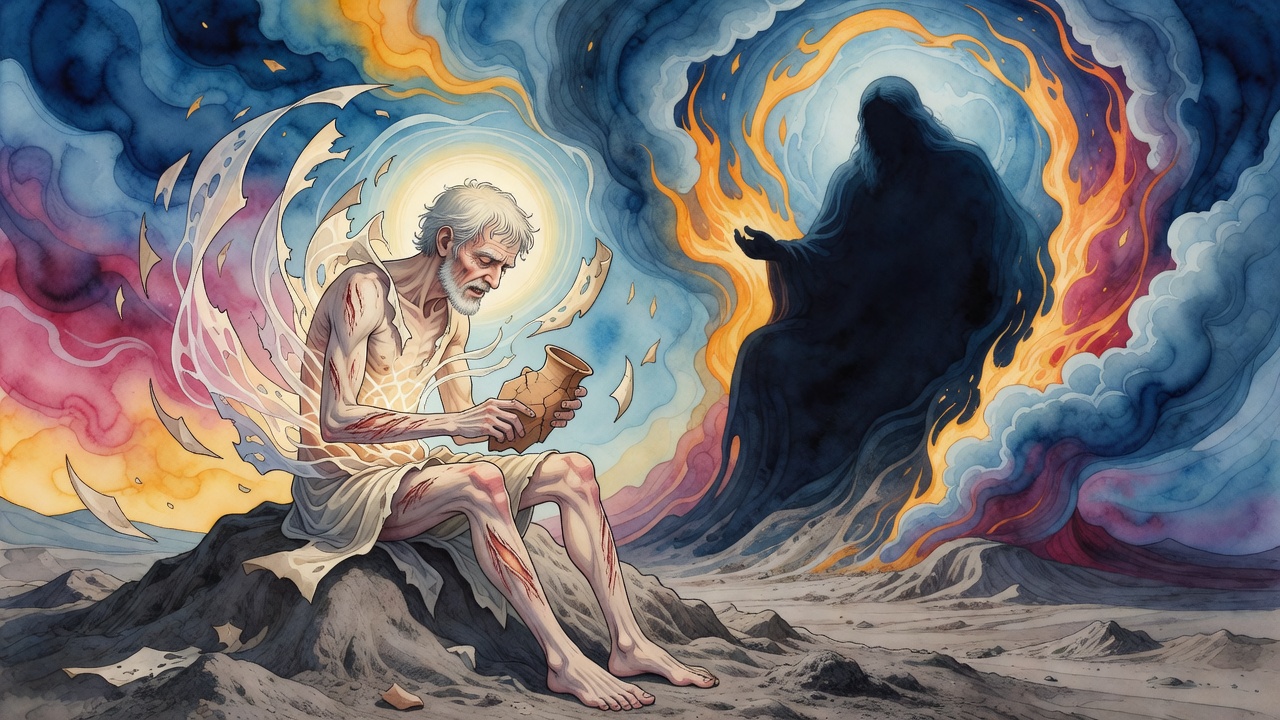
Job digs the potsherd under a scab until fresh blood answers. Ash sticks to the wound. Three friends have stopped talking. The wind on the ash heap smells of burned wool and old rain.

Job Scrapes His Skin While Heaven Hides in Dark Click for full size

He scrapes again. Not for medicine. For proof that he still owns a body that can hurt on purpose.

The Soul Peels Like Nested Shells

Inside him something begins to leave in order. First the Nefesh, the life that keeps the blood moving, thins until his pulse feels borrowed. Then the Ruach, the weather of his feelings, collapses into a single dry rage. The Neshamah, the knowing that once argued with God in clean sentences, hangs back like a lamp behind a curtain.

Higher still, Chayah and Yechidah do not depart. They wait. The nested dolls of the soul can reincarnate separately, the mystics will say later, but Job does not know that language. He only knows that the man who owned flocks and sons has become a stack of thin lights trying not to scatter.

He speaks his innocence into the ash. The ash does not argue. Heaven does not either. Silence is not empty. It is a weight with a shape.

Light That Looks Like Night

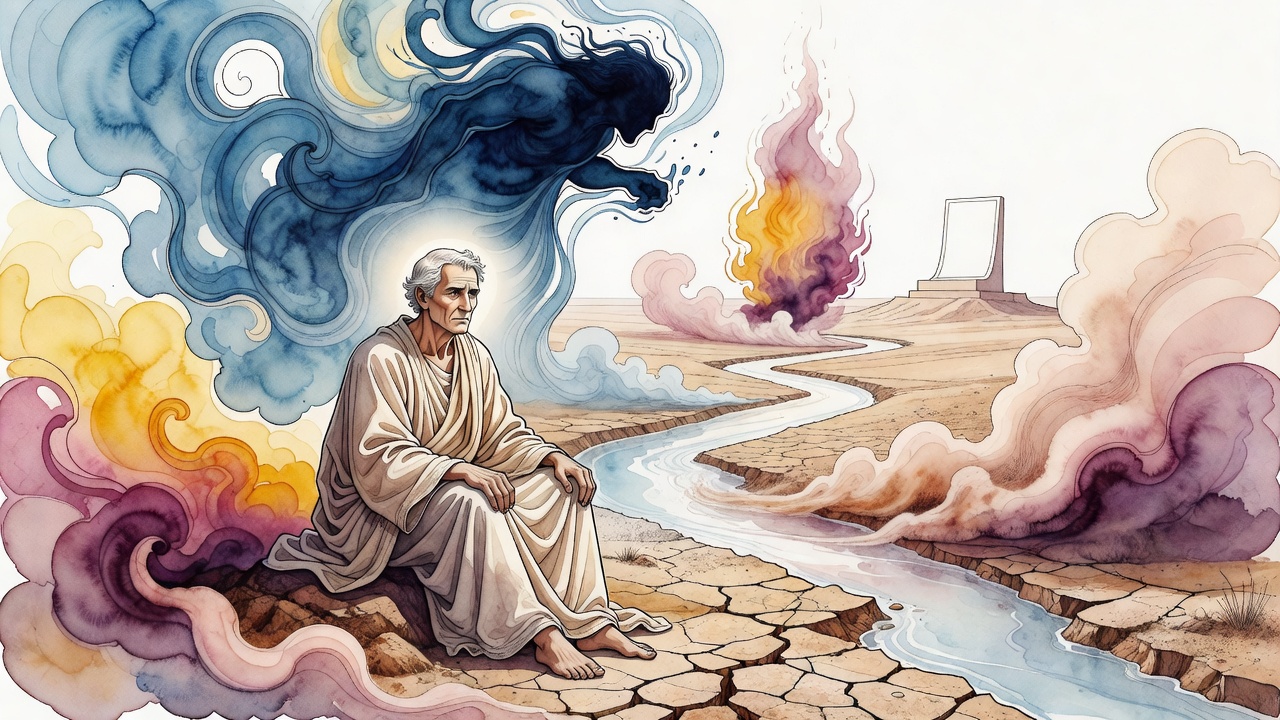
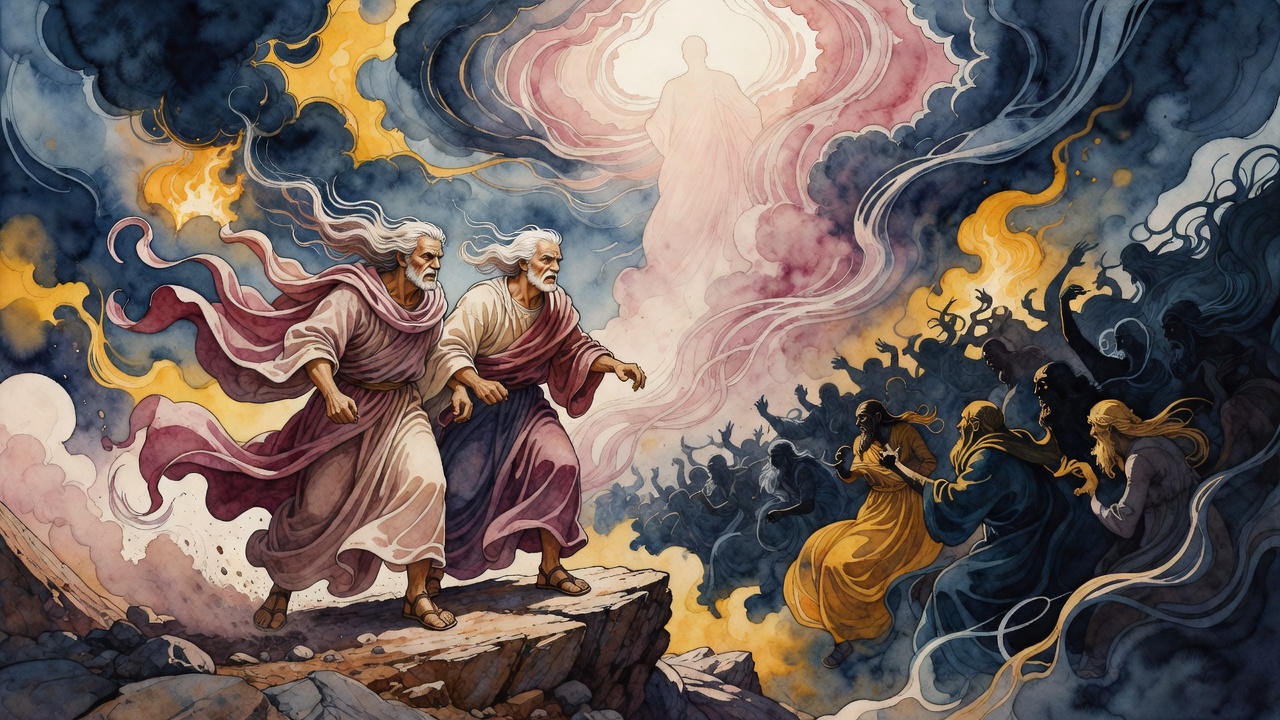
Above the ash heap, the old riddle of light and dark is already walking. One verse says brilliance fills the skies. Another says God made darkness His hiding place. Cloud and gloom surround Him. Job's friends call this punishment. Job calls it a trial that has forgotten its own rules.

What Job cannot see is that to God even darkness is not dark. Night shines like day. Light and darkness are the same when the Infinite holds them. The hiding is not absence. It is a kind of nearness too bright for eyes that only know sheep and sunlight.

Job lifts his face to a sky that looks like a slammed door. Behind the door, something is not gone. It is only wearing night the way a king wears a cloak.

The Accuser Has Already Left the Room

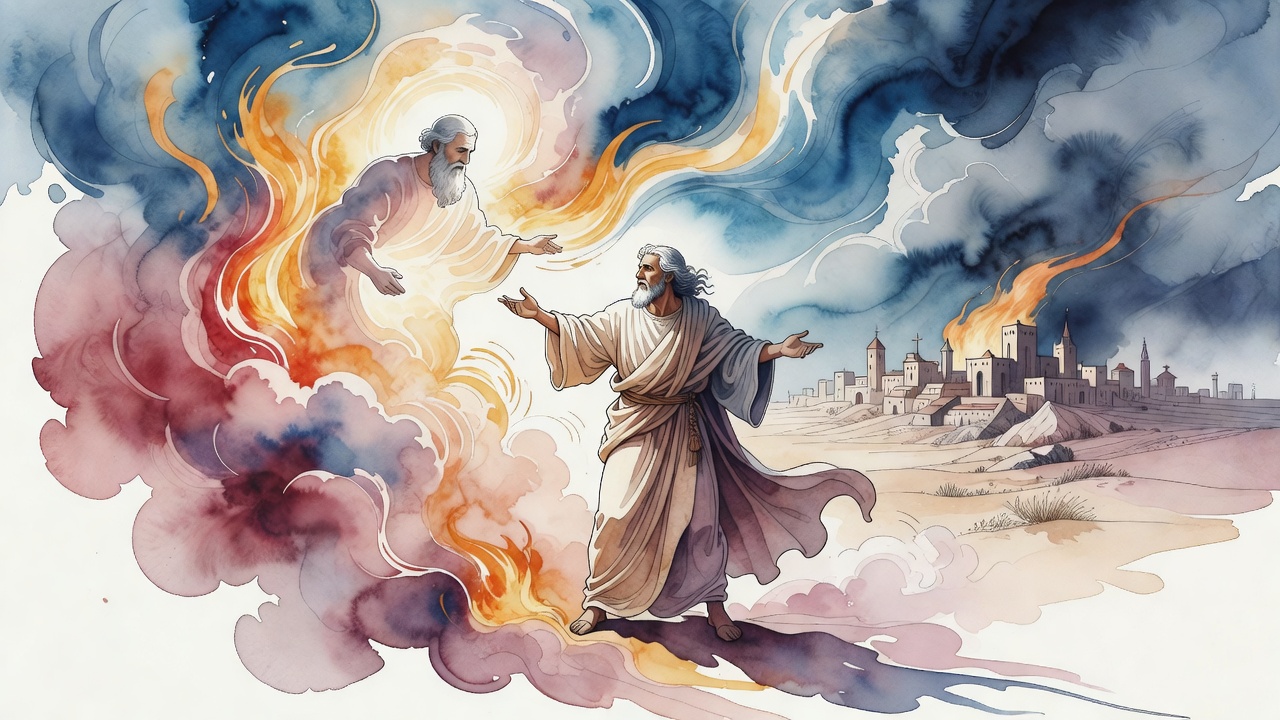
Earlier, in a court Job never saw, Ha-Satan walked among the sons of God and pointed at a righteous man with walls around his life. Take the walls, the Accuser said, and watch the praise fall with them. Permission was given. Children died. Skin opened. The prosecutor's work is finished. What remains is a man and a silence.

Job does not curse God. He curses the day he was born, which is a different violence, aimed at time instead of the Throne. His wife tells him to end it. He will not. The potsherd keeps moving.

Each scrape is a refusal to become an animal of pure pain. The Nefesh (the life-soul) wants only to flee the body. The Neshamah (the higher soul) still wants a verdict.

Why the Soul Must Stay Weak Enough to Choose

If the soul's light flooded the flesh without limit, Job would sit in bliss even on the ash. Deficiency would vanish. The yetzer hara (the inner urge toward evil) would have no room to speak. He would be an angel with sores, which is not a man at all.

Service in this world needs a dimmer switch. The soul fortifies the body slowly, year by year, choice by choice. Reward comes later, body and soul together. Job is trapped in the first phase with the second phase locked above him like a sealed storehouse.

He does not want storehouses. He wants one honest sentence from the dark.

The Whirlwind Arrives Without Apology

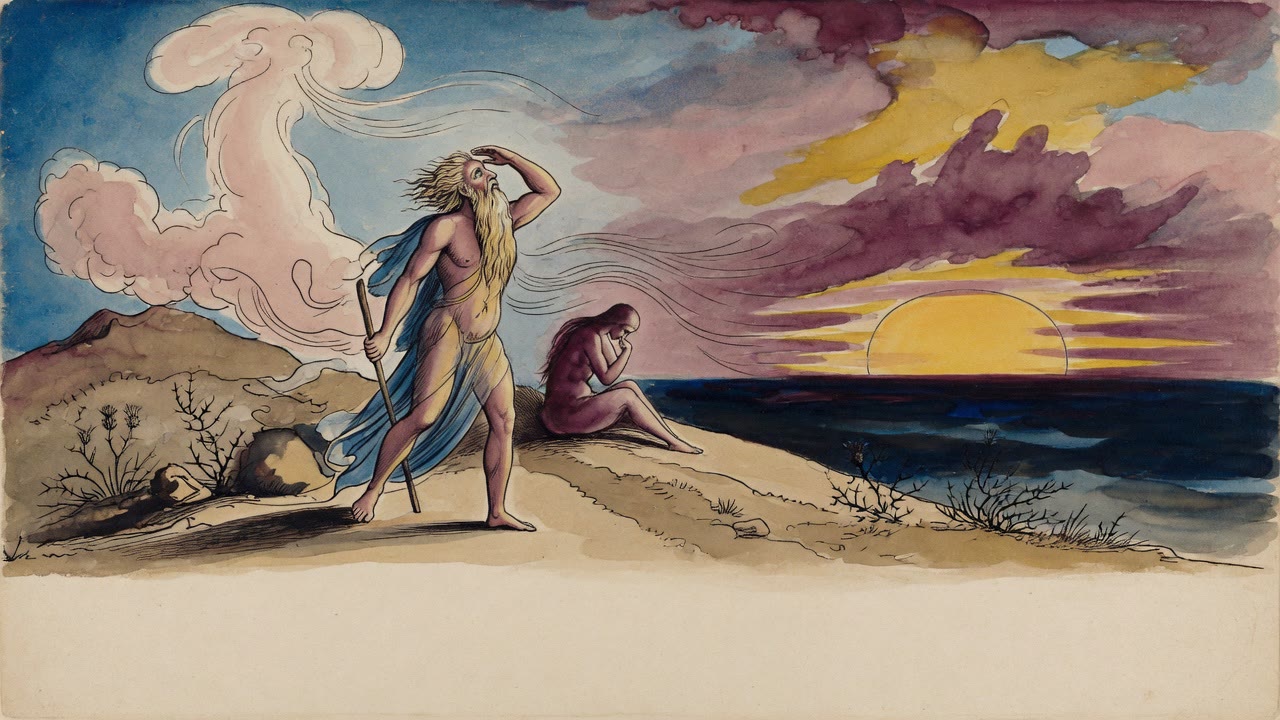
When God finally speaks, the speech is not soft. Foundations of earth, paths of lightning, the birth of ice. Job is asked if he was present when the morning stars sang. He was not. The answer does not explain the dead children. It relocates Job inside a creation larger than his case file.

Job puts his hand over his mouth. The potsherd falls. Ash climbs his wrist like a second skin. In the layers of his soul, something that had almost fled turns back toward the body. Not because the pain is gone. Because the darkness has spoken, and the darkness was never empty.

He will live again. New flocks. New years. The first scars will stay under the new cloth, a private map of the night that was still light to God.

A dog that once slept under his table now watches from a distance, unsure if the ash heap still belongs to a master. Job notices the animal and almost laughs, a cracked sound. Even loyalty needs a map, and the map has burned.

He names his dead children under his breath, one by one, not as argument but as inventory. Heaven already knows the names. Saying them keeps the Ruach from going entirely blank. Blankness would be a kind of death the Accuser would count as victory.

When the whirlwind finally peels the horizon open, Job's friends cover their faces. The speech that follows does not put coins back into empty hands. It puts Job back into a cosmos where behemoth and dawn have equal weight with his case. He learns that being right about his innocence is smaller than being held by a God who can hide in dark without becoming dark.

Years later, when new children run through restored rooms, Job will still flinch at the sound of wind. The flinch is not unbelief. It is memory that the soul can peel and still return, layer by layer, to a body that scrapes and prays and lives.


← All myths
From the tradition

Sources

2 sources

The texts behind this telling. Some cards carry a translation of the source; others are our own retelling of it, and each card says which. Every card links out to the original.

Asarah Perakim LeRamchal 10:4Asarah Perakim LeRamchal

Retold in our words. Read the original at the link below.Sefaria-hosted English translation · CC-BY

Jewish mystical tradition suggests you're absolutely right.

In Asarah Perakim LeRamchal, a foundational text often attributed to the great Kabbalist Rabbi Moshe Chaim Luzzatto (the Ramchal), the soul isn't a single entity, but rather a complex system composed of five distinct levels.

First, we have the Nefesh (the vital soul). This is the most basic level, the life force that animates our physical body. It’s our connection to the material world, our instincts, our drives. Then comes the Ruach (spirit), often translated as "spirit." This is the seat of our emotions, our personality, our sense of self. It’s what makes us… us. The Neshamah, the third level, is where things get really interesting. This is the "soul" in the more traditional sense: our intellect, our higher consciousness, our ability to connect with the Divine.

It doesn't stop there! Beyond the Neshamah are two even higher levels: the Chayah (the living essence of the soul), representing vitality and connection to the source of life, and finally, the Yechidah, the unique, singular essence that binds us directly to God. It’s the spark of the Divine within us.

Now, here's a mind-bender: These levels aren't necessarily bound together forever. The Nefesh, Ruach, and Neshamah can, according to this understanding, reincarnate independently. Parts of your soul’s essence embarking on different journeys, learning different lessons.

The text goes on to tell us that each soul has Levushim, garments or "clothing." These act as coverings or expressions of the soul in different realms. What's fascinating is that souls are sometimes associated with Levushim that aren't quite "their level." Why? That's part of the mystery.

And here's another twist: not all souls are created equal. New souls aren't the same as old souls, and those that have reincarnated once aren’t the same as those who have reincarnated multiple times. It's like spiritual experience accumulates, adding depth and nuance to the soul's journey. It echoes the sentiment that we are all on our own path, at our own pace.

So, what's the grand plan behind all this? Asarah Perakim LeRamchal cites verses from Job, Samuel, Isaiah, and Exodus to give us some clues. "And He, according to reasons that are His own, revolves according to ingenious plans so that His orders may be fulfilled" (Job 37:12). This suggests a divine orchestration, a cosmic plan unfolding in ways we can't fully comprehend.

And from Samuel II, "And he devises plans so that he does not forever banish from His presence him who is banished" (Samuel II 14:14). This hints at redemption, at the possibility of even the most lost souls finding their way back. Isaiah adds, "Everyone that is called by My name, and whom I have created, formed, even made for My glory" (Isaiah 43:7). We are all created for a purpose, a divine calling.

Finally, Exodus proclaims, "The Lord shall reign forever!" (Exodus 15:18), and Isaiah concludes, "Thy people also shall be all righteous, they shall inherit the land forever; the branch of My planting, the work of My hands, that I may be glorified" (Isaiah 60:21). These verses speak to the ultimate triumph of righteousness and the enduring nature of the divine promise.

So, what does all this mean for us? Maybe it means recognizing the incredible complexity and potential within ourselves and everyone around us. Maybe it means understanding that our struggles and triumphs are part of a much larger, divinely orchestrated plan. Maybe it means embracing the journey of the soul, with all its layers, complexities, and possibilities. A beautiful, intricate tapestry woven with divine intention.

Full source
Sefer HaBahir 1:1Sefer HaBahir

Retold in our words. Read the original at the link below.Sefaria-hosted English translation · CC-BY

Take the Sefer HaBahir, for example. This ancient text, a foundation of Kabbalah (Jewish mysticism), dives headfirst into these kinds of paradoxes. It starts with a question posed by Rabbi Nehuniah ben HaKana, a sage known for his profound insights.

Rabbi Nehuniah points out what seems like a flat-out contradiction in the scriptures. In (Job 37:21), it says, "And now they do not see light, it is brilliant in the skies..." So, light is out there, shining brilliantly! But then (Psalm 18:12) throws a curveball: "He made darkness His hiding place." And (Psalm 97:2) adds to the mystery: "Cloud and gloom surround Him."

So, is God light? Is God darkness? Is He both? Is He neither?

It’s enough to make your head spin. But here’s where the Bahir gets really interesting. It doesn't just leave us hanging in the darkness. Instead, it offers a resolution, a way to hold both ideas in our minds at the same time.

The Bahir brings in a third verse, (Psalm 139:12): "Even darkness is not dark to You. Night shines like day, light and darkness are the same." “Light and darkness are the same.”

What does it mean? Does it mean that God transcends our limited human understanding of light and darkness? That what seems like darkness to us is actually just a different kind of light in God's eyes?

The Sefer HaBahir doesn't spell it out completely. It leaves room for us to ponder, to meditate, to wrestle with these ideas ourselves. Maybe the point isn't to solve the riddle, but to embrace the mystery. Maybe the Divine is present in both the light and the darkness, and our task is to find Him. Or Her, in both.

It's a beautiful, challenging, and ultimately hopeful message. Even when we feel surrounded by darkness, the Bahir reminds us that even that darkness is not dark to God. And perhaps, within that darkness, we can find a light we never knew existed.

Full source