5 min read

Job Watches the River of Blessing Run Dry

The heron that hunted this bank is gone and the insects sound careful. Three friends arrive with advice about sin. Job scrapes a potsherd across his boils.

Curated by Arthur · Told by Maggid ·
Table of Contents
  1. The River Stops
  2. The Ox on the Left
  3. Temples in a Dry Bed
  4. Breath of the Heart
  5. When the Channel Opens
Job Watches the River of Blessing Run Dry Click for full size

The River Stops

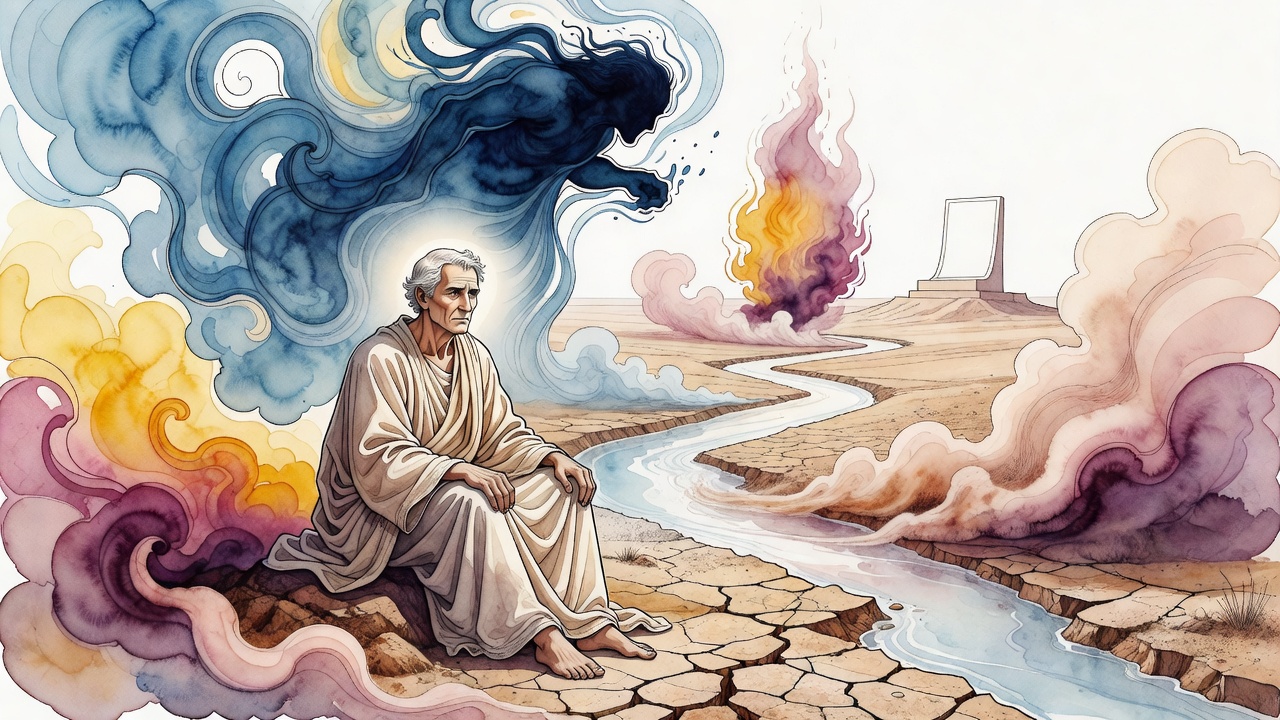
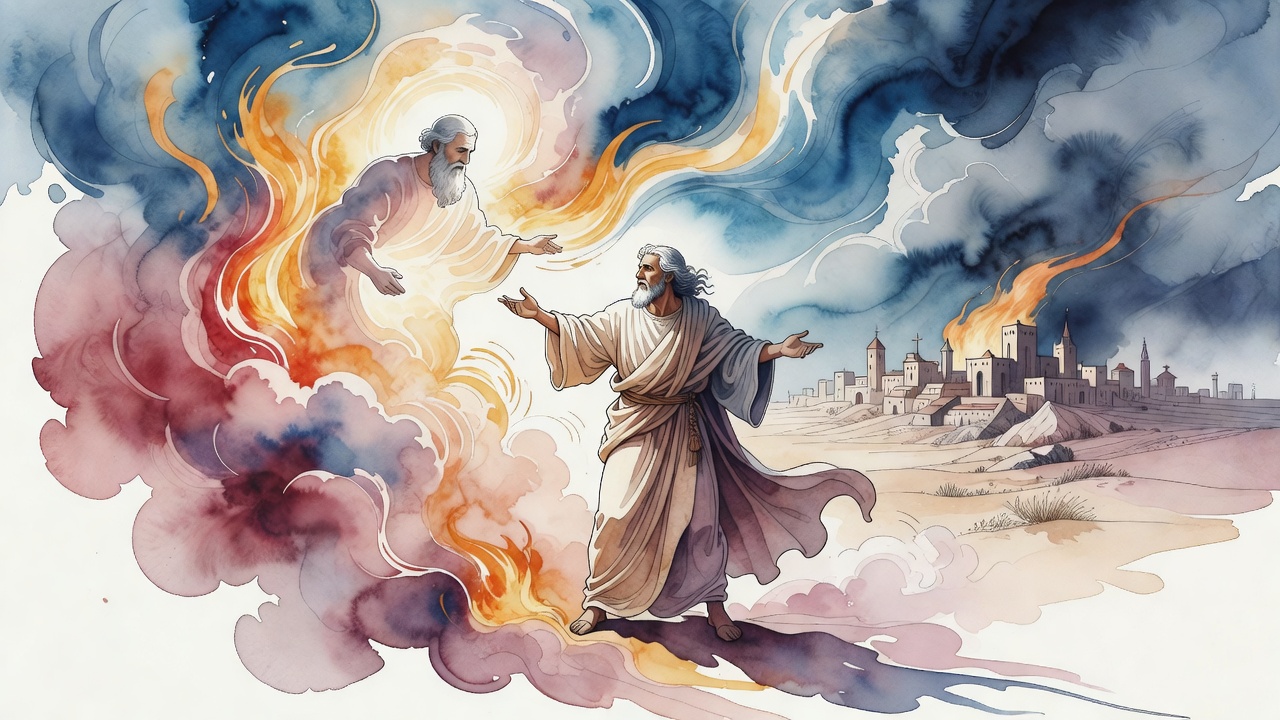
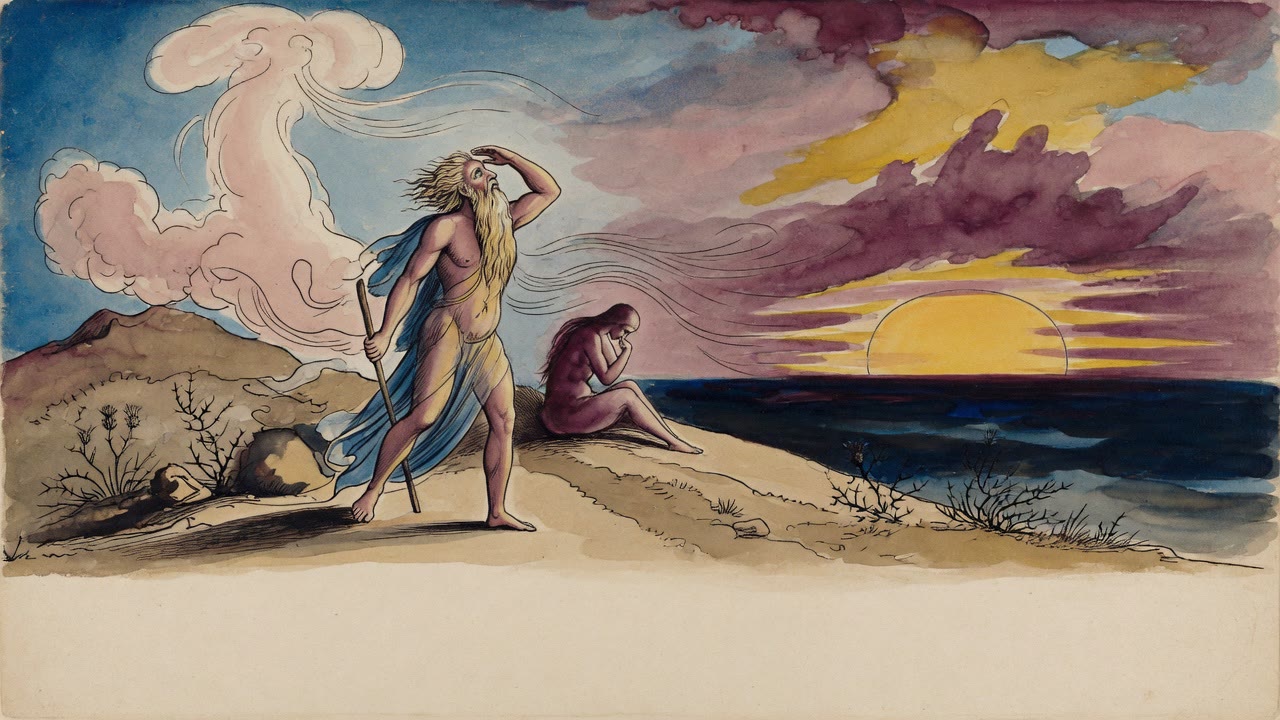
Job walks the bank at dawn and finds mud where current used to talk. "Waters fail from a lake, and a river becomes parched and dries up" (Job 14:11). He knows rivers. He has watered flocks from kinder seasons and watched spring flood leave gifts of silt. This drying is not weather only. It is a throat closed somewhere higher than the hills of Uz.

Blessing, when it runs, feels like water you do not have to name. When it stops, every dry reed becomes a ledger entry. Job crouches, digs fingers into cracked silt, and understands that the blockage has a face even if the face will not show itself in full daylight. A heron that used to hunt here is gone. Even the insects sound careful.

He stands. His robe hangs looser than last month. The riverbed answers with silence that has edges.

The Ox on the Left

In the map that reads his ordeal from the inside, an ox stands on the left, paired with the heart. Left is Gevurah (גבורה), severity, the side that measures and withholds. The letter Hei rides the breath of that heart like a pulse you can hear only when everything else has quieted. From the north, gold and hard weather arrive together (Job 37:22). North is the direction traders seek for wealth and the direction judgment uses for a cold wind that finds every gap in a tent wall.

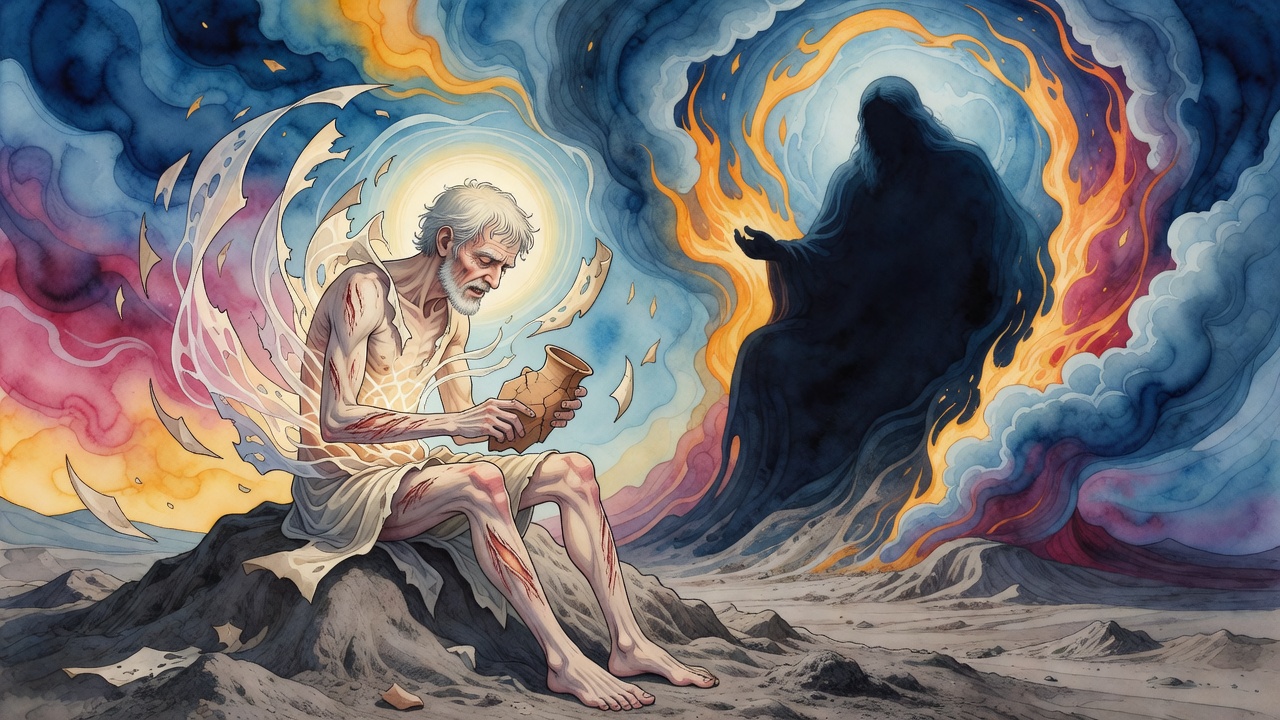
Job's chest tightens as if the ox has leaned its weight on his ribs. The Accuser, Ha-Satan (השטן), the prosecutor who works the heavenly court for God, has already asked leave to test. Permission was not rebellion against heaven. It was a docket number stamped and filed. Now the river's silence is exhibit one, and Job's sores are exhibit two through two thousand.

He does not call the Accuser a second god. He calls for a hearing that will not fake the evidence.

Temples in a Dry Bed

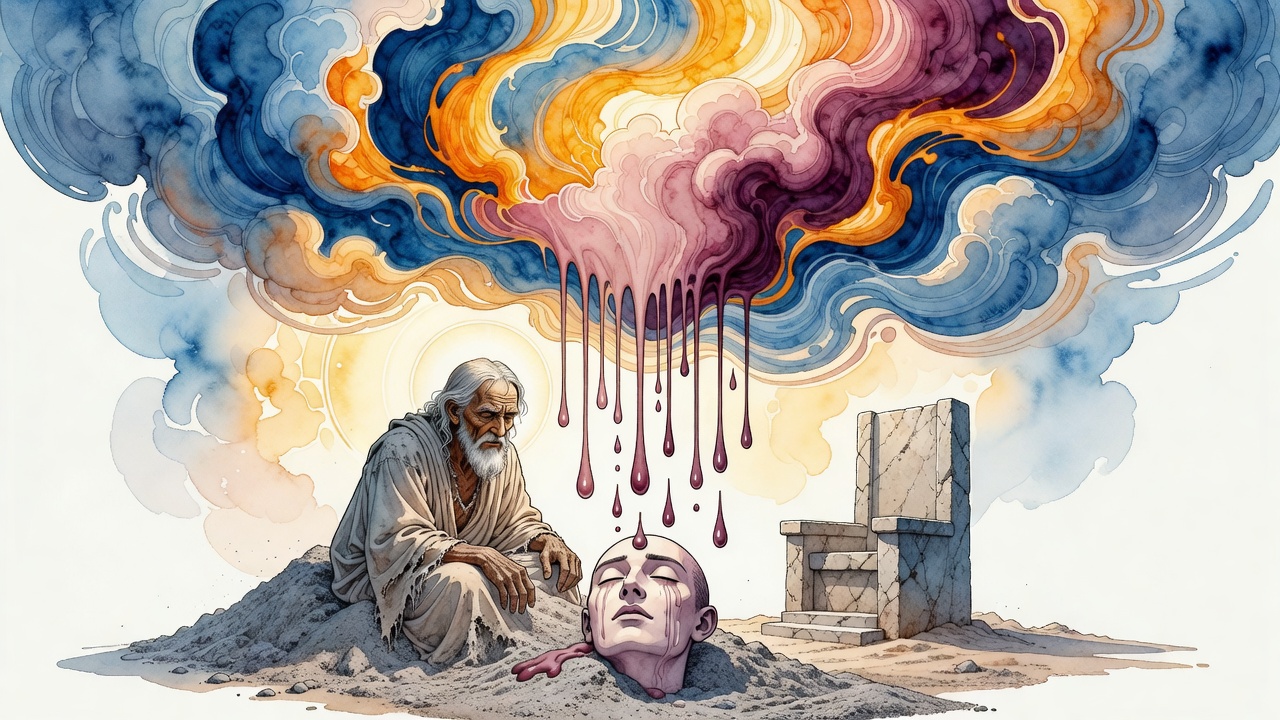
Sages who later stand over the same verse hear more than one man's drought. They hear the First Temple fall into ash and the Second follow, sacred houses becoming parched channels where offering-smoke once rose like a second river toward the sky. Job's private ruin rhymes with public ruin. A blocked flow above becomes rubble below, and widows learn the same vocabulary of thirst.

He does not know Jerusalem's future calendar. He only knows his children are gone, his skin is a map of sores, and three friends have arrived with speeches that sound like full rivers of advice poured into a dead creek. They talk of hidden sin as if confession were a pump handle. The mud stays mud. Job scrapes a potsherd across his boils and refuses to grease the blockage with a false confession designed to make his friends comfortable.

"Though He slay me, yet I will trust in Him," is the edge he walks, trust without makeup (Job 13:15). The friends want a neater story. The dry bed will not give them one.

Breath of the Heart

Hei is breath. When Hei sits in the heart, the old counsel says, the one who would grow rich turns north. Job is not hunting coins in a caravan. He is hunting the right to keep breathing honest words while severity sits on his chest like that ox of the left. Wealth, in this code, is not silver counted at dusk. It is the return of flow, the moment a channel remembers water.

The Accuser waits for a curse aimed at heaven's face. Job gives ash, questions, lawsuits spoken into wind, and a refusal to decorate God's verdict with a lie. Each unbroken sentence is a small channel cut through crust. The ox still stands on the left. The heart still beats under it. Night watches pass. Friends sleep in turns. Job's eyes stay open longer than sleep allows.

He names the north wind without worshiping it. Severity is a servant, not a sovereign.

When the Channel Opens

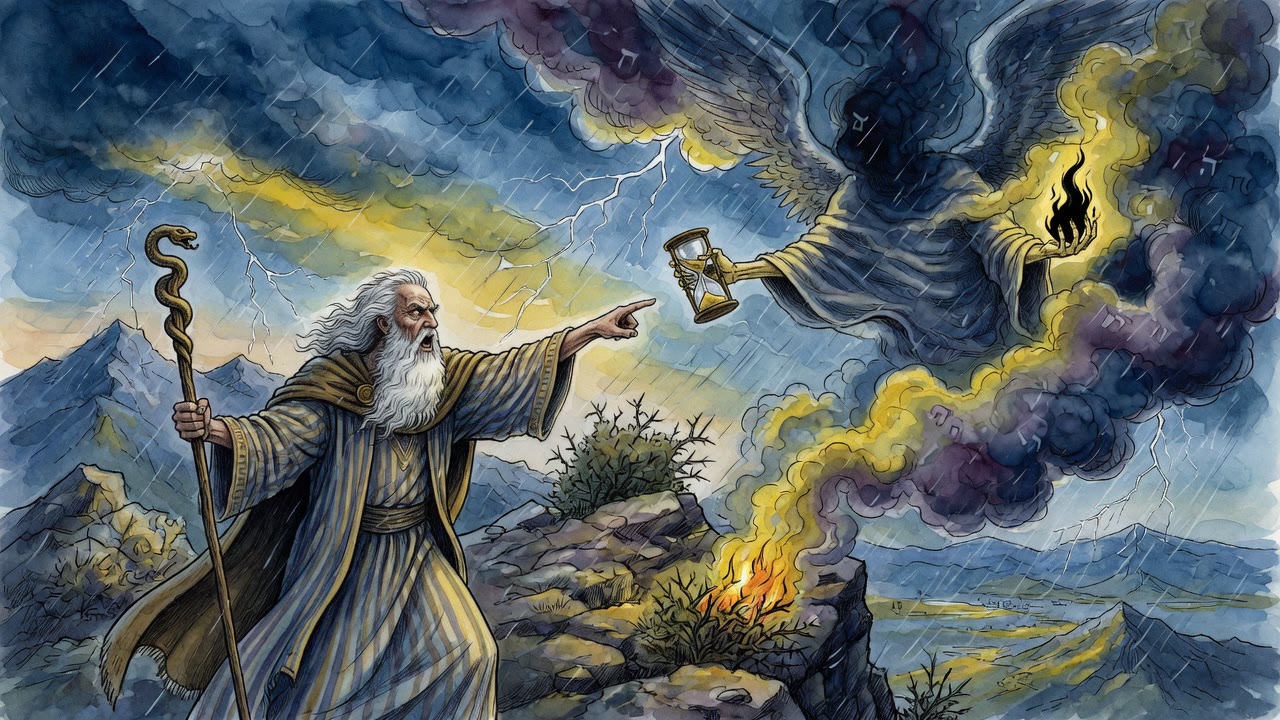
Whirlwind speech will come later, not as a neat receipt but as a voice large enough to make the dry bed feel seen. Behemoth and the storehouses of snow will rearrange Job's sense of scale. Restoration will come in numbers that look like a river in spring, flocks and years returned with interest that cannot replace the first children and somehow still arrives as mercy.

Between those hours Job sits in the cracked channel and keeps the lawsuit alive without resigning his integrity. The land of Uz holds a man who has learned how blessing sounds when it leaves. That knowledge is ugly and useful. Every later exile that watches a sanctuary burn can borrow his ear for the moment the water stops and the speeches begin.

Job presses his palm to the dead riverbed once more. Somewhere above, a seal waits to break. Until then he will not call the drought a kindness, and he will not call the Accuser a rival throne. One court. One Judge. One man still breathing Hei under the ox's weight, waiting for the north to give back what it took without pretending the taking was small.


← All myths
From the tradition

Sources

2 sources

The texts behind this telling. Some cards carry a translation of the source; others are our own retelling of it, and each card says which. Every card links out to the original.

Tikkunei Zohar 46:1Tikkunei Zohar

Retold in our words. Read the original at the link below.Sefaria-hosted English translation · CC-BY

The Tikkunei (spiritual repair) Zohar, a central work of Kabbalah and a companion to the Zohar, explores the inner dimensions of the Torah. In Tikkunei Zohar 46, we find a powerful connection between a verse in the Book of Job and the concept of blocked blessings. "(Job 14:11)...and the river becomes parched, ye-ḥerav. And dry."

The word ye-ḥerav, "becomes parched," isn't just a random word choice. The Kabbalists saw hidden depths, layers of meaning waiting to be uncovered. They believed that even the smallest detail in the Torah could reveal profound truths about the universe and our place within it. So what truth could be found here?

This drying up, this blockage, the text suggests, has cosmic implications. It affects the flow of blessings from above. When things aren't right in the spiritual realms, it trickles down. Or rather, doesn't trickle down, into our everyday lives.

It doesn't stop there. The sages, in Bereishyt Rabbah 2:5, take this imagery even further, connecting it to the destruction of the Temples in Jerusalem. The most sacred place in the Jewish world, reduced to rubble, linked to a parched riverbed.

“The First Temple was destroyed,” the Midrash (rabbinic interpretive commentary) tells us, “is alluded to by (Gen. 1:2) ‘And the earth was formless and void...’” The Hebrew phrase there is tohu va-vohu (תֹ֙הוּ וָבֹ֔הוּ). It's a picture of utter chaos and emptiness.

Then, referring to the Second Temple: “...is alluded to by (Gen. 1:2) ‘...and darkness upon the face of the deep...’” Here the Hebrew is ve-ḥoshekh ‘al-pnei tehom (וְחֹשֶׁךְ֙ עַל־פְּנֵ֣י תְהֹ֔ום). A profound darkness covering everything.

Why these connections? What are the sages trying to tell us? Perhaps that the destruction of the Temples wasn't just a historical event, but a cosmic one. A disruption in the flow of divine energy. A spiritual drought.

The destruction of the Temples wasn’t merely a political or military defeat; it represented a profound rupture in the relationship between humanity and the Divine. The Shekhinah, the divine presence, was, in a sense, exiled. And that exile, that absence, is felt as a dryness, a lack of blessing.

But here's the thing: recognizing the problem is the first step toward finding a solution. Understanding that our actions can impact the flow of blessings, that our choices can either nourish or parch the spiritual landscape, empowers us to become agents of healing and restoration. How can we What actions can we take to bring light into the darkness and end the spiritual drought? These are the questions this ancient wisdom invites us to ponder.

Full source
Tikkunei Zohar 50:9Tikkunei Zohar

Retold in our words. Read the original at the link below.Sefaria-hosted English translation · CC-BY

The Tikkunei (spiritual repair) Zohar is a collection of commentaries on the Zohar, a foundational work of Kabbalah, or Jewish mysticism. It’s dense, poetic, and often requires a guide to navigate its intricate symbolism. one small but fascinating corner: Tikkunei Zohar 50.

The passage starts with an image: "The ox is to the left, corresponding to the heart." What does an ox have to do with our hearts? In Kabbalah, the left side often represents Gevurah (Severity), strength, judgment, and the feminine principle, sometimes associated with the "Mother." The heart, the seat of emotion, is linked to this powerful force.

Then comes the Hebrew letter Hei (ה). "Hei is the breath of the heart." Hei is one of the letters of God's name, the Tetragrammaton. It represents divine presence, and here, it's linked to the very rhythm of our being. The text then quotes (Job 37:22), "From the north, the 'golden' shall come.." and connects it to the Hei in the heart. Interesting. "When Hei is in the heart, then 'one who wants to become wealthy should head north.'" It's a cryptic instruction, but it's not necessarily about material wealth. The "north" is associated with Gevurah, with strength and discipline. So, perhaps, true wealth comes from cultivating inner strength and aligning ourselves with divine presence.

Wait, there's more! The passage continues, introducing Yod-Qof (י-ק), representing "fear and love, Father and Mother, the right and left arm." These are fundamental polarities, the building blocks of creation. The right arm symbolizes Hesed, loving-kindness, the masculine principle, also called "Father". The left, as we mentioned, is linked to Gevurah.

Then comes a reference to (Exodus 34:6), "And He passed-by (vaya'avor).." This verse is central to Jewish tradition, describing God's attributes of mercy and compassion. The text breaks down vaya'avor into Hesed (△72) and Gevurah (△216). These numerical values, according to Kabbalistic numerology (gematria), correspond to the 72 "A-B words" and 216 "R-Y-V letters" of "the 72 Names" of God – powerful divine emanations.

The passage concludes with a fascinating connection: "And this is the mystery of: va-ya'avor – and-He-passed-by the letters of 'ibur – gestation △288, incorporating both-of-them." Ibur refers to the process of conception and formation. The idea is that within the act of "passing by," within God's self-revelation, lies the potential for new creation, a blending of Hesed and Gevurah.

So, what does it all mean?

On the surface, it might seem like a jumble of symbols and numbers. But when we delve deeper, we find a profound meditation on the interplay of divine forces within ourselves and the world. It suggests that by understanding these forces – love and fear, strength and kindness – and by aligning ourselves with the divine breath within our own hearts, we can unlock true wealth: a wealth of spirit, of understanding, and of connection to the source of all being. It is the process of gestation, of constant becoming. As Rabbi Ginsburgh explains, "The first stage in the development of any entity or phenomenon is its conception, or the stage of ibur ('gestation')." (Ginsburgh, The Hebrew Letters).

Perhaps the real treasure isn't found by heading north on a map, but by journeying inward, toward the north within our own hearts. Are we brave enough to begin that quest?

Full source