5 min read

Joel and the Ant Hill Seeds After Seven Years

After seven years of famine, Joel told Israel to plant the last grain. The seed came from ant hills, and the covenant held.

Curated by Arthur · Told by Maggid ·
Table of Contents
  1. Seven Years Without a Harvest
  2. Joel Asked for the Last Grain
  3. The Ant Hills Broke Open
  4. Eleven Days to the Omer
  5. The Covenant Refused the Divorce Bill

On the first day of Nisan, rain struck a land that had forgotten the sound.

For seven years the fields had failed. Storehouses thinned into corners. Mothers measured flour with the caution of surgeons. Men looked at the sky until looking became another form of hunger. Winter came after the seventh year, and winter betrayed them. No rain. No relief. No softening of the earth.

Seven Years Without a Harvest

The calendar had already moved toward spring when the clouds finally opened. Nisan is not the season when a starving farmer relaxes. The planting window had nearly closed. The dry months stood close. A person could hear rain on the roof and still know that water had arrived too late.

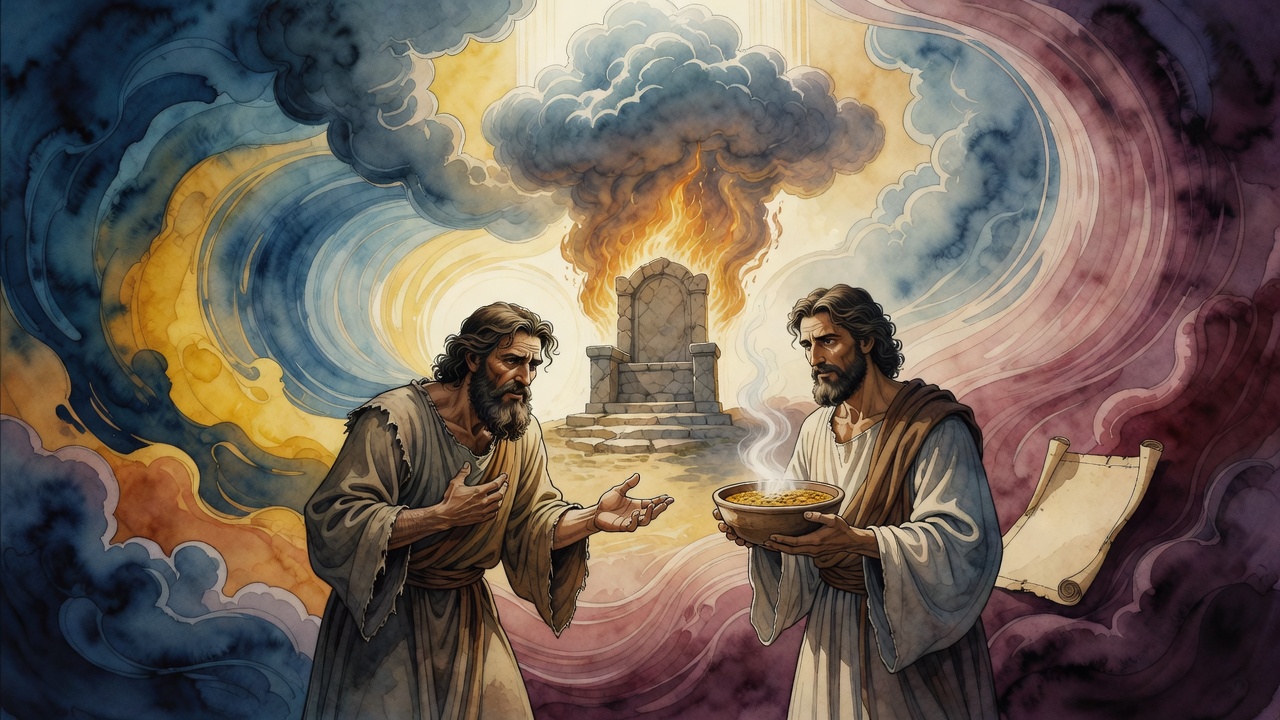
Joel heard more than rain. The prophet told the people to go out and sow.

They stared at him with the practical anger of the hungry. If a man had saved one measure of wheat, or two measures of barley, should he bury it in the ground and die? Seed is future food, but a famine teaches the body to distrust the future. A handful of grain in a sack can keep breath moving for one more day. Grain under dirt looks like surrender.

Joel Asked for the Last Grain

The prophet did not soften the command. Go out and sow.

So they went. Not because the barns were full. Not because the fields looked ready. They went because a prophet had placed the whole nation at the edge of a choice: eat the remnant and lengthen hunger, or plant the remnant and put their bodies between obedience and despair.

Then the ground began giving back what people had not known it held.

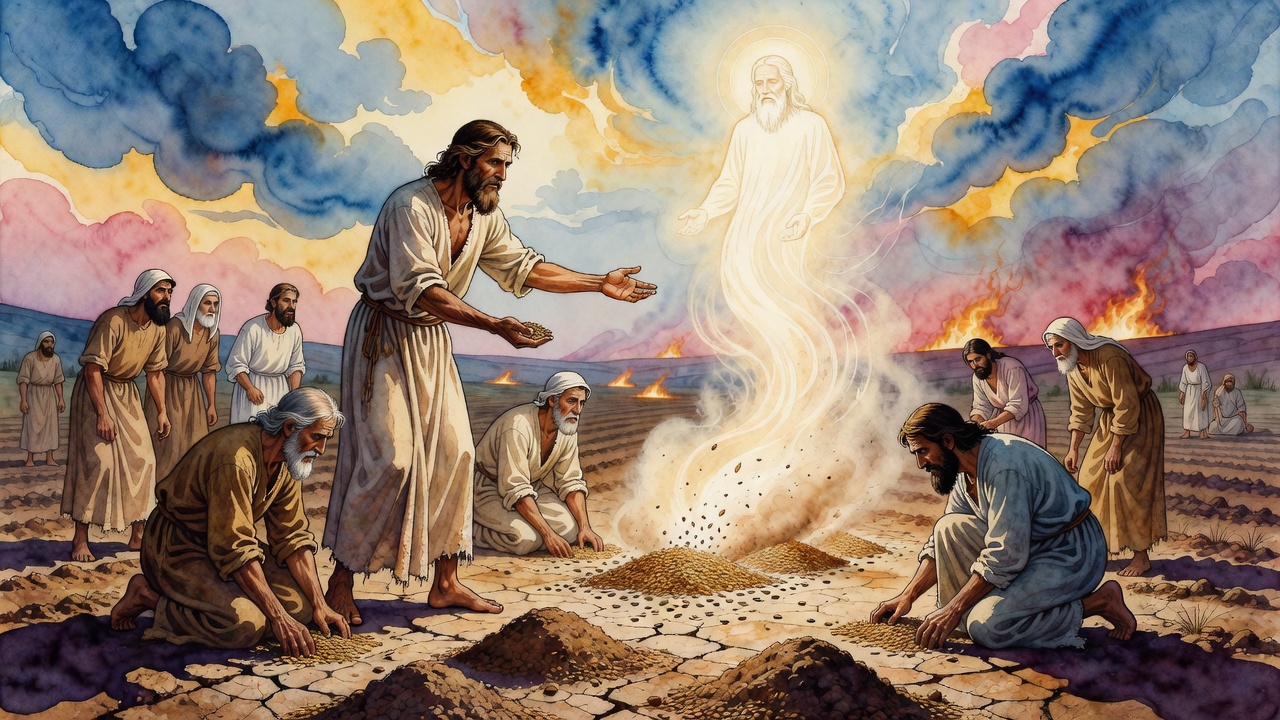
In ant hills, they found grain. In mouse holes, grain. Small stores hidden by small creatures through the long famine, kernels carried underground while human households were emptying above them. The land had looked stripped bare, but beneath feet and beside burrows, seed had been waiting in the dark.

The Ant Hills Broke Open

They gathered from the insects and the mice as if collecting treasure from royal vaults. A few kernels here. A palmful there. Not abundance, but enough for obedience.

On the second day of Nisan, they sowed. On the third, they sowed. On the fourth, they sowed again. The fields that had been mute for seven years received seed from ant hills and mouse holes, the humblest granaries in the kingdom.

The people had argued that planting would kill them. The soil answered by becoming a place where hidden life could be risked. Every cast of the hand was a small burial. Every furrow took food away from a mouth and asked heaven to return it multiplied.

On the fifth day, rain fell again.

Eleven Days to the Omer

Grain does not ripen in eleven days. It does not hear a calendar and hurry. It does not bend itself around the Temple service because hungry people need the world to move faster.

But that year, it did.

The green rose with impossible speed. Stalks hardened. Heads filled. By the sixteenth of Nisan, the Omer offering stood ready at its appointed time. The same people who had nearly eaten their seed now carried the first measure toward the altar.

Tears had gone into the furrows. Joy came back in sheaves. The miracle was not only that grain grew fast. It was that Israel's service did not miss its hour. Famine had tried to break the calendar, and the offering arrived on time.

The Covenant Refused the Divorce Bill

After hunger, Israel stood before God with another fear. The witnesses remained. Heaven and earth had been called to testify against the covenant, and they were still standing over the people like two ancient accusers.

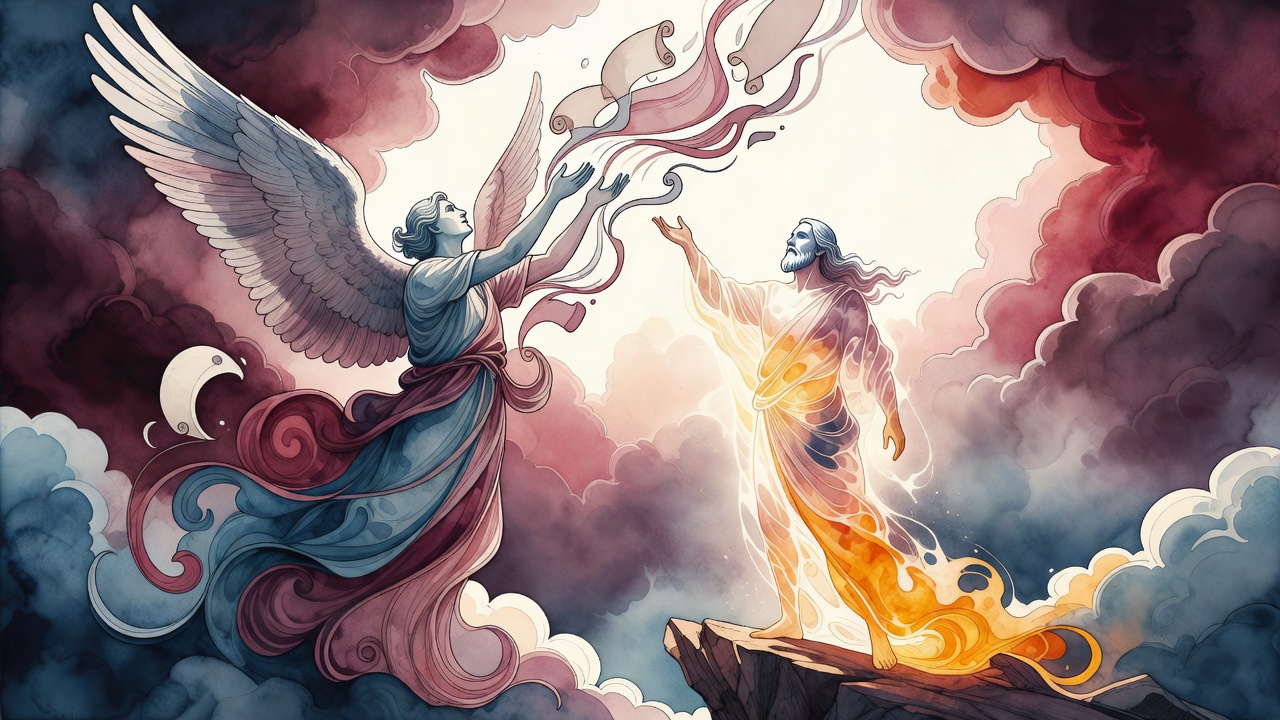
God answered that He would make new heavens and a new earth.

Israel looked at the valleys where shame had happened. God answered that every valley would be raised. Israel feared that the old name still clung to them. God answered with a new name. Israel feared that the names of false powers had been mixed into the mouth of the household. God answered that those names would be removed and not remembered.

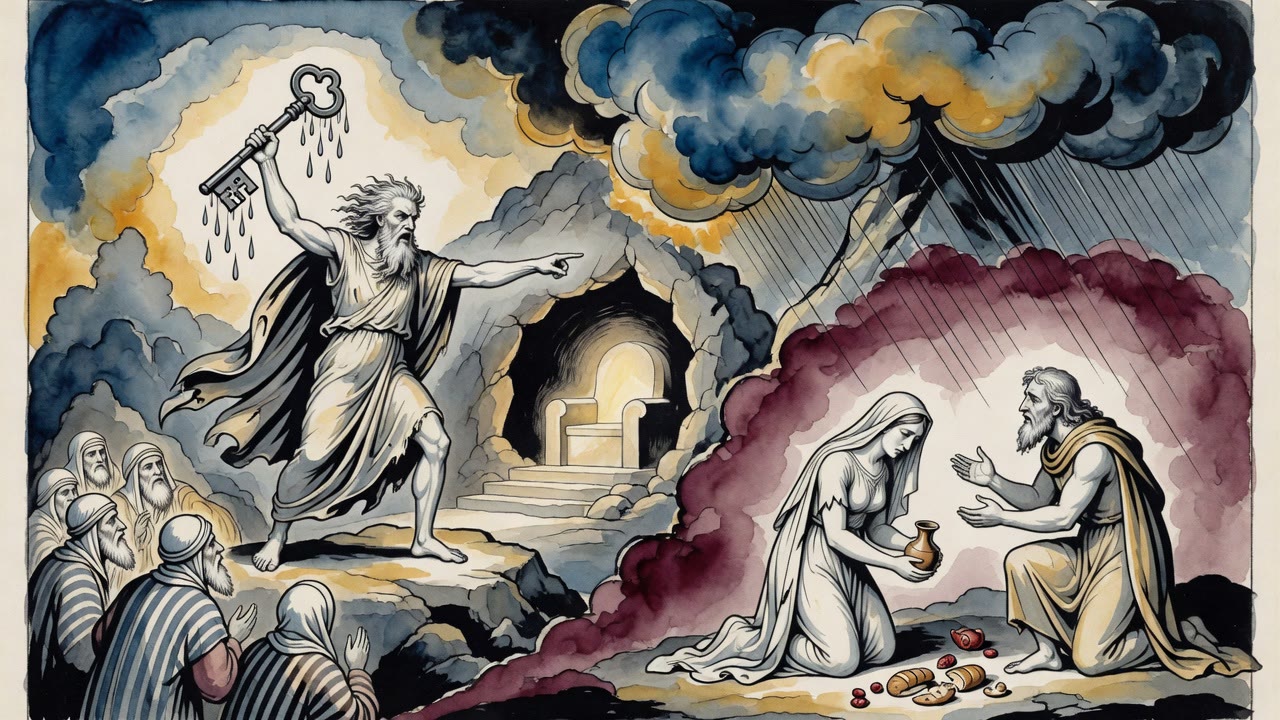
Last came the hardest fear. If a man sends away his wife and she belongs to another, can he return to her? God answered from the depth of the covenant: I am God, not a man. Where is the bill of divorce by which I sent your mother away?

By the sixteenth of Nisan, the altar had grain. The land that looked empty had been hiding seed in burrows, and the covenant that looked exposed before heaven and earth had been hiding its answer in the mouth of God.


← All myths

From the tradition

Sources

2 sources

The texts this telling draws on, in full. Open a card to read inline, or expand it for a wider, quieter read.

Sifrei Devarim 306:2Sifrei Devarim

The ancient text Sifrei Devarim paints a powerful picture of just that feeling, and offers a startling, hopeful response.

The entire congregation of Israel standing before the Holy One, Blessed be He, pleading their case. They cry out, "L-rd of the universe, there's no hope for me! My witnesses – the heavens and the earth themselves – remain, testifying against me!" They are referencing Devarim (Deuteronomy) 4:26 and 30:19, where heaven and earth are called upon as witnesses to Israel's covenant. It's a bleak moment, a reckoning.

Then, a response. A promise. God replies, "I will remove them." And how? By creating new heavens and a new earth, as foretold in (Isaiah 65:17). A clean slate? A fresh start on a cosmic scale? It sounds almost too good to be true.

The people's anxieties don't end there. They continue, "L-rd of the universe, I see the places where I went astray, acted shamefully!" They're haunted by the valleys of their past, echoing the words of (Jeremiah 2:23): "See your way in the valley, know what you have done." The baggage of regret is heavy.

Again, a promise. "I will remove them," God responds, echoing (Isaiah 40:4), "Every valley will be raised." The low points, the shameful episodes – even those will be lifted up, transformed.

Still, the people’s insecurity persists. "L-rd of the universe, but my name remains!" Our identity, our reputation – that's often the hardest thing to shake. But even that, God promises to change. "You will be called by a new name," (Isaiah 62:2). A chance to redefine ourselves? To shed the weight of past associations?

The dialogue continues, probing deeper. "L-rd of the universe, Your name is linked with that of the ba'alim!" The ba'alim, referring to false idols. Even God's name, in some contexts, has been intertwined with idolatry. This is deeply troubling.

"I will remove it," comes the reply, invoking Hoshea 2:19: "And I will remove the names of ba'alim from her mouth." Not only will the idols be forgotten, but the very words used to invoke them will vanish.

The people press further. "Still, those of my household use them!" The insidious nature of ingrained habits, the persistence of old ways. And the response? "They will not be mentioned again by their name" (Hoshea 2:19). A complete cleansing, from the individual to the household, to the very language itself.

Finally, a painful objection, drawing upon legal and marital metaphors. "But You have already written, 'If a man divorces his wife and she leaves him and marries another man, can he return to her again?'" (Jeremiah 3:1). The fear of permanent separation, of irreconcilable differences.

But God's response cuts to the heart of the matter: "Did I not write 'a man'? And have I not already told you, 'for I am G-d, and not a man!'" Citing Hoshea 11:9. God is not bound by human limitations, by the fallibility of human relationships. And the ultimate reassurance: "Where is your mother's bill of divorce by which I sent her away, or to which of My creditors have I sold you?" (Isaiah 50:1). A declaration that there has been no final severing, no abandonment.

What a powerful exchange! It’s a reminder that even when we feel burdened by our past, by the weight of our mistakes, the possibility of renewal, of transformation, always exists. The Sifrei Devarim offers a vision of hope, not just for a nation, but for each of us individually. It challenges us to consider: What witnesses are testifying against us? What valleys need raising? And what new name might we be called? Perhaps the answer lies in embracing the divine promise of a fresh start, a chance to rewrite our story, with God's help, one step at a time.

Full source
Legends of the Jews 6:31Legends of the Jews

There’s a powerful story in Jewish lore, found in Ginzberg's Legends of the Jews, about resilience in the face of famine that’s been echoing through generations.

A land gripped by seven long years of drought. Fields are barren, storehouses are empty, and despair hangs heavy in the air. It’s a truly bleak picture. But in this darkness, a prophet named Joel receives divine guidance, a lifeline thrown to a people on the brink.

The winter following the seven lean years offers no respite. The skies remain stubbornly dry, the earth cracked and thirsty. It seems the suffering will never end. Then, on the first day of Nisan – that's the first month of the Jewish calendar, marking the beginning of spring – the rains finally arrive. A collective sigh of relief must have swept across the land.

Joel, filled with the word of God, urges the people: "Go forth and sow seed!" It sounds almost cruel, doesn't it? To ask starving people to use their precious, dwindling reserves of grain for planting, rather than sustenance.

"Shall one who hath saved a measure of wheat or two measures of barley not use his store for food and live, rather than for seed and die?" they protested. Their reasoning is understandable. It’s a matter of survival. Why risk everything on a gamble?

But Joel insists. "Nay, go forth and sow seed." He speaks with the unwavering conviction of a prophet, knowing that something extraordinary is about to happen.

And it does. A miracle unfolds. The people, driven by faith and the prophet's urging, discover hidden caches of grain. In the ant hills and mouse holes, grain enough for seed is found. It's as if the very earth is conspiring to help them. They cast the seeds upon the ground on the second, third, and fourth days of Nisan.

Then, on the fifth day, the heavens open again, and the life-giving rain falls once more. An even greater miracle follows. Just eleven days later, the grain is ripe, ready for harvest! That’s astonishing, unheard of. The offering of the 'Omer – the first offering of the barley harvest, a ritual with deep spiritual significance – can be brought at the appointed time, on the sixteenth of the month.

This miraculous turn of events, this sudden abundance after so much scarcity, reminds us that even in the darkest times, hope can take root. It reminds us that faith, coupled with action, can yield the most unexpected blessings. It’s no wonder that the Psalmist, reflecting on such experiences, wrote, "They that sow in tears shall reap in joy" (Psalm 126:5). What a powerful image.

This story is more than just a historical anecdote; it’s a timeless parable. A evidence of the enduring power of faith, resilience, and the promise of renewal, even when we’re facing our own personal "seven years of famine." What seeds of hope are you planting today, even when it feels like you have nothing left to give?

Full source