5 min read

Jonah's Underground Tour Inside the Great Fish

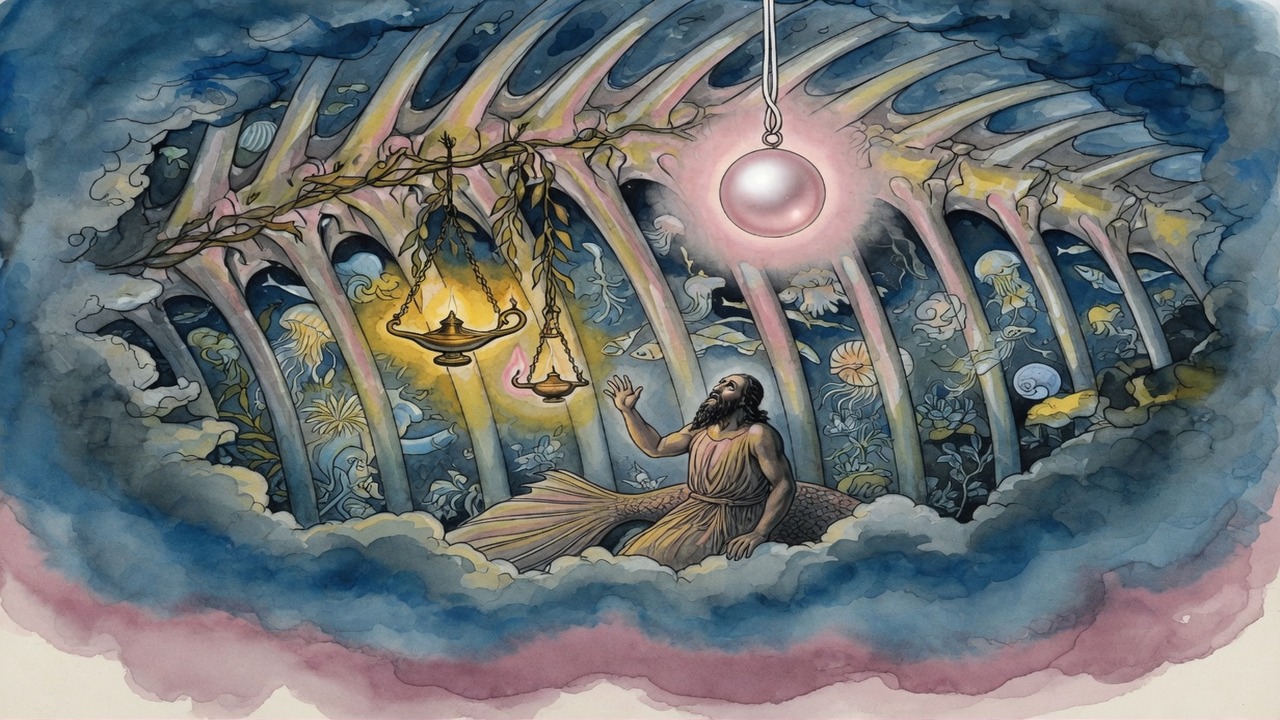
Inside the fish, two lamps lit the dark and a pearl hung from the ceiling so Jonah could see every wonder in the deep.

Curated by Arthur · Told by Maggid ·
Table of Contents
  1. The Swallowing
  2. The Lamp and the Pearl
  3. The Depths Spread Out
  4. The Prayer From the Bottom
  5. The Vomiting Out

The Swallowing

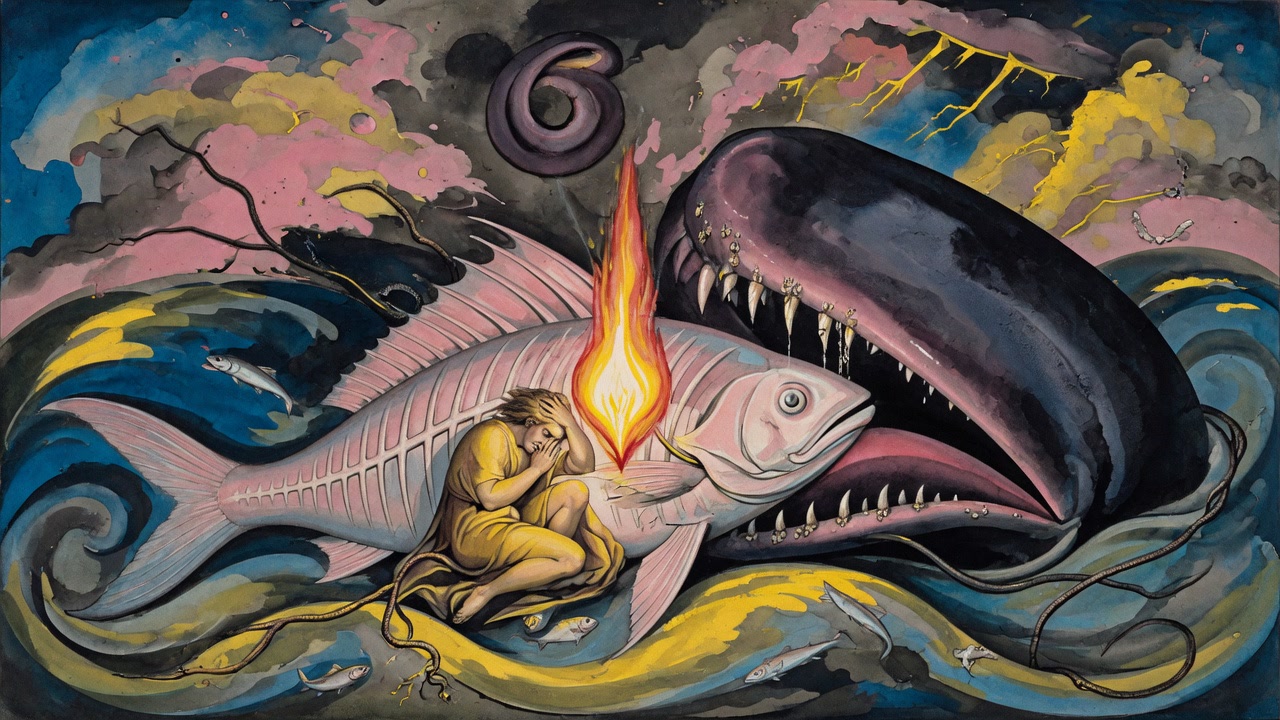
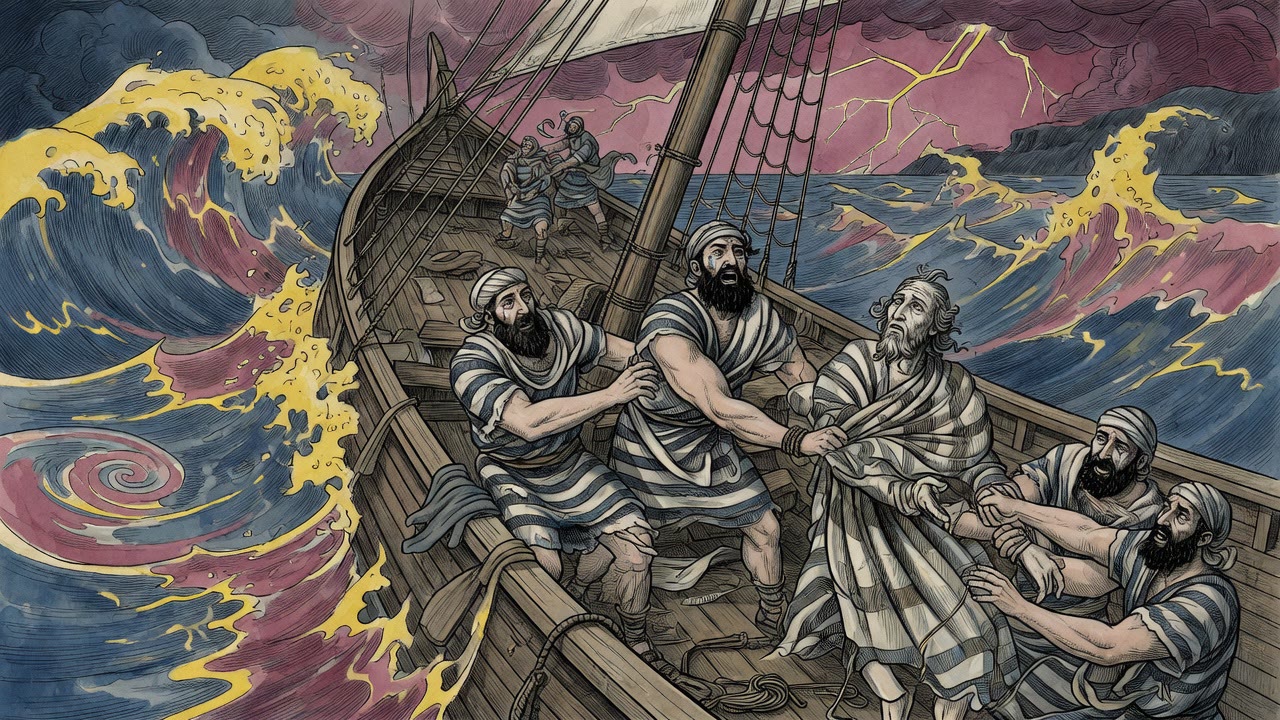
Jonah did not land softly. He had been thrown from the deck into a storm that was already tearing the ship apart, and the fish took him from below before he could drown. One moment: the chaos of water and wind and the desperate voices of sailors who had prayed to every god they knew. The next moment: stillness, darkness, and the smell of something ancient.

He lay there in the stomach of the fish and waited for death.

Death did not come.

The Lamp and the Pearl

The fish, the tradition says, had been prepared for this moment since the sixth day of creation. It was not an ordinary creature that happened to be passing. This was the fish designated from before Jonah was born, perhaps from before Israel existed, certainly from before Jonah boarded a ship in Jaffa trying to escape a God who, as everyone in the story seemed to understand except Jonah, was not escapable.

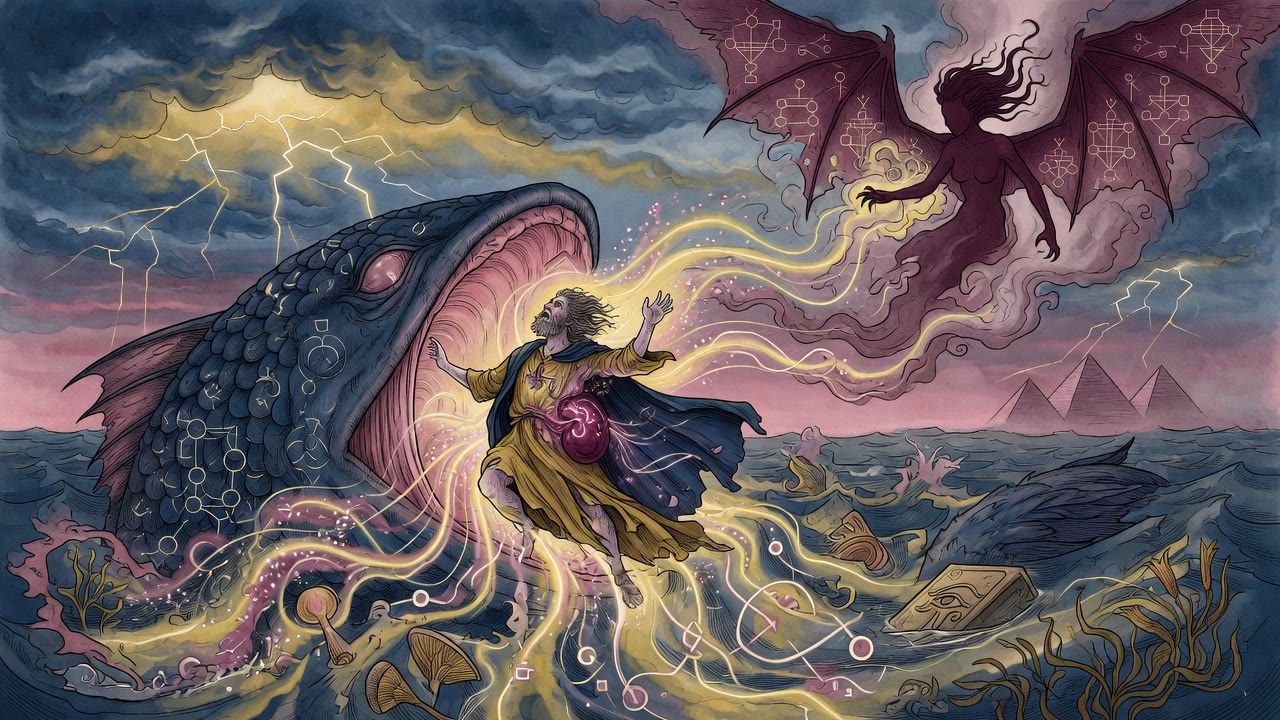
Inside, two eyes of the fish served as windows, and a pearl hung suspended from the belly's ceiling and gave off enough light to see by. Jonah could stand. He could look around. He was not crushed in a dark passage but placed in something that resembled, in its strange way, a room.

Through the eyes of the fish, he saw the floor of the sea. He saw it in detail, in a way no living person had ever seen it, because no living person had ever been exactly here.

The Depths Spread Out

The fish moved through waters that held their own histories. Jonah saw the foundations of the mountains that descend beneath the sea, roots of stone that reach to places the light never touches. He saw the paths the sea takes, the channels cut by the flood in the time of Noah, the seams of the deep where the waters above and below were once divided. He saw Leviathan.

That meeting stopped him. Leviathan was larger than Jonah had imagined anything could be, large enough that the fish itself was small beside it. And Jonah, standing in the belly of a creature that seemed enormous until a moment ago, felt the specific smallness of a man who has been trying to outrun his assignment.

The fish carried him past the place where the sea meets the roots of the land. Jonah saw the pillars of the earth from below, the foundations that hold everything up, the undersides of the world he had always walked on top of. He saw the entrance to Gehinnom from a distance. He saw the locked sea-gate of the wilderness where Israel had passed through on dry ground.

The Prayer From the Bottom

Somewhere in the third day, Jonah prayed. Not because he had given up resisting God, but because what he had seen had broken open something in him that the surface world had kept sealed. You cannot see the foundations of the earth and remain convinced your own reasons for running are substantial. You cannot see Leviathan and maintain the ordinary scale of human self-importance.

He prayed from the belly of Sheol. He said: the waters surrounded me, seaweed wrapped around my head, I went down to the base of the mountains, the earth's bars closed over me forever. And then: but You brought my life up from the pit.

He had not yet been brought up. He was speaking as if it had already happened. That is the grammar of faith in extremity: past tense for things not yet done, because in the depths of the fish, in the dark, having seen everything there was to see beneath the sea, the future and the past felt like the same word.

The Vomiting Out

On the third day the fish went to the surface and opened. Jonah came out onto dry land. He did not look healthy. He did not look like a man who had been on a pleasant underwater tour. He looked like someone who had been inside a fish for three days, which is what he was. But he went to Nineveh. He went without argument, without trying another ship, without a single recorded word of protest. Whatever he had seen in the deep had persuaded him of something the surface world had failed to teach.


← All myths
From the tradition

Sources

4 sources

The texts this telling draws on, in full. Open a card to read inline, or expand it for a wider, quieter read.

Pirkei DeRabbi Eliezer 10:4Pirkei DeRabbi Eliezer

The story picks up with Jonah fleeing God's command to preach repentance to Nineveh. He boards a ship, hoping to escape his divine assignment. But, as we quickly learn, you can run, but you can't hide – especially not from God.

They had traveled just a day's journey when, suddenly, a mighty tempest arose. The sea raged around them. Now, here’s a curious detail: Pirkei DeRabbi Eliezer 10 emphasizes that other ships nearby sailed on in peace. Only the ship carrying Jonah was in mortal danger. The text echoes the verse from the Book of Jonah (1:4): "But the Lord sent out a great wind into the sea, and there was a mighty tempest in the sea, so that the ship was like to be broken."

What do you do when disaster strikes? According to Rabbi Chanina, as quoted in Pirkei DeRabbi Eliezer, the ship was full of people from seventy different nations, each with their own god. Imagine the scene! Each person clutched their idol, fervently praying for salvation. "The God who shall reply and deliver us from this trouble, He shall be God," they cried. But their prayers, as the story tells us, "availed nought."

Where was Jonah in all this chaos? Sound asleep! Overcome by anguish, he'd retreated into slumber. Can you imagine the audacity? Or perhaps the despair?

The captain, desperate, finds Jonah and confronts him. "Behold, we are standing betwixt death and life, and thou art slumbering and sleeping; of what people art thou?" he demands.

Jonah confesses, "I am an Hebrew" (Jonah 1:9).

The captain, recognizing the significance, exclaims, "Have we not heard that the God of the Hebrews is great? Arise, call upon thy God, perhaps He will work (salvation) for us according to all His miracles which He did for you at the Reed Sea." He's remembering the Exodus, the parting of the Red Sea – a powerful evidence of God's might.

But Jonah's response is startling. He doesn't offer a prayer. He doesn't plead for divine intervention. Instead, he says, "It is on my account that this misfortune has befallen you; take me up and cast me into the sea and the sea will become calm unto you" (Jonah 1:12).

He takes responsibility. He acknowledges that his actions, his attempt to flee from God, are the cause of the storm. He offers himself as a sacrifice to save the others.

What a powerful, if unsettling, moment. What does it mean to take responsibility for the chaos we create? To recognize that our choices have consequences that ripple outwards, affecting those around us? Is Jonah's solution the right one? Is self-sacrifice always the answer? The story, of course, continues, but this initial encounter raises profound questions about accountability, divine will, and the interconnectedness of our lives. What do you think?

Full source
Legends of the Jews 8:25Legends of the Jews

The familiar story centers on Jonah, but some of the ancient legends surrounding this famous prophet are truly wild.

When God created the world, He also created a special fish, specifically designed to house Jonah. Not just any fish,. According to these tales, Jonah was as comfortable inside this creature as he would have been in a spacious synagogue! Ginzberg, in his Legends of the Jews, recounts how the fish’s eyes served as windows. And get this – there was a diamond inside that shone brighter than the midday sun! This allowed Jonah to see everything, even to the bottom of the sea.

The story doesn't end there.

There's a whole ecosystem down in the depths, with its own set of rules. One of those rules? When their time comes, all the fish have to go to Leviathan – yes, THAT Leviathan, the massive sea monster – and become lunch. Now, Jonah's fish was nearing the end of its days, and it warned Jonah about its impending fate. Can you imagine the conversation? "Hey, uh, prophet? Just so you know, we're about to become monster food."

So, the fish, with Jonah in its belly, approaches Leviathan. And here's where it gets really interesting. Jonah, ever the bold prophet, proclaims to Leviathan: "I came here for you! It is my appointed task to capture you in the world to come and slaughter thee for the table of the just and pious!" Talk about an entrance!

Apparently, Leviathan wasn’t too thrilled about this prospect. When it saw the sign of the covenant – the brit milah (circumcision) – on Jonah's body, it got spooked and fled. Jonah and the fish were saved!

Now, feeling a little grateful (understandably!), the fish decided to give Jonah a tour. It took him to see all sorts of incredible things. The river from which the ocean flows? Check. The very spot where the Israelites crossed the Red Sea? Check. Even Gehenna (hell) and Sheol (the underworld)? You bet. The fish showed him all sorts of mysterious and wonderful places. It's quite the underwater pilgrimage!

What are we to make of these fantastic additions to the familiar story? Perhaps they are simply imaginative expansions, designed to emphasize Jonah's righteousness and God's power. Or maybe they are meant to remind us that even in the darkest of times, even in the belly of the beast, there is always the possibility of seeing something new, of learning something profound. It makes you wonder what we might see if we, too, found ourselves in such an unlikely place.

Full source
Pirkei DeRabbi Eliezer 10:5Pirkei DeRabbi Eliezer

Jonah, told to prophesy to Nineveh, tries to flee from God's command by hopping on a ship. But a massive storm hits, threatening to sink everyone. And that's where our passage picks up.

The sailors on this ship? They weren't exactly eager to throw Jonah overboard. Rabbi Simeon tells us that they refused at first. Instead, they cast lots, hoping to find another reason for their misfortune. But, wouldn't you know it, the lot fell upon Jonah.

Still, they hesitated! These weren't cruel men. They tried everything else first. Desperate, they started tossing their belongings into the sea, anything to lighten the ship and calm the storm. Pirkei DeRabbi Eliezer emphasizes their efforts, but "it availed nought." It didn't work.

They even tried to row back to shore, fighting against the raging sea. But, as the Book of Jonah itself says (1:13), "Nevertheless the men rowed hard to get them back to the land; but they could not." They were trapped.

Finally, they were left with no other choice. They approached Jonah, standing on the edge of the ship. According to Pirkei DeRabbi Eliezer, they cried out to God, acknowledging their dilemma: "God of the world! O Lord! Do not lay upon us innocent blood, for we do not know what sort of person is this man." They were about to throw a man overboard, but they wanted to make absolutely sure they weren't committing a terrible sin. They were pleading for understanding, for forgiveness in advance. They admit they don't know Jonah, they don't understand why this is happening, but they're desperate.

And then comes Jonah's chilling confession: "…and he says deliberately, On my account has this misfortune befallen you." He takes responsibility. He knows he's the cause.

It's a powerful moment, isn't it? A moment of truth, of accountability. It raises so many questions. What would we do in that situation? Would we take responsibility for our actions, even if it meant sacrificing ourselves? Would we have the courage to face the storm, both literally and figuratively?

The story of Jonah, even in this small excerpt from Pirkei DeRabbi Eliezer, reminds us that our choices have consequences, not just for ourselves, but for everyone around us. And sometimes, the only way to calm the storm is to confront the truth within ourselves.

Full source
Pirkei DeRabbi Eliezer 10:8Pirkei DeRabbi Eliezer

The familiar version gives us the basic tale: prophet disobeys God, gets swallowed by a sea creature, repents, and is spit back out. But what about the details? What was it like inside that fish?

Well, the ancient text Pirkei DeRabbi Eliezer, a fascinating collection of stories and interpretations, dives right into that very question.

The verse from Jonah (1:17) tells us, "And the Lord had prepared a great fish to swallow up Jonah." Prepared? Rabbi Ṭarphon takes that word seriously. He suggests that this wasn't just any random fish that happened to be swimming by. No, this fish, this dag gadol, was specially appointed, specifically created during the six days of Creation, just waiting for this moment. Imagine! A creature whose entire purpose was to play this pivotal role in Jonah's story.

What was it like inside? Forget everything you think you know about dark, slimy bellies. Rabbi Ṭarphon paints a rather… comfortable picture. He says that Jonah entered the fish's mouth as easily as someone entering a grand synagogue. And once inside, he could stand! The fish's eyes, according to this interpretation, were like windows of glass, providing light.

But Rabbi Meir takes it a step further. He describes a single pearl, suspended inside the fish's belly, illuminating the space like the sun at noon. for a second. A pearl, radiating light, showing Jonah everything in the sea, all the hidden depths.

It's a powerful image, isn't it? And it echoes the verse from Psalms (97:11): "Light is sown for the righteous." Even in the belly of a fish, even in the darkest of circumstances, there is light, illumination, and the potential for seeing the world in a new way.

So, what does it all mean? Is it just a fanciful story? Perhaps. But maybe, just maybe, it's a reminder that even when we find ourselves in the belly of the beast, so to speak, trapped in a difficult situation of our own making, there's still a chance for reflection, repentance, and ultimately, for seeing the light. The pearl, the window-eyes...they suggest that even in the most unlikely of places, we can find guidance and a path back to ourselves, and back to the divine.

Full source