5 min read

Jonah Was Claimed by Zebulun and Asher Both

The rabbis argued over Jonah's tribe for three Sabbaths until one answer let him belong to the harbor and the prophet's house.

Curated by Arthur · Told by Maggid ·
Table of Contents
  1. Rabbi Levi Claimed the Harbor
  2. Rabbi Yohanan Claimed the Widow
  3. The Third Sabbath Settled the House
  4. The Preacher Won Twenty-Two Years

Before Jonah ran to the sea, the rabbis argued over where he came from.

Not Nineveh. Not the belly of the fish. His tribe. The question seems small until the room heats around it. A prophet is never only himself. He carries a father, a mother, a border, a blessing spoken generations before he was born. If Jonah came from the wrong tribe, the verses would not line up. If he came from the right one, the sea in his life had been waiting since Jacob's deathbed.

Rabbi Levi Claimed the Harbor

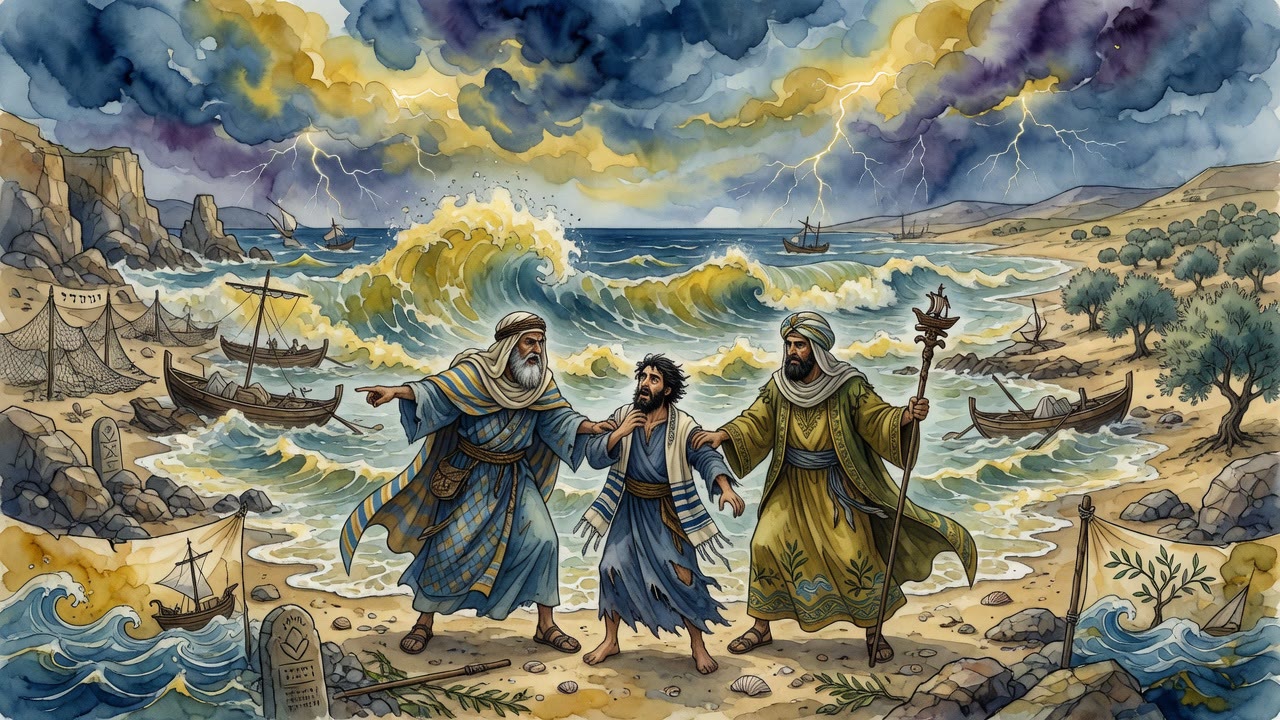
Rabbi Levi stood before the congregation on the first Sabbath and reached back to Jacob's blessing: Zebulun would dwell at the shore of seas. His border would lean toward ships and Sidon. The words smelled of salt. They belonged to sails, ports, rope, and men who knew the weather by the color of the morning.

Then Rabbi Levi placed Jonah inside that blessing. The prophet was from Gat Hefer. The boundaries of Zebulun passed through Gat Hefer. The argument had the clean satisfaction of a map clicking into place. Jonah, the man who would board a ship to flee God, had been born from the tribe whose inheritance faced the water.

The congregation could almost see it. A child of Zebulun growing under a blessing of harbors. A prophet who knew the pull of the coast before he knew the command to preach. The ship at Jaffa did not appear from nowhere. It rose from tribal memory.

Rabbi Levi sat with the confidence of a man whose proof had weight.

Rabbi Yohanan Claimed the Widow

The next Sabbath, Rabbi Yohanan came and overturned the map.

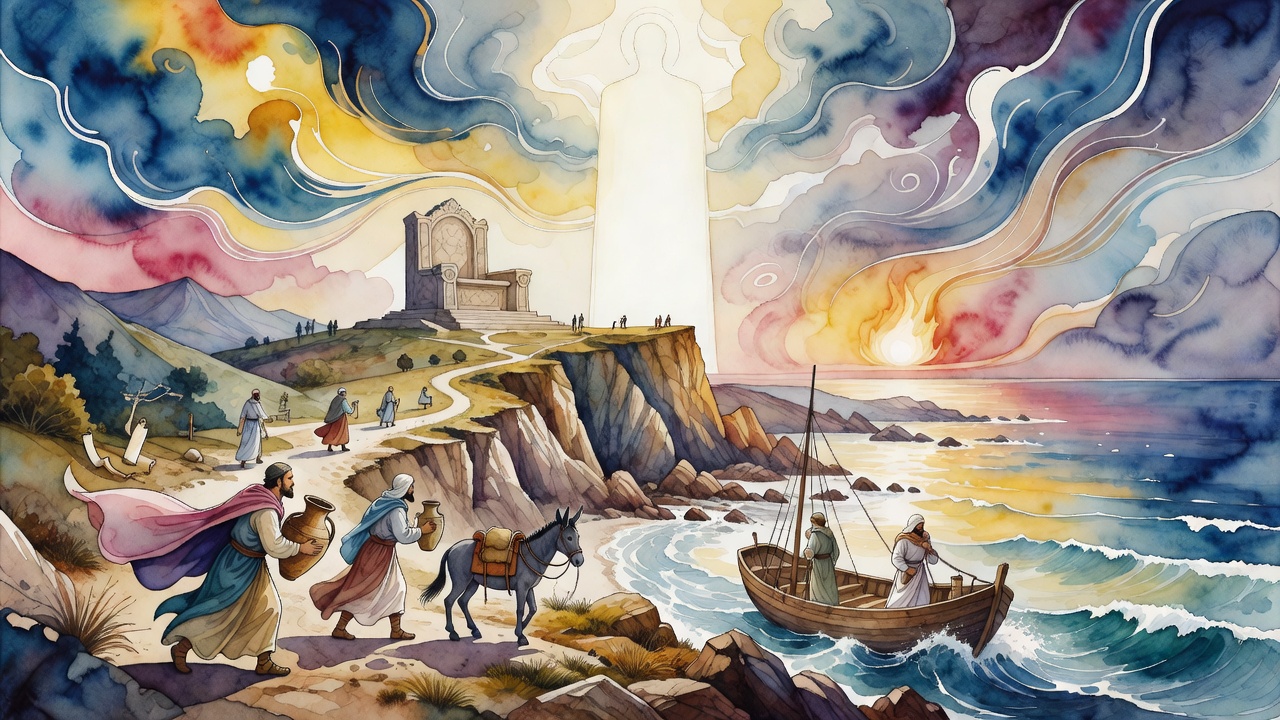
Jonah was from Asher, he said. The proof did not begin with Gat Hefer. It began along the northern coast, near Sidon, where Elijah had once been sent to a widow in Zarephath. That widow had a son. In one old tradition, the child who passed through death and life in Elijah's arms grew into Jonah the prophet.

If so, Jonah belonged to Asher through his mother's house. He was the child of a woman who had watched her jar of meal refuse to empty and her cruse of oil refuse to fail. He was the son who had stopped breathing and then breathed again because a prophet stretched himself over the boy and cried out to God.

That Jonah would later be swallowed into the deep and returned alive does not feel accidental after that. His life had already been marked by descent and return. Before the fish, there was the bed in the widow's house. Before the sea gave him back, breath had once been given back to his body.

The Third Sabbath Settled the House

Two Sabbaths had passed, and the prophet still stood between borders. Zebulun had the map. Asher had the mother. The congregation had heard two good arguments, which is often harder than hearing one bad one.

Then came the third answer. Jonah's father was from Zebulun. His mother was from Asher.

The solution did not split the prophet. It made him larger. His father's line gave him Gat Hefer, the harbor blessing, the tribal road toward ships and Sidon. His mother's line gave him the widow's house, the child restored from death, the memory of Elijah's prayer bending over a body until life returned.

Jonah could belong to both because his mission would require both. He would need Zebulun's sea and Asher's resurrection. He would flee by ship, sink under judgment, pray from a place no man chooses, and come back as one who had already been claimed by two inheritances.

The Preacher Won Twenty-Two Years

The answer did more than settle a genealogy. It gave the preacher a place. The one who reconciled the two claims was kept before the congregation for twenty-two years, a long reward for noticing that a person can carry more than one truth in his blood.

Jonah's story is usually told as refusal. God says go east. Jonah goes west. God sends a storm. Jonah goes down. The rabbis found another current running beneath it. Long before Jonah refused Nineveh, the blessings of Jacob and the miracle in Zarephath had already been folded into him. His flight was not away from identity. It dragged identity onto the ship with him.

The sailors saw one frightened Hebrew. Heaven saw Zebulun's coast, Asher's widow, Elijah's revived child, and a prophet who would have to learn that no border was strong enough to keep him from the God who had named him before he ran.


← All myths

From the tradition

Sources

2 sources

The texts this telling draws on, in full. Open a card to read inline, or expand it for a wider, quieter read.

Bereshit Rabbah 98:11Bereshit Rabbah

Bereshit Rabbah turns to Jonah, Zebulun at the Dawn of Creation.

The verse in question is (Genesis 49:13): "Zebulun will dwell at the shore of seas, and he will be a shore for ships, and his border will be upon Sidon." Seems straightforward. But rabbis throughout the ages love to dig deeper.

Our story unfolds with Rabbi Yehuda bar Naḥman and Rabbi Levi, who were paid two sela (ancient coins) each Shabbat (the Sabbath) to gather Rabbi Yoḥanan’s congregation. These two would deliver Torah discourses until Rabbi Yoḥanan himself arrived. One Shabbat, Rabbi Levi enters and declares something quite intriguing: that Jonah was from Zebulun!

How did he reach this conclusion? Well, he points to (Joshua 19:10), 13, which describes the boundaries of Zebulun's territory, mentioning a passage eastward to Gat Ḥefer. And then to II (Kings 14:25), which tells us that God spoke through Jonah, the son of Amitai, who was from – you guessed it – Gat Ḥefer! Rabbi Levi equates this Gat Ḥefer with the plateaus of Tzippori.

But the story doesn’t end there. The following Shabbat, Rabbi Yoḥanan enters and offers a different perspective: Jonah was actually from Asher. He bases this on (Judges 1:31)–32, which discusses Asher’s failure to dispossess the inhabitants of Akko and Sidon, and I (Kings 17:9), which speaks of Tzarefat, a part of Sidon, where Elijah finds a widow. There’s a tradition, Rabbi Yoḥanan says, that this widow was the mother of a prophet.

Now, you might be thinking, "Wait, which is it? Zebulun or Asher?" This is where it gets even more interesting.

The next week, Rabbi Levi, with a bit of persuasion (and two sela), gets to speak again. He acknowledges Rabbi Yoḥanan’s teaching but offers a compromise: Jonah was from Asher, but his father was from Zebulun, and his mother from Asher! He then interprets the phrase "and his border [veyarkhato] will be upon Sidon" to mean that the "thigh [yarekh] from which he emerged," referring to his maternal lineage, was from Sidon.

The rabbis listening are impressed. They tell him, "You have spoken words of consolation standing; you will come to say them while sitting." In other words, you've earned the right to succeed Rabbi Yoḥanan! And, Rabbi Levi goes on to deliver the main Torah discourse for twenty-two years. Talk about a mic drop moment!

There's even another interpretation offered by Rabbi Elazar, who identifies Sidon in the verse as Zevud of the Galilee, a location known in his time. Rabbi Yoḥanan offers yet another alternative, identifying it as Migdal Deyo.

What can we take away from this whirlwind of interpretations? It shows us that even a single verse can have multiple layers of meaning. It highlights the importance of lineage and how it can connect individuals to different tribes and places. And perhaps most importantly, it demonstrates the value of respectful debate and the pursuit of truth, even when different opinions clash. As we see in Midrash Rabbah, these rabbis weren't afraid to challenge each other, to offer new perspectives, and to ultimately arrive at a deeper understanding of the text.

Full source
Bereshit Rabbah 98:10Bereshit Rabbah

The verse Now, The first reading, it sounds like a blessing of abundance, of a land flowing with good things. But our sages, oh, they saw so much more.

In Bereshit Rabbah, a classic collection of rabbinic interpretations of Genesis, this verse gets a fascinating workout. Rabbi Azarya, Rabbi Yonatan ben Ḥagai, and Rabbi Yitzḥak ben Rabbi Maryon, some even attribute the idea to Rabbi Yosei bar Ḥanina, suggest that the verse is actually a hint about the tribe of Judah. Specifically, that most members of the Sanhedrin, the ancient Jewish high court, hailed from Judah.

How do they get that? Well, it's all in the interpretation. “His eyes shall be red… and his teeth white from milk.” The Rabbis see this as referring to the intense study habits of Judah's scholars. They would "arrange matters of Torah with their teeth until they express them clearly like milk.": chewing over a complex idea, wrestling with it, until it becomes clear, digestible, like pure, white milk. They wouldn't just skim the surface; they would constantly review their studies aloud, debating, questioning, until they achieved absolute clarity. It wasn't enough to just know the Torah; they had to internalize it, embody it, and make it their own.

There’s another layer to this interpretation, another way to understand "His eyes shall be red [ḥakhlili] from wine." This, according to Bereshit Rabbah, refers to the residents of the South. Why the South? Because, we're told, their eyes are bright [keḥulot] and they possess great strength for Torah study. The South, was considered a hotbed of intellectual energy, a place where the pursuit of wisdom burned brightly. The heat of passion, the brilliance of insight – all concentrated in the eyes.

But what about the teeth? "And his teeth white [ulven shinayim] from milk." Here, the Rabbis make an interesting connection. Wine, they say, is better for a person of years [leven shanim] – someone over forty – than milk is for a baby. It’s a commentary on maturity, on the ability to handle something strong and complex. Milk is for the young, for those just starting to learn. Wine is for those who have the experience and wisdom to appreciate its nuances, to savor its depths.

There’s even a little anecdote tucked in here. Someone from the South tells another: "If you drank red wine, it is [good] wine. But if you drank white wine, you have drunk lower-quality wine.” It's a subtle jab, perhaps, a playful way of saying that true wisdom comes from confronting the rich, complex "red wine" of Torah, not the diluted "white wine" of superficial understanding.

So, what does all of this tell us? It's not just about wine and milk, or even about the tribe of Judah. It's about the dedication, the passion, the sheer intellectual horsepower required to truly understand Torah. It's about the importance of wrestling with ideas, of questioning assumptions, of constantly striving for clarity. It’s about the South, a place of bright eyes and strong minds. And maybe, just maybe, it's a little bit about reminding us to drink the "red wine" of deep learning, rather than settling for the "white wine" of easy answers. What do you think?

Full source