5 min read

Joseph Emptied the Throne Room Before Tears

Joseph tested his brothers with a cup in Benjamin's sack, then emptied the throne room, wept aloud, and gave them back his name.

Curated by Arthur · Told by Maggid ·
Table of Contents
  1. The Cup Hid in Benjamin's Sack
  2. Judah's Rage Filled the Room
  3. Benjamin Carried Joseph's Names
  4. Joseph Sent Egypt Outside
  5. The Lost Brother Answered His Own Name

The throne room was close to violence before it became a room of tears.
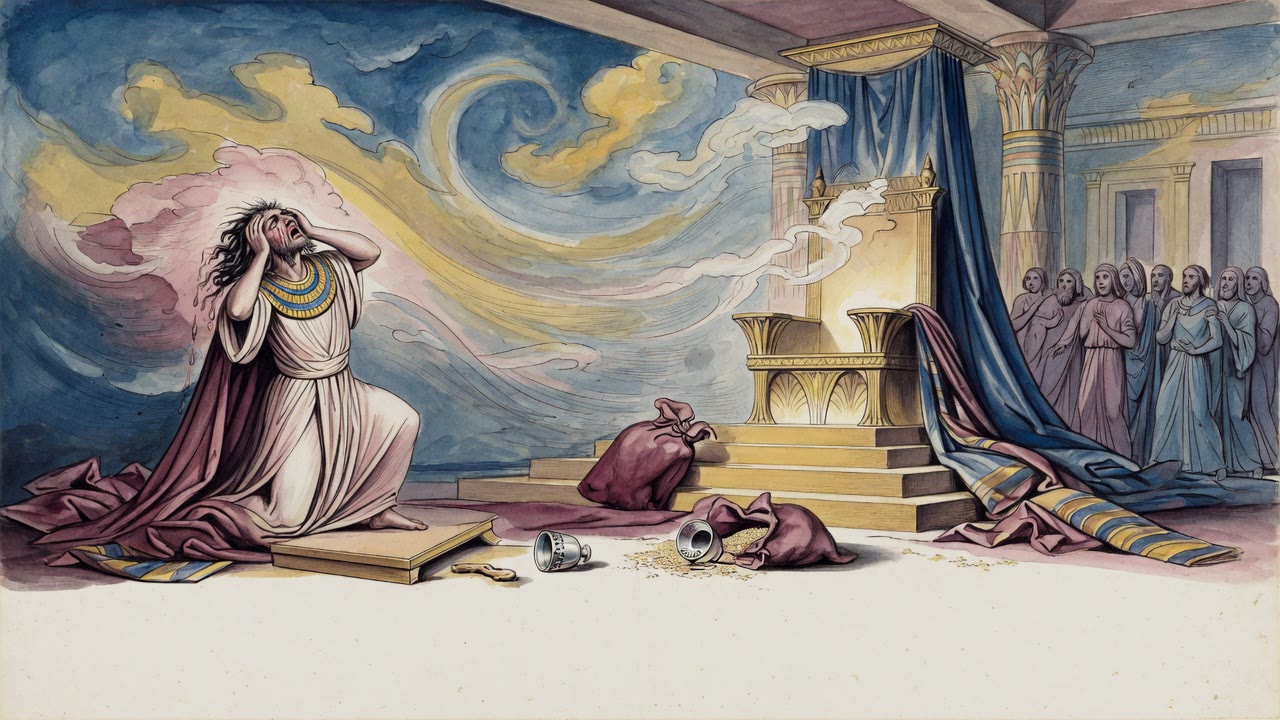
Joseph had arranged the final test with a governor's precision. The silver cup went into Benjamin's sack. The brothers left Egypt with grain, fear, and one more hidden weight. Then the soldiers overtook them, opened the bags, and found the cup exactly where Joseph had placed it.

The Cup Hid in Benjamin's Sack

The question was older than the cup. Would the sons of Jacob abandon Rachel's child a second time? Years earlier they had watched Joseph disappear into slavery and carried a bloodied garment home. Now another son of Rachel stood accused in Egypt, and the road back to Canaan could open if the brothers let him fall.

They did not leave him.

They tore their garments, loaded their animals, and returned to the city. Benjamin's face carried the whole family's terror. Judah stepped forward because he had promised Jacob that the boy would come home. Simeon, Levi, Reuben, the older men, all stood in the room, but the vow belonged to Judah.

Judah's Rage Filled the Room

The governor would not release Benjamin. Judah leaned toward his brothers and let his anger slip out in a whisper. "From this one we begin, and with Pharaoh we finish."

The Egyptian ruler caught every word.

Joseph had hidden his face behind language, rank, and Egyptian dress, but Hebrew still reached him cleanly. He could feel the room tightening. Judah's fury pressed against the guards. His brothers were no longer the men who sold a boy and went home to eat. They were ready to burn the empire down for Benjamin.

A young man from Joseph's side moved to calm Judah's storm. The air thinned. The test was working too well. Joseph had wanted proof of change, not a war in Pharaoh's house.

Benjamin Carried Joseph's Names

Joseph turned toward Benjamin and softened his voice. "Who counseled you to steal the goblet?"

Benjamin swore he had not taken it. He did not reach for a small oath. He swore by the brother he had lost before he could grow beside him. Not by the arrows shot at Joseph. Not by the tunic stripped from him. Not by the pit. Not by the sale to the Ishmaelites. Not by the blood that ruined Jacob's old age.

Then Benjamin opened the names of his sons like wounds. Bela, because his brother had been swallowed from him. Ashbel, because Joseph had been taken captive. Naaman, because his brother's words had been pleasant. Muppim, because Joseph had learned Torah from Jacob's mouth while the others went out with the flocks. Huppim, because Benjamin never stood under Joseph's wedding canopy.

The lost brother had become a father of names in Benjamin's house. Joseph listened to his own absence spoken through a younger brother's children.

Joseph Sent Egypt Outside

Then he ordered every Egyptian out.

It was a dangerous mercy. Alone with eleven shaken men, Joseph gave up the protection of witnesses and guards. One opinion in the heavenly court of memory could call him reckless. Another could call him clean. He would rather risk his life than shame his brothers in front of strangers.

The doors closed. The room shrank to one family and its buried crime.

Joseph looked at the men who had sold him and pressed one final blade against the old lie. "The brother you say is dead, is he truly dead?"

They answered yes.

"Why lie? Did you not sell him?"

The brothers froze. Joseph lifted his voice into the room and called, "Joseph son of Jacob. Joseph son of Jacob."

The men spun toward the corners. They searched the walls, the doorway, the empty spaces behind them. The name they had buried was moving through the air, and no body answered.

The Lost Brother Answered His Own Name

Joseph stopped calling.

"I am Joseph."

The words struck harder than accusation. The governor was the brother. The judge was the boy from the pit. The man with Pharaoh's seal was the child whose cries they had once refused to hear. Their mouths closed. No defense could fit inside the room.

"Is my father still alive?"

That question broke through power, grain, prison, silver, and revenge. Joseph did not first ask why they sold him. He asked for Jacob. Then the tears came with such force that Egypt heard them outside the doors, and Pharaoh's household heard the sound rise through the palace.

Joseph drew his brothers close. The sale had been evil, but heaven had carried life through it. Famine had covered the land, and food now moved from Joseph's storehouses because the betrayed brother had lived long enough to feed the family that wounded him.

Outside, Egypt heard a sob. Inside, the brothers heard a name stand in front of them.


← All myths
From the tradition

Sources

4 sources

The texts this telling draws on, in full. Open a card to read inline, or expand it for a wider, quieter read.

Yalkut Shimoni on Torah 151:2Yalkut Shimoni on Torah

"And he called: send every man out from me" (Genesis 45:1-4). Rabbi Chama bar Chanina said: Joseph did not act properly, for if one of them had kicked him he would have died. Rabbi Shimon bar Nachman said: he acted fittingly and properly, for he did not shame his brothers before the Egyptians. He knew the righteousness of his brothers; he said: Heaven forbid, my brothers are not suspect of bloodshed. He took courage and sat down. He said to them: that brother of yours whom you say is dead, is he certainly dead? They said to him: yes. And why do you tell falsehood? Did you not sell him? I will call him and he will answer me. And he kept calling, "Joseph son of Jacob, Joseph son of Jacob," and they kept looking into the four corners of the house. He said to them: I am Joseph your brother. And they did not believe him until he uncovered himself and showed them the circumcision. "And Joseph said to his brothers: I am Joseph."

Full source
Antiquities II.7-8Antiquities of the Jews (Josephus)

A golden cup hidden in a sack of grain. That was Joseph's final test, not to punish his brothers, but to see whether they had changed. He planted his own drinking cup in Benjamin's bag and sent soldiers to drag them all back. The question burning underneath: would these men abandon their youngest brother the way they had abandoned Joseph decades ago?

The brothers had already been through an ordeal. On their first trip to Egypt to buy grain during the famine, Joseph, now unrecognizable as Egypt's governor, accused them of being spies, demanded they bring Benjamin on their next visit, and kept Simeon as a hostage. Their father Jacob resisted sending Benjamin for months. Only starvation forced his hand.

When Benjamin finally arrived, Joseph could barely hold himself together. He wept in private at the sight of his youngest brother, composed himself, and hosted them all for a lavish dinner. Then came the trap. The cup was planted, the brothers were stopped on the road, and Benjamin was declared a thief.

This time, nobody ran. Judah, the same brother who had proposed selling Joseph to the Ishmaelites all those years ago, stepped forward with one of the most extraordinary speeches in ancient literature. He did not make legal arguments. He talked about his father. He described Jacob's grief over Joseph's disappearance, the old man's terror at sending Benjamin, and the certainty that losing another son from Rachel would kill him (Genesis 44:30-31). Then Judah offered himself as a slave in Benjamin's place.

That broke Joseph. He ordered everyone out of the room, then, weeping so loudly the Egyptians outside could hear, he said: "I am Joseph." He told them not to grieve over what they had done, because God had orchestrated the entire sequence, the pit, the slavery, the prison, the rise to power. So that Joseph would be positioned to save his family from starvation.

Joseph sent wagons loaded with gold, silver, and grain back to Canaan with a single message: bring our father. When Jacob heard Joseph was alive and ruling Egypt, he nearly fainted. God appeared to him at Beersheba and confirmed the journey, promising that Jacob's descendants would become a great nation and that Joseph would close his father's eyes at death. Jacob arrived in Egypt with seventy souls, sons, grandchildren, and their families. And fell on Joseph's neck in a reunion that had taken over two decades.

Full source
Legends of the Jews, I. Joseph, Joseph Makes Himself KnownLegends of the Jews

Legends of the Jews (Ginzberg) turns to Joseph Makes Himself Known.

We've seen Joseph rise to power in Egypt, second only to Pharaoh himself. We've seen his brothers unknowingly travel to Egypt seeking grain during a famine, and we’ve watched Joseph, unrecognizable after years apart, test them, subtly manipulating events to see if they've truly changed since they sold him into slavery. Now, according to Ginzberg's Legends of the Jews, Joseph sees that his brothers are truly on the verge of destroying Egypt in their fury over Benjamin's apparent theft of a valuable cup. He knows it's time.

How to reveal himself? Joseph, ever the strategist, engineers a perfect moment. He uses Manasseh to calm Judah's rage. Then, he gently questions them about the stolen cup. Benjamin vehemently denies any involvement, swearing an oath, invoking the memory of his lost brother Joseph. He cries out, "As true as my brother Joseph is separated from me… I swear that I did not touch the cup!"

Joseph, hearing these words, can no longer contain himself. He challenges them. “You said the brother of this lad was dead. Did you yourselves see him dead before you?” They confirm they did. Joseph presses further, "Did you stand beside his grave?" Again, they say yes. But then Joseph asks, "Did you throw clods of earth upon his corpse?" And this time, they say no.

Joseph seizes on this nuance. According to Legends of the Jews, Joseph reflects that his brothers are still pious and truthful. They believe him dead because, as the story goes, a poor man is like a dead man, and they did throw him into a pit, which they considered his grave. But they didn't actively cover him with earth, which would have been a lie.

It's a moment of intense psychological insight. He declares, "Ye lie when ye say that your brother is dead. He is not dead. You sold him, and I did buy him." Then he dramatically calls out, "Joseph, son of Jacob, come hither!" The brothers are bewildered, looking around for this mysterious Joseph. Finally, he cries out, "Why look ye here and there? Behold, I am Joseph your brother!"

Can you imagine the shock? The text says, "Their souls fled away from them." They are utterly stunned. God, however, performs a miracle and returns their souls to their bodies, allowing them to comprehend the unbelievable truth.

Joseph tries to reassure them, pointing out that he is speaking to them in Hebrew, proving his identity. But they are still in disbelief. The smooth-faced youth they betrayed is now a powerful, bearded ruler! So, Joseph bares his body, revealing the marks of his lineage, proving he is indeed a descendant of Abraham.

The brothers are ashamed and terrified. According to Legends of the Jews, they are so enraged at Joseph for revealing their misdeeds that they want to kill him! But an angel intervenes, scattering them. Judah's outcry is so powerful that the very walls of Egypt crumble!

Despite their fear, Joseph seeks to comfort them. "Now be not grieved, nor angry with yourselves, that ye sold me hither, for God did send me before you to preserve life." He emphasizes that he harbors no vengeful thoughts. He uses vivid imagery, saying, "As little as I harbor vengeful thoughts in my heart against Benjamin, so little do I harbor them against you."

Finally, his words begin to soothe them. They approach him, and Joseph, weeping, embraces and kisses each of them. He weeps because his prophetic spirit shows him the future enslavement of their descendants. He particularly weeps on Benjamin's neck, foreseeing the destruction of the two Temples, which would be located in Benjamin's territory. And Benjamin weeps for the sanctuary at Shiloh, in Joseph's territory, which is also destined for destruction.

Pharaoh, relieved by the reconciliation, welcomes Joseph's family to Egypt, offering them the best land. But even in this moment of triumph, there's a hint of future conflict, as some Egyptians worry about the influx of Hebrews.

Joseph showers his brothers with gifts, including changes of clothing for weekdays and the Sabbath. He gives Benjamin five changes of raiment, not to elevate him, but to foreshadow the future glory of Mordecai, a descendant of Benjamin, who would be arrayed in five royal garments. He presents his brothers to Pharaoh, who is impressed by their heroic stature and handsome appearance.

Joseph also provides wagons for his family to travel to Egypt. When Judah discovers that they are ornamented with idols, he burns them. Joseph replaces them with eleven others, including the one he used when he first rose to power, now intended for his father, Jacob. He sends lavish gifts to his brothers' children and wives, and even to his sister, Dinah.

As his brothers depart, Joseph gives them three pieces of advice for their journey: don't take too large steps, don't discuss Halakic (Jewish law) subjects and lose your way, and enter the city before sunset.

What a complex and emotionally charged moment! Joseph's revelation is not just a personal reunion; it’s a pivotal point in the history of his family and, ultimately, the Jewish people. He transforms potential tragedy into a moment of reconciliation and sets the stage for their future in Egypt. It leaves you wondering: how often do we misinterpret events in our own lives, only to realize later that they were part of a larger plan? And how often do we hold onto secrets, when perhaps, revealing them could lead to healing and understanding?

Full source
Midrash Tanchuma Buber, Vayigash 7:1Midrash Tanchuma Buber, Vayigash

Another interpretation: When Judah saw that Joseph would not be appeased, he began to say to his brothers, "[Why] are we standing here? From this one we will begin, and with Pharaoh we will finish." And they did not know that Joseph understood their language, as it is said, "And they did not know that Joseph was listening" (Genesis 42:23). When Joseph saw this, he began to speak to them with pleadings and with soft language. He said to them, "I do not wish to know anything except about this Benjamin: who gave him the counsel to steal the goblet? Perhaps it was you who gave him counsel to steal the goblet." When Benjamin heard this, he said, "They did not give me counsel, and I did not touch the goblet." He said to him, "Swear to me." He began to swear to him. And by what did he swear to him? By the separation of my brother Joseph from me: "I did not touch him, nor in the shooting of the arrows that were shot at him, as it is said, 'And the archers hated him' (Genesis 49:23); nor in the stripping with which they stripped him, as it is said, 'And they stripped Joseph of his tunic' (Genesis 37:23); nor in the throwing with which they threw him into the pit, as it is said, 'And they cast him into the pit' (Genesis 37:24); nor in the selling with which they sold him to the Ishmaelites; nor in the dipping with which they dipped his tunic in blood, that they did not give me counsel, and I did not touch the goblet."

Joseph said, "Who will make known to me that you are swearing about your brothers truthfully?" He said to him, "From the names of my sons you can know how much I cherish him, for I brought forth their names according to what happened to him." He said to him, "And what are the names of your sons?" He said to him, "Bela, and Becher, and Ashbel, Gera, and Naaman, Ehi, and Rosh, Muppim, and Huppim, and Ard" (Genesis 46:21). He said to him, "Why Bela?" He said to him, "Because my brother was swallowed up (nivla) from me. And Becher, because he was the firstborn (bekhor) to my mother. And Ashbel, because my brother was taken captive (shenishbah). Gera, because he was a sojourner (ger) in lodging. Naaman, because his words were pleasant (ne'imim). Ehi, because he was my brother (ahi) from the same mother, and I have none but him. And Rosh, because he was greater than I. Muppim, because he learned Torah from the mouth (mi-pi) of our father and taught it to me, and all his brothers would return and shepherd, while he sat beside my father and learned from him the traditions which he had received from Shem and Eber. And Huppim, because he was covered over (shenithapeh) until this very day. Another interpretation of Huppim: because I did not see his wedding canopy (huppah) and he did not see my wedding canopy. Another interpretation of Huppim: because until now I am mourning for him and go barefoot (yahef). And Ard, because he brought down (horid) all of us here. Another interpretation of Ard: 'For I will go down (ered) to my son mourning, to Sheol' (Genesis 37:35). I beg of you, do not bring down my father in grief to Sheol." And likewise Judah said, "For how shall I go up to my father, [and the lad not be with me]" (Genesis 44:34).

When Joseph heard this, he could not restrain his compassion, as it is said, "And Joseph could not restrain himself" (Genesis 45:1), "and he gave forth his voice in weeping" (Genesis 45:2), "and Joseph said to his brothers, 'I am Joseph'" (Genesis 45:3). When he said to them, "I am Joseph (your brother)," his brothers could not answer him, for they were terrified before him (Genesis 45:3). Rabbi Eleazar son of Rabbi Simeon said in the name of Rabbi Eleazar ben Azariah: If, in the case of Joseph, who said to his brothers, "I am Joseph," and they knew what they had done to him, they could not answer him, when the Holy One, blessed be He, comes to contend with each and every one of the creatures and to tell him his deeds, as it is written, "For behold, He who forms the mountains and creates the wind and declares to a man what his thought is" (Amos 4:13), how much more so will no creature be able to stand.

Full source