Parshat Vayeshev6 min read

Joseph Left His Cloak in a Festival Trap

Potiphar's wife faked illness to empty the house. Joseph fled, left his garment, and kept the Name that never left his lips.

Curated by Arthur · Told by Maggid ·
Table of Contents
  1. Prosperity Curled His Hair
  2. Day by Day for Twelve Months
  3. The Cloak Became the Evidence
  4. What the Camp Remembered

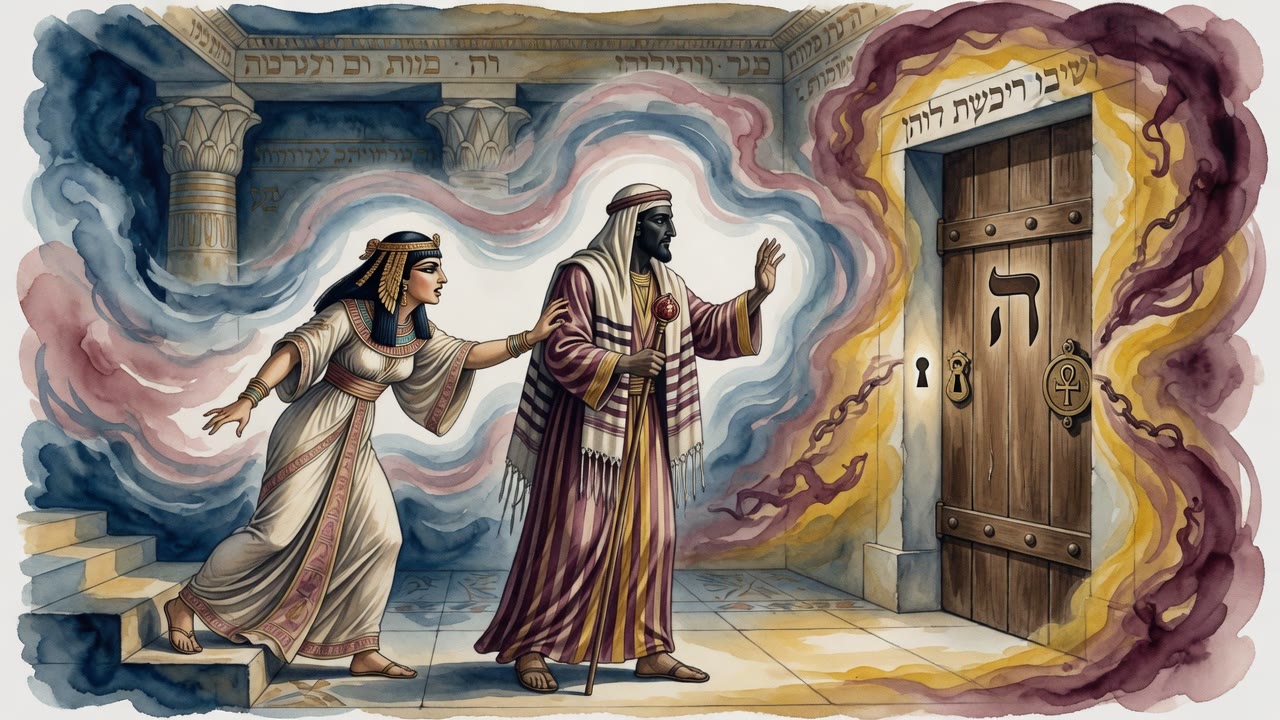
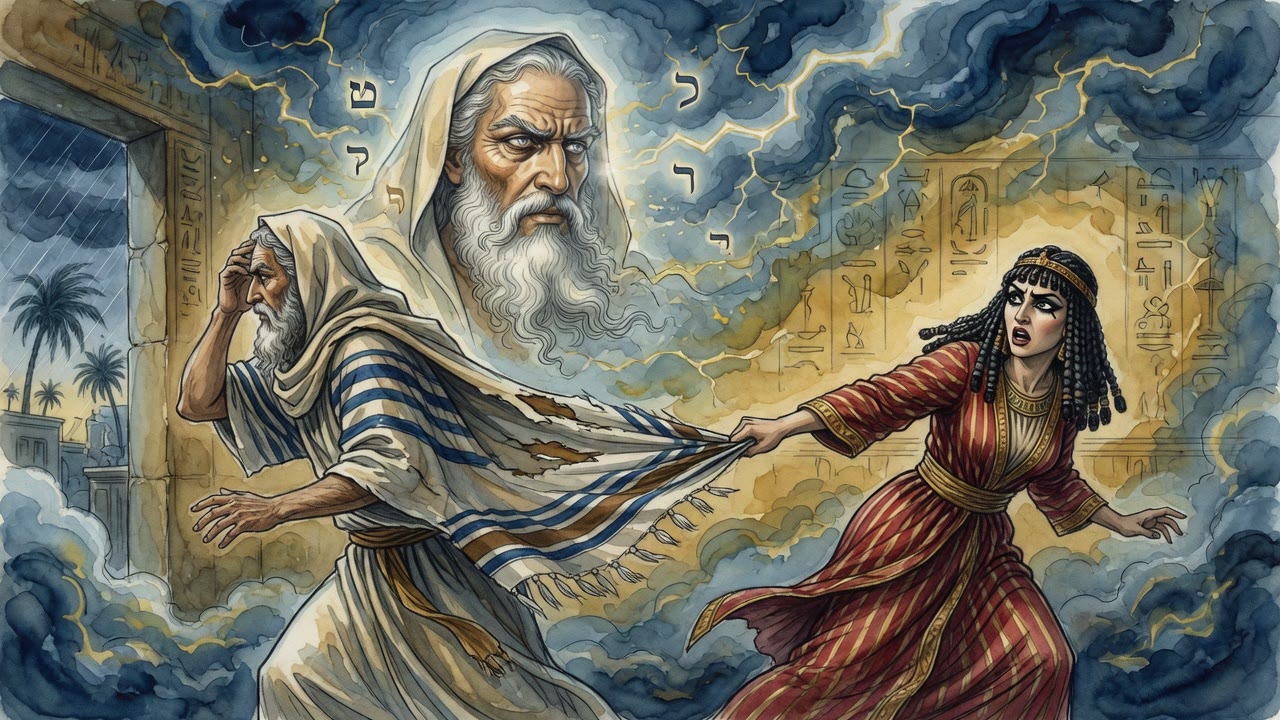
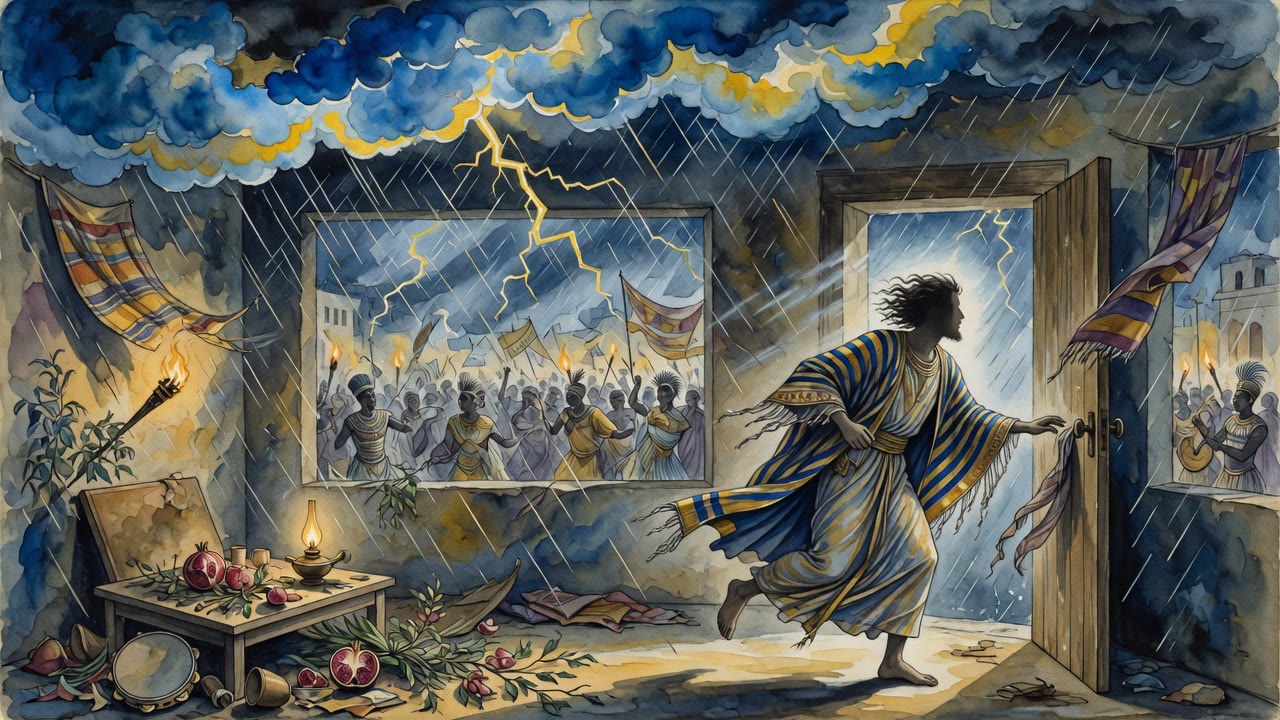
She faked an illness to be alone with him. That detail turns a familiar story into a trap with hinges. Potiphar's wife did not only speak once in a hallway. She engineered a day. A public festival emptied the household. She stayed home "sick." The corridors went quiet. Then she dropped pretense.
Joseph Left His Cloak in a Festival Trap Click for full size

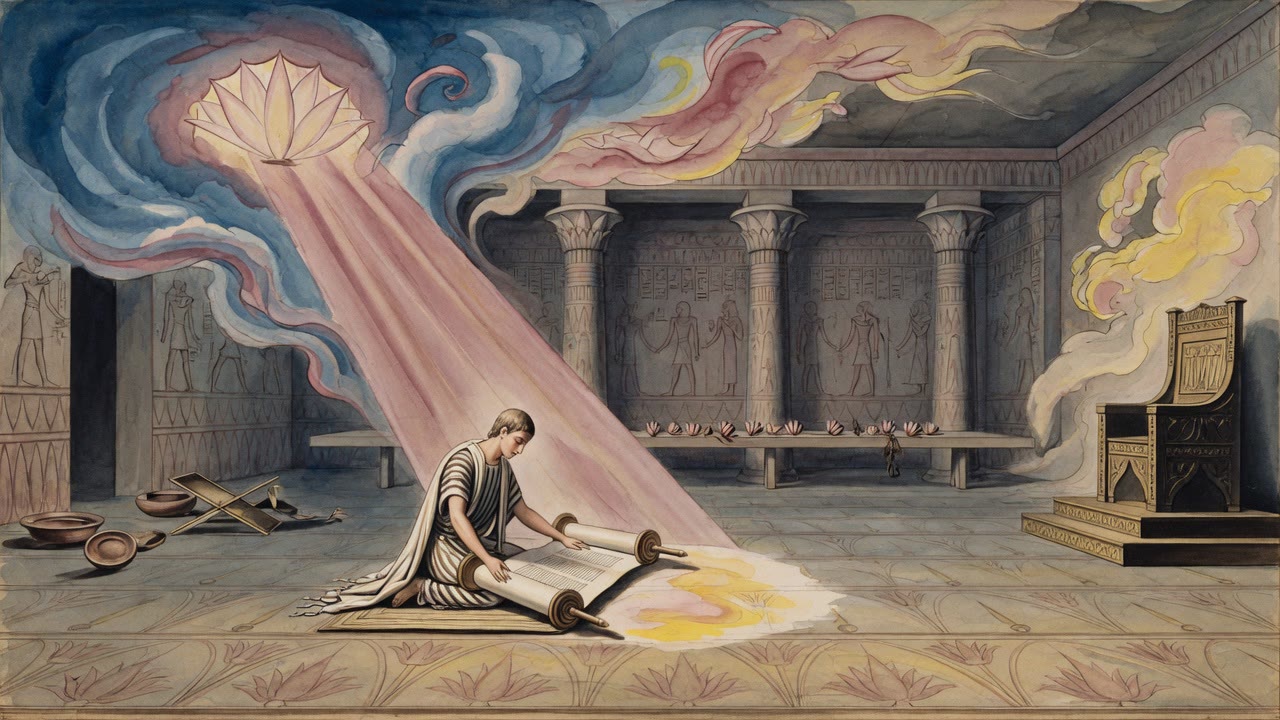
Joseph had risen fast. Bought as a slave from Ishmaelite traders, educated as a free man, set over the estate, fed better than any other servant. The Name of the Holy One never left his lips. When he entered to serve he whispered, Master of the Universe, You are the One in whom I trust. Potiphar asked what spell he was weaving. No spell, Joseph said. A prayer for favor. His master saw that the Lord was with him. Wine changed to the kind demanded. Water obeyed. Keys followed trust. Potiphar stopped concerning himself with the house.

Prosperity Curled His Hair

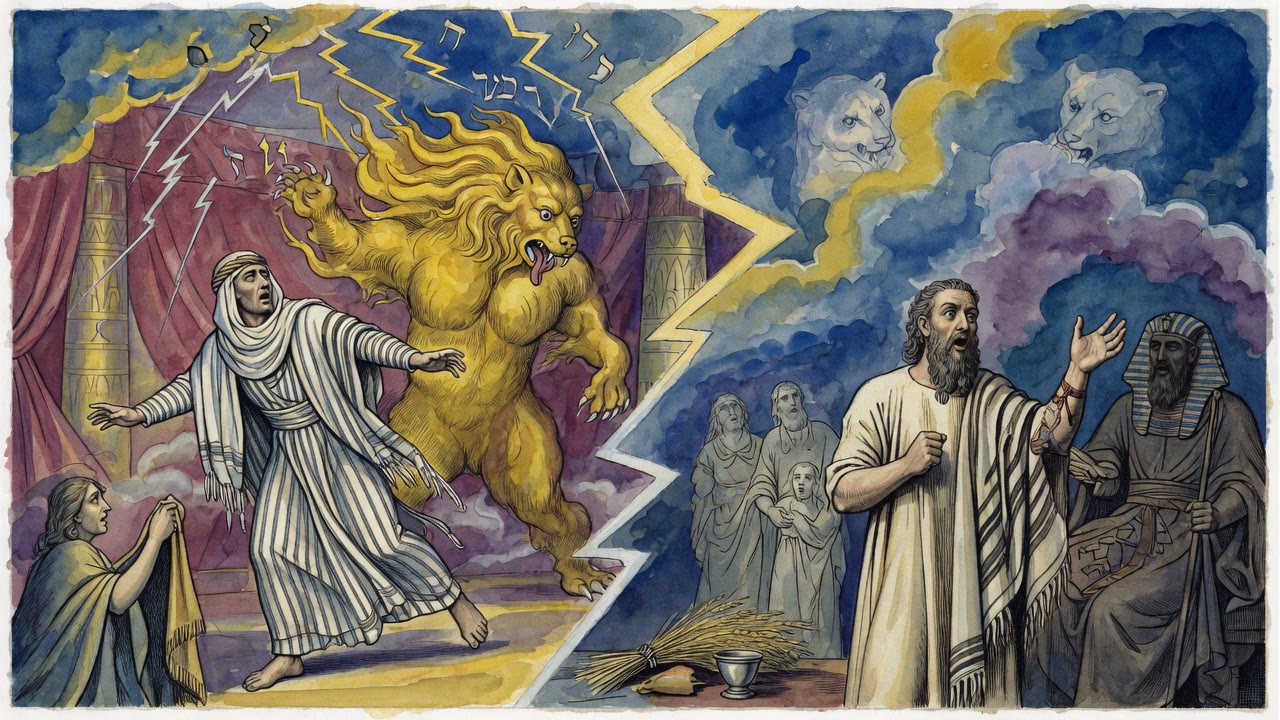
As soon as Joseph realized his own importance, he began to eat, drink, and curl his hair, and say, Blessed be the Omnipotent One who has caused me to forget my father's house. The Holy One rebuked him. Your father mourns for you in sackcloth and ashes, and you curl your hair. Therefore your mistress will impose herself on you and torment you. Measure for measure entered the story through vanity before it entered through lust.

The trials that had already found him traced back to the evil report he once brought against his brothers. He told Jacob they treated the sons of Bilhah and Zilpah as servants. Heaven answered, You will be sold for a servant. He said they looked covetously at native women. Heaven answered, Your master's wife will look covetously at you. The mouth that spoke against kin met a mouth that would speak against him in court.

Day by Day for Twelve Months

She spoke to him day by day, a phrase the sages stretch across twelve months. Whenever she approached, he bent his head so as not to look. She placed an iron spit under his beard so that when he bent, the bar struck him. Still he would not listen. Since I am the wife of another, she said, no one will know. He answered, Your virgins are forbidden to us. How much more the wife of a man. To lie by her in this world would be to be with her in Gehenna (the realm of judgment after death). Anyone who joins an idolatrous woman becomes chained to her like a dog, the paths winding into the waste.

Why did he refuse when the house was empty and the threat was plain? He beheld his father's image, which said, Joseph, the names of your brothers will be inscribed on the stones of the ephod. Do you wish yours to be the only one omitted because of your sin? Therefore he refused. He swore before God he would not commit this great evil. A clear conscience before God and men, he told her, is worth more than any secret pleasure. Concealed wickedness never stays concealed long.

The Cloak Became the Evidence

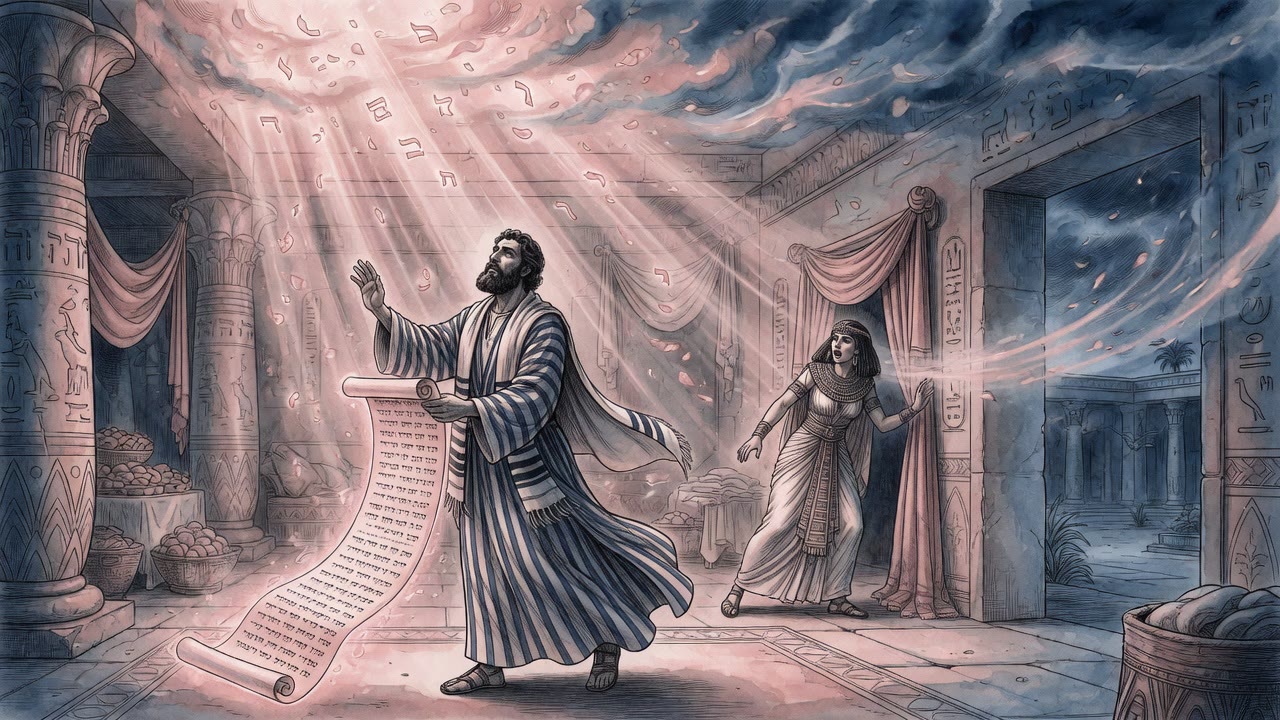
When words failed she grabbed him. Joseph tore free and fled, leaving his garment in her hands. That abandoned cloak became the prosecution's only proof. She arranged herself in grief, tears, dishevelment, righteous fury. When Potiphar arrived she delivered the accusation. The slave you elevated tried to defile your bed. Potiphar chose his wife's tears over his servant's character. He did not investigate. He threw Joseph into prison with common criminals.

Even in chains Joseph committed his fate to God, trusting that the One who knew the truth was more powerful than those who dispensed the punishment. The prison keeper recognized his quality and eased his conditions, a small mercy foreshadowing a larger reversal. The festival trap had worked as a human scheme. It failed as a spiritual one. Joseph left cloth in her hands and kept the Name on his tongue. The ephod stones of the future still had room for his name because he chose a empty corridor's flight over a full house's secret.

Egypt's house of Potiphar is a second pit after the brothers' cistern. Joseph rises again by the Name on his lips and falls again by a woman's hand and a husband's credulity. The midrash will not let the fall be pure victimhood. Vanity prepared the ground when he curled his hair and blessed the forgetting of his father's house. The evil report prepared the measure when he spoke against his brothers. Still the refusal is absolute. The ephod vision is a future of tribal names on stones, and Joseph will not erase his stone for a locked room's pleasure.

Josephus stresses that Joseph argued desire dies without hope, that secret sin becomes public, that conscience before God outranks a mistress's reward or threat. The festival trap is political as much as passionate. Empty houses make false witnesses easy. The cloak is perfect evidence because it is real cloth from a real flight. Truth and falsehood share the same object. Only the story attached to it differs. Prison becomes the next room in which the Name stays on Joseph's tongue.

Day after day for months, the iron under the beard, the bent head, the refusal to look, all of it builds a portrait of resistance that is physical, not only verbal. He is not a statue. He is a man who keeps choosing the harder posture. When he finally runs, the run is the climax of a long practice of saying no. The garment stays. The name for the ephod stays. The prison waits, and beyond it wait dreams that will lift him higher than Potiphar's keys ever did.

What the Camp Remembered


← All myths
From the tradition

Sources

3 sources

The texts behind this telling. Some cards carry a translation of the source; others are our own retelling of it, and each card says which. Every card links out to the original.

Antiquities II.5Antiquities of the Jews (Josephus)

Retold in our words. Read the original at the link below.Antiquities of the Jews, trans. William Whiston · Public Domain

She faked an illness to be alone with him. That detail, from Josephus's retelling in the Antiquities, transforms a familiar story into something far more calculated. Potiphar's wife did not simply proposition Joseph once. She engineered an entire scheme, pretending to be too sick to attend a public festival so the household would empty out and she could corner him with no witnesses.

Joseph had risen fast in Potiphar's household. Though purchased as a slave from Ishmaelite traders, he was educated as a free man, given authority over the entire estate, and fed better than any other servant. Potiphar's wife noticed him, his beauty, his competence. And made her desires known directly. She assumed a slave would consider it good fortune to be wanted by his mistress.

Joseph refused. He told her it would be a sin against God and a betrayal of the master who had trusted him with everything (Genesis 39:9). He urged her to conquer the passion, arguing that desire without hope eventually dies. His refusal only intensified her obsession.

So came the festival scheme. Alone in the house, she dropped all pretense. She offered rewards for compliance and threatened revenge for refusal. She told him plainly: submit, or I will accuse you of assault, and Potiphar will believe me over you. Joseph still refused. He told her that a clear conscience before God and before men was worth more than any secret pleasure. And that concealed wickedness never stays concealed for long.

When words failed, she grabbed him. Joseph tore free and fled, leaving his garment in her hands. That abandoned cloak became the prosecution's only evidence. She arranged herself in a posture of grief, tears, dishevelment, righteous fury. And when Potiphar arrived, she delivered a devastating accusation. The slave you elevated above all others, she said, tried to defile your bed.

Potiphar chose his wife's tears over his servant's character. He did not investigate. He threw Joseph into prison with common criminals. But Josephus notes something critical: even in chains, Joseph committed his fate entirely to God, trusting that the One who knew the truth would prove more powerful than those who dispensed the punishment. The prison keeper quickly recognized his quality and eased his conditions, a small mercy foreshadowing the extraordinary reversal still to come.

Full source
Midrash Tanchuma, Vayeshev 7Midrash Tanchuma

Retold in our words. Read the original at the link below.Townsend 1989 translation of Midrash Tanhuma, S. Buber Recension · CC-BY

His master’s wife cast her eyes upon Joseph (Gen. 38:7). Scripture states elsewhere in allusion to this verse: Death and life are in the power of the tongue; and they that indulge it shall eat the fruit thereof (Prov. 18:21). R. Hiyya the son of Abba declared: If a man should eat from a basket of figs without offering a blessing, death is in the power of the tongue, but if he should pronounce the blessing and then eat it, life is in the power of the tongue. All of the trials that befell Joseph occurred because of the evil he spoke against his brothers, as it is said: And Joseph brought evil report of them unto his father (Gen. 37:20).

What did he tell Jacob? Our rabbis maintain that he told his father: They treat the children of Bilhah and Zilpah as though they were servants. They call them servants, but I act toward them as one does to a brother, as it is said: Even with the sons of Bilhah and with the sons of Zilpah (ibid., v. 2). The Holy One, blessed be He, said to him: Be assured you will be punished with the very word you have spoken, as it is said: And Joseph was sold for a servant (Ps. 105:17).

R. Judah held that he told his father: My brothers eat the limbs of living animals. However, the Holy One, blessed be He, said to him: Even in the hour of their deepest degradation, they will not do that. They will slaughter their animals according to the rules of ritual slaughter, as is said: And they slaughtered the he-goat and dipped the coat (Gen. 37:31).

R. Yosé maintained that he told his father: They looked covetously at the native woman. The Holy One, blessed be He, said to him: Be assured you will suffer from this very thing. You master’s wife will look covetously at you, as it is said: His master’s wife cast her eyes upon Joseph.

Full source
Midrash Tanchuma, Vayeshev 8Midrash Tanchuma

Retold in our words. Read the original at the link below.Townsend 1989 translation of Midrash Tanhuma, S. Buber Recension · CC-BY

But he refused, and said unto his master’s wife (Gen. 39:8). Scripture states elsewhere in reference to this verse: Blessed is the man that trusteth in the Lord (Jer. 17:7). You find that while Joseph dwelt in his master’s home, the Lord was with Joseph, and he prospered, and his master saw that the Lord was with him (Gen. 39:2–3). How did the wicked Potiphar recognize, then, that the Holy One, blessed be He, was with him? In what way was the Lord with him? The name of the Holy One, blessed be He, never left Joseph’s lips. When Joseph entered to serve him, he would whisper to himself: “Master of the Universe, you are the One in whom I trust; you are the One who is my protector, may I find grace, kindness, and mercy in your sight, and in the sight of all who see me, and in the eyes of my master, Potiphar.” Thereupon Potiphar asked him: “What are you whispering about? Perhaps you are trying to weave a spell over me?” “No,” he replied, “I am praying that I may find favor in your sight.” Hence it is written: And his master saw that the Lord was with him.

What is indicated by the words And the Lord made all that he did to prosper in his hands (Gen. 39:3)? While he was pouring spiced wine for his master, his master would ask: “What kind of wine are you giving me?” If he replied: “Spiced wine,” his master would say: “I prefer absinthe wine,” and it would change into absinthe wine. If his master demanded an ordinary wine, it would immediately become plain wine, and if he asked for boiled wine, it would turn into boiled wine. The same thing happened with water and with everything else that he did, as it is said: And the Lord made all that he did to prosper.

When his master became aware of this, he entrusted him with the keys of the household, and concerned himself no longer with any household matters, as is said: Behold, my master, having me, knoweth not what is in the house (ibid., v. 8). As soon as he realized his own importance, he began to eat, drink, and curl his hair, and say: “Blessed be the Omnipotent One who has caused me to forget my father’s house.” Whereupon the Holy One, blessed be He, rebuked him, saying: Your father mourns for you in sackcloth and ashes, but you eat and drink and curl your hair; therefore, your mistress will impose herself on you and will torment you. Hence it is written: His master’s wife cast her eyes upon Joseph (ibid., v. 7).But he refused (ibid., v. 8).

Why did he refuse her? R. Judah the son of R. Shalum declared: He beheld his father’s image, which said to him: “Joseph, the names of your brothers will be inscribed on the stones of the ephod, do you wish yours to be the only one omitted, because of your sinful conduct?” Therefore he refused. And said unto his master’s wife: “Behold my master” (ibid.); that is to say, he said to her: “Behold, you have your husband, are not all men alike? He is not greater in this house than I; neither hath he kept back anything from me but thee, because thou art his wife…. shall I sin against Goḍ? (ibid., v. 9). I swear before God that I shall not commit this great evil.”

And it came to pass, as she spoke to Joseph day by day (ibid., v. 10). R. Judah the son of R. Shalum declared: The words day by day indicate that she spoke to him throughout twelve months, as is said: From day to day, and from month to month, to the twelfth month (Est. 3:7). Whenever she approached to speak to him, he would bend his head in order not to look at her. What did she do then? R. Huna the son of Idi stated: She placed an (iron) spit under his beard so that whenever he bent his head the bar would strike him, as is said: His feet they hurt with fetters, his person was laid in iron (Ps. 105:18). Nevertheless, He would not listen to her.

“Why will you not listen to me?” she pleaded. “Since I am the wife of another man, no one will know that there is anything between us.” He replied: “Your virgins are forbidden to us, how much more so is the wife of a man,” as it is said: Neither shall thou make marriages with them (Deut. 7:3). That is why he would not listen to her. R. Judah the son of Nahman explained: This may be compared to an idolater who tells an Israelite: “I have some delicious food for you.” “What kind of food do you have?” he asks. “The meat of a pig,” he replies. Whereupon the Israelite retorts: “You fool! If the flesh of a pure animal that you kill is forbidden to us, how much more so is the flesh of a pig.” Similarly, Joseph told her: “If your virgins are forbidden to us, how much more so another man’s wife.” He harkened not to her, to lie by her, or to be with her (Gen. 39:10). To lie by her signifies in this world, and to be with her refers to Gehenna. From the fact that Scripture states to be with her, you learn that anyone who has relations with an idolatrous woman becomes chained to her like a dog. Others conclude from this verse” The paths of their way do wind, they go up into the waste, and are lost (Job 6:18), for she clings to him and will lead him to the netherworld.

Full source