6 min read

Joseph Saw Jacob's Face and Left the Garment

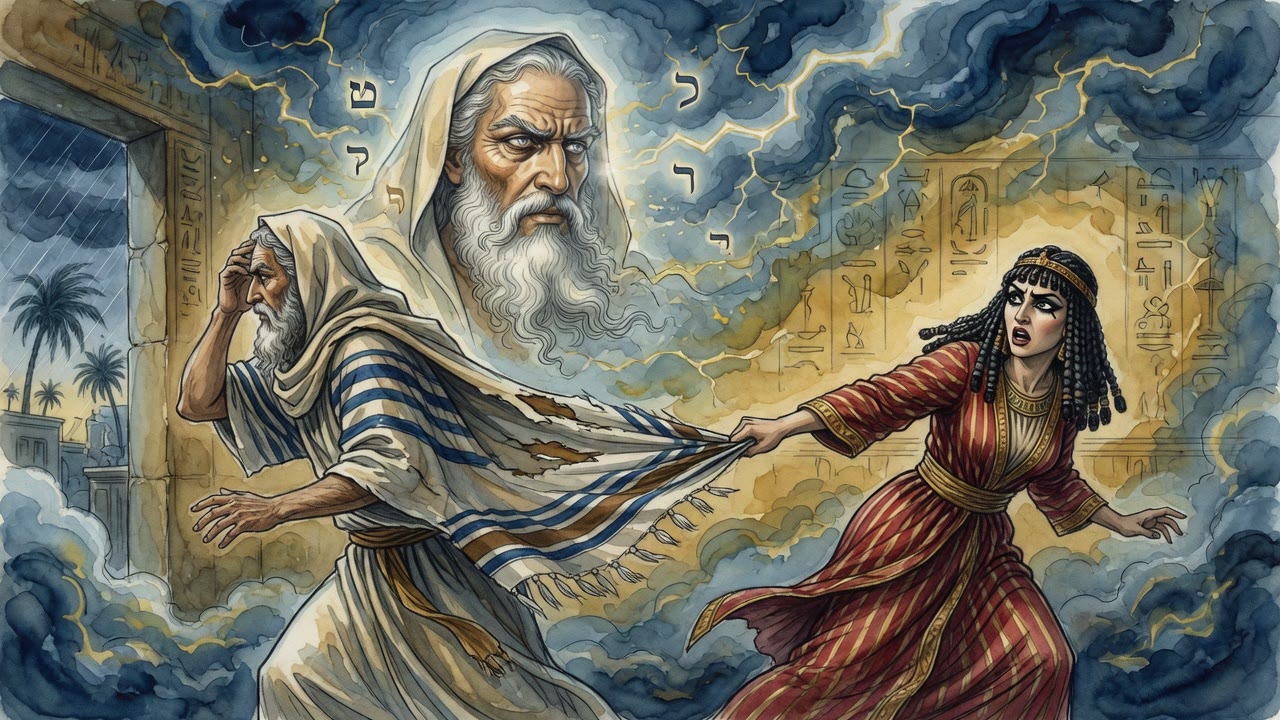
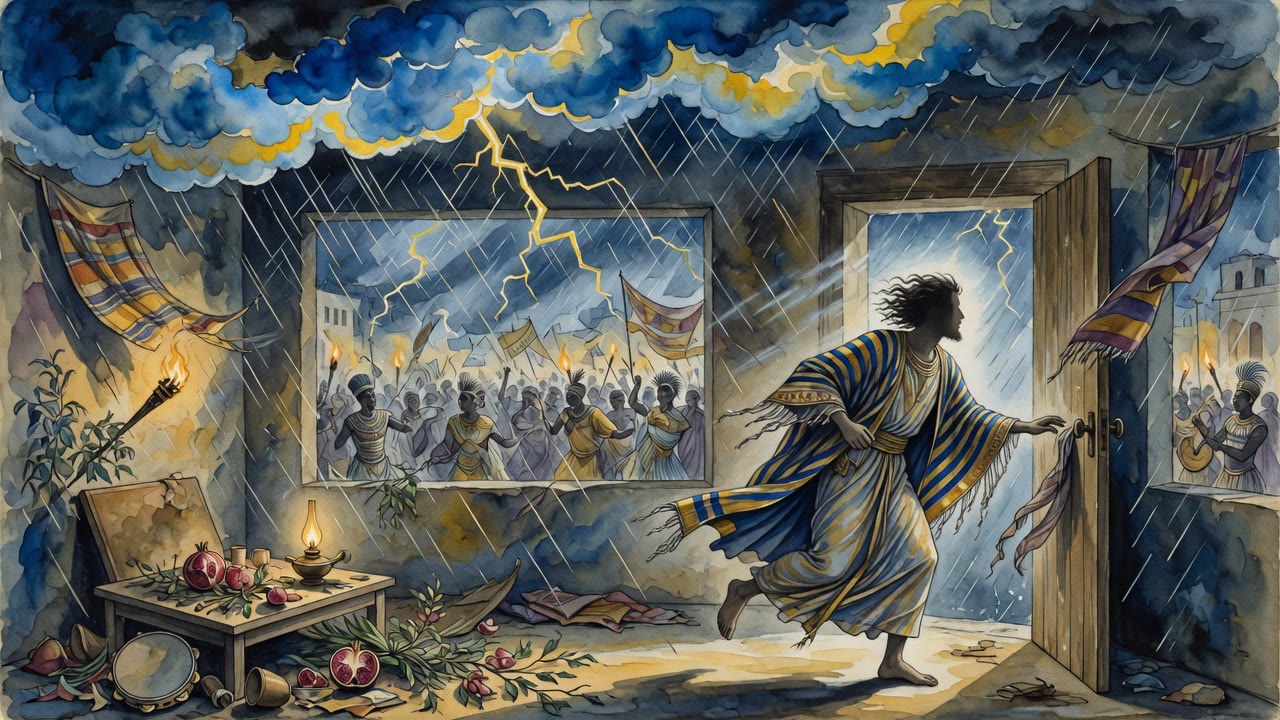
Joseph had thought Egypt would be easier than life under his brothers' eyes. Potiphar's wife came at him day after day, and he was seventeen.

Curated by Arthur · Told by Maggid ·
Table of Contents
  1. A Simple Youth Who Already Spoke Too Much
  2. Fear Stacked Against the Door
  3. A Matron's Challenge and a Father's Face
  4. Judgment Day Arguments Already Answered
  5. What the Bear Taught
Joseph Saw Jacob's Face and Left the Garment Click for full size

A Simple Youth Who Already Spoke Too Much

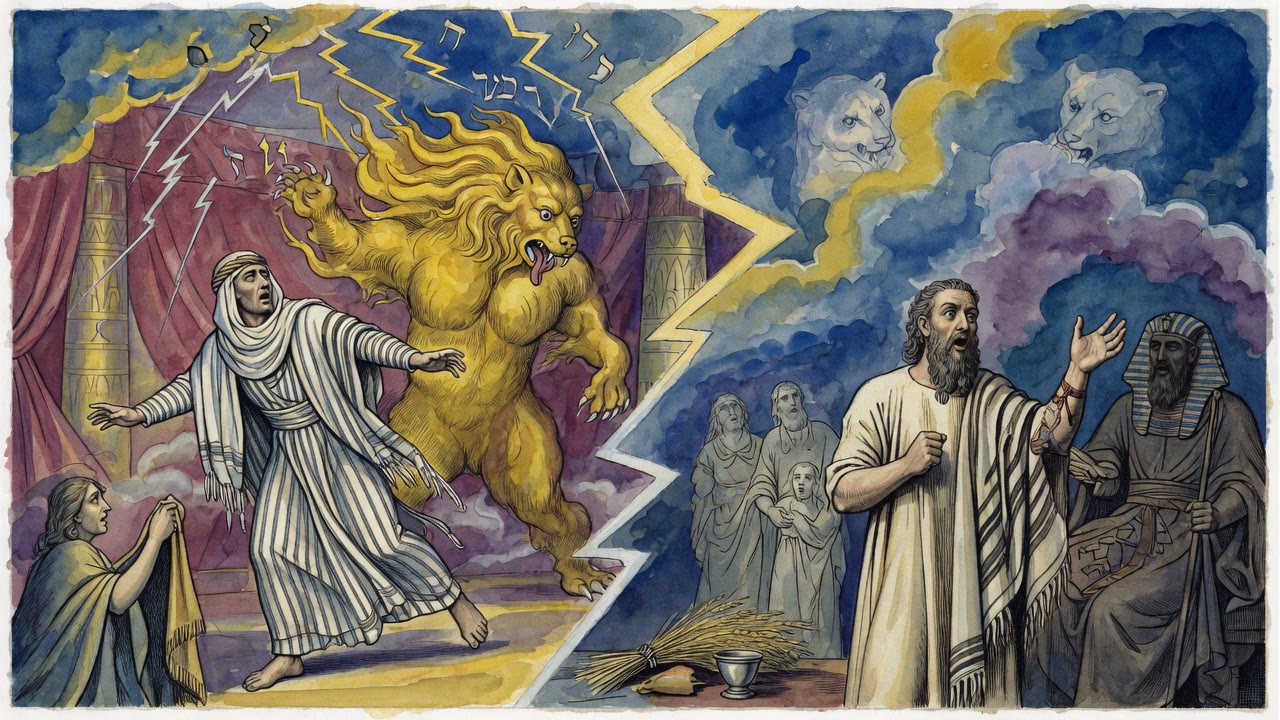
Proverbs sees a dangerous woman waiting in the street for a simple youth. The Yalkut Shimoni names the youth Joseph. He is not stupid. He is a boy who already showed poor judgment when he spoke against his brothers. Now he stands alone in Egypt, watched and hunted, grabbed by the garment. He knows he is beautiful. The midrash compares him to a warrior preening in the market until someone points at a bear and says: if you are strong, fight that.

Joseph had thought Egypt easier than life under his brothers' eye. He had wondered why the fathers were tested and he was not. The Holy One answered by sending the bear into Potiphar's house. Ease became a daily siege.

Fear Stacked Against the Door

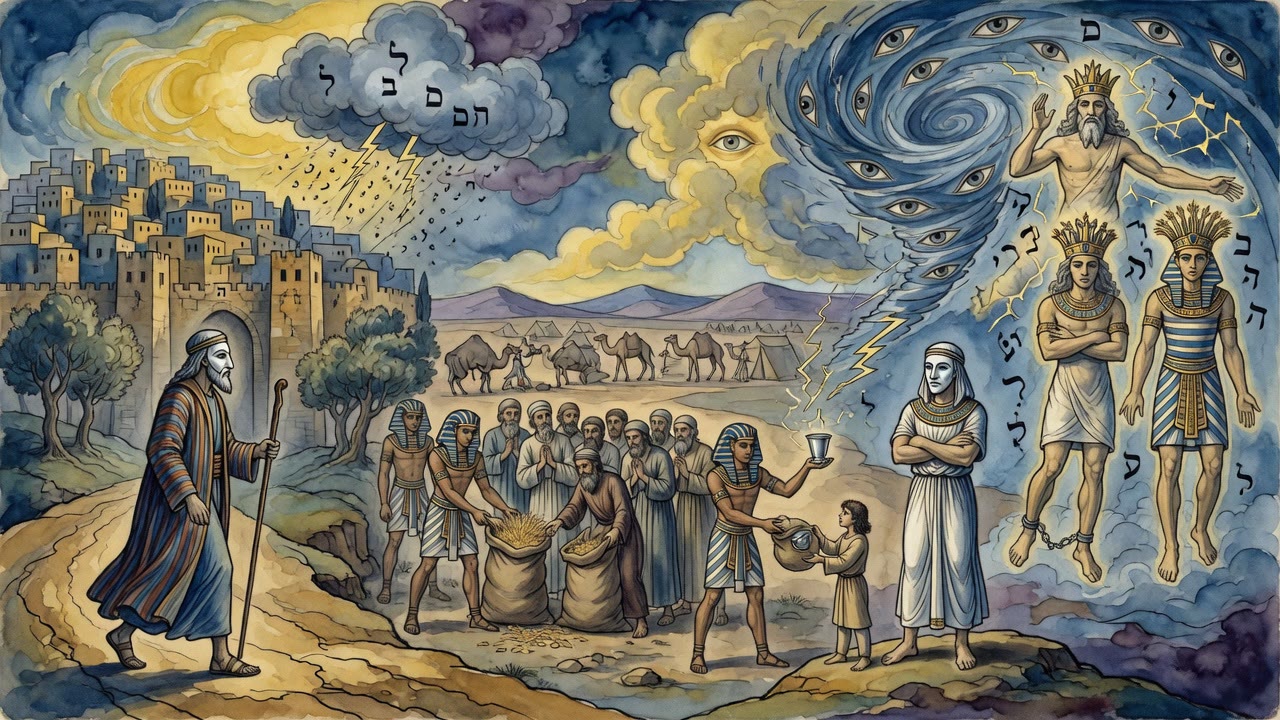
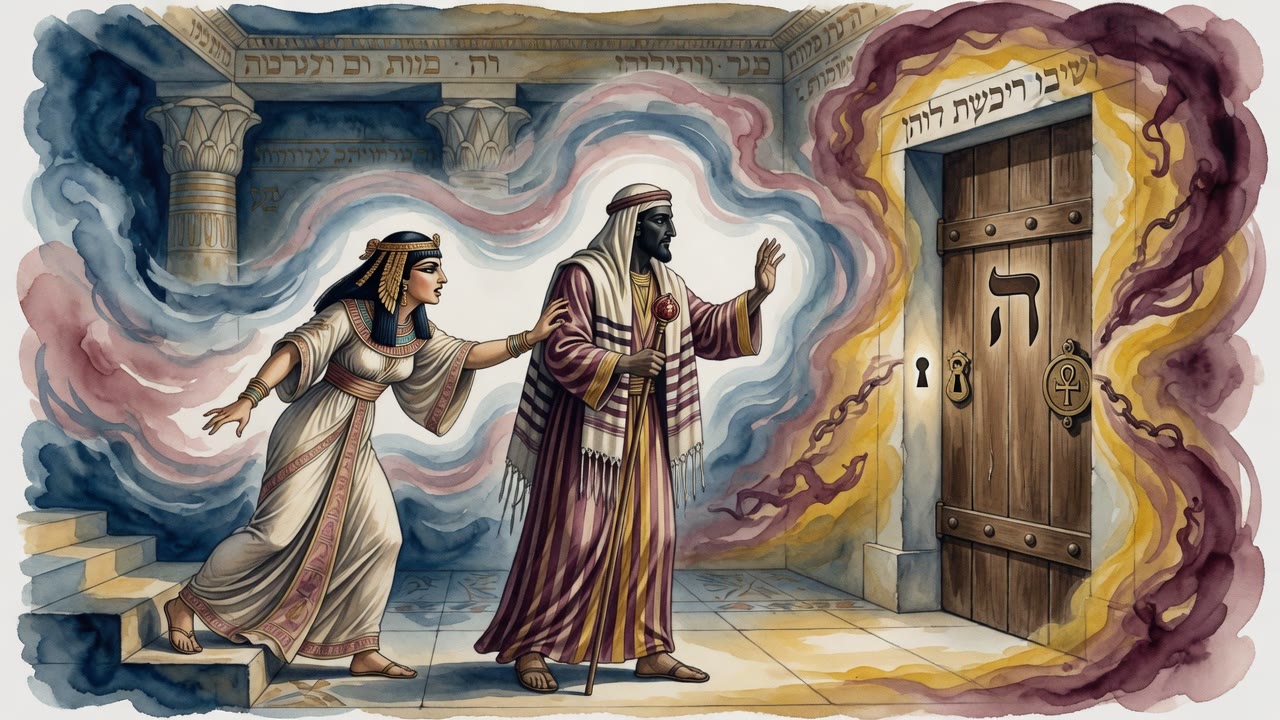
When Potiphar's wife presses him, Joseph answers with fear after fear. God might choose him as an offering and find him disqualified. God might appear at night as He appeared to Abraham, Isaac, and Jacob, and find him impure. Adam lost Eden over a lighter command. Reuben lost the birthright, and Joseph knows that birthright has come toward him. If she kills Potiphar, Joseph will stand among murderers as well as adulterers. If she covers the idol by the bed, the eyes of the Lord still see the whole earth.

The pressure does not pass in one afternoon. It returns day after day. The Yalkut pairs him with Mordecai, another child of Rachel pressed daily and later raised by royal ring and garments. Beauty and isolation are not proofs of inevitable fall. They are the conditions under which refusal becomes evidence.

A Matron's Challenge and a Father's Face

A matron once challenged Rabbi Yose: could a seventeen-year-old really resist? Rabbi Yose opened Genesis. Scripture did not hide Reuben. It did not hide Judah and Tamar. It would not have hidden Joseph if he had fallen. Then comes the terrifying version: Joseph did begin to heed her, until the Holy One showed him his father's face and shame drove him out. When he entered again, God lifted the Foundation Stone and warned that if he touched her, the world would be destroyed. One young man's refusal, in this reading, holds up the stone of Israel.

The garment left in her hand is not a prop for a courtroom farce only. It is what remains when a body chooses exile from a room rather than exile from the covenant.

Judgment Day Arguments Already Answered

The Yalkut widens the bedroom into a court. A mitzvah (a commandment) walks ahead of a person into the World to Come. A transgression coils and follows him to judgment. The poor cannot plead poverty, because Hillel froze on a roof to hear Torah. The rich cannot plead wealth, because Rabbi Eleazar ben Harsom left a thousand towns and ships for study. The wicked cannot plead desire, because Joseph was beautiful, hunted, bribed, alone, and still refused.

Elsewhere the same anthology tradition praises those who love the Land as Zelophehad's daughters did, and those who plant themselves by Torah as Abraham's study is imagined. Desire, land-hunger, and learning all get measured. Joseph's measure is the hardest private one: no audience, no public honor yet, only a face from home and a stone that holds the world.

What the Bear Taught

Egypt was not a vacation from testing. It was the test the brothers' house had not finished. Joseph learned that beauty is not safety, that daily pressure is a real weapon, and that a father's face can arrive as judgment before any royal dream comes true. He left cloth in a closed room and kept a name that later would feed nations.

The midrash will not let later sinners say, "No one beautiful ever stood firm." It points at the garment on the floor and at the man who is no longer in the room. That empty space is the story's victory, sharper than any sermon about self-control spoken from a full stomach in peacetime.

The midrash refuses a cartoon Joseph who never feels the pull. Beauty is admitted. Loneliness is admitted. The daily return of the pressure is admitted. Only then does the father's face arrive, and only then does the Foundation Stone rise as a warning that private sin can unmake more than one bed. The world held on a stone is a heavy image for a seventeen-year-old, and the Yalkut places it there on purpose. Desire is not small. The answer must be larger than willpower slogans.

By stacking fears, Joseph builds a fence of memory: patriarchs who saw God at night, Adam who lost a garden, Reuben who lost rank, idols that cannot hide an act from the One who sees. The fence is Jewish in every post. No foreign dualism, no praise of the tempter as a rival god. Only a boy of the covenant reminding himself what he stands to lose before he loses it. When shame finally moves the feet, the garment becomes the price of exit, cheap beside the name he keeps.

Later judgment scenes borrow his refusal as a closed door against excuses. If Joseph under siege could leave, then the claim "I could not help it" thins. The midrash is not cruel to the weak for sport. It is building a standard that desire, wealth, and poverty all fail to overturn. Torah study on a frozen roof, abandoned fleets for learning, a left garment in Egypt: three proofs that circumstance is not destiny when the covenant still has a hold on the eyes.


← All myths
From the tradition

Sources

3 sources

The texts behind this telling. Some cards carry a translation of the source; others are our own retelling of it, and each card says which. Every card links out to the original.

Yalkut Shimoni on Torah 145:17Yalkut Shimoni on Torah

Translation of the source text.Torat Emet (Yalkut Shimoni) + Sefaria Community Translation · CC-BY-NC

(Genesis 39:7) "And it came to pass after these things." (Proverbs 7:7) "I saw among the simple" refers to the tribes; in Arabia they call a child patya, "simple." "I discerned among the sons a youth lacking heart" (Proverbs 7:7) refers to Joseph, who used to speak evil speech about his brothers. Is there anyone more lacking in heart than this? "And behold, a woman came toward him" refers to his master's wife; "with the attire of a harlot" toward Joseph; "and guarded of heart" from her husband. "She is loud and wayward" means she cries out and wanders; "her feet do not dwell in her house," but rather "now outside, now in the streets, and at every corner she lies in wait" (Proverbs 7:11-12). She sent and said, "Have you seen Joseph?" "[And] she caught him and kissed him" (Proverbs 7:13), "and she caught him by his garment" (Genesis 39:12). "She hardened her face and said to him" (Proverbs 7:13), "Lie with me" (Genesis 39:7). (Psalms 125:3) "For the scepter of wickedness shall not rest" refers to Potiphar's wife; "upon the lot of the righteous" refers to Joseph, as it is said, "his master's wife lifted up her eyes" (Genesis 39:7). What is written just above the matter? "Joseph was beautiful of form" and then "his master's wife lifted up her eyes" (Genesis 39:6-7). A parable: to a strong man sitting in the market, touching up his eyes and fixing his hair. He said, "I am a man." They said to him, "If you are a man, there is a bear before you. Strike it down." "And it came to pass after these things" means thoughts of things were there. Who had the thoughts? Joseph had the thoughts. He said, "When I was in my father's house, my father would see some fine portion and give it to me, and my brothers would put the evil eye into me. Now that I am here, I admit that I am at ease." The Holy One, blessed be He, said to him, "By your life, I will stir up the bear against you." Another interpretation: Joseph said, "My father was tested, my grandfather was tested. Am I not to be tested?" The Holy One, blessed be He, said to him, "By your life, I will test you more than all of them." This was the custom of the nations of the world: when one of them bought a slave, he would go to an astrologer and say, "Is this a good omen?" The language of "she lifted up" is the language of astrology, as you say, "lest you lift up your eyes to heaven" (Deuteronomy 4:19). "She said, Lie with me." Cursed are the wicked: here she says, "Lie with me," like a beast, while later Ruth says, "Spread your skirt over your handmaid" (Ruth 3:9).

(Genesis 39:8-9) "And he refused and said to his master's wife." In a matter of commandment, one refuses; in a matter of transgression, does one not refuse? This is a wonder. In a matter of commandment one refuses, as it is said, "My husband's brother refuses to raise up a name for his brother in Israel" (Deuteronomy 25:7); in a matter of transgression, does one not refuse? In a matter of commandment one refuses, as it is said, "If her father utterly refuses" (Exodus 22:16); in a matter of transgression, does one not refuse? "And he refused and said, Behold, my master..." He said to her, "The Holy One, blessed be He, is accustomed to choose from my father's house forever, as it is said, 'Take now your son' (Genesis 22:2). If I listen to you, perhaps I will be chosen as an offering and disqualified from the sacrifice." Another interpretation: "[And he refused] and said to his master's wife." "The Holy One, blessed be He, is accustomed to reveal Himself to my father's house at night. With Abraham, 'After these things the word of the Lord came to Abram in a vision' (Genesis 15:1); with Isaac, 'the Lord appeared to him that night' (Genesis 26:24); with Jacob, 'he dreamed, and behold, the Lord stood over him' (Genesis 28:12-13). If I listen to you, perhaps the Holy One, blessed be He, will reveal Himself to me and find me impure." "Behold, my master." "I fear Adam the first man: because he transgressed a light commandment he was driven from the Garden of Eden. This is forbidden sexual relations, a severe transgression, all the more so." "Behold, my master." "I fear my father in the land of Canaan. Because it is written of Reuben, 'Reuben went and lay' (Genesis 35:22), his birthright was taken and given to me. If I listen to you, I will descend from my birthright." "Behold, my master." "I fear my master." She said to him, "I will kill him." He said to her, "Is it not enough for me to be counted in the company of adulterers, that I should also be counted in the company of murderers? If this is the thing you seek, behold, my master is before you." He said to her, "The milk of black goats and the milk of white goats have one taste." Another interpretation: "Behold, my master." "I fear the Lord." She said to him, "He is not here." He said to her, "Great is the LORD and greatly praised" (Psalms 145:3, printed as Psalms 105:3). She brought him from room to room and from chamber to chamber until she stood him before her bed, and there was an idol above it. She went and covered it. He said to her, "These faces you have covered. The One about whom it is written, 'the eyes of the LORD run to and fro through all the earth' (2 Chronicles 16:9), all the more so." "There is none greater in this house than I" (Genesis 39:9). Scripture left no opening: it is not written here "against the Lord," but "against God." "Against God I will not do this thing." (Genesis 39:10) "And it was, as she spoke to Joseph day by day." The children of Rachel, their test was equal and their greatness was equal. Their test was equal: "as she spoke to Joseph day by day" (Genesis 39:10), and "as they spoke to him day by day" (Esther 3:4). Their greatness was equal: "Pharaoh removed his ring" (Genesis 41:42), and "the king removed his ring" (Esther 8:2); "he clothed him in garments of fine linen" (Genesis 41:42), and "he clothed Mordecai" (Esther 6:11); "he placed a gold chain" (Genesis 41:42), and "Mordecai went out from before the king" (Esther 8:15); "he made him ride in the second chariot" (Genesis 41:43), and "he made him ride through the city square" (Esther 6:11); "he called before him, Avrekh" (Genesis 41:43), and "he called before him, Thus shall it be done to the man" (Esther 6:11). "And he did not listen to her, to lie beside her" in this world, "to be with her" in the time to come. A matron asked Rabbi Yose, "Is it possible that Joseph, seventeen years old, standing in all his heat, did not do this thing?" He brought before her the Book of Genesis and began reading the act of Reuben and the act of Judah and Tamar. He said to her, "If Scripture did not cover over these, who were adults and under their father's authority, then this one, who was young and under his own authority, all the more so." "And he did not listen to her." Rabbi said, "He did heed her, except that the Holy One, blessed be He, brought the likeness of his father, and he was ashamed and fled. A second time he entered, and the Holy One, blessed be He, took the Foundation Stone. He said to him, 'If you touch her, I will cast it down and destroy the world.'" This is what is written: "His arms were made firm by the hands of the Mighty One of Jacob; from there he sustained the stone of Israel" (Genesis 49:24). Rabbi Shmuel bar Nachmani said that Rabbi Yonatan said: "Anyone who performs one mitzvah in this world, it goes ahead of him and walks before him to the World to Come, as it is said, 'your righteousness shall go before you' (Isaiah 58:8). Anyone who commits one transgression in this world, it wraps around him and walks before him to the Day of Judgment, as it is said, 'The paths of their way are twisted; they go up into emptiness' and so on (Job 6:18)." Rabbi Elazar says, "It is tied to him like a dog, as it is said, 'and he did not listen to her, to lie beside her' in this world, 'to be with her' in the World to Come."

Our Rabbis taught: The poor, the rich, and the wicked come to judgment. To the poor person they say, "Why did you not occupy yourself with Torah?" He says, "I was poor and busy with my food." They say to him, "Were you poorer than Hillel?" They said of Hillel the Elder that every day he would earn a small coin, a tropaik; half he would give for his support and the support of the members of his household, and half to the gatekeeper of the study hall. One time he found no work, and the guard of the study hall did not let him enter. What did he do? He went up, suspended himself, and sat at the mouth of the skylight so that he could hear the words of the living God from the mouths of Shemaya and Avtalion. They said: it was the eve of Shabbat, and it was the season of Tevet, and snow fell on him. When dawn rose, Shemaya said to Avtalion, "Avtalion my brother, every day the house is bright, and today it is dark." They looked and saw the form of a man in the skylight. They went up and found snow three cubits high over him. They broke him loose, washed him, anointed him, and seated him opposite the fire. They said, "This one is worthy for Shabbat to be desecrated on his behalf." To the rich person they say, "Why did you not occupy yourself with Torah?" He says, "I was rich and busy with my possessions." They say to him, "Were you richer than Rabbi Eleazar ben Harsom?" They said of him that his father left him one thousand towns on dry land and, corresponding to them, one thousand ships at sea, and he never went and saw them, but sat and occupied himself with Torah. One time his servants found him and pressed him into forced labor. He said to them, "Leave me, for I am going to learn Torah." They said to him, "By the life of our master, we will not leave you," and so on. To the wicked person they say, "Why did you not occupy yourself with Torah?" He says, "I was handsome and busy with my inclination." They say to him, "Were you more beautiful in form than Joseph the righteous?" They said of him that Potiphar's wife would entice him with words. The clothes she wore for him in the morning she would not wear for him in the evening; the clothes she wore for him in the evening she would not wear for him in the morning. She said to him, "Listen to me." He said to her, "No." She gave him one thousand talents of silver, and he did not listen to her. It follows that Hillel obligates the poor, Rabbi Eleazar ben Harsom obligates the rich, and Joseph the righteous obligates the wicked.

Full source
Yalkut Shimoni on Nach 617:2Yalkut Shimoni on Nach

Retold in our words. Read the original at the link below.Sefaria Community Translation · CC-BY

Wouldn't that be a blessing? That image is at the heart of a beautiful teaching found in the Yalkut Shimoni on Nach (617).

Rabbi Yose uses this powerful metaphor to explain the verse "And he will be like a planted tree." He asks, "What’s it like?" And then tells this story: A weary traveler, nearly overcome by thirst in a desolate land, discovers this incredible tree. Revived by its gifts, the traveler wants to thank the tree. But what can he offer? It already has everything! The streams flow, the fruit is sweet, the shade is perfect.

So, the traveler offers a different kind of blessing: "May it be the Will that all of the saplings that will be planted from you be like you." It’s a wish for future generations to inherit the same qualities.

Where does Avraham fit in? The Yalkut Shimoni goes on to say that God says something similar to Avraham. What blessing could God possibly bestow upon him? Avraham has already made God known, he's already crowned God through his actions. So God says, "May it be the Will that all of the offspring of your innards be like you.” God isn't just promising Avraham descendants; God is hoping they will embody his qualities.

The text then unpacks what it means to be like Avraham's offspring, "a planted tree that gives off its fruit in its time." These fruits, we're told, are the Torah scholars who will descend from him. And "its leaf does not wither" refers to the masters of faith who will never cease to come from his lineage. Finally, "and everything that he does be successful" alludes to Avraham himself, who, as the verse in Isaiah (41:2) says, "shook up all of the kings of the East and the West."

It's a multi-layered interpretation. We aren’t just talking about physical descendants, but spiritual ones, carriers of Avraham's legacy.

The Yalkut Shimoni, through Rabbi Yose's beautiful analogy, invites us to consider what kind of "tree" we are, and what kind of "saplings" we are cultivating. Are we offering shade and sustenance to those around us? Are we striving to embody the qualities of faith and learning that define Avraham's legacy? Perhaps, like the traveler, we too can strive to be like that tree.

Full source
Yalkut Shimoni on Torah 773:13Yalkut Shimoni on Torah

Translation of the source text.Torat Emet (Yalkut Shimoni) + Sefaria Community Translation · CC-BY-NC

"Of the families of Manasseh son of Joseph" (Numbers 27:1): just as Joseph loved the land, so those who came from his loins loved the Land of Israel. "And these were the names of his daughters: Mahlah..." One might think that the one who comes first in Scripture also came first in deed. Scripture therefore says, "And Mahlah, Tirzah... were" (Numbers 36:11), teaching that all of them were equal to one another. "And they stood before Moses..." (Numbers 27:2): Scripture teaches that they stood only in the fortieth year, the year in which Aaron died, as it is said, "And Aaron the priest went up..." (Numbers 33:38). "Before Moses and before Eleazar": if Moses did not know, and so on, as above. "For he died in his own sin" means that he did not cause others to sin with him. "And he had no sons": if he had had a son, we would not have claimed. "Why should our father's name be diminished from among his family?" Rabbi Yehudah says: "Name" is said here and "name" is said there (Deuteronomy 25:6). Just as the "name" said here concerns inheritance, so the "name" said there concerns inheritance; and just as the "name" said there concerns seed, so the "name" said here concerns seed. "For he has no son": why is this said? Has it not already been said, "and he had no sons"? What does Scripture teach by saying, "for he has no son"? It teaches that they were wise and expounded: if he had had a son's daughter, we would not have claimed. "Give us a possession" (Numbers 27:4). Rabbi Natan says: the strength of women is finer than the strength of men. The men said, "Let us appoint a head and return to Egypt" (Numbers 14:4), but the women said, "Give us a possession."

"Then the daughters of Zelophehad came near" (Numbers 27:1): any worthy person who stands within a tribe is praise for his whole tribe, all the more for his household, all the more for himself, all the more for his family, all the more for his father's house. And so it says, "And with him was Oholiab son of Ahisamach," praise for his whole tribe, all the more for his family, and so on. "Then they came near": any worthy person who stands in the midst of a wicked generation merits to take the reward of them all. Noah stood in the generation of the Flood and merited to take the reward of them all. Abram stood in the generation of the Dispersion and merited to take the reward of them all. Lot stood among the people of Sodom and merited to take the reward of them all. These women stood in the generation of the wilderness and merited to take the reward of them all. This teaches at what hour they stood before Moses: at the hour when Israel said, "Let us appoint a head" (Numbers 14:4). Moses said to them: Israel is seeking to return to Egypt, and you are seeking an inheritance in the land? They said: We know that in the end all Israel will take hold of the land, as it is said, "It is time to act for the LORD; they have broken Your Torah" (Psalms 119:126). Do not read it that way, but: "They have broken Your Torah; it is time to act for the LORD." And so it says, "And Aram went out in bands... and she said to her mistress" (II Kings 5:2-3), teaching that she said to her: in such-and-such a way they purify the poor person, and in such-and-such a way they purify the rich person, as it is said, "Such and such spoke the maiden." This teaches that she knew the section of skin afflictions. But she did not know when the house of her father practiced the Torah: at the hour when he said to them, "How long will you limp between two opinions?" (I Kings 18:21), to fulfill what is said, "It is time to act for the LORD; they have broken Your Torah." Do not read it that way, but: "They have broken Your Torah; it is time to act for the LORD." And so Hillel would say: at a time when others scatter, draw in your foot; in a place where there is no eager buyer, buy from him; in a place where there are no men, strive to be a man.

Another interpretation: "Then the daughters of Zelophehad came near..." Is it not already known that Manasseh was the son of Joseph? Why did Scripture trace him here? Rather, whenever a worthy king arose, they would look to see whose ancestors were worthy and attach him to that ancestor. Thus it says concerning Hezekiah, "Thus says the LORD, the God of David your father" (Isaiah 38:5). Was Hezekiah David's son? Were there not several generations between them? Rather, every worthy king who arose was attached to David. And every wicked king who arose was attached to Jeroboam, as it is said, "because of the sins of Jeroboam" (I Kings 15:30). "And the name of Zelophehad's daughters" (Numbers 26:33): they had a name through merit, and they had a name through deed. "The name of one was Shiphrah, and the name of the second Puah" (Exodus 1:15): they had a name through merit, and they had a name through good deed. And so it says, "There was a man in the land of Uz, Job was his name" (Job 1:1): he had a name. Thus every name in the Torah, in the Prophets, and in the Writings, if it is in a matter of merit, he has a name through merit; and if it is in a matter of wickedness, he has a name through wickedness.

Full source