5 min read

Joseph's Buried Fortune and Korah's Fatal Discovery

Joseph buries three immense treasures in the Egyptian wilderness, and centuries later Korah finds one of them. The wealth consumes him from the inside.

Curated by Arthur · Told by Maggid ·
Table of Contents
  1. How Much Grain Costs
  2. The Man with Three Hundred Mules
  3. What the Money Required of Him
  4. The Earth Opened

How Much Grain Costs

Joseph managed Egypt's food supply through seven fat years and seven lean ones. Every sheaf of grain that entered the storehouses was a transaction, and seven years of transactions, at the scale of a continental empire, produced a fortune beyond ordinary accounting. When the famine came and the entire ancient Near East came to Egypt to buy food, the money poured in. The Pharaoh's grain was the only grain there was. Joseph named the price.

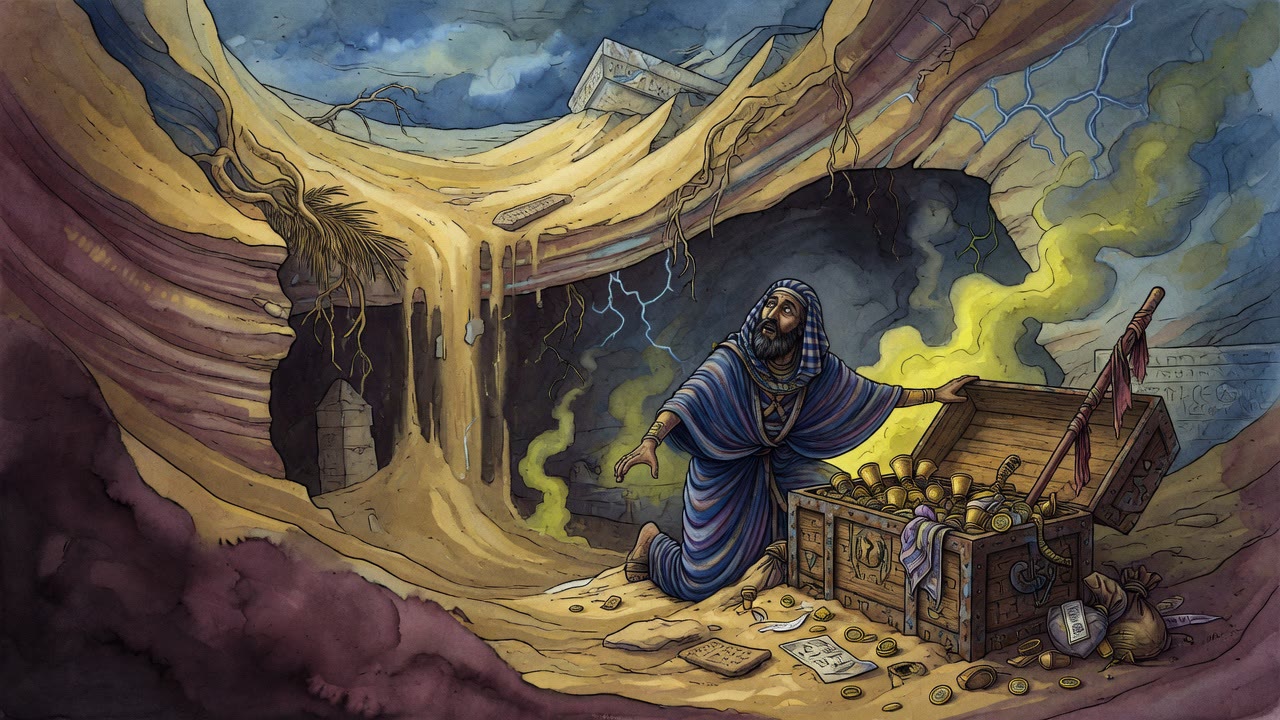
What the Torah does not say is what happened to the money afterward. The tradition preserved in Legends of the Jews fills in the gap: Joseph divided the accumulated wealth into three portions. The first went to Pharaoh, as proper accounting demanded. The third was distributed across the wilderness in hidden caches, buried in the ground against some future need that Joseph may or may not have specified. The second portion was something else entirely. That one Joseph concealed in a place only he knew, against a reckoning that had not yet arrived.

The Man with Three Hundred Mules

Generations later, in the wilderness after the Exodus, Korah was Pharaoh's treasurer. He had come out of Egypt with Israel, but his mind was still arranged around the logic of enormous wealth. His position in the hierarchy of the Egyptians had given him access to the royal accounts, and somewhere in those accounts he had found a thread that led to Joseph's hidden treasury.

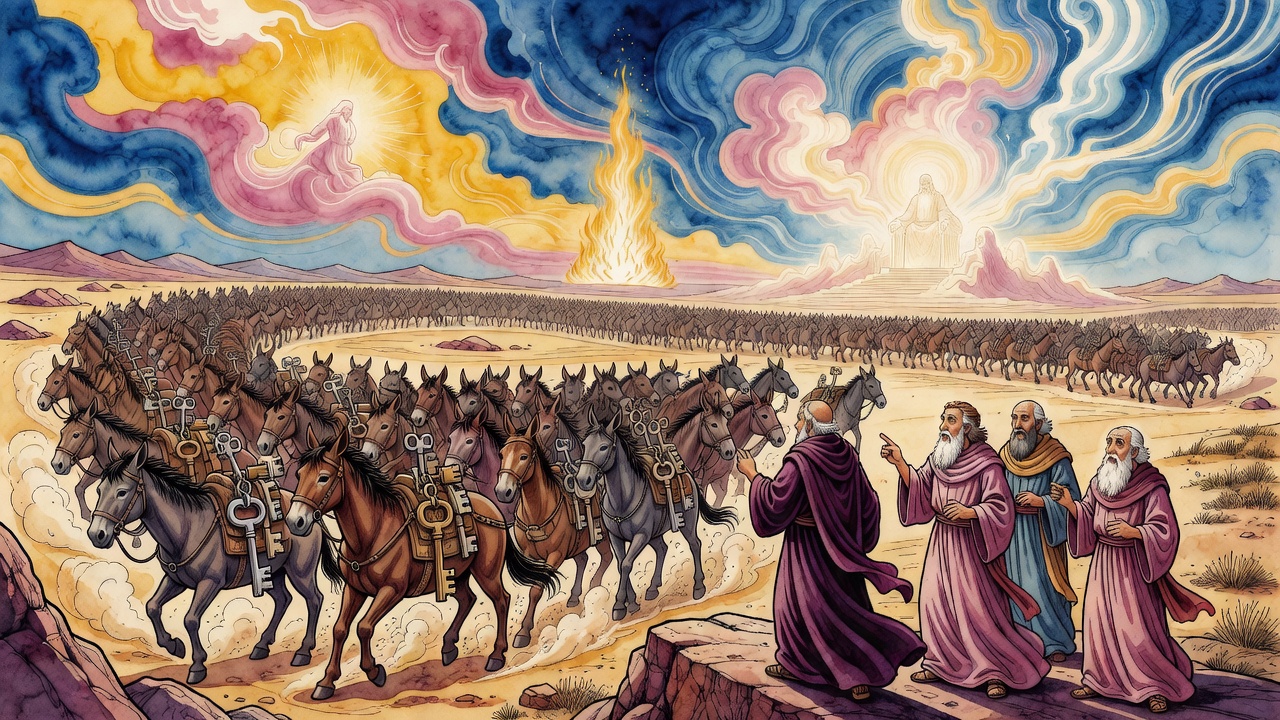
The midrashic tradition is vivid about the scale of what Korah found: three hundred white mules just to carry the keys to his treasure rooms. Not the treasure itself. The keys. Each key heavy enough to require transport. He had so much that the weight of managing the inventory of his wealth was itself a logistical problem that required livestock.

His sons staggered under the accumulated riches. His household was built around the architecture of excess. Korah wore such elaborate garments that when the sun struck them, bystanders shaded their eyes.

What the Money Required of Him

The Proverbs verse that gets attached to Korah's story is blunt: he who trusts in his riches will fall. Korah did not simply have wealth. The wealth had him. It had reorganized his sense of what was possible, what was his right, what the ordinary rules of the community applied to and what they could not touch.

When Moses appointed Aaron to the priesthood and the Levites to their specific roles, Korah heard it as an arrangement that did not account for him sufficiently. He brought two hundred fifty princes of the assembly, men of renown, and said to Moses: all the congregation is holy, every one of them, and God is among them. Why do you lift yourselves above the assembly of God?

The question sounded like egalitarianism. It was the question of a man who owned the keys on three hundred mules asking why someone else had been given an honor he had not been consulted about. Wealth of that scale does not make a man content. It makes him impatient with every arrangement that was decided without him.

The Earth Opened

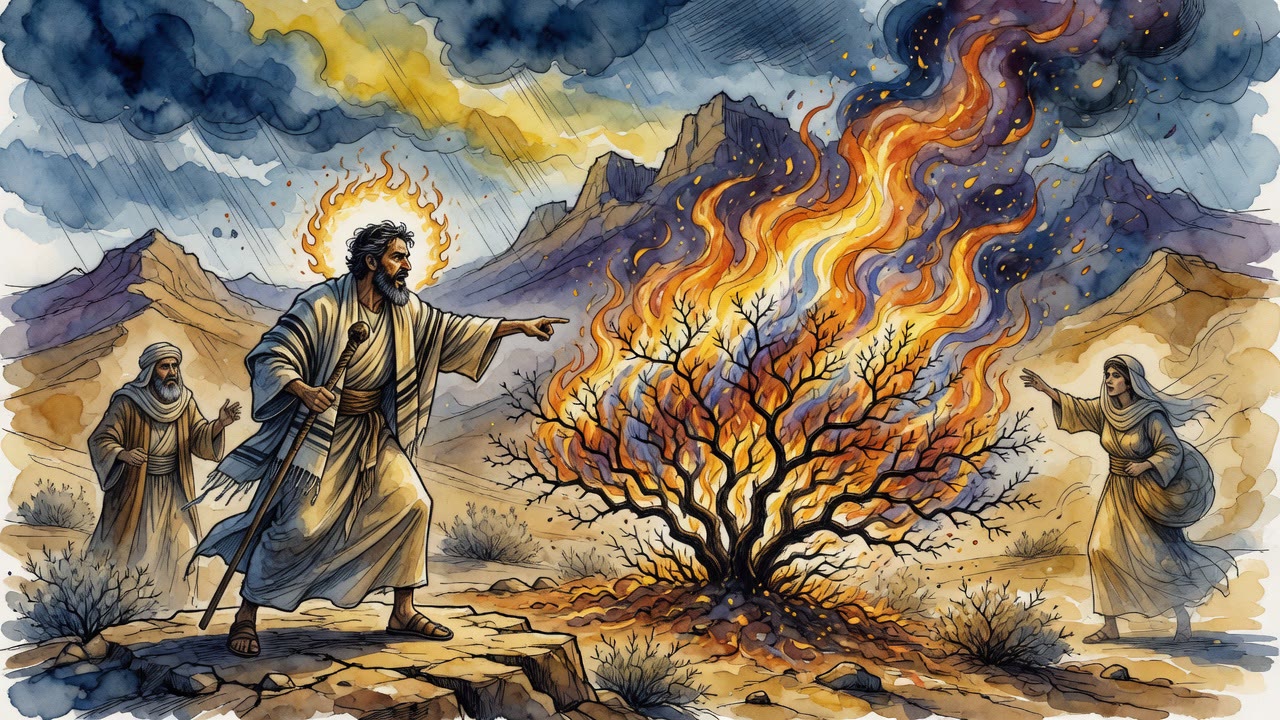
Moses told Korah: in the morning, God will show who is holy. Take fire pans, all two hundred fifty of you, and come before God and we will see whom God chooses. Moses said to the whole congregation: stand away from the tents of Korah and his companions.

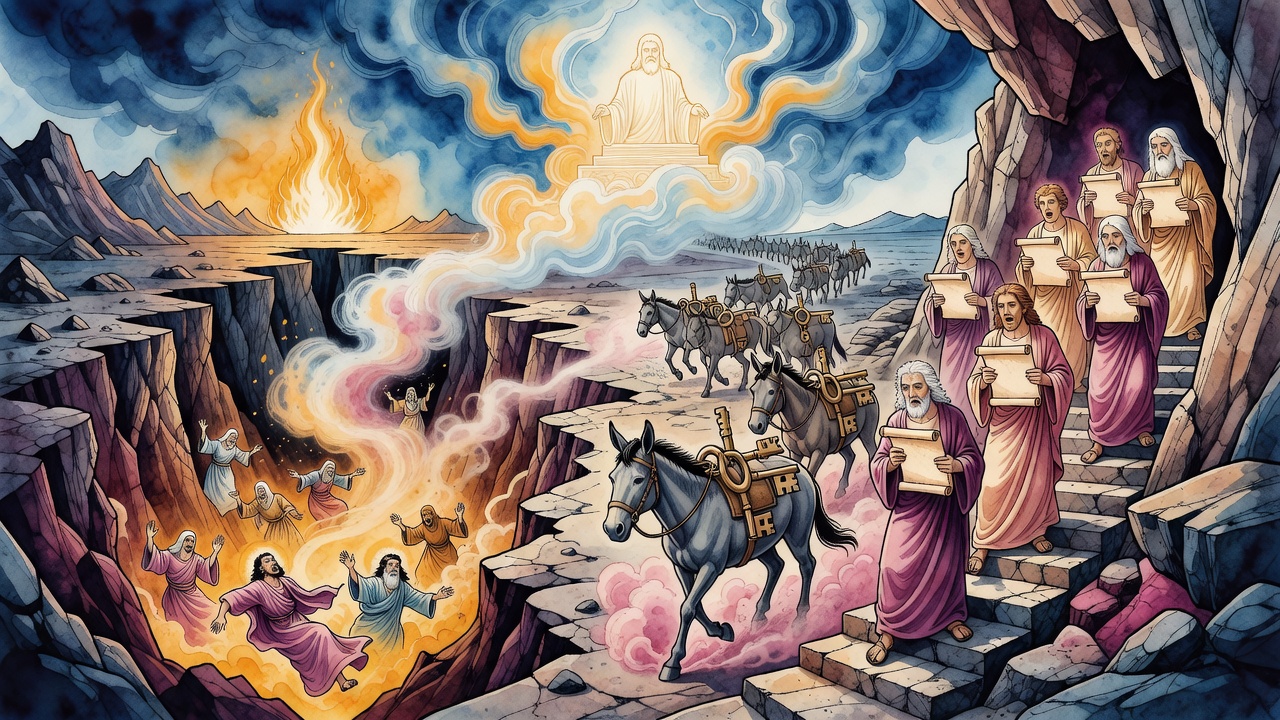
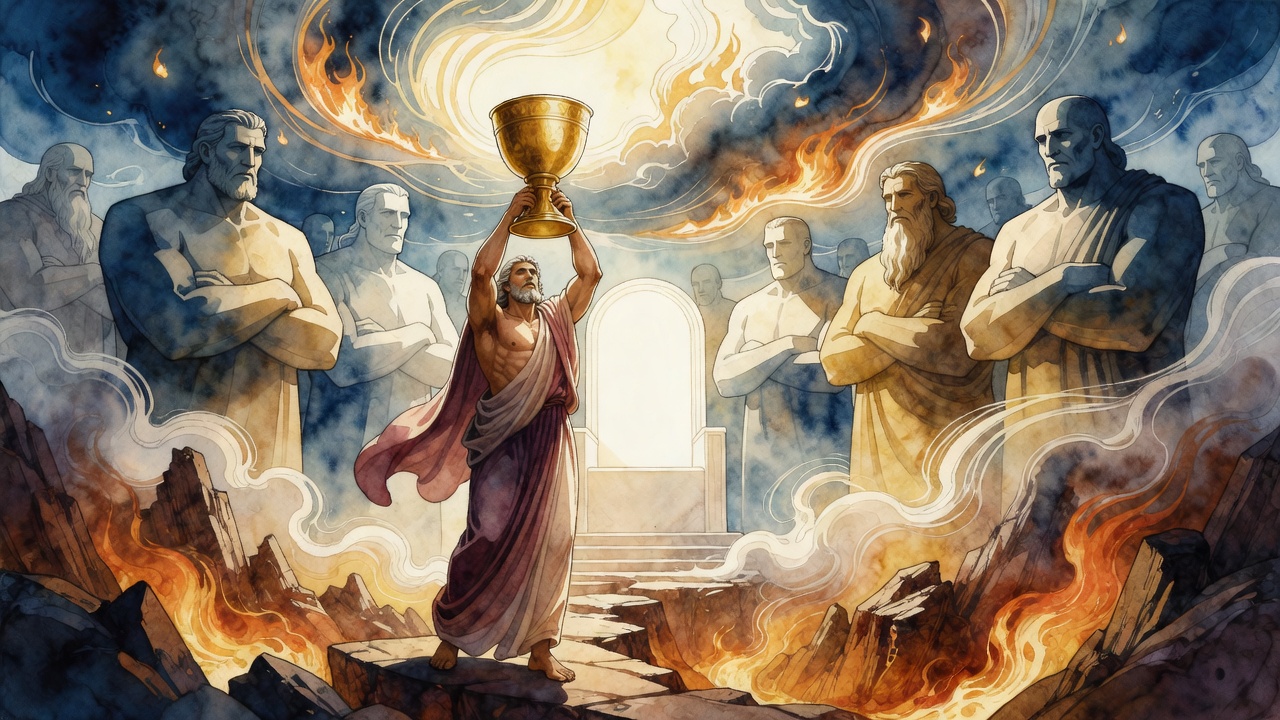
The ground split beneath Korah and his household and swallowed them down, them and everything that belonged to them, their possessions and the earth closed over them and they were gone from the assembly. Fire came out from God and consumed the two hundred fifty men who had offered incense.

The treasure that had required three hundred mules to carry its keys went into the earth with its owner. Joseph had buried his fortune in the wilderness against some future purpose. Korah's fatal discovery of that fortune had not been a gift. It had been an instrument. The discovery gave him the material power to challenge Moses, and the challenge brought the earth down on top of everything he owned. Korah's fortune buried itself, along with Korah, as the final accounting of what the wealth had been worth.


← All myths

From the tradition

Sources

2 sources

The texts this telling draws on, in full. Open a card to read inline, or expand it for a wider, quieter read.

Legends of the Jews 1:12Legends of the Jews

The familiar story is this: from Genesis – how he wisely stored up food for the famine. But what became of that fortune?

Well, legend has it that Joseph, a brilliant administrator if ever there was one, divided the wealth into three impressive stashes.

In Legends of the Jews, the first portion went to Pharaoh, as you might expect. He was, after all, Joseph's boss. That makes sense. But The second part, that immense hoard of riches, was hidden away in the wilderness. Can you imagine stumbling across that? The story goes that Korah, yes, the very same Korah who rebelled against Moses, actually found it! But, alas, it wasn’t meant to be. The treasure vanished again. A tantalizing thought, isn't it?

The third part? This is perhaps the most intriguing. Joseph supposedly concealed it in the sanctuary of Baal-zephon. Baal-zephon was a deity, a kind of Canaanite storm god. His sanctuary became a place called Pi-hahiroth. Why hide it there? Perhaps it was seen as a secure place, a temple dedicated to a powerful god. Or perhaps it was a deliberate act, a test. Whatever the reason, the Israelites, in their exodus from Egypt, seized this treasure as booty. Imagine what that must have felt like: taking back wealth that had been used, perhaps, to oppress them!

So, there you have it. A glimpse into the legendary fate of Joseph's wealth. One part given to the ruler, one part hidden for a future, more righteous time, and one part taken as spoils of a hard-won freedom. It makes you think about the different ways wealth can be used, doesn’t it? And the enduring hope for a future where it will be used for good.

Full source
Legends of the Jews 5:2Legends of the Jews

He wasn't a Canaanite, those ancient inhabitants of the land of Israel. But, like some of them, Korah serves as a cautionary tale: immense wealth, squandered by pride. The Midrash (rabbinic interpretive commentary) tells us that Korah was no ordinary man; he was Pharaoh's treasurer! Imagine the coffers he oversaw, the sheer volume of gold and silver. They say he had 300 white mules just to carry the keys to his treasure rooms! It's a mind-boggling image, isn't it? As (Proverbs 11:28) says, "He that trusts in his riches shall fall." And fall, Korah did.

So, how did he amass such a fortune? The story, as retold by Ginzberg in Legends of the Jews, is quite fascinating. Remember Joseph, from the Book of Genesis? When he was second-in-command in Egypt, and oversaw the grain distribution during the years of famine? Well, all that grain was paid for, and Joseph, being an honest man, amassed tremendous wealth for Pharaoh. He built three enormous storehouses, each a hundred cubits wide, long, and high – absolutely packed with money. And when the famine ended, he turned it all over to Pharaoh. Joseph was too scrupulous to even keep a few silver shekels for his own family. Korah, somehow, discovered one of these hidden treasuries. Can you imagine stumbling upon such a find?

This incredible wealth led to his downfall. As we find in Pirkei Avot (Ethics of the Fathers), "Who is rich? He who is happy with his lot." Korah, it seems, was not. His newfound riches swelled his ego, and he began to feel slighted. He became convinced that Moses had unfairly favored others, specifically by appointing his cousin Elizaphan as the chief of the Kohathite Levites.

Korah's argument, as presented in Numbers 16, went something like this: "My grandfather, Kohath, had four sons: Amram, Izhar, Hebron, and Uzziel. Amram, being the eldest, got all the perks – Aaron is the High Priest, and Moses is the king! But I, the son of Izhar, the second son, should be the prince of the Kohathites! But Moses skipped over me and appointed Elizaphan, whose father, Uzziel, was the youngest! I will stir up rebellion and overthrow everything!"

Now, Korah wasn't stupid. He was a wise man. The Zohar tells us that he knew God wouldn't just stand idly by while someone rebelled against Moses. But here's the tragic irony: Korah possessed a prophetic vision! He foresaw that Samuel, a prophet as great as both Aaron and Moses, would be his descendant. He also knew that twenty-four of his descendants, inspired by the Ruach (spirit) HaKodesh (Holy Spirit), would compose and sing Psalms in the Temple.

He thought to himself: "God wouldn't let the father of such righteous people perish, would He?" But Korah's vision wasn't clear enough. He didn't see that his own sons would repent of their rebellion and because of that repentance, they would be deemed worthy of fathering prophets and Temple singers. He only saw the glory of his future lineage, not his own tragic end.

And so, driven by pride and a distorted vision, Korah launched his rebellion, challenging the authority of Moses and Aaron. He focused on his perceived slight by Moses and the appointment of Elizaphan to incite others. The outcome, as we know, was catastrophic. The earth opened up and swallowed Korah and his followers. A truly terrifying end.

Korah's story is a powerful reminder that wealth and power, without humility and a clear vision of what truly matters, can lead to devastating consequences. It begs the question: What are we truly striving for? And are we willing to sacrifice our integrity, our relationships, and ultimately, ourselves, for the sake of ambition?

Full source