5 min read

Joshua Bowed Before the Angel Moses Refused

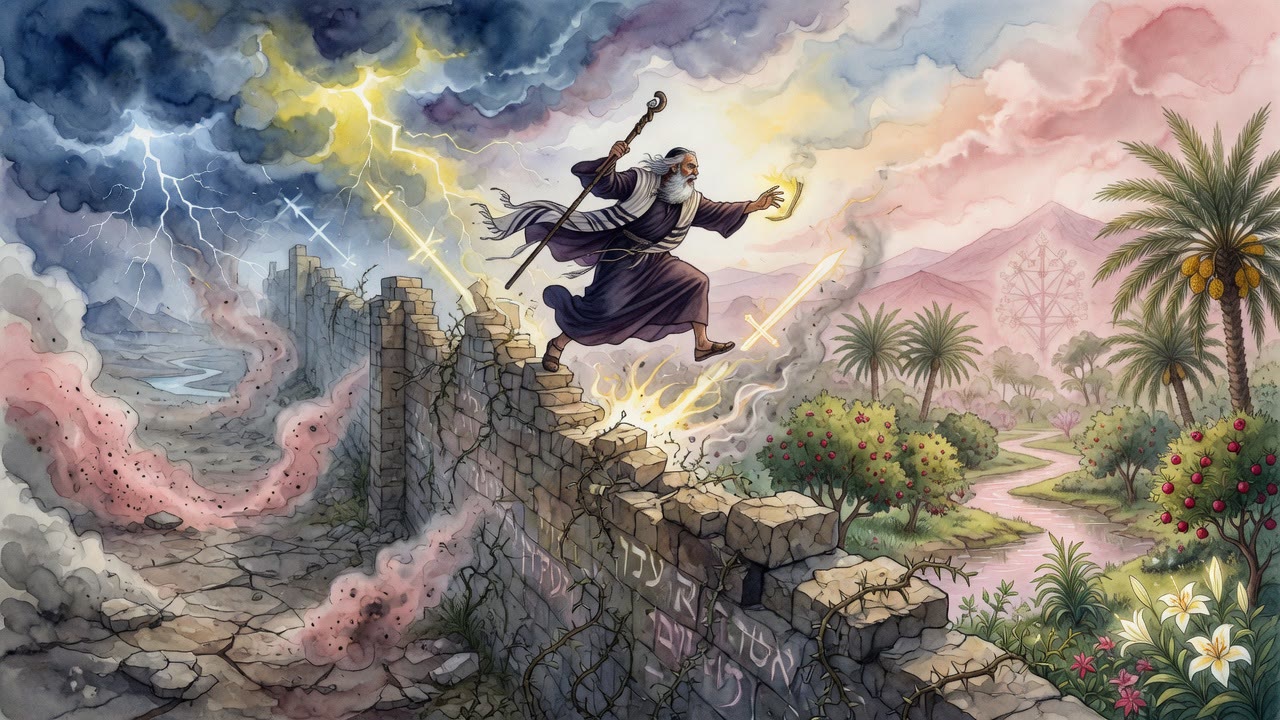
The drawn sword outside Jericho carried an old refusal. Moses had turned away the angel, but Joshua bowed low enough to receive him.

Curated by Arthur · Told by Maggid ·
Table of Contents
  1. A Blessing Sent the Angel Forward
  2. Moses Chose the Face of God
  3. The Sword Waited Outside Jericho
  4. Humility Opened the Gate
  5. Qipod Opened the Gates of Fire
  6. The Messenger Was Never Small

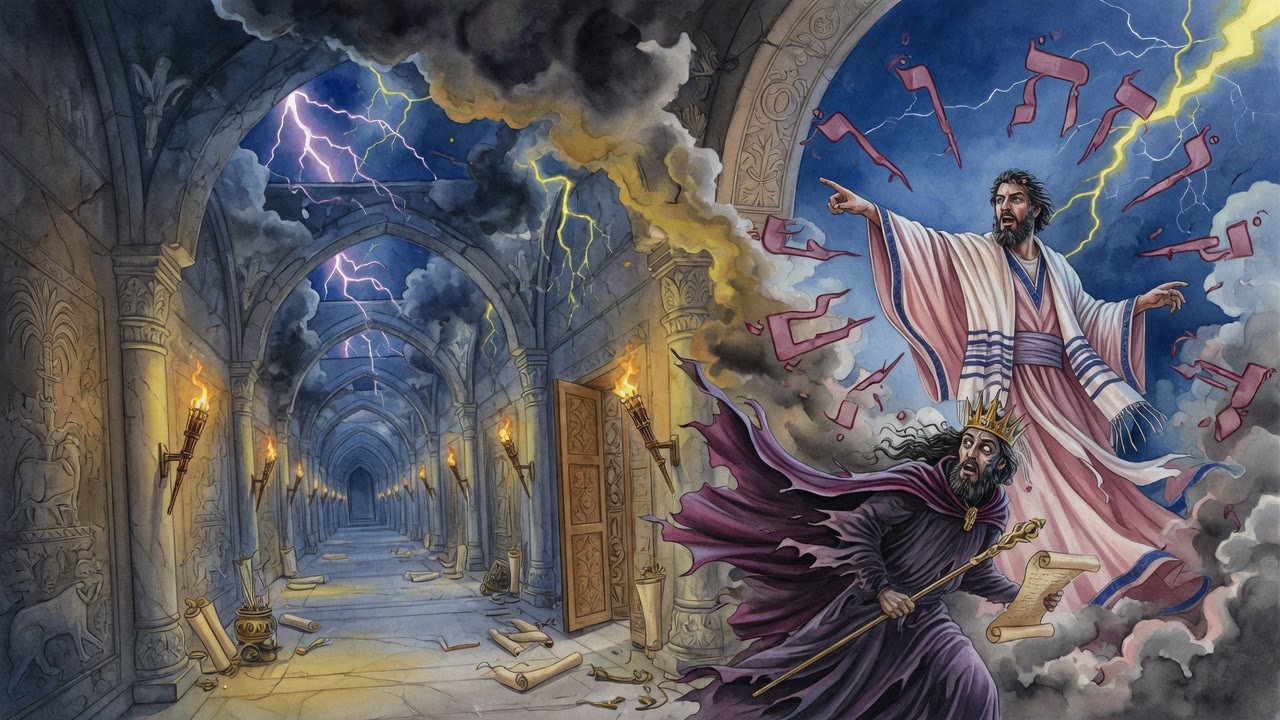
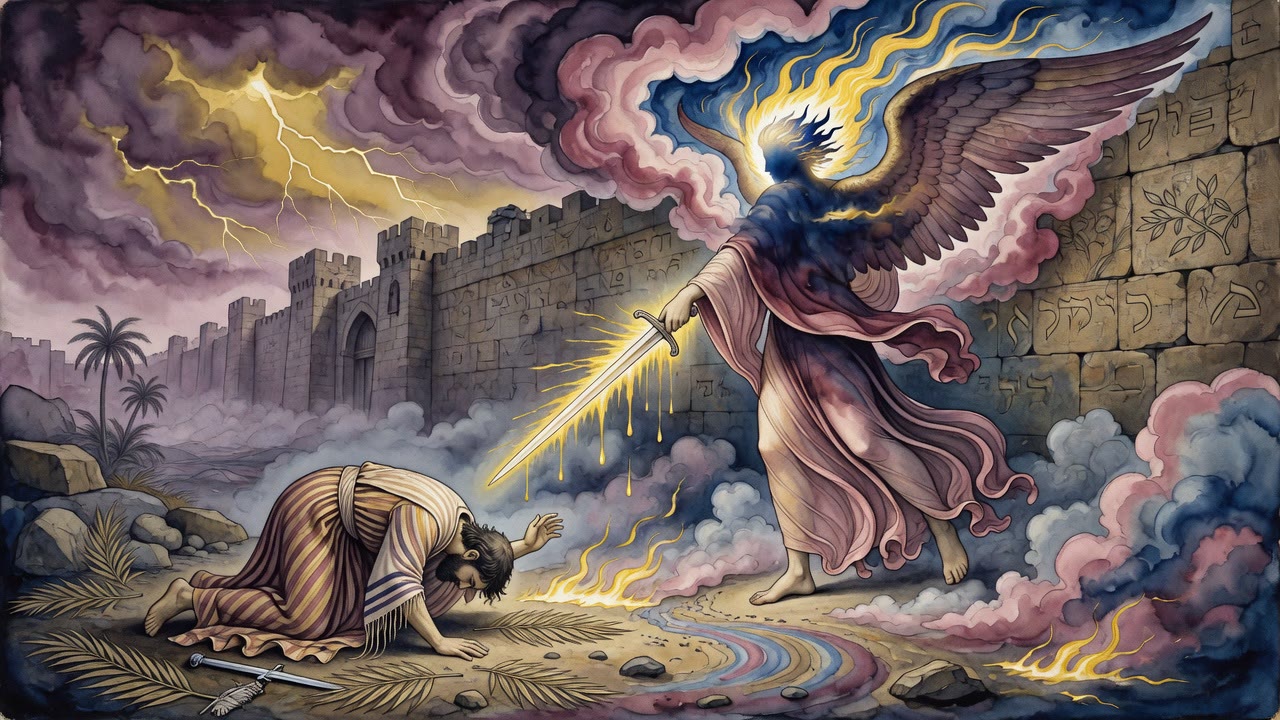
The sword was already drawn when Joshua lifted his eyes outside Jericho. One man stood before him, armed and silent, and the whole camp of Israel waited behind Joshua's back.
A Blessing Sent the Angel Forward

Long before Jericho's walls held their breath, Jacob had placed his hands over Ephraim and Manasseh. He blessed the lads with the angel who had redeemed him from all evil. The old patriarch did not give them only memory. He sent protection into their future, a messenger moving ahead of descendants who had not yet drawn breath.

From Ephraim would come Joshua, the servant who became leader after Moses. From Manasseh would come Gideon, another man who would meet an angel while Israel trembled under pressure. Jacob's blessing did not lie flat on the deathbed. It walked.

By the time Joshua stood near Jericho, he carried more than command. He carried a blessing old enough to have crossed generations, a promise that an angel could arrive when danger sharpened into a blade.

Moses Chose the Face of God

The angel had already been sent once. Moses refused him.

That refusal was not small arrogance. Moses had lived on speech from God. He had stood in the Tent of Meeting and received a nearness that made ordinary mediation feel like distance. A messenger, even a holy one, was still not the face he wanted. Moses wanted the Presence itself, no substitute, no lowered flame.

So the angel turned away from the prophet who had argued with Pharaoh, split the sea, climbed Sinai, and carried Israel through fire and complaint. Greatness can make a man fearless before angels. It can also make him dangerous to bless.

The Sword Waited Outside Jericho

Joshua was not Moses. He knew it. For forty years he had watched the master enter places where others could not follow. He had heard the voice from the cloud and learned the weight of second place. Now Moses was gone, the Jordan had been crossed, and Jericho stood locked ahead of him.

Then came the armed stranger.

Joshua asked the only question a commander could ask. Are you for us, or for our enemies? The answer cut across the battlefield. No. I am the commander of the host of the Lord.

The sword did not lower. The angel did not flatter him. The message struck deeper than tactics: do not treat the messenger as less than the One who sent him. Wherever the angel appears, the Holy One appears with him.

Humility Opened the Gate

Joshua bowed. The dust received his body before Jericho received his army.

That was the difference. Moses had wanted no angel because he had known God's nearness face-to-face. Joshua received the angel because he knew the gap between himself and Moses, between command and certainty, between a drawn sword and a voice from heaven. He did not need the messenger to be small so that he could feel large.

Israel's next war began with a posture, not a trumpet blast. Before the walls could fall, the leader had to fall lower. The man who would command a nation first accepted command from a figure with a sword.

Qipod Opened the Gates of Fire

Another Joshua, Rabbi Joshua ben Levi, also wanted an angelic boundary opened. He wanted to see Gehinnom. The Messiah refused him at first. It was not fitting, he said, for the righteous to look into that place, because the righteous do not belong there.

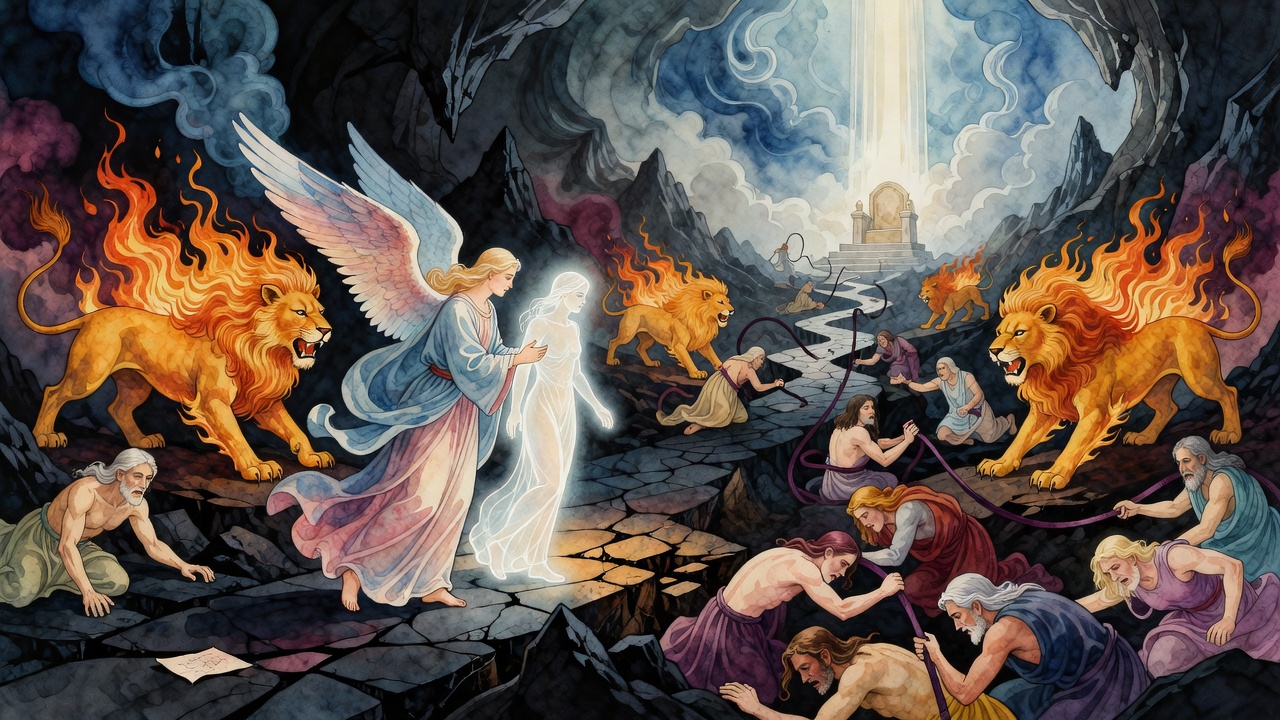
Rabbi Joshua pressed. The answer changed, and the angel Qipod became his escort.

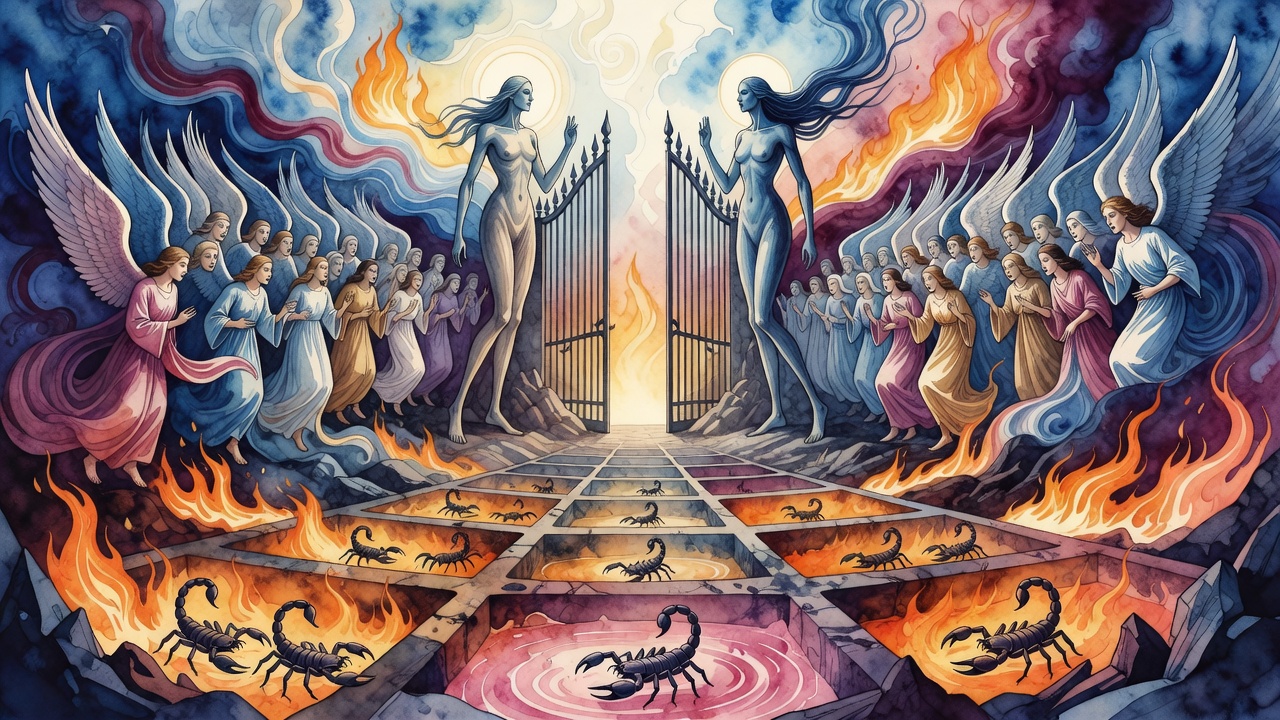
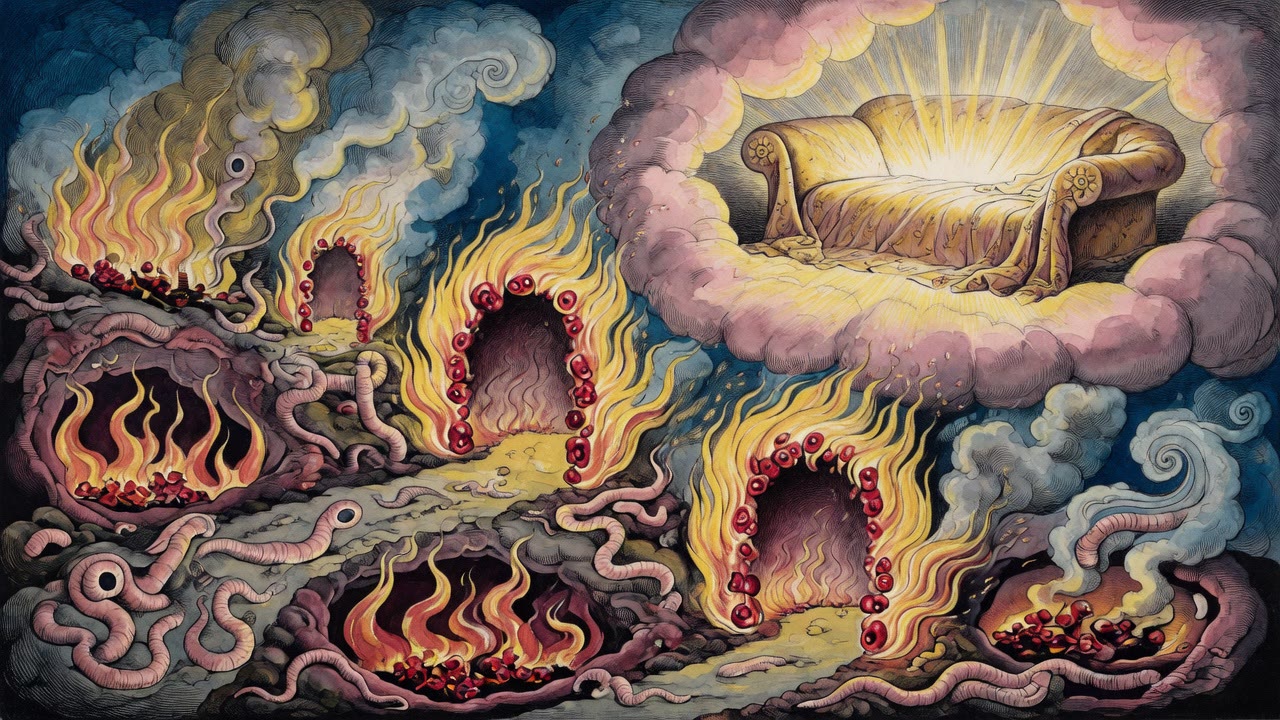
The gate opened on seven compartments of fire. The first stretched a mile in length and a mile in breadth. Open pits waited there. Lions made of flame stood over them. Two brooks ran through the burning place, and when the wicked fell in, the fire-lions hurled them back into the flames.

Then the light of the Messiah reached the condemned. They cried out from the heat because they thought rescue had come. For one flash, the place of punishment filled with hope, and the angel kept leading the sage deeper into what no righteous man was meant to see.

The Messenger Was Never Small

The same pattern returns with a sword outside a city and a guide at the gates of fire. A messenger arrives where a human being cannot master the threshold alone. Moses could refuse such a messenger and still remain Moses. Joshua could receive him and become ready for Jericho. Rabbi Joshua ben Levi could press until Qipod opened a burning world.

The angel was never small. The danger was mistaking nearness to God for permission to despise the one God sent.


← All myths
From the tradition

Sources

2 sources

The texts this telling draws on, in full. Open a card to read inline, or expand it for a wider, quieter read.

Bereshit Rabbah 97:3Bereshit Rabbah

Our Sages, delving deep into the Torah, confront this very idea in Bereshit Rabbah 97, a section of the ancient Midrash (rabbinic interpretive commentary). They begin with a verse from Genesis (48:16), where Jacob blesses his grandsons, Ephraim and Manasseh: “May the angel who redeems me from all evil bless the lads, and let my name and the name of my fathers, Abraham and Isaac, be called upon them, and may they proliferate like fish in the midst of the land.”

What does it really mean to be "redeemed from all evil?" Rabbi Yosei bar Ḥalafta offers a surprising comparison: Sustenance, he says, is actually twice as difficult as childbirth! Childbirth, with all its pain (be’etzev in Hebrew), is explicitly described in the Torah. Yet, sustenance, the daily grind of making a living, is described with an even stronger word: be’itzavon, interpreted by the Midrash as the plural of be’etzev, implying double the difficulty.

Rabbi Elazar and Rabbi Shmuel bar Naḥman take this idea even further. Rabbi Elazar points out that redemption and sustenance are constantly linked. Just as God performed multiple miracles in redeeming Israel, so too is sustenance a constant, daily miracle. Rabbi Shmuel bar Naḥmani then makes a startling claim: Sustenance is greater than redemption! How can that be? Because redemption is often carried out by an angel, while sustenance comes directly from the Holy One, blessed be He. As it says in Psalms (145:16), "You open Your hand and satisfy everything living."

Rabbi Yehoshua ben Levi adds another layer, comparing the difficulty of earning a living to the splitting of the Red Sea! He connects the verse "Who split apart the Red Sea" (Psalms 136:13) with "He gives food to all flesh" (Psalms 136:25). In other words, the very same power that parted the waters is at work in providing our daily bread.

The Midrash doesn’t stop there. It connects Jacob's blessing, "May…bless the lads," to Joshua and Gideon, descendants of Ephraim and Manasseh, to whom angels appeared. We're reminded of the powerful image of Joshua encountering an angel, the "commander of the host of the Lord" (Joshua 5:13-14). Rabbi Yehoshua, in the name of Rabbi Ḥanina bar Yitzḥak, even says the angel cried out from his toenails! The angel essentially tells Joshua, "Everywhere I am seen, the Holy One, blessed be He, is seen."

And then comes a fascinating little digression, where the angel explains that he had initially been sent to Moses, but Moses refused him, preferring God's direct presence. The angel warns Joshua not to make the same mistake!

Finally, the Midrash returns to the blessing, "May they proliferate like fish in the midst of the land." Just as the eye has no dominion over the fish, hidden beneath the water, so too, the evil eye will have no dominion over Jacob's descendants. Just as fish are only caught by their throat, so too will the descendants of Joseph be vulnerable only in that specific way.

The Midrash beautifully illustrates this with stories of the tribe of Ephraim, who were identified by their inability to pronounce the word Shibolet correctly, leading to their demise.

The Rabbis even explore the sheer number of Israelites, claiming that when the Israelite women conceived six hundred thousand babies in one night, all cast into the Nile, but they ascended by Moses’s merit! Rabbi Zakkai Rabba then connects this back to the fish, saying just as in the midst of the land they were six hundred thousand, so, in the milieu of the fish they were six hundred thousand.

The passage concludes with a clever play on words: One whose name is like the name of fish (Nun, meaning fish in Aramaic), his son (Joshua the son of Nun) will take them into the Land of Israel.

So, what does it all mean? This passage from Bereshit Rabbah isn't just a dry commentary on a biblical verse. It's a profound reflection on the hidden miracles that sustain us, the constant interplay between redemption and provision, and the enduring power of blessing. It reminds us that even the most mundane aspects of our lives are touched by the Divine, and that perhaps, just perhaps, earning our daily bread is a miracle on par with the splitting of the Red Sea. Next time you sit down to a meal, take a moment to appreciate the extraordinary effort, seen and unseen, that made it possible.

Full source
Chronicles of Jerahmeel XXIChronicles of Jerahmeel (Gaster, 1899)

Rabbi Joshua ben Levi wanted to see Gehinnom (the place of spiritual purification after death). The Messiah refused. "It is not fitting for the righteous to see it," he said, "for there are no righteous people in hell." But Rabbi Joshua pressed the matter, and eventually the angel Qipod escorted him to the fiery gates. According to the Chronicles of Jerahmeel, a 12th-century Hebrew chronicle translated by Moses Gaster in 1899, what he found was a system of seven compartments, each more terrible than the last.

The first compartment measured one mile in length and breadth, filled with open pits containing lions made of fire. Two brooks ran through it, when the wicked fell in, the fire-lions standing above cast them back into the flames. When the Messiah accompanied Rabbi Joshua to the gates, the wicked saw his light and rejoiced, crying, "This one will bring us out of this fire!"

The second compartment held nations of the world with Absalom presiding over them. The nations argued among themselves, "If we sinned because we rejected the Torah, what sin did you commit?" They challenged Absalom: "Your ancestors accepted the Torah. Why are you punished?" He answered simply: "Because I did not listen to my father." The punishing angel Qushiel struck the wicked with a rod of fire, cast them into flames, and burned them, seven times daily and three times nightly. But Absalom himself was spared each time, because he descended from those who declared at Sinai, "We shall do, and we shall hear."

This pattern repeated through all seven compartments. Korah in the third, Jeroboam in the fourth, Ahab in the fifth, Micah in the sixth, and Elisha ben Abuya in the seventh. Each Israelite sinner was rescued from the worst punishments by the merit of their ancestors' covenant at Sinai. The darkness filling these compartments was the primordial darkness that existed before creation. So thick that no soul could see another.

Full source