5 min read

Joshua Received the Staff While Moses Still Stood

At a hundred and twenty his eye had not dimmed. Moses laid hands on Joshua anyway, with joy, and never asked why the honor missed his own sons.

Curated by Arthur · Told by Maggid ·
Table of Contents
  1. Take Joshua With Joy
  2. Strength That Had Not Abated
  3. Three Signs of the Redeemer
  4. Israel Cannot Fly Without Elders
  5. The Overflowing Vessel
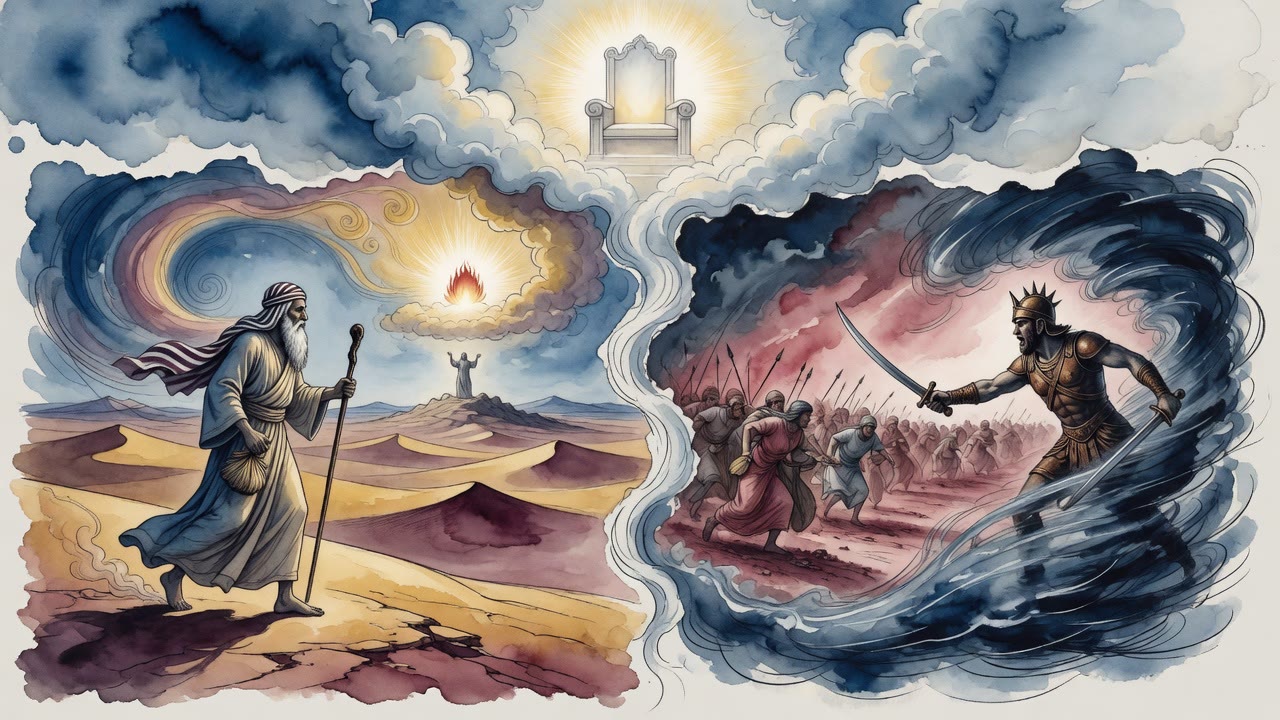
Joshua Received the Staff While Moses Still Stood Click for full size

Take Joshua With Joy

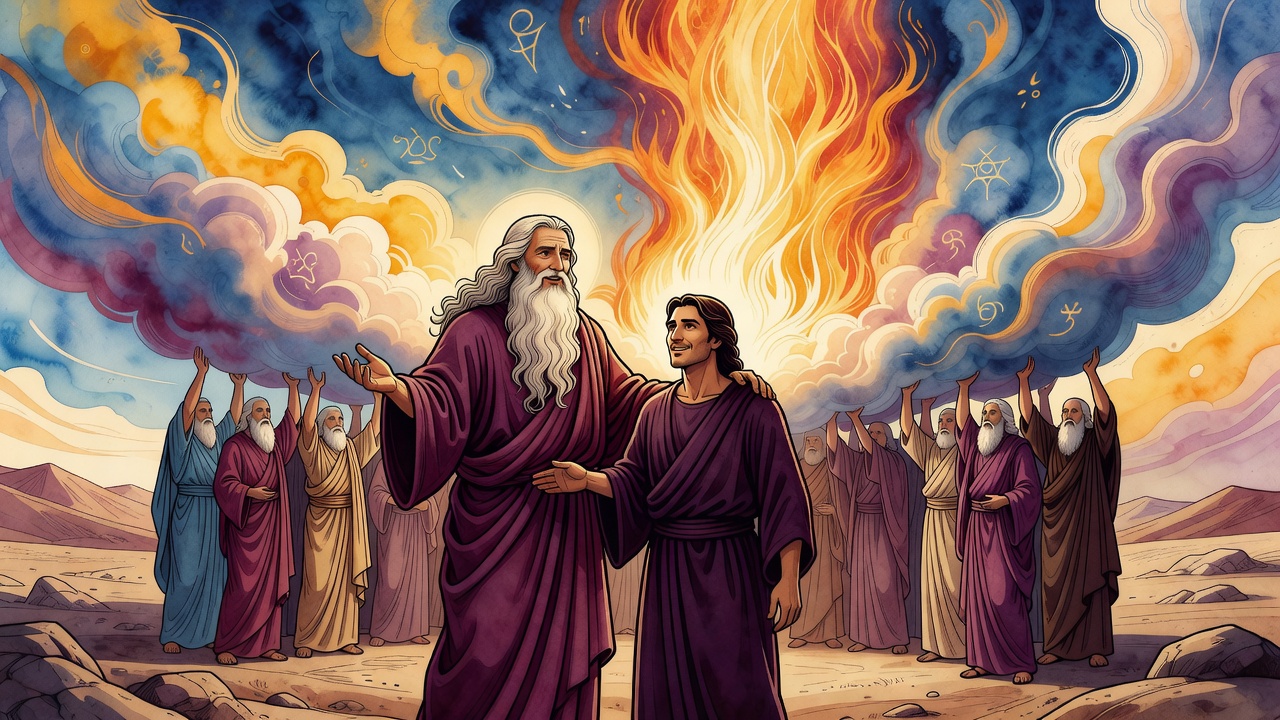
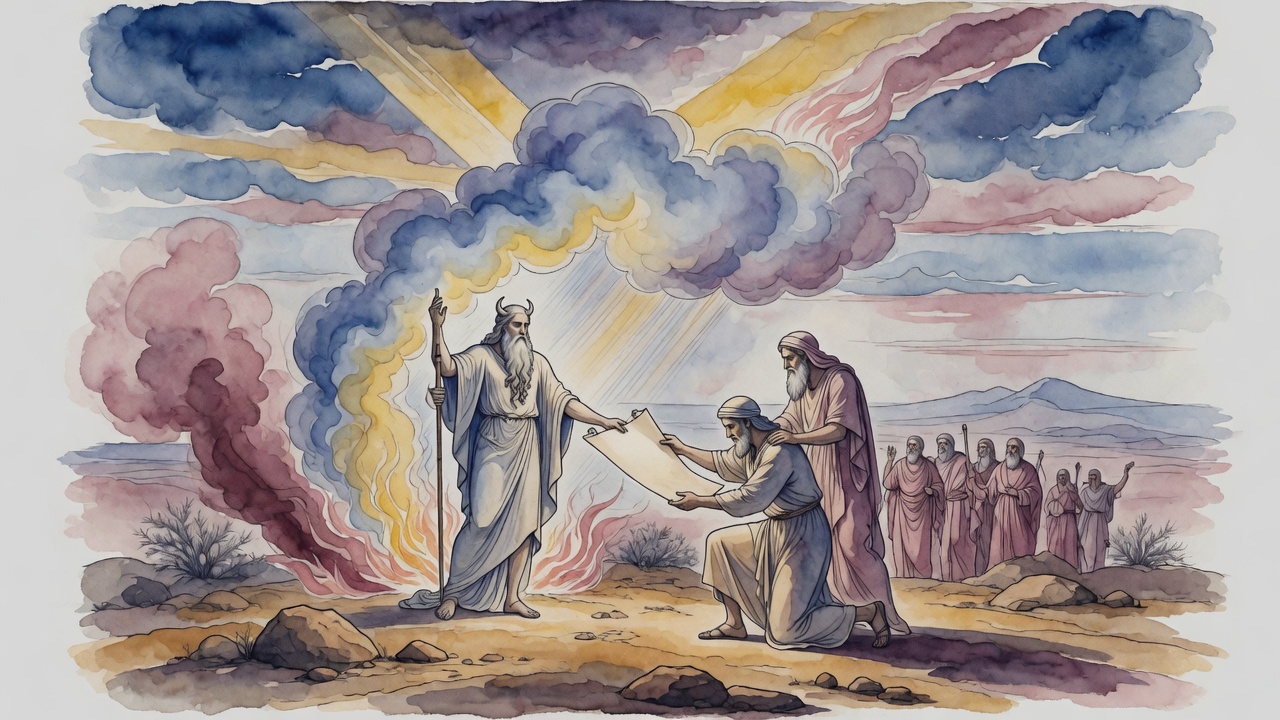
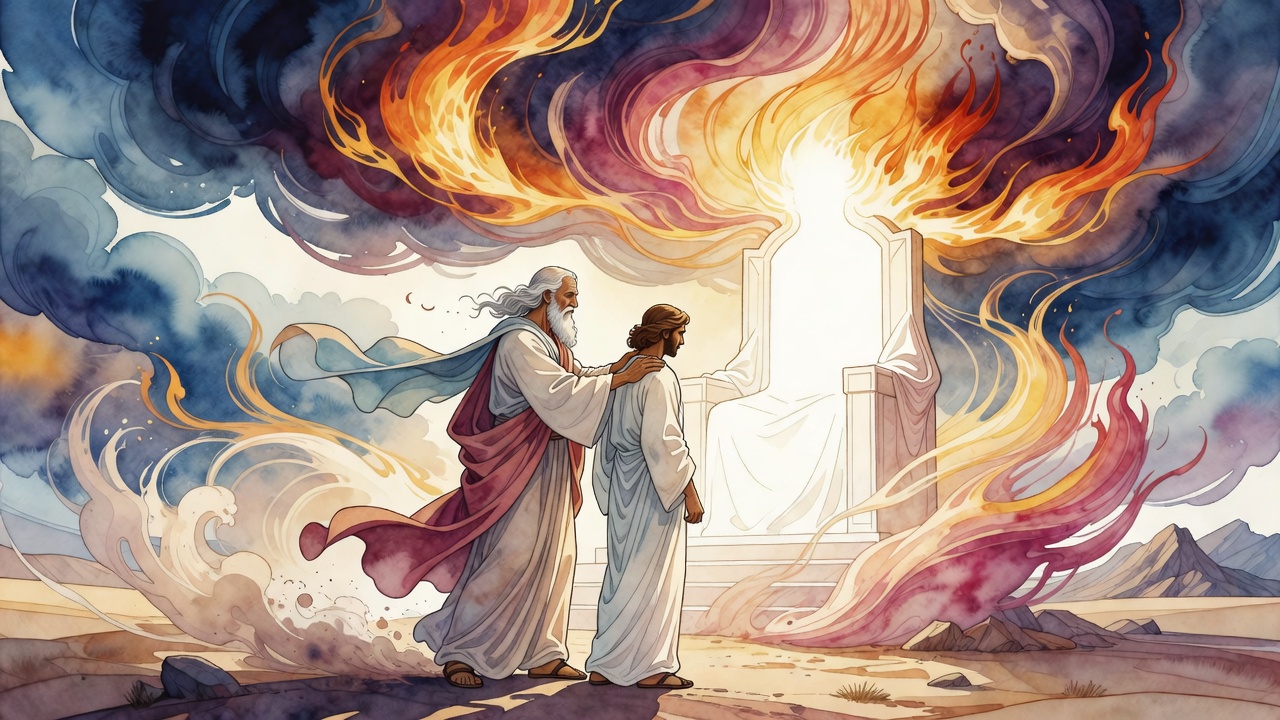
God tells Moses to take Joshua son of Nun, a man in whom there is spirit, and lay hands on him (Numbers 27:18). Moses does it with joy, the same joy with which God commanded him. No sour edge. No private wish that the honor might have fallen to his own sons. The transfer is not a grudging surrender of a throne. It is a gift passed while the giver still stands upright.

"And he took Joshua." The taking is with words as much as with hands. Moses speaks to him of the reward waiting for the leaders of Israel in the world to come. He prepares Joshua not only for wars and judgments in this dust, but for the account that continues after breath. Then he sets his hands on him and makes him an overflowing vessel of Torah, wisdom poured until it runs over the rim.

Joshua has already lived as the youth who did not depart from the tent (Exodus 33:11). The book of the Torah is not to leave his mouth (Joshua 1:8). The hands do not create diligence from nothing. They authorize and increase what tent-loyalty already began.

Strength That Had Not Abated

Some will wonder whether Moses' hands over power because age has thinned him. Deuteronomy answers before the rumor ripens. Moses is a hundred and twenty years old at his death; his eye has not dimmed, his moisture has not fled (Deuteronomy 34:7). He can still tell clean from unclean, permitted from forbidden, with a mind that has not gone soft.

The succession is not emergency salvage. It is obedience while the first leader still has full sharpness. That fact cleans the moment of self-pity. Moses is not discarded as worn tools are discarded. He is commanded to multiply himself in another man while he can still feel the exact weight of the work.

Joshua receives the overflow. The people watch a living Moses choose not to clutch. The sight lands harder than any speech about humility.

Three Signs of the Redeemer

Long before the wilderness handover, Jacob on his deathbed gave Joseph signs by which the future redeemer of the children of Israel would be known. He would use the word anokhi, "I." He would appoint elders. He would say pakod, "He will remember." Moses fulfills all three: the "I" of his commission, the gathering of elders, the language of divine remembering (Exodus 3:11, 3:16, 4:29).

Rabbi Hunya hears in place of anokhi the ineffable Name itself, tying redemption even tighter to the Presence that spoke from the bush. Either reading keeps the same spine: the man who will free Israel must match a pattern Jacob planted in Joseph's ear generations earlier.

So Joshua's ordination does not float free of history. It sits inside a chain of signs, elders, and names that began when a dying patriarch spoke to a son in Egypt. Leadership in this family is never only charisma. It is recognition against an old password.

Israel Cannot Fly Without Elders

Rabbi Akiva says Israel is like a bird. As a bird cannot fly without wings, Israel cannot act without elders. God honors elders in Egypt, at the bush, at Sinai, at the tent of meeting, and in the future when the moon is abashed and the sun ashamed before the Lord of hosts, and opposite His elders there is honor (Isaiah 24:23).

Moses does not hand Joshua a people with no council. He hands him a nation whose wings are gray-bearded judgment, memory, and restraint. When priests err with wine, the warning after Nadav and Avihu proves that even the honored are chastised. Honor is not immunity. It is weight.

Joshua will need those wings over Jordan. Moses has already spent forty years learning that a lone hero without elders becomes a danger to himself and to the camp.

The Overflowing Vessel

Hands on the head. Words about the world to come. A Torah that does not depart from the mouth. Signs Jacob gave. Elders like wings. The scene of succession is crowded with more than two men. It holds the dead patriarch, the living God, the council of the aged, and the still-sharp eyes of Moses at the edge of his own ending.

Joshua rises from under the hands heavier and lighter at once: heavier with charge, lighter because the joy of the giver has blessed the gift. The staff of leadership has moved, and the first shepherd has not yet lain down. That overlap is the mercy. The people are not asked to trust a stranger in a vacuum. They are asked to trust a servant Moses filled while he could still fill him.


← All myths
From the tradition

Sources

3 sources

The texts behind this telling. Some cards carry a translation of the source; others are our own retelling of it, and each card says which. Every card links out to the original.

Sifrei Bamidbar 141:3Sifrei Bamidbar

Retold in our words. Read the original at the link below.Sifrei by Rabbi Shraga Silverstein · CC-BY

The Torah gives us a powerful example in the story of Moses and Joshua.

We find ourselves in the book of Numbers, Bamidbar, specifically chapter 27. God has commanded Moses to appoint Joshua as his successor. Now, think about this for a moment. Moses, the leader who led the Israelites out of Egypt, who received the Torah at Sinai, is now tasked with handing over the reins. How does he do it?

The verse (Bamidbar 27:22) tells us, "And Moses did as the L-rd commanded him." But it's the commentary on this verse in Sifrei Bamidbar that truly illuminates the moment. It wasn't just obedience; it was obedience with joy. Moses felt no regret that this honor wasn't bestowed upon his own sons or nephews.

It gets even more beautiful. The text continues, "and he 'took' Joshua." But this "taking" wasn't a mere physical act. According to Sifrei Bamidbar, Moses "took" Joshua with words, sharing with him the reward awaiting the leaders of Israel in the world to come. He prepared Joshua not just for the earthly task of leadership, but for his eternal reward. What an incredible gift to give someone!

The next verse (Bamidbar 27:23) says, "And he placed his hands upon him." This wasn't just a symbolic gesture either. Sifrei Bamidbar interprets this as Moses making Joshua "an overflowing vessel of Torah." He was imbuing him with knowledge and wisdom, preparing him to lead the people according to God's law. This idea of being an "overflowing vessel" reminds me of the proverb, "the watcher of the fig-tree will eat its fruit," meaning that diligent study and dedication to Torah will yield its own sweet rewards.

Think about Joshua’s dedication. As we learn in Exodus (33:11), "And his attendant, Joshua the son of Nun, a youth, did not depart from the midst of the tent," and similarly in Joshua (1:8), "this book of the Torah shall not depart from your mouth." Sifrei Bamidbar makes a powerful point: if Joshua, who was already so dedicated, never strayed from the Torah, how much more so should everyone else strive to remain connected to it? If someone already filled with the spirit of wisdom (Deuteronomy 34:9) felt the need to constantly immerse himself in Torah, then it is certainly a lesson to us all.

The text emphasizes that Moses commanded Joshua with the same joy that God commanded Moses. There was a seamless transfer of leadership, guided by divine will and fueled by genuine happiness.

But here's a question that might arise: Did Moses's abilities wane as he aged? The Torah anticipates this concern, telling us in Deuteronomy (34:7) that "Moses was a hundred and twenty years old in his death. His eye had not dimmed...and his strength had not abated." This wasn't just about physical strength; it was about his unwavering clarity in discerning between right and wrong, clean and unclean, permitted and forbidden. He never lost his ability to toil in Torah.

It's not just about succession; it's about the spirit in which we approach it. It’s about passing on our knowledge and wisdom with joy, without regret, and with the genuine desire to see the next generation succeed. It's about recognizing that true leadership isn't about clinging to power, but about empowering others to carry the torch forward, ensuring the light of Torah continues to shine brightly for generations to come.

Full source
Bereshit Rabbah 97:6Bereshit Rabbah

Retold in our words. Read the original at the link below.The Sefaria Midrash Rabbah, 2022 · CC-BY

The verse in question is (Genesis 48:21): "Israel said to Joseph: Behold, I am dying, and God will be with you, and He will restore you to the land of your fathers." It seems straightforward enough. But the rabbis of the Midrash (rabbinic interpretive commentary), in their boundless wisdom, saw layers upon layers of meaning hidden within.

The text hones in on the word "I" – anokhi in Hebrew. A teaching attributed to the son of Rabbi Yosei's brother suggests that Jacob gave three signs to identify the future redeemer of the Israelites. The redeemer would use the term anokhi, appoint elders, and say pakod ("he will remember"). Lo and behold, Moses fulfills all three signs! We can see this, for instance, in (Exodus 3:11), 3:16, and 4:29.

Rabbi Ḥunya offers a slightly different take. He replaces anokhi with the ineffable Name of God. Referencing (Exodus 3:13-14), this links the idea of redemption even more directly to the Divine Presence.

The passage then moves onto (Genesis 48:22): "And I have given to you one portion [shekhem] beyond your brothers, which I took from the hand of the Emorite with my sword and with my bow." Here, the rabbis explore what this "portion" represents.

One interpretation suggests that the "portion" is the city of Shekhem itself. It was granted to Joseph because, unlike his brothers, he didn't act wrongly in Shekhem. Remember the story of Joseph being sold into slavery (Genesis 37:14)? Or even earlier than that, the terrible story of Shekhem's rape of Dina (Genesis 34:2)? Joseph, according to this reading, represents restraint and righteousness. He even resisted the advances of Potiphar's wife! As Rabbi Pinḥas puts it, "In Shekhem there was breach in the area of licentiousness, and you repaired it; therefore, it will be in your portion."

Then we have Rabbi Yehuda and Rabbi Neḥemya offering different perspectives. Rabbi Yehuda says the "one shekhem" refers to the birthright and the garment of Adam. He equates the "Emorite" to Esau, explaining that Esau acted like an Emorite. And the "sword and bow"? Those are mitzvot (commandments), good deeds. Rabbi Neḥemya, on the other hand, sticks to the literal interpretation: the "one shekhem" is the city of Shekhem. He identifies the "Emorite" as Ḥamor, the father of Shekhem, explaining that the Hivites were included in the larger group of Emorites. According to the Etz Yosef commentary, the Emorites were a larger group surrounding the Hivites, and therefore the Hivites were sometimes called Emorites.

Finally, Rabbi Neḥemya addresses the "sword and bow." He explains that Jacob didn't want his sons to commit the act of violence in Shekhem. Yet, when they did, Jacob worried about their safety. So, he took his sword and bow, stood at the entrance of Shekhem, and declared he would defend them if necessary. This is backed up by Bereshit Rabba 80:10.

What's so powerful about this passage from Bereshit Rabbah is how it shows us that even seemingly simple words and stories can hold multiple layers of meaning. It invites us to engage with the text, to wrestle with different interpretations, and to find our own connection to the wisdom of our ancestors.

Full source
Midrash Tanchuma, Shmini 11Midrash Tanchuma

Retold in our words. Read the original at the link below.Townsend 1989 translation of Midrash Tanhuma, S. Buber Recension · CC-BY

And to the elders of Israel: Rabbi Akiva said, "Israel is compared to a bird - just like a bird cannot fly without wings, so [too,] Israel cannot do anything without elders. Rabbi Yose bar Chalafta said, "Great is old age - as if they are elders, they are beloved; and if they are youths, the Holy One, blessed be He, makes old age spring upon them [early]." Rabbi Shimon ben Yochai said, "Not [only] in one place, nor in two or three places do we find that the Omnipresent dispenses honor to the elders: In Egypt, as it is stated (Exodus 3:18), 'And they will listen to your voice and you will come, you and the elders of Israel'; at the [burning] bush, 'Go and collect the elders of Israel' (Exodus 3:16); at Sinai, 'you and Aharon, Nadav and Avihu and seventy of the elders of Isreal' (Exodus 24:10); at the tent of meeting, 'to Aharon and to his sons and to the elders of Israel. So [too,] in the future to come, the Holy One, blessed be He, dispenses honor to the elders, as it is stated (Isaiah 24:23), 'And the moon will be embarrassed and the sun ashamed, since the King, the Lord of hosts [will be] on Mount Zion and in Jerusalem and across from His elders will be honor.'" The Sages, may their memory be blessed, said, "The Holy One, blessed be He, will in the future make an assembly of His elders. And that is what the verse states, 'since the King, the Lord of hosts [will be] on Mount Zion and in Jerusalem and across from His elders will be honor.'" And the Holy One, blessed be He, honors the righteous ones and the pious ones, but any time that a mistake comes from them, He chastises them. See that which is written about the sons of Aharon, as they were assistant priests and erred with wine, as so did they, may their memory be blessed, say - that they were inebriated with wine; and hence the Holy One, blessed be He, commanded after their death, to warn about wine, as it is stated, "Wine and strong drink shall you not drink, you and your sons with you." The Holy One, blessed be He, said, "Be careful with wine. See that which Noach did, as he began to err with it, as it is stated (Genesis 9:20), 'And Noah, the man of the earth, began to plant a vineyard,' and it is written (Genesis 9:21), 'And he drank from the wine and he became drunk and he revealed himself.' What caused him to become disgraced? The wine. And it caused him to bring a curse upon his seed, as it is stated (Genesis 9:25), 'And he said, "Cursed is Canaan."' And hence, be warned about wine, since wine brings a person to all the sins in the world - to licentiousness, to the spilling of blood, to theft and to all the [other] sins in the world." And does it not gladden the heart of man; and the verse praise it like one reading in the Torah? As it is stated, (Psalms 104:15), "And wine gladdens the heart of a man," and it states (Pslams 19:9), "The precepts of the Lord, gladdening the heart." And further, He bequeaths the Garden of Eden to those occupied with Torah and its precepts, as it is stated (Deuteronomy 30:20), "as it is your life and the length of your days"; and a drunk - when the wine is still with him - sits happily, as if he was sitting in the Garden of Eden. [The resolution is] like [the story of] that student who was a pious man, and he had a father that drank heavily. And each time he would fall in the marketplace [from drinking], people would come and hit him with stones and pebbles. And they would yell and call out behind him, "Look at the drunkard." And when his son the pious man saw, he was embarrassed and wished for his soul to die. And every day, he would say to [his father,] "I will order [it] and they will bring you from every wine that they sell in the province to your house, and [just] don't go to drink in the tavern, such that you make a disgrace of yourself and of me." And he [would] say this to him once or twice every day, until his father said that he would do this, as he said, not to go to drink in the tavern. And so did the pious man do, that he would make food and drink for him every day and every night and put him to sleep in his bed, and then leave. One time, rain was falling and that pious man went out to the marketplace and was walking to the synagogue for prayer. And he saw a drunkard laying in the marketplace and a puddle of water was falling on him. And the young men and the youths were hitting him with stones and pebbles and throwing clay in his face and into his mouth. When this pious man saw, he said in his heart, "I will go to father and bring him to here, and I will show him this drunkard and the disgrace that the young men and youths make out of him; maybe he will prevent his mouth from drinking in the tavern and from getting drunk." And so did he do, he brought him to there and showed [the drunkard] to him. What did his old father do? He walked over to the drunkard and asked him in which [tavern] he drank that wine from which he became drunk. His pious son said to him, "Father, for this did I call you? Rather to see the disgrace they make out of him, as so do they do to you at the time that you drink - maybe you will prevent your mouth from drinking in the tavern?" He said to him, "My son, I have no enjoyment and Garden of Eden in my life besides this." When the pious man heard, he left with a bitter spirit. But the precepts and the Torah are not [just like] the joy of wine - since when the wine leaves his body, sorrow comes into his heart, 'this one leaves and that one comes'; but the Torah and the commandments are a delight and joy in this world and in the world to come, as it is stated, "as it is your life and the length of your days" - in this world and in the world to come, which is completely long. And you will find further with the sacrifices that it states about the lambs, "two one-year old unblemished lambs" (Numbers 28:9); about the bread, two issaron; but about the wine, [only] a quarter of a hin. So little would they offer [of the wine] to make known proper action (derekh erets). As much wine brings a person to sin, to great grief and to loss of the purse, as it is stated (Proverbs 23:31), "Do not ogle that red wine, as it lends its color to the cup, as it flows on smoothly" - in his home, such that there not be with what to cook, since he sells and gives everything for the sake of wine. Another [understanding]: Do not read it [as] "to the cup (kos)," but rather "to the purse (kis)," as he puts an evil eye into his purse. And so do you find with the Children of Ephraim, as it states (Hosea 7:11), "But Ephraim was like a silly dove, with no heart." Why? Because they drink much wine; and it states (Isaiah 28:1), "Woe, the crown of pride of the drunkards of Ephraim." And we have also found with a man and a woman that the verse states to take out their son to pelt him with stones, as it is stated (Deuteronomy 21:18), "And if a man has a son that is wild and rebellious," and it states (Deuteronomy 21:19), "And his father and his mother shall grab him." And why all of this? Because he went out to bad culture, such that he will spend his money, steal and do sins, and become liable for the death penalty. And before he becomes liable for death, "And his father and his mother shall grab him, etc. And all of the people of his city shall pelt him, etc." (Deuteronomy 21:19-21). And know [from this], that there is great evil in drinking much wine. And how much meat does he eat more than another man, for which he is liable for death? One litra. And another verse states, "Do not be of those who guzzle wine, or glut themselves on meat to them" (Proverbs 23:20). What is [the meaning of] "to them?" Meaning to say, to them do they do the evil - as they spend [all] their money and come to disgrace; and in the end, they become liable for death in this world and in the world to come.

Full source