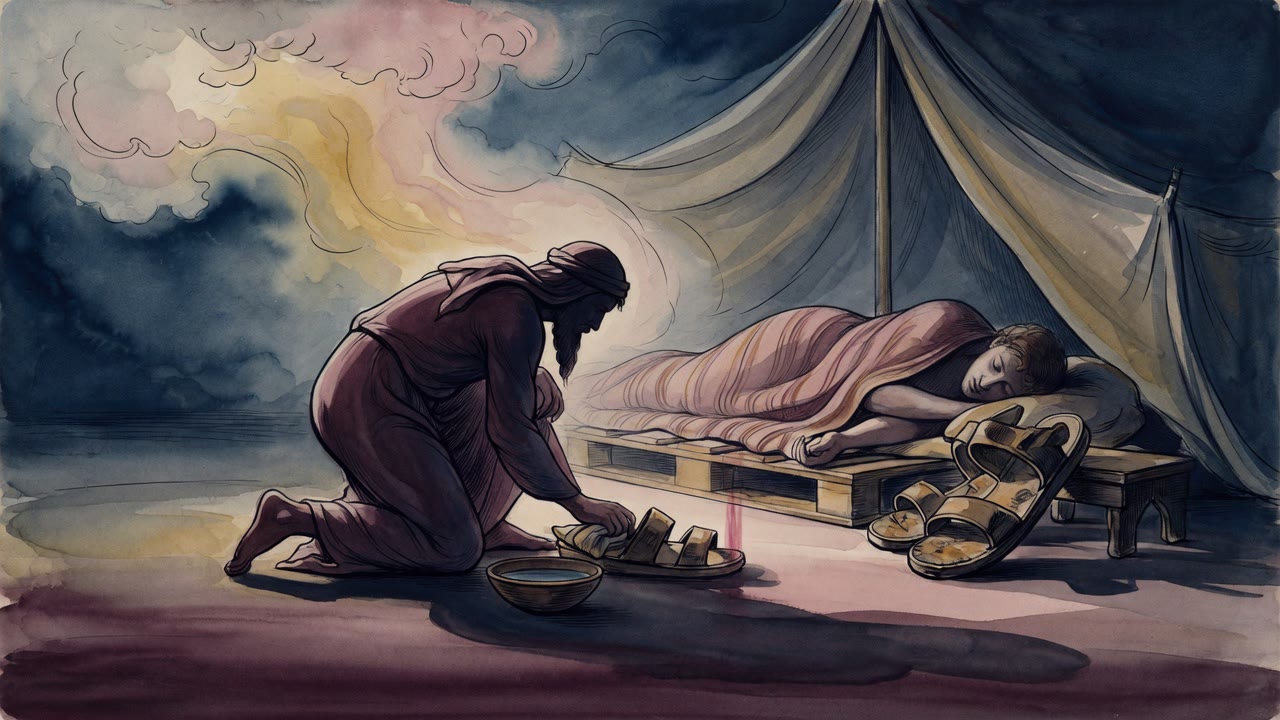
5 min read

Moses Asked for a Son and Received Joshua

Moses wanted one of his sons to inherit the burden of leadership. God chose Joshua instead, then made Moses strengthen him in public.

Curated by Arthur · Told by Maggid ·
Table of Contents
  1. The Sons Were Not Chosen
  2. The Shepherd Had to Know Every Spirit
  3. Joshua Still Had to Stand at Another Door
  4. Moses Strengthened the Man Who Replaced Him

The daughters of Zelophehad had just won their case, and Moses heard something inside the ruling that hurt.
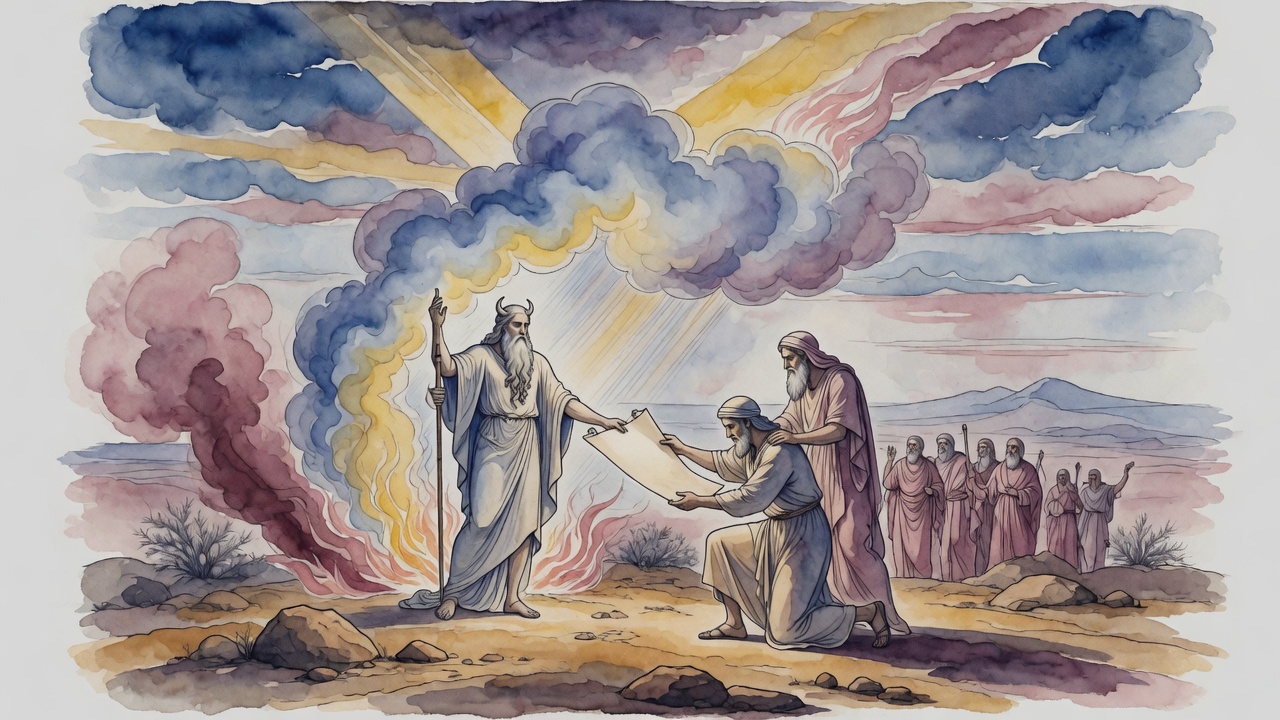
Their father had died without sons. They stood before the leaders and asked that his name not vanish from his clan. God accepted their claim. Daughters could inherit when there were no sons. A family line did not have to disappear because the usual path had closed.

Moses, standing at the edge of his own death, felt the question turn toward him. If inheritance could preserve a name, what about his name. If a father could worry that his house would vanish, what about the man who had carried all Israel on his back.

The Sons Were Not Chosen

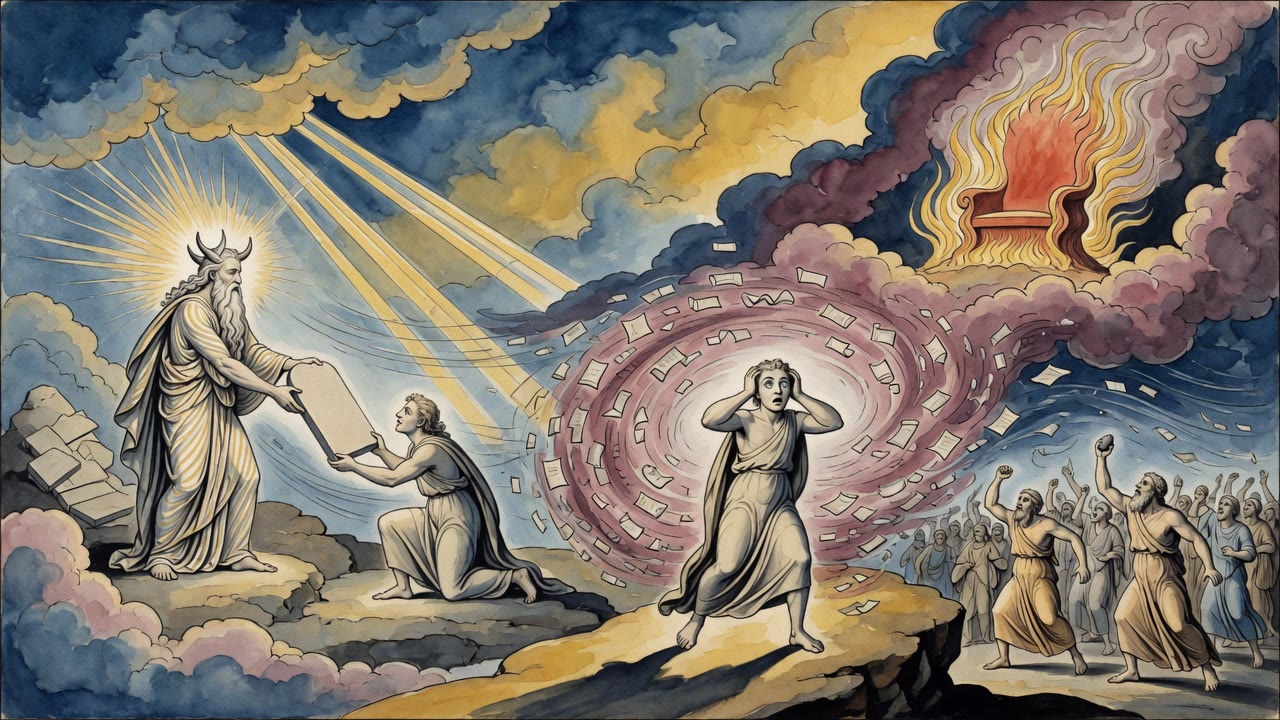
He wanted one of his sons to succeed him.

It was not greed. It was grief with a father's face. Moses had given Israel everything public: his voice, his sleep, his anger, his skin shining from Sinai, his years in the wilderness. Now, at the end, the private hunger rose. Let one son stand after me. Let my house not be empty of the work.

God's answer did not flatter the request. "Aaron's sons are like your sons," God told him. The work of leadership does not pass by blood alone. The one who will lead must be fit for the people, not merely close to the leader.

The sentence landed hard. Moses had already been denied the land. Now even succession would not carry his household across in his place. The future he had made would not wear his son's face.

The Shepherd Had to Know Every Spirit

Moses did not sulk into silence. He changed the prayer.

"Lord of the spirits of all flesh, appoint a man over the congregation." The words matter. Moses did not ask for a commander who could shout over the camp. He asked the God who knows every spirit to choose someone who could bear different spirits without crushing them into one shape.

No two faces are alike. No two dispositions are alike. A leader of Israel has to know that before he opens his mouth. He must go out before them and come in before them. He must lead them out and bring them back. He must keep the congregation from becoming sheep without a shepherd, scattered not only by enemies, but by the unbearable variety of being human.

Moses had learned this in the hardest school. He knew the complainer, the zealot, the frightened parent, the tribal elder, the prophet, the hungry child, the man who remembered Egypt too fondly, and the woman who could see farther than the spies. One kind of voice could not carry them all.

Joshua Still Had to Stand at Another Door

God chose Joshua.

The choice did not turn Joshua into an unchecked king. Even after appointment, he had to stand before Eleazar the priest. The sages shaped the demand with a sharp royal image: a king may give greatness to the one he loves, but the beloved must still stand at the door of the king's son. Honor does not remove dependence. Authority does not end learning.

Joshua had served Moses for years. He had waited at the tent. He had fought Amalek. He had gone into Canaan and returned without joining the panic. Still, he would need the priestly house of Aaron. Still, he would receive counsel. Still, the leader after Moses would lead under a structure larger than himself.

That made the denial less cruel and more exact. Moses' sons were not rejected so one man's ambition could replace another's. They were passed over because Israel needed a shepherd shaped by service, counsel, courage, and restraint.

Moses Strengthened the Man Who Replaced Him

Then came the public act.

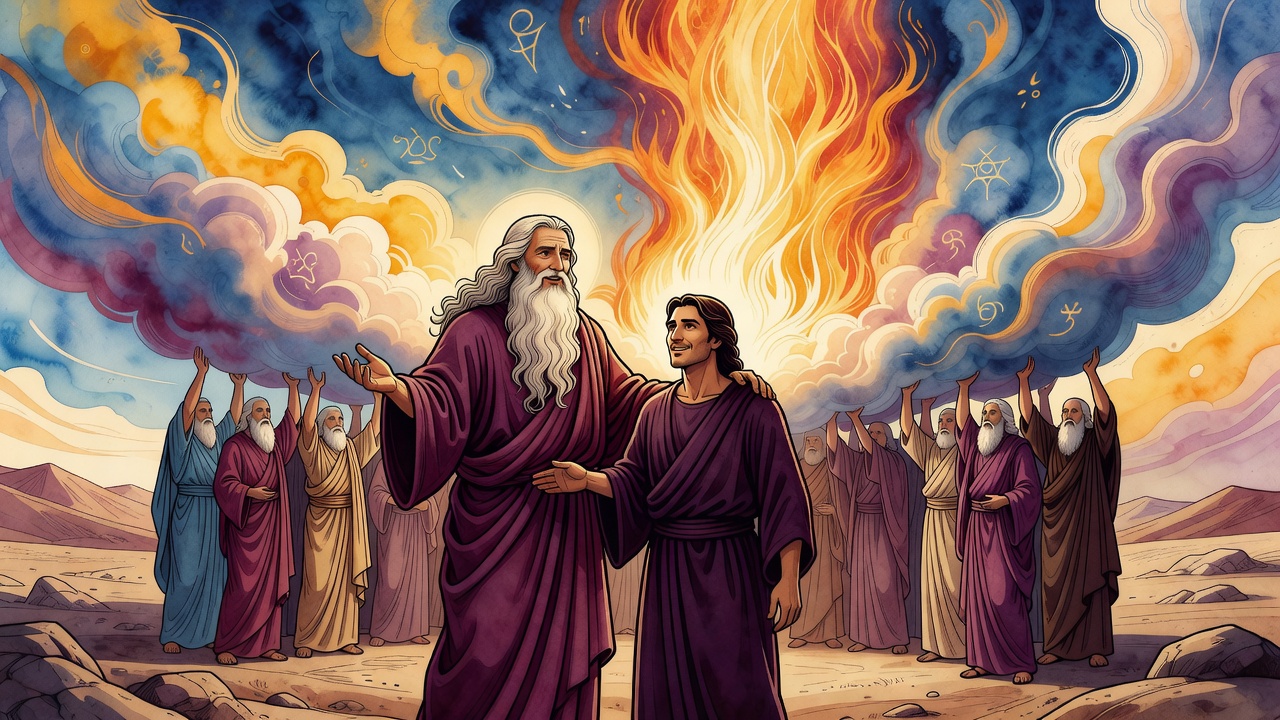
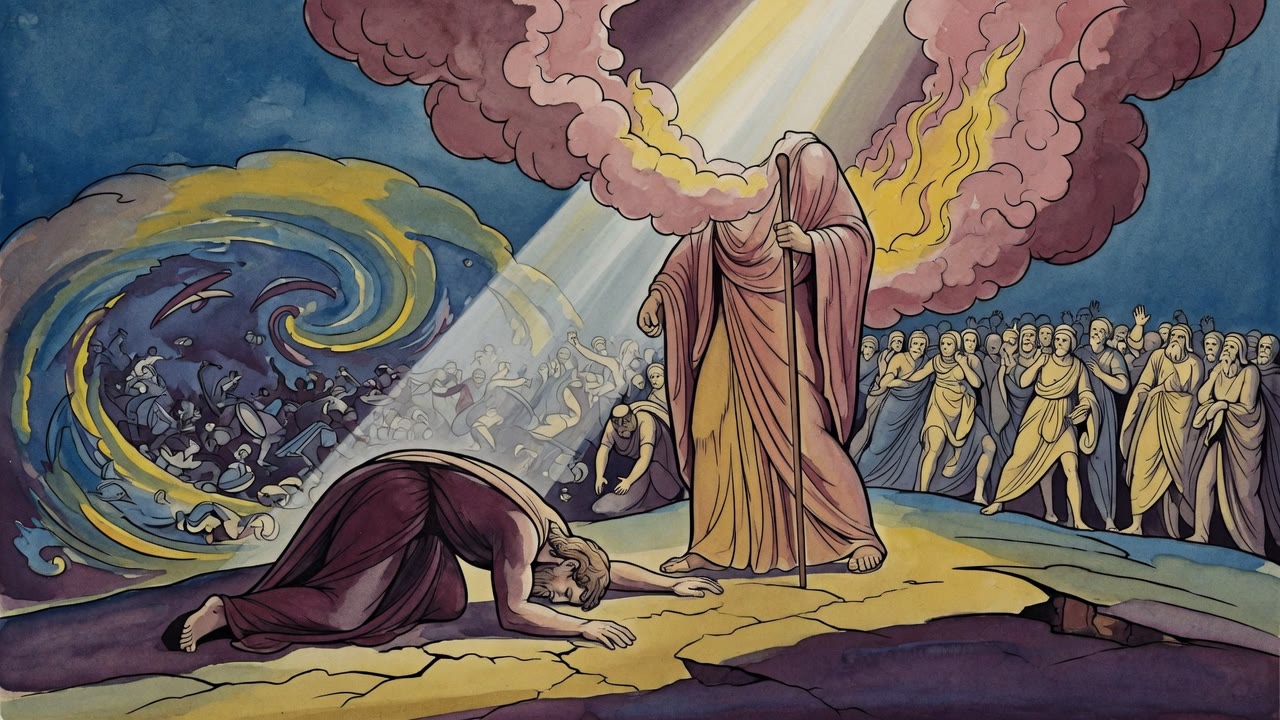
Moses called Joshua before the eyes of all Israel and told him to be strong and firm. He did not whisper the blessing in a tent. He did not leave the matter to rumor. The people had to see his hands move toward the man who would cross the river without him. They had to hear Moses lend strength to the future that had wounded him.

That was leadership after the last personal request had failed.

Nearby, the menorah stood as a memory of another difficulty. Moses had struggled with that lamp until God showed him how gold could be cast into fire and shaped beyond ordinary craft. Some things a man cannot hammer into being by will. He casts the gold. God completes the form.

So Moses gave Israel the gold he had left: a public blessing, a shepherd's prayer, and the humility to strengthen the successor who was not his son.


← All myths
From the tradition

Sources

7 sources

The texts this telling draws on, in full. Open a card to read inline, or expand it for a wider, quieter read.

Sifrei Devarim 305:2Sifrei Devarim

Here he was, the leader who brought the Israelites out of Egypt, the one who stood face-to-face with God on Mount Sinai... and none of his sons were deemed fit to succeed him.

In Sifrei Devarim, Rabbi Nathan tells us that Moses was deeply saddened by this. He yearned for one of his own to carry on his legacy. But God, in His infinite wisdom, had other plans.

What were those plans? Well, God essentially said to Moses: "Are the sons of your brother Aaron not like your own sons?" In other words, lineage isn't everything. Merit and capability matter too. The one I appoint will still need to learn – even from Elazar.

This teaching uses a powerful analogy: a king who takes the kingdom from his own son – a son fit for royalty,! – and gives it to his lover. "Though I gave you greatness," the king tells his lover, "go and stand at my son's door." Humbling. In the same way, God tells Joshua, the chosen successor: "Go and stand at the door of the sons of Elazar." This is a direct reference to (Numbers 27:21), where it's written, "And before Elazar the priest shall he [Joshua] stand." Even though Joshua was appointed to lead, he was still expected to learn from the priestly line of Aaron. No one is above learning, above seeking wisdom from others.

The text continues, and at that moment, Moses’ strength actually increased. It wasn't diminished by this decision; it was bolstered. Knowing God's plan was in motion, Moses strengthened Joshua before all of Israel. As (Deuteronomy 31:7) says, "And Moses called to Joshua and said to him before the eyes of all of Israel: 'Be strong and firm!'"

But why? What was so important about this public display of support?

God then gives Moses further insight, almost a pep talk for dealing with the people he’s about to lead: "Behold, the people that I am giving you are still kids, still infants. Do not be censorious of what they do, for neither was their Master." In other words, have patience! Remember their history. After all, as (Hosea 11:1) reminds us, "For Israel was a youth, and I loved him." They're young, still learning, still growing.

The passage even uses imagery from the (Song of Songs 1:8): "And graze your kids by the dwellings of the shepherds." Take them into the shepherds' tents, nurture them, guide them. Another interpretation offered is based on the Hebrew phrase "beikvei hatzon" (בְּעִקְּבֵי הַצֹּאן), meaning "by the tracks of the flock" or, more literally, "by the heels of the flock." This suggests that the people were "trodden down by the heel" (ekev עֵקֶב), emphasizing their vulnerability and need for gentle leadership.

So, what does this all mean for us? Well, it's a powerful reminder that leadership isn't just about authority; it's about guidance, mentorship, and recognizing the potential in others, even when it's not immediately apparent. It's about understanding that even the most capable leaders still need to learn and that sometimes, the greatest strength comes from empowering those around us, even if they aren't who we initially expected. Maybe, just maybe, our own disappointment can lead to someone else's moment to shine.

Full source
Sifrei Devarim 304:2Sifrei Devarim

Nowhere is it more poignant than in the story of Moses, right before his passing.

Moses, the greatest prophet, standing at the edge of the Promised Land, knowing he won't cross over. His heart, undoubtedly heavy, is filled with concern for the people he's led for forty long years. According to Sifrei Devarim, he turns to the Holy One, Blessed be He, with a heartfelt plea. "L-rd of the universe," he says "I'm leaving this world. Show me a trustworthy person, someone to guide them in peace." He wants someone who will "go out before them and who will come in before them, and who will take them out and who will bring them back," just as the Torah states in Bamidbar (Numbers) 29:17. Moses doesn't want the "congregation of the L-rd" to be "as sheep without a shepherd."

Isn't that a beautiful, human image? Moses, the towering figure, worried about his flock.

This plea echoes in the tradition. The Song of Songs (1:7) asks, "Tell me, O You whom my soul loves: Where will You graze (Your flock)? Where will you lay (them down) in the afternoon? For why should I be like (a woman) veiled (in mourning) among the flocks of Your neighbors?" It’s a desperate cry for direction, a fear of being lost and vulnerable.

And what is G-d's response? It's… unexpected. Instead of naming a successor outright, He says (Ibid. 8), "If you do not know, O fairest of the women (i.e. "greatest of the prophets"), go out in the footsteps of the sheep." What does this mean? The text interprets this as: see what I am destined to do with them in the future. In other words, look to the patterns of history, to the way I've guided them before.

Because, sadly, the path ahead won't always be easy. The text goes on to say that Israel will pass through four exiles, "without a shepherd, without a prophet, without a sage." Times of immense hardship and spiritual desolation. It's a stark reminder that leadership isn't always readily available.

This idea finds further resonance in II (Chronicles 18:16), which describes a vision of Israel "scattered on the mountains like sheep that have no shepherd" during the days of Achav. A time of immense spiritual crisis.

So what are we to make of this? Is it a pessimistic outlook? Perhaps. But I think there’s a deeper message here. While strong leadership is vital, it’s not always guaranteed. We, as individuals and as a community, need to cultivate our own inner compass, to learn from the past, to seek guidance from tradition, and to trust that even in the darkest of times, the Divine presence is still there, subtly guiding our steps. It's a call to develop our own spiritual resilience and to find our own way, even when the shepherd seems absent. And maybe, just maybe, to become shepherds ourselves.

Full source
Bamidbar Rabbah 21:2Bamidbar Rabbah

Our tradition teaches us that each individual is unique, a world unto themselves, with their own distinct ruach (spirit) and temperament. And it’s precisely this understanding that lies at the heart of a fascinating passage in Bamidbar Rabbah 21.

This passage opens with Moses's plea to God, as found in (Numbers 27:15-16): “Moses spoke to the Lord, saying, ‘May the Lord, God of the spirits of all flesh, appoint a man over the congregation.’”

The Midrash (rabbinic interpretive commentary) uses this verse as a springboard to discuss the profound diversity of human nature. It notes a halakha, a point of Jewish law: "If one sees numerous multitudes of people, he recites: Blessed are You, Lord our God, Ruler of the universe, who knows all secrets. Just as their faces are not similar to one another, so their dispositions are not identical to one another, but rather, each has a disposition of his own." We praise God for knowing the secrets of each individual. The Midrash connects this to (Job 28:25), "To set the calibration of the wind [laruaḥ]” – of the spirits of each and every person. According to Ginzberg's retelling in Legends of the Jews, this verse emphasizes the individual nature of each person's spirit.

It’s said that Moses, nearing his death, recognized this inherent diversity within the Israelite people. He understood that leading such a varied group required a leader who could understand and accommodate each individual's unique disposition. He knew, as the Zohar tells us, that each soul has its own unique spark. That's why he implored God to appoint a leader who could "bear each and every one in accordance with his dispositions." The Midrash emphasizes that the verse says "spirits," not "spirit," highlighting the multiplicity of human nature.

But here's where the story takes an interesting turn. God responds with a counter-request. The Midrash illustrates this with a parable: A king marries a woman, and the groomsman acts as a mediator. When the groomsman is dying, he asks the king to care for his wife. The king responds, "If you are commanding me regarding my wife, command my wife in my regard that she should be careful regarding my honor."

So, too, God says to Moses, according to Bamidbar Rabbah, “Instead of you commanding Me: ‘May the Lord…appoint,’ command them that they should be diligent regarding My honor.” In other words, instead of focusing solely on appointing a leader, Moses should also instruct the Israelites to be mindful of their duties to God. This is reflected in (Numbers 28:2): “Command the children of Israel…My offering, My food.” The emphasis shifts to the importance of the offerings, a tangible expression of the people's devotion.

What does this all mean? It seems the Midrash is teaching us a vital lesson about leadership and community. While it's crucial to have leaders who understand and respect individual differences, it's equally important for the community to share a common commitment to something greater than themselves – in this case, their relationship with God.

It's a delicate balance, isn't it? Recognizing the unique spirit within each person while also fostering a sense of shared purpose and responsibility. Perhaps that's the key to building a truly thriving and harmonious community.

Full source
Bamidbar Rabbah 15:4Bamidbar Rabbah

The Midrash (rabbinic interpretive commentary), specifically Bamidbar Rabbah 15, tells us that crafting the menorah was uniquely challenging for Moses. More so than any other object in the Tabernacle! Can you picture it? Moses, the great leader, the one who spoke to God face-to-face, struggling with a lamp.

This teaching paints a vivid picture. It wasn't just the menorah, either. There were other instances where God had to show Moses explicitly what to do. Think about identifying kosher animals. "This is the beast that you shall eat," God says in (Leviticus 11:2), and "this you shall not eat" (Leviticus 11:4), pointing, as it were, to the specific features. The same with determining the new moon, "This month is for you" (Exodus 12:2).

The menorah... ah, the menorah. The verse in (Numbers 8:4) reads, "This is the crafting of the candelabrum, hammered [miksha] gold." The Midrash emphasizes the word kasha, "how difficult!" It was incredibly hard work for Moses.

So what did God do? Did He give Moses a detailed instruction manual? Nope. Instead, He told him to take a talent of gold – a massive amount – and throw it into the fire. "Take a gold talent, cast it into the fire, remove it, and it will be crafted on its own," God says. The idea is that "Its knobs and its flowers, its cups, and its shaft 'were from it'" (Exodus 37:17). He would strike with the hammer and it would be crafted on its own.

This is where it gets really interesting. (Exodus 25:31) says, "Hammered it shall be crafted [tei’aseh]." But the Midrash points out that the word tei’aseh, "it shall be crafted," is written with a missing yod in some versions. The yod is a Hebrew letter, and its absence here suggests something profound: "it shall be crafted on its own." Moses simply had to trust.

So, Moses throws the gold into the fire and says, "Master of the universe, the talent is in the fire. Just as You will it, so it will be crafted." And immediately, the menorah emerges, perfectly formed.

That's why (Numbers 8:4) doesn't say, "So Moses crafted the candelabrum." It says, "So was it made" – without elaboration. According to the Midrash, God Himself crafted it.

And here's the kicker: God tells Moses that if the Israelites are careful to kindle the lamps before Him, He will protect their souls from all evil. Because, as (Proverbs 20:27) says, "The spirit of man is the lamp of the Lord." Souls, like lamps, need tending, need kindling.

So, what does it all mean? Maybe it's a reminder that even the greatest among us face challenges that seem insurmountable. Maybe it's about trusting in a power greater than ourselves, letting go, and allowing things to unfold as they should. And perhaps, most importantly, it's about recognizing the sacredness of our own souls and the importance of keeping that inner light burning bright.

Full source
Sifrei Bamidbar 140:1Sifrei Bamidbar

The Torah, our guide to life, gives us a glimpse in the book of Bamidbar (Numbers) when Moses is tasked with selecting his successor. It’s more than just picking someone competent; it's about identifying a soul ready to lead.

The verse (Bamidbar 27:18) tells us, "And the L-rd said to Moses: Take for yourself Joshua the son of Nun." But what does "for yourself" really mean? The Sifrei Bamidbar, an ancient commentary on the Book of Numbers, unlocks this a bit for us. It suggests that Moses was told to choose someone according to "what is in your heart." In other words, pick the person you know is worthy. It's a profoundly personal choice, not just a political appointment. It's about recognizing the inner qualities of leadership.

Think of it like the verse from Mishlei (Proverbs 27:18): "The watcher of the fig-tree will eat its fruit, and the keeper of his master will be honored." Joshua, who had been Moses' loyal attendant, was ready to "eat the fruit" of leadership because he had faithfully "kept" or served his master.

It wasn't just about loyalty. The Torah continues, describing Joshua as "a man who has spirit in him." Now, what does that mean? The Sifrei Bamidbar explains this beautifully: it means someone "who can accommodate himself to the spirit of each individual." A leader who can understand and connect with everyone. Not just the powerful or the agreeable, but everyone.

And here's where it gets really interesting. G-d tells Moses to "place your hand upon him." This wasn't just a symbolic gesture. According to the Sifrei Bamidbar, Moses was instructed to give Joshua an interpreter, so Joshua could ask, expound, and issue rulings while Moses was still alive. Why? To prevent the people of Israel from saying, "He didn’t rule in his master's lifetime, and now he rules!"

Imagine the humility and foresight required for that! Moses, the greatest prophet, ensuring a smooth transition of power, preventing any doubts about Joshua's legitimacy. So, Moses raised Joshua from the ground, from the place of the disciples, and sat him next to him on the judge's bench.

Rabbi Nathan adds another layer to this story. He says that when Joshua entered the room, Moses would silence the interpreter until Joshua had come in and taken his place. Talk about respect and deference! It shows how Moses was actively elevating Joshua in the eyes of the people, preparing them to accept his leadership.

What can we learn from this? It's not just about finding someone qualified, but about nurturing their leadership potential, giving them opportunities to lead, and ensuring a seamless transition. It's about recognizing that true leadership isn't about power, but about service, humility, and connecting with the spirit of every individual.

It makes you wonder, doesn't it? How many potential leaders are among us, waiting to be recognized, mentored, and given the opportunity to lead with spirit and compassion? Maybe, just maybe, we each have a role to play in identifying and nurturing the next generation of leaders, in our own communities and beyond.

Full source
Sifrei Bamidbar 138:1Sifrei Bamidbar

It’s a question the Torah touches upon in subtle, yet profound ways. We find a beautiful example in the book of Bamidbar, Numbers, chapter 27, verse 15. "And Moses spoke to the L-rd to say, etc."

The first reading, it But the Sifrei Bamidbar, a collection of ancient rabbinic commentaries on the Book of Numbers, asks a crucial question: why the extra words "to say"? What's the significance? It suggests this seemingly redundant phrase reveals something truly remarkable about Moses.

The Sifrei Bamidbar tells us that this phrase highlights the virtues of the righteous. Even as they near death, they set aside their own concerns and dedicate themselves to the needs of the community. Facing his own mortality, Moses isn't focused on himself. His heart is still with the people he's led for so long.

There's more. The commentary delves deeper into the meaning of "to say." Moses, knowing his time is short, is essentially asking God a vital question: "Tell me, are you going to appoint leaders for them, or not?" He needs to know the future of his people is secure. And God answers him directly: "Take for yourself Joshua the son of Nun, a man who has spirit in him, and place your hand upon him" (Numbers 27:18).

Rabbi Eliezer ben Azaryah points out that this isn't an isolated incident. There are four times in the Torah where Moses uses this phrase, "to say," each time seeking clarity from God about the future of the Israelites.

Think back to (Exodus 6:12): "And Moses spoke before the L-rd, to say: The children of Israel did not hearken to me. How, then, will Pharaoh do so? And I am impeded of speech." Again, what's the "to say" about? Moses is pleading: "Tell me whether or not you will redeem them." And God responds, promising to take them out of Egypt (Exodus 7:4).

Then there's the story of Miriam’s illness in (Numbers 12:13): "And Moses cried out to the L-rd to say 'G-d, I pray You; heal her, I pray you.'" He's asking, "Tell me, I pray You, whether or not You will heal her." And God provides an answer, a path to her healing (Numbers 12:14).

And of course, there’s Moses' desperate plea to enter the Promised Land in (Deuteronomy 3:23): "And I supplicated the L-rd at that time to say." He's begging, "Tell me whether or not I will enter the land." But this time, the answer is different, a firm "It is enough for you" (Deuteronomy 3:26).

Each instance reveals Moses' unwavering dedication and his constant communication with the Divine. He's not just a leader; he's an advocate, a shepherd, always seeking guidance for his flock.

So, what can we take away from this? Perhaps it's a reminder that true leadership isn't about power or personal gain, but about selfless service and a deep concern for the well-being of others. Even in our own lives, facing our own challenges, can we emulate Moses' example? Can we set aside our own worries and focus on the needs of those around us? It's a powerful question to ponder, isn't it?

Full source
Midrash Tanchuma Buber, Pinchas 1:1Midrash Tanchuma Buber, Pinchas

(Numbers 25:10–11:) "And the LORD spoke to Moses, saying: Phinehas son of Eleazar, etc." Let our master teach us: One who sees human beings who are different, how does he bless? Thus our Rabbis taught: One who sees the dark-skinned person, and the red-blotched, and the white-blotched, and the abnormally tall, and the freckled, and the dwarf, and the dropsical, says, "Blessed is the One who varies the creatures." One who sees [the amputated], the blind, and the one stricken with boils, says, "Blessed is the One who varies the creatures, the true Judge." When? At a time when they were whole and became changed. But if they were so from their mother's womb, he says, "Blessed is the One who varies the creatures." One who sees beautiful creatures and beautiful trees says, "Blessed are You, LORD our God, King of the World, who created such in His world." But if he saw multitudes of human beings, he says, "Blessed is the Knower of secrets." Just as their faces are not alike one to another, so their minds are not alike; rather, each and every one has a mind of his own. And so it says (Job 28:25): "to make a weight for the wind", the weight of each and every one. Know for yourself that it is so, for so did Moses request of the Holy One, blessed be He, at the time of death, and he said before Him: Master of the World, the mind of each and every one of them is revealed before You, and the mind of this one is not like the mind of that one. And at the time when I depart from them, I beg of You, if You wish to appoint over them a leader, appoint over them a man who will bear with each and every one according to his mind. From where? From what they read on the subject (Numbers 27:16): "Let the LORD, the God of the spirits of all flesh, appoint, etc."

Full source