7 min read

Manasseh Leads Penitents in Paradise's Silver Chamber

The worst king's soul meets a sword that swings between fire and ice, then takes the silver ceiling of paradise's second chamber for the penitent.

Curated by Arthur · Told by Maggid ·
Table of Contents
  1. What Adam Could Not Re-Enter
  2. The Sword Between Fire and Ice
  3. Cedar, Crystal, and the First Teachers
  4. The Tree Beyond the Silver Room
  5. What the Living Still Cannot Buy

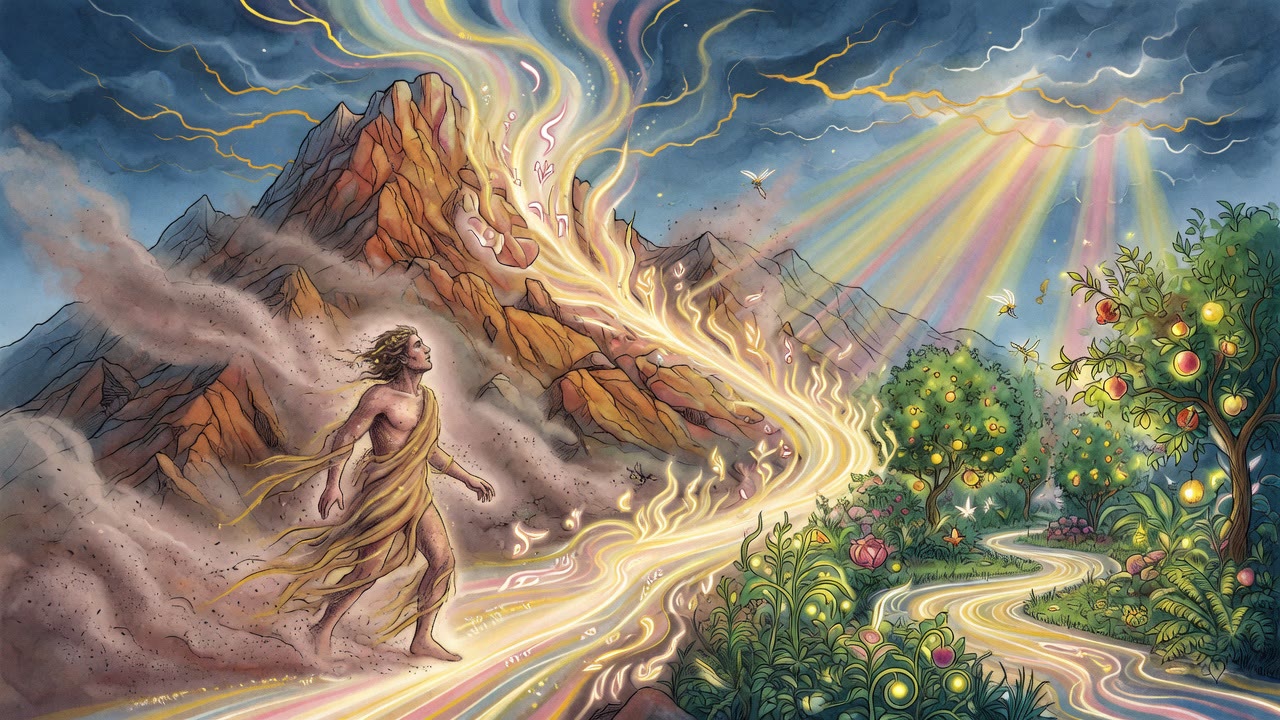
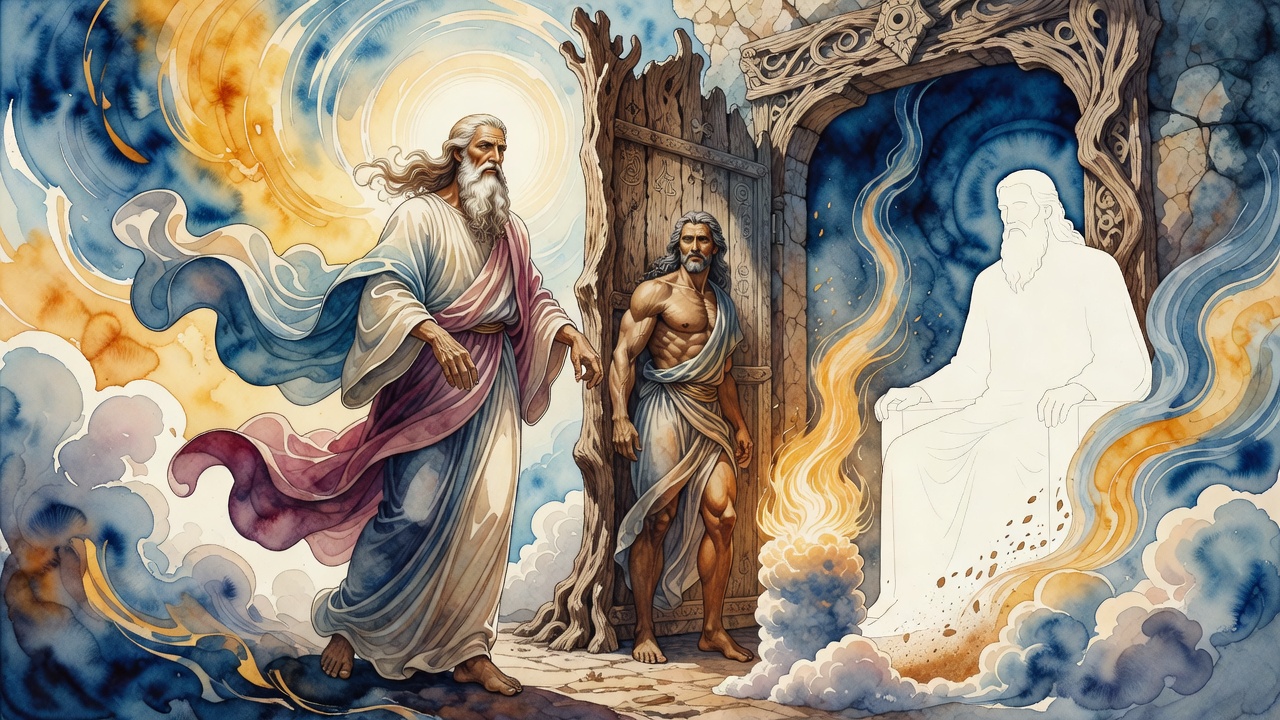
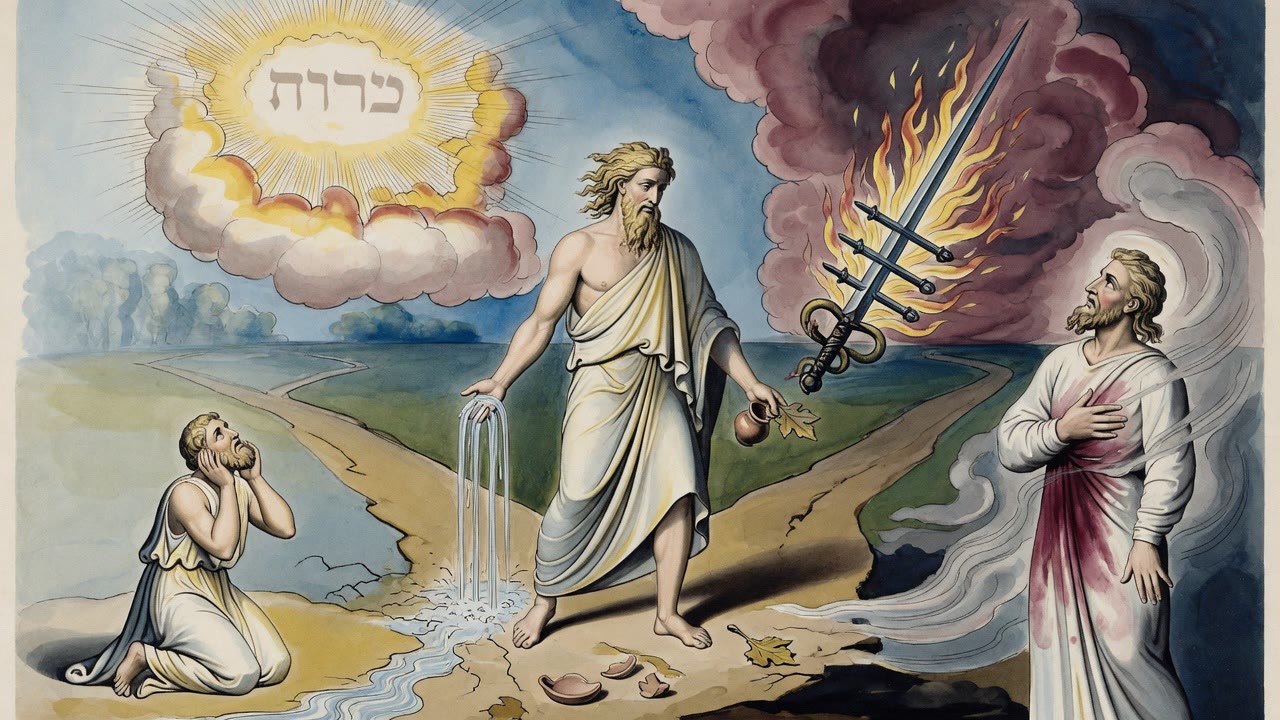
Manasseh felt the sword before he saw it. Heat licked the left side of his face. Cold bit the right. The blade was ten years long in the measure of those who still count time, and it swung in a long arc that filled the gate of the upper garden. He had died in a bed of silk and iron memory. Now he stood in a place where silk meant nothing and memory meant everything.
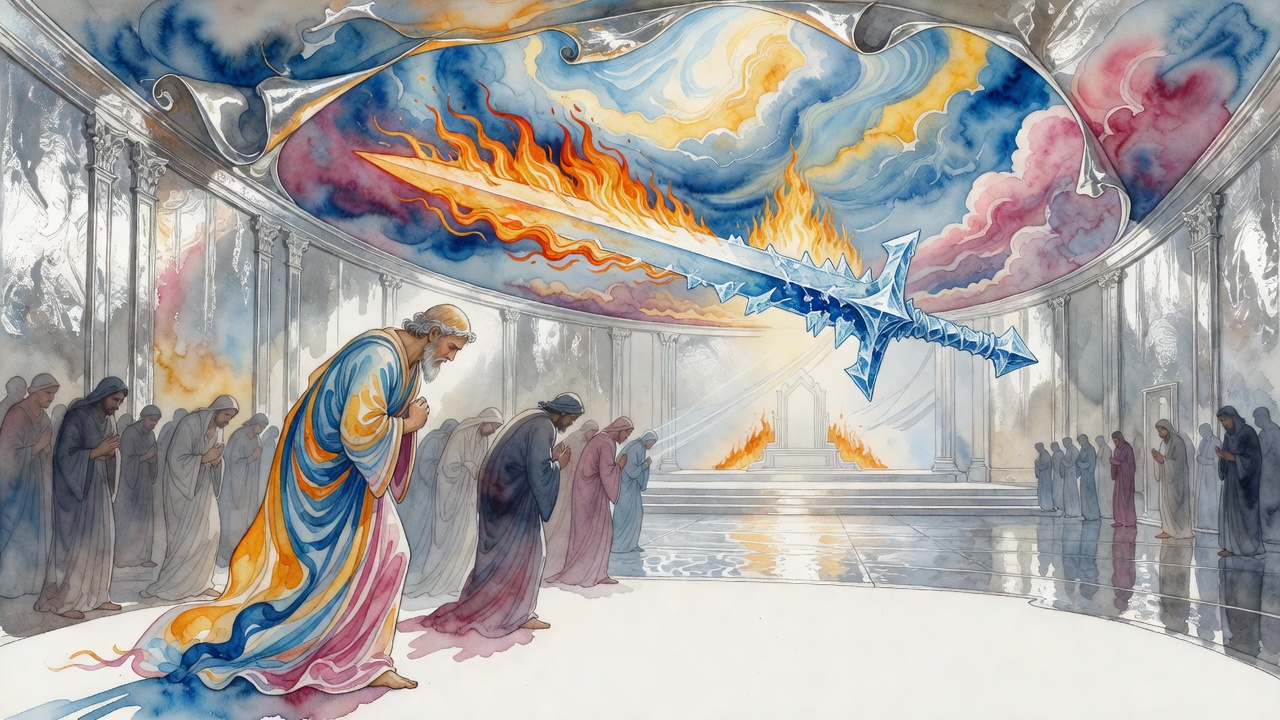
Manasseh Leads Penitents in Paradise's Silver Chamber Click for full size

He tried to step past. The sword drove him back with a wall of frost. He tried the other way. Fire closed his eyes. He fell to his knees on stone that smelled of balsam and crushed leaves, and for the first time since the brass bull and the hooks and the long return to Zion, he did not know which plea would open a door.

What Adam Could Not Re-Enter

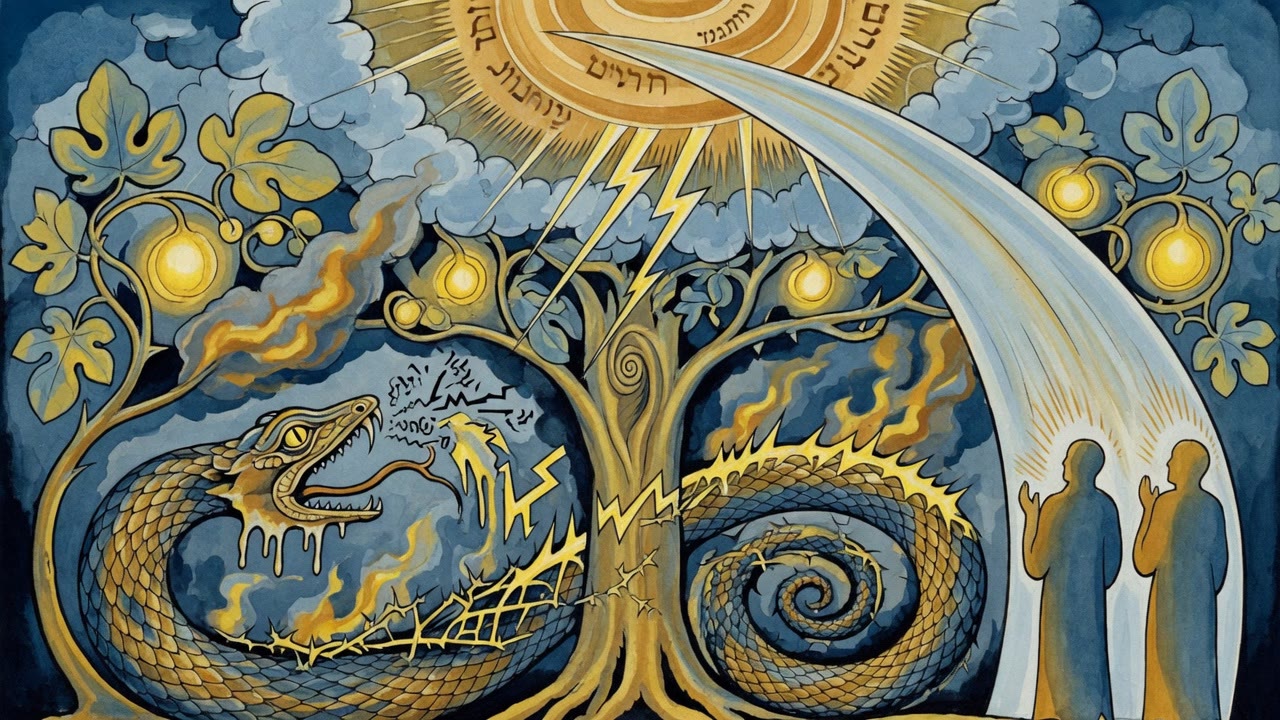
Far behind that gate, in a story older than any king of Judah, Adam had once stood tall enough that his head brushed the floor of heaven and his heels pressed the dust of the earth. Angels had brought him bread. Creation had bowed. His skin had shone like a garment of light. When he ate what was forbidden, the light tore off him like a cloak caught on a nail. The heavens dimmed. The earth dimmed. Cherubim took the gate, and the first man was driven out to till the ground from which he was taken.

Living flesh could not walk back through. Adam learned fire by striking stones in the first true night, when darkness fell and he thought the curse had swallowed the sun forever. He lived nine hundred and thirty years, seventy short of the thousand-year day of God, and died knowing the garden behind him was sealed against the living. His body had been gathered from the dust of many lands: head from the Holy Land, trunk from Babylonia, limbs from the rest of the world. When he fell, the whole map of dust learned thorns.

Manasseh, worst of the line that came after, had no claim on Adam's first glory. He had only the claim of a penitent: the long prayer from the bull, the torn heart, the late obedience. The sword at paradise's gate did not care about crowns. It cared about whether a soul had finished lying to itself.

The Sword Between Fire and Ice

The blade swung again. Heat. Ice. Heat. Manasseh pressed his forehead to the stone and spoke the only inventory he had: idols smashed, prophets ignored, a late turning that still tasted of ash. The sword slowed. It did not vanish. It measured him the way a gate measures a cart, waiting for the load to settle.

When he rose, the arc opened just wide enough for one body. He stepped through. On the other side the air thickened with spice. Two hundred and forty-eight rivulets of balsam and attar ran in shallow beds, and souls who had just crossed bathed until the death-smell left their hands. Manasseh washed. The water stung the places where iron bands had once bitten. He did not hurry.

Beyond the rivulets the garden opened in chambers, not in the simple orchard Adam had tended. The eastern expanse ran on a scale no surveyor of the living world could hold: years of walking for a span the living call miles. Cedar walls rose. Ceilings caught light that did not come from any sun Manasseh remembered.

Cedar, Crystal, and the First Teachers

The first chamber smelled of new cedar and shone with a ceiling of transparent crystal. There the sincere converts who had left other gods sat under the instruction of the prophet Obadiah and the proselyte Onkelos. Manasseh paused at the threshold. He had spilled enough blood in life to make converts fear his name. He did not enter. He bowed once, stiffly, and walked on.

The second chamber rose in cedar with a silver ceiling that threw a cool light onto the faces of those inside. These were the penitents: men and women who had ruined what they loved and then spent the rest of their strength putting one stone back on another. They looked up when Manasseh crossed the door. No one fled. No one cheered. A place was already waiting at the front of the room, as if the chamber had known his schedule better than he had.

He sat. The silver light lay on his hands. Someone passed him a scroll. The letters were the letters he had once forbidden. He began to teach the portion of return, not because he had always known it, but because the chamber required a leader who had paid the full price of learning it late.

The Tree Beyond the Silver Room

On free hours he walked as far as the third chamber, where silver and gold met pearl, and the Tree of Life rose five hundred years high. Under its shadow the patriarchs rested crowned as if still alive. Moses taught Torah in a voice that made Manasseh's late lessons feel like scraps. Aaron trained priests whose hands no longer shook. Souls climbed and descended the tree as if it were a ladder between rest and service. A radiance the old books call the Shechinah (שכינה), the indwelling presence, filled the air until even a former idolater's eyes watered.

Manasseh did not claim a seat under that tree. He returned to the silver ceiling and the hard work of teaching people who had broken what could not be fully mended. Adam's sealed garden was for the living and the unrepentant imagination. This garden was for the dead who had finished running. The difference was not geography. It was whether the sword had found a soul still soft enough to open.

Once a new arrival asked him why the worst king sat at the head of the penitents. Manasseh did not answer with a proverb. He pointed at the scar the sword's heat had left along his cheek and the pale line the ice had drawn on the other side. "I was measured," he said. "You will be measured. Sit."

What the Living Still Cannot Buy

In the world of breath and markets, men still argued where Eden lay: Beth-Shean if in the land, Damascus if between rivers, some dry south if the equator theories held. None of those maps opened for a living foot. The cherubim still kept Adam's first gate. The flaming sword at the upper garden still swung for souls, not for travelers with staffs and water-skins.

Manasseh taught through the silver hours and rested when the light on the ceiling dimmed to the color of old coins. He no longer ruled a people. He ruled a classroom of the broken who had chosen not to stay broken. Outside, far below, his name still meant horror in the mouths of children learning kings. Inside, the name meant a seat that had cost a sword's full swing to earn.

When he closed his eyes, he sometimes saw Adam's long body falling from heaven-height to human measure, light peeling off like bark. The first man had lost a garden. The late king had found a chamber. Both ends of that rope pulled on the same knot: no one walks back into glory by right, and no one is locked out of return once the lying stops.


← All myths
From the tradition

Sources

2 sources

The texts behind this telling. Some cards carry a translation of the source; others are our own retelling of it, and each card says which. Every card links out to the original.

Jewish Encyclopedia, "Adam" (1906)Jewish Encyclopedia (1901-1906)

Retold in our words. Read the original at the link below.The Jewish Encyclopedia, 1901-1906 · Public Domain

Adam is the Hebrew and Biblical designation for humanity generally, and specifically for the progenitor of the human race. According to Genesis i, mankind was created on the sixth day "made in the image of God" with dominion over all animate creation. Genesis ii provides a more detailed account, locating the creation near Babylon at the confluence of the Euphrates and Tigris rivers in Eden. God "formed man of the dust of the ground, and breathed into his nostrils the breath of life; and man became a living soul" (Gen. ii. 7). He was placed in a garden to tend it, permitted to eat all fruit except from "the tree of the knowledge of good and evil." When no suitable companion was found among animals, God created woman from Adam's rib.

CURSE OF DISOBEDIENCE

Genesis iii describes humanity's moral history. The serpent tempted the woman, claiming the forbidden fruit would grant divine knowledge. She ate and gave fruit to her husband. Consequences followed: the serpent faced perpetual enmity with humanity; the woman endured childbirth pain and subjection to her husband; Adam received a curse making the ground produce thorns and thistles, requiring toilsome labor for sustenance. Both were expelled from Eden "to till the ground from which he was taken."

IN APOCRYPHAL AND RABBINICAL LITERATURE

Rabbinical tradition emphasizes Adam's representative character, teaching that "he who destroys a single soul destroys a whole world" (Sanh. iv. 5). His creation from dust gathered from all world regions symbolized humanity's unity. One tradition holds "His head was made of earth from the Holy Land; his main body, from Babylonia; and the various members from different lands" (Sanh. 38a).

Haggadic sources emphasize Adam's pre-fall glory. He was "like one of the angels," with body "reaching from earth to heaven" (Hag. 12a, Sanh. 38b). His beauty was sunlike, his skin bright like garments of light. When God said "Let us make man," jealous angels questioned: "What is man that Thou thinkest of him? A creature full of falsehood, hatred, and strife!" (Gen. R. viii.). Love pleaded his favor, and the Lord responded, "Let truth spring forth from the earth!"

A significant legend, preserved in Adam and Eve and the Slavonic Book of Enoch, describes Michael commanding all angels to honor Adam's image. All obeyed except Satan, who was hurled from heaven for his rebellion, his throne reserved for Adam at future resurrection.

Pre-fall privileges included angelic attendants, "angel's bread," and universal creation's reverence. Sin stripped him of all glory; the earth and heavens lost brightness, returning only in Messianic times (Gen. R. xii.). Death came to Adam and creation. Given God's thousand-year day (Ps. xc. 4), Adam lived 930 years, seventy less than one thousand, fulfilling "in the day that thou eatest thereof, thou shalt surely die."

Jewish sources stress repentance's redemptive power. Adam exemplifies the penitent sinner, undergoing purification through fasting, praying, and bathing for forty-nine days (Vita Adae et Evae; Erekhin 18b; Abodah Zarah 8a; Pirke R. El.).

When darkness first came after his sin, Adam feared God's wrath. The Lord taught him to make fire by striking stones, initiating the blessing over fire concluding each Sabbath. Receiving the curse "Thou shalt eat of the herbs of the earth," Adam despaired he and his donkey would share the same manger. God reassured him: "With the sweat of thy brow shalt thou eat bread!" Angels subsequently taught him agriculture, trades, and ironwork.

ADAM IN THE FUTURE WORLD

Adam initially wore garments of light, not skin (Gen. R. xx.). Described as "the first to enter Hades" (Sibylline Oracles, i. 81), he was also "the first to receive the promise of resurrection" (Gen. R. xxi. 7).

According to the Testament of Abraham, Adam sits at the gates watching multitudes pass, weeping for the many entering the wide gate toward punishment, rejoicing for the few entering the narrow gate toward reward.

The distinctive Jewish perspective appears in Shabbath (the Sabbath) 55a (based on Ezekiel xviii. 20): "No man dies without a sin of his own." Thus pious ones, permitted to behold God's glory before death, reproach Adam for bringing death. He responds: "I died with but one sin, but you have committed many: on account of these you have died; not on my account."

Rabbis attributed Psalms v, xix, xxiv, and xcii to Adam. His body was supposedly displayed at Hebron's cave of Machpelah (B. B. 58a; Gen. R. lviii.). The rabbis taught the beautiful idea that "Adam was created from the dust of the place where the sanctuary was to rise for the atonement of all human sin," ensuring sin would never become inherent to human nature (Gen. R. xiv.).

Modern critics identify two source documents in Genesis creation accounts. The Priestly Code (P) presents creation as the first stage in Israel and theocracy's history. The second narrative (Genesis ii. 4-iv.), written earlier than the priestly document, centers on Adam founding the human race. Its descriptions are naive and anthropomorphic: man's Eden home, divinely-given mate, knowledge progression, sin, paradise banishment, and his children's fates.

"Adam" derives from the ground concept. Genesis ii. 7 explains: "God formed man of dust of the ground." The man was called "Adam" because formed from ground (adamah) (Gen. iii. 19). Originally, "Adam" was not a proper name but generic. Genesis i uses it wholly generically. "Adam" as proper name likely appears first at Genesis iv. 25 (J) and v. 3 (P).

Authors: J. Frederic McCurdy, Kaufmann Kohler, Richard Gottheil

Full source
Jewish Encyclopedia, "Paradise" (1906)Jewish Encyclopedia (1901-1906)

Retold in our words. Read the original at the link below.The Jewish Encyclopedia, 1901-1906 · Public Domain

The term "paradise" likely derives from Persian origins. Within the Hebrew Bible, it appears only three times: Canticles 4:13, (Ecclesiastes 2:5), and (Nehemiah 2:8). The first usage denotes "garden," while the latter two signify "park." In apocalyptic writings and Talmudic literature, the word references the Garden of Eden and its heavenly counterpart.

The earthly Garden of Eden receives two scriptural depictions: one in Genesis 2-3 and another in (Ezekiel 28:13-17). According to Genesis, the Almighty planted this garden "eastward in Eden," containing the tree of life and the tree of knowledge. A river flowed outward, dividing into four principal streams: Pison, Gihon, Hiddekel (Tigris), and Euphrates. Adam received stewardship of this domain.

All creatures inhabited the garden initially, yet none suited companionship with humanity until woman was created. The serpent, described as the subtlest creature, questioned the woman regarding permitted vegetation. Upon eating the forbidden fruit, both humans recognized their nakedness and fashioned coverings. Divine judgment stipulated thorns would burden agriculture, childbirth would bring suffering, and expulsion would follow. Cherubim guarded against re-entry.

Ezekiel's Eden portrayal appears within prophetic condemnation of Tyre's king. This figure stood within "the garden of God," adorned with precious stones, positioned amid "the mountain of God" surrounded by fire-stones.

In rabbinical context, the Hebrew term for paradise functions metaphorically within mystical philosophy. The popular designation "Gan 'Eden" contrasts with "Gehinnom (the place of spiritual purification after death)" (hell). Jewish scholars maintain both terrestrial and celestial Gan 'Eden exist, with Genesis's Garden serving as prototype for heavenly paradise. The term "'Olam ha-Ba (the World to Come)" (the world to come) occasionally substitutes for paradise, though technically denoting post-millennial existence. Nahmanides identifies Gan 'Eden as "'Olam ha-Neshamot" ("world of souls"), wherein righteous departed souls enter immediately post-mortem.

The Midrash (rabbinic interpretive commentary) Agada provides elaborate paradise descriptions with cabalistic imagery. The Midrash Konen presents detailed chamber specifications. The eastern Gan 'Eden spans 800,000 years' measurement (approximately 3,650 miles annually). Five chambers house various righteous classifications:

The first chamber (cedar construction, transparent crystal ceiling) houses non-Jewish sincere converts, instructed by Prophet Obadiah and proselyte Onkelos.

The second chamber (cedar with silver ceiling) houses penitents, led by King Manasseh, receiving Torah instruction.

The third chamber (silver-gold construction, pearl ornamentation) contains the Tree of Life, towering 500 years high. Patriarchs Abraham, Isaac, and Jacob rest beneath its shadow alongside Egyptian exodus participants, wilderness dwellers, David, and Solomon, each crowned as though living. Moses instructs in Torah; Aaron trains priests. This tree functions as a spiritual ladder permitting ascent and descent for righteous souls. Above, Patriarchs, Ten Martyrs, and those sacrificed for God's Name convene daily, descending to reunite with families upon jeweled cathedras. Each receives audience according to merit, praising the Eternal amid Shekinah (the Divine Presence)'s brilliant radiance. A ten-year-length flaming sword, fluctuating between intense heat and icy cold, guards against living mortals. Upon entry, souls bathe in 248 rivulets of balsam and attar.

The fourth chamber (olive-wood) houses those suffering for religious conviction, olives symbolizing both bitterness and illumination, representing persecution and reward.

The fifth chamber (precious stones, gold, silver, myrrh, aloes) has the River Gihon flowing before it, bordered by fragrant shrubs. Golden and silver couches with fine draperies furnish the space. The Davidic Messiah, Elijah, and Ephraim's Messiah dwell here. Within stands a cedar canopy (Tabernacle-styled) with silver posts and vessels. The suffering Messiah rests, awaiting Israel's liberation while Elijah provides comfort. Patriarchs, Moses, Aaron, and others visit Monday, Thursday, Sabbath, and holy days to encourage him.

Expanded versions present seven sections. Separate divisions exist for pious women's souls, headed by Bithiah (Pharaoh's daughter, proselyte), Jochebed (Amram's wife), Miriam, Prophetess Hulda, Abigail, and the Matriarchs occupying highest ranks.

Alternative versions establish seven sections with twelve soul grades: (1) God-fearers, (2) charitable persons, (3) dead-buriers, (4) sick-visitors, (5) honest dealers, (6) poor-lenders, (7) orphan-carers, (8) peacemakers, (9) poor-instructors, (10) martyrs, (11) Law-students, (12) righteous monarchs including David, Solomon, Josiah, and Hezekiah.

A midrashic account attributed to Rabbi Joshua b. Levi (likely ninth-century composition) portrays paradise featuring diamond gates and 600,000 attending angels with luminous countenances. Upon righteous arrival, attendants remove burial shrouds, clothing them in eight garments fashioned from "clouds of honor," placing double golden crowns studded with jewels upon heads and eight myrtles in hands.

Angels escort the righteous along water-flanked valleys containing 800 rose and myrtle species. Each righteous individual receives canopies befitting their merit, connected to four rivulets: milk, wine, balsam, and honey. Golden grapevines with thirty pearl clusters crown each canopy. Onyx tables beneath, set with diamonds and pearls, receive service from sixty guardian angels encouraging consumption of honey (symbolizing Torah study per (Psalm 19:1)0) and preserved wine (representative of spiced Torah per Canticles 8:2).

Even the least comely righteous transforms to Joseph-like or Rabbi Johanan's beauty. Small silver pomegranates reflect perpetually-shining sunlight, fulfilling (Proverbs 4:18). Three progression stages exist: children's section, youth section, and elder section, each providing age-appropriate enjoyment.

The righteous feast upon Leviathan and wine preserved since Creation's six days. The divine banquet proceeds as follows: The Almighty invites the righteous; King David requests attendance. Gabriel provides two thrones. God's and David's, as per (Psalm 89:36). After three wine goblets, a blessing-toast is offered to Abraham (Father of the World), who declines due to Ishmael's antagonism toward God. Isaac declines (Edomites destroyed the Temple). Jacob declines (married two sisters against Law). Moses declines (never crossed Jordan). Joshua declines (left no heir). Finally David accepts, reciting (Psalm 116:13).

Following grace, the Law is produced and God, through interpreter Zerubbabel ben Shealtiel, reveals commandment secrets and reasons. David preaches from Haggadic tradition; the righteous respond: "Let His great Name be hallowed forevermore in paradise!" The wicked in Gehinnom, hearing this doxology, answer "Amen!" The Almighty then commands angels to open paradise gates, permitting the wicked entry.

Gehinnom and paradise adjoin closely. Rabbi Johanan claims merely hand-breadth separation (four inches) exists; other rabbis cite two-finger width. Rabbi Akiba taught: "Every person has two reserved places, one in paradise, one in Gehinnom. The righteous receive both their own and their wicked neighbor's paradise place; the wicked receive both their own and their righteous neighbor's Gehinnom place."

Paradise candidacy determination follows majority-rule principle: meritorious acts result in paradise entry; wicked acts lead to Gehinnom; equal acts allow God's mercy to remove one sin and balance the scales.

The Talmud derives soul immortality from (Ecclesiastes 12:7) ("spirit returns to God"), (Isaiah 57:2) (righteous bodies "enter into peace"), and (1 Samuel 25:29) (souls "bound in life's bundle" under God's "throne of honor").

Paradise dimensions, attendant names, materials, and articles possess cabalistic value and symbolic meaning. Feasting and enjoyment represent spiritual rather than material experiences. Rab declares: "Paradise contains no eating, drinking, cohabitation, business, envy, hatred, or ambition; but the righteous sit crowned-headed, enjoying Shekinah's luster" (Exodus 24:11 understood as God-viewing sufficing as food-drink equivalent).

Medieval populations and many rabbis failed grasping spiritual meaning, accepting haggadic references literally. Maimonides challenged this literalism, asserting such belief represents juvenile expectation of "nuts and sweetmeats" as academic reward. He maintained Gan 'Eden is terrestrial, discoverable at millennium's advent, emphasizing celestial pleasures transcend mortal comprehension, neither blind distinguishing colors nor deaf appreciating music. This provoked French rabbinical opposition but Spanish support, particularly Nahmanides's endorsement.

The paradise narrative within Genesis 2-3 comprises the J Pentateuchal stratum, though scholarly consensus recognizes multiple authorial hands. The garden's presumed Babylonian placement suggests Hebrew knowledge derived from Babylonian sources. Though no identical narrative exists in Babylonian literature, parallel elements appear throughout. Eridu's sacred palm-garden spawned the Adapa legend, referencing life-food and life-water granting god-like status, concepts prominent within Genesis. The Gilgamesh epic contains narrative parallels: wild-man Eabani dwelling with animals, enticed by woman to abandon them and achieve god-likeness.

Babylonian-Assyrian lion and bull gate-guardian deities parallel Biblical cherubim. Assyrian monuments frequently depict sacred-tree emblems, often with cherubim fertilizing palm-trees. Babylonian cylinders show man-woman seated opposite such trees bearing date-clusters, serpent positioned behind the woman whispering. The flaming-sword imagery probably references Tiglathpileser's mentioned "exalted lightning" punishment-implement.

The serpent as evil-author parallels Babylonian dragon Tiamat (Creation-narrative), though operating within different contexts. "Eden" itself appears within Babylonian "edennu" (field/plain), confirming Hebraic Babylonian derivation.

Full source