Meir Took Seven Spits to Save a Marriage
Her husband locked the door unless she spat in Rabbi Meir's face. Meir asked for seven doses, as if his eye were sick.
Table of Contents
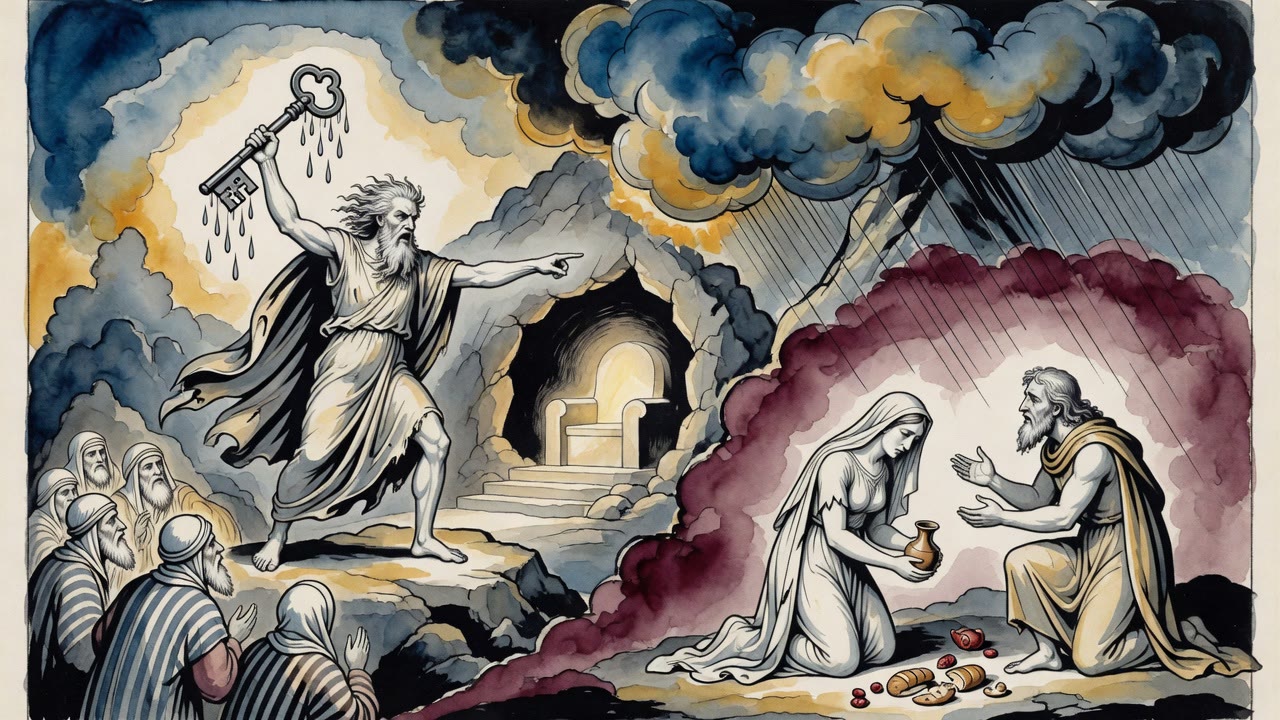
The woman stood in Rabbi Meir's doorway with her hands clenched and her mouth shut. Her husband had locked her out. He would open the house only if she spat in the teacher's face. She had come to say she would sleep in the street first.
 Click for full size
Late From the Lecture
She had stayed until the last argument cooled and the last student packed his notes. Torah, she told her husband when he demanded an account of the hours. He heard theft. Heaven had stolen his evening. He set the price of the key: public disgrace for the man who taught her.
Neighbors went to his door with bread and with talk. He would not bend. A locked house is a kind of court, and he had already issued the sentence. Word of the impasse reached Meir before the woman did, carried by people who knew how fast a private rage becomes a public wound.
Meir did not call a court. He sent for her as if nothing in the street were broken. He greeted her. Then he touched the skin beneath his eye.
"My eye has been sore for days," he said. "I have been told a woman's spittle, offered seven times, is a folk remedy. Would you spit in my eye seven times to cure me?"
Seven Times
She understood at once. The request was a way out that left her husband his pride and left the teacher the shame. She spat once. Meir did not wipe it. She spat again. The second landed on the cheek and ran. Five more. She counted under her breath so she would not lose the number and have to begin again.
Seven.
He sent her home without a speech. When the husband heard she had done not once but seven times what he had demanded, the rage had nowhere to go. The ultimatum looked small in the mouth of a man who had asked for it as medicine. The door opened. She went in. He did not ask her to spit again. The street kept its peace, which is a quieter sound than a locked bolt.
What He Would Not Keep
Students later asked how a teacher of Israel could accept that on his face. Meir gave them two words. Shalom bayit (peace of the house). Peace between husband and wife weighed more than the honor he could have kept for himself. One night of spit, he said, built more Torah than clean lectures that sent people home to break each other with smaller insults.
He did not make a show of it. If the husband had smelled theater, pride would have hardened and the door would have locked again. Meir washed, taught the next session, and spoke of his eye as if it had always been fine. The woman sat in her own house that week and did not have to explain the street to anyone. That was the payment he wanted.
Beruriah Stops the Prayer
This was the same Meir whose wife, Beruriah, once found him praying for death. Coarse men had settled on their street. Noise at night. Threats in the alley. Small cruelties stacked until a scholar's house felt like a siege. Meir opened Psalm 104 and asked that the sinners be consumed from the earth, that the wicked be no more (Psalm 104:35). He had the verse ready like a blade.
Beruriah came in as a colleague, not as a petitioner. "Is it because it is written, 'Let the sinners be consumed'? The word is not chot'im, sinners. It is chata'im, sins. And the verse continues, 'and the wicked will be no more.' Pray that the sins cease, and the wicked will cease too. Pray for their turning, not their erasure."
Meir did not defend his exhaustion. He closed the old prayer and opened a new one. He asked that the men turn. They turned. The street quieted. The same mouth that would later invite spit had already learned, in his own house, not to ask Heaven to erase people.
The Face He Spent
Destroy the sin. Keep the household. Beruriah had moved a letter in a verse until the prayer changed. Meir moved his face into a woman's path so a marriage would not die in the road. She went home to a table that was a table again. He went back to teaching. Beruriah kept the psalm open longer than he did.
Of her a later mouth said, "She opens her mouth with wisdom, and on her tongue is the Torah of kindness" (Proverbs 31:26).
Years on, some remembered Meir for rulings. Some remembered a wet face that bought a couple another night under one roof. The door that had been locked stayed open. He never billed them for the eye. On the street where the coarse men had lived, neighbors greeted one another in the morning as if the night prayers had been about weather. Meir walked to the study house with a clean face and did not tell the new students what it had cost to keep a house from splitting.
← All myths