5 min read

Moses Begged Creation but Only Torah Remained

On his last day, Moses turned from Israel to heaven itself, while the Torah he had carried remained older than creation.

Curated by Arthur · Told by Maggid ·
Table of Contents
  1. The Tent Filled With Mourning
  2. The Torah Was Older Than the World
  3. The Names Opened Creation
  4. The Cry Rose Above the Camp

Moses dressed Joshua before he died.

He did it in public, with his own hands, while Israel watched the old prophet place garments of succession on the man who would cross the Jordan without him. A golden throne was brought. A crown, a diadem of pearls, a royal cap, and purple garments were set out. A herald moved through the camp calling everyone to hear the new prophet God had raised that day.

Moses did not sit on the throne.

He sat below Joshua like a student before a teacher. Joshua opened his mouth and spoke Torah for the first time as leader. Moses listened from the lower place and knew the order of the world had shifted.

The Tent Filled With Mourning

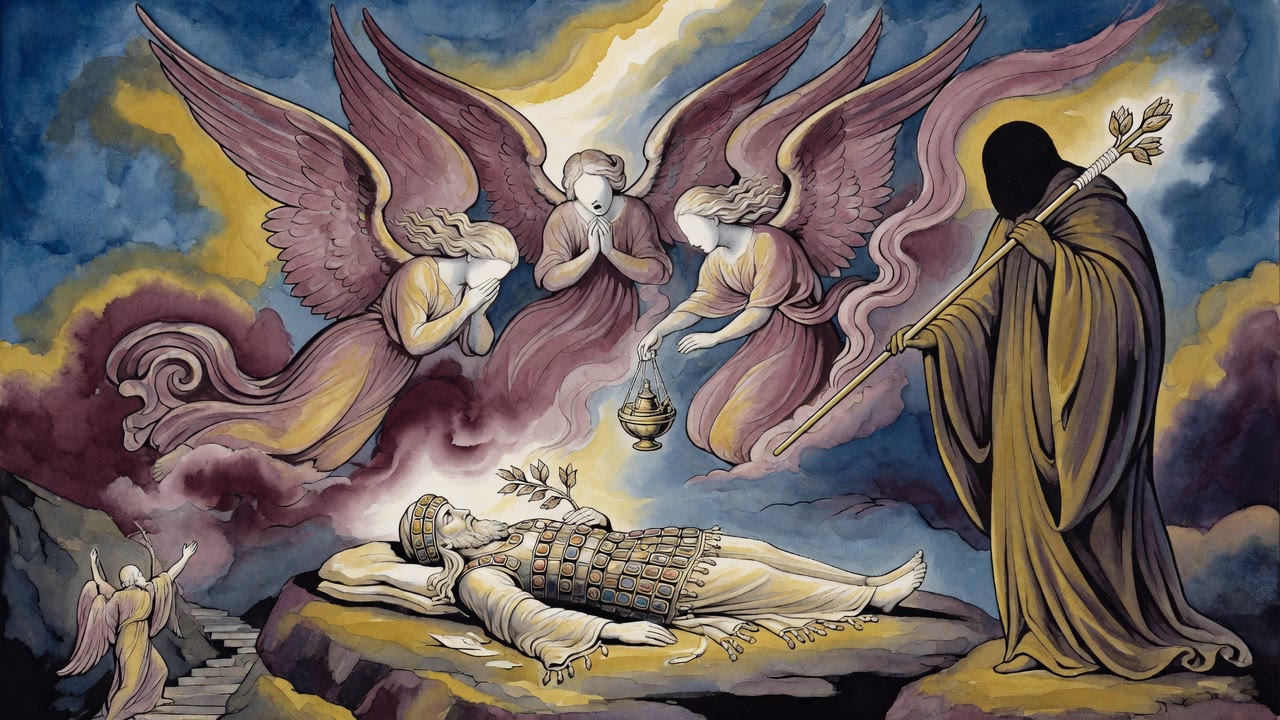
When the hour came closer, Moses tore his garment.

He plucked his beard, put dust on his head, and entered his tent with a cry that had no dignity left in it. Woe to my feet, he said, that never walked in the Land of Israel. Woe to my hands that never plucked its fruit. Woe to my throat that never tasted the produce of a land flowing with milk and honey.

The man who had split the sea grieved like a man barred from a doorway.

He blessed Israel with peace and promised he would see them again at the resurrection of the dead. Then he walked out from among them, and the camp's weeping rose all the way to the highest heavens.

The Torah Was Older Than the World

What remained after Moses was not ordinary inheritance.

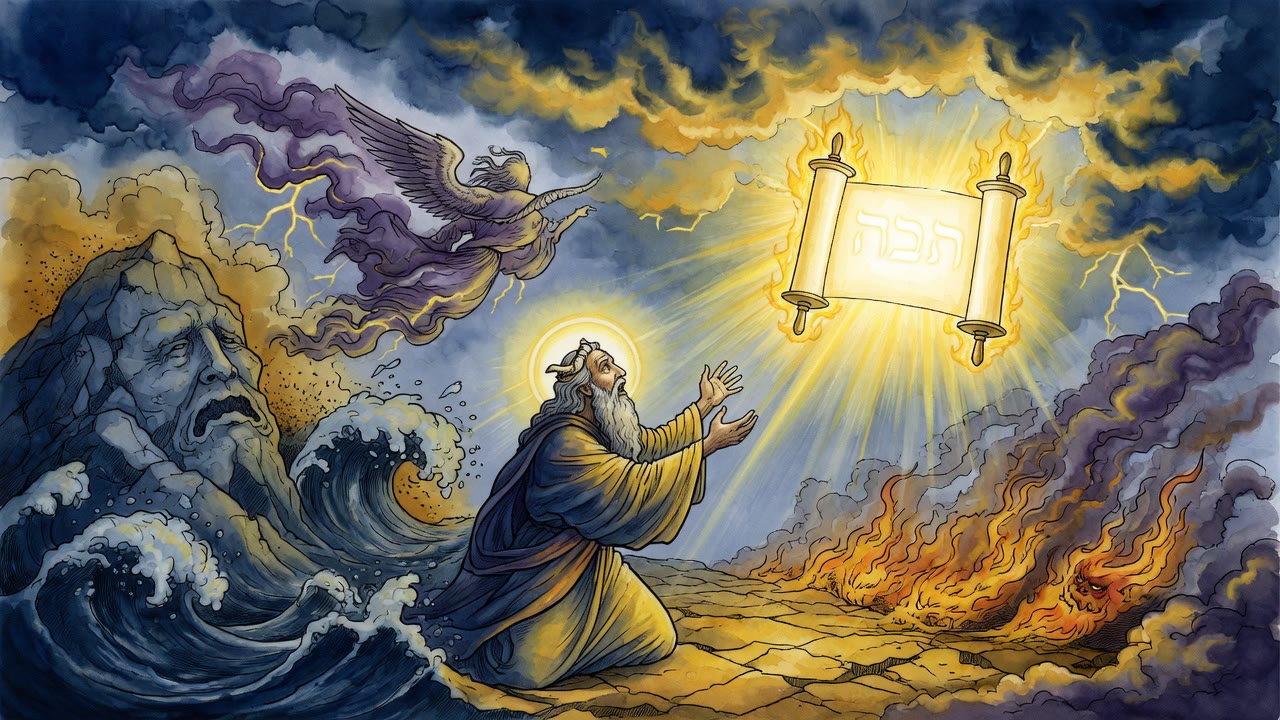
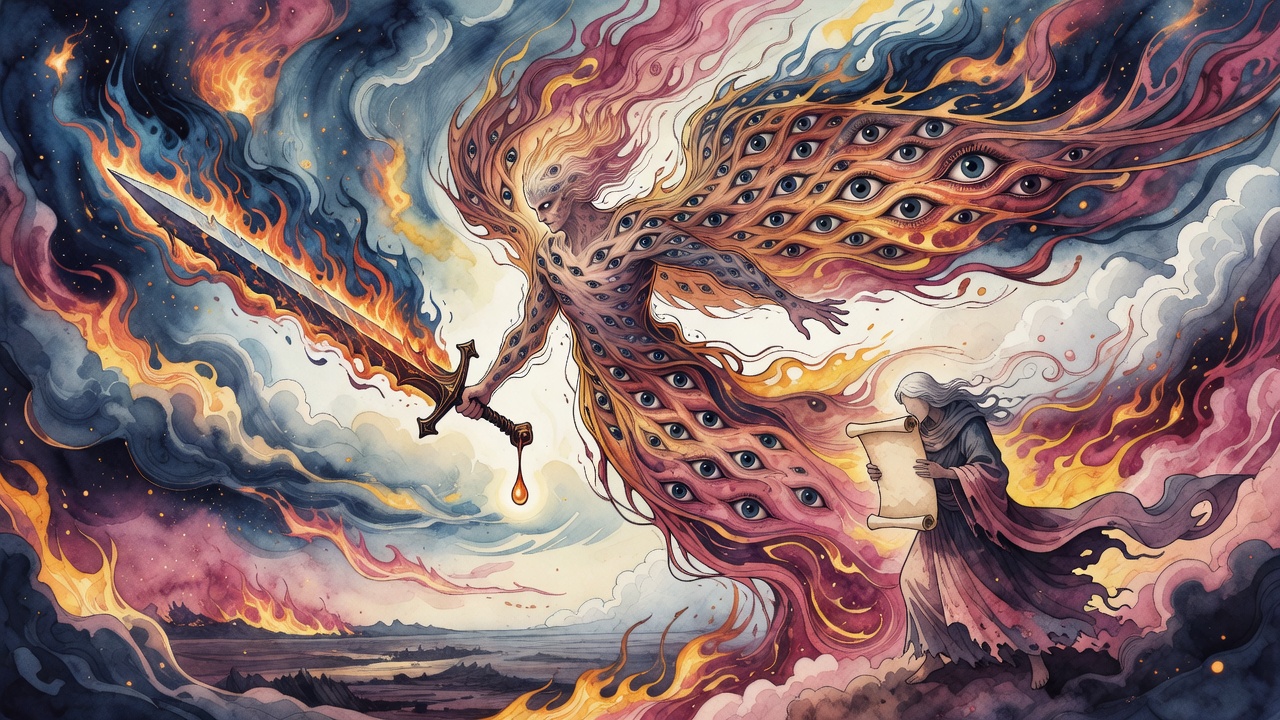
The Torah had been hidden before heaven and earth. It was not written on parchment, because animals had not yet been created. It was not written on gold, silver, metal, or wood, because none had been refined or grown. It was black fire on white fire, bound to the arm of the Holy One.

God looked and saw no angel in heaven and no human on earth. He desired a world where humanity would engage in Torah. So He consulted wisdom and founded the earth.

Moses could die. The Torah he carried could not.

The Names Opened Creation

The hidden Torah was not a scroll waiting in storage.

It held names by which creation opened. One name filled the sea with forty drops. Another drew out light for this world, light for the World to Come, and light for Torah itself. Wisdom held seventy-three names, and seventy names remained with the power to create worlds upon worlds for the righteous.

This is why Moses' death shook everything. He was not only a leader leaving office. He was the human vessel through whom the fiery law had entered Israel's camp, through whom the hidden teaching had become spoken command.

Joshua could receive authority. No one could replace the first descent.

The Cry Rose Above the Camp

Israel saw succession and loss in the same hour.

Joshua had been dressed. Torah would continue. The promised land still waited. But Moses' feet would not touch it, and his hands would not gather its fruit. Creation itself had been made for Torah, and the man who gave Torah had to stop at the border.

That contradiction is the wound of the day.

The fiery Torah remained bound to Israel. Joshua stood ready. The people wept until heaven heard them. Moses walked toward death after giving away everything that could be given, keeping only the grief of a servant who had brought his people home and could not enter with them.

He had begged heaven before. He had argued for Israel after the golden calf, stood between plague and people, and carried complaints that would have broken another leader. On this day, the argument was no longer for the nation. It was for one forbidden step, one taste of the land, one fruit in the hand before the grave.

The answer remained no. That refusal gives the scene its force. Moses could clothe Joshua, bless Israel, and hand over Torah, but he could not command his own ending. The servant who had brought divine speech down from fire had to become obedient even at the border.

The people had often seen Moses as the one immovable thing in the camp. On this day, they learned that even Moses could be moved aside. Torah did not depend on his staying alive. That truth made the succession possible and the grief almost unbearable.

Joshua's sermon therefore did not erase Moses. It proved Moses had succeeded. A teacher who can sit below the student he crowned has given more than authority. He has given continuity.


← All myths

From the tradition

Sources

2 sources

The texts this telling draws on, in full. Open a card to read inline, or expand it for a wider, quieter read.

Midrashim on Moses Our Master, Drash on Petirat MosheOtzar Midrashim (Eisenstein)

On the last day of his life, Moses did something no prophet had ever done, he dressed his successor in public, with his own hands. He commanded that a golden throne be brought, along with a crown, a diadem of pearls, a royal cap, and purple garments. He arranged every piece before Joshua and clothed him while all Israel watched.

A herald marched through the camp crying: "Come and hear the words of the new prophet whom the Holy One has raised over you today!" All Israel rose in honor. And then Moses sat down, not on the throne, but before it, like a student sitting before his teacher. Joshua opened his mouth and expounded Torah for the first time, while Moses listened from below.

Joshua's first sermon was a flood of praise: "Blessed be the Lord God of Israel who gave the Torah through Moses my teacher, His servant and chosen one, faithful in all His house." The people responded: "Amen, Hallelujah!" Joshua spoke of a God who is One with no second, with no end to His praise and no limit to His glory, whose wonders cannot be searched and whose kingdom cannot be measured.

Moses knew what came next. When his time arrived, he tore his garment, plucked his beard, put dust on his head, and wrapped himself in mourning. He entered his tent with a bitter cry, clapping his two hands together and weeping: "Woe to my feet that never walked in the Land of Israel! Woe to my hands that never plucked its fruit! Woe to my throat that never tasted the produce of a land flowing with milk and honey!"

Before departing, Moses turned to Israel one final time and blessed them with peace. Then he raised his voice and said: "I will see you at the resurrection of the dead. In the future that is coming, I will see you." He walked out from among them, and all Israel raised their voices in weeping, a great and bitter cry that rose all the way to the highest heavens (Deuteronomy 34:8).

Full source
Midrash Konen ('He Established')Otzar Midrashim (Eisenstein)

It is written, "The Lord established the earth with wisdom", this is the Torah. The Torah, where was it and where will it be? Why is it called Torah? Because a teaching descended to the world. And it is also called Torah because its gematria is 613, and the two commandments, "I am the Lord" and "You shall not have other gods," which were heard from the Creator, make it 613. And it is written, "The Torah was commanded to us by Moses." Another explanation: The Torah in Greek is called "the appearance and form of the Torah," meaning it was hidden and then revealed and given to Israel. It was hidden in the heavens before the heavens and the earth were created. What was its name? Its name was "Faith," as it is written, "And I was with Him as a confidant." And perhaps you might say it was written on a book, but before the beasts and animals were created, there was no skin to make a parchment to write on. And if you say it was written on silver and gold or various metals, they had not yet been created, refined, or purified in the world. And if you say it was written on a wooden tablet, the trees had not yet been created in the world. So, on what was it written and with what was it written? In black fire upon white fire, and it was bound in the arm of the Holy One, blessed be He, as it is said, "A fiery law for them" [and it is said, "A refuge is God from eternity and under the arms of the world"], when the Holy One, blessed be He, looked here and there and saw no angel in heaven [and no man on earth] and desired to create the world to make man engage in the Torah, as it is said, "He is one, and who can reverse it," and consulted with the Torah, which is wisdom, to create the world, as it is said, "The Lord by wisdom founded the earth." With His understanding, the depths were split open and the heavens rained down dew. Wisdom in gematria is 73 names, 8 (chaf) eight, 20 (kaf) twenty, 40 (mem) forty, 5 (hei) five, thus 73 names are engraved on the arm of the Holy One, Blessed be He. In one of them light was created, in one fire, and in one water, thus 3 remain from them, 70 names, and for each name He can create a world like this. And with them, He is destined to create worlds upon worlds to be inherited by the righteous in the future, to expand their boundaries and fill their treasures, as it is said, "to inherit the beloved ones, yes, etc." What did he do? He took the Torah, opened it, and took from it a name that was not given to any creature, as it is said, "This is My name forever" (Exodus 3:15), with the missing "vav" indicating concealment. He struck and dripped from it forty drops into the sea, and it was filled with water. The Holy Spirit and the Divine Presence of the Creator hovered and blew upon it, as it is said, "And the Spirit of God" (Genesis 1:2). He opened the Torah and took from it a second name and extracted from there three drops of light, one for the light of this world, one for the light of the world to come, and one for the light of the Torah. One for the light of this world, as it is said, "And God said, 'Let there be light'"; one for the light of the world to come, as it is said, "Arise, shine, for your light has come"; one for the light of the Torah, as it is said, "For the commandment is a lamp, and the Torah is light." He opened the Torah and took out the third name, and from it, he took three drops of fire and ignited the entire world from that fire, except for the fire of humans, as it is said, "From His right hand came a fiery law for them." And the entire world was filled with water, light, and fire. When God saw fire to His right and light to His left, and water beneath Him, He took them and combined them two by two. He took fire and water and combined them with each other and made the heavens from them. He took water and light and combined them with each other and made from them a canopy of darkness and clouds of glory, as it is said, "He made darkness His hiding place, His canopy around Him." He took light and fire and combined them together and made from them the holy creatures. He said to the heavens, "Stretch out like a tent," and they stretched out by themselves, as it is said, "He stretches out the heavens like a curtain." Until God said to them, "Enough." God began to stand in light and His Shechinah in the heights, and He closed the gates of darkness and sealed and locked His windows. God began to stand in the light, and His Shechinah (Divine Presence) was in the heavens, and He closed the darkness and sealed and locked its windows. God said, "This light is worthy of being hidden away, and if it is not revealed to flesh and blood, it will turn into darkness. If I reveal both of them together, the ministering angels will see and not be seen. If I mix both of them together, their light will not be equal (i.e., they have no value if used together in a mixture). Rather, I will separate and take the light from the darkness, and the light will dwell with Me, as it is said, 'And the light dwells with Him,' and the darkness will dwell below, as it is said, 'And darkness was upon the face of the deep,' and it is said, 'And God saw the light that it was good, and God separated,' and it is said, 'And God called the light day.'" On the first day He took a lump of snow from beneath the Throne of Glory and threw it on the face of the waters in the middle of the world and it became land as it says, “For He says to the snow, 'Be upon the earth'…” (Iyov 37:6) And He took the foundation stone and cast it onto the place of the Temple and the world was founded upon it as it says, “…or who laid its foundation?” (Iyov 38:6) He called to the land and it stood in its place in order that it not move back and forth like a ship on the high seas as it says, “…God, God the Lord, spoke and called to the earth…” (Tehillim 50:1) And since His light shined, it shined first on the land of Israel and from there illuminated the whole world as it says, “From Zion, the perfection of beauty, God appeared.” (Tehillim 50:2) How did He illuminate it? He donned His tallit and wrapped Himself in His light and lit up the world as it says, “[You] enwrap Yourself with light like a garment…” (Tehillim 104:2) All that day the waters covered the land and it was dissolving until He donned the garments of majesty and His glory was seen as it says, “The Lord has reigned; He has attired Himself with majesty…” (Tehillim 93:1) And He girded Himself with a belt of might and established it through His might as it says, “…He has girded Himself with might. The world also is established that it cannot be moved.” (ibid.)

Full source