6 min read

Moses Hung Mountains of Torah on a Single Hair

On his last day Moses orders Israel to put heart, eye, and ear into the words. Torah hangs like mountains on a hair, and a slip drops the range.

Curated by Arthur · Told by Maggid ·
Table of Contents
  1. Eyes, Ears, and the Fragile Chain
  2. Serve Him Where Service Has a Door
  3. Ezekiel at the Gates
  4. If Stone Needs a Heart, How Much More a Word
  5. The Last Pressure Before the River

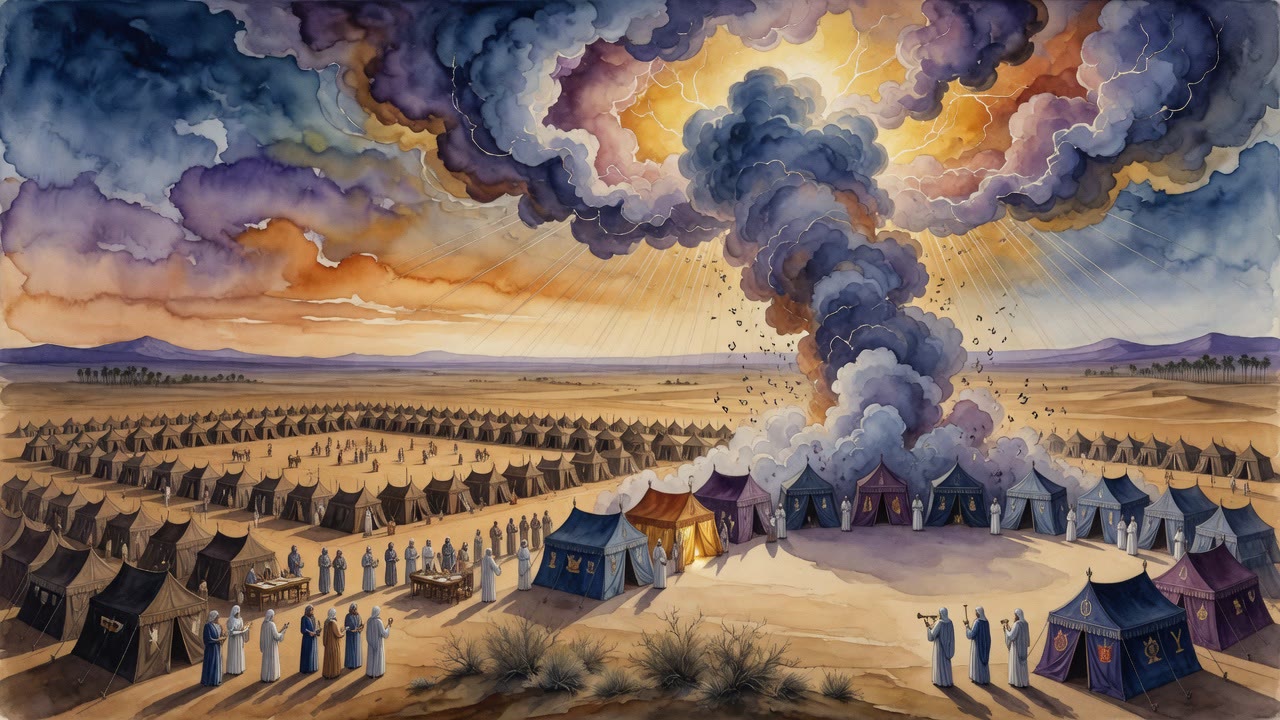
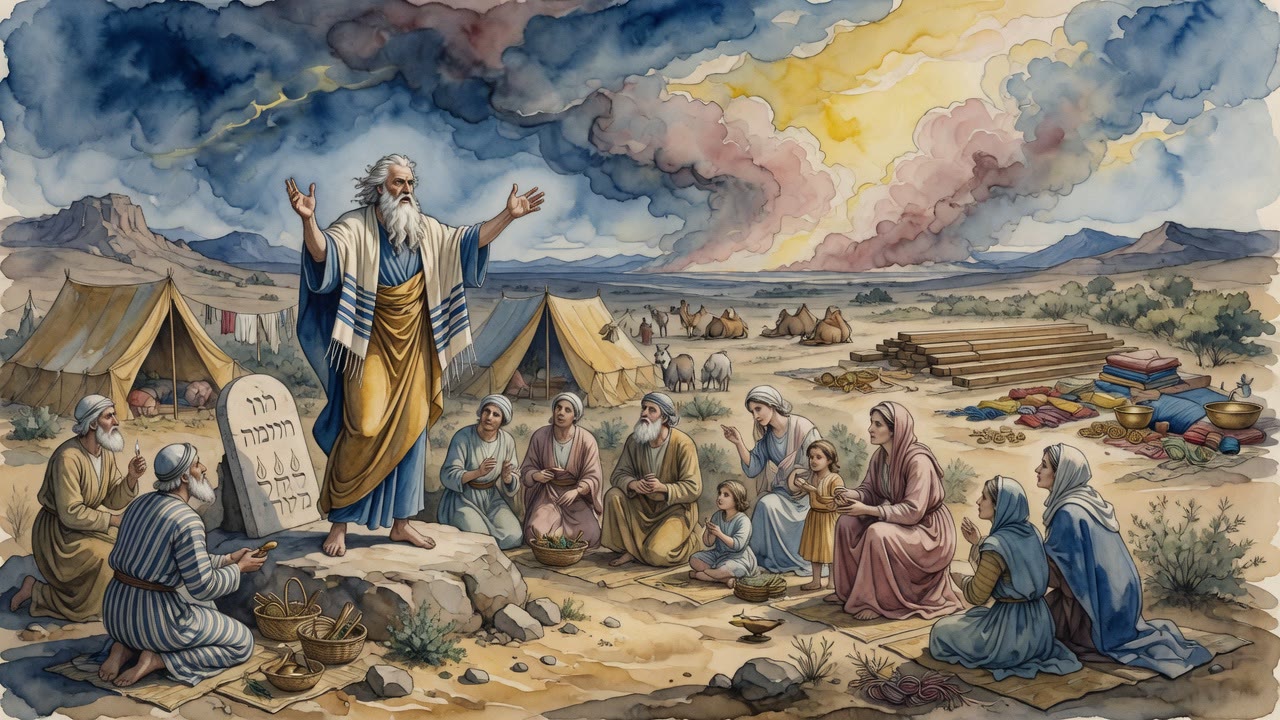
Moses stood in the plains of Moab with the last of his strength still in his throat and the Jordan already glittering beyond the camp like a border he would never cross. The people pressed close enough that he could smell travel-dust and lamb fat and fear of the empty place he would leave. He did not open with comfort.
Moses Hung Mountains of Torah on a Single Hair Click for full size

"Put your hearts to all the words that I testify among you this day" (Deuteronomy 32:46).

He said hearts, not ears alone. A man near the front blinked as if the word had struck him between the eyes. Heart first. Then the rest of the body would have to follow or admit it was only pretending to hear.

Eyes, Ears, and the Fragile Chain

Moses pressed the demand wider than a single organ. The words of Torah need the eye that stays open, the ear that does not wander toward the next market quarrel, the heart that does not half-attend while the mouth nods. He reached for an image that could make a tired nation flinch.

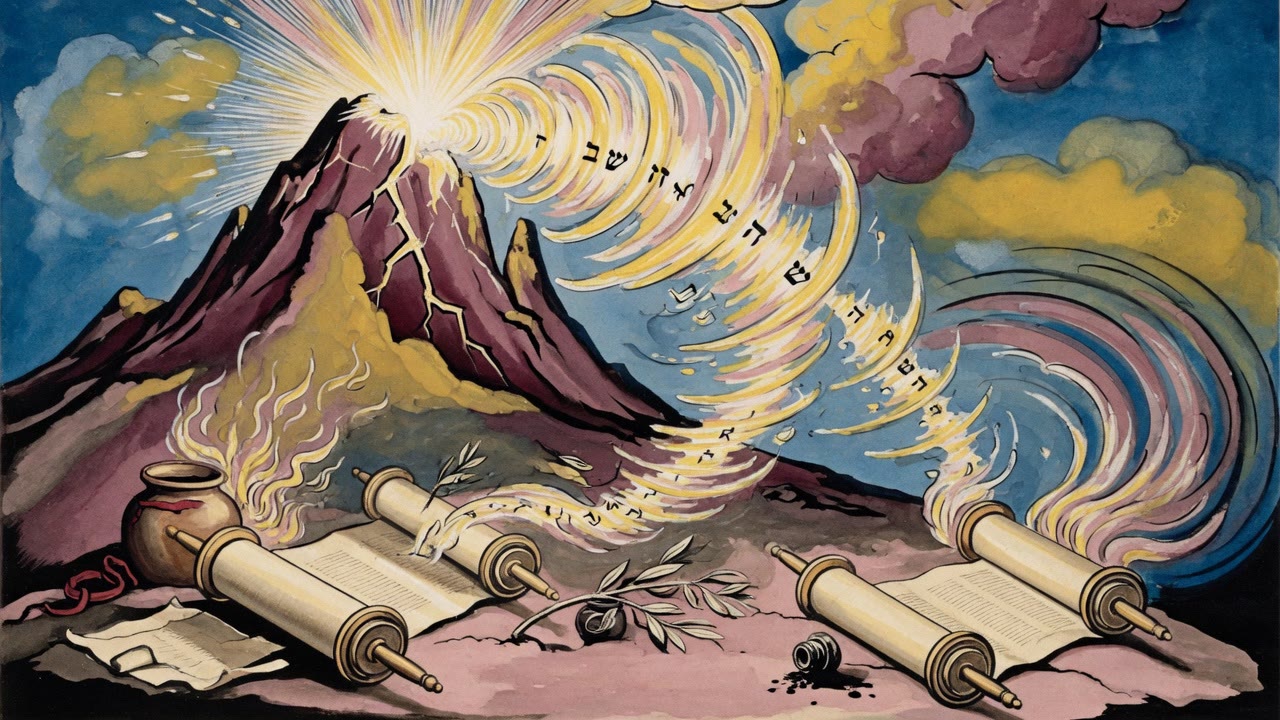
Words of Torah are like mountains hanging on a hair.

A mountain range, mass enough to crush a city, balanced on a strand thin enough to snap under a careless breath. One slip of attention and the whole weight falls. The image did not flatter the listener. It accused him. Anyone who treated the teaching as background noise was already sawing at the hair.

A boy in the third rank tried to picture basalt suspended on a thread and felt his stomach drop. An old woman closed her eyes and saw the same thread fray. Moses kept talking. The hair did not thicken for anyone's comfort.

Serve Him Where Service Has a Door

Earlier in the long farewell he had already named the shape of loyalty. Fear Him with awe that draws close rather than terror that only hides. Keep His commandments as a living restraint, not a shrug. Heed the voice of His prophets. Serve Him in His Temple. Cleave to Him by cutting free of every carved rival (Deuteronomy 13:5).

Service had a place. The Sanctuary was not a mood. It was stone and gate and altar and a body that had to walk through a door with intention sharp enough to cut. "Him shall you serve" meant hands and feet in the House. "To Him shall you cleave" meant separation from idolatry first, then the cling.

Men who had never yet seen the future Temple still felt the demand. The camp already practiced a smaller version: when the cloud lifted they moved; when it rested they stayed. Service always had a threshold.

Ezekiel at the Gates

Generations later, in a ruined age, God seized the prophet Ezekiel and refused him a soft tour of holy architecture. "Son of man, set your heart and see with your eyes, and hear with your ears all that I am saying to you about all the laws of the Temple... and set your heart to the entrance of the Temple and to all the exits of the sanctuary" (Ezekiel 44:5).

The Temple could be measured. A man could walk its courts, count its gates, put a palm to its stone. Even so, God demanded heart, eye, and ear together, and then the heart again at every entrance and every exit. Attention was not a courtesy. It was the only way a finite body could hold a structure that carried heaven's claim.

Ezekiel stood where thresholds decided who entered clean and who stayed out. He did not get to skim. The voice that had rolled him into exile now pinned him to lintels and exits until the map of the House lived inside his ribs.

If Stone Needs a Heart, How Much More a Word

The teaching ran the line from the lesser to the greater. If a building of timber and stone, visible and walkable, still requires a prophet to set his whole sensorium on every doorway, how much more the words of Torah, which hang like mountains on a hair. A gate can bruise a shin. A verse can be missed without a bruise, and the miss still drops the range.

Moses on the plains and Ezekiel at the gates share one refusal. Neither accepts half-listening as piety. Moses will die on this side of the river. Ezekiel will sketch a House the exile can barely hope to rebuild. Both stand under the same demand: put the heart where the mouth already claims to be.

In the camp, after Moses finished, men walked back to tents with the hair-image still cutting. Some opened the words again that night by lamp oil and forced the eye to stay. Some did not. The mountains did not announce which strand had begun to fray. They only waited, heavy, above a people that now knew the balance was thinner than pride.

The Last Pressure Before the River

Moses did not cross. Joshua would. The Temple of stone would rise and fall and rise in other centuries. The command to put the heart into the words did not wait for any of that. It sat on the last day of a prophet's mouth like a seal.

A man who had nodded through the speech later woke with his jaw clenched on the image of basalt and thread. He rose and recited until sweat stood on his neck, not because the night was holy in itself, but because he had felt the hair thin under his earlier shrug. Elsewhere a woman taught her son to stop his feet when the cloud of study settled, the way the camp once stopped when the cloud of glory did. Small practices. Real weight.

Serve in the House when the House stands. Cleave by cutting rivals when rivals sing. Set heart and eye and ear on gates when gates can still be counted. Above all, treat the words as mountains that do not forgive a casual grip. Moses left them that image and then climbed toward a grave no man would mark for show. The hair still held. The range still hung.


← All myths
From the tradition

Sources

2 sources

The texts behind this telling. Some cards carry a translation of the source; others are our own retelling of it, and each card says which. Every card links out to the original.

Sifrei Devarim 86:1Sifrei Devarim

Retold in our words. Read the original at the link below.Sifrei by Rabbi Shraga Silverstein · CC-BY

It’s from Sifrei Devarim, a portion of the book of Deuteronomy, and it unpacks what it REALLY means to serve God.

The verse (Deuteronomy 13:5, or 13:6 in some translations) is Simple. But like with so many things in Jewish tradition, the real richness is in the unpacking.

First, "and Him shall you fear": This isn't about cowering in terror. The Sifrei Devarim explains that it’s about having awe. Awe. Think about the difference. Terror makes you want to hide. Awe… awe makes you want to draw closer, to understand the immensity of something far greater than yourself. It's about recognizing the sheer magnitude and wonder of the Divine.

Then, "and His mitzvoth shall you keep": Now, mitzvoth (commandments) are a big deal. But the Sifrei Devarim highlights something fascinating here: it frames this as a negative commandment. What does that mean? Maybe it's about not just blindly following rules, but actively choosing to avoid actions that would violate God’s will, choosing restraint. It's about the conscious choice to stay on the right path.

Okay, next: "and His voice shall you heed": Whose voice are we talking about here? The text specifies “the voice of His prophets.” It's not just hearing any voice, but listening to those who are divinely inspired, who can guide us towards righteousness.

Now, this is where it gets really interesting: "and Him shall you serve": How do we serve God? The Sifrei Devarim says: "Serve Him in His Temple." Now, we don't have the Temple today, so what does that mean for us? Perhaps it's about bringing that same sense of dedication, reverence, and focused intention to our prayers, our acts of kindness, and our daily lives. To make everything we do a form of service.

And finally, "and to Him shall you cleave": This is the real kicker. How do you "cleave" to the Divine? the verse says: "Separate yourselves from idolatry and cleave to the L-rd." It's not enough to just say you're devoted. You have to actively turn away from anything that distracts you from that connection. Anything that becomes an idol – be it money, power, ego, anything. It’s a constant process of purification and re-alignment.

The Sifrei Devarim then adds a fascinating little note about prophets in a later verse. It comments on the phrase "And that prophet" in (Deuteronomy 13:6) (13:7 in some translations), specifying "and not one who is under compulsion." In other words, a true prophet isn’t someone forced into the role, but someone who genuinely and freely chooses to speak truth to power, to guide the people. Authenticity matters.

So, what does all this mean for us today? It's not a set of boxes to tick off. It's an active, conscious, and ongoing relationship. It's about awe, restraint, listening, service, and, above all, choosing to cleave to the Divine in every moment of our lives. It’s a lifelong journey, not a destination.

What are you choosing to cleave to today? And what are you willing to turn away from in order to strengthen that connection? .

Full source
Sifrei Devarim 335:1Sifrei Devarim

Retold in our words. Read the original at the link below.Sifrei by Rabbi Shraga Silverstein · CC-BY

Our tradition understands that truly absorbing wisdom takes more than just passively hearing. It demands our full attention – heart, mind, and soul.

The book of Devarim (Deuteronomy), the last book of the Torah, in chapter 32, verse 46, tells us, "And he said to them: Put your hearts…" This seemingly simple phrase opens up a world of understanding about how we should approach learning, especially learning Torah. Sifrei Devarim 335, a commentary on Deuteronomy, unpacks this verse, and reveals a profound truth: that our eyes, hearts, and ears must be attuned to the words of Torah.

What does it really mean to attune ourselves? It's more than just showing up. The text goes on to illustrate this point by referencing the prophet Ezekiel. In (Ezekiel 44:5), God tells him, "Son of man, set your heart and see with your eyes, and hear with your ears all that I am saying to you about all the laws of the Temple…and set your heart to the entrance of the Temple and to all the exits of the sanctuary." The Temple, the Beit HaMikdash (the Holy Temple in Jerusalem), was a physical structure. You could see it, touch it, measure it. Yet, even with something so tangible, God commands Ezekiel to really pay attention, to focus all his senses and his heart on understanding its intricacies.

The Sifrei Devarim then asks a powerful question: "Now does this not follow a fortiori?" In other words, if such intense focus is required for understanding the physical Temple, how much more crucial is it when dealing with the words of Torah?

The text doesn't leave us hanging there. It offers a powerful image: "words of Torah, which are like mountains hanging on a hair!" Can you visualize that? The immensity of Torah, its depth and complexity, is likened to a mountain range. Yet, it's held aloft by something as delicate and fragile as a single strand of hair.

This image is so striking. It speaks to the preciousness and the fragility of Torah learning. If we don't approach it with the right intention, with our hearts and minds fully engaged, we risk letting that mountain of wisdom slip away.

It's a call to be present, to be mindful, to truly listen and engage when we study and learn. It means putting away distractions, opening our hearts, and actively seeking to understand the deeper meaning behind the words. It’s about recognizing the immense value and the delicate nature of Torah, and approaching it with the reverence and attention it deserves.

Next time you open a siddur (prayer book), a Tanakh (Hebrew Bible), or any sacred text, remember this image: mountains hanging on a hair. Let it remind you to attune your heart, your eyes, and your ears, and to embrace the profound wisdom that awaits. What mountains will you move?

Full source