Parshat Shemot6 min read

Moses Killed an Egyptian Then Faced the Bush

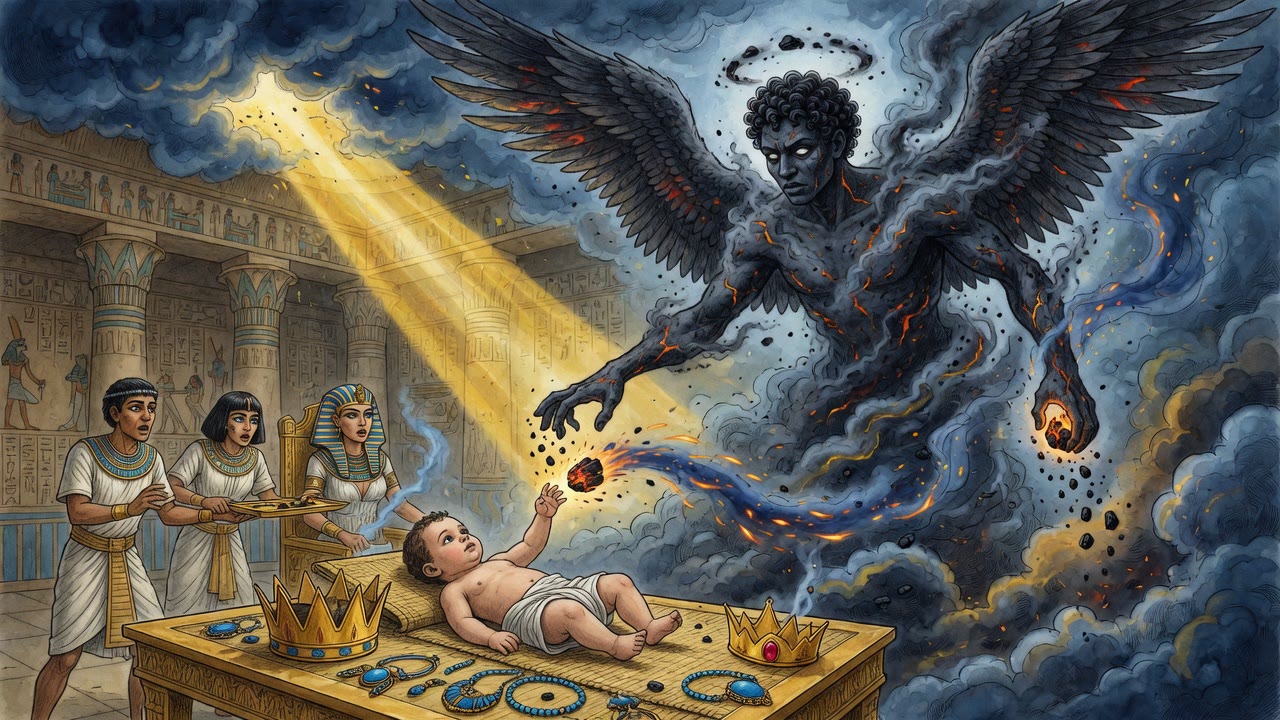
Moses hid the body in the sand. The next day two Hebrews were quarreling, and one of them asked whether he meant to kill them too.

Curated by Arthur · Told by Maggid ·
Table of Contents
  1. The Prince Who Walked Toward the Beating
  2. The Bush That Would Not Agree to Ash
  3. Ten Promises Broken Like Cheap Seals
  4. The Man the Bush Refused to Excuse
Moses Killed an Egyptian Then Faced the Bush Click for full size

The Prince Who Walked Toward the Beating

Everyone in Pharaoh's house had a hand in raising Moses. Palace milk. Palace tutors. Palace manners laid over a Hebrew birth that the river had failed to keep. When he was grown he went out to his brethren and saw an Egyptian taskmaster crushing a son of Kohath, a Levite, flesh of the people whose blood Moses carried under royal linen that still smelled of the women's wing.

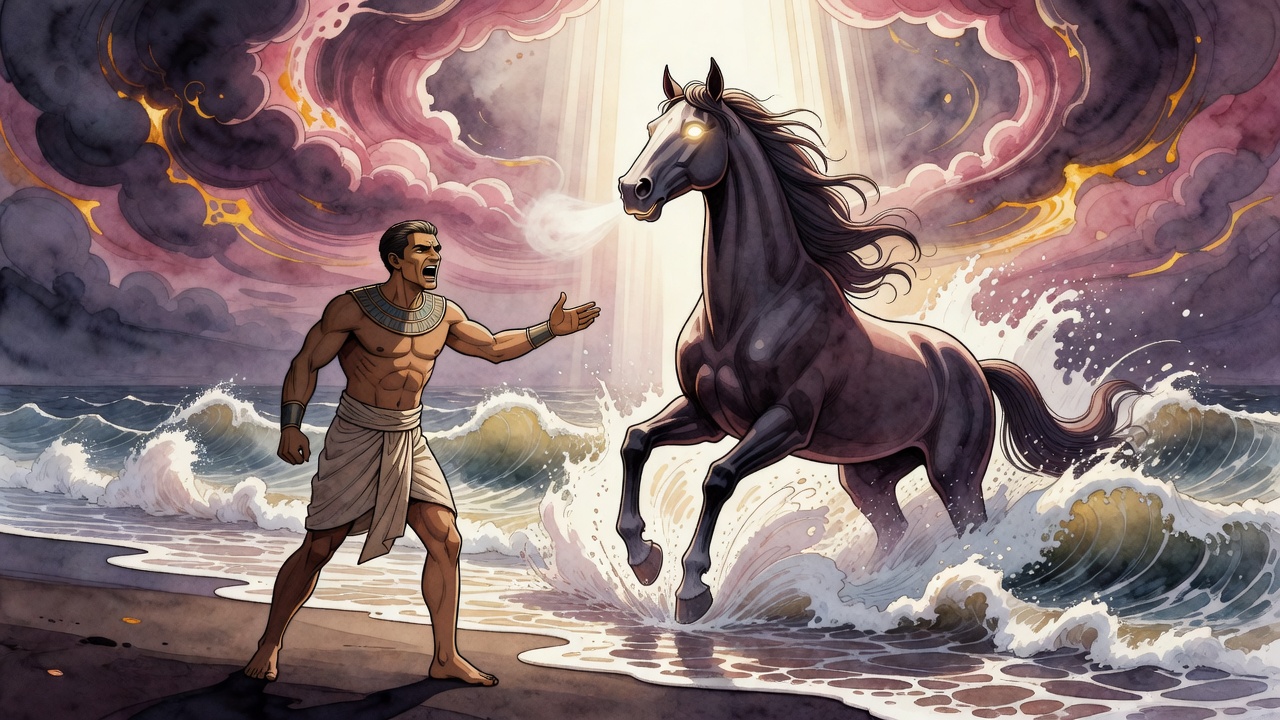
He rebuked with the sword of his lips first, words sharp enough to leave a mark if words had been enough. Then he struck. The Egyptian fell into the dust of other people's labor. Moses hid him in the sand. Pirkei DeRabbi Eliezer hears more than grit in that word. Sand is Israel's image in the prophets, children numberless as the shore. He buried the oppressor among his own, a loyalty sealed before any bush spoke, before any staff became a serpent, before any sea learned to stand.

The next day Hebrew quarrelers threw the deed back in his face like a stone. "Will you kill us as you killed the Egyptian?" Pharaoh heard through the usual pipes of gossip. Moses fled the only home he had eaten in, a wanted man with dust of two nations on his heels and no map that led anywhere but away.

The Bush That Would Not Agree to Ash

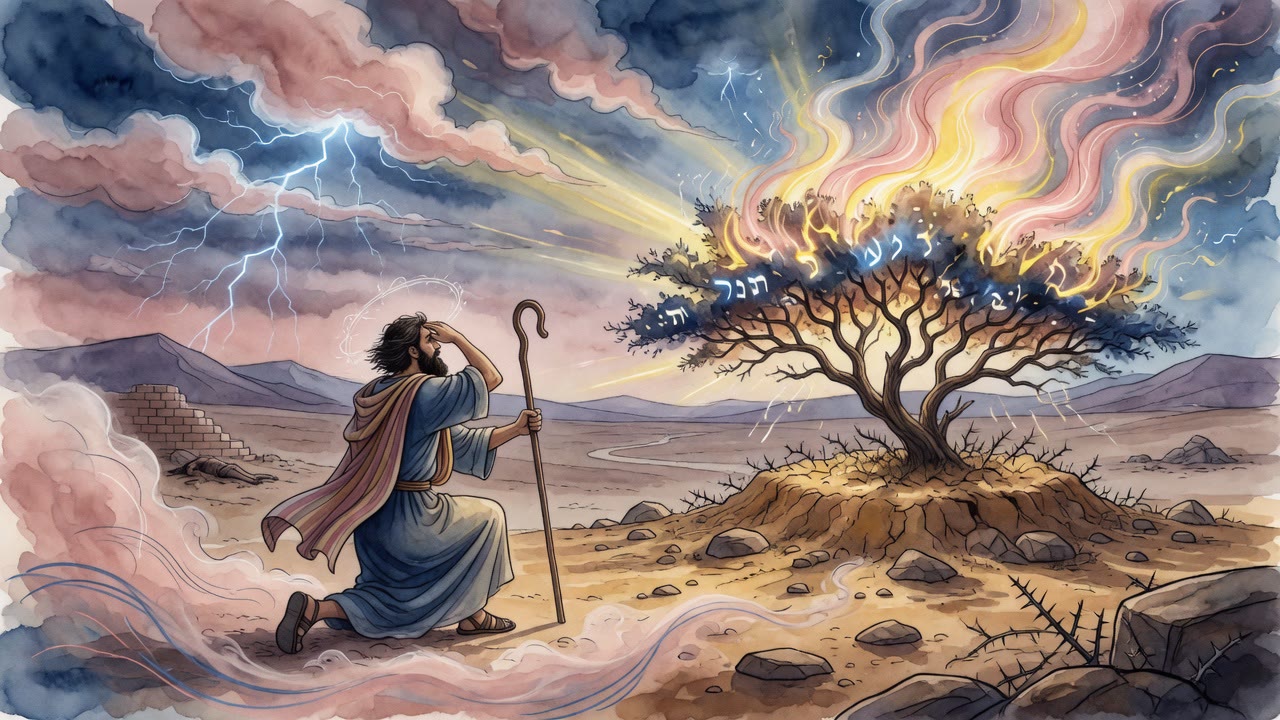
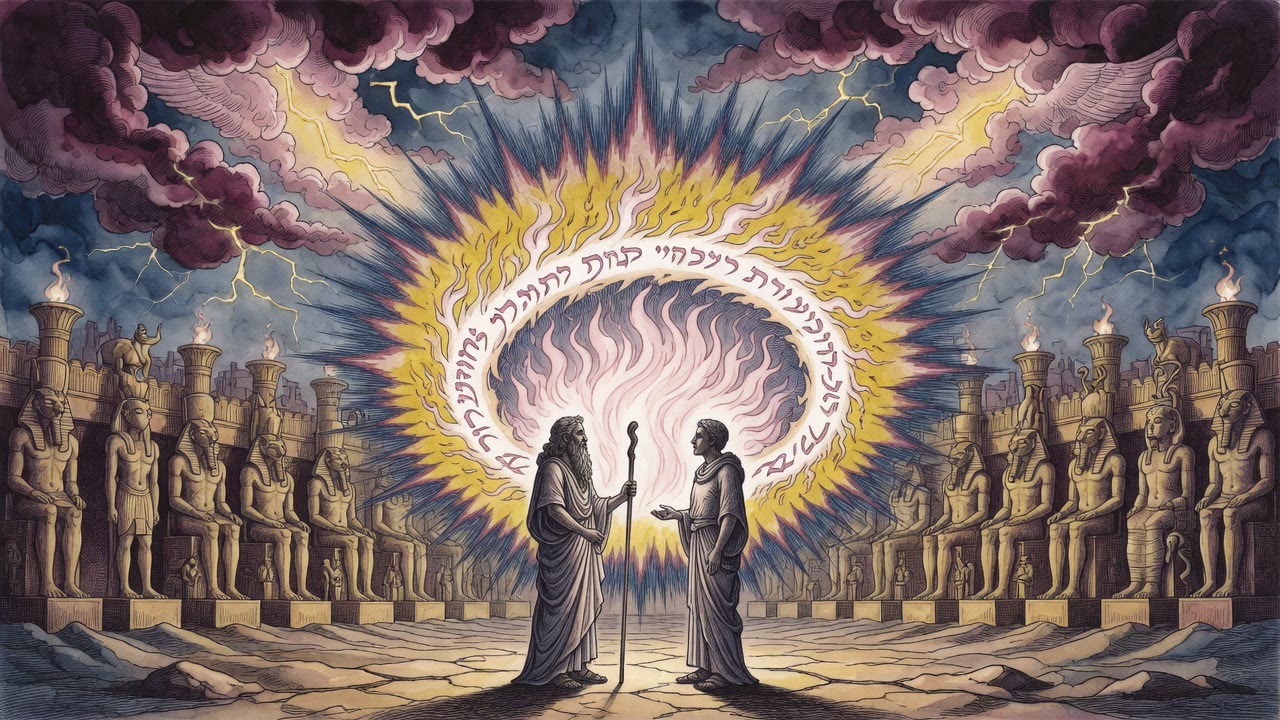
Midian took him into its dry hills. Flocks took his years and taught him the patience of water holes. He married. He fathered. He learned the names of winds. Then Sinai, and a bush on fire that refused the logic of fuel. Flame without charcoal. Heat without collapse. He turned aside. Turning is the first obedience, the small pivot on which nations later hinge.

From the flame the God of Abraham, Isaac, and Jacob spoke a mission that sounded like a return to the noose. "Go to Pharaoh. Bring My people out of Egypt." The mountain held the words without echo, as if ordinary physics had stepped back to give prophecy room.

Moses answered with a resume of refusals polished by fear. A heavy mouth. A heavy tongue. An enemy still on the throne who had wanted his life. "I fled from that danger. Now You send me back into his hand?" The complaint was not abstract theology. It was a body remembering a warrant and a palace that knew his face. God answered the fear with a fact colder and kinder than comfort. "Do not be afraid. All the men who sought your life are dead." The past tense cut the chain. The road opened not because Moses became eloquent overnight, but because the hunters had already gone to their graves without him.

Ten Promises Broken Like Cheap Seals

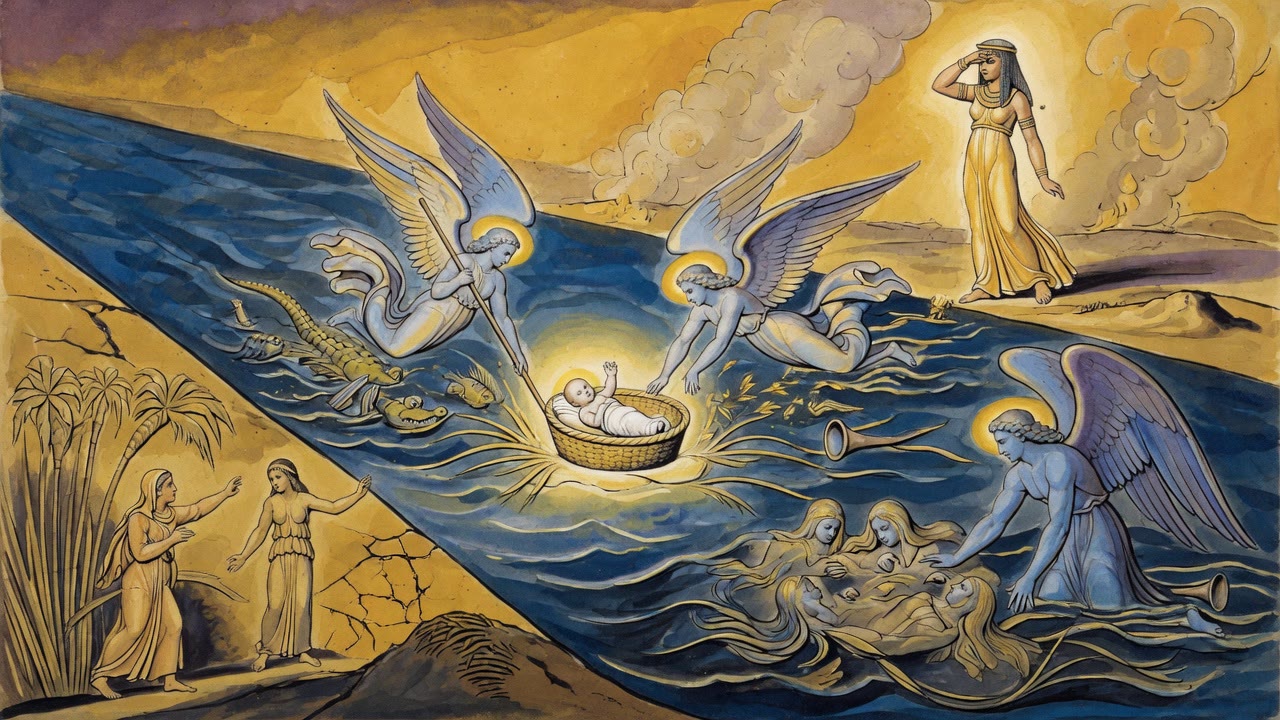
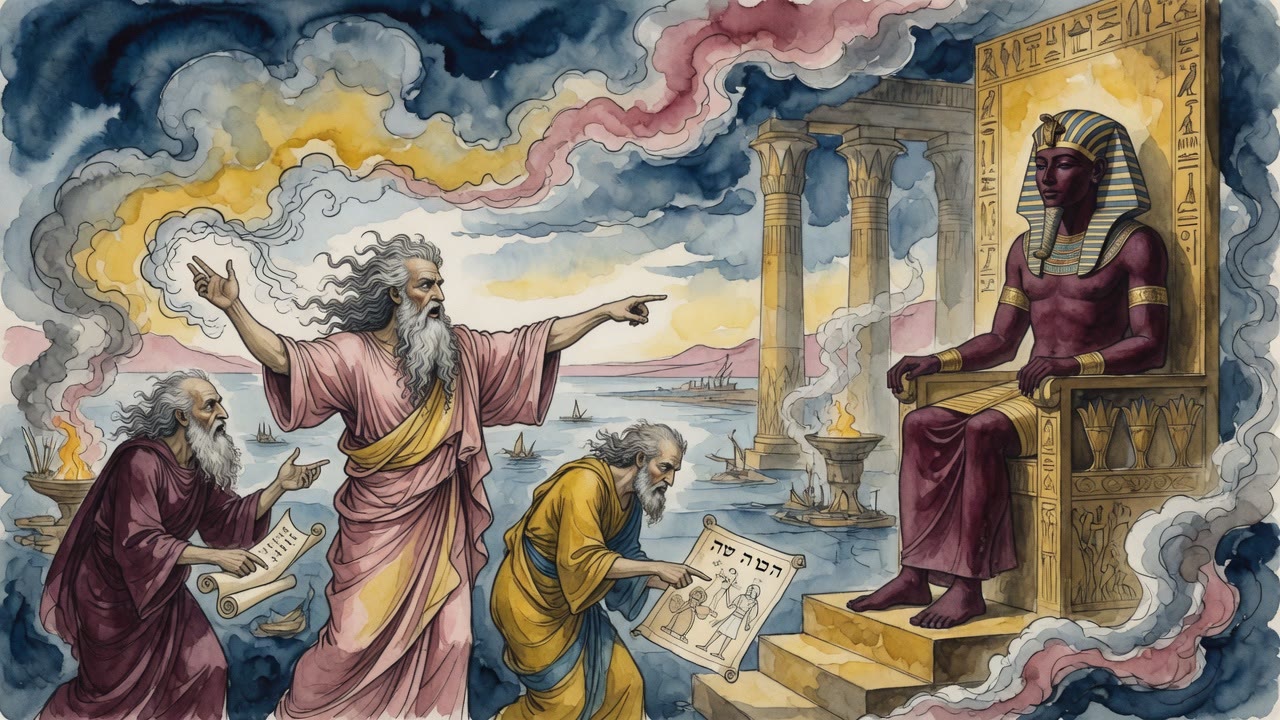
Josephus counts the war that followed when Moses finally stood again in Egypt's court with Aaron for a mouth and signs for an argument. Ten times Pharaoh promised release. Ten times he broke the word as if speech were clay he could remold at will. The Nile turned to blood so completely that Egyptians who forced a drink found pain, while the same river ran sweet for Hebrews drawing nearby. Frogs filled beds and kneading bowls. Lice boiled from flesh. Beasts no one could name walked the lanes. Boils opened. Hail shattered orchards. Locusts finished the seeds the hail had spared. Darkness lay three days thick enough to trouble breath, a black that felt like a hand over the nose.

Each plague followed a rhythm. Negotiation. Partial concession. Wives left behind, or children, or cattle, traps dressed as mercy. Escalation answered the trap until even the king's magicians could no longer pretend their arts matched the field. When darkness failed to bend him, the instruction came for the Passover lamb on the fourteenth of Nisan, blood on the posts, roasted meat in houses that had learned, at last, to listen when a stammering man spoke for the Maker of the river.

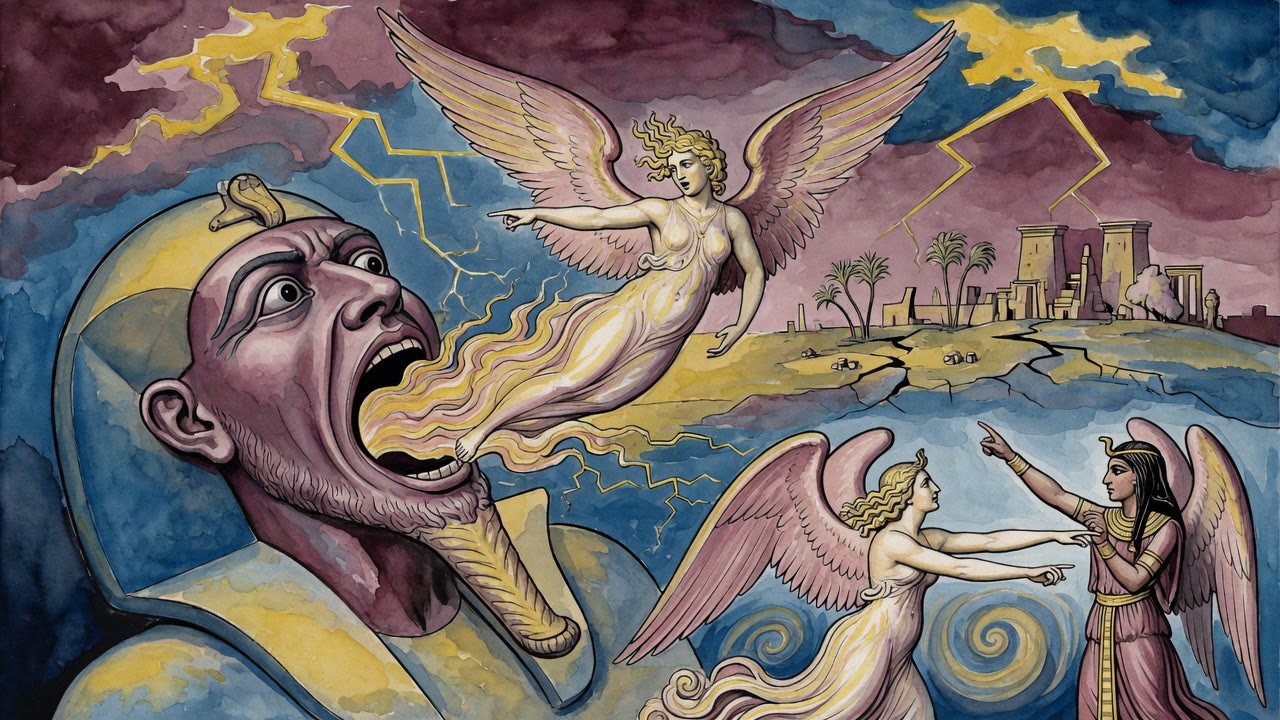
That night the firstborn died. Neighbors stormed Pharaoh with a demand that was no longer political. Leave. Take them. Egyptians loaded the Hebrews with gifts, frantic to push the God they had mocked out past the last marker stone before another midnight invented itself.

The Man the Bush Refused to Excuse

Between the hidden Egyptian and the midnight cry stood a shepherd who had tried to talk God out of choosing him. The palace boy who killed for a Levite became the stammering envoy who would not get to stammer forever. Staff, signs, a brother for speech, and a nation that would follow a man who once fled the same gates he now forced open with plagues for keys.

The bush had not burned to ash because the mission would not burn to ash. Egypt had raised him. Egypt had hunted him. Egypt would release a people under his hand while his tongue still felt thick in his mouth. That thickness remained part of the story on purpose. Heaven did not need a perfect speaker. It needed the one who had already chosen a beaten slave over a palace quiet, and who would choose again when the sea stood up and the people complained that death in Egypt would have been softer.

He left the mountain with sandals off and a Name in his chest. The flocks of Midian dwindled behind him. Ahead, brick-molds and a throne waited to learn that a man buried in sand can still rise when a bush refuses to die.


← All myths
From the tradition

Sources

3 sources

The texts behind this telling. Some cards carry a translation of the source; others are our own retelling of it, and each card says which. Every card links out to the original.

Pirkei DeRabbi Eliezer 48:9Pirkei DeRabbi Eliezer

Retold in our words. Read the original at the link below.Pirke de Rabbi Eliezer, trans. Rabbi Gerald Friedlander, London (1916) · CC-BY

It paints a picture of a young Moses deeply connected to his people, even while living in Pharaoh's palace.

Everyone in Pharaoh's household was involved in Moses' upbringing. Imagine the future liberator of the Israelites being nurtured, taught, perhaps even loved, by the very people who were oppressing his brethren!

Then, the story takes a dramatic turn. As it says in (Exodus 2:11), "And it came to pass in those days, when Moses was grown up, that he went out unto his brethren." He ventured into the Israelite camp. And what he saw there sparked something within him.

In Pirkei DeRabbi Eliezer, Moses witnessed an Egyptian taskmaster brutally beating one of the sons of Kohath, a Levite. The text emphasizes that these were Moses' brethren. His own flesh and blood. It was this injustice, this act of violence against his people, that ignited his righteous anger.

The text says, "He began to rebuke him with the sword of his lips, and he slew him, and buried him in the midst of the camp, as it is said, "And he smote the Egyptian, and hid him in the sand" (Ex. 2:12)."

Now, this is where it gets really interesting. The Pirkei DeRabbi Eliezer offers a unique interpretation of the word "sand" – Chôl in Hebrew. It suggests that here, "sand" doesn't just mean the literal desert sand. Instead, it represents the people of Israel themselves!

How so? Well, the text references (Hosea 1:10), which says, "Yet the number of children of Israel shall be as the sand of the sea." So, burying the Egyptian in the "sand" could be interpreted as Moses burying him amongst his own people, symbolically or perhaps even literally within their encampment. Think about the implications of that!

What does that act really mean? Perhaps it signifies Moses' complete identification with the Israelites. His commitment to their liberation was so profound that he was willing to take a life and risk everything to defend them. It speaks to a deep, inherent sense of justice and a fierce loyalty to his people, even before God commanded him to lead them out of Egypt. It's a powerful moment that shapes our understanding of Moses as more than just a prophet, but as a man of action, driven by his conscience.

This passage from the Pirkei DeRabbi Eliezer offers a fascinating and thought-provoking glimpse into the early life of Moses, revealing the seeds of leadership and compassion that would eventually blossom into the liberation of an entire nation. It leaves us pondering the complexities of identity, justice, and the extraordinary path of a man destined for greatness.

Full source
Pirkei DeRabbi Eliezer 40:6Pirkei DeRabbi Eliezer

Retold in our words. Read the original at the link below.Pirke de Rabbi Eliezer, trans. Rabbi Gerald Friedlander, London (1916) · CC-BY

God is calling to Moses from the burning bush. A pretty dramatic way to get someone's attention. And what's the message? "Go to Pharaoh and bring my people out of Egypt!" (Exodus 3:10).

Most of us would probably be at least a little bit intimidated by that request. But Moses? He's got a whole list of reasons why he's the wrong guy for the job.

In Pirkei DeRabbi Eliezer, a fascinating early medieval text that expands on biblical narratives, we get a glimpse into Moses' initial reluctance. Moses essentially argues with God. He pleads his case: "Sovereign of all worlds! Haven’t I told you, like, three or four times already that I'm just not cut out for this? I have a speech impediment! I’m not eloquent!" (Exodus 4:10). Moses is saying, "God, you know I have a defective tongue! Why would you choose me?"

It gets even better. Moses doesn't just claim to be unqualified; he points out that God is sending him right back into the lion's den! "Not only that," he says, "but you're sending me into the hands of my enemy, someone who wants to hurt me! That's why I fled in the first place!" He's referring, of course, to the time he fled from Pharaoh after killing an Egyptian (Exodus 2:15).

You run away from a dangerous situation, and then you're told to go right back?

So, what does God say to all this? Does He get angry? Impatient? No. He reassures Moses. He says, "Don't be afraid. All the men who sought your life are already dead."

It's a simple statement, but it's packed with meaning. God is telling Moses that the past is the past. The dangers he faced before are no longer a threat. He's clearing the path, so to speak. It’s almost as if God is saying, "Trust me. I've got this."

Now, why is this little exchange so compelling? Because it's so human! We see Moses, the future leader of the Israelites, wrestling with doubt, fear, and a very understandable desire to avoid a dangerous situation. People with flaws, anxieties, and moments of profound uncertainty.

And it also reminds us that sometimes, the things we fear the most are not as insurmountable as they seem. Sometimes, the obstacles in our path have already been cleared, even if we don't realize it yet. And sometimes, all we need is a little reassurance from a higher power – or, perhaps, from within ourselves – to take that first step forward.

So, the next time you're facing a daunting task, remember Moses and his burning bush moment. Remember his reluctance, his fears, and the reassurance he received. And remember that even with our imperfections and anxieties, we too can be called to do great things.

Full source
Antiquities II.14Antiquities of the Jews (Josephus)

Retold in our words. Read the original at the link below.Antiquities of the Jews, trans. William Whiston · Public Domain

Ten times Pharaoh promised to free the Hebrews. Ten times he broke his word. Each broken promise brought something worse than the last, and according to Josephus, the plagues that struck Egypt were unlike anything any nation had ever experienced.

It began with the Nile. God turned the river to blood, not symbolically, but so completely that the Egyptians had no water to drink anywhere. Those desperate enough to try suffered terrible pain. But the same river ran sweet and clean for the Hebrews. Pharaoh relented. The plague stopped. Pharaoh changed his mind.

Then came the frogs. They swarmed out of the river, invaded every house, crawled into beds, contaminated food and water, and filled the land with a nauseating stench as they died in heaps. Pharaoh begged Moses to take the Hebrews and leave. The frogs vanished. Pharaoh forgot his promise instantly.

Lice erupted from the bodies of the Egyptians themselves, impossible to wash off, impossible to treat. Then came pestilential creatures of species no one had ever seen before, killing both the animals and the farmers who tended them. Then boils, breaking open with infected sores while the flesh beneath was already decaying. Then hail larger than anything Egypt had ever known, smashing fruit-laden branches to the ground. Then locusts, devouring every seed the hail had spared.

Each plague followed the same devastating rhythm: Pharaoh would negotiate, offering partial freedom, go, but leave your wives; go, but leave your children; go, but leave your cattle. Each concession was a trap, and each trap provoked God to escalate further.

Then came darkness. Not ordinary night but a suffocating blackness so thick it obstructed breathing. Egyptians died in terror, believing the darkness itself would swallow them. Three days and three nights it lasted.

When even this did not move Pharaoh, God commanded the Hebrews to prepare the korban (a sacrificial offering) Pesach (קרבן פסח), the Passover sacrifice, on the fourteenth of the month of Nisan. They marked their doorposts with blood and ate the roasted lamb. That night, the firstborn of Egypt died. Pharaoh's own neighbors came to the palace demanding he let the Hebrews go. He finally called for Moses and told them to leave. And the Egyptians loaded them down with gifts, desperate to see them gone.

Full source