5 min read

Moses Pours His Soul into the Last Plank

All Israel builds the Tabernacle, yet Scripture names only Moses at the finish. He steps inside and hears a voice that settles for peace, not judgment.

Curated by Arthur · Told by Maggid ·
Table of Contents
  1. Credit for a House Many Built
  2. The Blessing on Their Hands
  3. A Sound Inside the Curtains
  4. Peace After the Calf
  5. God Arrives Laden
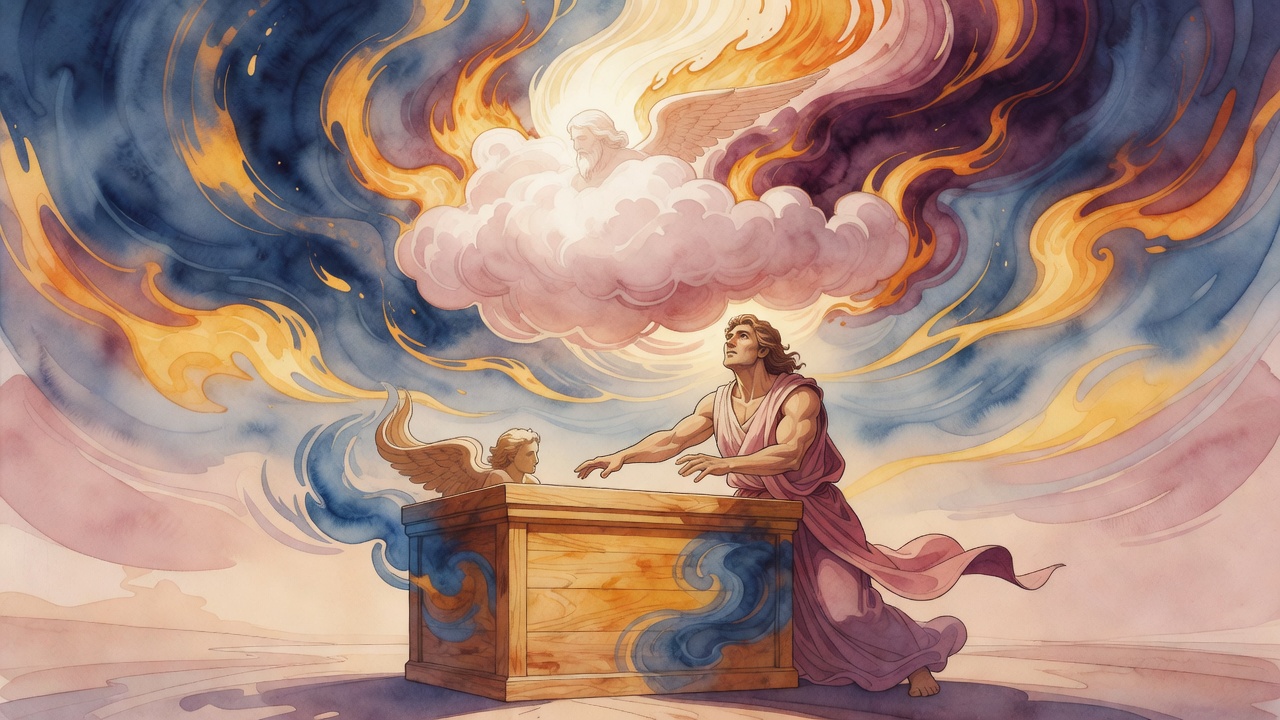
Moses Pours His Soul into the Last Plank Click for full size

Credit for a House Many Built

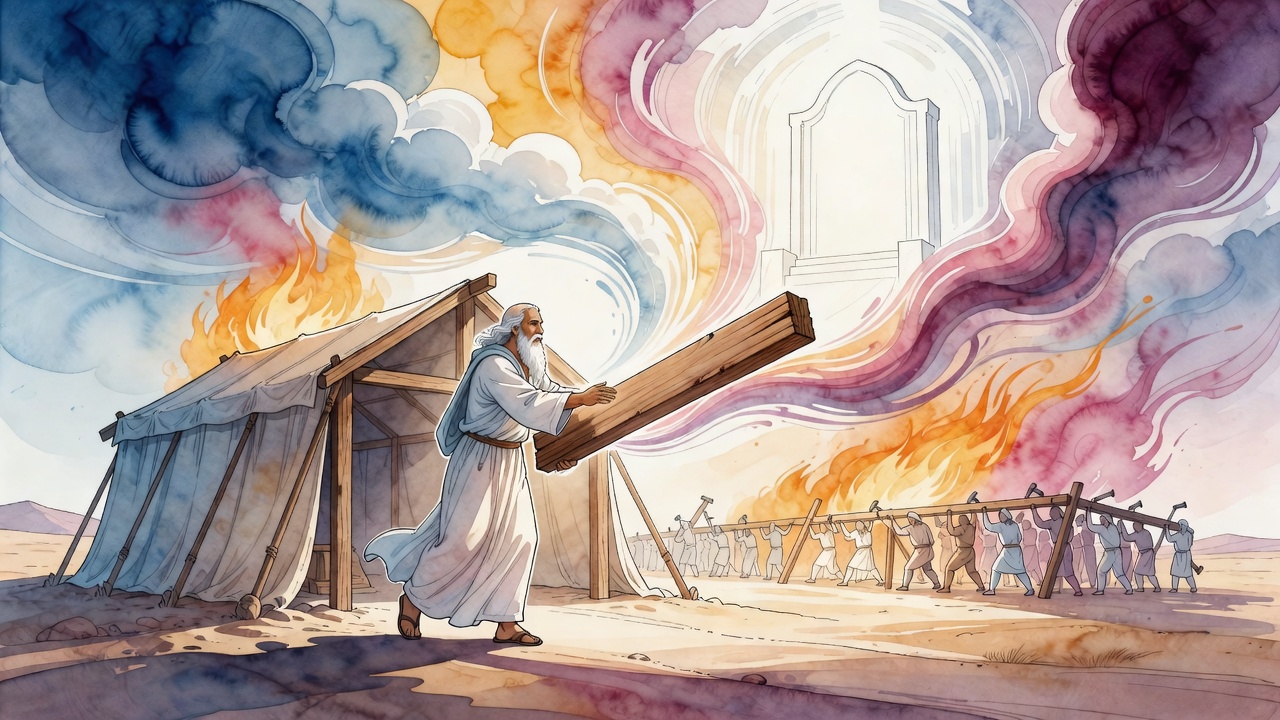
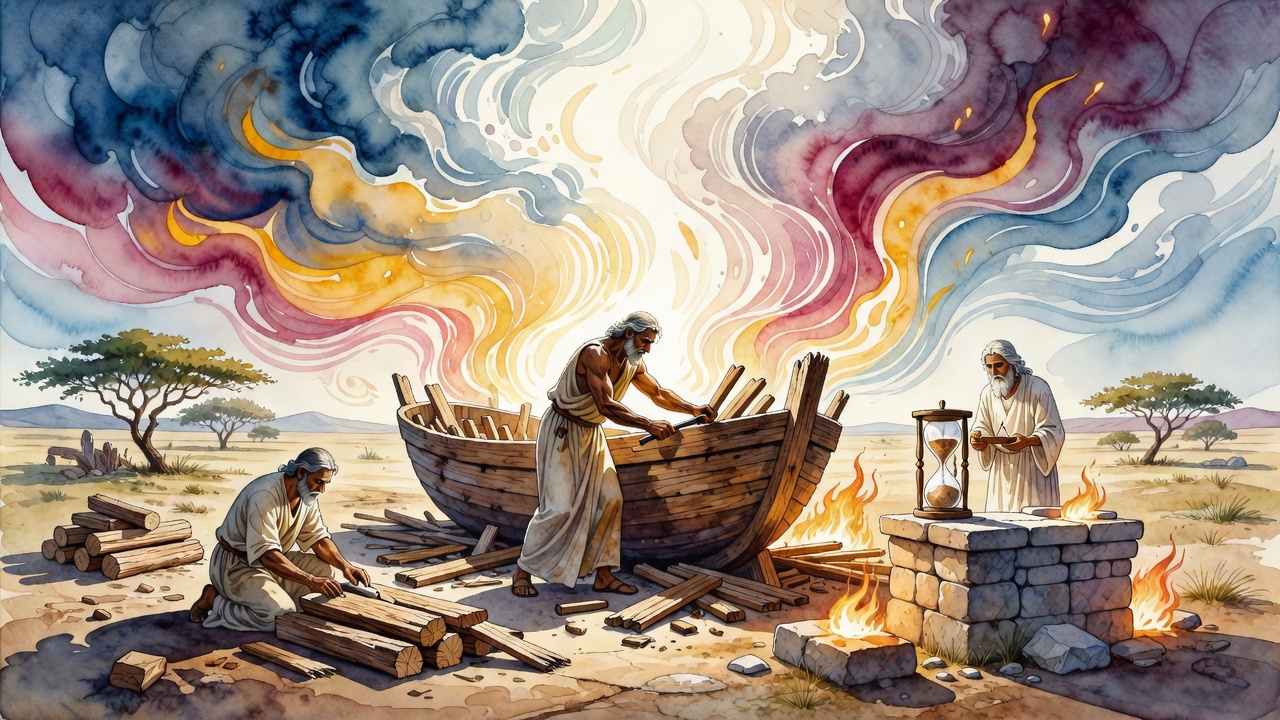
All Israel builds. The women spin goats' hair. Bezalel and Oholiab and every wise heart work the gold and the wood. Then Scripture writes the finish as if one man alone closed the last seam: on the day that Moses had finished.

Why? King Solomon taught that whoever tends a fig tree shall eat its fruit. The Holy One withholds no creature's reward. Whoever labors and pours out his soul upon a thing receives the fruit of his toil.

David gave his soul to a Temple he would never build, swearing he would not climb into his own bed until he found a place for the Lord. The dedication psalm still bears David's name, though Solomon raised the stones. So too the Tabernacle. Moses guarded every cubit against straying from the pattern shown on the mountain. Over every single thing: as the Lord commanded Moses. Many hands raise walls. One sleepless fidelity earns the byline.

The Blessing on Their Hands

When the work was done, Moses blessed them. May the Shekhinah (God's Presence dwelling among people) rest upon the work of your hands. The Holy One answered the poured-out soul with a line in the permanent record. Since Moses gave his soul to this house, I will write it in his name alone.

The people still own the labor. Moses owns the sleepless fidelity that kept the labor true. Scripture chooses the fidelity for the credit line.

A house can be raised by many and still finished by the one who refused to let the pattern blur. The women who spun do not lose their thread in that choice. They gain a blessing spoken over hands that ache from good work.

A Sound Inside the Curtains

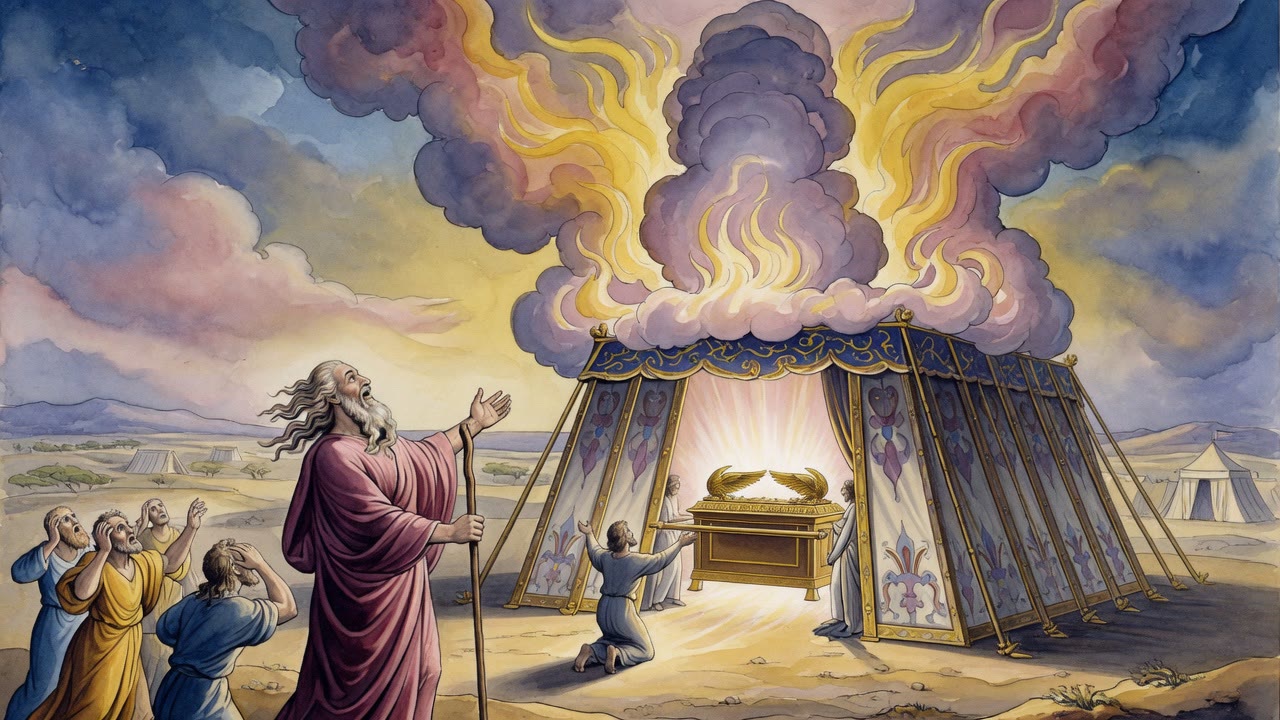
On the day the Tabernacle rises at last, Moses steps inside. A sound meets him there, glorious, pleasant, worthy of all praise. His heart trembles with a question he dares not assume. Judgment or mercy?

He prays in the words of the Psalmist: "Let me hear what God the Lord will speak." Is He stern with us, or tender?

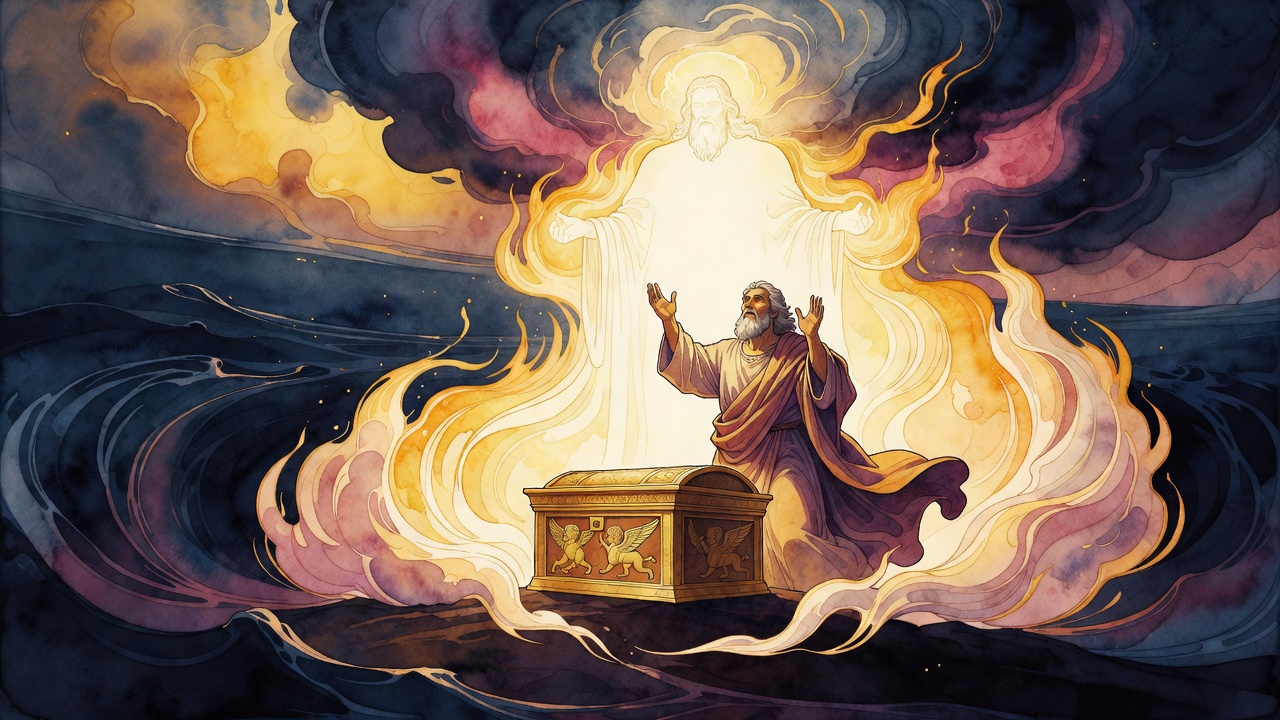
The Holy One answers: Moses, I am speaking peace. There is nothing in My heart against My children. "He will speak peace to His people and to His pious ones, and let them not turn back to folly." The man who poured his soul into planks now pours his ear into a tone he cannot risk misreading. Glory without clarity would still be terror. The answer names the tone: peace.

Peace After the Calf

Until the Tabernacle stood, contention hung between the Holy One and Israel, a quarrel since the sin of the calf. On the day the Tabernacle rose, peace was made between them, sealed and whole. Rabbi Shimon ben Lakish hears it already in the priestly blessing: "May the Lord lift up His face toward you and grant you peace." When was this peace granted? On the very day the Tent was erected.

The voice Moses feared might be a courtroom is a treaty. The house he poured his soul into becomes the room where the quarrel ends.

He does not leave empty. He leaves with a sentence that can steady a people still smelling smoke from an older sin. Curtains that once hid shame now hide a conversation that ends in shalom.

God Arrives Laden

Long before the Tent stood, while Israel still trembled at Sinai, the Holy One left a hint. When I come to you, I will not come empty-handed. I come laden with blessings. Rabbi Berekhyah presses the logic through Jacob, who would not leave Pharaoh's throne room until he pressed a gift into the king's hands, a blessing that the Nile should rise to meet Pharaoh's foot.

If flesh and blood departs only after blessing, the Holy One surely arrives bearing more. At Sinai He sealed it: an altar of earth you shall make for Me... I will come to you and bless you.

The day Moses finishes, God makes good. The priestly blessing pours out: May the Lord bless you. Every blessing has its appointed day, and this day was bought with a soul poured into planks, rings, and curtains that finally stood without a gap. Moses walks back into the light of the courtyard carrying peace in his ears and a people waiting to be blessed by hands that finally have a house to stand in.

Bezalel's tools cool. The women's spinning stops. The courtyard fills with people who want to know if the house they built will accept them. Moses carries their question into the curtains and brings back a single clear tone: peace. Not a vague calm. A settled quarrel since the calf. A face lifted, as the blessing will soon say, toward a people that almost lost the right to be faced.

David's unslept nights and Moses's measured cubits meet in one principle. Soul poured out earns a name on the work. God arrives laden because the day arrived full. The priestly words wait like gifts already packed, needing only a finished threshold and a servant who asked whether the sound inside was judgment before he dared to smile.


← All myths
From the tradition

Sources

3 sources

The texts behind this telling. Some cards carry a translation of the source; others are our own retelling of it, and each card says which. Every card links out to the original.

Midrash Tanchuma Buber, Nasso 20:1Midrash Tanchuma Buber, Nasso

Translation of the source text.Midrash Tanchuma (Buber), Public Domain, on Sefaria · CC-BY-SA

Another interpretation of (Numbers 7:1) "And it came to pass on the day that Moses had finished." This is what Scripture says (Proverbs 27:18): "Whoever tends a fig tree shall eat its fruit." The Holy One, blessed be He, does not withhold the reward of any creature; rather, for everything in which a person labors and gives his soul over the matter, the Holy One, blessed be He, does not withhold his reward. Therefore it is said: "Whoever tends a fig tree shall eat its fruit."

Do you wish to know? Solomon built the Temple, as it is said (1 Kings 6:14): "So Solomon built the house, and finished it." Yet because David had given his soul over the Temple, that it should be built, as it is said (Psalms 132:1-5): "Lord, remember David, and all his affliction; how he swore to the Lord, and vowed to the Mighty One of Jacob: Surely I will not come into the tent of my house, nor go up into the bed that is spread for me... until I find a place for the Lord", the Holy One, blessed be He, did not withhold his reward, but had it written in his name, as it is said (Psalms 30:1): "A Psalm; a Song at the Dedication of the House, of David." It does not say "of Solomon," but rather "of David." Solomon spoke well: "Whoever tends a fig tree shall eat its fruit."

So too you find with the Tabernacle, that all gave their souls and made the Tabernacle. All Israel volunteered; the women spun the goats' hair; and likewise (Exodus 36:8): "And all the wise-hearted among them that wrought the work made the Tabernacle"; and likewise (Exodus 36:1): "And Bezalel and Oholiab shall work." Yet because Moses gave his soul over it, that it should be made just as the Holy One, blessed be He, had shown him on the mountain, as it is said (Exodus 25:40): "And see and make them after their pattern", and Moses went and gave his soul that they should not err. Therefore it is written concerning each and every matter (Exodus 39): "As the Lord commanded Moses." And so it says (Exodus 39:43): "And Moses saw all the work... and Moses blessed them." And with what blessing did he bless them? He said to them: May the Divine Presence rest upon the work of your hands. The Holy One, blessed be He, said: Since Moses gave his soul over the Tabernacle, I will write it only in his name, as it is said (Numbers 7:1): "And it came to pass on the day that Moses had finished."

Full source
Midrash Tanchuma Buber, Nasso 25:1Midrash Tanchuma Buber, Nasso

Translation of the source text.Midrash Tanchuma (Buber), Public Domain, on Sefaria · CC-BY-SA

[(Numbers 7:1) "And it came to pass on the day that Moses had finished."] Rabbi Yehudah bar Simon said: On the day the Tabernacle was erected, Moses entered, and he was hearing a glorious voice, a pleasant voice, a praiseworthy voice. Moses said (Psalms 85:9), "Let me hear what God the Lord will speak" - is He speaking harshly, is He speaking with mercy? "Let me hear what God the Lord will speak." The Holy One, blessed be He, said to him: Moses, I am speaking peace; there is nothing in My heart against My children, as it is said, "For He will speak peace to His people and to His pious ones, and let them not turn back to folly" (ibid.). And it is written after it, "Surely His salvation is near to those who fear Him," etc. (Psalms 85:10). When? On the day the Tabernacle was erected. [For Rabbi Yehoshua the Priest said in the name of Rabbi Eliezer] that until the Tabernacle was erected there was contention between the Holy One, blessed be He, and Israel, and on the day the Tabernacle was erected peace was made, as it is said, "For He will speak peace to His people and to His pious ones, and let them not turn back to folly." Rabbi Shimon ben Lakish said to him: Why should I need to learn it from the book of Psalms? It is a matter of Torah, and even in its own place it lacks nothing. What is written above on the matter? "May the Lord lift up His face toward you and grant you peace" (Numbers 6:26). When? On the day the Tabernacle was erected.

Full source
Midrash Tanchuma Buber, Nasso 26:1Midrash Tanchuma Buber, Nasso

Translation of the source text.Midrash Tanchuma (Buber), Public Domain, on Sefaria · CC-BY-SA

[(Numbers 7:1:) "And it came to pass on the day that Moses finished." Said Rabbi Berekhyah the Priest Berabbi:] Before the Tabernacle was erected, when Israel stood before Mount Sinai, the Holy One, blessed be He, gave them a hint and said to them: When I come to you, I come laden with blessings.

Said Rabbi Berekhyah the Priest Berabbi: "Shall a mortal be more righteous than God?" (Job 4:17). Jacob, when he went to Pharaoh, did not depart from him until he had blessed him. And how did he bless him? He said to him: May the Nile rise to his foot. From where? As it is said, "And Jacob blessed Pharaoh" (Genesis 47:7). And I, when I come to you, I come laden with blessings.

And where did He hint this to them at Sinai? As it is said, "An altar of earth you shall make for Me... I will come to you and bless you" (Exodus 20:24). And when He came to them, He blessed them, as it is said, "May [the Lord] bless you" (Numbers 6:24). When? On the day that the Tabernacle was erected, "And it came to pass on the day that Moses finished."

Full source