5 min read

Moses Refused Three Times and God Started Speaking to Aaron Too

A man in the market shouted that he was selling purple wool. The king had him brought in and asked what he was selling, and the man said nothing.

Curated by Arthur · Told by Maggid ·
Table of Contents
  1. The Man Who Was Selling Nothing
  2. He Refused Three Times at the Bush
  3. The Sentence That Changed Shape
  4. Words in Abundance at the Jordan
  5. Purple for the Street, Nothing for the Throne
Moses Refused Three Times and God Started Speaking to Aaron Too Click for full size

The Man Who Was Selling Nothing

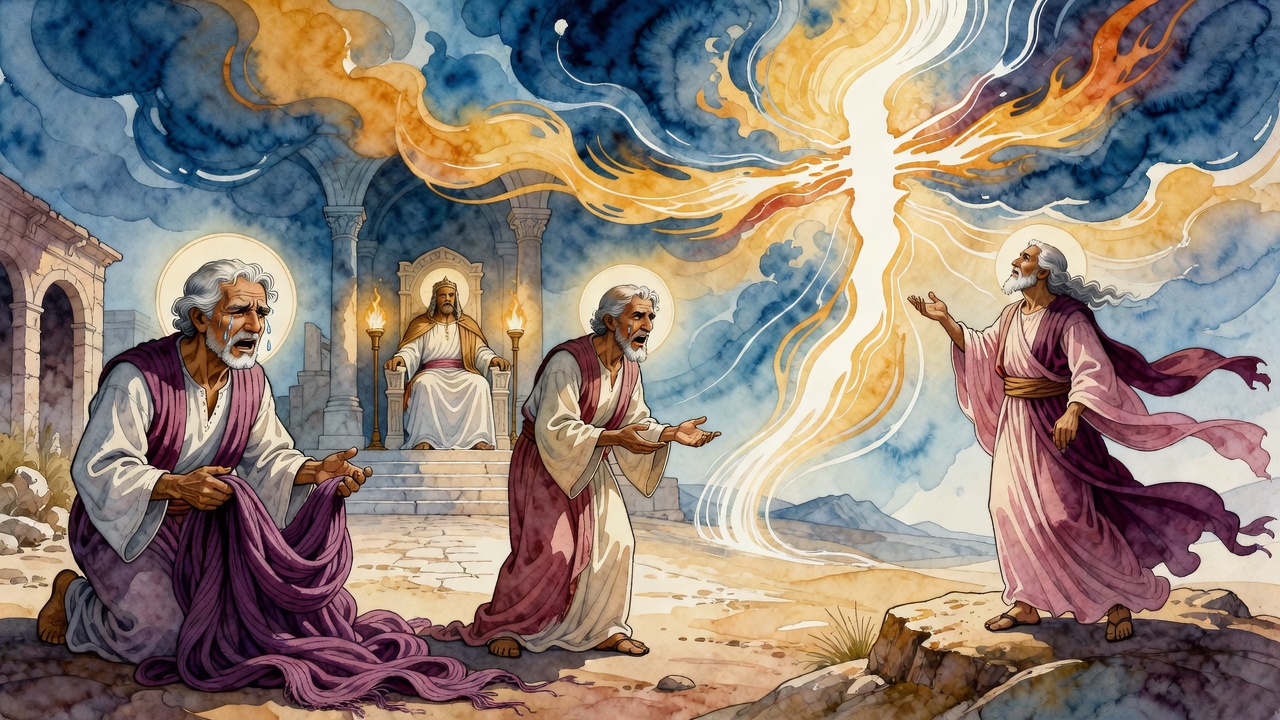
A merchant walked the market with purple over his arm, calling out what he had. Purple was the dye of kings. A man who got hold of any wanted the whole street to know it.

The king heard him through a window and sent down for him.

"What are you selling?"

"Nothing."

"I heard your voice. You were calling, here is purple wool. And now you tell me nothing?"

"My lord, it is purple wool." He held the bolt out so the light fell across the weave. "For you it is nothing. It is not worthy of a king."

He Refused Three Times at the Bush

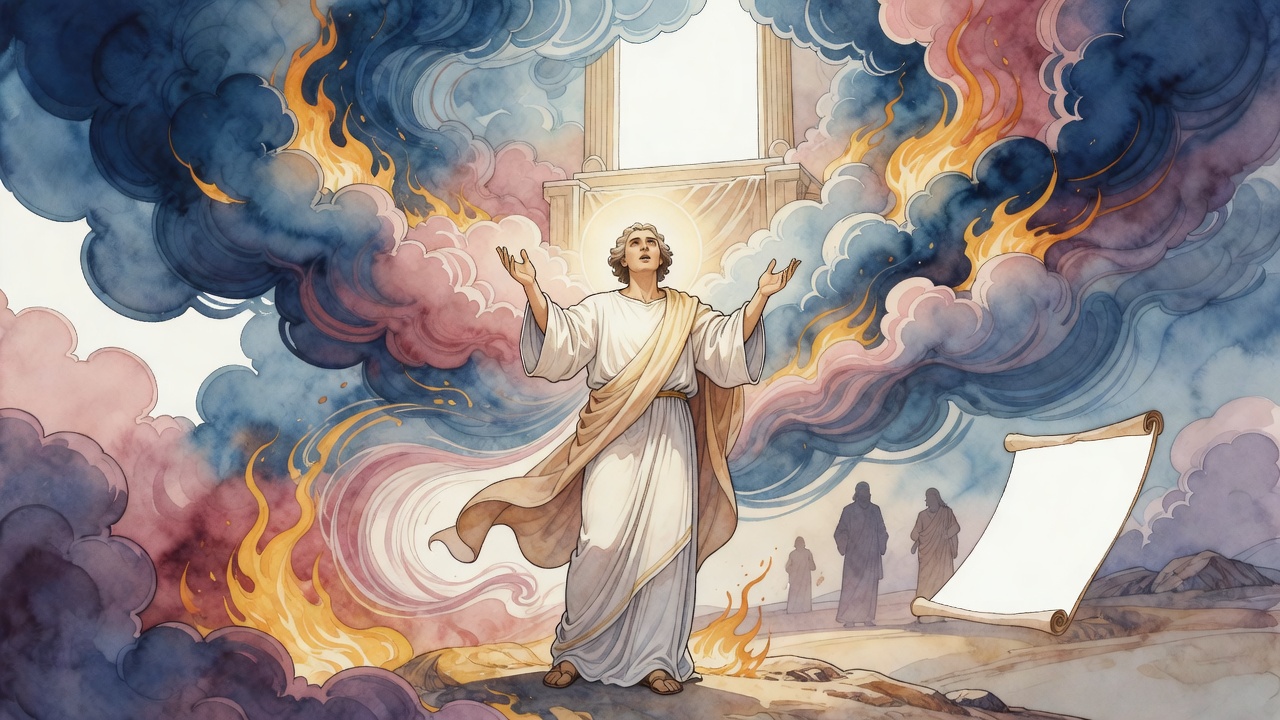
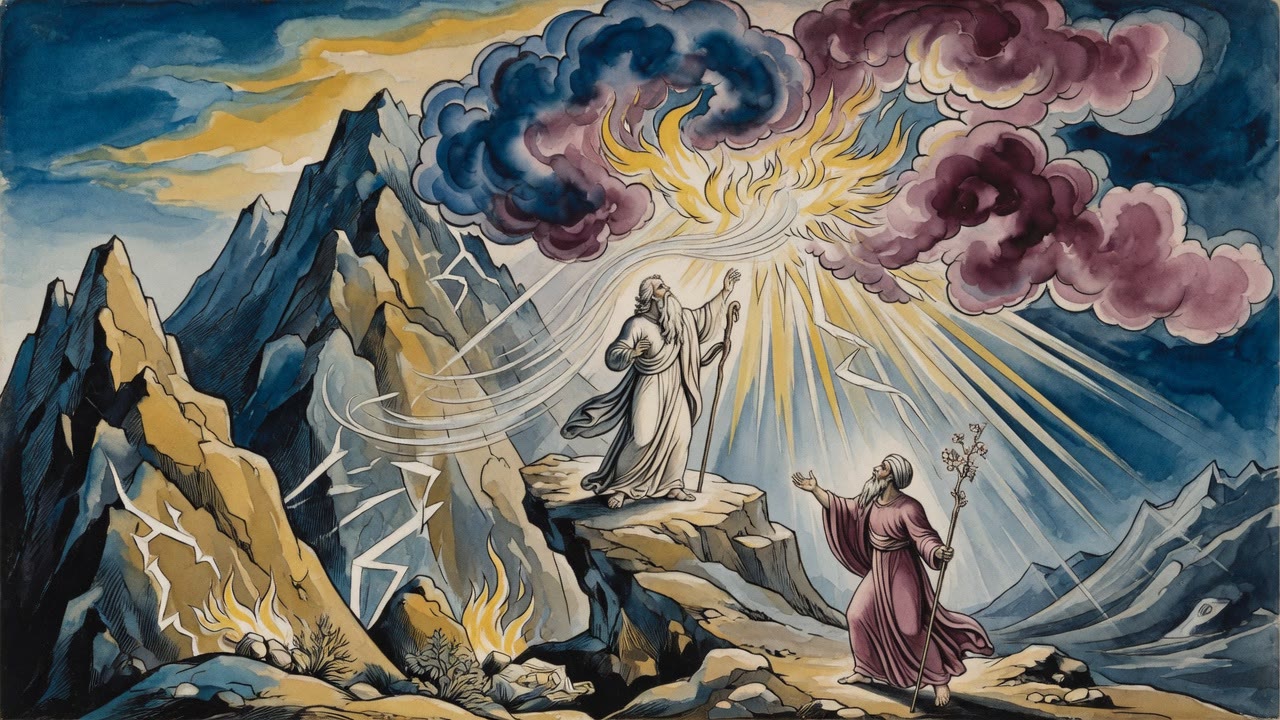
A bush burned on the far side of the wilderness and did not burn up, and Moses turned off the path to look at it, and the voice inside it sent him to Pharaoh.

He said, "They will not believe me."

So the staff in his hand became a snake on the ground, and he ran from it, and took it by the tail and it was a staff again. His hand went white as snow inside his cloak and came out clean. Take the signs, he was told, and go.

He said, "I am not a man of words."

Who made a man's mouth, he was asked. Who makes him mute, or deaf, or seeing, or blind. Go, and I will be with your mouth.

He said, "Send by the hand of whomever You will send."

Three times a man is granted, and three times heaven waits. If he turns in those three, well and good. If he does not, the earlier refusals are brought back and set against him. Moses stood in front of a bush that would not stop burning, with a snake at his feet and his own hand healed in front of his eyes, and asked to be excused a third time.

The Sentence That Changed Shape

He went anyway. He stood in front of Pharaoh and asked for three days in the wilderness, and Pharaoh took the straw away and doubled the bricks, and the foremen of Israel came out of the palace and cursed Moses to his face in the road.

Moses went back and said the children of Israel had not listened to him, so how was Pharaoh going to listen, a man of uncircumcised lips.

That was one refusal past the three.

Then the opening of the sentence changed. It had always run: the Lord spoke to Moses. From then on it ran: the Lord spoke to Moses and to Aaron.

His older brother came inside the commission with him. Not behind him holding the staff, but named in the address itself, in the same breath. Heaven had started speaking to Aaron too, so every word that came down from then on came down for two men. Moses had asked to be let off. He was not let off. He was joined.

Words in Abundance at the Jordan

Forty years later the same mouth would not stop.

He stood on the far bank of the Jordan with the whole nation in front of him and named every place they had broken. The sea. The mountain. The night the spies came back. He did it to their faces, in the open, and they stood in the dust and took it.

Then the word came down to him: since they have accepted your rebukes, you have to bless them.

He blessed them on the spot. The Lord your God has multiplied you, and here you are today, like the stars of heaven for number. Then he went past what he had been told to say. May the Lord God of your fathers add to you a thousand times as many as you are, and bless you as He promised.

In this world, he told them, other people have blessed you. In the end God will do it Himself.

Purple for the Street, Nothing for the Throne

The wool was real. It was good enough to stop traffic in a market and good enough to make a grown man shout in the street about it. Held up in front of a throne, the weave showed.

Moses had a book of words for Israel and nothing at all for the One who made the mouth. Both measurements were honest. He talked to a nation for forty years and never once believed he had anything worth handing upward.

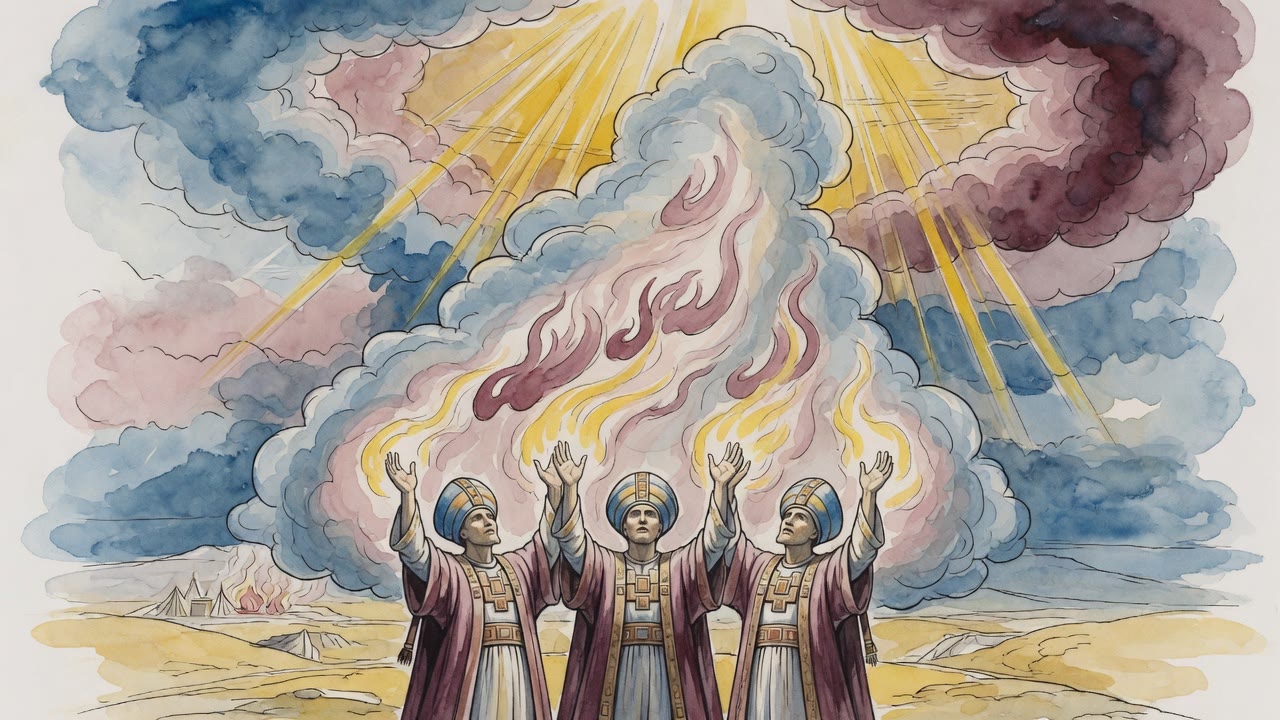
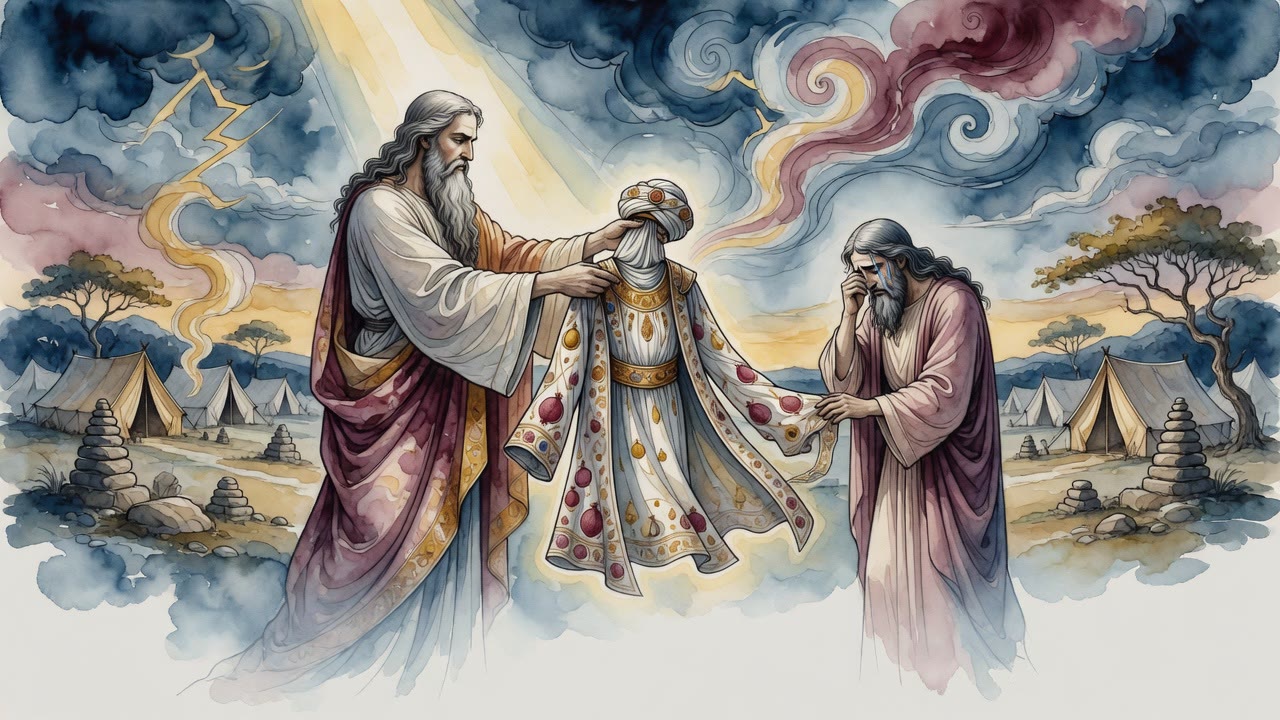
He died on a mountain in sight of a country he was not allowed to enter, and nobody knows where the grave is. Aaron had gone first, on another mountain, with the garments taken off him and put on his son while he watched. The word that came for two men went quiet in one of the mouths, and then in the other.


← All myths
From the tradition

Sources

3 sources

The texts behind this telling. Some cards carry a translation of the source; others are our own retelling of it, and each card says which. Every card links out to the original.

Devarim Rabbah 1:7Devarim Rabbah

Retold in our words. Read the original at the link below.The Sefaria Midrash Rabbah, 2022 · CC-BY

Like the amazing thing you have to offer just isn't... quite good enough?It touches on exactly that feeling.

Rabbi Tanhuma, a well-known sage, tells a story. Here is purple wool!" Now, purple wool in those days? That was a luxury item, the kind of thing fit for royalty.

The king, hearing the merchant's cry, takes notice. He summons the man and asks, "What are you selling?" And The merchant replies, "Nothing."

The king, understandably confused, challenges him. "But I heard you! You were clearly advertising purple wool. How can you say you have nothing?"

The merchant explains, "My lord, it is true that it's purple wool. But for you, it's nothing. It's not of a quality worthy of a king." The merchant acknowledges the value of his product, at least to the general public. But he also recognizes that it falls short of the king's standards. He's being honest, maybe even a little self-deprecating. Etz Yosef, a commentary on the Midrash (rabbinic interpretive commentary), explains that the merchant was announcing to the masses that he had purple wool, but it was not of a quality worthy of a king, and therefore to the king he said that he had nothing.

So, what does this have to do with Moses?

The Midrash connects this parable to Moses’ famous reluctance to speak. Before God, the ultimate King, the creator of language itself, Moses says, "I am not a man of words" (Exodus 4:10). He felt inadequate, perhaps, to the task of speaking for God.

But when it comes to the Israelites, the people he's leading? It's different. It is written in his regard: “These are the words.” Moses finds the words to speak to his people, to teach them, to guide them.

Isn't that a powerful insight? Sometimes, we might feel inadequate when facing the ultimate authority, the highest standard. We might feel like what we have to offer isn’t good enough. But perhaps, like Moses, we can still find our voice, our "purple wool," when it comes to connecting with those around us. When it comes to sharing our gifts with the people who need them.

Maybe it's not about perfection. Maybe it's about finding the right audience for our "purple wool," and speaking our truth, even if it feels a little rough around the edges.

Full source
Devarim Rabbah 1:9Devarim Rabbah

Retold in our words. Read the original at the link below.The Sefaria Midrash Rabbah, 2022 · CC-BY

It all stems from the opening of Devarim, the Book of Deuteronomy. Moses stands before the Israelites, ready to deliver his final, powerful speeches. And the very first verse we encounter, "These are the words…" (Deuteronomy 1:1), sparks a whole chain of thought in the Sages' minds.

The Rabbis in Devarim Rabbah ask: why "these are the words?" What’s so special about them? They suggest that God, blessed be He, actually tells Moses that because the Israelites have accepted his rebukes – his strong words of correction and guidance – he now must bless them! The acceptance of criticism becomes a prerequisite for blessing. Where do we see this blessing emerge? Right in the next verse: "The Lord your God has multiplied you, and, behold, you are today as the stars of the heavens in abundance" (Deuteronomy 1:10). This isn't just a statement of fact; it's a blessing, a direct result of the Israelites' willingness to listen and learn.

It continues! The very next verse goes on to say: “May the Lord, God of your fathers, add to you one thousand times as you are, and He will bless you, as He spoke to you” (Deuteronomy 1:11). It’s like the floodgates have opened.

Is this connection between rebuke and blessing just a lucky coincidence? The Rabbis don't think so. They find support in (Proverbs 24:25), where Solomon wisely states: "For those who rebuke it will be pleasant, and a blessing of goodness will come upon them." It's a universal principle, applicable in all times and places: accepting correction leads to goodness and blessing.

Devarim Rabbah takes it a step further. God says to Israel: ‘In this world, you were blessed by others. In the future, I will bless you,’ as it is stated: “May God be gracious to us and bless us…” (Psalms 67:2). There’s a progression here, a promise of an even greater blessing to come, a direct blessing from God Himself.

So, what does this all mean for us? Perhaps it's a reminder to be open to criticism, to see it not as an attack, but as an opportunity for growth. Maybe it’s a call to embrace the sometimes-uncomfortable process of self-improvement, knowing that it can ultimately lead to unexpected blessings.

Full source
Shemot Rabbah 7:2Shemot Rabbah

Retold in our words. Read the original at the link below.The Sefaria Midrash Rabbah, 2022 · CC-BY

The Book of Job, that epic poem of suffering and faith, contains a verse that hints at this: "Behold, all these God will do, twice, three times to a man" (Job 33:29). The Midrash (rabbinic interpretive commentary), specifically Shemot Rabbah, sees this as a fundamental principle: God gives us three opportunities to turn things around. Three chances to repent, to course-correct. If we take them? Wonderful. If not… well, consequences follow.

It’s like a cosmic "three strikes" rule, but with a loving, albeit firm, parent at the helm.

Where do we see this in action? Think about Moses.

Remember when God first commands Moses to go to Pharaoh and demand the Israelites' release? Moses doesn't exactly jump at the opportunity. In fact, he argues. Several times.

First, he says, "But they will not believe me" (Exodus 4:1). He doubts the people will accept him as their leader.

Then, he claims, "I am not a man of words" (Exodus 4:10). He says he’s not eloquent enough for the task.

Finally, he pleads, "Please…send by means of whom You will send" (Exodus 4:13). This is the big one: just send someone else, anyone else!

Three times. Three refusals. Three chances to embrace his destiny.

So, what happens? According to Shemot Rabbah, because Moses didn't “recant”, didn’t take those opportunities to step up. And instead even complained that "Behold, the children of Israel did not heed me" (Exodus 6:12), the divine speech, the mission, the partnership… it shifted. It included Aaron. "The Lord spoke to Moses and to Aaron" (Exodus 6:26).

Now, Aaron was always meant to play a role, of course, but the implication here is that Moses’s reluctance altered the dynamic. It wasn't just Moses's show anymore. He had to share the leadership, the burden, the glory. It’s not necessarily punishment, but it is a consequence. A shift in the divine plan, perhaps, to accommodate human hesitation.

Maybe it's a reminder that opportunities don't always knock forever. Maybe it’s a call to examine our own reluctance, our own excuses when faced with a challenge. Do we embrace the call, even when it’s scary? Or do we keep making excuses until the universe finds another way, another messenger?

The story of Moses, as told in Shemot Rabbah, isn't just about ancient history. It’s about the choices we make every day, and the ripple effects those choices have on our own lives and the world around us. It's about recognizing that sometimes, the greatest blessings come disguised as the greatest challenges. And sometimes, divine patience has its limits.

Full source