5 min read

Miriam Speaks First Against Her Brother Moses

Miriam sees Tzipporah unadorned and opens a harsh case against Moses. Heaven answers the sister who once measured three cubits of rescue.

Curated by Arthur · Told by Maggid ·
Table of Contents
  1. The Unadorned Wife
  2. Three Cubits of Deliverers
  3. Beauty Called Cushite
  4. Uzziah's Incense
  5. Height and Hard Words
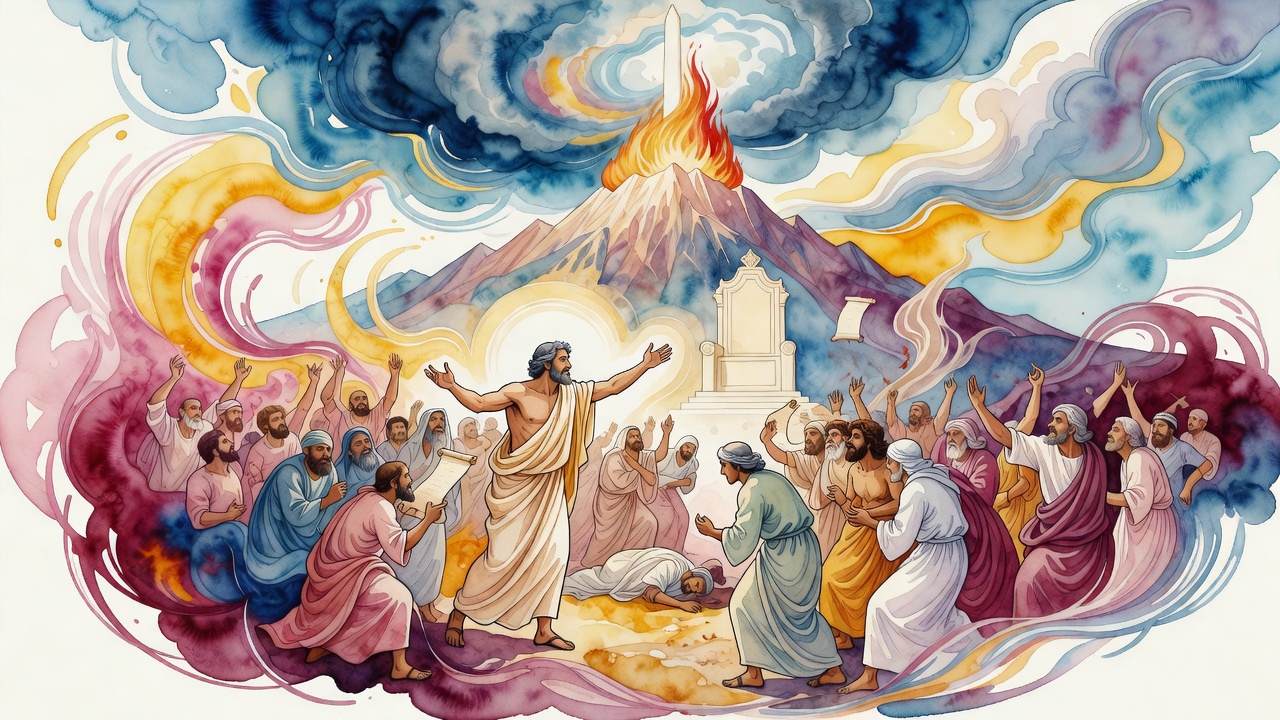
Miriam Speaks First Against Her Brother Moses Click for full size

The Unadorned Wife

Tzipporah walked among the camp without the ornaments other wives wore. Miriam noticed. Eyes that had watched a basket on the Nile did not miss a bare neck in the dust of Numbers. She asked. The answer came quiet and sharp: Moses no longer came to her as a husband. He stood always ready for the Voice. Intimacy had been set down like a staff he would not pick up again.

Miriam carried the news to Aaron. Concern for Israel's future, for children not born, for a leader living as if marriage were a finished chapter, filled her mouth. "And Miriam and Aaron spoke against Moses" (Numbers 12:1). The verb is dibbur, the hard kind of speech, the kind Joseph's brothers remembered when a lord in Egypt spoke roughly to them. Not a soft amirah. A case.

The order of names tells who opened the file. Miriam spoke first. Aaron joined. The sister who had danced at the sea now prosecuted the brother who climbed the mountain.

Dust stuck to Tzipporah's unpainted skin. Somewhere a child asked why the prophet's wife looked like a widow while her husband still breathed.

Three Cubits of Deliverers

On the altar that would stand in the courtyard, length and breadth ran five cubits each, one set of five for each tablet of the Law. Height ran three cubits. The legends map those three measures onto three bodies who led Israel out of Egypt: Moses, Aaron, and Miriam. She is not a side character in stone. She is a vertical third of the rescue.

Horns at the altar's corners answer other horns from Sinai: Torah, Presence, priesthood, kingdom. The furniture remembers gifts. It also remembers who carried the people when water was bitter and when a baby needed a watching sister. Miriam's name is built into the height a priest's eye meets when he approaches fire.

That same Miriam now spoke against the middle cubit of that trio. Leadership does not retire from family speech. It walks into the tent and starts a fight about a wife.

A young Levite measuring wood for the altar would later learn the numbers without knowing the sister's hard verb. The tradition keeps both on the same shelf.

Beauty Called Cushite

The charge ran "because of the Cushite woman he had married." Scripture doubles the phrase, and the Sifrei hears a defense. Everyone who saw Tzipporah attested to her beauty. "Cushite" here marks distinction the way dark skin marks a Cushite face, not a simple map of Midian. She was Midian's priest's daughter (Exodus 2:16) and still could wear a name that means exceptional.

Outer beauty and inner sense, the midrash says, both sat on her, not a gold ring in a pig's snout. Moses had not taken a woman the camp could mock. Miriam's worry was not ugliness. It was absence. A beautiful wife left unadorned because prophecy had taken the husband to another kind of nearness.

Good intent does not cancel the bill. If Miriam, aiming at fruitfulness and even at praise of Moses' level of prophecy, still faced heaven's anger, how much more the one who speaks to diminish and to spread rot in public. The a fortiori lands like a second plague of words.

Aaron's nod had seemed harmless in the tent. Under the cloud it became joint liability.

Uzziah's Incense

King Uzziah once seized incense in the Temple with a heart that may have thought itself honoring God. Leprosy answered him. The Sifrei sets Miriam beside that throne for a moment. Intention that feels holy can still cross a line God drew. Speech about a brother is not free because the speaker once saved him as a baby.

Cloud at the tent door. Aaron pleading. Miriam white as snow with the mark. Seven days outside the camp while the people waited for her, the same people who would not march without the woman of the three cubits. Moses prayed the shortest hard prayer. The sister who spoke first learned what first speech costs.

Tzipporah's ornaments still lay unused. The case about Moses' marriage did not put them back on her. Heaven defended Moses' unique face-to-face and still would not let Miriam's tongue pass without a scar.

Children watched from rope edges as their prophet-sister sat outside, a living warning that love of the people does not license every sentence.

Height and Hard Words

Stand at the altar and measure three cubits up. Miriam is in that number. Stand in Numbers 12 and hear her open the harsh verb. Both scenes are true in the tradition. A deliverer can prosecute a prophet. A prophet can be hurt by family who love the people enough to err.

The camp moved when she returned. Dust covered old footprints. The altar's height did not shrink. Neither did the memory of who spoke first against Moses because a wife walked unadorned through a holy war of daily revelation.

Somewhere Tzipporah watched the cloud lift. Somewhere Aaron washed guilt from his mouth. Miriam stepped back inside the ropes of the camp, still one of three, still marked by a week the people refused to leave behind.

Years later, when someone recites the altar's measures, a careful teacher may still add: the third cubit once waited seven days in white before the people would walk again.


← All myths
From the tradition

Sources

2 sources

The texts behind this telling. Some cards carry a translation of the source; others are our own retelling of it, and each card says which. Every card links out to the original.

Sifrei Bamidbar 99:1Sifrei Bamidbar

Retold in our words. Read the original at the link below.Sifrei by Rabbi Shraga Silverstein · CC-BY

The Torah portion of Bamidbar (Numbers) opens a fascinating window into exactly that, with a story about Miriam and Aaron speaking against their brother, Moses.

The verse in (Numbers 12:1) says, "And Miriam and Aaron spoke (vatedaber) against Moses..." Now, right away, the Sifrei Bamidbar, an ancient collection of legal and ethical teachings, wants us to pay attention to the word choice. Why vatedaber, "spoke," instead of a different Hebrew word for speaking? Because, the text suggests, dibbur, this type of "speaking," often implies harshness, like in (Genesis 42:30) where Joseph's brothers describe how "the man, the lord of the land, spoke (dibber) roughly to us." In contrast, amirah, another word for "saying," often implies a plea or request, like in (Numbers 12:6) where God says, "Hear, I pray you (vayomer), My words.

Who spoke first? The text clues us in: "Miriam and Aaron spoke against Moses. We are hereby apprised that both spoke against him, but that Miriam spoke first." This wasn't her usual behavior, But the situation, whatever it was, called for it. It reminds me of the passage in Jeremiah (36:6) where Baruch reads from a scroll, even though he doesn't usually speak before Jeremiah. Sometimes, the moment demands we step outside our usual roles.

So, what was this all about? The Sifrei Bamidbar tells us Miriam noticed that Moses' wife, Tzipporah, wasn't adorning herself as other married women did. When Miriam inquired, Tzipporah explained that Moses was no longer intimate with her, likely because he was constantly "on call" for divine communication. Miriam, concerned about the implications for the future of the Israelite people and their ability to procreate, then shared this information with Aaron, and together, they spoke out.

Now, here's where it gets really interesting. The text presents a powerful a fortiori argument – a "how much more so" argument. If Miriam, whose intentions were arguably good – to encourage propagation and praise Moses (albeit indirectly) – was still held accountable for her words, how much more so would someone be who speaks with malicious intent, aiming to diminish someone and spread negativity publicly? It's a powerful warning about the weight of our words and the importance of pure intentions.

The Sifrei Bamidbar draws a parallel to King Uzziah, who, in (2 (Chronicles 26:16-1)9), was punished for offering incense in the Temple, even though his intentions might have been seen as honoring God. If Uzziah, with arguably good intentions, faced consequences, how much more so would someone driven by ego and self-aggrandizement?

And what was the subject of their criticism? The text notes it was "because of the Cushite woman" Moses had married. This is where the story gets a bit layered. The Sifrei Bamidbar interjects with a fascinating observation: Scripture wants us to know that everyone who saw her attested to her beauty. It's like the Torah is subtly defending Tzipporah.

But wait, was she really Cushite (Ethiopian)? The text itself raises the question. After all, (Exodus 2:16) describes her as the daughter of the priest of Midian. The answer offered is that "Cushite" here isn't necessarily about ethnicity, but about exceptional beauty. Just as a Cushite is known for their distinctive skin, Tzipporah was exceptionally beautiful. The text draws parallels to other figures like Saul, who was exceptionally tall, and the Israelites themselves, who are exceptional in their performance of mitzvot (commandments).

The text goes on to point out the seemingly redundant phrase, "about the Cushite woman that he had taken, for he had taken a Cushite woman." Why repeat it? The Sifrei Bamidbar suggests that it's because Tzipporah possessed both external and internal beauty, unlike the proverb in (Proverbs 11:22) about "a golden ring in a pig's snout," a beautiful woman lacking in sense. Tzipporah was beautiful both inside and out.

It highlights the importance of carefully considering our motivations and the potential impact of our speech. And it gently reminds us not to judge others based on superficial appearances, but to recognize the beauty that lies within.

Full source
Legends of the Jews 3:29Legends of the Jews

Retold in our words. Read the original at the link below.The Legends of the Jews by Louis Ginzberg (1909) · Public Domain

It wasn't just a building; it was a story, a symbol, a living evidence of the covenant between God and Israel.

Speaking of symbols, This wasn't just a place for offerings; it was a microcosm of Jewish law and history. According to the Legends of the Jews, the altar's dimensions held deep significance. Its length and breadth, each five cubits, corresponded to the five commandments inscribed on each of the two tablets of the Law. A subtle reminder that ritual and ethics are inextricably linked.

There's more. The altar's height, three cubits, pointed towards the three figures who led the Israelites out of Egyptian slavery: Moses, Aaron, and Miriam. Three deliverers, three cubits – a powerful echo of redemption.

What about those distinctive horns, one at each corner? Well, they weren't just decorative! The Legends of the Jews, drawing on earlier sources, tells us they served as atonement for the people. But atonement for what, exactly? For receiving four "horns" at Sinai: "the horn of the Torah," "the horn of the Shekinah (the Divine Presence)" (the divine presence), "the horn of Priesthood," and "the horn of the Kingdom." These 'horns' represent the immense gifts and responsibilities bestowed upon Israel at Sinai.

It’s a coded message, a reminder of the Law, of liberation, and of the many-sided blessings – and burdens – of covenant. It's a symbol that speaks volumes about the relationship between God and the Jewish people.

Full source