Parshat Shemot6 min read

Moses Shed His Shoe-Body at the Burning Bush

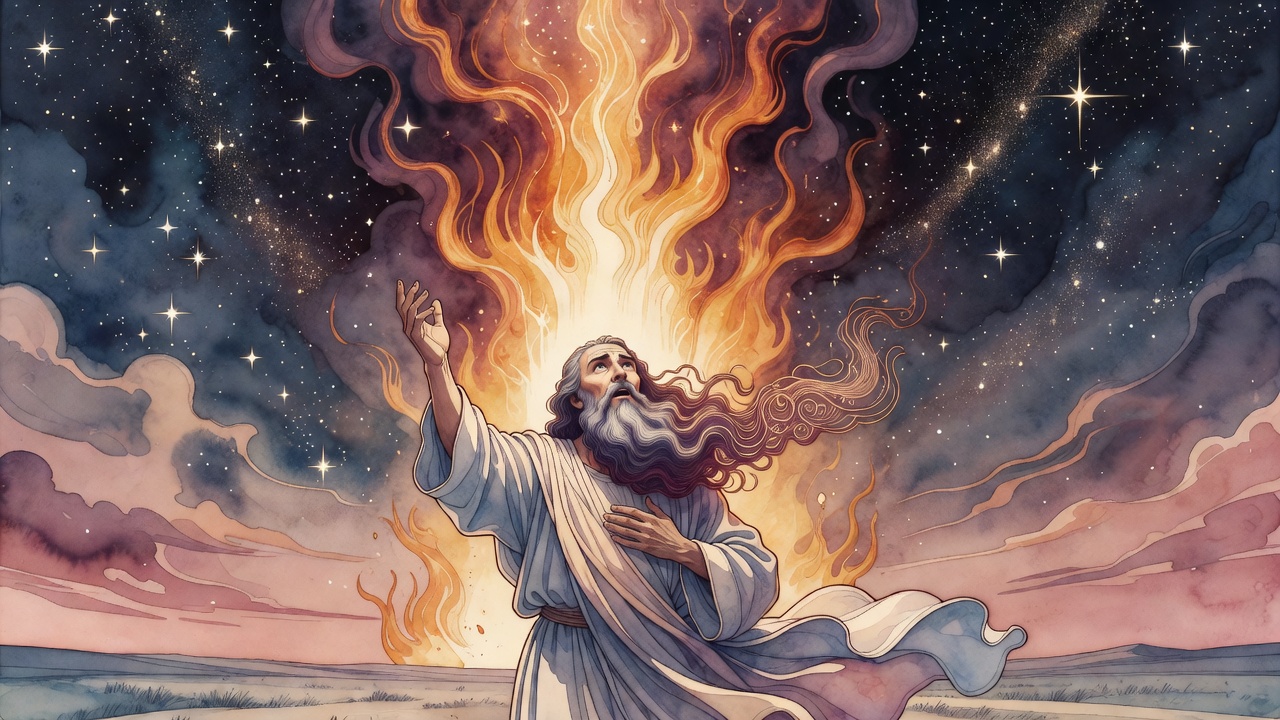
At Horeb the bush burned and held. Moses stripped the shoe of flesh, gripped the staff of covenant, and sang through Hod until the sea split open.

Curated by Arthur · Told by Maggid ·
Table of Contents
  1. The Bush That Would Not Die
  2. The Staff That Was a Sign
  3. Praise Through Hod
  4. What the Flame Demanded
Moses Shed His Shoe-Body at the Burning Bush Click for full size

The Bush That Would Not Die

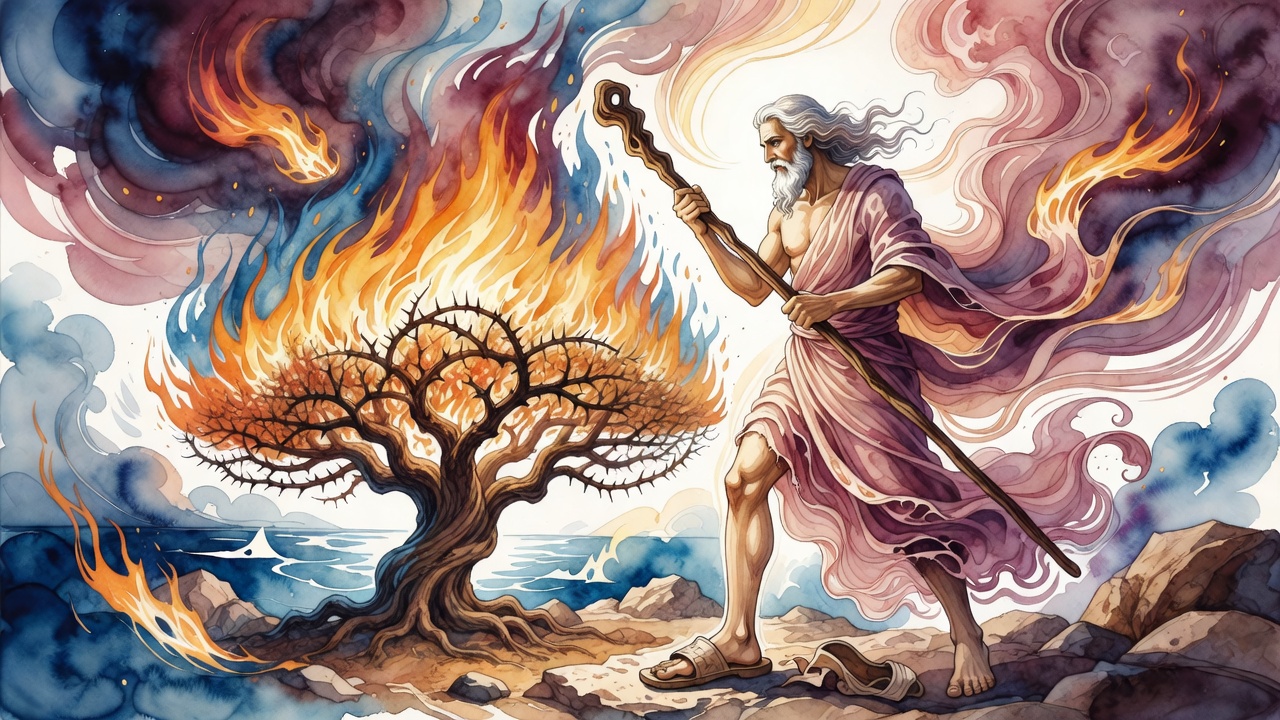
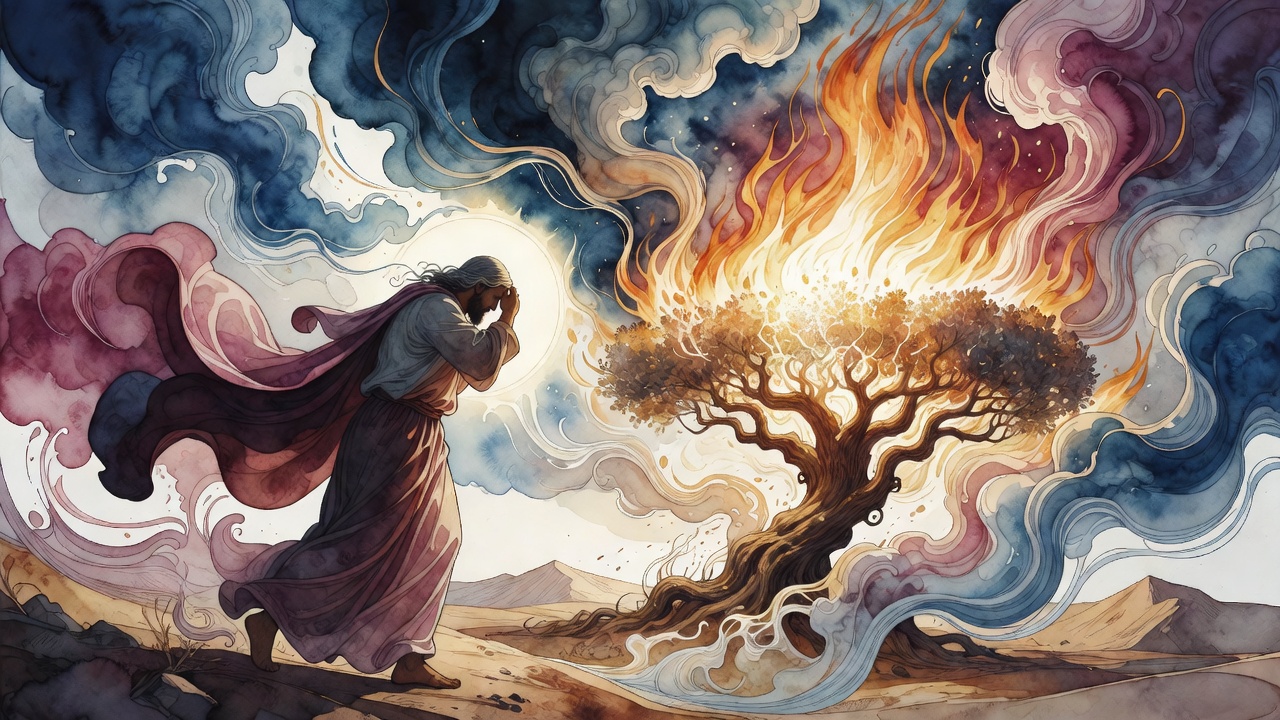
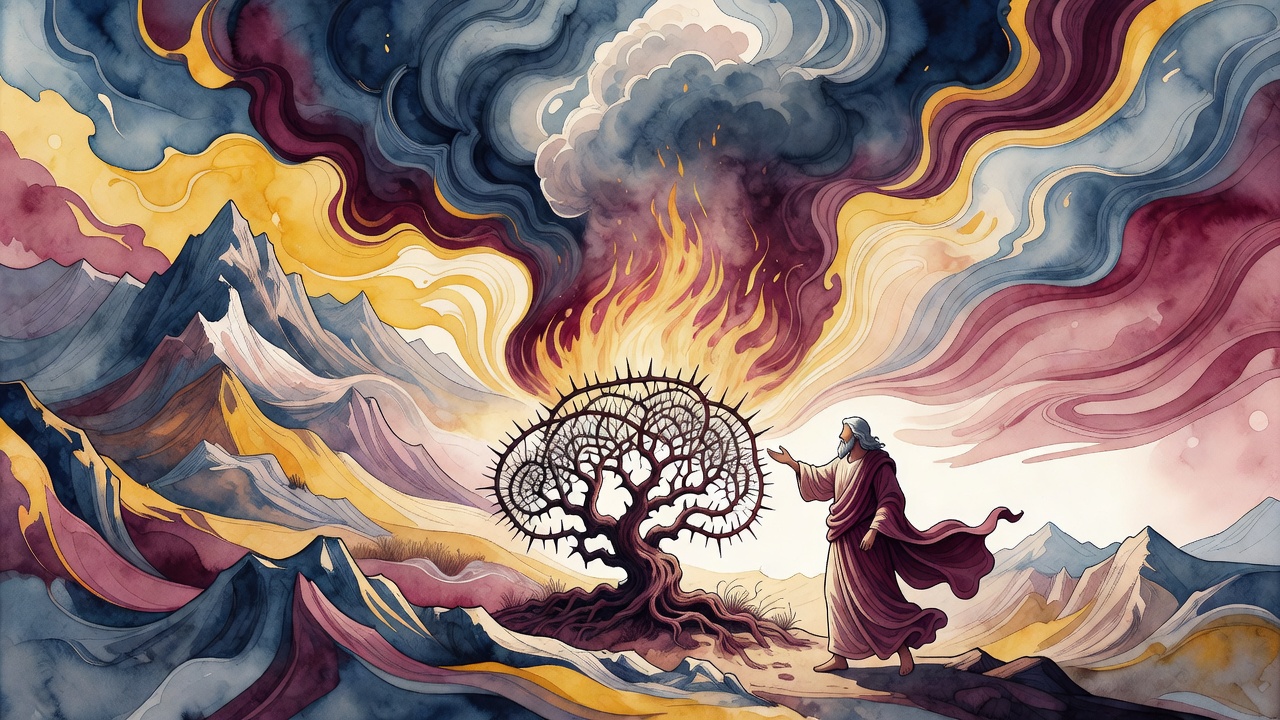
Moses turned aside on the mountain slope because the fire refused to finish its meal. Thorns blackened, then greened again. Heat licked his face and left the branches standing. Goats drifted below him on the rock. He stepped closer until the voice rose from the middle of the flame and told him to stop, then to strip what stood between his feet and the ground.

He bent and pulled the sandals free. Dust pressed into bare skin that had not known holy dirt since Egypt. In that act he felt a heavier shoe loosen too: the body that had kept him safe among Midian flocks, the hide of habit, the weight of a man who still answered to names Pharaoh's house had given him. The voice did not want boots on holy dust. It wanted a prophet light enough to enter.

Some say the shoe was flesh. Some say the shoe was the bond that held him to Zipporah's tent and Jethro's well. Both were true in the same breath. He set the leather aside and stood empty-handed before the bush that ate fire without becoming ash. His heels sank a little. The flock bleated once and went quiet, as if even animals knew the ground had changed its rules.

He did not argue yet. Argument would come later, over speech and signs and the hardness of a king's heart. First came the undressing. First came the admission that a body can be a barrier even when it is healthy and strong.

The Staff That Was a Sign

Later, when the same voice pressed a staff into his palm, the wood was no shepherd's stick. It was a sign of life-force, the covenant mark that knocks at heaven's door and begs, "Open my lips." Masters of that sign pray with eighteen blessings, each one a drop of ḥaiy, life spelled in the count of letters. Bulls and rams and doves of the old offerings folded into speech. Strength and purity rose as words instead of smoke on an altar no one could see.

God told him the staff would be the proof: not a trick for Pharaoh's court alone, but the same sign given at the bush. What burned without consuming now rested in wood that could become a serpent, then a staff again, then a path through water. Moses felt the grain under his thumb and understood that covenant is not a contract on parchment. It is a living channel that must be held upright when the world knocks for speech and finds the door shut.

He practiced the throw in private first. Wood hit dust and writhed. His hand jerked back the way any hand would. When he seized the tail and felt it stiffen into a rod again, sweat ran into his eyes. The sign was not gentle. It demanded a man who had already shed one kind of shoe and was willing to risk his fingers on another kind of fire.

He walked down the mountain with empty sandals tied at his belt and a full staff in his grip. Egypt waited with its own heat: kilns, brick, the sun on bent backs. The bush stayed behind him, still burning in the corner of his sight whenever he blinked.

Praise Through Hod

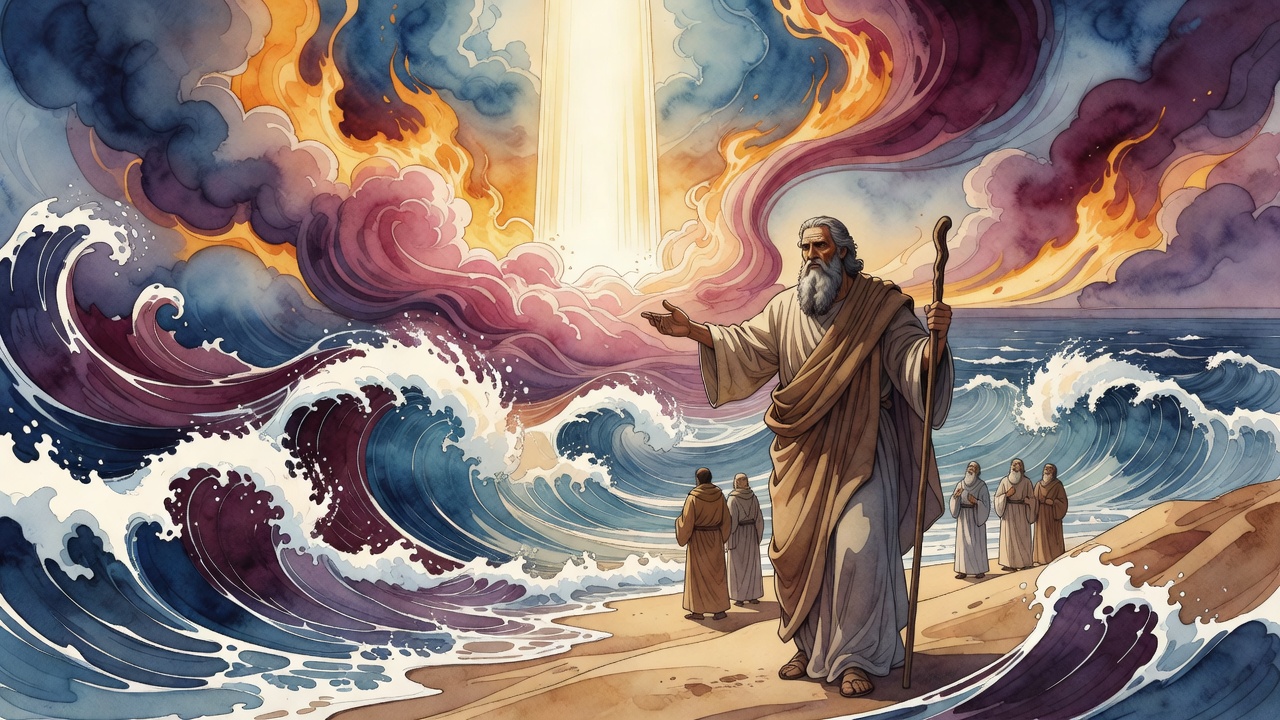
At the sea, when the water stood like walls and the chariots drowned, Moses did not invent a song from nowhere. The attribute called Hod, splendor that bows, opened in him. The word az, "then," left his mouth as the hinge of praise: "Then sang Moses." Hod is the vessel of acknowledgment. Without it, victory stays mute. With it, the rescued throat becomes an instrument tuned to what just happened, not to what the ego wants to claim.

Isaiah later heard the same hinge: then you shall call, and the Name shall answer. Moses learned it first, barefoot on mountain rock, staff in hand, body still half shed of its shoe. He called from humility, not from triumph's swagger. That is why the sea answered with a road dry enough for children and carts.

Miriam took a drum. The women followed. The song widened until the whole camp was Hod for a moment, bowing while still walking. Moses felt the staff in his hand as a continuation of the bush: wood that had been serpent and rod and now was a conductor's baton for a people who had never sung free before.

Hod also ties to the covenant of the eighth day, the sign of Yesod, the righteous channel. Praise and circumcision, song and foundation, met in one man who had stripped himself light enough to carry both without confusing them. He was lawgiver and singer in the same hour. The sea kept the beat with collapsing walls behind the last foot that left the path.

What the Flame Demanded

Pharaoh saw staffs and plagues. Israel saw walls of water. Moses kept seeing the bush: a fire that refused to finish, a command to undress the heavy self, a wood that was also a prayer of life. He never put the shoe back on in the old way. Even when he wore sandals again in the camp, something in him stayed bare against the ground of the command.

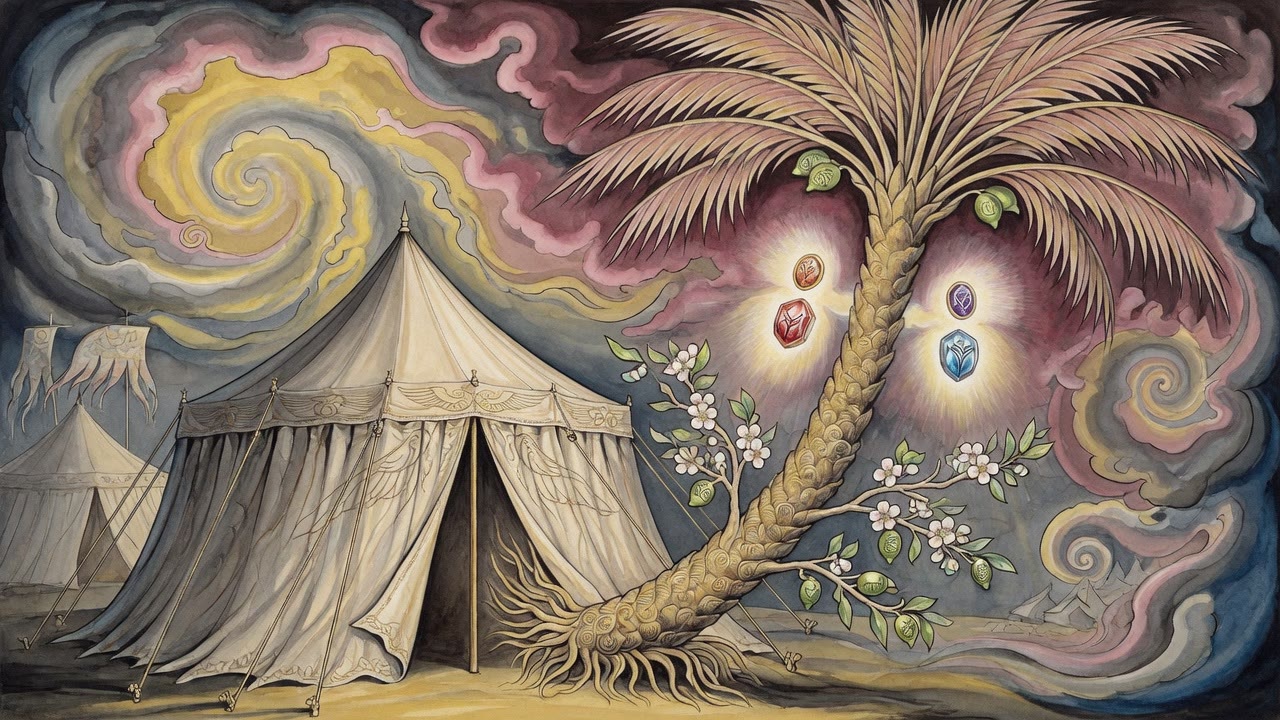
Nights in the wilderness he would wake and feel dust under his heel as if Horeb had followed him. The staff leaned against the tent pole. Outside, the cloud of glory stood or moved according to a schedule he did not set. He had asked to be slow of speech. The bush had not accepted the excuse. Hod had forced song out of him anyway when the moment cracked open.

When the people sang after him, they sang through the same Hod he had opened. When the staff struck rock or sea, it struck as the sign first shown in flame. The mountain still held the print of his bare feet in the story that matters. The bush, for those who know how to turn aside, never finished burning. A man can walk years from Horeb and still smell the thorns that would not die.


← All myths
From the tradition

Sources

3 sources

The texts behind this telling. Some cards carry a translation of the source; others are our own retelling of it, and each card says which. Every card links out to the original.

Tikkunei Zohar 53:9Tikkunei Zohar

Retold in our words. Read the original at the link below.Sefaria-hosted English translation · CC-BY

It all starts with a burning bush. iconic image: Moses, tending his flock, when suddenly...WHOOSH! A bush bursts into flames, yet somehow remains untouched. Intrigued, he approaches. And then, a voice. A voice that changes everything.

Tikkunei (spiritual repair) Zohar, a central text of Kabbalah, offers a fascinating interpretation of this scene. It focuses on the moment when God tells Moses, "Do not approach here, remove your shoes.." (Exodus 3:5). What's up with the shoes?

The Tikkunei Zohar suggests that these "shoes" are more than just footwear. They represent Moses's physical body. His earthly form. The thing that separates him from the pure spiritual realm. It states that Moses needed to "shed his body, which was ‘a shoe’, na’al, relative to the other body, in which he became enclothed when he approached." In other words, to truly connect with God, Moses had to leave behind the limitations of his physical self.

Think of it like this: Imagine trying to swim with heavy boots on. You'd be weighed down, unable to move freely. Similarly, our physical selves, with all their desires and limitations, can sometimes hinder our spiritual journey.

But wait, there's more! The text adds another layer to this symbolic shoe removal. "And there is one who says that the shoe is his wife." Now, that might seem like a non sequitur, but in Jewish tradition, marriage is often seen as a representation of the relationship between the divine and the earthly. Our relationships, particularly our most intimate ones, can both ground us and challenge us to grow. They can be both a support and, at times, a hindrance.

So, what are we to make of this? Are the shoes Moses's physical form? Or is it his relationship? The Tikkunei Zohar answers with a resounding: "And it is all truth: this opinion and that."

It's not an either/or situation. It's a both/and. Both our physical existence and our relationships can act as "shoes" that we need to shed, at least metaphorically, in order to draw closer to the divine.

This isn't about renouncing the world or abandoning our loved ones. It's about recognizing the limitations of the physical and the potential for our relationships to both elevate and constrain us. It's about consciously choosing to shed those limitations, to let go of the things that hold us back, so we can stand on holy ground.

So, what "shoes" are you wearing? What are you holding onto that might be preventing you from experiencing a deeper connection with the divine? Maybe it's time to take them off, one step at a time.

Full source
Tikkunei Zohar 71:2Tikkunei Zohar

Retold in our words. Read the original at the link below.Sefaria-hosted English translation · CC-BY

The Tikkunei (spiritual repair) Zohar, that mystical, poetic expansion of the Zohar, paints a picture of just that scene, a constant stream of souls seeking entry, seeking voice.

It describes beings – we might even think of them as aspects of ourselves – who are "knocking at the entrance," pleading, "ADNY! Open my lips.." (Psalm 51:17). It's a plea for articulation, for the ability to express the deepest longings of the heart. But who are these entities?

The Tikkunei Zohar identifies them as "the masters of 'the sign' of circumcision." Now, this isn't just about a physical act. In Kabbalah, everything holds layers of meaning. Here, circumcision represents a profound connection to the life-force, the ḥaiy, that animates all worlds. It’s about entering into a covenant, a bond of dedication and responsibility.

These "masters of the sign" pray with ḥaiy, with the life-force, offering eighteen blessings in their prayers. Eighteen, a number significant because it spells out the word ḥaiy, life, in Hebrew. These blessings, the Tikkunei Zohar tells us, become an offering to the Holy One, blessed be He.

And what kind of offering? It's likened to the sacrifices described in the Torah: "seven bulls and seven rams" (Numbers 23:1), and "two turtle-doves or two doves" (Leviticus 5:7). These weren't just random animals. Each sacrifice held symbolic weight. The bulls and rams represented power and strength, while the doves symbolized purity and devotion. So, through these eighteen life-infused blessings, the masters are offering the essence of their being: strength, purity, and unwavering dedication.

But it goes even deeper. This "sign," this connection to life, is the very sign God gave to Moses at the burning bush. Remember that moment? God tells Moses, "…‘and this’, ve-zeh is the sign for you…" (Exodus 3:12). Ve-zeh, "and this," is a powerful phrase, pointing to something immediate, tangible, and deeply significant. The Tikkunei Zohar implies that the same divine spark present in that moment of revelation is connected to this "sign," this covenant, this offering of life.

So, what does this all mean for us? Are we, too, standing at that entrance, yearning to speak our truth, to offer our own unique blessings to the world? Are we ready to embrace the "sign," to connect to that life-force that flows through all things? The Tikkunei Zohar invites us to consider the power of our words, the depth of our devotion, and the possibility that every prayer, every act of kindness, can be a sacred offering, evidence of the life that burns within us.

Full source
Tikkunei Zohar 57:1Tikkunei Zohar

Retold in our words. Read the original at the link below.Sefaria-hosted English translation · CC-BY

The Tikkunei (spiritual repair) Zohar, a companion volume to the Zohar, is a deep dive into the mysteries of the Torah, revealing hidden layers of meaning within its words and stories. In Tikkunei Zohar 57, we find a fascinating connection between the word az and the biblical figure of Moses. It was through Hod, one of the sefirot (divine attributes), that Moses offered praise, specifically with the word az. Hod, often associated with splendor, humility, and acknowledgement, was the vessel through which Moses sang, "Az yashir Moshe…," "Then sang Moses…" (Exodus 15:1). The Tikkunei Zohar sees this as more than just a historical detail; it’s a profound insight into the nature of divine communication. The text emphasizes, “It is Hod that He gave to Moses." What does this mean? Perhaps it means Moses was uniquely attuned to this divine attribute, allowing him to connect with God and express his gratitude through inspired song.

The connection doesn't stop there. The verse from Isaiah (58:9), "'Az' Then you shall call, and Ha-Shem shall answer." further illuminates the power of az. It suggests that when we call out to God with sincerity and humility – perhaps embodying the essence of Hod – our prayers will be answered. The word az, in this context, becomes a trigger, a key that unlocks divine responsiveness.

The Tikkunei Zohar then shifts our focus to another significant ritual: circumcision. It connects the eight days of circumcision to the bryt, the covenant, which is linked to Yesod (Foundation). Yesod, often translated as "foundation," is the sefirah (a divine emanation) associated with tzaddik, the "Righteous One of the world." According to Kabbalistic thought, Yesod acts as a conduit, channeling divine energy from the higher realms down to our physical world.

What about the Yod of circumcision? The Yod is the smallest letter in the Hebrew alphabet but holds immense significance, representing the spark of divine energy. It's the tenth of the ten sefirot. The act of circumcision, therefore, becomes a profound act of connection, linking us to the divine source through the covenant and the power of the Yod.

The Tikkunei Zohar invites us to see beyond the surface of words and rituals, to explore the hidden meanings that resonate with the divine. The word az, the sefirot, and the ritual of circumcision, they are all interconnected, revealing pathways to connect with God and deepen our understanding of the universe. It is a reminder that even the smallest details can hold profound spiritual significance, if only we take the time to look, to listen, and to explore the depths of our tradition.

Full source