Parshat Shemot5 min read

God Left Every Mountain for One Thorn Bush

God abandoned the high slopes and settled in a shrub of thorns because Israel was in grief. Moses asked for an oath before he would go down.

Curated by Arthur · Told by Maggid ·
Table of Contents
  1. Not on the Summit
  2. The Oath Moses Required
  3. Feet on Sinai, Body in Heaven
  4. Fire That Refuses to Go Out
God Left Every Mountain for One Thorn Bush Click for full size

Not on the Summit

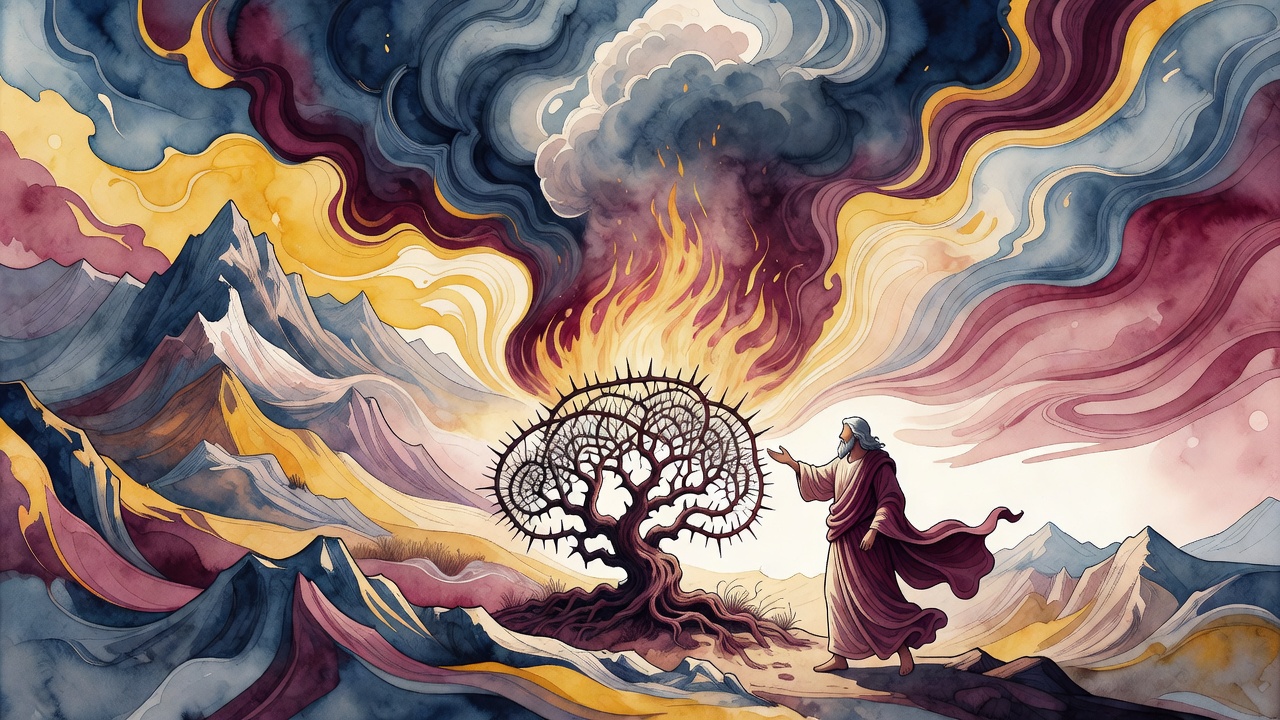
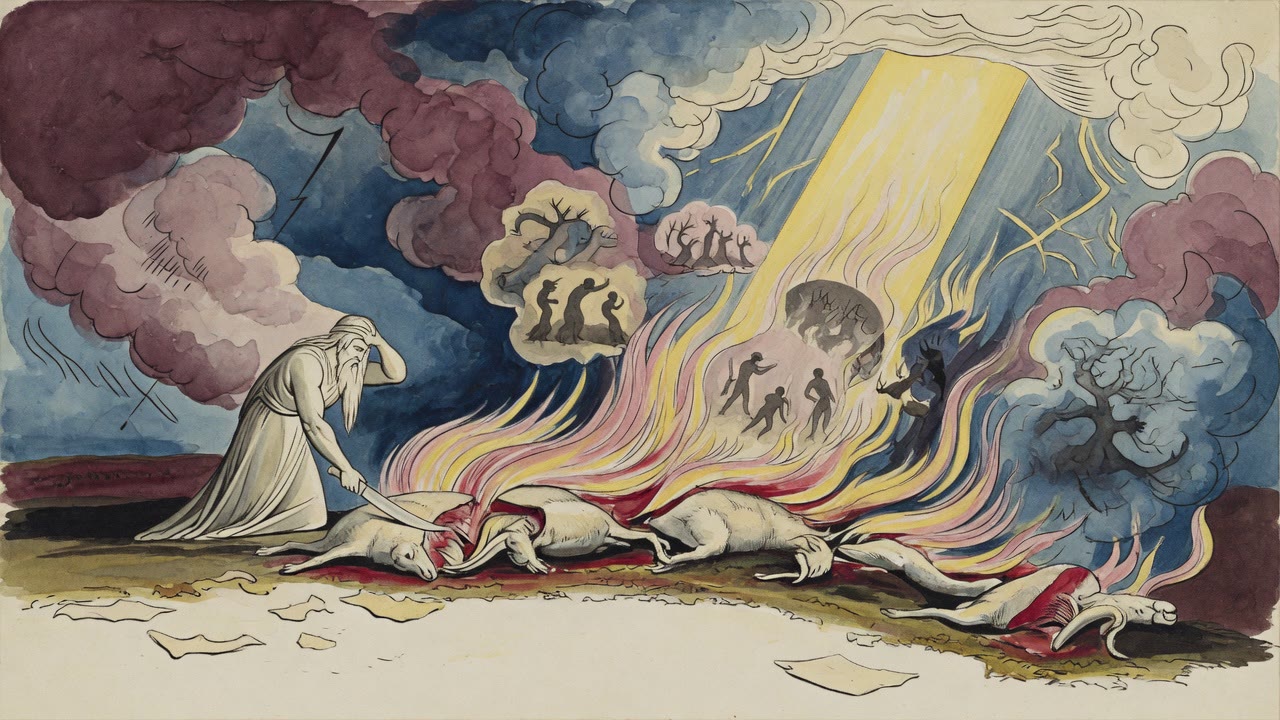
The mountain stood available, high and clean, a place fit for proclamations. The Holy One left it. He descended into a thorn bush, a sneh dense with thorns and thistles, and abode there as if the shrub were a throne. Pirkei de-Rabbi Eliezer asks why abandon the majesty of the slope for a plant that scratches. Because the bush was an emblem of grief and distress, full of thorns, and He saw Israel in great grief in Egypt, and He also dwelt with them. In all their affliction He was afflicted. The revelation to Moses did not begin on a peak of glory meant to impress a prophet. It began in a plant that draws blood from the hand that grips too quickly.

Fire in that bush was Israel itself, the house of Jacob as flame among nations that are thorns and thistles. The fire would not consume the thorns at first. The thorns would try to extinguish the flame of Torah, the words that keep a people burning without turning to ash. Later, the midrash says, the fire would reverse the contest and the peoples would be as burnings of lime. For now the sign was simpler and harder. God keeps company inside the hurt, not above it on a cooler ridge.

The Oath Moses Required

Moses, still a shepherd with a past of flight from Pharaoh's house, did not rush to accept the mission like a man hungry for titles. Sovereign of all the worlds, he said, swear to me that all things I desire to do, Thou wilt do. He wanted a guarantee that promises spoken before Pharaoh would hold in public, so that Moses himself would not die for words that failed in a tyrant's court. God swore, with only two exceptions carved out in advance like stones set at a field's edge. Moses would not enter the land of Canaan, and the day of his death would not be postponed at his request. Even friendship with heaven, face to face as a man speaks to his friend, has borders the friend cannot move.

The bush was already teaching the shape of leadership. Presence in thorns. Power under oath. A man who negotiates terms because he has seen what Egypt does to Hebrew bodies and will not traffic in hope he cannot cash. The rod in his hand would become a serpent before Pharaoh, a sign that the Shepherd's staff carries more than sheep and can swallow the tricks of court magicians. The Shekhinah (God's indwelling presence) that settled in the sneh would walk with a nation through seas and deserts when the mountain stage came later.

Feet on Sinai, Body in Heaven

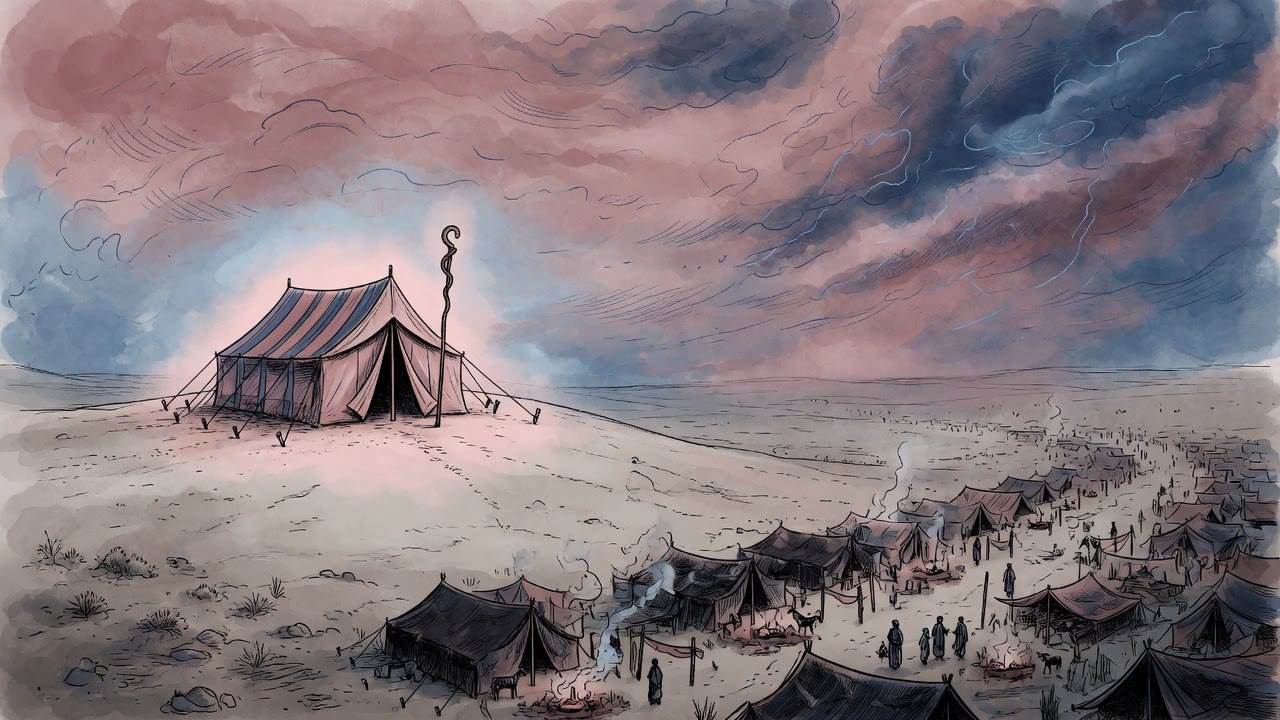
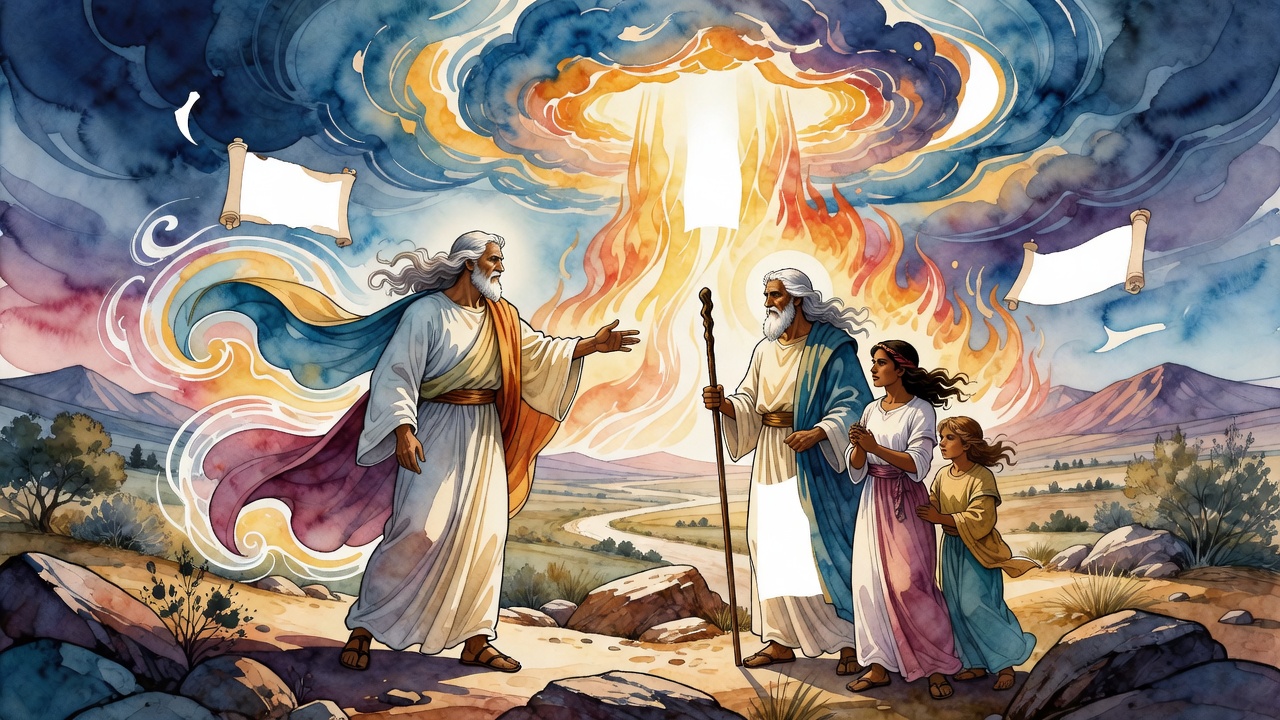
Later, at the mountain of the Torah, Rabbi Joshua pictured Moses with only his feet on the ground, the rest of him filling the space between earth and heaven like a tent stretched across the sky. Those who stand inside a tent have feet on soil and bodies under canvas. So Moses stood, feet on Sinai, self spread through the upper rooms of glory, seeing what the camp below could not survive seeing raw. The Lord spoke to him face to face. The people ate manna, drank from Miriam's well, walked under clouds of glory, and prepared two days in sanctity, bodies already marked by covenant, no uncircumcised among them in that wilderness hour.

Moses had once stood at a bush of pain and asked for an oath. Now he stood as a living span between realms, still the same man, still carrying the memory of thorns into the hour of tablets. The first address was not abstract theology for academies. It was a thorn pricking a prophet until he answered with his whole name.

Fire That Refuses to Go Out

Why show Moses fire in a thorn bush and not in a cedar of Lebanon? Because Israel would live among the nations the way flame lives among briars, pressed, scraped, surrounded, and still not extinguished. The nations would try to put out the words of Torah with water and wind and law. The bush burned and was not consumed. That is the whole political midrash in one image a shepherd could carry home to Midian and then to Egypt. Suffering is not proof of absence. Sometimes it is the address where the Presence chooses to sit when the mountain would be too easy a symbol.

Moses left that place with a name to speak, a staff to cast down, sandals off because the ground near grief is holy, and a vow ringing in his ears. Egypt waited with bricks and blood and a throne that did not know it had already lost an argument started in a shrub. The mountain he would climb later was already implied in the fire that needed no fuel. First he had to learn that God prefers the shrub that hurts to the summit that impresses tourists of the spirit.


← All myths
From the tradition

Sources

4 sources

The texts behind this telling. Some cards carry a translation of the source; others are our own retelling of it, and each card says which. Every card links out to the original.

Pirkei DeRabbi Eliezer 40:1Pirkei DeRabbi Eliezer

Retold in our words. Read the original at the link below.Pirke de Rabbi Eliezer, trans. Rabbi Gerald Friedlander, London (1916) · CC-BY

The answer, my friends, might be more profound than you think.

The text And it offers a really powerful explanation.

In this passage, God's choice of the thorn-bush, the sneh, wasn't arbitrary. It was deeply symbolic. "He abandoned the entire mountain, and descended into the thorn-bush, and He abode therein," the verse says. Why abandon the majestic mountain for a prickly shrub?

Because, it continues, "the thorn-bush was (an emblem of) grief and distress, and it was full of thorns and thistles."

Think about what that means. The thorn-bush represents suffering. It embodies the pain and hardship of the Israelite people in Egypt. It’s a symbol of their oppression.

And where does God choose to reveal Himself? Not in a place of power or glory, but right in the thick of that suffering. "Why did He abide in the midst of the thorn-bush which was (an emblem of) grief and distress?" the text asks. The answer? "Because He saw Israel in great grief and He also dwelt with them."

God doesn't just observe suffering from afar. God doesn't send help from a distance, remaining untouched. Instead, God actively dwells within it. As it says in (Isaiah 63:9), a verse quoted in Pirkei DeRabbi Eliezer to emphasize this point, "In all their affliction He was afflicted."

This idea. God's presence in suffering, is a recurring theme throughout Jewish thought. We see it echoed in the concept of the Shekhinah, the Divine Presence, accompanying the Israelites in their wanderings, even in exile. The Shekhinah, in Kabbalistic thought, is often associated with the feminine aspect of God, embodying compassion and empathy. The Zohar, the foundational text of Kabbalah, expands on this idea, depicting the Divine as intimately connected to the suffering of the world.

And, as Louis Ginzberg recounts in his monumental work, Legends of the Jews, the details surrounding the burning bush are filled with layers of meaning designed to illustrate God's deep concern for His people.

Remember that, according to this ancient text, you are not alone. The Divine is not distant, but present, dwelling with you, even in the midst of the thorns.

Full source
Pirkei DeRabbi Eliezer 40:9Pirkei DeRabbi Eliezer

Retold in our words. Read the original at the link below.Pirke de Rabbi Eliezer, trans. Rabbi Gerald Friedlander, London (1916) · CC-BY

It's a symbol, layered with meaning, hinting at the complex relationship between Israel and the world. fire and thorns. Not exactly a match made in heaven. Pirkei DeRabbi Eliezer, a fascinating early medieval text, dives deep into this very image. It asks a profound question: Why show Moses fire in a thorn bush?

The answer, according to this ancient wisdom, is many-sided. The fire, it says, represents Israel. Remember the prophecy in Obadiah 18: "And the house of Jacob shall be a fire"? That potent image is brought to bear here. Israel, a people with a burning passion for justice, for God, for life itself.

The thorn bush? That's the nations of the world. Rough, prickly, sometimes even dangerous. Think of the thorns and thistles mentioned elsewhere in scripture.

The text continues with a powerful, if sobering, observation. God showed Moses the burning bush to illustrate Israel's place among the nations. "Likewise," God says, "shall Israel be in the midst of the nations."

But here’s the twist: the fire of Israel will not consume the nations. Isn’t that surprising? Instead, the nations – the "thorns and thistles" – will try to extinguish the flames of Israel. And what are those flames? The words of the Torah, the very essence of Jewish faith and practice.

Ouch. It’s a stark reminder of the challenges faced by the Jewish people throughout history, the constant struggle to maintain their identity and traditions in the face of external pressures.

But the story doesn't end there. Pirkei DeRabbi Eliezer offers a glimmer of hope, a vision of the future. It says that in the time to come, the fire of Israel will consume all the nations, who are compared to thorns and thistles. This is tied to (Isaiah 33:12): "And the peoples shall be as the burnings of lime."

What does it all mean? Is it a prophecy of destruction? Perhaps. But maybe, just maybe, it's a metaphor for the ultimate triumph of truth and justice. Perhaps it suggests that the values embodied in the Torah, the fire of Israel, will eventually transform the world, burning away the negativity and hate represented by the thorns.

The burning bush, then, isn't just a symbol of divine revelation. It's a symbol of resilience, of struggle, and ultimately, of hope. It's a reminder that even in the most unlikely of places, even surrounded by thorns, the fire of the human spirit can endure…and even illuminate the world. What do you think?

Full source
Pirkei DeRabbi Eliezer 45:1Pirkei DeRabbi Eliezer

Retold in our words. Read the original at the link below.Pirke de Rabbi Eliezer, trans. Rabbi Gerald Friedlander, London (1916) · CC-BY

Pirkei DeRabbi Eliezer turns to The Burning Bush of Israelites.

The narrative begins, surprisingly, not with the Israelites' impatience, but with MOSES himself. When God first appeared to Moses in the burning bush, preparing to send him to Egypt, Moses, ever the cautious leader, makes a bold request. He essentially asks God for a guarantee, a kind of divine contract. "Sovereign of all the worlds!" Moses pleads, "Swear to me that all things which I desire to do, Thou wilt do." He wants assurance that whatever he promises Pharaoh will come to pass, preventing any deadly consequences for himself. Moses, the future lawgiver, is negotiating terms with the Almighty! And God, in His infinite wisdom, agrees. He swears an oath, as (Isaiah 45:23) tells us: "By myself have I sworn, saith the Lord, the word is gone forth from my mouth in righteousness." God promises to fulfill Moses' desires, with only two exceptions: allowing Moses to enter the land of Canaan and postponing the day of his death. Quite a deal. But Fast forward to the giving of the Ten Commandments at Mount Sinai. The Israelites, overwhelmed by the experience, are left waiting for Moses' return. And after only forty days, their faith wavers, their fear takes over. They turn to AARON.

"The Egyptians," they complain, "were carrying their god, and they were singing and uttering hymns before it, and they saw it before them. Make unto us a god like the gods of the Egyptians, and let us see it before us." As (Exodus 32:1) plainly states, "Up, make us a god."

Pause for a moment and consider the parallels. Moses sought assurance, a tangible guarantee of God's power. The Israelites, witnessing divine revelation, still craved a visible, understandable symbol of that power. Were they so different?

Pirkei DeRabbi Eliezer doesn't explicitly draw this comparison, but it invites us to ponder the human need for something concrete, something we can grasp. The Israelites’ request for a golden calf wasn't just about idolatry; it was about a yearning for a visible representation of the divine, a desire to replicate the familiar religious practices they'd witnessed in Egypt. They wanted a god "before them," a tangible presence.

It’s easy to condemn their actions, to see them as a complete betrayal of God's covenant. But perhaps, in their fear and confusion, they were also expressing a very human longing for connection, for a sense of security in the face of the unknown.

What does this story, as presented in Pirkei DeRabbi Eliezer, ultimately tell us? Maybe it's a reminder that even in moments of divine revelation, our human desires and weaknesses persist. Maybe it's a call for empathy, urging us to understand the motivations behind even the most egregious mistakes. Or perhaps, it's evidence of God's unwavering patience, His willingness to work with flawed humans, even after they break their promises. The story of the Golden Calf, it seems, is far more nuanced than we often realize.

Full source
Pirkei DeRabbi Eliezer 41:8Pirkei DeRabbi Eliezer

Retold in our words. Read the original at the link below.Pirke de Rabbi Eliezer, trans. Rabbi Gerald Friedlander, London (1916) · CC-BY

He paints a picture, a truly awe-inspiring one, of Moses standing on the mountain. But here's the thing: only his feet were actually on the ground. The rest of him? According to Rabbi Joshua, he filled the heavens, like a tent stretched out across the sky.

That for a moment.

He uses the analogy of a tent. We stand inside a tent, our feet on the earth, but the whole of us is within its shelter. So too, with Moses. His feet were planted on Sinai, but the rest of him was soaring in the heavens, witnessing everything. He was seeing things we can only dream of.

It wasn't just a one-way street. The Pirkei DeRabbi Eliezer tells us that the Holy One, blessed be He, spoke to Moses as one friend speaks to another. As it is said in (Exodus 33:11), "And the Lord spoke unto Moses face to face." It’s an incredible image of intimacy and connection.

Then, God instructs Moses to sanctify the Israelites for two days, preparing them for the momentous occasion. "And the Lord said unto Moses, Go unto the people, and sanctify them to-day and to-morrow" (Ex. 19:10). But what did this sanctification, this kiddush, actually involve in the wilderness?

The text reminds us of the unique state the Israelites were in. There were no uncircumcised among them, signaling a physical commitment to the covenant. Manna, that miraculous bread, fell from the sky to nourish them. They drank from Miriam's Well, a source of constant sustenance. And clouds of glory, ananei hakavod, surrounded them, offering protection and Divine presence.

But Rabbi Joshua goes deeper. He suggests that the true sanctity of Israel in the wilderness was their abstinence from sexual relations. This act of self-control, of focusing their energies purely on the spiritual, was perhaps the ultimate preparation for receiving the Torah. It was about creating a space, both physically and spiritually, to connect with the Divine.

What does it mean to truly sanctify ourselves, to prepare ourselves to receive the blessings that are waiting for us? Perhaps it's not about filling the heavens like Moses, but about opening our hearts and minds to the possibility of connection, of seeing the Divine in the everyday.

Full source