6 min read

Moses Stood on the Hill and Merit Fought Amalek

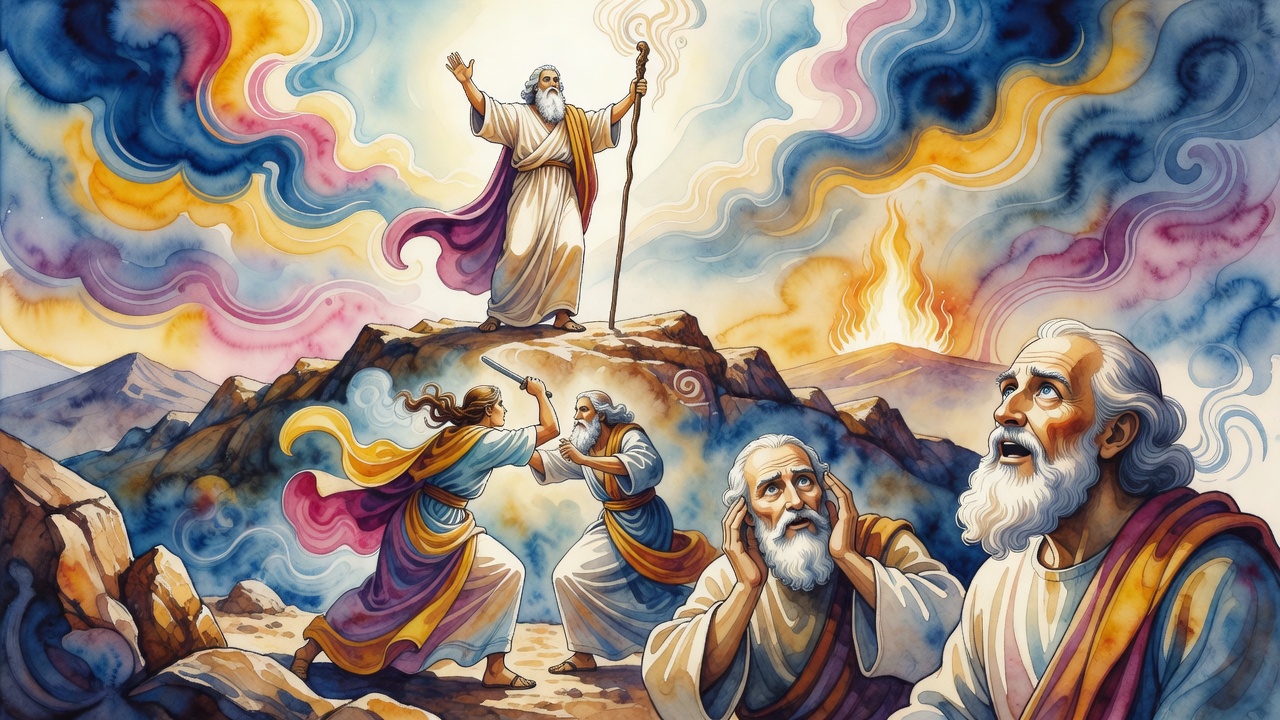
At Refidim, Amalek struck and Moses promised the hill. One sage heard tactics; another heard Abraham, Isaac, and Jacob fighting in the staff.

Curated by Arthur · Told by Maggid ·
Table of Contents
  1. The Night After the Water
  2. What Joshua Heard
  3. What Moses Meant
  4. Arms Until Sunset
  5. Who Wrote the Name Into the Ground
  6. The Empty Table
Moses Stood on the Hill and Merit Fought Amalek Click for full size

The Night After the Water

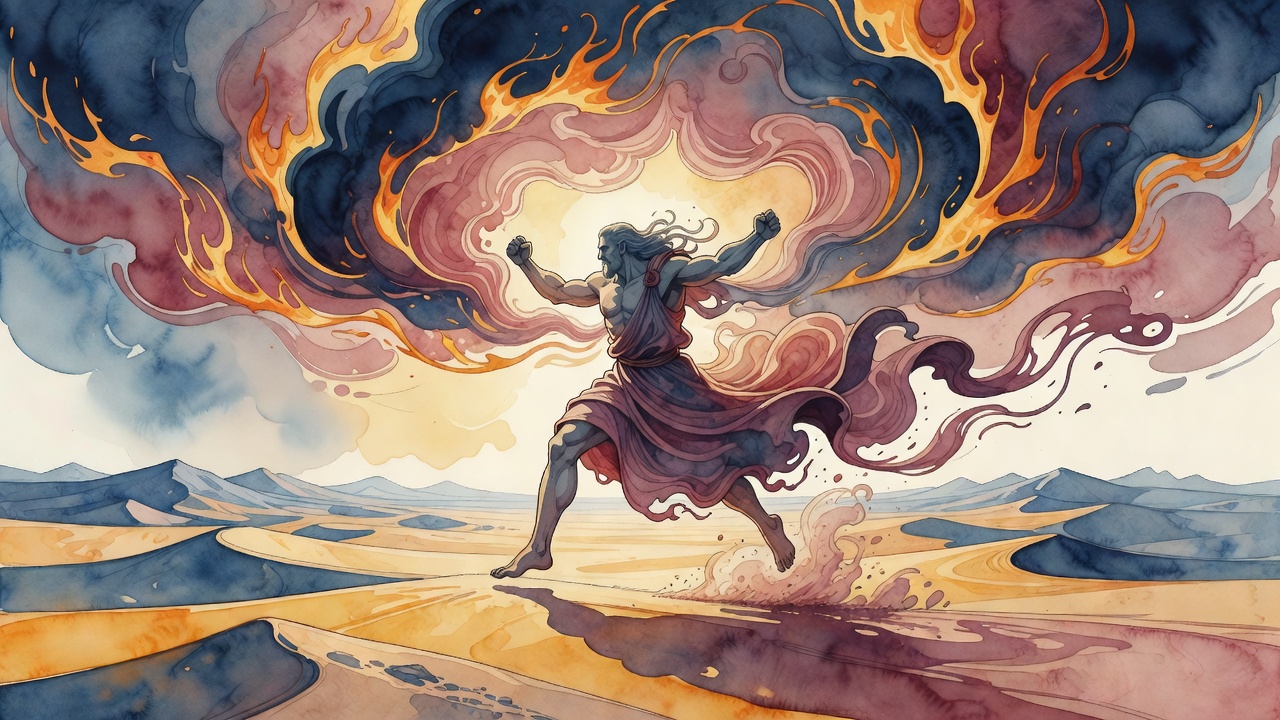
Refidim had no water in it, so the camp had turned on Moses over the shortage and asked the question out loud: is the LORD among us, or not. He struck a rock in front of the elders and the water came, but the question stayed in the air where everyone could hear it. Then Amalek came up on the tail of the column and cut down the ones walking slowest, the tired and the sick and the children who could not keep the pace, and did it without any fear of God at all.

That evening Moses told Joshua to pick out men and go fight in the morning. Then he added the sentence the whole day would turn on. "Tomorrow I shall stand on top of the hill with the staff of God in my hand" (Exodus 17:9).

What Joshua Heard

Joshua heard a commander making him a promise. Tomorrow we will be with you, up on the height where the line can see us, the staff held where a man swinging a blade can glance up and find it. An army that can see its leader keeps its shape; an army that cannot see him comes apart from the middle. He went to choose his men with a picture in his head of a silhouette on the ridge and a rod against the sky, and he slept the way a general sleeps when he knows where his rallying point will be.

What Moses Meant

Moses meant something else by tomorrow. He meant they would proclaim a fast.

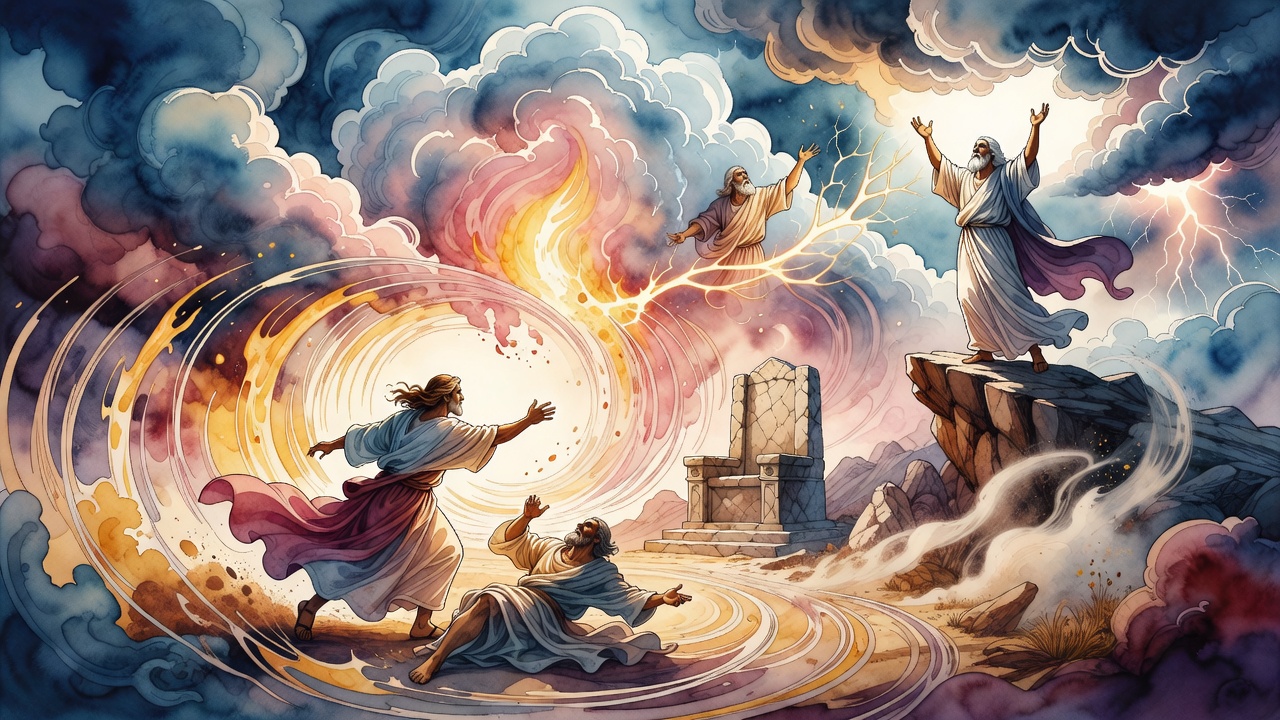
By standing on the hill he did not mean being visible. He meant putting their weight on the deeds of the fathers, so the staff in his hand was not a banner, and the wood was not the point; what he was carrying up that slope was the merit of Abraham, Isaac, and Jacob, three men who could no longer be summoned to say anything on Israel's behalf. Joshua had asked for a signal and was being handed three dead men and an empty stomach. Amalek did not fear God, though he had every reason to, and a people who had just asked out loud whether God was with them were going to answer that question with their own arms in the morning.

Arms Until Sunset

The fighting started early and settled into an ugly arithmetic. While the hand was up, Israel pushed forward; when the hand came down, Amalek came back over the same ground. Nobody in the valley could see the fathers in the wood. They could see a man on a ridge whose arms were failing.

Moses' hands got heavy. That is all the record says about the worst part of it, that they got heavy, and it does not take long standing with both arms over your head before the shoulders start to burn and the elbows drift and the whole thing becomes a matter of will and then stops being a matter of will at all. Aaron and Hur put a stone under him and sat him on it. Then one of them took the right arm and the other took the left, and they held him up like that, one on each side, and his hands stayed steady until the sun went down.

Who Wrote the Name Into the Ground

The place already had two names from the quarrel over the water. Massah, testing. Merivah, strife. Moses could have hung those on the spot himself, branding a campsite with what his own people had done there, and one reading of the verse says he did exactly that.

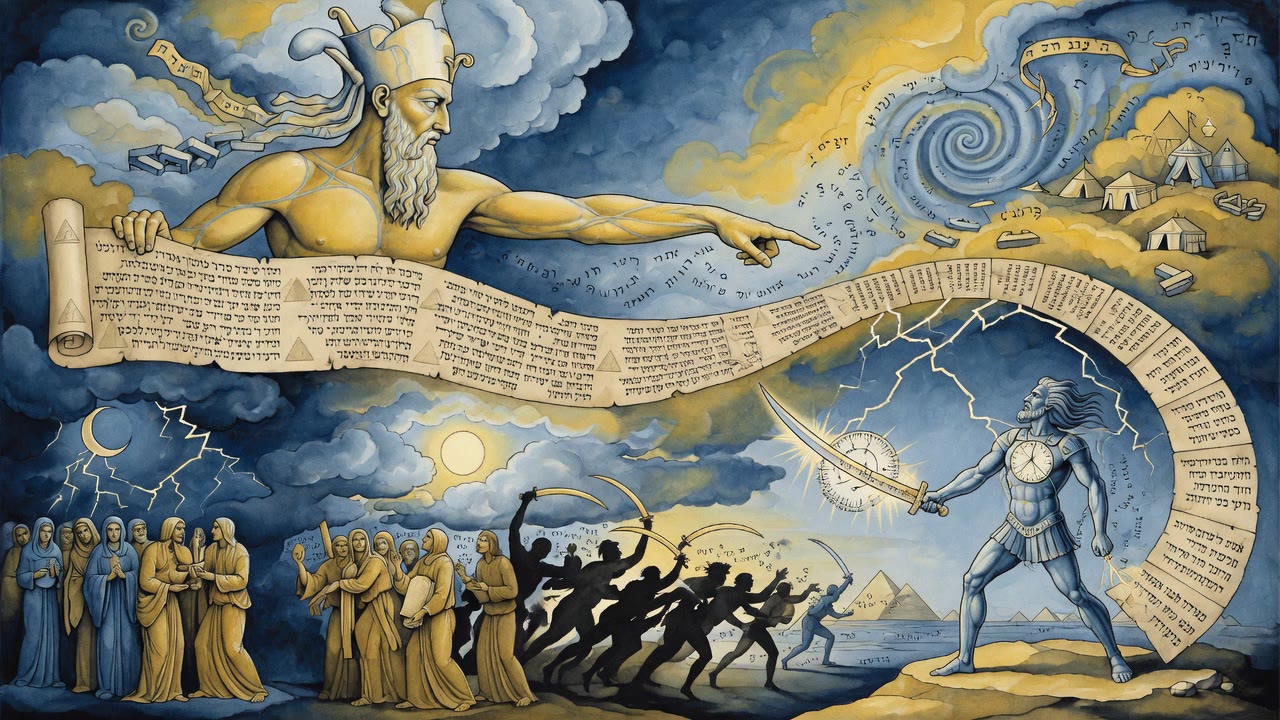
Read it the other way and it was not Moses who named it. It was the Makom, the Place, which is one of the names of God, because the world does not hold Him, He holds the world. On that reading the shame in the map was not carved by the man who was embarrassed by it. It was carved by the one who contains the ground it was carved into, which means no later generation gets to scrub it out, and it also means the title stands: the Holy One is called Makom.

The Empty Table

Remember is the word for the Sabbath and remember is the word for Amalek, which looks at first like the two of them being weighed the same. A king made a banquet and called his guests in. While the tray came through the door loaded with everything good he said, "I call to mind my friend so-and-so." When the tray had been cleared and was going back out empty he said, "I call to mind my enemy so-and-so." His friends asked him how he could name the two of them in one evening. He said the first was named over a full tray and the second over an empty one.

The Sabbath gets remembered over food and drink and clean clothes. Amalek gets remembered over a cleared table, and the remembering runs until the memory is blotted out from under heaven, which has not happened yet.

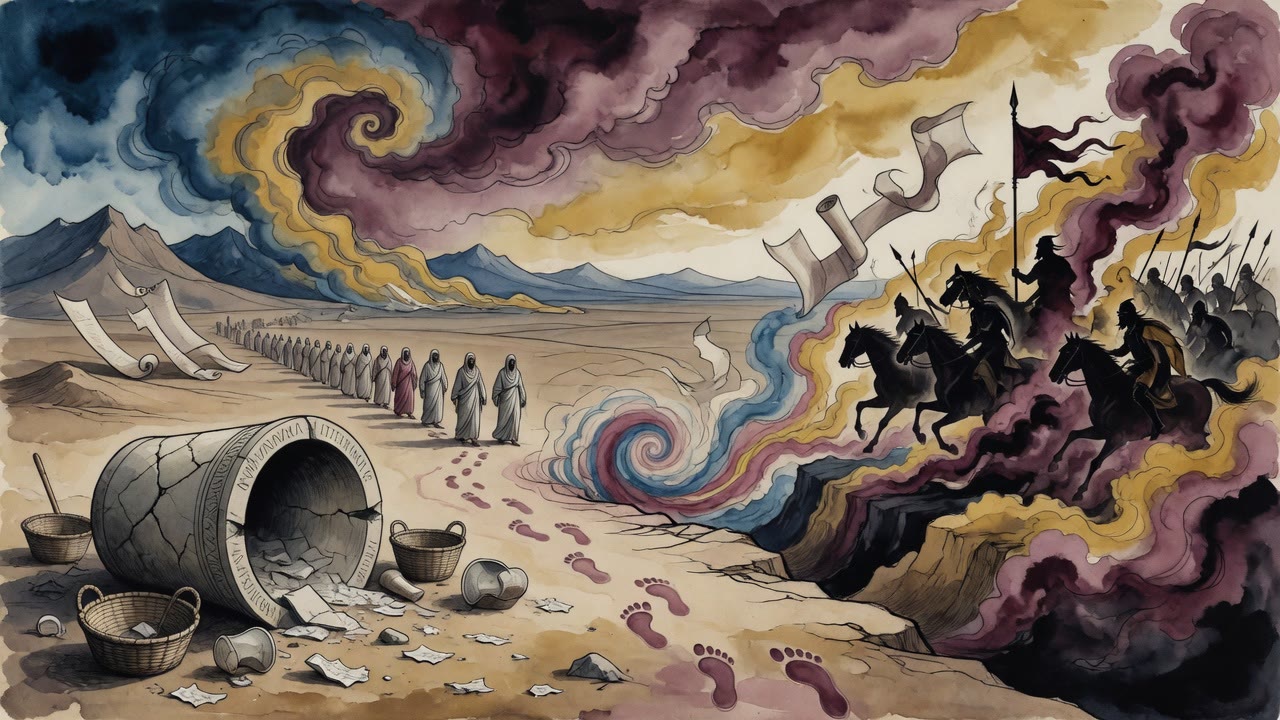
They broke camp at Refidim in the state a beating leaves a people in, and the record says they came into the desert of Sinai the same way they left, penitent both times. So they carried a place-name meaning quarrel with them to the foot of the mountain and set it down there, and stood in front of it, and waited.


← All myths
From the tradition

Sources

4 sources

The texts behind this telling. Some cards carry a translation of the source; others are our own retelling of it, and each card says which. Every card links out to the original.

Mekhilta Tractate Amalek 1:20Mekhilta DeRabbi Yishmael

Retold in our words. Read the original at the link below.Mechilta, translated by Rabbi Shraga Silverstein · CC-BY

Before the battle against Amalek, Moses made a declaration: "Tomorrow I shall stand on top of the hill with the staff of God in my hand" (Exodus 17:9). But what did he mean by "tomorrow"? And what did standing on the hill accomplish? Two sages offer very different explanations.

Rabbi Yehoshua reads the statement straightforwardly. Moses was making a military promise to Joshua, who would lead the troops: "Tomorrow we will be with you, standing on top of the hill." Moses would take up a visible position on the heights where the army could see him, staff raised, rallying the soldiers by his presence. It was a commander's pledge to his general, I will be there, watching over the battle.

Rabbi Eliezer Hamodai hears something entirely different. "Tomorrow" did not refer to the battle at all. It meant: "Tomorrow we will decree a fast." Moses was announcing a day of repentance, not a day of fighting. And "standing on the hill" meant: "We will put our trust in the deeds of the fathers."

On this reading, the real battle happened not on the field but in prayer. The weapon was not Joshua's sword but the accumulated merit of Abraham, Isaac, and Jacob. Moses was not positioning himself for a tactical advantage, he was invoking ancestral righteousness. Two interpretations, two models of warfare: one relies on visible leadership, the other on invisible faith.

Full source
Mekhilta Tractate Vayassa 7:18Mekhilta DeRabbi Yishmael

Retold in our words. Read the original at the link below.Mechilta, translated by Rabbi Shraga Silverstein · CC-BY

After the crisis at the rock, the place received two names: Massah, meaning "testing," and Merivah, meaning "quarreling" (Exodus 17:7). But who gave it those names? The Mekhilta records a debate between two sages that reveals a deeper theological question.

Rabbi Yehoshua says Moses named the place. The verse reads, "And he called the name of the place Massah and Merivah." The "he" is Moses, who memorialized the people's failure by branding the location with the evidence of their sin. A human leader named a place after human weakness.

Rabbi Elazar Hamodai disagrees entirely. He reads the verse differently: "And He, the Makom, called it Massah and Merivah." The word "Makom" literally means "the Place," but it is also one of the names of God in rabbinic tradition. God Himself is called "the Place" because He is the place of the world, the world does not contain Him; He contains the world.

On this reading, it was God who named the location, not Moses. And the Mekhilta draws a remarkable conclusion from the wordplay: "Whence it is seen that the Holy One Blessed be He is called Makom." A dispute about who named a desert campsite becomes proof of one of God's most profound titles, the One who is the Place of all existence.

Full source
Midrash Tanchuma, Ki Teitzei 7Midrash Tanchuma

Retold in our words. Read the original at the link below.Townsend 1989 translation of Midrash Tanhuma, S. Buber Recension · CC-BY

Remember that which [Amalek] did to you, etc. (Deuteronomy 25:17): Here it is written, "Remember," and with Shabbat (the Sabbath) it is written, "Remember." Both of them are equal. Shlomo said (Ecclesiastes 2:15-16), "So I reflected: 'The fate of the fool is also destined for me; to what advantage, then, have I been wise?'... Because the wise man is never remembered as the fool." Even though it is written about Shabbat, "Remember," and about Amalek, "Remember," they are not equal. Shlomo said, "The fate of the fool is also destined for me." There is a [relevant] parable [about this]. To what is the matter comparable?To a king that made a banquet and invited guests. The tray entered in front of him, full of all good things. He said, "I mention (remember) my friend x." When the tray was cleared, he said, "I mention (remember) my enemy y." His friends said to him, "You mentioned this one and you mentioned that one [alike]?" He said to them, "This one I mentioned over a tray full of all good things and that one I mentioned over an empty tray." So [too], about the Shabbat it is written (Exodus 20:8), "Remember the Shabbat, to sanctify it," and to honor it with food, drink and clean clothing. But with Amalek it is written, "Remember that which Amalek did to you." Upon what do you remember it? Upon an empty table, as it is stated (Deuteronomy 25:19), "you shall blot out the memory of Amalek from under heaven."

Full source
Mekhilta Tractate Bachodesh 1:11Mekhilta DeRabbi Yishmael

Retold in our words. Read the original at the link below.Mechilta, translated by Rabbi Shraga Silverstein · CC-BY

The Torah records that the Israelites "journeyed from Refidim and came to the desert of Sinai" (Exodus 19:2). But the Mekhilta notices a problem. The previous verse already stated "they came to the desert of Sinai." Why repeat it? If we already know they arrived, why tell us again?

The answer lies in a fundamental principle of rabbinic interpretation: when the Torah seems to repeat itself, it is teaching something new. The second mention is not redundant. It creates a comparison. Their journeying from Refidim is being likened to their coming to the desert of Sinai. Just as the latter was in a state of repentance, so too was the former.

This is a remarkable claim about the inner life of the Israelite nation. Refidim was the place where the people had quarreled with Moses over the lack of water, where they had tested God by asking "Is the Lord among us or not?" (Exodus 17:7). It was also where Amalek attacked. And the rabbis taught that Amalek's assault was a direct consequence of Israel's doubt. Refidim was a place of spiritual failure.

By the time they left Refidim, something had changed. The people had repented. And when they arrived at Sinai, where they would receive the Torah, they arrived in that same state of repentance. The journey between the two locations was not merely physical. It was spiritual. They departed as penitents and arrived as penitents, ready to stand before God and accept His covenant.

Full source