Parshat Beshalach5 min read

My Dove Sang Between the Sea and the Army

Trapped between Egypt and the deep, Israel became the dove in the clefts. God asked for her voice, then the sea split and song rose.

Curated by Arthur · Told by Maggid ·
Table of Contents
  1. Clefts of Water and Rock
  2. The Voice Before the Path
  3. Bundle of Myrrh
  4. Scent After Song
  5. From Shore to Altar
My Dove Sang Between the Sea and the Army Click for full size

Clefts of Water and Rock

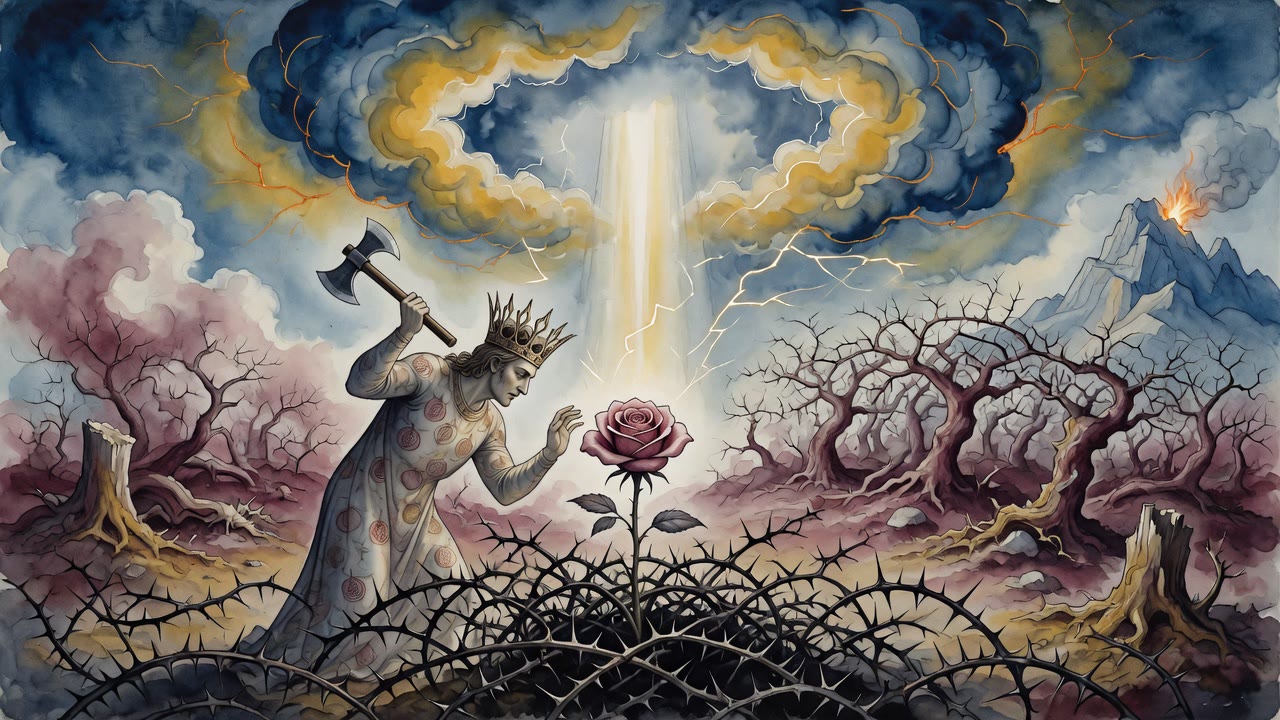
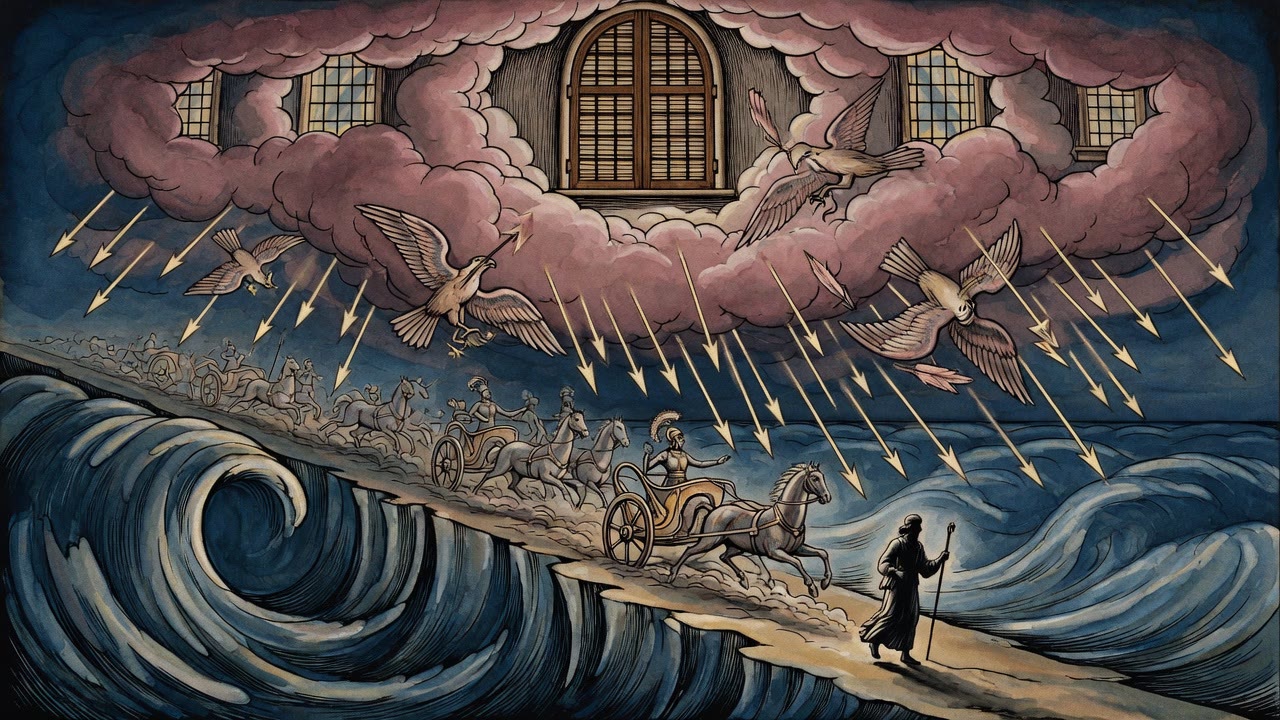
The army filled the rear. The sea filled the front. Israel stood shadowed in the recesses, in danger of being flushed into the deep and destroyed. Rabbi Elazar heard Song of Songs open over that trap: my dove, in the clefts of the rock (Song of Songs 2:14).

A dove does not look like a nation with carts and children. On that strip of shore the nation looked exactly like a dove: small, pressed, searching for a crack that was not death.
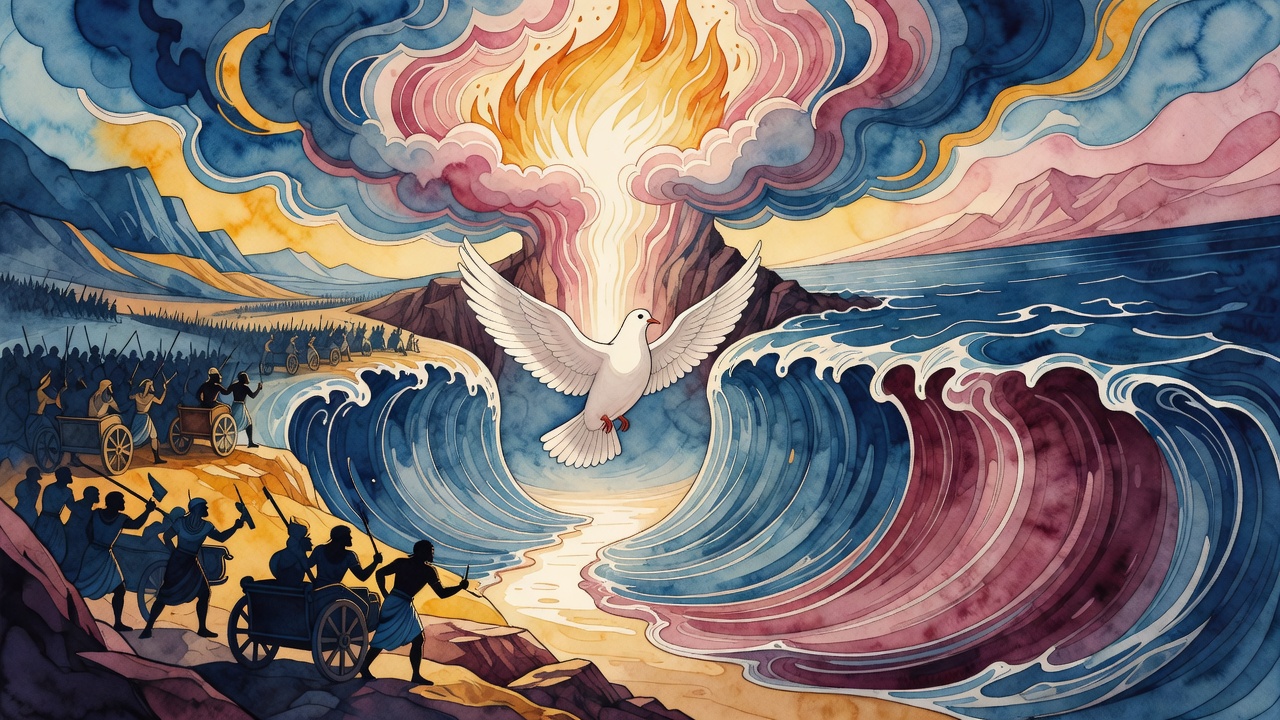
God did not only open water. First He asked for appearance and voice. Show me your appearance. Let me hear your voice. Stand and see the salvation of the Lord, Moses had cried (Exodus 14:13). Seeing was not enough. Heaven wanted sound from the pressed birds before the walls of water rose.

The Voice Before the Path

"Let me hear your voice" becomes the song they will sing after the crossing, pulled forward into the moment of panic. Faith is demanded while chariot wheels still grind sand. The dove must coo while the hawk is still diving.

Some wanted to throw themselves into the sea. Some wanted to return to Egypt. Some wanted to fight. The Song reading gathers them into one address: dove, not factions. One Beloved speaking to one flock in a rock's crack between two deaths.

Then the sea split. Then the song that had been requested in terror became the song performed in dry mud. Cause and effect run backward and forward at once. Heaven heard the voice it asked for across the water that had not yet opened.

Bundle of Myrrh

Later, in a Temple that remembered the same Beloved, Rabbi Yochanan read another line of the Song over incense: a bundle of myrrh is my beloved to me, that lies between my breasts. A cluster of henna in the vineyards of Ein Gedi (Song of Songs 1:14).

The house of Avtinas kept the craft of the sacred incense. Master perfumers of the priestly line, they mixed the eleven spices until smoke rose as a direct line upward. The Mishnah in Shekalim marks their office. Exodus had already listed stacte, onycha, galbanum, and pure frankincense under Moses' hand (Exodus 30:34).

Love poem becomes recipe. Recipe becomes presence. The Beloved who asked for a dove's voice at the sea now receives a scent carefully guarded by a family that would not share every secret of the blend.

Scent After Song

At the sea the proof was sound. In the Temple the proof was smell. Both are intimate. Both refuse spectacle that costs the people nothing. A song from a trapped throat. Smoke from hands that know exact weights.

Egypt's army could not answer a dove. The nations could not copy Avtinas' measure. The Holy One keeps asking for something only the pressed beloved can give: voice under pressure, fragrance under law. Salvation opens a path. Worship keeps a path warm after the army has drowned.

Children who never saw the sea still smell the incense and hear the Song's dove. Memory travels by nose and ear when eyes grow tired of reading plagues.

From Shore to Altar

My dove, in the clefts. My beloved, a bundle of myrrh. The same Song holds panic and perfume. Israel sings between water and spears, then later lifts smoke between curtains of blue and purple. The Beloved who demanded appearance and voice receives both across centuries of the same courtship.

Walls of water stand like rock clefts. Smoke stands like a ladder. Between them the people learn they are not only rescued. They are addressed, requested, answered, and scented into ongoing nearness.

The last Egyptian horse sinks. The first careful grain of spice is weighed on a priestly scale. Somewhere between those two acts the dove stops shaking long enough to be called beloved without irony.

The shore at night stinks of fear-sweat and wet wool. Infants cry in a key that has no theology. Men argue tactics. Women pack dough that will not have time to rise. Into that noise the Song inserts a dove, a soft bird-name for a people who feel anything but soft. The Beloved's request for appearance is a demand to stop dissolving into panic long enough to be seen as a single flock.

Show me your appearance means form ranks, lift faces, stop vanishing into separate schemes of suicide, surrender, or war. Let me hear your voice means the future song of the sea must begin as a present willingness to trust. Moses' "stand and see" is not passivity. It is the posture that makes salvation visible instead of missed while everyone is busy inventing private exits.

Avtinas' workshop centuries later still answers the same Beloved. Eleven spices, exact, some foul alone and sweet only in blend, mirror a people who are not pure perfume as individuals. The secret of the incense is less vanity than vocation. A family keeps a recipe so the camp's nearness has a smell that is not blood alone. After the sea, worship needs more than memory of walls of water. It needs daily smoke that says the courtship continues in ordinary hours.

When the Song joins dove and myrrh, rescue and ritual stop competing for the title of real religion. The dove without later incense becomes a one-time miracle story. The incense without the dove becomes perfume without a history of being saved. Together they teach that the Beloved wants both the scream of trust at the edge of death and the careful craft of staying near afterward.


← All myths

From the tradition

Sources

2 sources

The texts behind this telling. Some cards carry a translation of the source; others are our own retelling of it, and each card says which. Every card links out to the original.

Shir HaShirim Rabbah 2:14Shir HaShirim Rabbah

Retold in our words. Read the original at the link below.The Sefaria Midrash Rabbah, 2022 · CC-BY

The ancient rabbis certainly knew that feeling. And they found it mirrored in one of the most dramatic moments in the Torah: the splitting of the Red Sea.

In Shir HaShirim Rabbah, a collection of rabbinic interpretations of the Song of Songs, we find a beautiful reading of that pivotal moment. Rabbi Elazar focuses on the verse, "My dove, in the clefts of the rock..." (Song of Songs 2:14). He connects it directly to the Israelites standing at the edge of the sea, the Egyptian army bearing down on them.

The scene. The Israelites are, quite literally, "shadowed in the recesses of the sea," as Rabbi Elazar puts it. They're trapped. Between a rock and a very watery place. As the text says, they were in danger of being "flushed into the sea and destroyed."

So, what happens next? God, of course, intervenes. But how do the Israelites respond? This is where the interpretation gets really interesting.

The verse continues, "Show me your appearance, let me hear your voice..." Rabbi Elazar interprets this as God's call to the Israelites at that moment of crisis. "Show me your appearance" becomes a call to action, echoing the words of Moses: “Stand and see the salvation of the Lord” (Exodus 14:13).

But it's not just about seeing. It's about speaking, about voicing their faith. "Let me hear your voice," God says, and this is understood as the song they will sing after their salvation, the Shirat Hayam, the Song of the Sea: “Then Moses and the children of Israel sang…” (Exodus 15:1).

That song, that expression of gratitude and awe, is what makes their appearance truly lovely.

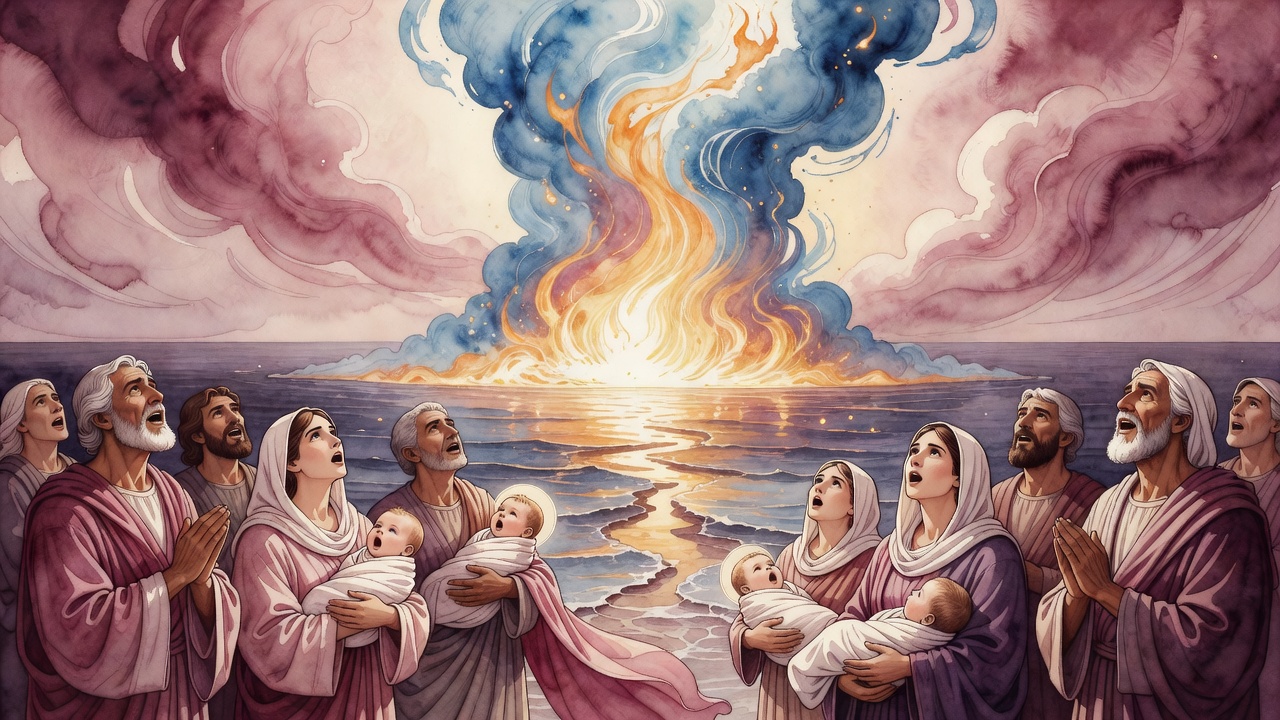
Rabbi Elazar draws a fascinating connection here using a play on words. The verse says, “And your appearance [marekh] is lovely.” He links marekh to the Hebrew word marin, meaning "pointing." He suggests that the beauty of their appearance lies in the act of pointing with a finger and declaring, “This is my God and I will glorify Him!” (Exodus 15:2). image: a sea of people, united in joy and relief, pointing towards the heavens, acknowledging the miracle they've witnessed. That's a powerful picture of faith in action.

It's not just enough to be saved. It's about recognizing the source of that salvation and expressing our gratitude, our amazement. The act of pointing, of declaring, "This is my God," transforms a moment of desperation into a moment of profound connection.

Remember that even in the darkest of times, there's always the possibility of a miracle. And remember to raise your voice, to sing your song of gratitude, to point and declare: "This is my God!"

Full source
Shir HaShirim Rabbah (chapter/verse reference unresolved; pre-import artifact 14:3)Shir HaShirim Rabbah

Retold in our words. Read the original at the link below.The Sefaria Midrash Rabbah, 2022 · CC-BY

Ever catch a whiff of something amazing and wonder, "What is that?" Our senses are powerful doorways to memory and meaning. And in ancient Jewish tradition, few things were as powerfully evocative as the incense used in the Temple. The scent wasn't just pleasant; it was a direct line to the Divine.

Shir HaShirim Rabbah, a rabbinic commentary on the Song of Songs, to uncover some fragrant secrets about that incense. Specifically, we'll be exploring verse 1:14, "A bundle of myrrh is my beloved to me, that lies between my breasts. A cluster of henna in the vineyards of Ein Gedi." What could a love poem have to do with Temple incense? More than it first appears!

Rabbi Yoḥanan, in Shir HaShirim Rabbah, interprets the verse in light of the Avtinas family. The house of Avtinas was a priestly family renowned for their expertise in preparing the incense for the Temple. Think of them as the master perfumers of their day! The Mishnah (the earliest code of rabbinic law) in Shekalim (5:1) hints at their importance. The verse, "A bundle of myrrh," Rabbi Yoḥanan suggests, alludes to one of the eleven spices included in the sacred blend.

Rabbi Huna digs deeper, referencing (Exodus 30:34), where God instructs Moses to "Take spices for you [stacte and onycha and galbanum; spices and pure frankincense; each part shall be equal]." He ingeniously counts the words and phrases to arrive at the number eleven. "Spices for you," two; "stacte, onycha, and galbanum," five; "each part shall be equal," another five; and "pure frankincense," one. From this careful parsing, the sages deduced that these eleven spices were the key to the perfect incense.

The commentary continues, "Lying between my breasts, as it was confined between the two staves of the Ark." The burning incense on Yom Kippur (the Day of Atonement) created a cloud that filled the Holy of Holies, specifically contained within the space between the Ark's staves, according to Matnot Kehuna.

Then comes the phrase "A cluster of henna [eshkol hakofer]," which the Rabbis connect with atonement (mekhaper) for Israel's sins. Rabbi Yitzḥak describes the incense rising like a column before spreading out like a cluster. He also connects the word hakofer to atonement. We even see a connection to (Leviticus 16:13), "The incense cloud will cover." But what does it mean to "cover?" David gives us a clue in (Psalms 85:3): "You forgave the iniquity of Your people; You covered all their sins." The incense, therefore, wasn't just a pleasant aroma; it was a symbol of divine forgiveness.

Finally, we arrive at "In the vineyards of Ein Gedi." This phrase is linked to the covenant God made with Abraham in (Genesis 15:18). The Rabbis see a connection to the sacrifices Abraham's descendants would offer. Rabbi Levi, quoting Rabbi Ḥama, even suggests that Abraham had "ruminations" after his victory over the four kings. He worried that another person might surpass his good deeds, threatening the covenant. God reassured him, saying, "Fear not, [Abram,] I am your shield" (Genesis 15:1). God promised to raise up protectors and righteous people from Abraham's line.

The commentary goes even further, interpreting "Eshkol" as a man who embodies all aspects of Torah – Bible, Mishnah, Talmud, Tosefta, and aggadot (stories). He is the "hakofer," the one who atones for Israel's sins. It's a powerful image of leadership and responsibility.

Another interpretation offered by Ben Gezira sees Eshkol as a reference to God Himself, the One in whom everything exists. Hakofer then becomes the One who renounced the other nations and acknowledged Israel. This idea is illustrated by the war of Yehoshafat in II Chronicles 20, where God aided Yehoshafat against Moab and Ammon.

Rabbi Levi bar Zekharya makes a final, poignant observation. If God, even in this world where He is described as "a consuming fire, a zealous God" (Deuteronomy 4:24), can renounce the nations and acknowledge Israel, how much more so in the future, when He will be like dew for Israel (Hosea 14:6)?

So, what does this all mean? It means that a simple verse about perfume and vineyards is actually a tradition of interconnected ideas about atonement, covenant, and divine love. It shows how deeply the Rabbis explored scripture, finding layers of meaning that resonate even today.

Full source