5 min read

Unborn Mouths Opened When the Waters Stood

At the Song of the Sea even infants in the womb and nursing babies opened their mouths, while God's morning watch answered the patriarchs' dawn obedience.

Curated by Arthur · Told by Maggid ·
Table of Contents
  1. Rebbi Moves the Ages by a Handspan
  2. The Morning Watch When Heaven Looked Down
  3. A Chorus Without Training
  4. What Survives the Argument

The sea walls stood, and the smallest throats in Israel tried to sing.
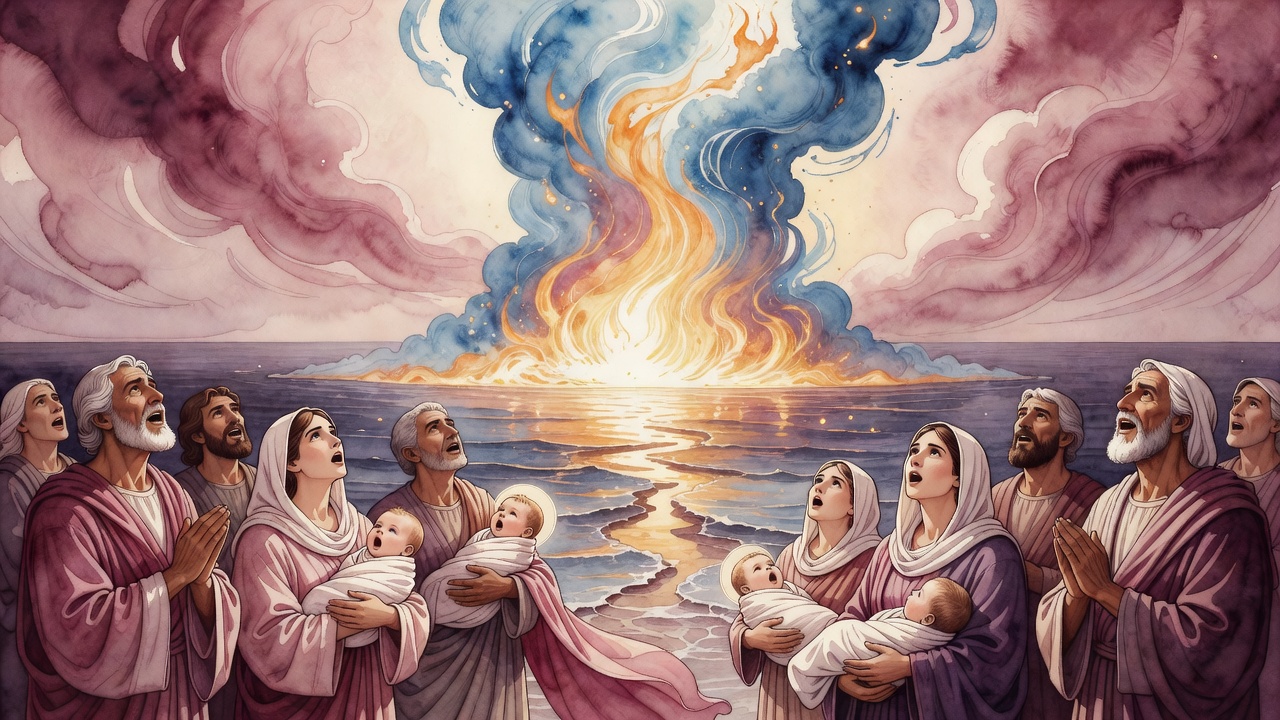
Unborn Mouths Opened When the Waters Stood Click for full size

"From the mouths of olelim and yonkim You have founded strength" (Psalms 8:3). Rabbi Yosei refused to leave those Hebrew words soft. Olelim, he said, are infants still in their mothers' wombs. His proof comes from Job's wish to have been like buried stillbirths, like olelim who never saw light (Job 3:16). Yonkim are those who seek the breast, nursing babies already born but still dependent, as in Joel's call to gather suckers of the breasts (Joel 2:16).

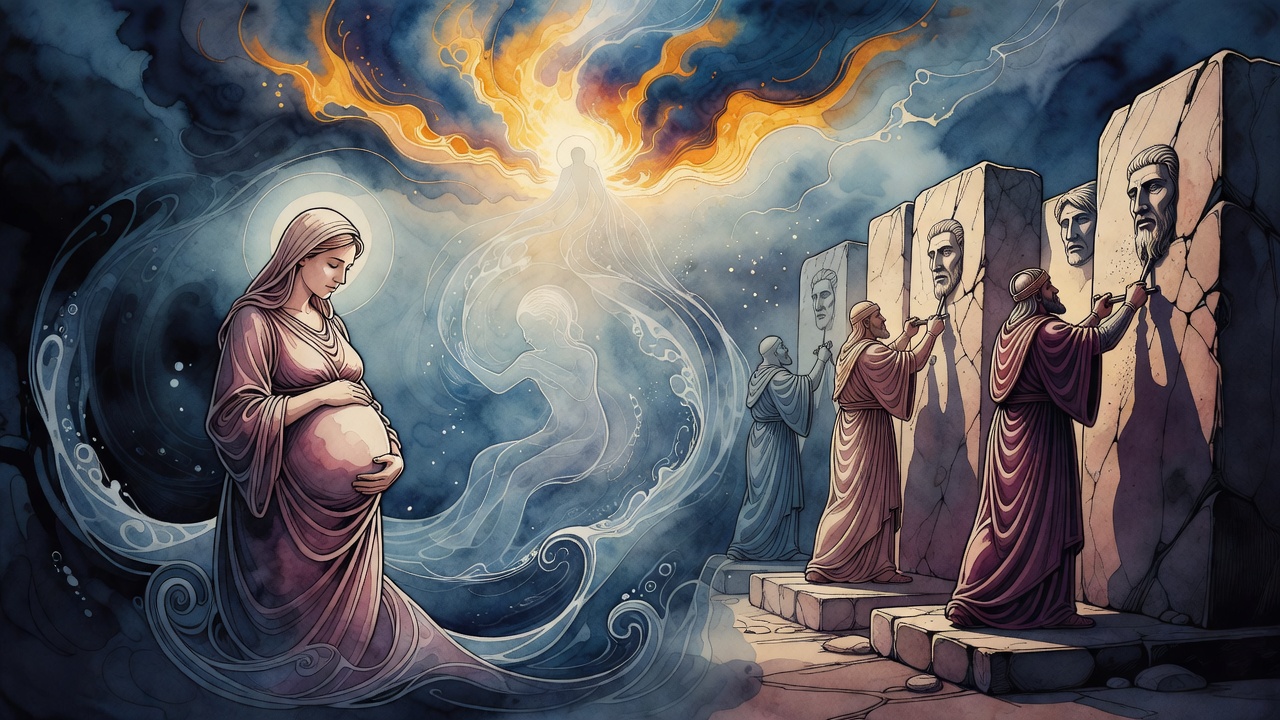
When Israel crossed and broke into the Song, even the unborn joined. Fetuses enclosed in darkness opened mouths no midwife had yet cleaned. Nursing infants left the nipple long enough to praise. Mothers felt the double motion: child within, child at chest, both pulled into a music older than their own fear.

Rebbi Moves the Ages by a Handspan

Rebbi, Rabbi Yehudah HaNasi, compiler of the Mishnah, adjusts the map without killing the miracle. For him olelim are infants already outside the womb, small children in the street, the ones Jeremiah and Lamentations call olel when they beg for bread or face the sword. Yonkim remain those at the breast.

Toddlers and nursing babies, then, not only fetuses. A child who can stumble and still needs milk. A child who can ask for bread with a word and a cry. The conclusion stays the same: "These and those opened their mouths and chanted song before the Lord." The argument is not about diminishing wonder. It is about how early the human voice becomes a vessel for the Song.

In the study hall the disagreement sounds technical. On the seabed-turned-road it sounds like a nursery of praise walking between walls of water.

The Morning Watch When Heaven Looked Down

The Torah marks the crisis hour: "And it was in the morning watch" (Exodus 14:24). God looked down on the Egyptian camp in the predawn and threw them into confusion. Why morning? Because the prayers of the righteous are heard then.

The teachers walk the word "morning" back through the patriarchs. Abraham rose early to bind Isaac (Genesis 22:3). He did not wait for a softer hour. Father and son walked together in first light toward the altar (Genesis 22:6), both knowing the knife's appointment, both moving anyway. Morning is not only clock time. It is the hour when costly obedience and costly listening share the same pale sky.

At the sea, heaven answers in that same register: early, sharp, decisive. Egyptian horses panic while Israelite infants find voice. The dawn that once framed a binding now frames a birth of national song.

A Chorus Without Training

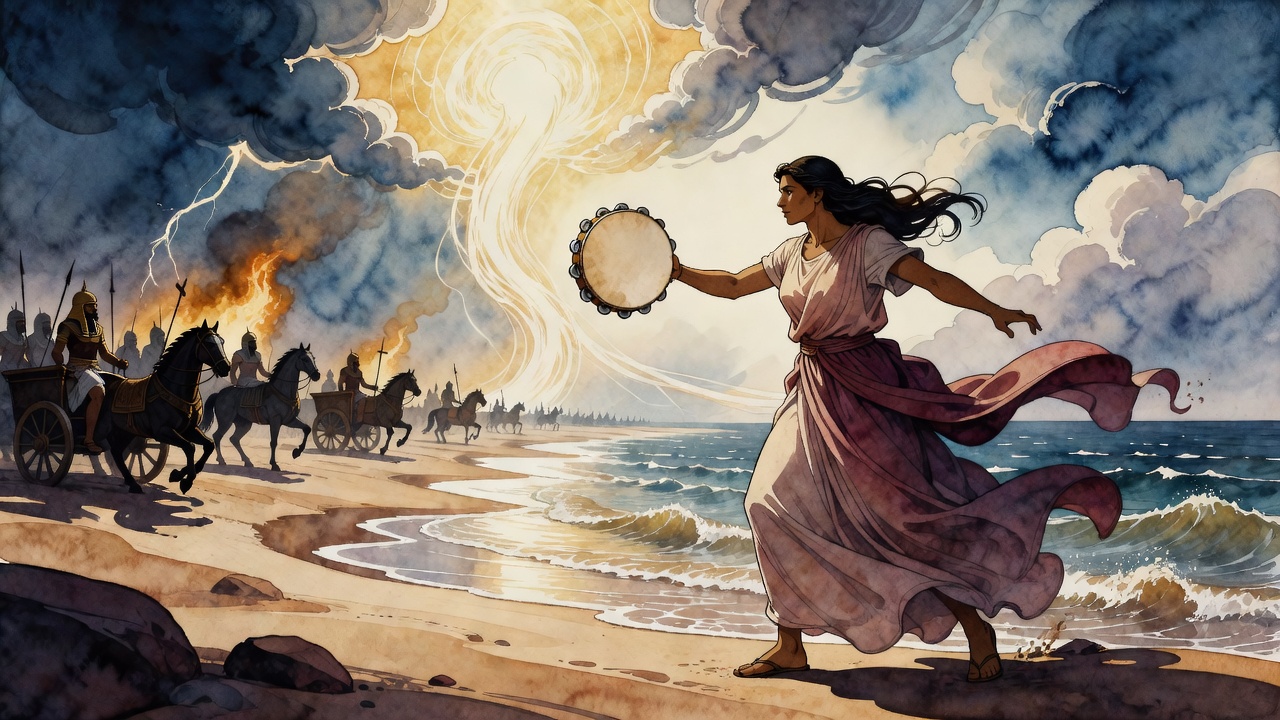
Imagine the camp: wet ankles, salt on lips, Egyptian iron behind, open path ahead. Adult men start the Song. Women answer with drums in other tellings. Here the midrash adds a layer no choir director can rehearse. Wombs vibrate with praise. A baby who cannot yet say "mother" shapes holiness. Strength is founded from mouths that have no politics and no strategy.

Pharaoh's army dies in daylight's approach. Israel's smallest members sing while they still smell of milk and amniotic dark. The contrast is the point. Power that looked permanent drowns. Voices that looked negligible hold the Song's foundation.

A father carrying a toddler feels the child's chest move with sounds that are not ordinary fretting. A pregnant woman places a hand on her belly and understands, in the tale's logic, that the life inside her is already a witness. The Mekhilta does not ask whether this is biologically comfortable. It asks who is allowed to count as a singer when heaven opens a road.

What Survives the Argument

Yosei and Rebbi disagree about ages and still agree about event. The Song was not only the property of leaders who understood the theology. It leaked into bodies too young to choose sides. Morning favored the righteous pattern of Abraham's dawn. The sea favored a people whose infants could not yet walk the dry ground without being carried.

Later generations who sing the Song at festivals inherit more than adult memory. They inherit a claim that praise began before speech lessons, before the eighth-day name settled, before a child knew Egypt as a story rather than as a whip-sound in the parents' sleep.

Every year the liturgy returns the adults to that corridor of water. If the midrash is right, the corridor was never empty of the very young. It was full of them. Their mouths, open in the dark of womb or at the breast or in a father's arms, founded strength while chariots learned what a stoppered sea can do to breath.

The argument over olelim keeps the wonder sharp. Whether the singers were unborn or newly born, the claim stands: the Song did not wait for majority.


← All myths

From the tradition

Sources

3 sources

The texts behind this telling. Some cards carry a translation of the source; others are our own retelling of it, and each card says which. Every card links out to the original.

Mekhilta Tractate Shirah 1:23Mekhilta DeRabbi Yishmael

Retold in our words. Read the original at the link below.Mechilta, translated by Rabbi Shraga Silverstein · CC-BY

Rabbi Yossi interprets a verse from Psalms that adds an astonishing dimension to the Song of the Sea. "From the mouths of olelim and yonkim You have founded strength" (Psalms 8:3). The two Hebrew words, olelim and yonkim, refer to the youngest and most helpless members of the Israelite community, and Rabbi Yossi identifies exactly who they are.

Olelim, he explains, are infants still in their mothers' wombs. His proof text comes from Job: "Why was I not like a buried stillbirth, like olelim who never saw the light" (Job 3:16). The word olelim here clearly refers to the unborn, those who exist but have not yet seen daylight. These are fetuses, not yet breathing on their own, still enclosed in the darkness of the womb.

Yonkim are those who seek their mothers' breasts, nursing babies who have been born but are still dependent on their mothers' milk for survival. The proof comes from the prophet Joel: "Gather olelim and suckers of the breasts" (Joel 2:16), where the term yonkei describes infants at the breast.

The implication is extraordinary. When the Israelites crossed the Red Sea and sang the Song of praise to God, even the tiniest participants joined in. Babies too young to speak and infants not yet born opened their mouths and sang. God's salvation was so overwhelming, so undeniable, that it bypassed every natural limitation. You did not need language to recognize what had happened. You did not even need to have been born yet. The miracle spoke for itself, and every soul in Israel, born and unborn, responded.

Full source
Mekhilta Tractate Shirah 1:24Mekhilta DeRabbi Yishmael

Retold in our words. Read the original at the link below.Mechilta, translated by Rabbi Shraga Silverstein · CC-BY

Rebbi, Rabbi Yehudah HaNasi, the compiler of the Mishnah (the earliest code of rabbinic law), offers an alternative reading that slightly adjusts the ages of the miraculous singers at the Red Sea. Where Rabbi Yossi understood olelim as unborn infants in the womb, Rebbi identifies them as infants who have already been born but are still very small, young children who are "outside" their mothers' bodies.

His proof texts are precise. "To cut off the olel outside" (Jeremiah 9:20), the word olel here refers to a child in the streets, already born and walking about. And "Olelim begged for bread" (Lamentations 4:4), children old enough to feel hunger and ask for food, but still too young to fend for themselves. These are toddlers, perhaps, or very young children capable of simple speech but not yet independent.

Yonkim, in Rebbi's reading, are those still nursing at their mother's breast, the same definition as Rabbi Yossi's. The verse from Joel about "suckers of the breasts" confirms this identification.

Despite the slight difference in defining olelim, Rebbi arrives at the same conclusion: "These and those opened their mouths and chanted song before the Lord." At the splitting of the Red Sea, both the toddlers and the nursing infants sang. Rebbi's version grounds the miracle in slightly more natural terms than Rabbi Yossi's, these children had at least been born and possessed mouths capable of sound. But the supernatural element remains. Infants and toddlers who could barely form words produced coherent song praising God.

Full source
Mekhilta Tractate Vayehi Beshalach 6:11Mekhilta DeRabbi Yishmael

Retold in our words. Read the original at the link below.Mechilta, translated by Rabbi Shraga Silverstein · CC-BY

The Mekhilta draws attention to a pattern hidden in the Torah's language. The verse states, "And it was in the morning watch" (Exodus 14:24), God looked down upon the Egyptian camp at the Red Sea during the predawn hours and threw them into confusion. Why the morning? Because the prayers of the righteous are heard in the morning.

The rabbis trace this principle through the patriarchs. The "morning" of Abraham appears in the story of the Binding of Isaac: "And Abraham rose early in the morning" (Genesis 22:3). Abraham did not delay, did not wait until a more comfortable hour. He woke at dawn to fulfill God's most terrifying command. The "morning" of Isaac is embedded in the same narrative: "and both of them went together" (Genesis 22:6), father and son walking side by side in the early morning light, both knowing what lay ahead, both willing.

The Mekhilta establishes that morning is not merely a time on the clock. It is a spiritual reality. The patriarchs chose the morning for their most consequential acts of faith. Abraham rose before dawn to bind his son. Isaac walked beside his father at first light toward the altar. God responded in kind at the Red Sea, choosing the morning watch to deliver Israel. The hour of dawn, in rabbinic thought, carries a charge of divine responsiveness, it is when heaven most readily answers the prayers of those who, like the patriarchs, do not hesitate.

Full source