5 min read

Nadab and Abihu Fed Their Eyes on the Presence

Behind Moses at Sinai the gifted sons whisper of a community that will be theirs. They stare at the Presence like a meal. Fire answers later.

Curated by Arthur · Told by Maggid ·
Table of Contents
  1. Two Old Men Walk Ahead
  2. They Stared the Way a Man Stares at a Friend
  3. A King Who Will Not Stain the Wedding
  4. What Justice Looks Like When Moses Comes Down
  5. The Community That Was Never Theirs
Nadab and Abihu Fed Their Eyes on the Presence Click for full size

Two Old Men Walk Ahead

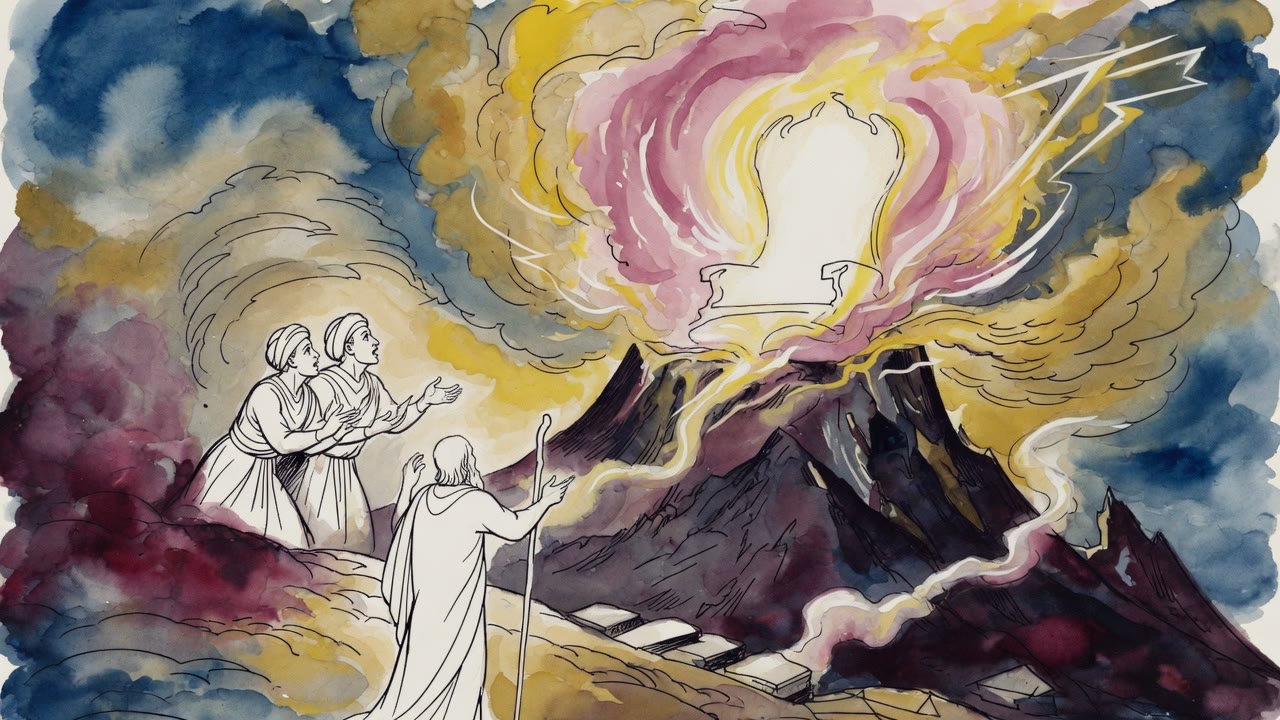
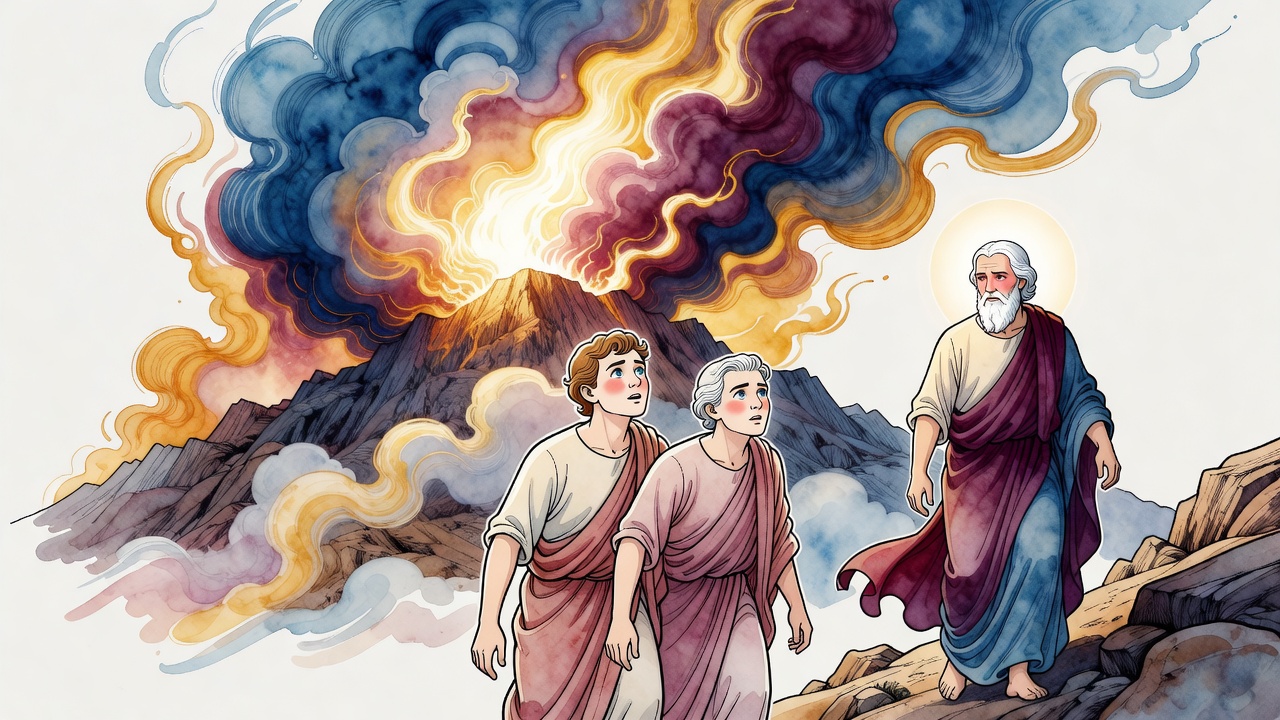
Moses and Aaron climb the slope of Sinai with the weight of the whole camp on their backs. Dust rises from their sandals. Behind them walk Nadab and Abihu, gifted, young, already measuring the distance between their elders' steps and the day those steps will stop.

The whisper is small enough that only heaven is sure it was spoken. Maybe it never left their mouths. Maybe it only lived in the heart. "When these two old men die, the community will be ours."

No one answers them on the mountain. The cloud does not part to rebuke. The answer waits for a festival day, when joy should have sealed their mouths and holiness should have taught their hands to wash.

Solomon's warning already hangs over them, though they do not hear it yet. Do not boast of tomorrow. Many a young colt dies, and its hide is spread on its mother's back.

They Stared the Way a Man Stares at a Friend

At Sinai the nobles of Israel beheld God and ate and drank. Nadab and Abihu fed their eyes on the Divine Presence the way a man stares across a table at a companion. No veil. No fear. No turning aside. The vision became a meal for the appetite of the eye.

Moses had done the opposite at the bush. He hid his face. Because he did not grasp at holiness, holiness later shone from his skin until Israel could not look at him without a covering. The brothers grasped. They took the Presence as if it were already inheritance. They left the mountain empty in a way no one else could see yet, pockets full of vision and hearts thin of awe.

The sages gather every charge that Scripture allows. Wine at the sanctuary. Unwashed hands and feet. A missing robe whose bells should have been heard when a priest approached the holy. No wives. No children. Pride that held every woman beneath their bloodline. Under all of them sits the same hunger: they wanted the Presence without the discipline that keeps a priest alive.

A King Who Will Not Stain the Wedding

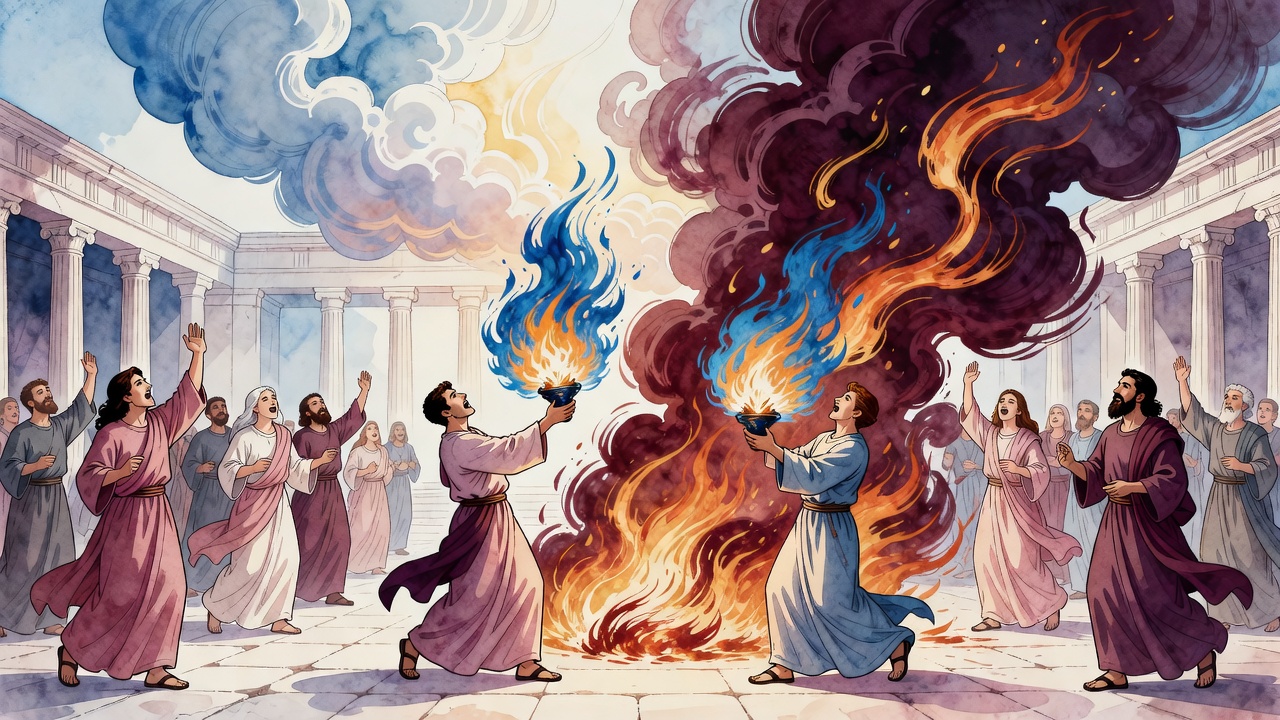
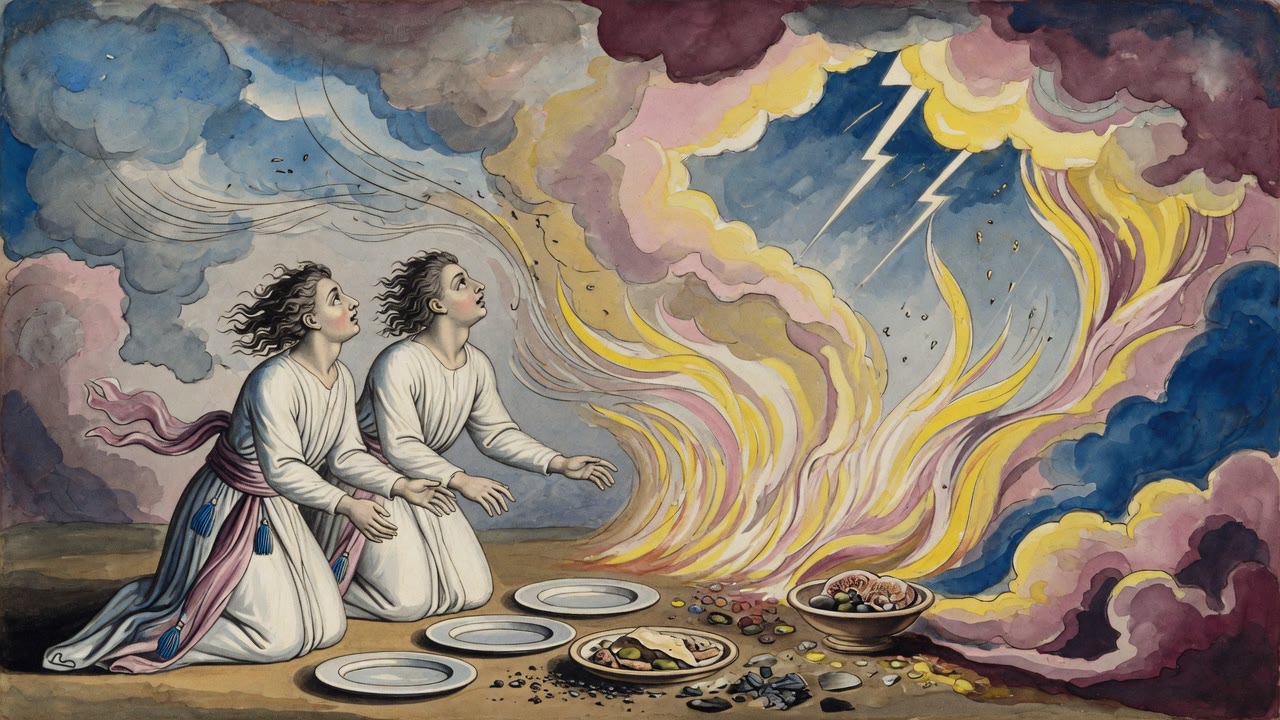
God holds the blow until the festival has passed. Like a king who will not let grief spoil his daughter's wedding day, Heaven waits until the joy is complete, then acts. The fire that was meant for the altar finds the men who treated the altar's Owner as a spectacle.

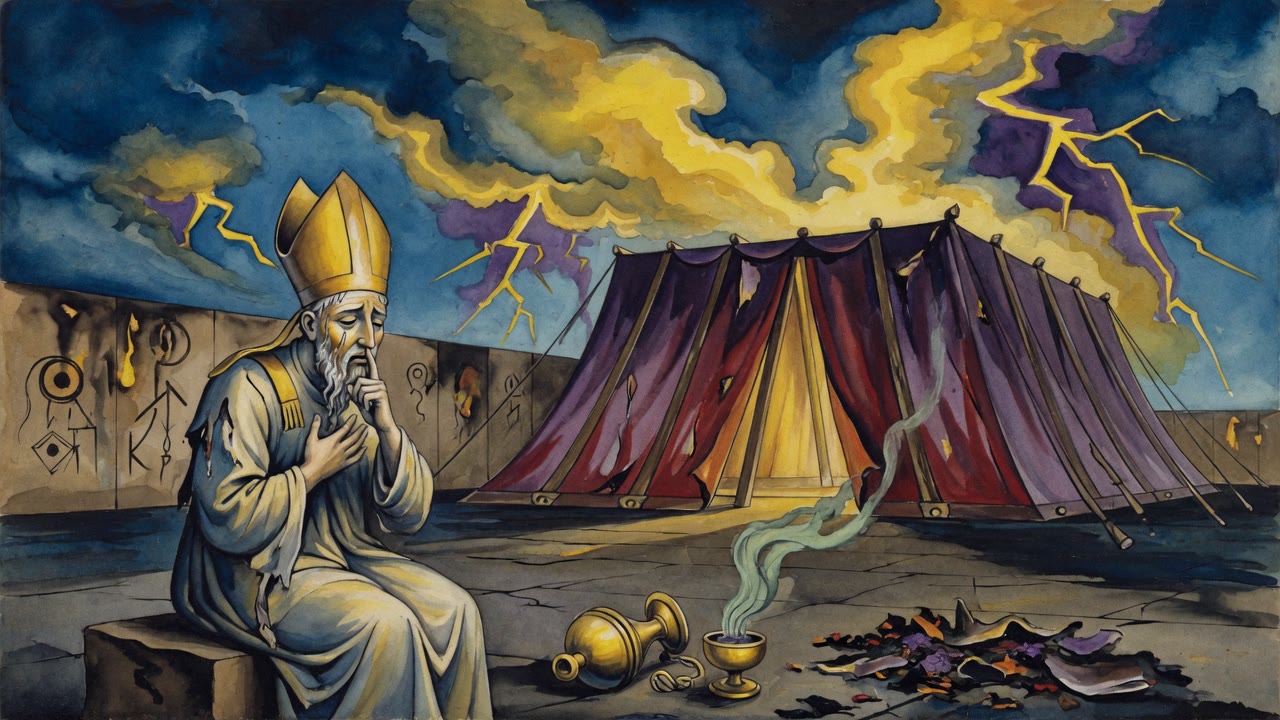
Aaron's silence afterward is thick enough to choke the tent. Two sons gone in a single strike. The same fire that accepted the first offerings now takes the second generation of priests for offering what was not commanded. The camp smells of celebration and of burning at once.

Their death is grievous to Heaven, the teaching runs, twice as bitter to God as it was even to their father. The colt dies young. The hide is laid on the mother's back. No one may boast of tomorrow while the cloud still rests and the oil is still wet on younger hands.

What Justice Looks Like When Moses Comes Down

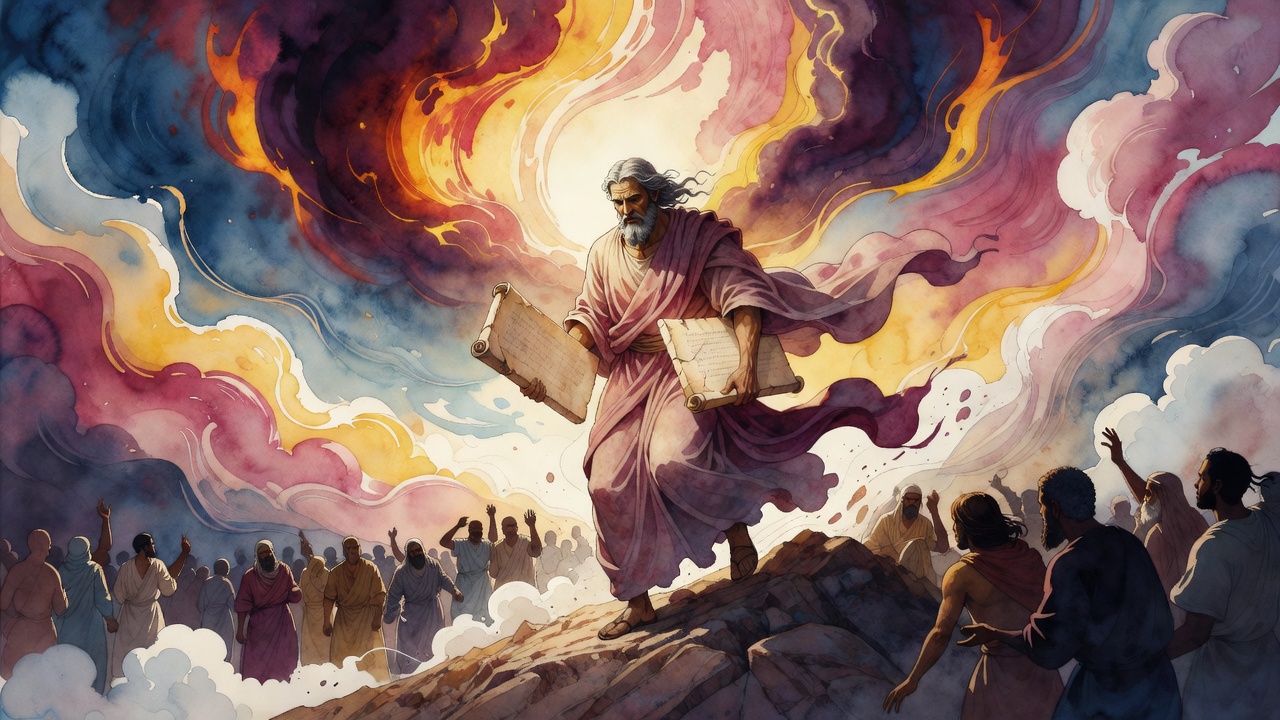
When Moses descends later with the tablets still warm in his arms, the nation gathers and asks a hard question. "Moses, our teacher, what is the attribute of justice like on high?"

He does not paint a cold machine. He says the Rock does not clear the guilty or convict the innocent, and does not even "exchange" one against the other. Perfect work. No fudging of the ledger. No private discount for beloved names. The same integrity that refused to stain a festival with premature fire is the integrity that will not call wrong right because the wrongdoers are sons of Aaron.

Even when Israel is full of blemishes, they are still called sons. Rabbi Meir presses the line further. If they are called sons when full of blemishes, how much more when they are unblemished. That mercy does not cancel the fire that took Nadab and Abihu. It sits beside it. Sons can still die for what sons do. The Rock remains perfect work.

The Community That Was Never Theirs

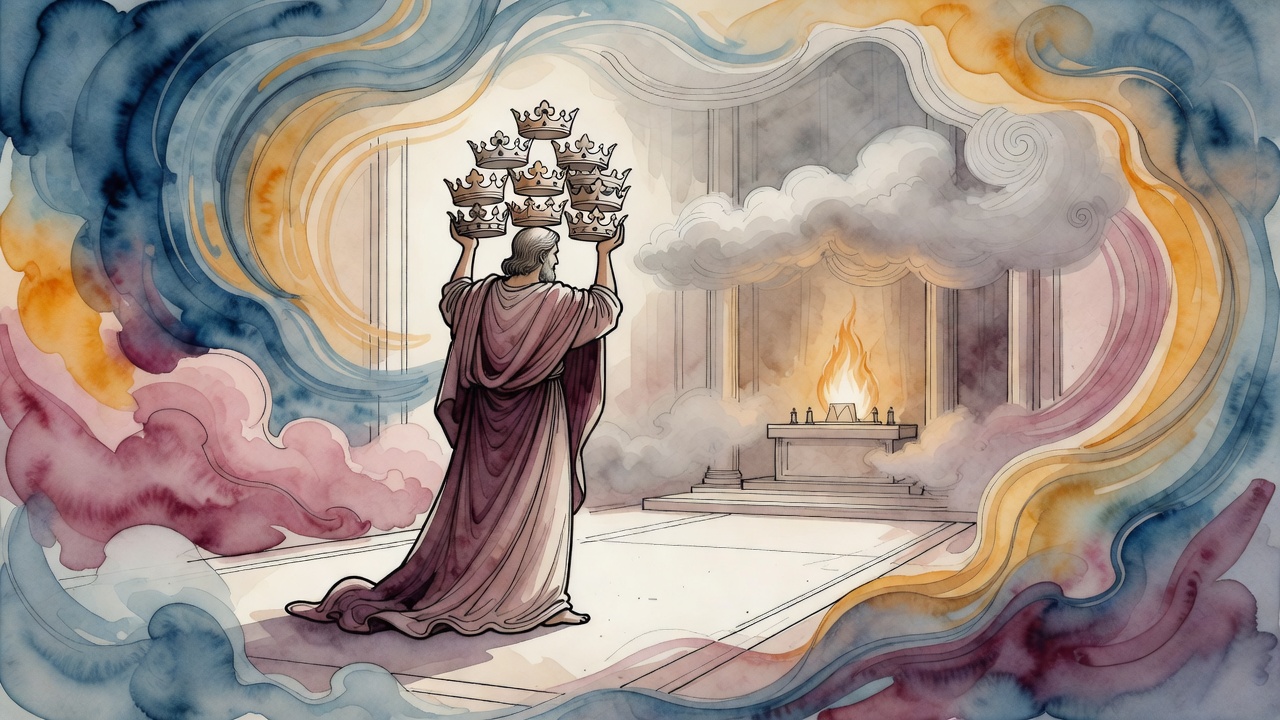
The community they claimed on the slope never becomes theirs. Aaron's line continues through other sons who wash and dress and fear. The robe with bells is worn by hands that know the sound is not decoration but warning. The Presence remains in the camp, but it is not a meal for the careless eye.

Aaron stands in the doorway of the tent with his hands empty of those two sons. Moses does not fill the silence with comfort that would cheapen the fire. On Sinai the young priests looked too long and too lightly. On the day of dedication the fire finished the looking. Between the whisper and the flame, heaven counted every tomorrow they had already spent.


← All myths
From the tradition

Sources

2 sources

The texts behind this telling. Some cards carry a translation of the source; others are our own retelling of it, and each card says which. Every card links out to the original.

Pesikta DeRav Kahana 26:9Pesikta de-Rav Kahana

Translation of the source text.Pesikta de Rav Kahana according to an Oxford manuscript, Dov Mandelbaum ed., N.Y. 1987 · CC-BY

Rabbi Mani of Sheab and Rabbi Joshua of Sikhnin in the name of Rabbi Levi: For four reasons the sons of Aaron died, and in connection with each of them death is written. Because they entered the Sanctuary having drunk wine, death is written of it, as it is said, "Drink no wine nor strong drink" (Leviticus 10:9). And because they entered without washing their hands and feet, as it is written, "And Aaron and his sons shall wash from it" (Exodus 30:19), and it is written of them, "When they come into the tent of meeting they shall wash with water, that they die not" (Exodus 30:20). And because they lacked the proper garments, and death is written of it, as it is written, "And they shall be upon Aaron and upon his sons when they come in" (Exodus 28:43). And what were they lacking? Rabbi Levi said, they lacked the robe, and death is written of it, as it is written, "And it shall be upon Aaron to minister, and its sound shall be heard" (Exodus 28:35). And because they had no children, and death is written of it, as it is written, "And Nadab and Abihu died before the LORD when they offered strange fire before the LORD" (Numbers 3:4).

Abba Hanan says: Because they had no wives, as we have learned there, "And he shall make atonement for himself and for his house" (Leviticus 16:6) means his wife. Rabbi Levi said they were arrogant. Many women sat waiting for them in sorrow, and what did they say? Our father's brother is king, our mother's brother is prince, our father is high priest, we are two deputies of the priesthood, what woman is fit for us?

Rabbi Menahema in the name of Rabbi Joshua bar Nehemiah: Why is it written, "Fire devoured their young men" (Psalms 78:63)? Because "their virgins had no wedding song" (Psalms 78:63). And further from this, "And to Moses He said, Come up to the LORD, you and Aaron, Nadab and Abihu" (Exodus 24:1). This teaches that Moses and Aaron walked in front and Nadab and Abihu walked behind them, and they said, when these two old men die, we will hold authority over the community in their place. Rabbi Judan in the name of Rabbi Ivu said, they said this to one another with their mouths. Rabbi Pinhas said, they thought it in their hearts. Rabbi Berekhiah said, the Holy One, blessed be He, said to them, "Do not boast of tomorrow, for you do not know what a day may bring" (Proverbs 27:1). Many colts have died, and their hides have been spread upon the backs of their mothers.

And further from this, "And against the nobles of the children of Israel He did not lay His hand" (Exodus 24:11). Rabbi Pinhas said, from here we learn they deserved to have a hand laid upon them. Rabbi Hoshaya said, did eye-salve go up with them to Sinai, that you say "And they beheld God, and ate and drank" (Exodus 24:11)? Rather, this teaches that they fed their eyes upon the Divine Presence as a man who gazes at his fellow while eating and drinking. Rabbi Yohanan said, it was eating enough, as it is written, "In the light of the king's face is life" (Proverbs 16:15). Rabbi Tanhuma said, this teaches that they grew haughty in heart and stood on their feet and fed their eyes upon the Divine Presence.

Rabbi Joshua of Sikhnin in the name of Rabbi Levi: Moses did not feed his eyes upon the Divine Presence and so he benefited from the Divine Presence. That he did not feed his eyes upon the Divine Presence, from where? As it is written, "And Moses hid his face" (Exodus 3:6). That he benefited from the Divine Presence, from where? As it is written, "And Moses did not know that the skin of his face shone" (Exodus 34:29). Another interpretation: "And Moses hid his face, for he was afraid" (Exodus 3:6) corresponds to "and they were afraid to come near him" (Exodus 34:30); "to look" (Exodus 3:6) corresponds to "and he beholds the form of the LORD" (Numbers 12:8). Nadab and Abihu fed their eyes upon the Divine Presence and did not benefit from the Divine Presence.

And further from this, "And Nadab and Abihu died before the LORD" (Numbers 3:4). Rabbi Yohanan said, did they die before the LORD? Rather, this teaches that it is grievous before the Holy One, blessed be He, when the children of the righteous depart in the lifetime of their fathers. Rabbi Nahman of Jaffa asked before Rabbi Pinhas bar Hama in the name of Rabbi Simon: Here you say "before the LORD" (Leviticus 10:2), "before the LORD" (Numbers 3:4), two times, and there you say "in the presence of Aaron their father" (Numbers 3:4), one time. Rather, this teaches that it is twice as grievous before the Holy One, blessed be He, as for their father. "In the wilderness of Sinai" (Numbers 3:4): did they die in the wilderness of Sinai? Rather, this teaches that from Mount Sinai they took their verdict for death.

A parable of a king who was marrying off his daughter, and something offensive was found among his groomsmen. The king said, if I kill them now I will spoil my daughter's joy; tomorrow my own celebration comes, and better in my celebration than in my daughter's. So the Holy One, blessed be He, said, if I kill Nadab and Abihu now I will spoil the joy of the Torah; tomorrow my celebration comes, better in my celebration than in the joy of the Torah. This is what is written, "On the day of his wedding" (Song of Songs 3:11), this is Sinai; "and on the day of the gladness of his heart" (Song of Songs 3:11), this is the tent of meeting.

Full source
Sifrei Devarim 308:1Sifrei Devarim

Retold in our words. Read the original at the link below.Sifrei by Rabbi Shraga Silverstein · CC-BY

One particularly striking passage from Sifrei Devarim explores this very idea, starting with a poignant scene.

Moses, descending from Mount Sinai, tablets in hand, after that earth-shattering encounter with the Divine. The entire Israelite nation gathers, filled with awe and, perhaps, a little trepidation. They ask him a direct question: "Moses, our teacher, what is the attribute of justice like on high?"

Moses's answer isn't what you might expect. He doesn’t describe some cold, calculating system. Instead, he says that God "not only does He not exculpate the guilty and inculpate the innocent, but even vis-à-vis 'exchanging' (i.e. deducting one from the other), 'He is a G-d of trust, without wrong.'" This is based on the verse in Devarim (Deuteronomy) 32:4: "The Rock, perfect is His work." In other words, Divine justice is utterly fair and trustworthy. There’s no fudging the numbers, no shading the truth. It's a system where even in the most minute calculations, divine integrity reigns supreme.

The passage doesn't stop there. It goes on to explore the idea of God's relationship with the Jewish people, even when they fall short. Here, the text quotes (Deuteronomy 32:5): "Shicheth lo lo. Banav mumam" – "Even though they are full of blemishes, they are still called sons (banim)."

Rabbi Meir beautifully expands on this concept. He says, “If when they are full of blemishes they are called 'banim,' if they are unblemished, how much more so!" It's a powerful a fortiori argument, a qal vachomer in Hebrew, moving from the lesser to the greater. If even in imperfection, the connection remains, how much stronger is it in perfection?

The passage continues with similar arguments, drawing from other prophetic books. Take (Isaiah 1:4): "Evil seed, corrupt sons." If even when corrupt they are still called "sons," how much more so if they were not corrupt! Or consider (Jeremiah 4:22): "They are wise to do evil. And again, "They are foolish sons, and not understanding." If they are called "sons" even when foolish, how much more so if they were understanding!

The final example comes from (Ezekiel 23:31): "And they come to you as a people comes, and My people sit before you and hear your words." The verse continues, "but they do not fulfill them." Even when they hear God's word but fail to act upon it, they are still called "My people." How much more so, then, when they hear and fulfill!

What’s the takeaway here? This passage from Sifrei Devarim, through the lens of Rabbi Meir's interpretations, offers a profound and comforting message. It highlights the enduring, unbreakable bond between God and the Jewish people. Even when we stumble, even when we fall short, the connection remains. It's evidence of a love that persists, a relationship that endures. It’s a reminder that even in our imperfections, we are still cherished, still considered banim – children. And perhaps, that unwavering love is the most profound form of justice of all.

Full source