Parshat Bo5 min read

Ninety Million Destroyers Waited While God Struck Egypt

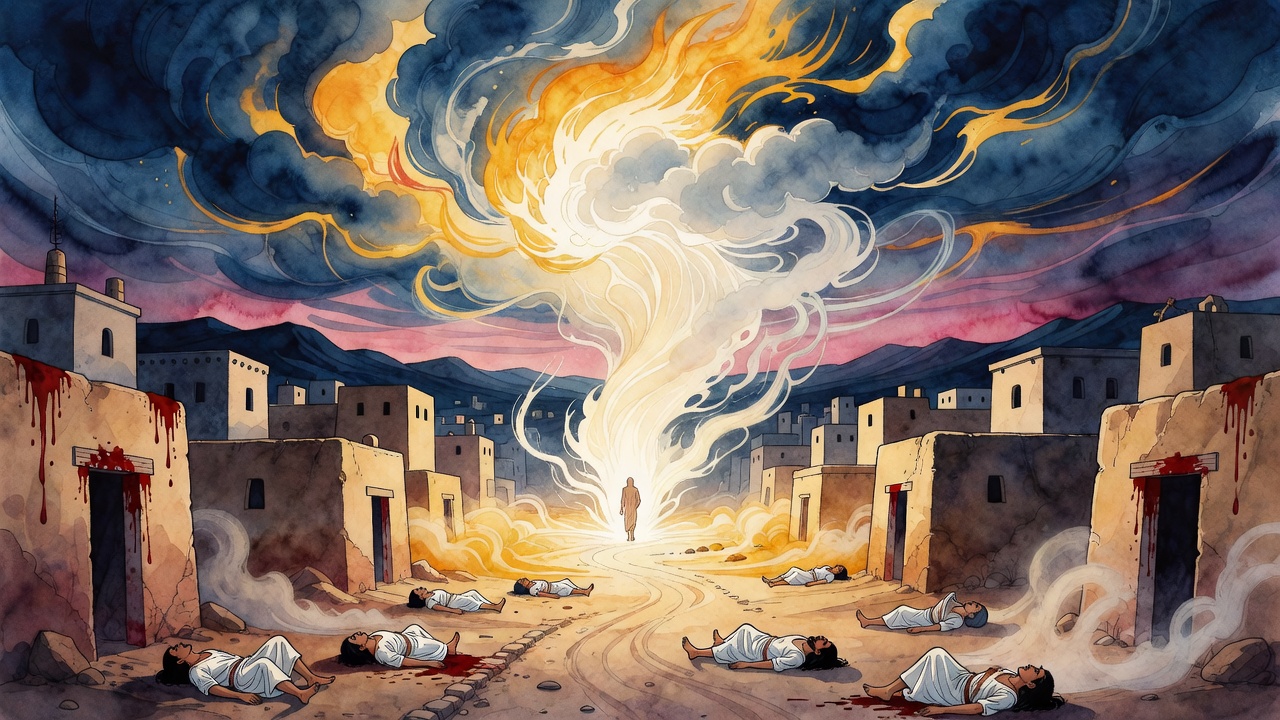
At midnight God arrived with ninety million angels of destruction. He held them back and struck Egypt Himself, from firstborn sons to the oldest in each house.

Curated by Arthur · Told by Maggid ·
Table of Contents
  1. Wider Than the Word Firstborn
  2. Ninety Million Waiting for a Nod
  3. Plagues That Remembered Specific Cruelty
  4. Midnight Without Negotiation
  5. What the Myriads Teach
Ninety Million Destroyers Waited While God Struck Egypt Click for full size

Wider Than the Word Firstborn

Pharaoh thought the death of a few firstborn sons was a price he could pay to keep Israel in chains. The legends refuse him that narrow math. The blow fell on firstborn sons and firstborn daughters. It fell on firstborn children from previous unions as well as from present marriages. Egyptian households, the tradition says, often mixed fathers the way markets mix coin. A woman might have ten children, each the firstborn of a different man. The net dropped over all of them.

Some strands push further. The oldest member of every household fell, whether or not the legal title "firstborn" fit. What God resolves is executed. Pride had called the earlier plagues survivable. Midnight would not be survivable by policy or by bribe.

The hour was exact. Only the Holy One could cut time that fine. At the stroke of midnight He appeared in Egypt, and He did not come alone.

Ninety Million Waiting for a Nod

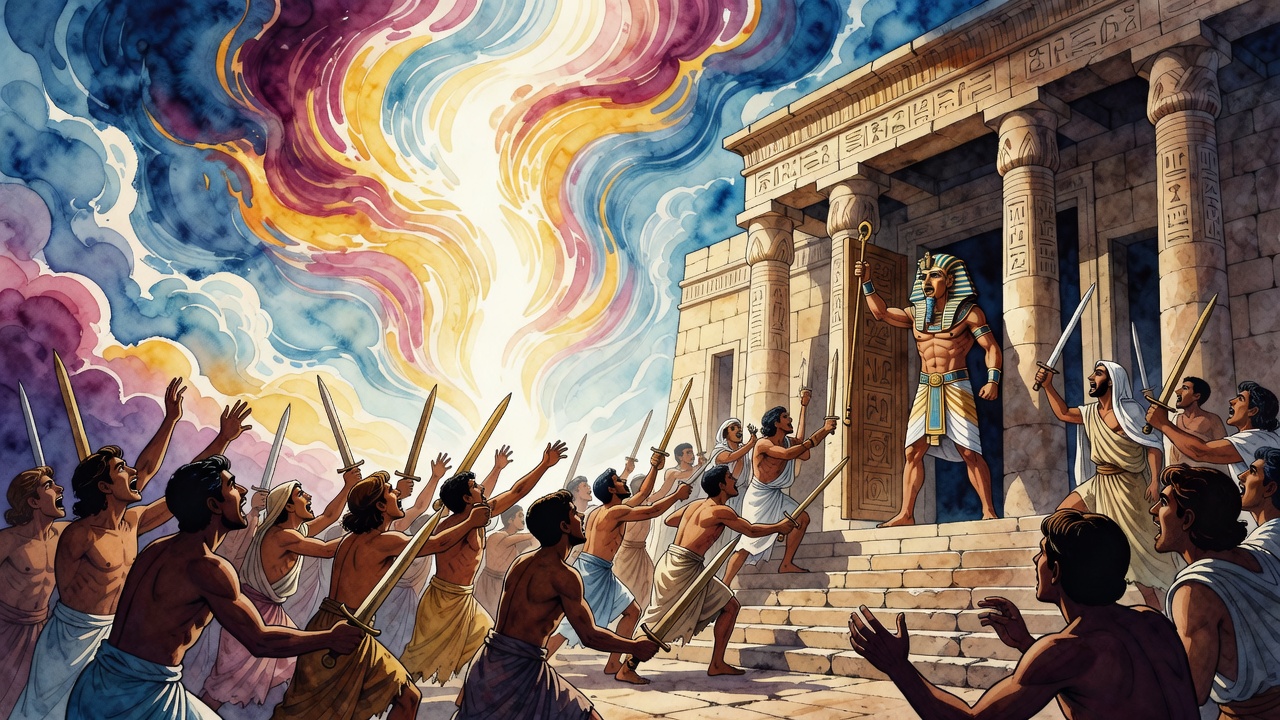
Nine thousand myriads of Angels of Destruction attended Him. Ninety million. They were not messengers of soft light. They were angels of hail and flame, their gaze itself a cause of terror. They poised to unleash annihilation the way an army poises at a breach.

God restrained them. "My wrath will not be appeased until I Myself execute vengeance upon the enemies of Israel." The Creator refused to outsource this plague. The myriads stood ready and unused while the Judge of all the earth walked the streets that had watched Hebrew boys sink into the Nile.

Empire loves middlemen. Heaven, in this telling, wanted none. The hand that had turned dust to lice and streets to hunting grounds for beasts would not, at the climax, let a subordinate take the signature kill.

Plagues That Remembered Specific Cruelty

Earlier blows had already matched Egyptian sins with Egyptian losses. Dust became lice because the Egyptians forced Israelites to clean houses, courtyards, and streets, grinding human dignity into dirt and then meeting dirt that crawled. Wild animals poured into homes because Egyptians had sent Israelites into deserts to capture beasts for entertainment, thinning the people under the mask of spectacle. A lion took one child, a bear another, until a Hebrew slave sent to watch ten Egyptian children returned alone.

The firstborn plague sits on top of that ledger. It is not a random horror stacked for drama. It is the final line item. Pharaoh would not release the people. Heaven released the oldest life in every stubborn house. The blood on Israelite doorposts marked a difference the angels of destruction were not invited to blur, because God Himself was doing the work and God Himself was keeping the covenant boundary.

Joseph the dreamer had once stored grain against famine in this same land. Now the land stored corpses against a king's refusal. Memory and judgment shared streets.

Midnight Without Negotiation

There was no audience for Pharaoh at the palace gate at that hour. No magicians to copy the act. No warning that could be bargained into a lighter sentence. The legends stress precision because tyranny had spent years being imprecise with Hebrew life, drowning infants as policy and calling it order. The counterstroke arrived with a clock no court could adjourn.

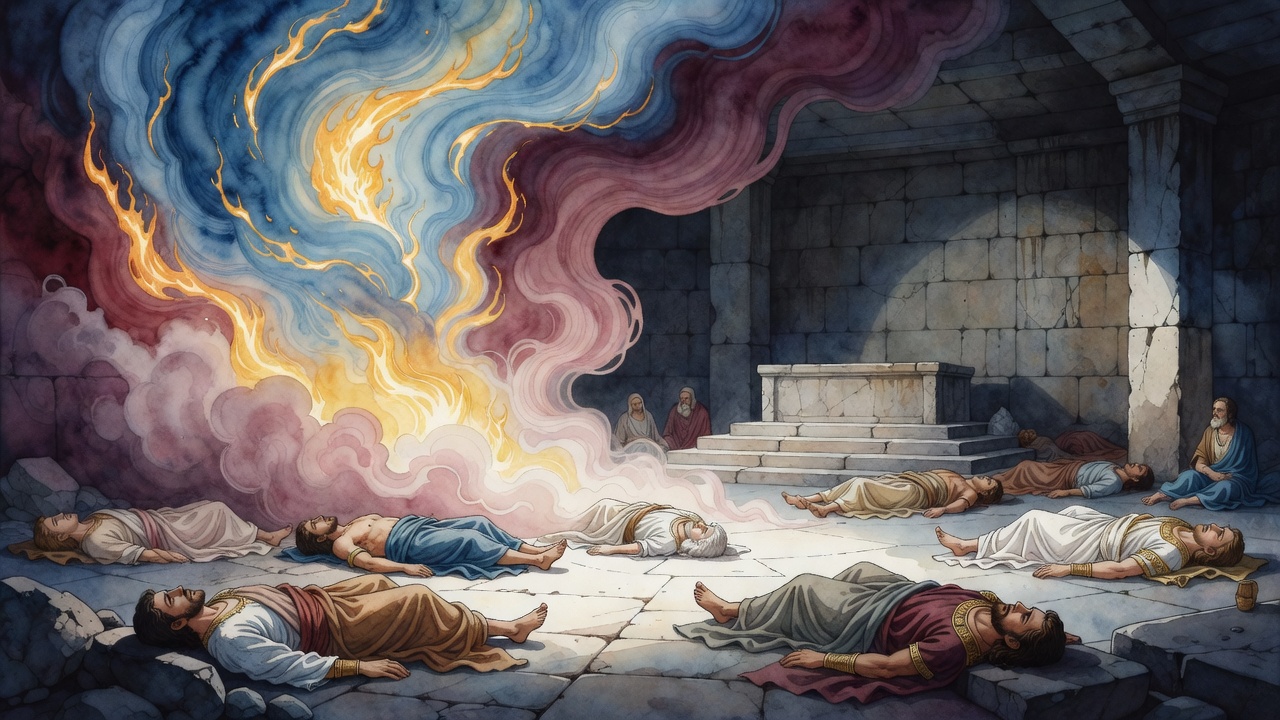
Mothers screamed. Firstborn daughters fell beside firstborn sons. Old men who were simply the oldest in the room fell too. The myriads watched and did not move. Their restraint was part of the terror. Destruction was available in infinite supply and still the Holy One insisted on personal execution.

By morning Pharaoh would summon Moses and Aaron and shove the people out. The conversion was not repentance. It was the sound a throne makes when its heir-structure collapses in a single night.

What the Myriads Teach

Why bring ninety million angels only to hold them back? The legends answer with theology of intimacy and wrath. Israel is not rescued by a committee of powers. Israel is rescued by the God who claims the quarrel as His own. The angels prove capacity. The restraint proves choice. The personal blow proves that Egypt's war on Hebrew children had reached the only court that never adjourns.

Later generations recite the night with wine and questions. Behind the ritual sits this harder picture: a sky full of destroyers ordered to wait, a king who miscounted the cost of stubbornness, and a people who walked out past houses where the oldest breath had stopped at the same instant. Freedom began not only with open gates but with a midnight that refused to be delegated.


← All myths
From the tradition

Sources

2 sources

The texts behind this telling. Some cards carry a translation of the source; others are our own retelling of it, and each card says which. Every card links out to the original.

Legends of the Jews 4:332Legends of the Jews

Retold in our words. Read the original at the link below.The Legends of the Jews by Louis Ginzberg (1909) · Public Domain

It is often remembered as simply the death of the firstborn sons, but the scope, according to some fascinating interpretations in our tradition, was far, far wider.

Pharaoh, blinded by pride, and all those who sided with him, figured the loss of a few firstborns was a price worth paying to keep the Israelites enslaved. A minor setback, they thought. They couldn't have been more wrong.

The decree, as the Legends of the Jews, that monumental compilation by Rabbi Louis Ginzberg, tells us, wasn't limited to just the firstborn sons. Oh no. It included the firstborn daughters as well! And, critically, it wasn't just about the firstborn children from current marriages. It encompassed all firstborn children from any previous relationships the parents had ever had.

Consider this: the Egyptians, well, they weren't exactly known for their strict adherence to marital fidelity. As Ginzberg points out, it wasn't uncommon for a woman to have ten children, each of whom was the firstborn of a different father! So, the net was cast incredibly wide.

But it gets even more intense. According to some traditions, God went even further. The decree ultimately extended to the oldest member of every household, regardless of whether they were technically the firstborn or not. What God resolves, as they say, is executed.

And the moment of execution? Precise. Absolutely precise. The stroke of midnight, so exact that only God Himself could discern it. At that instant, He appeared in Egypt. Not alone, mind you. He was attended by nine thousand myriads – that’s ninety million! – of Angels of Destruction.

These weren't your fluffy, cherubic angels. These were angels of hail and flames, their very gaze capable of inspiring terror and trembling. Ready to unleash annihilation, they poised themselves to strike.

But then, God, in His infinite power, restrained them. "My wrath," He declared, "will not be appeased until I Myself execute vengeance upon the enemies of Israel."

Think about the weight of that for a moment. The Creator of the Universe, stepping in to personally deliver justice. It emphasizes the profound significance of this moment in our history. It wasn't just a plague; it was a divine intervention of unparalleled magnitude, a demonstration of God's unwavering commitment to His people.

Full source
Legends of the Jews 4:268Legends of the Jews

Retold in our words. Read the original at the link below.The Legends of the Jews by Louis Ginzberg (1909) · Public Domain

The familiar version gives us the broad strokes – God freeing the Israelites from slavery, Pharaoh stubbornly refusing to let them go, and each plague serving as a divine warning. But what about the why behind the what? What sins specifically triggered each devastating act?

Well, the source enters some fascinating details from Ginzberg's Legends of the Jews which pulls from a wealth of midrashic (rabbinic interpretive commentary) and talmudic sources.

Think about the third plague: lice. It wasn't just a random act of annoyance. Ginzberg's retelling explains that God turned the dust of the air into lice because the Egyptians had forced the Israelites to clean their homes, courtyards, and streets. The Zohar tells us of the mystical connection between dust and humanity, and to debase humans to dust, only to then be overcome by dust-turned-lice… there's a poetic justice there, isn't there? And the sheer scale! The vermin, Even putting on fresh clothes offered no respite from the unending itching and crawling.

The story of the fourth plague – wild animals – is even more striking. We're talking lions, wolves, panthers, bears… an entire menagerie unleashed upon the land. Not just a few stray animals, but hordes of them, invading homes, devouring people. According to Legends of the Jews, they overran the houses of the Egyptians, bypassing all attempts to keep them out.

And here’s where it gets really specific. Remember, these plagues weren't arbitrary. The Egyptians had a particular cruelty: they would order the Israelites to capture wild animals for their circuses.: sending enslaved people into dangerous, distant deserts, separating them from their families, all for the sake of entertainment. As we find in Midrash Rabbah, this was a calculated effort to diminish the Israelite population.

So, when the wild animals attacked, it was a direct consequence of their own actions. Ginzberg paints a vivid picture of the horror: If an Egyptian entrusted his ten children to an Israelite for a walk, a lion would snatch one, a bear another, and so on, until the Israelite returned home alone. A truly terrifying image, highlighting the utter helplessness of the Egyptians against the divine retribution.

These stories, drawn from Ginzberg's Legends of the Jews, offer more than just dramatic narratives. They reveal a deeper understanding of divine justice, a world where actions have consequences, and where even the smallest details of cruelty are not overlooked.

Full source