Parshat Bo5 min read

Egypt's Firstborn Begged Pharaoh Before Midnight

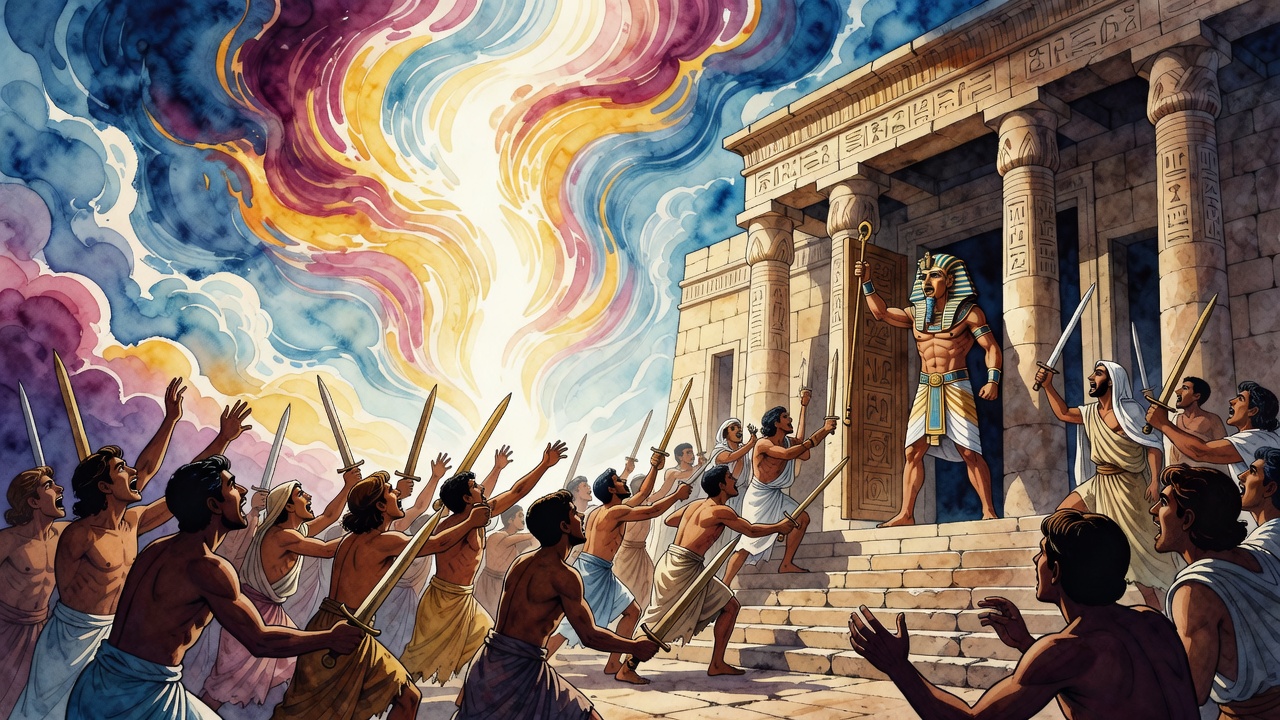
Firstborn sons stormed the palace with swords and pleas. Pharaoh beat them back. At exact midnight God walked Egypt without a guide.

Curated by Arthur · Told by Maggid ·
Table of Contents
  1. The Warning the Heirs Believed
  2. Blood on Three Altars Called a Door
  3. Midnight Without a Human Clock
  4. The Sound After the Stillness
Egypt's Firstborn Begged Pharaoh Before Midnight Click for full size

The Warning the Heirs Believed

Moses finished the last threat in a voice that left no poetry for comfort. At midnight the firstborn would die. Egypt's designated victims did the arithmetic their fathers refused. They went to Pharaoh and to the men who drank from his stubbornness. "Let the Hebrews go, or we shall all die." The sentence was not theology. It was inheritance bargaining with a clock.

The court calculated percentages. A fraction of the population, they said, was a bearable tax for keeping a slave nation. Advisors spoke of stability. Priests spoke of patience. The firstborn heard their own lives named as acceptable loss and felt the palace floor tilt. Some drew steel on their fathers in houses that had never known a son contradict a patriarch. Some stormed the approaches to the throne with the raw courage of people who have nothing left to inherit if they wait. Pharaoh ordered them beaten for insolence. The last civil war of the plagues was fought inside Egyptian families before heaven lifted a hand.

Midrash VaYosha remembers those swords. Measure answered measure across ten blows. Waters barred from Israelite women became blood. Street-sweeping became lice. Field labor, bathhouse labor, orchard and herd, each cruelty came home wearing a plague's face until even the air of Egypt felt like a courtroom. Still the king would not open the gate.

Blood on Three Altars Called a Door

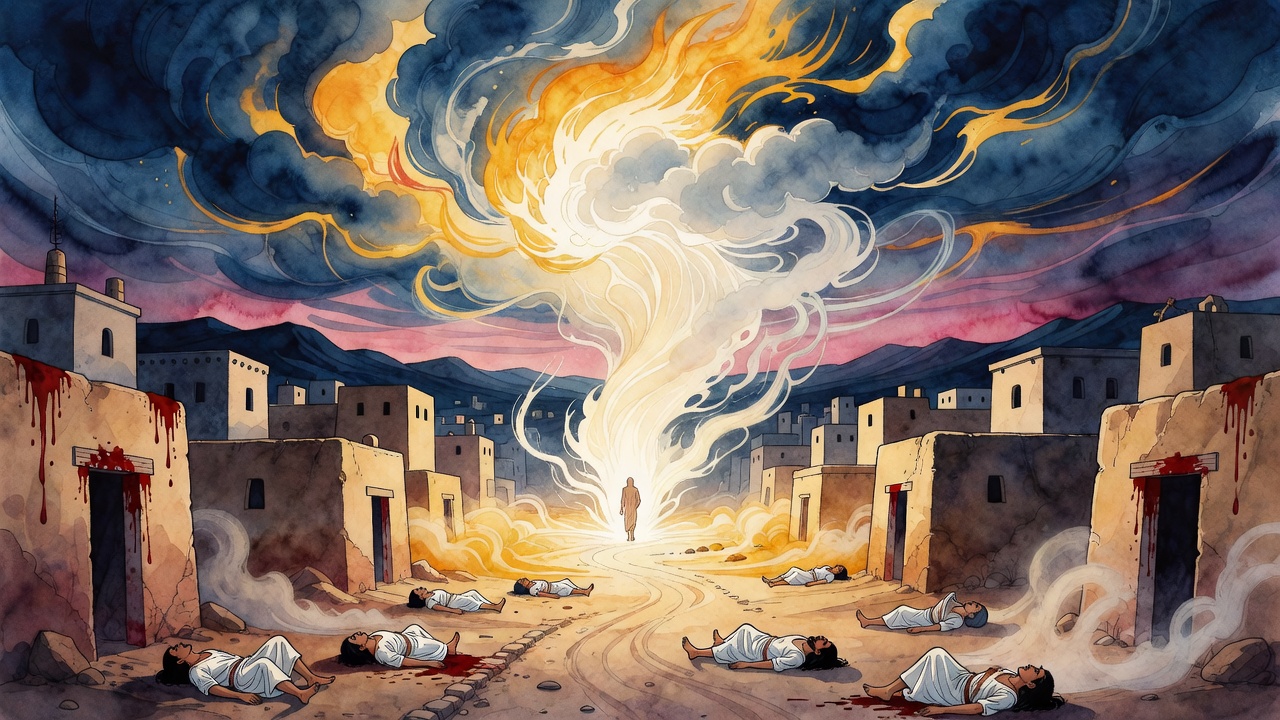
Israel took lambs chosen without blemish. Blood went on lintel and two doorposts in strokes that shook. The Mekhilta of Rabbi Ishmael treats those beams as altars. Sequence did not matter. Whether post or lintel first, the house became a small sanctuary on a night when ordinary houses were insufficient. Rabbi Shimon counted four sides, adding the threshold basin, so the doorway was framed in protection on every edge a hand could touch, a rectangle of mercy cut into wood and plaster.

They roasted meat in haste, bitter herbs sharp on the tongue, belts already fastened for a road they could not yet see. They prayed to lie down in peace, to have the Accuser removed from before and behind, to go out and come in toward life. Some Egyptians, half believing Moses and half mocking him, sent their firstborn to sleep in Hebrew rooms, hoping the plague would skip a threshold marked by foreign blood. Morning would show corpses beside living Israelites. Proximity is not covenant. Borrowed safety is not safety.

Midnight Without a Human Clock

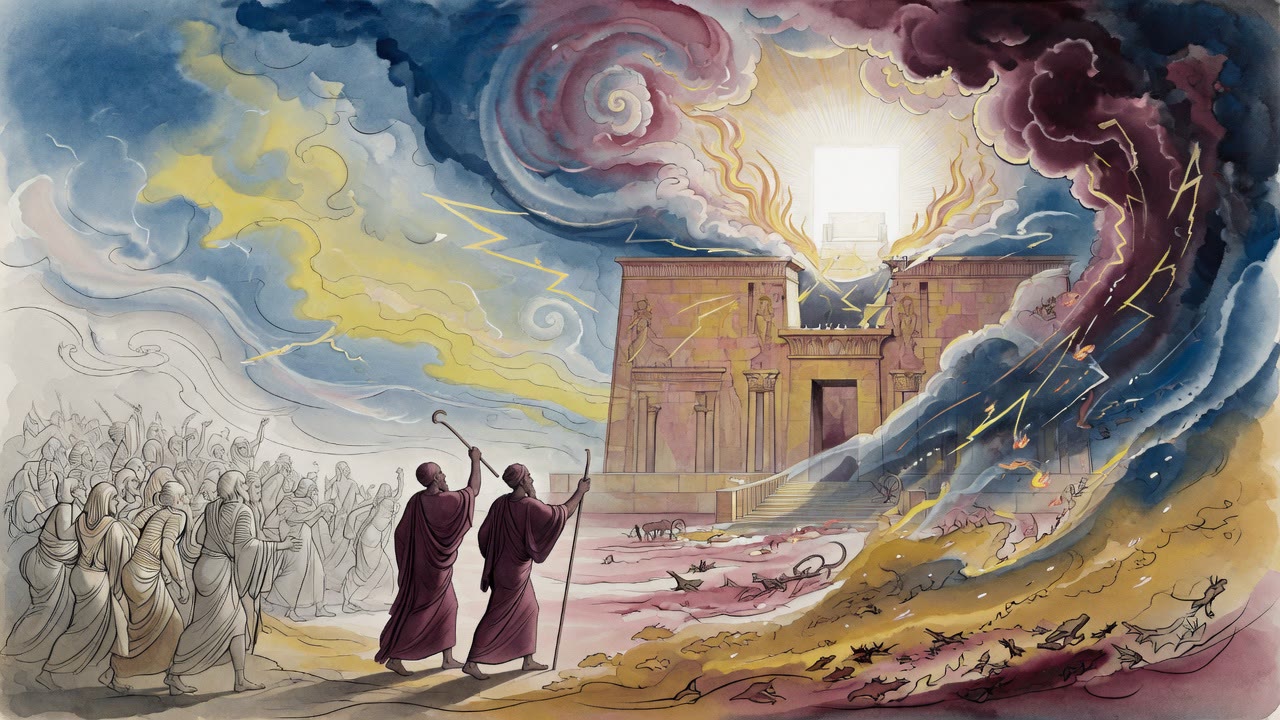
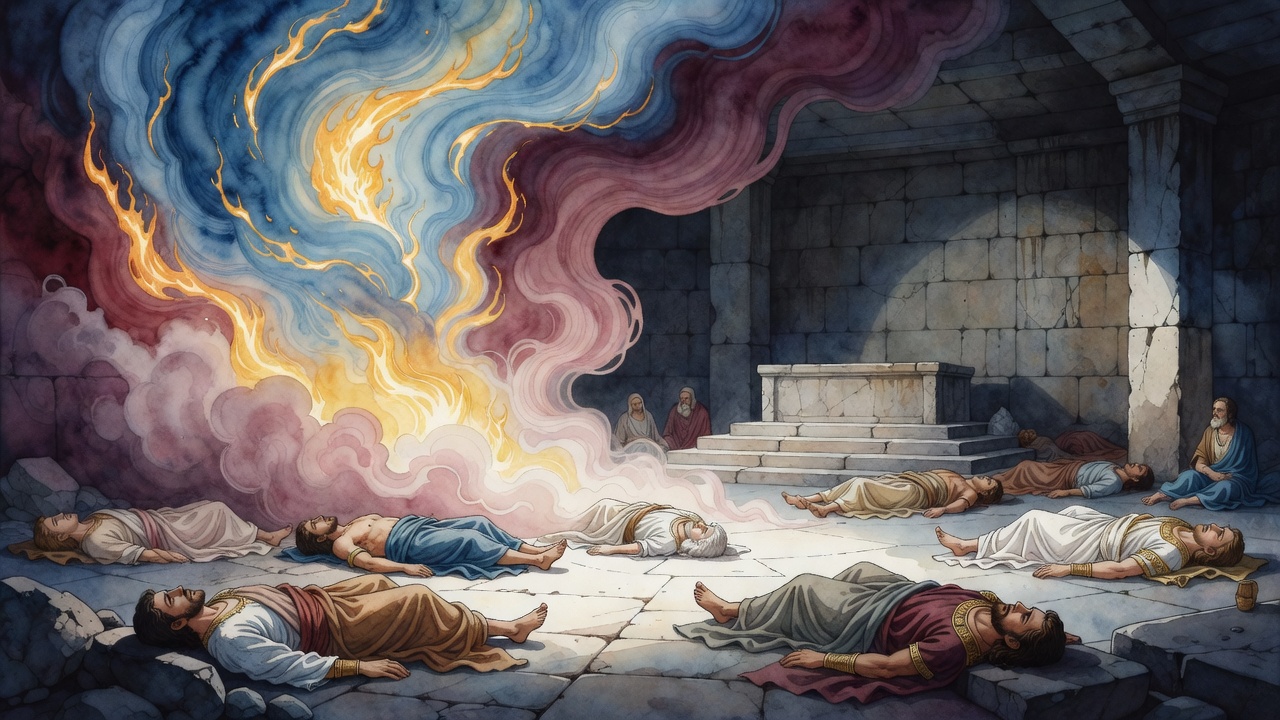
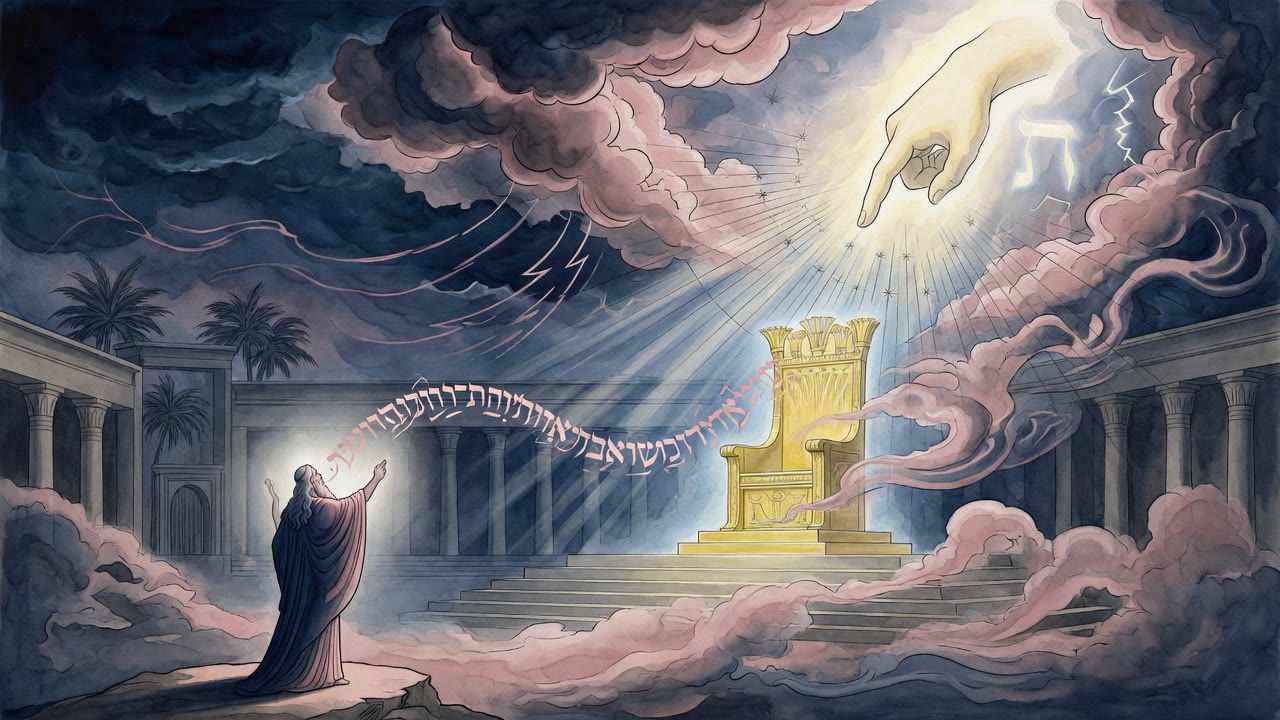
Tradition places the stroke at the exact middle of the night, a seam only God can feel, finer than any water clock in Pharaoh's house. Angels of destruction stood ready, hail and flame in their making, faces that unmake courage at a glance. God held them back. "I Myself will execute vengeance on the enemies of Israel." The Presence moved through Egypt without needing a guide in streets it had poured and named before any pyramid cast a shadow.

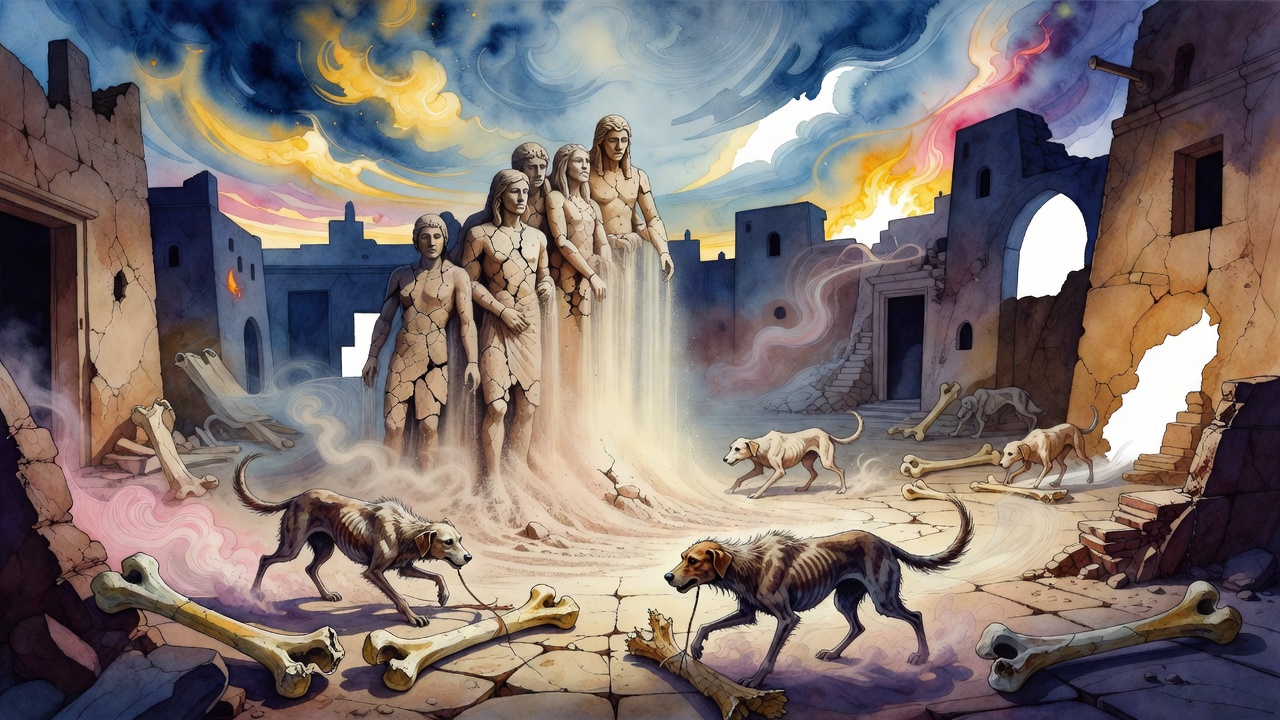
The decree widened past neat genealogy. Firstborn daughters. Firstborn of earlier unions forgotten by polite society. In houses where men had scattered seed carelessly, nearly every child could answer to the name firstborn. In some tellings the oldest in the house fell whether or not the midwife's memory matched the law. Egyptian firstborn abroad died in foreign beds. Foreign firstborn living in Egypt died under Egyptian roofs. Dogs dragged long-buried firstborn from household graves where the dead had been kept near the living. Monuments raised to dead heirs crumbled to powder as if stone could mourn late and dust could testify.

Slaves in pits, prisoners in iron, livestock that carried the rank of first, all entered the count. Egypt discovered that a king cannot bargain with a midnight that does not recognize his seals, his titles, or the soft mouth with which he once recruited brickmakers.

The Sound After the Stillness

A cry rose that no court musician had ever been paid to imitate, a braid of every house losing its future in the same hour. Pharaoh's neighbors came to the palace not as subjects but as a mob with empty arms and ruined heir-lists. He called for Moses in a voice that had run out of strategies. Go. Take what you take. Egyptians pressed gifts into Hebrew hands, silver and gold and garments, frantic to push the danger out of their doorways the way a man pushes a burning brand away from dry thatch.

Behind them the blood still marked the posts, dark and drying. Children of Israel stood in houses that had been altars for a night, shoes on, staffs in hand, children awake with questions no parent could finish. Ahead waited a sea and a road of dry ground that creation had never shown before. Behind waited a kingdom counting its dead with fingers that shook too hard for abacus beads, firstborn who had begged before midnight proven right in the only way no one wanted.

The heirs who stormed the palace had not been cowards. They had only been early. Heaven kept the appointment they advertised, and the lamb's blood on the wood did what Pharaoh's heart would not. Egypt learned the cost of a refused release in a single watch of the night, and Israel stepped into freedom wearing the smell of roast and hyssop.


← All myths
From the tradition

Sources

3 sources

The texts behind this telling. Some cards carry a translation of the source; others are our own retelling of it, and each card says which. Every card links out to the original.

Legends of the Jews, IV. Moses In Egypt, The Smiting Of The First-bornLegends of the Jews

Retold in our words. Read the original at the link below.Project Gutenberg eBook #1494, The Legends of the Jews, Volume 2 · Public Domain

The familiar version gives us the big picture: plagues, Moses, Pharaoh, the Red Sea. But what about the details, the little-known corners of the narrative? to one of the most dramatic moments: the slaying of the firstborn.

The tension. Moses, having warned Pharaoh of the impending doom, announces the death of the firstborn. Ginzberg, in his Legends of the Jews, tells us that these designated victims, realizing the gravity of the situation, pleaded with their fathers, "Let the Hebrews go, or we shall all die!" But Pharaoh, stubborn as ever, and his advisors, underestimated the power of the coming plague. They figured sacrificing a small percentage of the population was a reasonable price to pay to keep the Israelites enslaved. A grave miscalculation,.

The firstborn, desperate, even turned on Pharaoh, demanding he release the Israelites. In response? Pharaoh, in his fury, ordered his servants to beat them for their audacity! Seeing that gentle persuasion was getting them nowhere, they tried to force the issue. A truly chaotic scene.

Here’s where it gets even more intense. The Divine decree, as we find in the tradition, wasn't just limited to the firstborn sons. It included firstborn daughters, and not just from current marriages, but from all previous unions. Given the, shall we say, "dissolute" lifestyles of some Egyptians, as the text delicately puts it, this meant that in some families, nearly every child could be considered a firstborn!

And then, the hammer truly fell. in the story, God decreed that death would smite the oldest member of every household, regardless of whether they were actually the firstborn. The Zohar tells us of the precise timing – the exact middle of the night, a moment so precise only God could discern it. Imagine the terror as God Himself, attended by legions of terrifying angels of destruction, descended upon Egypt. These weren't your fluffy cherubs, mind you. These were beings fashioned from hail and flames, their very gaze inducing terror.

These angels were ready to unleash their full power, but God, in His wrath, held them back. He declared that He Himself would execute vengeance upon the enemies of Israel. A powerful statement about divine justice.

Some Egyptians, perhaps swayed by Moses' earlier warnings, tried to protect their firstborn by sending them to stay with their Hebrew neighbors, hoping the plague would bypass those homes. But in the morning, a horrifying discovery: the corpses of these Egyptian children lay beside the Israelites. A grim evidence of the inescapable nature of the Divine decree.

It's said that that night, the Israelites prayed a specific prayer: "Cause us, O Lord our God, to lie down in peace, remove Satan from before us and from behind us, and guard our going out and our coming in unto life and unto peace." Because, it was Satan who caused the frightful bloodshed among the Egyptians.

But the plague wasn't limited to Egyptian firstborn within Egypt. It struck Egyptian firstborn living abroad, and even the firstborn of other nationalities residing in Egypt. And, in a truly gruesome detail, even the long-dead firstborn weren't spared. The dogs dragged their corpses from their graves, a common Egyptian practice to bury the dead within their homes.

The Egyptians, understandably, mourned as if these deaths had just occurred. Even monuments and statues erected to honor the dead firstborn crumbled to dust.

And it didn't stop there. Slaves, even those imprisoned, weren't exempt. Even the most downtrodden held animosity towards the Hebrews, and rejoiced in their persecution. So, they too, were punished. Female slaves grinding corn, who wished for the Israelites to be silenced, shared in the fate.

The text emphasizes that in punishing these aliens, God demonstrated his dominion over both the land and the false gods of the Egyptians. Had the slaves and captives been spared, they might have attributed their survival to their own deities. Therefore, all the Egyptian idols were destroyed that night – stone idols ground to dust, wooden idols rotting, metal idols melting away. This prevented the Egyptians from attributing their suffering to the wrath of their own gods.

Even the firstborn of the cattle were not spared, because the Egyptians worshipped animals. God wanted to make it absolutely clear that their gods were nothing but vanity.

So, what are we to make of this intense, almost unbelievable story? It’s also a powerful, albeit brutal, statement about justice, both for the oppressed and against those who perpetuate oppression. It forces us to confront uncomfortable questions about divine retribution and the consequences of unchecked power. It's a story that continues to resonate, challenging us to consider the complexities of faith, justice, and the enduring struggle for freedom.

Full source
Mekhilta Tractate Pischa 6:5Mekhilta DeRabbi Yishmael

Retold in our words. Read the original at the link below.Mechilta, translated by Rabbi Shraga Silverstein · CC-BY

Mekhilta examines the command of the first Passover in Egypt, when Israel was told to take the blood of the lamb and "place it on the two side posts and on the lintel of the houses" (Exodus 12:7). The legal question the rabbis raise is one of order: if a person smeared the blood on one place before the other rather than all at once, might we think he had failed to fulfill the commandment?

To settle the matter the sages bring the parallel verse, "and you shall take a bunch of hyssop and dip it in the blood that is in the basin, and you shall touch the lintel and the two doorposts" (Exodus 12:22). Because that verse lists the lintel first and the doorposts second, while the earlier verse named the doorposts first, the two together teach that the sequence does not matter. Even if a person reversed the order, he has fulfilled his obligation, since Scripture itself records the two in opposite arrangements.

From this the rabbis draw a further point about the houses of Egypt. They learn that our forefathers had, in effect, three altars upon which the blood of the offering was placed, namely the lintel and the two doorposts of each home, so that the doorway itself became a place of sacrifice and protection on the night of redemption. R. Shimon disagrees and counts four, adding the saf, the threshold or basin at the bottom of the door, to the lintel and the two posts, expanding the sacred frame of the doorway to all four of its sides.

Full source
Midrash Vayosha 7Midrash VaYosha

Translation of the source text.Otzar Midrashim, New York 1915, Public Domain · CC-BY-SA

"And in the greatness of Your majesty" (Exodus 15:7), The Sages said: Ten plagues did the Holy One, blessed be He, bring upon the Egyptians in Egypt. The first plague He brought upon them was blood. And why did He bring blood upon them? Because the Egyptians prevented the daughters of Israel from performing immersion; therefore He brought blood upon them. The second plague He brought upon them was frogs, which fell into their kneading-troughs and into the chambers of their dwellings and their beds, and croaked in their faces. And the plague of frogs was the harshest of them all. And why did He bring frogs upon them? Because the Egyptians used to say to Israel, "Go, hunt fish for us" (another version: creeping and crawling things) "from the sea"; therefore He brought frogs upon them. The third plague He brought upon them was lice, and the lice were a cubit high upon the ground, and when the Egyptians put on their clean garments they were immediately filled with lice. And why did He bring lice upon them? Because the Egyptians used to say to Israel, "Go and sweep our houses, our courtyards, and the marketplaces"; therefore the dust of the earth was turned into lice.

The fourth plague He brought upon them was a mixture of lions, wolves, bears, and leopards, and they entered their houses, and the Egyptians shut their doors. And the Holy One, blessed be He, sent them a beast from the sea, whose name is siloni, and it would enter through the windows and open the doors, and the beasts would enter and devour the Egyptians. And why did He bring the mixture upon them? Because the Egyptians used to say to Israel, "Go and hunt beasts for us from the field"; therefore He brought the mixture upon them. The fifth plague the Holy One, blessed be He, brought upon them was pestilence. And why did He bring pestilence upon them? Because the Egyptians used to say to Israel, "Go and pasture our cattle for us"; therefore He brought pestilence upon them, so that all their cattle died. The sixth plague the Holy One, blessed be He, brought upon them was boils, on man and on beast. And why did He bring boils upon them? Because the Egyptians used to say to Israel, "Go and prepare bathhouses for us, that we may pamper ourselves"; therefore He brought boils upon them, which heated their flesh.

The seventh plague the Holy One, blessed be He, brought upon them was hail, upon man and upon beast. Why? Because the Egyptians used to say to Israel, "Go, plow and sow our fields and our land"; therefore He brought hail upon them, which shattered the trees and the seedlings. And the Sages said: When Moses lifted his hands to the Holy One, blessed be He, the hail stood between heaven and earth, as it is said, "And Moses went out of the city from Pharaoh, and spread out his hands to the Lord, and the thunderings and the hail ceased, and the rain was not poured upon the earth" (Exodus 9:33), rather it was suspended between heaven and earth, until Joshua came and waged war with those thirty-one kings, and the Holy One, blessed be He, cast it down upon them, as it is said, "more died from the hailstones than those whom the children of Israel slew with the sword" (Joshua 10:11). And what remains the Holy One, blessed be He, will rain down upon Gog and Magog, as it is said, "Then the Lord shall go forth and fight against those nations, as when He fought in the day of battle" (Zechariah 14:3). The eighth plague the Holy One, blessed be He, brought upon them was locusts, whose teeth were like the teeth of a lion and which had the fangs of a lioness. Why did He bring locusts upon them? Because the Egyptians used to say to Israel, "Go and plant trees for us and guard their fruits"; therefore He brought locusts upon them, and they ate what remained of the hail.

The ninth plague the Holy One, blessed be He, brought upon them was the darkness of Gehinnom, and one who was sitting could not stand, and one who was standing could not sit, because of the heaviness of the darkness. And why did He bring darkness upon them? Because there were transgressors among Israel, and the Holy One, blessed be He, sought to put them to death during the three days of gloom, so that the Egyptians would not see their downfall and rejoice over them; therefore He brought darkness upon them. And the tenth plague, that is the plague of the firstborn. And before the plague came, Moses went to the firstborn of Egypt and said to them, "Thus says the Lord: About midnight I will go out into the midst of Egypt, and every firstborn in the land of Egypt shall die" (cf. Exodus 11:4-5). Immediately all the firstborn of Egypt went to their fathers and said to them, "Know that all the plagues that Moses said, they have all come, and now he has said that every firstborn in the land of Egypt shall die." Their fathers answered them, "Go to Pharaoh, for he too is a firstborn." And so they did, and they said to him, "Send out this people, and if you do not send them, every firstborn in the land of Egypt shall die." Pharaoh said to his servants, "I said: either my life shall go forth or their life shall go forth" (its meaning: I shall die, or Israel shall die, before I send them out). And he said to his servants, "Strike them with every kind of chastisement." Immediately all the firstborn of Egypt went and each took his sword and slew their fathers, as it is said, "to Him who struck Egypt through their firstborn" (Psalms 136:10). And on top of all this, at midnight every firstborn of Egypt was slain. Therefore it is said, "And in the greatness of Your majesty You overthrow those who rise up against You; You send forth Your wrath, it consumes them like stubble" (Exodus 15:7).

"And with the blast of Your nostrils the waters were piled up" (Exodus 15:8), The Sages said: When the waters of the sea saw the love with which the Holy One, blessed be He, loved Israel, the waters lowered themselves for the honor of Israel; and the sea too lowered itself and made itself into twelve splits (paths) corresponding to the twelve tribes of Israel, and raised its waves on high six hundred cubits (mil), and congealed itself below, and made its waters sweet, and made itself like a wall, and windows were made in it so that Israel could see one another and praise the Holy One, blessed be He, with songs and praises, and they walked within the sea like a man who walks in his house, until they came out onto dry land. Therefore it is said, "And with the blast of Your nostrils the waters were piled up, the floods stood upright like a heap, the depths congealed in the heart of the sea" (Exodus 15:8).

"The enemy said" (Exodus 15:9), The Sages said: When the Egyptians pursued Israel at the sea, they became three companies. The first company said, "Let us drown ourselves in the sea"; the second company said, "Let us return to Egypt"; and the third company said, "Let us wage war with them." To the company that said, "Let us drown ourselves in the sea," Moses said, "Stand firm and see the salvation of the Lord" (Exodus 14:13). To the company that said, "Let us return to Egypt," Moses said, "You shall not see them again forever" (cf. Exodus 14:13). To the company that said, "Let us wage war with them," Moses said, "The Lord will fight for you, and you shall hold your peace" (Exodus 14:14). And when the sea was split, the report of it was heard from one end of the world to the other, and the waters rose one thousand six hundred mil (in Targum Yonatan on the portion Beshalach it states: three hundred mil), and all the world was terrified and seized with dread and trembling. At that hour all the tribes stood at the edge of the sea and said, "Who shall go down into the sea first?" until the tribe of Benjamin leaped and went down first, and all the tribes after him. Therefore Benjamin merited that there went forth from him Mordecai the Righteous, through whom Israel was redeemed from death to life. When the Egyptians saw that Israel had entered the Sea of Reeds, they too divided into three companies. The first company said, "Let us bring them back to Egypt"; the second company said, "Let us kill them"; the third company said, "Let us strip them and leave them naked." To the company that said, "Let us bring them back to Egypt," the Holy One, blessed be He, blew upon them with His wind and the sea covered them, as it is said, "You blew with Your wind, the sea covered them" (Exodus 15:10); and the company that said, "Let us kill them," the Holy One, blessed be He, drowned, as it is said, "and the choicest of his officers are drowned in the Sea of Reeds" (Exodus 15:4); and the company that said, "Let us strip them and leave them naked," the Holy One, blessed be He, shook into the sea, as it is said, "and the Lord shook off Egypt in the midst of the sea" (Exodus 14:27). When the Egyptians saw that the punishment had begun upon them, they said, "The God of Israel is exceedingly great; let us turn and flee to Egypt." When the Holy One, blessed be He, saw this, He sent before them an angel in the form of a female horse, and it entered the sea, and all the horses ran after it and entered the sea against their will. Immediately the Holy One, blessed be He, said to Moses, "Stretch out your hand over the sea, and the waters shall return upon Egypt." And Moses stretched out his hand over the sea, and immediately Israel plundered the wealth of Egypt. Therefore it is said, "The enemy said, 'I will pursue, I will overtake, I will divide the spoil; my desire shall be satisfied upon them; I will draw my sword, my hand shall dispossess them'" (Exodus 15:9).

Full source