Parshat Noach5 min read

Noah Stepped Out of the Ark and Wept for the World

The flood ended, but Noah would not open the ark until God swore. On dry ground, his grief turned into an accusation against heaven.

Curated by Arthur · Told by Maggid ·
Table of Contents
  1. The Door Stayed Shut
  2. The Oath Came Before the First Step
  3. Noah Wept on Dry Ground
  4. God Answered from the Ruins
  5. Smoke Rose from a Wounded Earth
  6. Remembered With the Animals

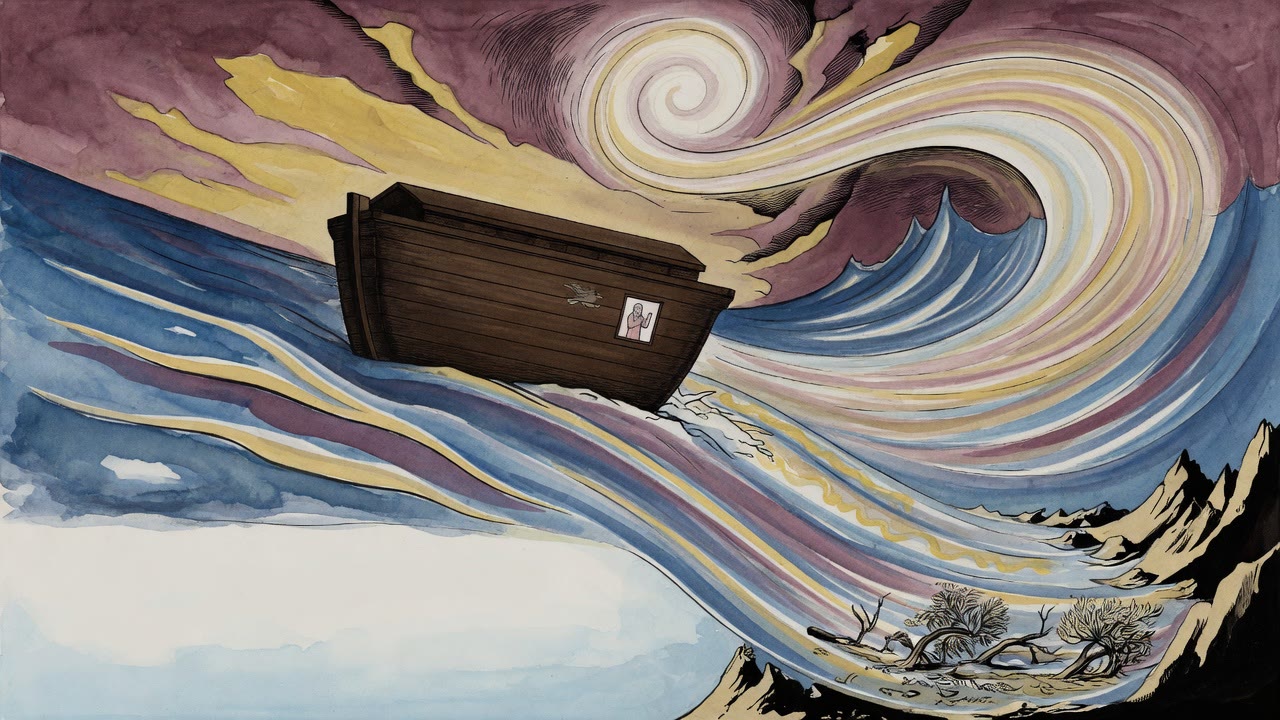
The ark had stopped moving, but Noah kept the door shut. Outside was dry ground. Inside was the last breathing remnant of the world.
The Door Stayed Shut

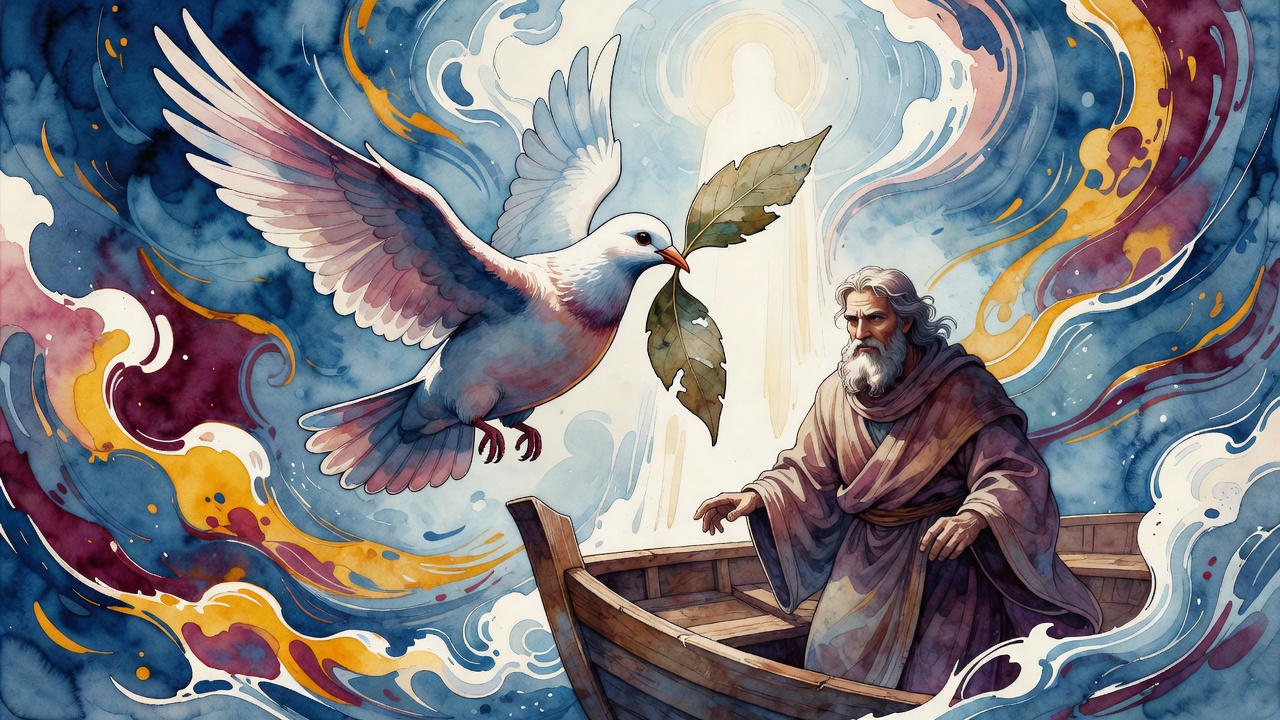
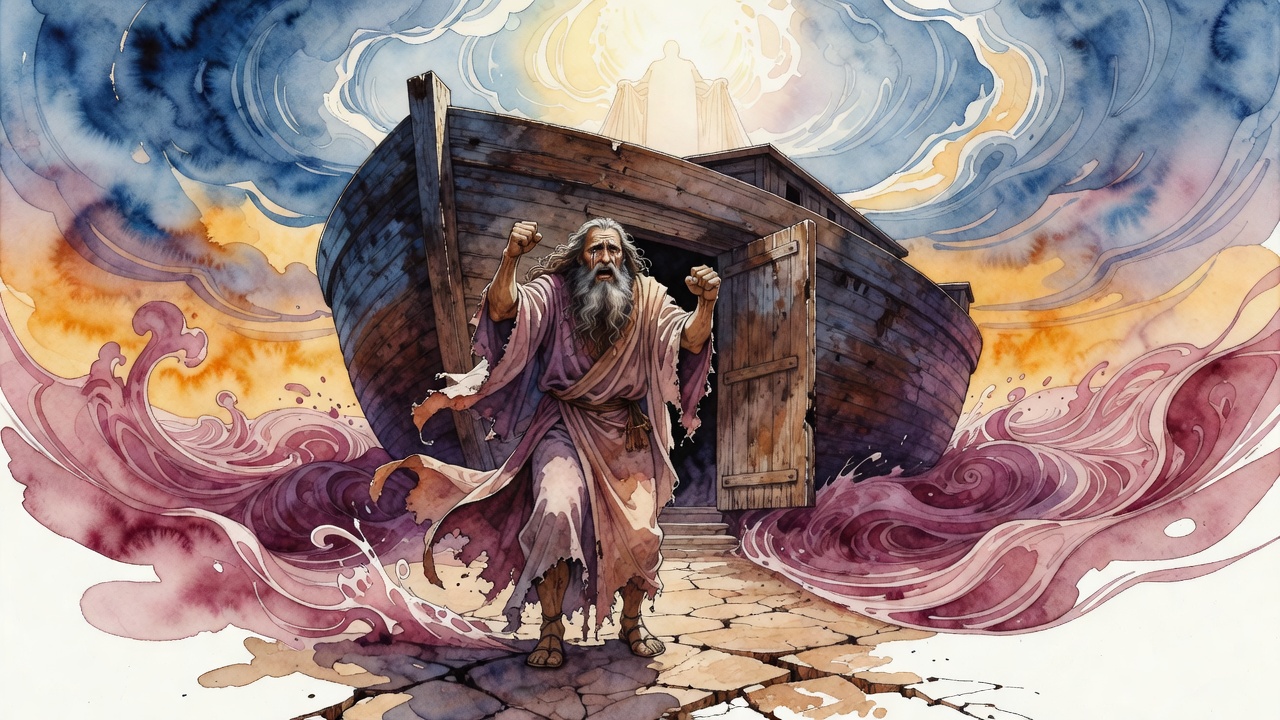
The waters had pulled back. The wind had passed over the earth. Beasts shifted in their stalls, birds beat their wings against the stale air, and Noah listened for the same voice that had ordered him into the ark.

He would not leave by instinct. He had entered at the bidding of God, and he would leave only at God's bidding. Survival had taught him obedience down to the hinge. A door opened too early could still be rebellion.

Then the command came. Go out from the ark.

Noah did not move.

The Oath Came Before the First Step

The man who had survived the flood was afraid of the future. He could step out, raise children, fill the earth again, and then watch the waters return after another generation failed. He had already heard the world break once. He would not rebuild inside a threat.

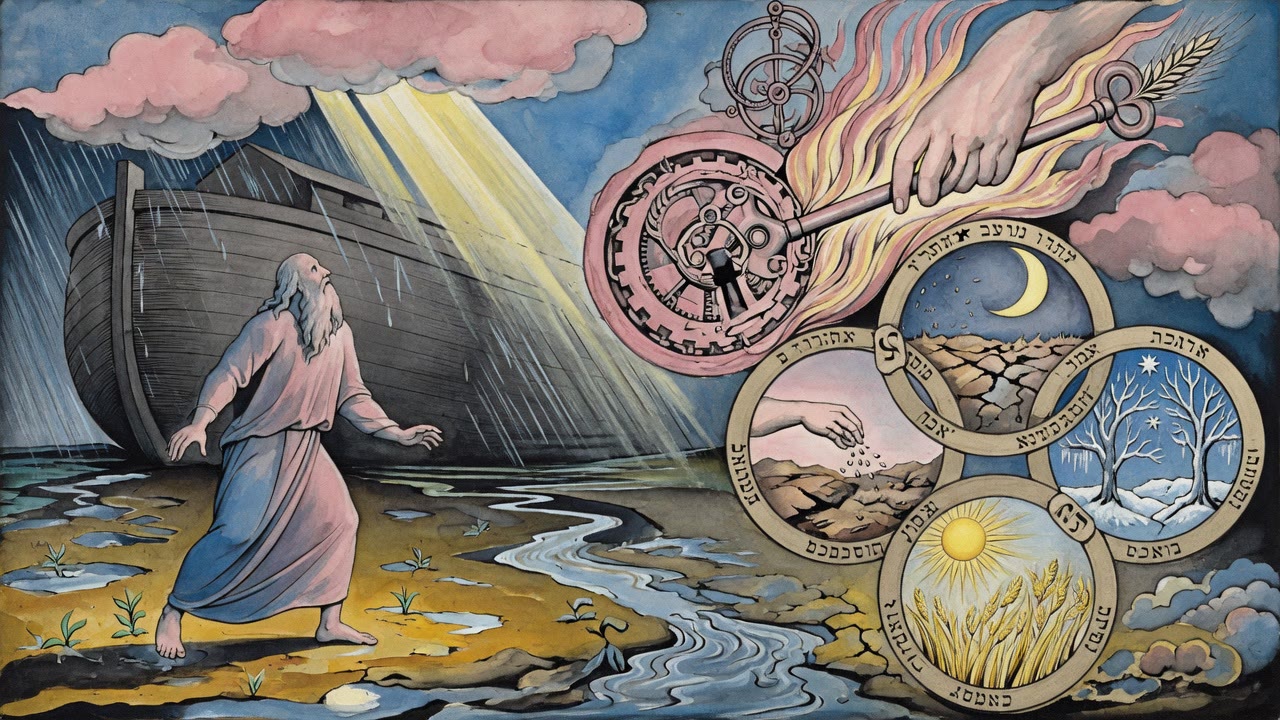
So Noah held the doorway closed until God swore. No more flood to destroy the earth. No second drowning after the first renewal. The oath had to come before the footstep, because a world without a promise was only a grave with sunlight on it.

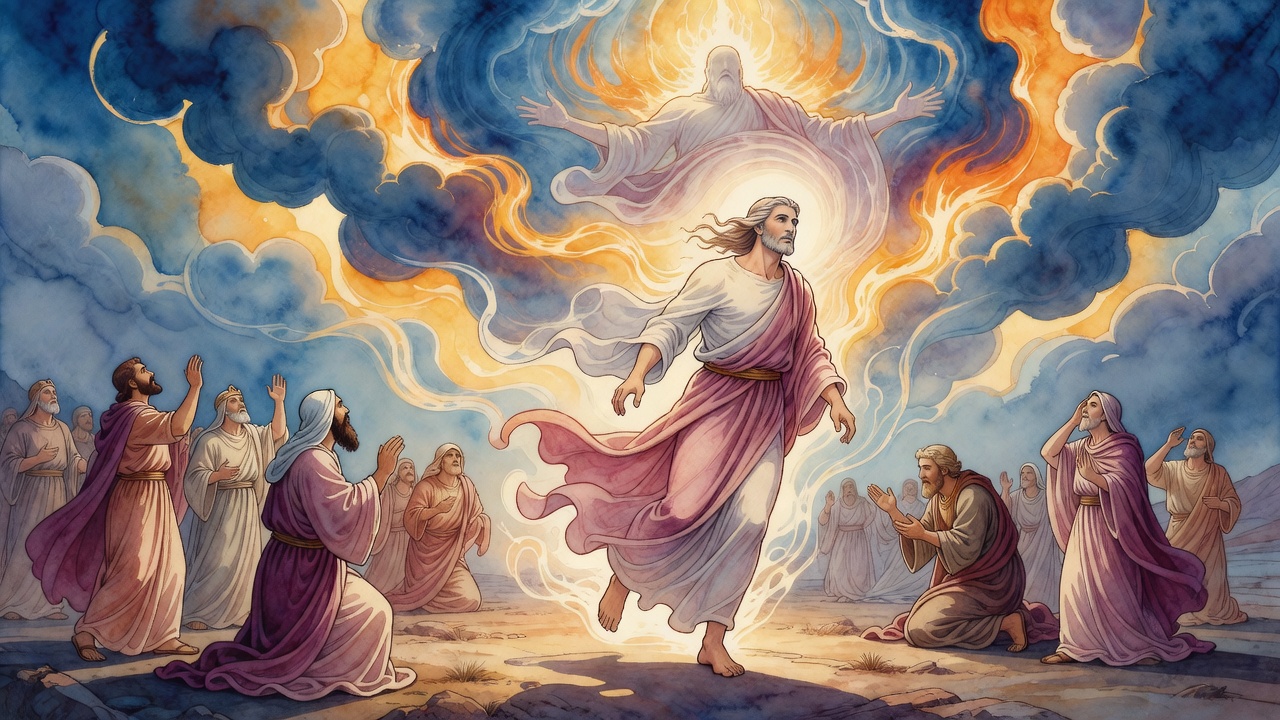
Only then did Noah open the ark. Damp air struck his face. Mud took the mark of his feet. Behind him came his family, then the animals, pairs and herds and trembling wings pouring into a silence too large for them.

Noah Wept on Dry Ground

The earth had been emptied.

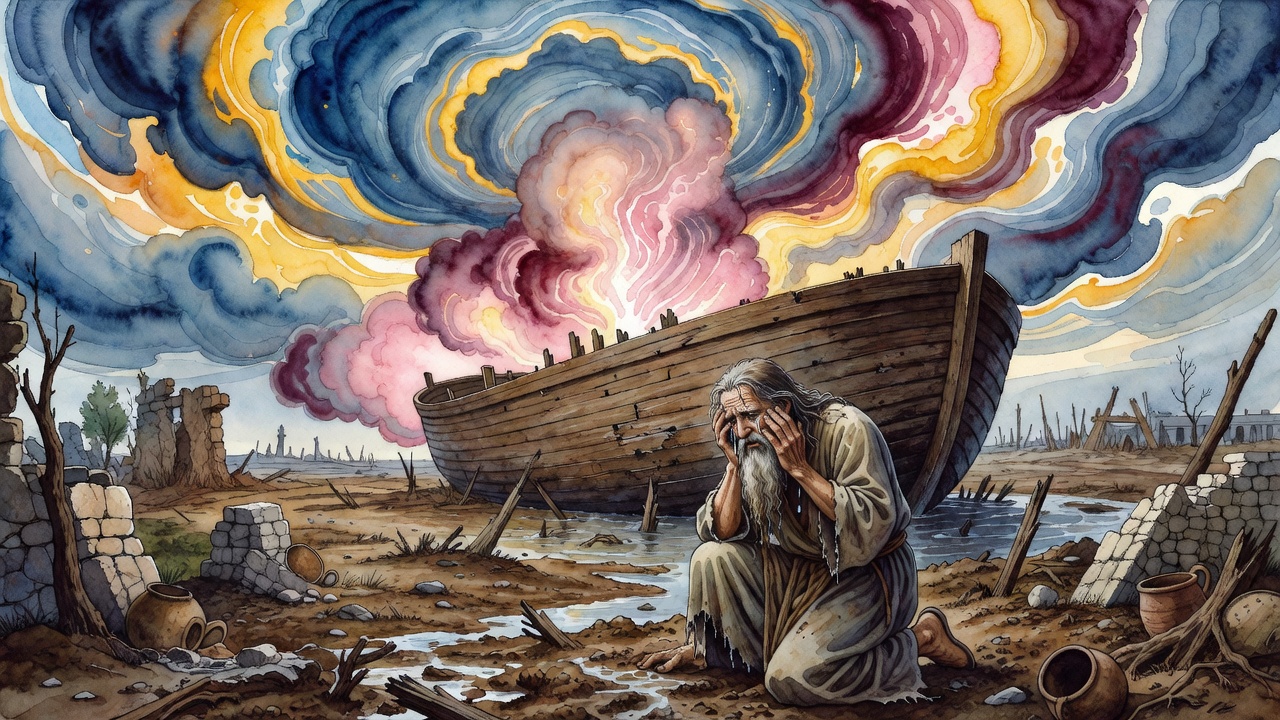
No market noise. No neighbors. No children running between tents. No arguments over wells, no smoke from cooking fires, no one calling across a field. The world had become wide enough for grief to echo.

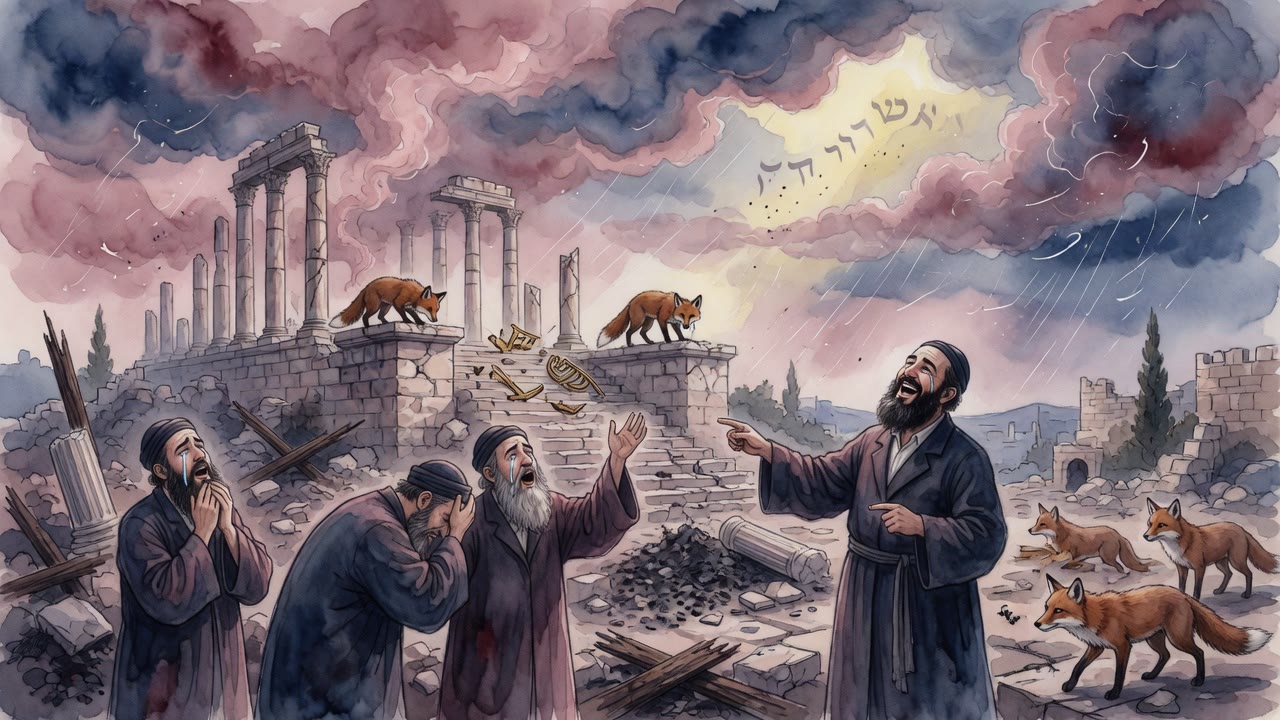
Noah stood there and wept. Then he turned his grief upward. Master of the world, You are called Merciful. You should have had mercy on Your creatures.

It was a terrible thing to say after being saved. It was also the first human sound on the other side of judgment that was not relief. Noah looked at the ruined earth and could not keep silence.

God Answered from the Ruins

God's answer cut harder than the floodwater.

Where were your tears before the door closed? The ark had not been built in an hour. Its boards had risen in public, year after year, high enough for the doomed to see. Every plank was a warning. Every hammer strike was a chance for someone to ask, and for Noah to answer, and for prayer to rise before rain did.

Noah had built well. He had obeyed. He had saved his household. But he had not stood before God for the generation that was about to drown. He had not torn open heaven with a plea for the people outside the door.

Righteousness can preserve a man and still leave him wounded by what he failed to ask.

Smoke Rose from a Wounded Earth

Noah prepared an offering on the washed-clean ground. The animals had stepped out alive because God had remembered not only the man, but the beasts and all that had breathed with him in the ark. The first altar after the flood rose in a world where memory had included hooves, feathers, hides, and human fear.

But Noah could not perform every priestly act himself. The offering rose through hands marked by survival and limitation. The smoke climbed over mud, over bones hidden beneath the softened earth, over the place where the ark had opened like a second creation.

The sacrifice did not erase the accusation. It stood beside it. Noah could weep, accuse, obey, and offer in the same ruined morning. That is what remained of him after the water.

Remembered With the Animals

God remembered Noah, and all the living things with him. The words do not leave the animals as scenery. They are named inside the rescue. The same judgment that had been a great deep now met righteousness like mighty mountains, and the ark became the place where man and beast were carried together through the end.

Noah's first day outside was not clean triumph. It was oath, mud, grief, rebuke, and smoke. The saved man stood on dry land and learned that being spared is not the same as being finished.


← All myths
From the tradition

Sources

2 sources

The texts this telling draws on, in full. Open a card to read inline, or expand it for a wider, quieter read.

Legends of the Jews, IV. Noah, Noah Leaves The ArkLegends of the Jews

Sounds… intense. That’s what Noah faced. But what happened after the floodwaters receded? it first appears it was all sunshine and rainbows, but the story, as the Legends of the Jews recounts, is a little more complicated.

Even after the year of punishment was over, Noah didn’t just throw open the ark doors and say, "Alright, everyone out!" No, he waited. Why? Because, as Ginzberg tells us, "As I entered the ark at the bidding of God, so I will leave it only at His bidding." He wasn't about to make a move without divine instruction.

When God did tell Noah to leave the ark, Noah hesitated. He refused! Can you imagine? After all that, he was reluctant to step back onto dry land. The reason? He feared God might send another flood after he and his family had repopulated the earth. He wouldn't budge until God swore – swore! – that He would never again destroy the world with a flood.

When Noah finally emerged, he was overcome with grief at the devastation. He wept bitterly, questioning God: "O Lord of the world! Thou art called the Merciful, and Thou shouldst have had mercy upon Thy creatures." It's a very human reaction. To see such destruction and to question the divine plan.

But God, in turn, rebuked Noah. He reminded Noah that He had warned him about the impending flood, giving him the opportunity to plead for humanity. But, as God says, Noah was too busy building his ark to worry about anyone else. Ouch. It's a harsh lesson about responsibility and the importance of interceding on behalf of others.

Noah, realizing his mistake, sought to atone for his inaction. He offered a sacrifice to God. Noah didn't perform the priestly duties himself; his son Shem did. Why? Well, legend has it that Noah had been injured by a lion in the ark – a hungry lion he’d forgotten to feed! This left him with a physical defect, disqualifying him from performing priestly duties. The sacrifices included various animals – an ox, a sheep, a goat, turtle doves, and pigeons. These were likely chosen, the text suggests, because Noah believed they were designated for sacrifice, as God had instructed him to bring seven pairs of them into the ark.

The altar, we are told, was erected on the very spot where Adam, Cain, and Abel had offered their sacrifices, and where the altar in the Jerusalem Temple would later stand. Talk about a place steeped in history!

After the sacrifice, God blessed Noah and his sons, granting them dominion over the world, just as He had done with Adam. He commanded them to be fruitful and multiply. The text notes that during their time in the ark, humans and animals had practiced abstinence, as "while a public calamity rages continence is becoming even to those who are left unscathed." However, Ham, along with a dog and a raven, broke this rule and were punished. Ham’s punishment, according to this tradition, was that his descendants would have dark skin.

As a sign of His promise never to flood the earth again, God set His bow in the cloud – the rainbow. Even when humanity sins, the rainbow serves as a reminder that their sins won't bring about another deluge. The text adds a fascinating detail: when people were particularly righteous, the rainbow wouldn't even appear, because there was no need for a reminder of God's promise.

God then granted Noah and his descendants permission to eat meat, something that had been forbidden since the time of Adam. However, they were forbidden from consuming blood. God also established the seven Noachian Laws, a set of moral principles binding on all of humanity, not just the Jewish people.

One of the most important of these laws was the prohibition against murder. "Whoso would shed man's blood, his blood would be shed," God declared. Even if human courts failed to punish a murderer, divine justice would prevail. And even animals that killed humans would be held accountable.

So, what does this all mean? The story of Noah's exit from the ark is more than just a tale of survival. It's a story about responsibility, atonement, and the establishment of a new moral order for humanity. It reminds us that even after the worst of times, there is always the possibility of renewal, and that with renewal comes the responsibility to build a better world. A world, perhaps, where we don't need rainbows quite so often.

Full source
Bereshit Rabbah 33:1Bereshit Rabbah

Our journey begins with the story of Noah and the flood. (Genesis 8:1) tells us, "God remembered Noah, and all the beasts, and all the animals that were with him in the ark; God caused a wind to pass over the earth, and the water subsided." But what does it mean that God "remembered?" It's not like He forgot. The verse is immediately followed by a quote from (Psalms 36:7): "Your righteousness is like mighty mountains [keharerei el]; Your judgments are a great deep. Lord, You save man and animal." This juxtaposition is where the fun begins!

The Bereshit Rabbah, a classic collection of rabbinic interpretations of Genesis, delves deep into this connection. Rabbi Yishmael and Rabbi Akiva, two towering figures of Jewish thought, offer contrasting views. Rabbi Yishmael suggests that God deals with the righteous "up to the mighty mountains" – meaning, He is exceedingly generous with them because they accepted the Torah, which was given from the "mountains of God." But the wicked, who rejected the Torah? God is exacting with them "down to great depths."

Rabbi Akiva, ever the nuanced thinker, disagrees. He argues that God is exacting with everyone "down to great depths." With the righteous, He collects His due for the few bad deeds they performed in this world, ensuring they receive a better reward in the World to Come. And the wicked? He showers them with tranquility and reward for the few good deeds they did in this world, only to exact a fuller retribution from them in the World to Come. It's like God is settling accounts, making sure everyone gets what they deserve, eventually.

Rabbi Levi adds another layer, suggesting the verse is a metaphor comparing the reward of the righteous to their abode and the punishment of the wicked to their abode. The righteous are promised pasture on the "mountains of the height of Israel" (Ezekiel 34:14), while the wicked descend to the "netherworld" (Ezekiel 31:15), covered in darkness.

Rabbi Yehuda bar Rabbi even plays with the Hebrew word he'evalti, meaning "I caused mourning," in (Ezekiel 31:15). He cleverly suggests reading it as hovalti, "I led him [to the netherworld]." He uses the analogy of a vat, noting that you don't cover a vat made of clay with silver or gold; you use more clay. Similarly, the wicked, who are darkness themselves, are led to Gehenna (hell), and covered with the depths of the earth – darkness covering darkness.

Rabbi Yonatan, citing Rabbi Yoshiya, gives a brilliant twist, transposing the words of the verse to read, "Your righteousness is upon Your judgments; like mighty mountains are upon the great depths." He explains that just as mountains weigh down the water of the deep, preventing it from flooding the world, so too do the righteous suppress God's strict judgments, preventing them from incinerating the world. And just as mountains are endless, so is the reward of the righteous. Just as mountains are sown and produce fruit, so do the actions of the righteous produce fruit, as (Isaiah 3:10) says, "Say of the righteous man that it shall be well with him, for they will eat the fruit of their actions." Conversely, the punishment of the wicked is as unmeasurable as the depths of the earth, and their actions bear no fruit.

The Midrash (rabbinic interpretive commentary) then shares a story about Rabbi Yehoshua ben Levi visiting Rome. Seeing opulent pillars draped in weaves to protect them from the elements, and then witnessing a poor man shivering in rags, he recited the verse: "Your righteousness is like mighty mountains" for the pillars – to the one to whom You give, You give abundantly. And for the poor man, "Your judgments are great depths" – to the one whom You hit, You hit powerfully.

Another anecdote features Alexander the Great visiting a king who, when asked why he doesn't need Alexander's money, replies he only wants to know how Alexander administers justice. The king then resolves a complex property dispute by having the claimants' children marry each other and share the treasure found on the land. Alexander, astonished, admits he would have simply killed both claimants and seized the treasure. The king rebukes him, saying that the rain and sunshine aren't for Alexander's sake, but for the sake of the animals, echoing (Psalms 36:7): "Lord, You save man and animal" – the Lord saves man for the sake of the animals.

Finally, Rabbi Yehuda bar Simon returns us to Noah, explaining that God's righteousness toward Noah was performed through the "mighty mountains" upon which the ark rested (Genesis 8:4). The suffering imposed on Noah's generation was through the "great depths" of the floodwaters (Genesis 7:11). And when God remembered Noah, He remembered not just Noah himself, but everything that was in the ark with him – "God remembered Noah and all the beasts…"

So, what does all this mean for us? Perhaps it's a reminder that the world isn't always fair in the short term. Sometimes, the righteous suffer, and the wicked prosper. But the Bereshit Rabbah suggests a deeper, more complex accounting at play. A system where actions have consequences, where even small acts of goodness are recognized, and where, ultimately, everyone receives their due. Maybe that's a comforting thought in a world that often feels chaotic and unjust. It reminds us that even when we don't understand the "why," there's a grander design at work, a cosmic balance being maintained.

Full source