Parshat Noach5 min read

Noah's Baby Walked the Ark Over Open Fangs

On the Ark a year-old child stepped across snakes unharmed, while Noah prayed under a Name later generations no longer knew how to speak.

Curated by Arthur · Told by Maggid ·
Table of Contents
  1. Fangs on the Planks
  2. Stories in the Belly of Wood
  3. The Name He Could Not Teach
  4. Prayer Under Pitch
  5. What the Body Remembers
Noah's Baby Walked the Ark Over Open Fangs Click for full size

Fangs on the Planks

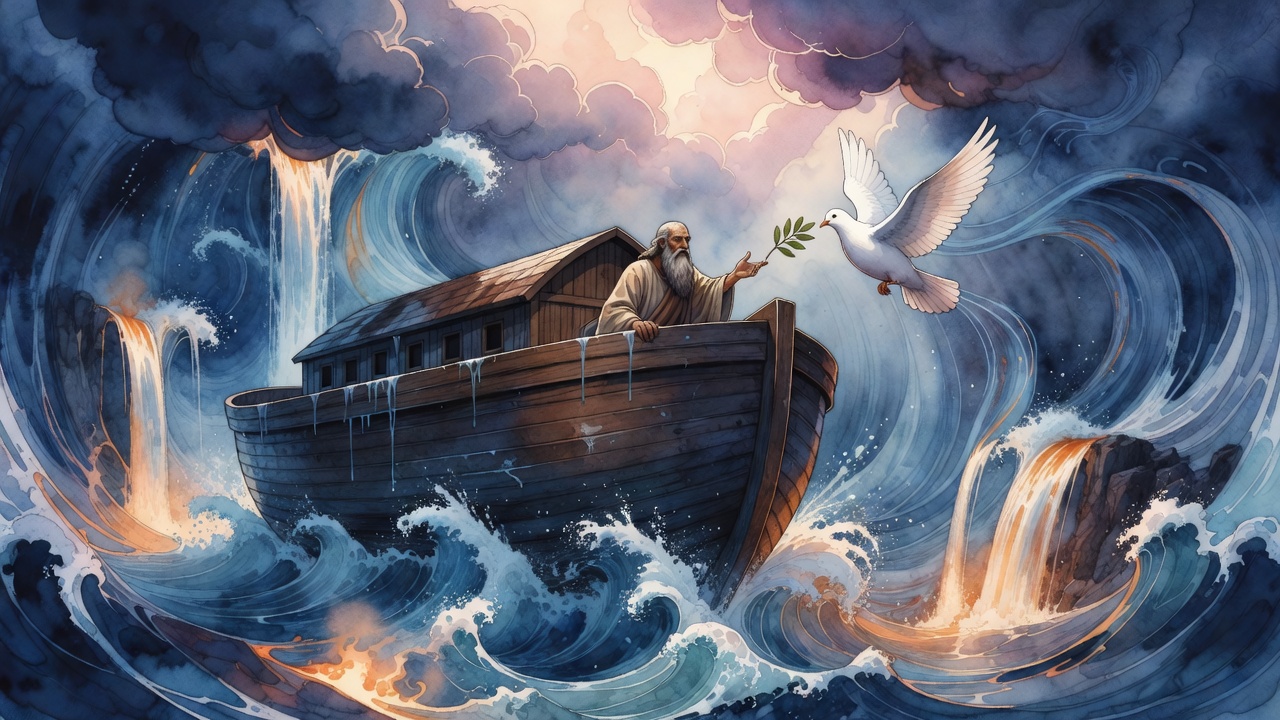
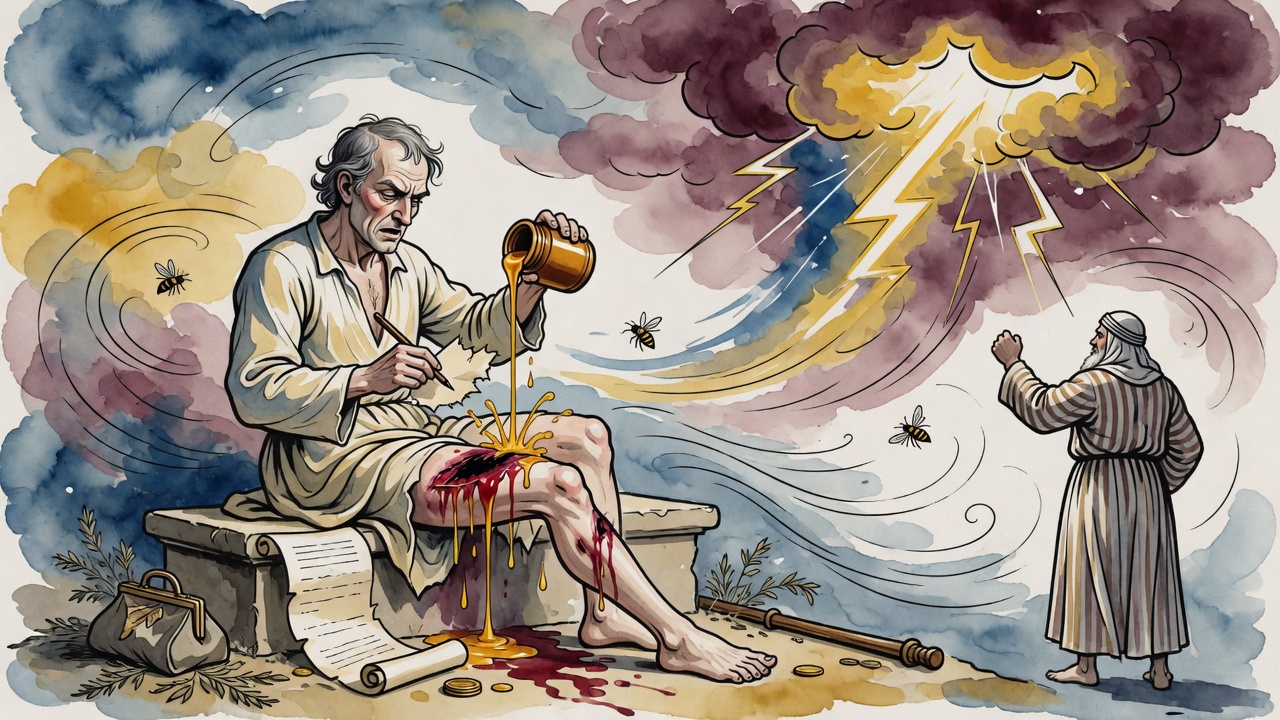
The Ark rolled, and the snakes rolled with it. Their scales whispered against wet wood. Clams and snails clung to the lower seams where pitch still smelled of rain that would not stop. In the middle of that moving zoo a child of one year put a bare foot down and did not die.

Noah watched the small weight land on coils that should have risen. The infant toddled over snail shells and open mouths as if the floor itself had agreed not to strike. "Upon the snail and the clam you shall tread," the old song would later claim, "for in Me there is desire." On the Ark the desire was not poetry. It was a hush in the poison, a stillness in jaws that knew how to end a life in one close.

Noah did not clap. He held the rail until his knuckles whitened. Protection that obvious felt like a debt he could not pay in grain or clean animals. Somewhere above the clouds the Name that ordered the waters was still speaking, and the child's skin was answering without words, without fear, without the adult knowledge that fangs are a language.

His wife called from the upper level. He did not answer at once. He was counting steps the child took on death and finding the count impossible.

Stories in the Belly of Wood

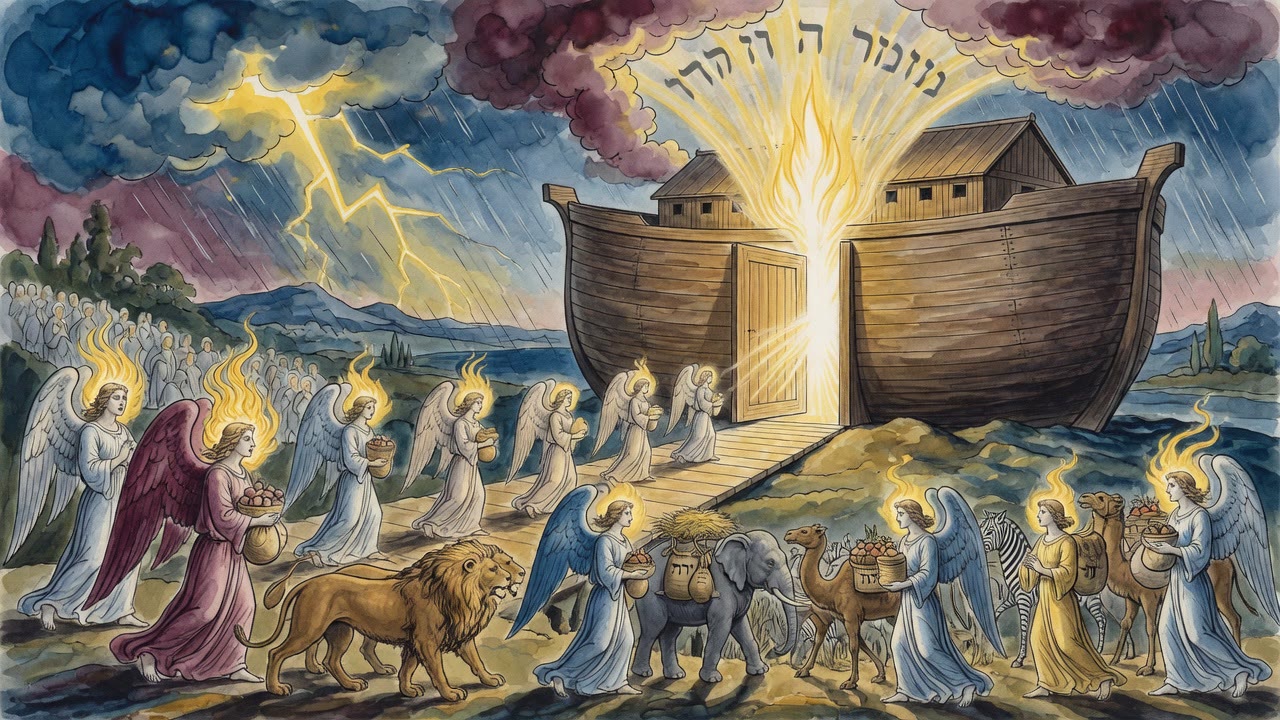
The vessel itself was no simple barn. Lower levels stacked like two and three stories of gut, coils where food and beasts and waste had to travel without chaos. A straight shot from mouth to end would have turned the floating world into panic and filth in a single week. The windings bought time. Strength drawn in the belly. Heat armed in the liver. Flavor settled last, the way a body learns not to empty itself at every pitch of the sea.

Noah walked those corridors as a man walking his own insides made large and loud. The Ark was a body that refused greediness. The flood outside was pure rush, pure erasure. Inside, providence insisted on delay, on layered rooms, on the long path that keeps a creature from starving and from soiling its own refuge in the same hour. Beasts shifted. Hay soured. The air was animal and human and holy all at once.

He pressed a palm to a beam and felt the whole structure digest the storm. If the gut of the world could hold order while mountains drowned, then a child's foot on a snake was only the smallest proof of the same mind.

The Name He Could Not Teach

Why did the child walk free while later generations would trip over smaller snakes in smaller rooms? Rabbi Yehoshua ben Levi, in the name of Rabbi Pinchas ben Yair, named the lack: they did not know the Shem HaMeforash (שם המפורש), the explicit Name. Not a charm for market tricks. A password of presence. Without it, prayer traveled farther and arrived thinner, like a shout across water that loses its shape.

Noah had lived inside a world where the Name still pressed close enough to quiet fangs. He could not bottle that nearness for the grandchildren of grandchildren who would need it when the ground was dry and the danger was subtler. "Therefore My people shall know My Name," a later promise would say, and with the knowing would come the answer: "He will call upon Me and I will answer him."

Until then, trouble would still answer seekers who looked for God in the middle of it, but the instant line the infant walked would stay rare, a story told to explain why prayer sometimes feels like knocking on thick wood.

Prayer Under Pitch

Noah prayed without an audience. The rain drummed a single long syllable. Beasts coughed and settled. His wife slept in snatches between the child's cries and the shift of cages. He asked not for a drier deck but for the child to keep walking, for the coils of the lower stories to keep their order, for the Name not to turn its face while the world unmade itself outside the pitch.

He prayed for the snakes to remain snakes, not symbols, not sermons, just animals under a decree of peace that had nothing to do with their nature and everything to do with the One who desired a remnant.

When the dove finally found a leaf, the snakes were still snakes. The miracle had not been their disappearance. The miracle had been a small foot that did not need to learn fear before the waters fell.

What the Body Remembers

Years later, when the earth hardened again and vineyards grew where graves of cities lay, people would build smaller arks of skin and bone and call them bodies. They would still need windings in the gut, still need a Name for the worst hour, still need a prayer that did not wait for perfect weather. The child on the planks remained the measure: protection is not the absence of fangs. Protection is the decision of the One who desires that a bare foot, for a moment, may pass.

Noah planted and drank and sometimes forgot the hush on the coils. The story did not forget. It kept the infant mid-step, forever above a mouth that did not close.


← All myths
From the tradition

Sources

2 sources

The texts behind this telling. Some cards carry a translation of the source; others are our own retelling of it, and each card says which. Every card links out to the original.

Midrash Tehillim 91:6Midrash Tehillim

Retold in our words. Read the original at the link below.Rabbi Mike Feuer, Jerusalem Anthology · CC-BY

Our ancestors grappled with this too. And Midrash Tehillim, a collection of rabbinic interpretations on the Book of Psalms, offers some fascinating perspectives on why, and what we can do about it.

A baby, just a year old, toddling through the Ark with Noah. Snakes slithering everywhere. Terrifying! But, according to Midrash Tehillim, this infant could walk right over those snakes, and even snails and clams, unharmed. It’s a powerful image of inherent protection, connected to the verse, "Upon the snail and the clam you shall tread, for in Me there is desire." It suggests a state of grace, of being shielded by a divine presence.

So why don't we experience that same level of protection? Why aren't our prayers instantly answered?

Rabbi Yehoshua ben Levi, quoting Rabbi Pinchas ben Yair, offers a compelling reason: We don't know the Shem HaMeforash, the "explicit Name" of God. We find this idea echoed throughout Jewish mystical thought. The Zohar, a foundational text of Kabbalah, often hints at the power and mystery surrounding God's true name.

The Midrash (rabbinic interpretive commentary) continues, promising a future time when God will reveal this Name. “Therefore, My people shall know My Name.” And when that happens? Instant connection. Instant answers. "He will call upon Me and I will answer him." That’s the promise. A direct line to the divine.

Rabbi Yitzhak, in the name of Rabbi Acha, reinforces this idea, reminding us that even now, in times of trouble, if we seek God, we will be answered. So, maybe it’s not about having the secret password all the time, but about the sincerity of our seeking, especially when things get tough.

But here's where it gets really interesting. Asaph, a figure associated with music and prophecy in the Bible, tells Israel: "Whoever saves you, honor him in prayer, for he saves you from distress and gives you honor ('he will bring you out and bring you honor'). Rescue him and honor him." It's a call to recognize and appreciate those who help us, to acknowledge the blessings we receive through others.

And then comes this profound statement: "This is one of the difficult verses regarding the salvation of Israel, for their salvation is the salvation of the Holy One, blessed be He."

Pause for a moment. What does that mean? It suggests a deep, intertwined relationship between our fate and God's. Our struggles are, in a way, God's struggles. Our salvation, God's salvation. That our well-being is somehow connected to the divine well-being.

Maybe the unanswered prayers aren't about a lack of divine attention, but about a call to action. A call to seek, to connect, to recognize the divine spark within ourselves and within each other. Maybe it’s about understanding that our salvation, and God's, are inextricably linked. And maybe, just maybe, that's the closest we can get to understanding the "explicit Name" in this world.

Full source
The Midrash of Philo 16:4The Midrash of Philo

Retold in our words. Read the original at the link below.The Works of Philo Judaeus, trans. C. D. Yonge, London, H. G. Bohn, 1854-1890 · Public Domain

Philo, a Jewish philosopher living in Alexandria in the first century CE, offers a unique allegorical interpretation of the Torah. And in this particular midrash (rabbinic interpretive commentary), number 16, he tackles the curious description of the ark having "two and three stories" in its lower part (Genesis 6:16).

Philo sees these "stories" not just as levels for animals, but as a symbolic representation of our digestive system! Specifically, the intestines. He calls them "receptacles of food," cleverly linking the physical structure of the ark to the very human need for sustenance.

Why two or three stories, though? Philo argues that the intricate, multi-layered design of our intestines is no accident. It's evidence of the Creator's providence, a divine solution to ensure we're adequately nourished. If our digestive tract were a straight shot from stomach to… well, you know… things would get messy, and fast! As Philo puts it, "some awkward circumstances must have taken place." We'd be constantly hungry, prone to "sudden evacuations," and consumed by a "greediness" born of perpetual emptiness.

The long coils and windings, the "two and three stories," allow for a more efficient and controlled process. Food lingers, its nutrients are extracted, and the body has time to process what it needs. First, the food's "strength" is drawn out in the belly. Then, it's "armed" in the liver. Finally, according to Philo, the essential flavors are distributed throughout the body, fueling growth and strength. Waste is collected and eliminated.

It's a beautiful, if somewhat graphic, picture of the body as a carefully designed vessel. And that’s not all. Philo takes the analogy even further. He declares that the ark itself is a metaphor for the human body. Just as the ark contained all living creatures, so too does our body contain and sustain us.

And here’s where it gets even more interesting. Philo suggests that by contemplating the ark, "made by art," we can better understand ourselves. "Men beholding by means of that which was made by art, a comparison and analogy to the human body, might in that manner be more manifestly taught.."

Why? Because, according to Philo, the "essential humours of the body" – our physical desires and imperfections – are what keep us "in a servile condition." The "vicious pleasures and desires" arising from our physical nature are the root of much human suffering.

So, the ark, the body, the digestive system… they're all connected. By understanding the intricacies of our physical selves, we can begin to overcome the limitations and desires that hold us back.

Philo's midrash isn't just about anatomy; it's about spiritual growth. It suggests that even the most seemingly mundane details of the Torah – like the dimensions of an ark – can offer profound insights into the human condition and our potential for transcendence.

Could the measurements of Noah's Ark really hold the secrets to understanding the human body and our spiritual nature? Maybe next time you're feeling a bit "empty," you'll remember Philo's words and consider the amazing, multi-storied vessel that sustains you.

Full source