6 min read

Priests Trace Bloodlines Before the Temple Fire

Before a priest could marry, his family checked the woman's line in old records and asked witnesses. Then Titus came, and the archives burned.

Curated by Arthur · Told by Maggid ·
Table of Contents
  1. A Marriage Is a Public Investigation
  2. When the Archives Burn
  3. Babylon Already Taught the Cost
  4. Why Lineage Was Not Snobbery Alone
  5. After the Smoke
  6. Witnesses at the Door of the Family
Priests Trace Bloodlines Before the Temple Fire Click for full size

A Marriage Is a Public Investigation

Before a priest took a wife, the house did not ask first about dowry. It asked about blood. Josephus, defending his people against Greek scorn in Against Apion near the end of the first century CE, describes a rule older than any empire's fashion. A priest married a woman of his own nation. Wealth did not buy the match. Status did not replace proof. Genealogies were traced through ancient records and the mouths of many witnesses.

The altar required a lineage that could be named. Service in the Temple was not a career open to talent alone. It was a trust carried in families who could show their fathers' names without a blush or a gap.

Josephus points to the care given those lists in the generations before Jerusalem fell. Accuracy was a sacred habit. A missing generation was not a clerical error. It was a wall against the holy place.

When the Archives Burn

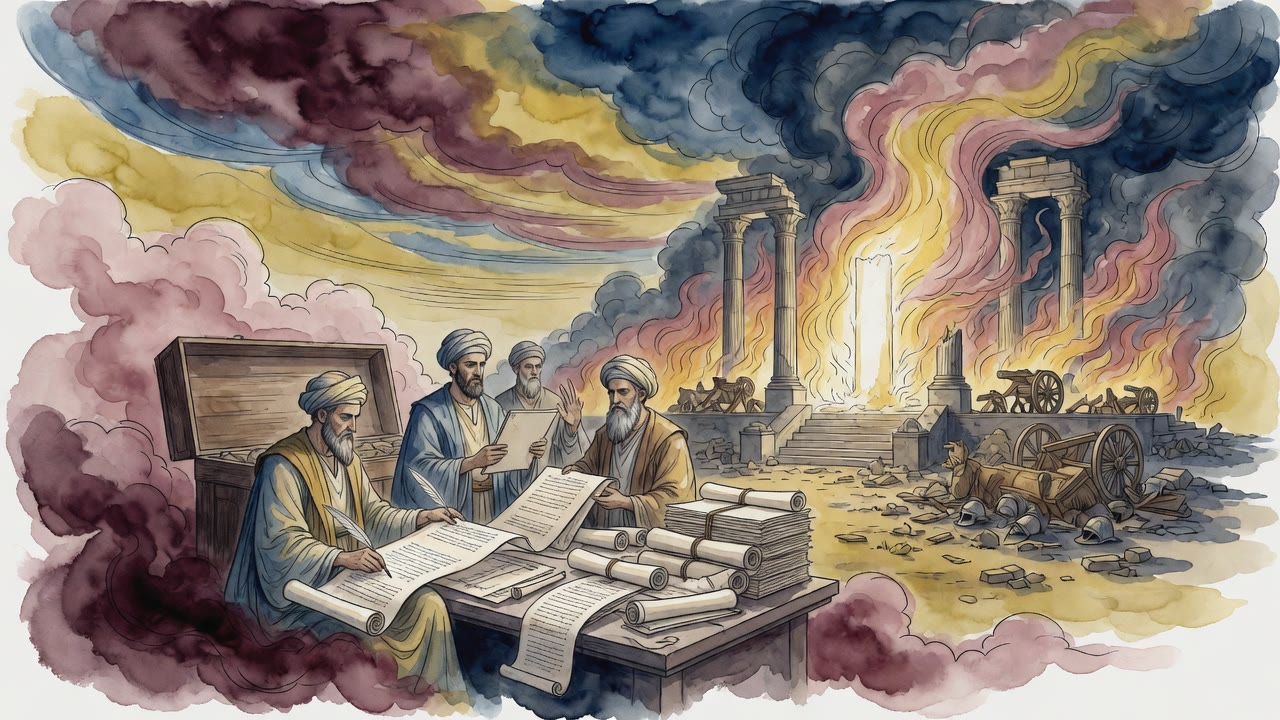
That habit largely died with the city. Titus wrecked Jerusalem. Later Hadrian's wars ground what remained. The meticulous books of priestly marriage and descent could not outrun fire and exile. What had been a living bureaucracy of holiness became memory, argument, and fragments.

A people can keep laws without buildings. It is harder to keep filing systems when the filing rooms are ash. Josephus writes as a man who still remembers the old precision and wants Rome and Alexandria to know it was real, not a boast invented after the loss.

Babylon Already Taught the Cost

Long before Titus, another fire had taught the same lesson. Josephus calls on Berosus, the Babylonian priest-historian, whose Chaldean History he trusts over Greek romance. Berosus fumes that Greeks credit Semiramis with building Babylon when the real works belong to other hands. Josephus uses him as a lever: on Babylonian affairs, the Chaldean record outweighs tourist myth.

Phoenician archives, he adds, confirm that Nebuchadnezzar conquered Syria and Phoenicia. Philostratus mentions the siege of Tyre. Megasthenes even claims the Babylonian king outdid the heroes of other nations in the reach of his campaigns. The resume is long. Then Josephus turns the ledger toward home. The same power attacked Jerusalem and burned the Temple.

Empires keep score in conquests. Israel keeps score in whether the sanctuary still stands and whether the priests still know who may enter.

Why Lineage Was Not Snobbery Alone

From outside, the priestly marriage rules can look like pride. From inside the system Josephus defends, they look like quarantine for a service that handles blood, incense, and the Name. A random appointment would turn the altar into a stage. A verified house turns it into a continuity.

The same mind that refuses a priestly match without witnesses is the mind that refuses to let Greek storytellers invent Babylon's skyline. Proof matters. Archives matter. When archives die, a different kind of faithfulness must carry what paper no longer can.

After the Smoke

The Temple's stones can fall twice and still leave a people. The priestly lists cannot be fully rebuilt from ash. Josephus writes into that gap. He holds up the old bloodline discipline beside the Babylonian and Roman destructions so no reader mistakes the loss for a lack of prior order.

Somewhere a father once unrolled a genealogy by lamplight before he agreed to a wedding. Somewhere a scribe copied a name that would never reach a grandson because the city burned first. The holy sanctuary and the marriage record rose and fell together. What remains is the argument Josephus still makes: this people ordered its holiest offices with a care empires only notice after they have broken it.

Witnesses at the Door of the Family

Picture the evening before a priestly betrothal. Elders unroll names. Someone recalls a grandmother's town. A witness swears he stood at a wedding two generations back. The young man waits. The young woman waits. Romance is present, but it is not the only officer in the room. The altar's future purity sits at the table like a silent relative.

Josephus wants Greek readers to feel the weight of that room because his opponents painted Jewish custom as irrational stubbornness. He answers with procedure. Investigation. Records. National endogamy for the priestly house without a sale of office to the richest bidder. Then he shows the opposite force: Babylonian engines at the walls, Roman engines later, fire that does not read genealogies before it eats them.

Berosus, for Josephus, is a foreign priest who still understands that archives beat legends. Nebuchadnezzar's reach across Tyre and Syria is attested outside Jewish books. The burning of the Holy Sanctuary sits in that wider map of conquest. Israel is not inventing its losses. Empires keep confirming them while failing to copy the care of the priestly lists they destroy.

After the smoke, a different holiness must travel light. Prayer, law, memory of service. The bloodline office cannot fully restart without the building and the books. Josephus writes so the care itself will not be forgotten, even when the paper is gone.

Josephus writes as a priest's son as well as a historian. The care he describes is not abstract patriotism. It is the memory of a caste trained to fear a wrong marriage the way a surgeon fears a dirty blade. Greek critics could mock that fear. They could not replace it with a better method for keeping a sacrificial service continuous across centuries.

When Nebuchadnezzar burned the first Temple, and when Titus burned the second, the same question rose from the smoke: what of the service now? Sacrifices stopped. Genealogies frayed. Study and prayer took heavier loads. Against Apion is partly a refusal to let outsiders define the prior centuries as chaos. There were lists. There were witnesses. There was a Holy Sanctuary whose staff could name their fathers. Empires broke the system. They did not invent a cleaner one.


← All myths
From the tradition

Sources

2 sources

The texts behind this telling. Some cards carry a translation of the source; others are our own retelling of it, and each card says which. Every card links out to the original.

Against Apion 7:1Against Apion

Retold in our words. Read the original at the link below.Against Apion, trans. William Whiston · Public Domain

It was a matter of utmost importance, a sacred duty meticulously observed. Josephus, in his work Against Apion, gives us a fascinating glimpse into this world.

He explains that our ancestors didn't just pick anyone to be a priest or to serve in the Temple. From the very beginning, they ensured the priestly line remained pure and unmixed. How did they do this? Well, a priest had to marry a woman of the same nation, with no consideration for wealth or status. Instead, they had to carefully investigate her genealogy, tracing it back through ancient records and numerous witnesses. Josephus himself mentions the accuracy of these genealogical records during the time of "our Savior" and before, highlighting the special attention given to the priestly lines (Josephus's Life, sect. 1). Sadly, he notes that this meticulous record-keeping largely ended with the destruction of Jerusalem, first by Titus and then by Hadrian.

Here's the really interesting part: this wasn't just a local custom in Judea. Josephus emphasizes that wherever Jewish communities lived – whether in Egypt, Babylon, or "any other place of the habitable earth" – they maintained these detailed priestly marriage records. Priests would send their ancestral names, along with the names of their parents and even more distant ancestors, to Jerusalem, along with the names of witnesses.

Of course, life isn't always smooth sailing. What happened during times of war and upheaval, like the invasions by Antiochus Epiphanes, Pompey, or Quintilius Varus, or the wars of Josephus's own time? The surviving priests would reconstruct the genealogical tables from the old records, carefully examining the backgrounds of the remaining women. They were particularly cautious about those who had been taken captive, suspecting potential interaction with foreigners.

And here's the kicker, the strongest evidence of the accuracy of their system: Josephus claims they had records of the high priests, father to son, spanning an incredible two thousand years! If any of these priests broke the rules, they were barred from the altar and from participating in purification rituals.

Why was this level of scrutiny so important? Because not just anyone could write these records. According to Josephus, the original accounts were written by prophets, inspired by God Himself. Others wrote about events in their own times, but always with great care and precision. The implications are clear: maintaining the purity and accuracy of the priestly lineage was seen as a direct link to divine authority and the integrity of Temple service. It was a system built on trust, tradition, and a profound sense of responsibility to future generations. A pretty powerful legacy, don’t you think?

Full source
Against Apion 20:1Against Apion

Retold in our words. Read the original at the link below.Against Apion, trans. William Whiston · Public Domain

He’s wading into a historical debate, and it's more tangled than it first appears.

Josephus brings up Berosus, a Babylonian priest and historian, who wrote a Chaldean History. Berosus is pretty steamed about the Greeks crediting Semiramis, the queen of Assyria, with building Babylon. Berosus, as Josephus tells it, insists that these incredible Babylonian structures weren't Semiramis' doing at all. As Josephus points out, when it comes to Babylonian affairs, the Chaldean History has to be the most reliable source.

Josephus mentions that the archives of the Phoenicians confirm that King Nabuchodonosor (Nebuchadnezzar) conquered all of Syria and Phoenicia. Philostratus agrees, mentioning the siege of Tyre in his history. Megasthenes, in his Indian History, even claims that Nebuchadnezzar was stronger than Hercules, conquering a large part of Libya and Iberia! Quite the resume. But what about Jerusalem? Josephus reminds us that the Babylonian's attacked and burned the Temple, but it was later reopened when Cyrus took control of Asia. To back this up, he shares more from Berosus's third book: "Nabuchodonosor, after he had begun to build the forementioned wall, fell sick, and departed this life, when he had reigned forty-three years; whereupon his son Evilmerodach obtained the kingdom."

Things get a little Game of Thrones-y from here. Evilmerodach, Nebuchadnezzar's son, ruled "after an illegal and impure manner" for just two years before being assassinated by Neriglissoor, his own sister's husband! Neriglissoor then took the throne for four years. His son, Laborosoarchod, became king as a child but was killed after only nine months due to his "ill temper and ill practices." Yikes.

After that, the conspirators got together and crowned Nabonnedus, a Babylonian who was involved in the insurrection. According to Berosus, it was during Nabonnedus’s reign that the walls of Babylon were impressively built with burnt brick and bitumen. But his reign wasn't peaceful.

In Nabonnedus's seventeenth year, Cyrus of Persia arrived with a massive army. Nabonnedus met him in battle but was defeated and fled to the city of Borsippus. Cyrus captured Babylon and ordered the outer walls of the city demolished because they had been too troublesome to overcome. He then besieged Nabonnedus in Borsippus. Nabonnedus eventually surrendered. Cyrus initially treated him kindly, giving him Carmania as a place to live, but exiled him from Babylonia. Nabonnedus spent the rest of his days in Carmania, where he eventually died.

Josephus, through Berosus, paints a vivid picture of power struggles, conquests, and the rise and fall of kings. It's a reminder that history is rarely simple, and the stories we inherit are often shaped by the perspectives and agendas of those who tell them.

Full source