Parshat Vayera5 min read

The Ram at Moriah Became Every Shofar Blast

The ram that saved Isaac did not vanish into smoke. Its horns became the sound that opens judgment, Sinai, and the end of days.

Curated by Arthur · Told by Maggid ·
Table of Contents
  1. The Sound Was Promised at the Altar
  2. One Horn Opened Sinai
  3. The Greater Horn Waits for the End
  4. Abraham's Tears Entered Isaac's Eyes
  5. Every Year the Cry Returns

The ram did not arrive like an afterthought.
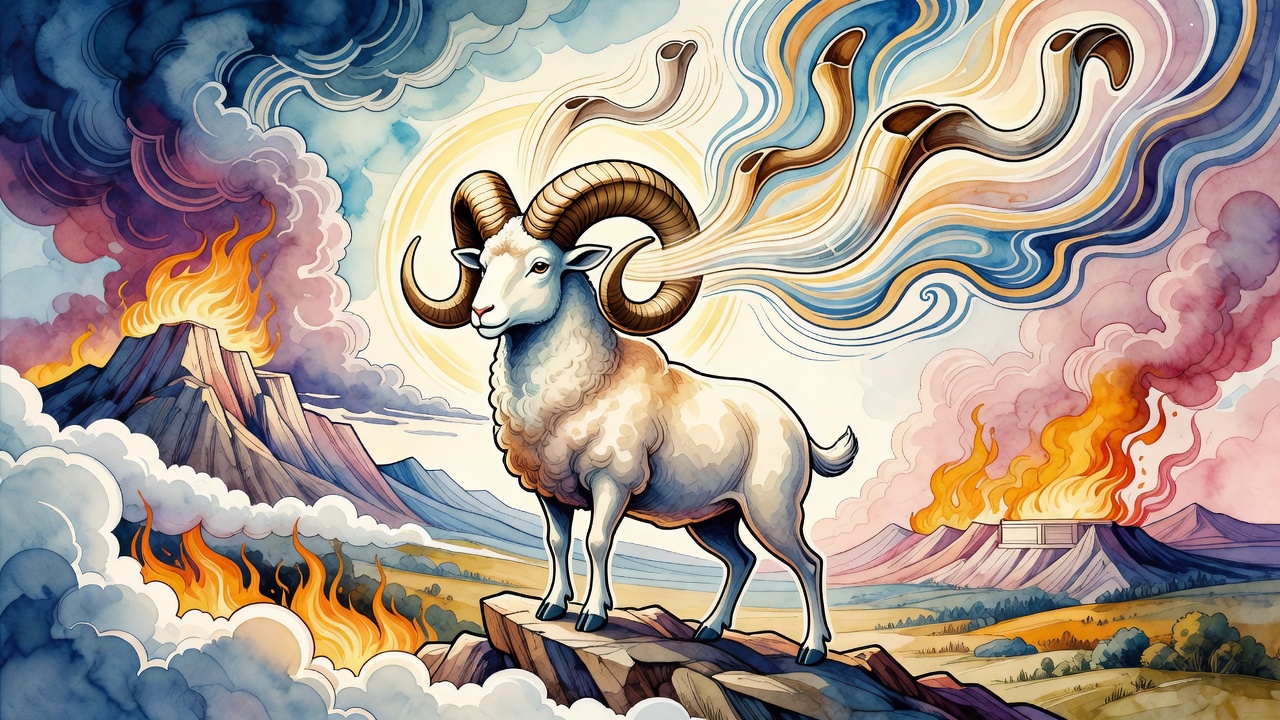
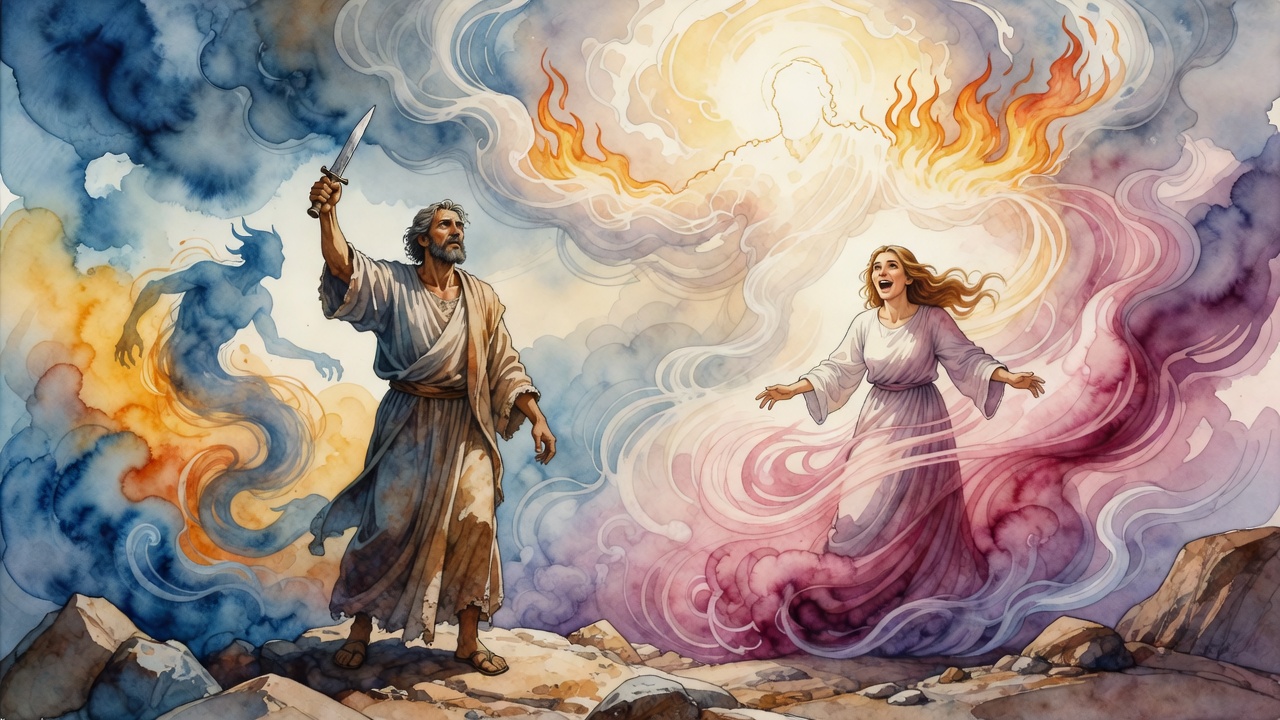
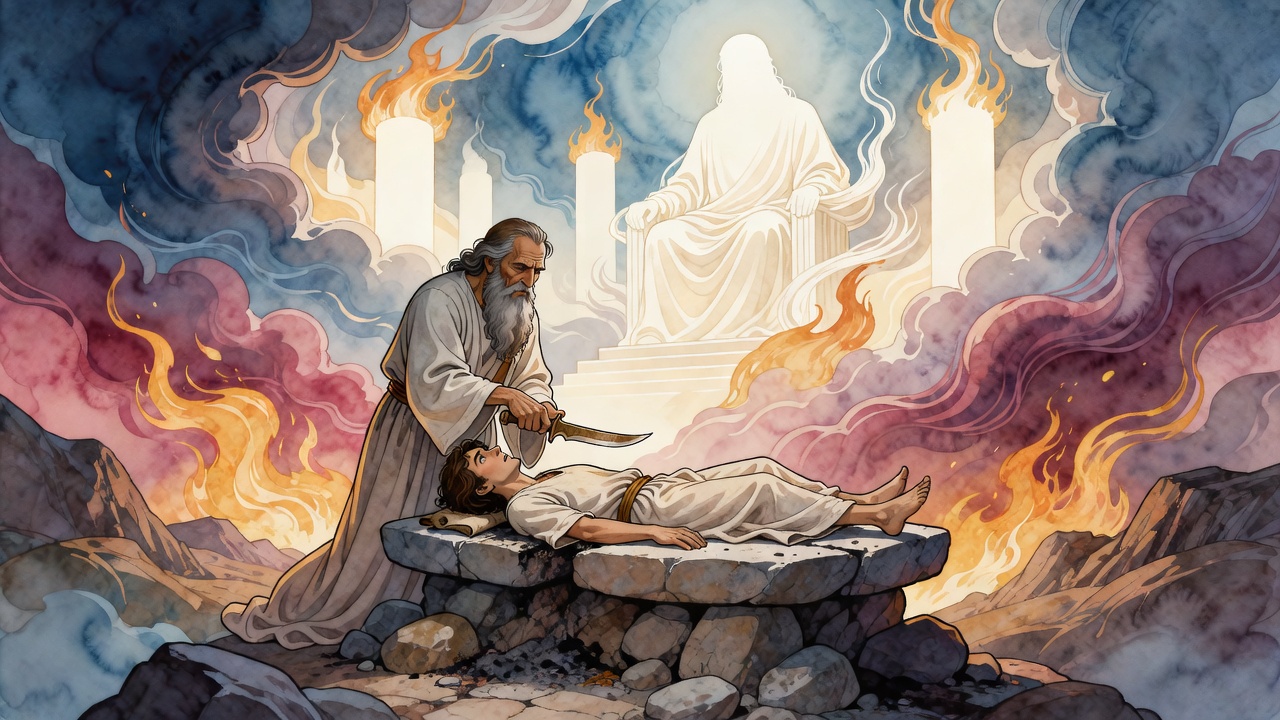
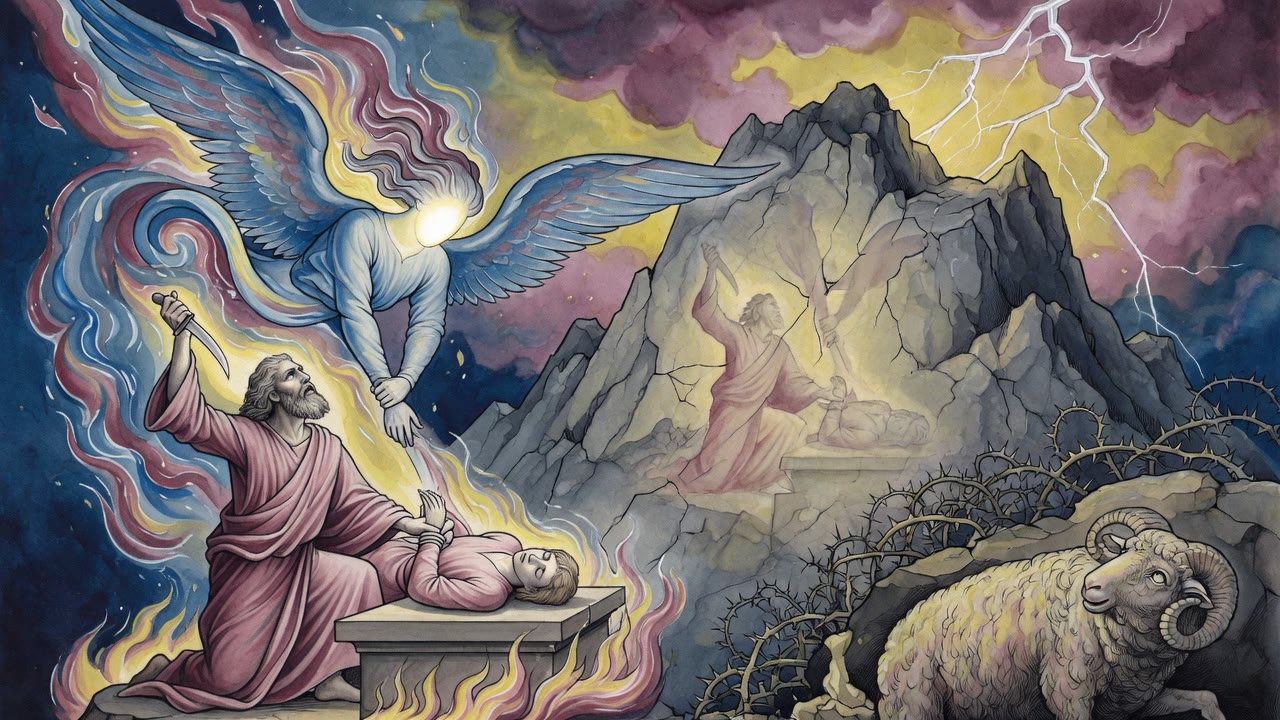
Abraham's knife had been lifted. Isaac had been bound. The altar had already learned the weight of the son. Then the angel stopped the hand, and Abraham saw the animal caught in the thicket, held by its horns as if the world itself had trapped the substitute and kept it waiting for the exact breath when it would be needed.

Abraham offered the ram. Isaac lived. The smoke rose, but the horns did not disappear.

The Sound Was Promised at the Altar

God made memory into sound.

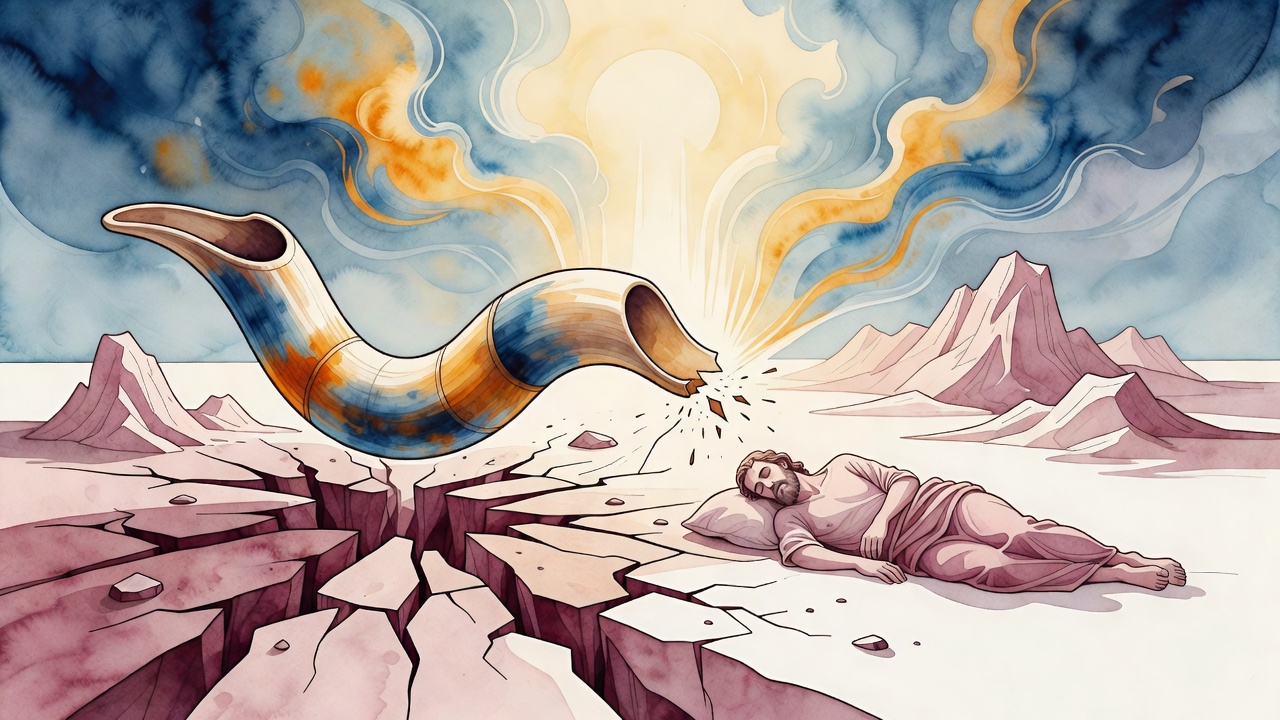
The horn of that ram would be blown at the beginning of the year. When the shofar cried out, heaven would remember Moriah. The sound would carry the altar back into the court of judgment, not as argument and not as explanation, but as a wound remembered. A father had lifted the knife. A son had lain still. A ram had taken the death meant for the child.

From then on, the year could not begin without that cry.

One Horn Opened Sinai

The left horn did not stay on the mountain.

It sounded at Sinai when the Torah was given. Israel stood beneath the mountain while thunder, fire, smoke, and shofar filled the air. The covenant at Sinai did not float free from the binding at Moriah. The same animal whose body spared Isaac lent its voice to the moment when Isaac's descendants accepted Torah.

The blast told them that covenant is never clean ceremony. It comes from survival, trembling, and a life returned when death seemed certain.

The Greater Horn Waits for the End

The right horn was larger.

It was kept for the future, for the hour when exile breaks and scattered Israel hears the call home. The first horn gathered the people at Sinai. The last horn will gather them again. Between those two sounds lies all of Jewish history: law received, law broken, law carried, kingdoms lost, prayers said into silence, and generations waiting for a blast old enough to remember the first altar.

The ram's body was burned once. Its sound keeps returning.

Abraham's Tears Entered Isaac's Eyes

The rescue did not leave everyone whole.

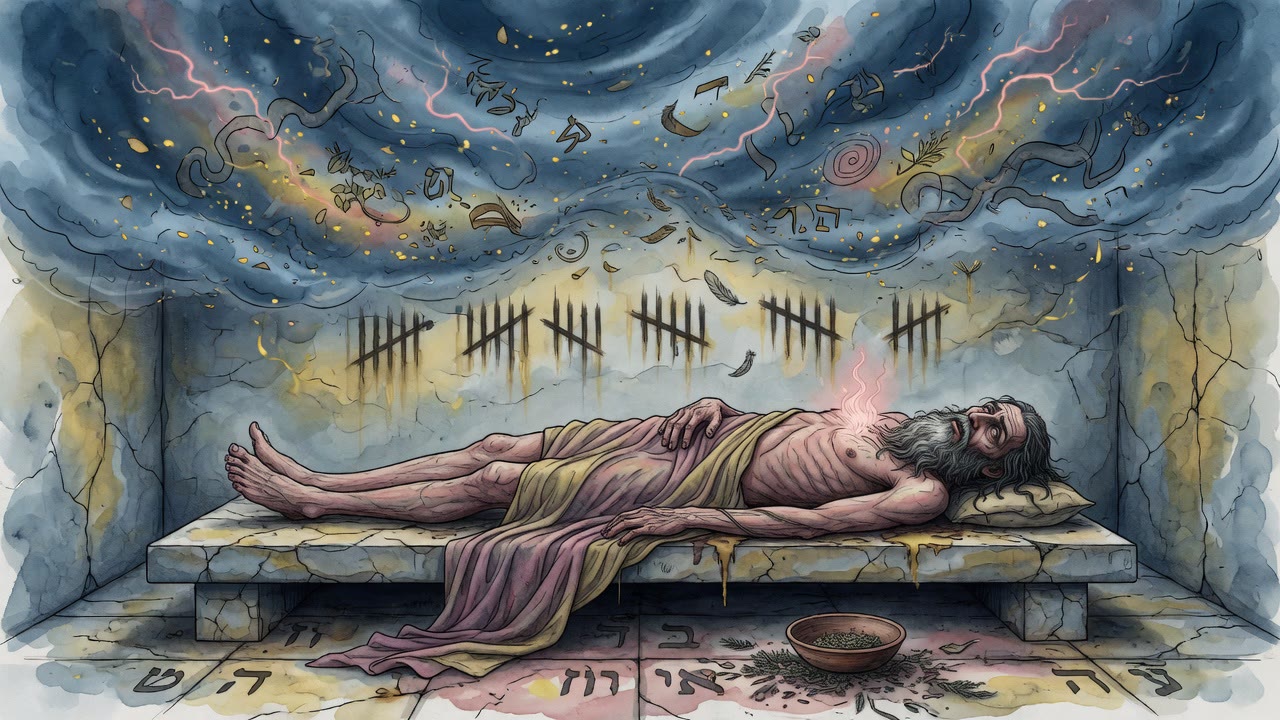
Abraham wept when the knife was stopped. Tears fell on Isaac's face. The tradition remembers those tears entering Isaac's eyes and dimming them for the future. The blindness that later covered Isaac before Jacob took Esau's blessing began at Moriah, in the wet shock of a father receiving back the son he had already surrendered.

The miracle saved Isaac's life, but it did not erase the cost. Some rescues leave marks that ripen years later.

Every Year the Cry Returns

On Rosh Hashanah, the shofar does not explain itself.

It wails. It breaks. It gathers short sobs into a long cry and long cries into broken breath. That is why it can carry Moriah. Words would make the binding too neat. A horn can remember without smoothing anything over.

When the sound rises, Isaac is still on the altar and already alive. Abraham is still holding the knife and already empty-handed. The ram is still caught and already sacrificed. Judgment begins with that sound because mercy first sounded there.

The ram also changed Isaac's place in the binding. He was not only the one spared. He became the one whose survival generated the sound his descendants would later carry into judgment. Every blast remembers the altar from both sides: Abraham's hand and Isaac's breath, the knife above and the living body below.

That is why the shofar is not a polished instrument of court music. It is raw, curved, and animal. It comes from the creature that stood between command and death. Its cry has no grammar because the altar had gone beyond grammar. The sound does not argue for mercy. It reenacts the moment when mercy interrupted the knife.

The thicket itself becomes part of the memory. The ram is caught by the horns, the very part that will later become sound. Its entanglement saves Isaac, but it also preserves the instrument. The place that held the animal back gives Israel a way to call forward. A trapped horn becomes a free cry.

That cry binds fear and rescue in one breath, exactly as Moriah did.


← All myths
From the tradition

Sources

4 sources

The texts this telling draws on, in full. Open a card to read inline, or expand it for a wider, quieter read.

Legends of the Jews 5:257Legends of the Jews

The story goes that after Abraham proved his unwavering faith by being willing to sacrifice his son, Isaac, God intervened. A ram, caught in a thicket, was offered instead. But what happened after that? Did you ever wonder if there were more to the conversation between God and Abraham?

Well, according to Legends of the Jews, God told Abraham something profound. He acknowledged Abraham's faithfulness, but also foretold a future where Abraham's descendants would falter. "Thy children will sin before me in time to come," God said, "and I will sit in judgment upon them on the New Year's Day."

Heavy stuff. But there's hope woven in. God continued, revealing a path to redemption. "If they desire that I should grant them pardon," He said, "they shall blow the ram's horn on that day, and I, mindful of the ram that was substituted for Isaac as a sacrifice, will forgive them for their sins." The sound of the shofar, a primal, ancient sound, is a direct appeal to God's mercy, a reminder of Abraham's devotion and the ram that stood in place of his son.

The story doesn't end there. The Lord then revealed even more about the future. Abraham learned that the Temple, which would one day stand on the very spot where he nearly sacrificed Isaac, would be destroyed. And just as the ram struggled from one tree only to be caught in another, Abraham's children would be scattered, moving from kingdom to kingdom.

As Ginzberg retells it in Legends of the Jews, they would be delivered from Babylonia only to be subjugated by Media. Rescued from Media, they would be enslaved by Greece. Escaping from Greece, they would serve Rome. A cycle of liberation and oppression, a pattern of hope and hardship.

Yet, even within this prophecy of exile and suffering, there’s an unwavering promise: "yet in the end they would be redeemed in a final redemption, at the sound of the ram's horn." This final redemption, echoing the words of Isaiah (27:13) that on that day "the Lord God shall blow the trumpet," signifies a complete and ultimate deliverance. As the prophet Zechariah envisions (9:14) "the Lord shall be seen over them, and his arrow shall go forth as the lightning: and the Lord God shall blow the trumpet, and shall go with whirlwinds of the south."

So, when we hear the shofar blast on Rosh Hashanah (the Jewish New Year), we're not just observing a tradition. We’re participating in a cosmic drama that began with Abraham, a drama of sin, forgiveness, exile, and, ultimately, redemption. We are, in that moment, both remembering the past and calling out for a better future. A future where the echoes of the shofar herald not just another year, but the final, complete, and resounding redemption we’ve been waiting for.

Full source
Legends of the Jews 10:34Legends of the Jews

We remember him most vividly, perhaps, from the Binding of Isaac, the Akeidah. A moment of ultimate faith, ultimate sacrifice averted at the last possible second. But what about the lingering effect of that moment? According to Legends of the Jews, when faced with the plight of his descendants, Isaac doesn't hesitate to invoke that very event. He cries out, "O Lord of the world, when my father told me, 'God will provide Himself the lamb for a burnt offering, my son,' I did not resist Thy word. Willingly I let myself be tied to the altar, my throat was raised to meet the knife. Let that plead with Thee, and have Thou pity on my children."

Think about the sheer vulnerability in those words. The raw plea. He's not boasting, not demanding. He's reminding God of his willingness, his obedience, his almost-sacrifice. He's offering it as a merit, a zechut, on behalf of generations yet to come.

Then there's Jacob, Isaac's son, a man who wrestled with angels, literally and figuratively. His life was a constant struggle, a series of trials and tribulations. Remember those twenty long years he spent working for Laban? According to Ginzberg's retelling in Legends of the Jews, Jacob too uses his own life experiences to plead for his children.

"O Lord of the world," he cries, "for twenty years I dwelt in the house of Laban, and when I left it, I met with Esau, who sought to murder my children, and I risked my life for theirs. And now they are delivered into the hands of their enemies, like sheep led to the shambles, after I coddled them like fledglings breaking forth from their shells, after I suffered anguish for their sake all the days of my life. Let that plead with Thee, and have Thou pity on my children."

Notice the shift in focus. Isaac appeals to a single, dramatic moment. Jacob points to a lifetime of hardship, a constant struggle to protect his offspring. He speaks of his children as vulnerable fledglings, a powerful image of tenderness and care. He reminds God of his constant worry, his "anguish for their sake all the days of my life." This isn't just about physical protection; it's about the emotional toll of parenthood, the constant fear for the well-being of those you love.

What does this tell us? Perhaps it's about the enduring power of intergenerational connection. The idea that the actions of our ancestors, their sacrifices and struggles, can still resonate through time, influencing the fate of their descendants. It’s also a reminder of the profound responsibility that comes with being a parent, a leader, an ancestor. We are not just individuals; we are links in a chain, carrying the weight of the past and shaping the future.

And maybe, just maybe, it’s a comfort. Knowing that even in the face of overwhelming odds, we are not alone. We stand on the shoulders of giants, those who came before us, who fought and prayed and sacrificed for our sake. And their merit, their zechut, still echoes through the generations, a silent plea for mercy and compassion.

Full source
Pirkei DeRabbi Eliezer 29:8Pirkei DeRabbi Eliezer

This text isn't just a dusty historical record. It's a vibrant window into how our ancestors understood their relationship with God, and with each other. It focuses on Abraham, our patriarch, and his unwavering obedience.

"Abraham did not delay aught," the verse states, "with reference to all things which He commanded him." It’s a powerful statement. When God commanded circumcision, Abraham didn't hesitate. He understood the covenant, the brit, and acted accordingly. The verse cited is from (Genesis 17:12): "And he that is eight days old shall be circumcised." No questions, no bargaining, just action.

Then comes Isaac. When Isaac was born, on the eighth day, Abraham circumcised him. (Genesis 21:4) confirms this: "And Abraham circumcised his son Isaac when he was eight days old." This wasn't just a medical procedure; it was a sacred act, a continuation of the covenant.

Here's where it gets really interesting. Pirkei DeRabbi Eliezer draws a stunning parallel: "Everyone who brings his son for circumcision is as though he were a high priest bringing his meal offering and his drink offering upon the top of the altar." The Kohen Gadol, the High Priest, performing the most sacred rituals in the Beit Hamikdash, the Temple in Jerusalem. The text equates that level of holiness, that level of dedication, to a parent bringing their son into the covenant. Wow.

What does this comparison tell us? It elevates the act of circumcision to something far beyond the physical. It becomes a profound spiritual offering, a dedication of the next generation to God and to the Jewish people. It's a commitment to carry on the traditions, the values, and the faith of our ancestors.

And because of this, "the sages said: A man is bound to make festivities and a banquet on that day when he has the merit of having his son circumcised, like Abraham our father." A Seudat Mitzvah, a celebratory meal, is not just a party; it's an expression of joy and gratitude for the continuation of the covenant. It mirrors Abraham's joy when he circumcised Isaac.

So, what does all of this mean for us today?

It reminds us that rituals are not empty gestures. They are powerful acts of connection, binding us to our past, present, and future. They are opportunities to reaffirm our commitment to our values and to pass them on to the next generation. It encourages us to see the sacred in the everyday, to recognize the profound significance of seemingly simple acts.

And maybe, just maybe, the next time you attend a brit milah, you'll see it not just as a family celebration, but as a reenactment of a sacred offering, a continuation of a covenant that stretches back to Abraham himself.

Full source
Book of Jubilees 31:41Book of Jubilees

The Book of Jubilees gives us a peek into the morning after.

Jacob, still buzzing with the memory of his encounter with the Divine, rushing to tell his father, Isaac. He recounts his vow to the Lord – that solemn promise he made – and the awe-inspiring vision he witnessed. He excitedly explains how he built an altar, prepared everything for sacrifice, just as he had vowed to do. And, in his enthusiasm, he tells his father he's ready to help him onto a donkey so they can travel together.

Can you picture the scene? Young Jacob, practically radiating spiritual energy, eager to share this profound experience with his aging father.

Isaac, bless his heart, is a hundred and sixty-five years old at this point. That's a lot of candles on the birthday cake! “I am not able to go with thee," he tells Jacob. "For I am old, and not able to bear the way.” He sends his son off with a blessing: “Go, my son, in peace… I am no longer able to journey.”

It’s a poignant moment, isn't it?

There's a beautiful contrast here. We see the youthful fervor of Jacob, fresh from his encounter with the divine, and the wisdom and limitations of age embodied in Isaac. One is ready to begin a new spiritual path, fueled by revelation; the other, grounded in the reality of his physical body, offers his blessing and understanding.

The Book of Jubilees doesn't explore Isaac's feelings, but we can imagine the bittersweet mix of pride and perhaps a touch of wistfulness as he watches his son depart. He can't physically join Jacob on this journey, but he can offer his blessing, sending him forth with peace.

What does this little scene tell us? Perhaps that our spiritual journeys are often personal, even when shared within families. That even in moments of great revelation, the realities of life – age, limitations, responsibilities – remain. And that sometimes, the greatest gift we can give is our blessing, allowing others to follow their own paths, even when we can't walk alongside them.

Full source