Parshat Matot5 min read

Reuben and Gad Listed Their Cattle Before Their Children

Two tribes asked Moses for land east of the Jordan and listed sheepfolds before their children. Moses corrected the order without raising his voice.

Curated by Arthur · Told by Maggid ·
Table of Contents
  1. The Land Across the River
  2. What Moses Did With the Order of Words
  3. Moses Connects Them to the Spies
  4. The Children They Left Behind
  5. What Joshua Sent Them Home With

The Land Across the River

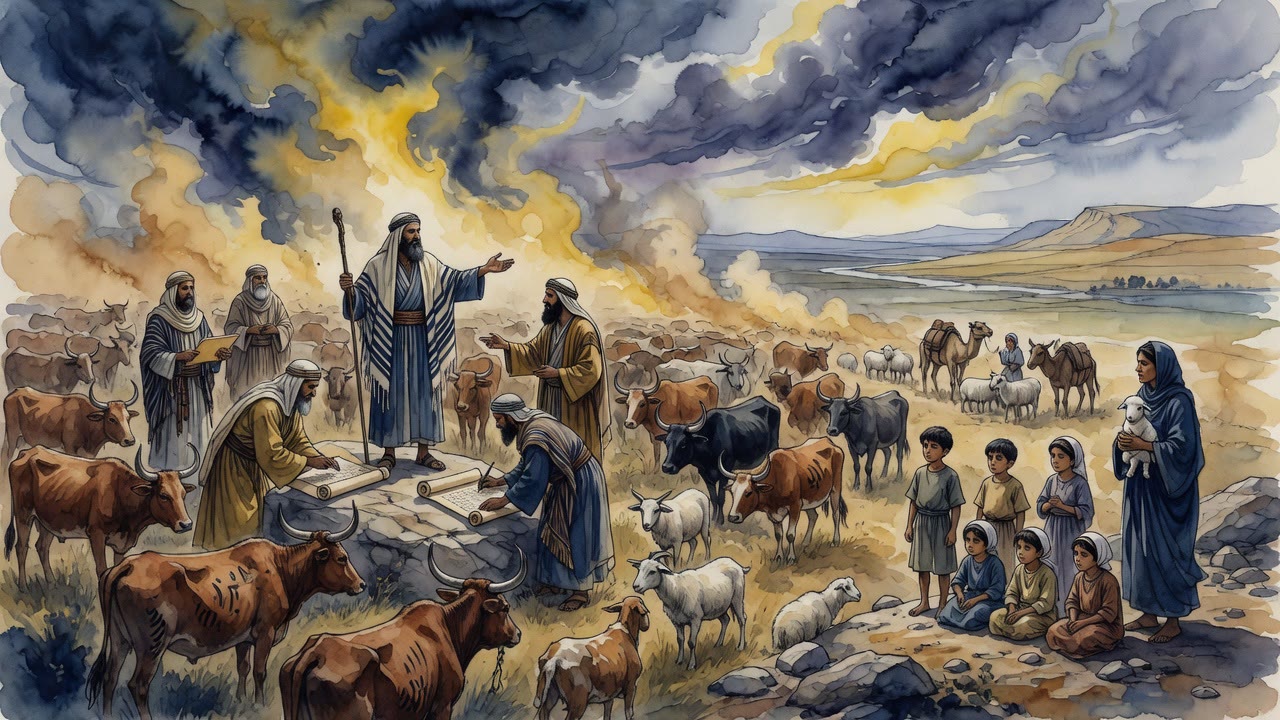
The plateau was wide, the grass was thick, and the herds of Reuben and Gad were enormous. The Israelite army had just destroyed Sihon and Og, and the territory east of the Jordan was still settling into conquered quiet. Two tribes looked at it and made a decision: this was better for livestock than anything they would find west of the river.

So they came to Moses with a proposal: let us stay here. "We will build sheepfolds for our cattle," they said, "and cities for our little ones. Our brothers can cross the Jordan without us."

Moses heard every word.

What Moses Did With the Order of Words

In Legends of the Jews, Ginzberg's early-twentieth-century compilation of classical rabbinic sources, Moses's response to this proposal is a quiet but devastating correction. He did not shout. He did not denounce them. He repeated their request back to them, but with the order reversed. "Build cities for your little ones," he said, "and folds for your sheep."

Cattle before children. That was what Reuben and Gad had said. Children before cattle. That was what Moses said back. The correction was contained in the repetition itself, a rebuke that required no commentary because the rearrangement was the commentary. Any listener who had heard both versions in sequence understood what had gone wrong in the original.

Whoever values possessions more than people, the Midrash says, will eventually lose both.

Moses Connects Them to the Spies

The Targum, the Aramaic translation-commentary on Numbers compiled over several centuries beginning in the early Common Era, records Moses's fury in sharper language than the Torah itself. He did not merely correct the order of words. He connected what Reuben and Gad were proposing to the worst collective failure in Israelite history.

"You are repeating what your fathers did when I sent them from Kadesh Barnea to survey the land." The spies went up, saw what the land contained, and came back with a report designed to make Israel afraid. They enfeebled the will of the people's heart. The same Hebrew verb Moses now applied to what Reuben and Gad were proposing: by hanging back while their brothers crossed the Jordan to fight, they would enfeeble the determination of Israel to finish the conquest. The request was not merely selfish. It was structurally identical to the sin that had condemned the first generation to die in the wilderness.

The Children They Left Behind

In the version preserved in the Midrash, there is a detail the Torah itself does not dwell on. Reuben and Gad had left young children behind when they crossed the Jordan to help their brothers fight. They had made the commitment Moses required: "we will not return to our houses until every Israelite has received an inheritance." And they kept it. They crossed. They fought for fourteen years alongside the other tribes while the conquest and distribution of the land took place.

A child left at ten years old was twenty-four when his father came home. Some children had been left as infants. Some fathers returned to grown sons and daughters they no longer recognized. The cattle, meanwhile, had been watched over by the families and servants left east of the Jordan, tended and multiplied while the men were gone. The cows were fine. The children had grown up without their fathers present.

The thing they had put first had waited faithfully. The thing they had put second had grown past them in their absence.

What Joshua Sent Them Home With

When the conquest was complete and Joshua released the eastern tribes to return to their land, the dispatch carried both honor and instruction. Joshua praised them for keeping their word. They had done what Moses required. They had not abandoned their brothers. They had earned the right to return home.

And then he told them what to do with what they had accumulated during fourteen years of service: "take great wealth back with you, much cattle, silver and gold, copper and iron, and very much clothing. Divide the spoil of your enemies with your brothers who stayed behind." The brothers who had guarded the families and tended the herds east of the Jordan, the men who had not crossed to fight, they were entitled to a share.

The correction Moses had made in his repetition of their words was not a petty rebuke. It was a preview of how the story would end: the cattle would be divided. The children had already grown without them. Which mattered more would be measured not in the moment of the request but in what those years without their fathers had made of their children.


← All myths
From the tradition

Sources

5 sources

The texts this telling draws on, in full. Open a card to read inline, or expand it for a wider, quieter read.

Legends of the Jews 6:115Legends of the Jews

There's a fascinating little moment in the Torah that really highlights this human tendency, and it involves the tribes of Reuben and Gad. They come to Moses with a proposition. They've seen the lands east of the Jordan River, and they're impressed. Perfect for their livestock, they think!

In retelling in, Ginzberg's Legends of the Jews, their request to Moses went something like this: "We will build sheepfolds here for our cattle, and cities for our little ones."

Did you catch that?

They mention the sheepfolds before the cities for their children! Ginzberg points out that this reveals their misplaced priorities – they seem to value their cattle more than their own kids, thinking of the animals first.

Now, Moses, ever the wise leader, doesn't explicitly scold them. But he subtly corrects their order. He replies, "Build you cities for your little ones, and folds for your sheep."

He flips the script. Kids first, cattle second.

It's a gentle but powerful lesson. It's not that tending to our livelihoods, our possessions, is inherently wrong. But it is a reminder to keep things in perspective. What truly matters? What are our core values? Are we prioritizing what should be prioritized?

Food for thought, isn't it? What "sheepfolds" might we be putting ahead of our "cities"? And what would it look like to reorder our lives to reflect our true values?

Full source
Targum Jonathan on Numbers 32Targum Jonathan

The tribes of Reuben and Gad had enormous herds, and when they saw the conquered territory east of the Jordan, they wanted to stay. The Targum's version of (Numbers 32) captures Moses's fury at their request in sharper terms than the Torah. "Shall your brethren go to the war, and you sit down here?" he demanded. "Why should you enfeeble the will of the sons of Israel from going over to the land which the Lord has given to them?"

Moses connected their selfishness to Israel's greatest historical trauma. "So did your fathers when I sent them from Rekem Giah to survey the land", the Targum's name for Kadesh Barnea. The spies "went up to the brook of Ethkela, and saw the land, but enfeebled the will of Israel's heart." The same verb, enfeeble, links the two generations. Reuben and Gad were repeating the sin of the spies, choosing comfort over covenant.

God's oath in response was absolute. The entire generation that left Egypt, everyone twenty years and older, would die in the wilderness "because they have not fully walked according to My fear." Only Caleb and Joshua survived, "for they have fully walked after the fear of the Lord." Moses warned the two tribes: "You are risen up after your fathers, disciples of wicked men, to increase yet the anger of the Lord against Israel."

The tribes proposed a compromise. They would build fortified towns for their families and sheepfolds for their flocks, then march armed at the front of Israel's army "until we have brought them into their place." The Targum emphasizes that these were not rear-guard volunteers, they would lead the invasion, not follow it.

The rebuilt cities are listed with their Targum names, including details the Torah omits. The sons of Reuben rebuilt "the city of the two streets paved with marble which is Beresha" and "the place of the sepulchre of Moses", a striking reference to Moses's future burial site being prepared by the very tribe that had nearly provocation a second wilderness sentence. They also rebuilt "the city of Balak, destroying out of it the idol of Peor, in the house of his high places," purging the territory of the cult that had nearly destroyed Israel at Shittim.

Full source
Bereshit Rabbah 98:15Bereshit Rabbah

The story begins with the tribes of Reuben and Gad. As Israel was in the process of conquering and dividing the land, these tribes, as the midrash (rabbinic interpretive commentary) tells it, had left young children behind. They asked for land on the eastern side of the Jordan River. Moses agreed, but with a crucial condition: they had to cross the Jordan and help the other tribes conquer the land from the Canaanites (Numbers 32:20–27).

The scene. These men settled their families east of the Jordan, then bravely joined their brothers in the grueling fourteen-year conquest and distribution of the land. Only after that arduous task were they allowed to return home, as Joshua instructed (Joshua 22:1–9).

Think about the passage of time. A child left at ten years old was now twenty-four. Someone left at twenty was now thirty-four. Can you imagine the reunions? The years of separation?

The story doesn't end there. Three wicked families – Yetur, Nafish, and Kedma – confronted them. (I Chronicles 5:10) tells us, "In the days of Saul, they waged war with the Hagrites, [who fell into their hand, and they dwelled in their tents across all the east of the Gilad]." These families, descendants of Ishmael through Hagar (Genesis 25:13–15), were called Hagrites, after Ishmael’s mother.

Rabbi Yehoshua bar Neḥemya offers an interesting interpretation. He suggests that the "Saul" mentioned here might actually refer to Joshua. Why call him Saul (Sha’ul)? Because, according to Rabbi Yehoshua, the kingship was "borrowed" (she’ula) in his hand. This means that Joshua, along with the Judges and King Saul, were caretakers of the kingdom until the true king, a descendant of Judah, would take the throne.

Now, this is where it gets really interesting. The men and children of Reuben and Gad, along with the Ishmaelites, would grow their hair. Why? As a sign of anguish, the midrash says, until they could be reunited.

But this created a problem! When the fathers finally returned, they had trouble distinguishing their own children from the Ishmaelites. How could they tell them apart after so many years? What a heartbreaking and confusing situation that must have been.

So, what happened? The midrash says that the Holy One blessed be He placed something in the hearts of the children. They began to cry out: "Answer us, Lord, answer us, God of Abraham, God of Isaac, and God of Israel, answer us." (I Chronicles 5:20) tells us, "They were aided against them, and the Hagrites…were delivered into their hand, [for they cried out to God in the battle, and He acceded to their entreaty]."

But why were they answered? What was the merit behind this divine intervention? Rabbi Levi and other Rabbis offer two reasons. The Rabbis suggest it was due to Jacob's blessing: "Gad, a troop will slash his enemies." A troop will come to slash them, and they will slash the troop. Rabbi Levi, on the other hand, attributes it to Joshua's blessing, as recorded in (Joshua 22:8): "He said to them, stating: [Return to your tents] with much wealth…[divide the spoils of your enemies with your brethren]."

So, what do we take away from this interplay of stories and interpretations? It's a story of dedication, hardship, and faith. It's about the sacrifices made for a greater cause, the pain of separation, and the power of prayer to bridge even the widest gaps. It reminds us that even in the most confusing and challenging times, a heartfelt cry can be heard, and that sometimes, the blessings of our ancestors can still resonate powerfully in our lives. What challenges are we facing today where we might draw strength from the faith and resilience of those who came before us?

Full source
Midrash Tanchuma, Matot 6Midrash Tanchuma

(Numb. 32:1:) “Much livestock.” This text is related (to Ps. 75:7), “For it is not from the east or from the west [or from the wilderness that there comes an exaltation (harim)].” What is the meaning of (Ps. 75:7) “For it is not from the east (rt. mts') or from the west?” It is not from a person working hard by going out (rt. mts') for trade and traveling from east to west and searching in wildernesses and on mountains (harim) that he becomes wealthy. Rather even if one sails away in ships to go from east to west and searches in wildernesses and on mountains (harim), he does not become wealthy. What is the meaning of (Ps. 75:7, cont.), “or from the wilderness that there comes an exaltation (harim)?” R. Abba Sanagoria says, “Every use of harim in Scripture denotes mountains except for here, where it denotes exaltation. Thus one is not exalted from these things.” So what does the Holy One, blessed be He, do? He takes possessions (nekhasim) from one and gives them to another, as stated (in Ps. 75:7, cont.), “For God it is who gives judgment; He brings down one man, He lifts up another.” That is why they are called nekhasim, as they are covered (nikhsim) from one and revealed to another. And why is the name of [common coins] called zuzim? Because they move (zazim) from one and are given to another. [It is called] money (mammon), because what you count (mah [she’atah] moneh) is not anything. [It is called] coins (ma’ot), because they are from time (me’et) to time. And one can expound [with these] expression[s of money]. And so did Hannah say (in I Sam. 2:7), “The Lord makes poor and makes rich; He casts down, He also (af) lifts high,” [meaning] with the anger (af) that He bring upon one, He lifts up the other. A certain matron asked R. Jose ben Halafta, “In how many days did the Holy One, blessed be He, create His world? He said to her, “In six days, as stated (in Exod. 31:17), ‘for in six day the Lord made the heavens and the earth.’” She said to him, ��And what has He been doing since that time?” He said to her, “He sits down and makes ladders for raising up one and putting down another. Hence it is stated (in Ps. 75:7), ‘For God it is who gives judgment; He brings down one man, He lifts up another.’” You yourself know that, when He wanted the Children of Gad and the Children of Reuben to become wealthy, He brought down the Midianites in front of Israel, so that the Children of Gad and the Children of Reuben would become wealthy. What is written above (in Numb. 31:9)? “Then the children of Israel took the women and children of the Midianites captive, and all their cattle, all their livestock, and all their wealth they seized as plunder.” Then after that, it is written (in Numb. 32:1), “Now [the Children of Reuben and the Children of Gad] had much livestock.” See that He brought down the Midianites and raised up the Children of Reuben and the Children of Gad, to fulfill that which is stated, (in Ps. 75:8), “For it is not from the east or from the west…, for it is God who judges; He brings down one man, He lifts up another.”

Full source
Midrash Tanchuma, Matot 7Midrash Tanchuma

"And much cattle" (Numbers 32:1). This is [the meaning of] that which is stated by the verse (Ecclesiastes 10:2), "A wise man’s heart is to his right," that is Moshe; "but a fool’s heart is to his left," that is the Children of Reuven and the Children of Gad, who made the essential, secondary, and the secondary, essential. Why? Because they loved their possessions more than their selves. As they said to Moshe (Numbers 32:16), "'We will build here sheepfolds for our flocks,' first, and afterwards, 'and towns for our children.'" Moshe said to them, "Do not do like this, make the essential first; 'build towns for your children,' and afterwards 'sheepfolds for your flocks' (Numbers 32:24)." Hence, "A wise man’s heart is to his right," that is Moshe; "but a fool’s heart is to his left," that is the Children of Reuven and the Children of Gad. The Holy One, blessed be He, said to them, "You loved your money more than your souls. By your lives, there is no blessing in this, as stated (Proverbs 20:21), 'An estate acquired in haste at the outset will not be blessed in the end.'" "Do not toil to gain wealth; have the sense to desist" (Proverbs 23:4). And who is wealthy? One who is happy with his lot, as stated (in Psalms 128:2), "You shall eat the produce of your hands; you shall be happy, and it shall go well with you."

Full source