6 min read

Samael Carries the Poison and Serves the Throne

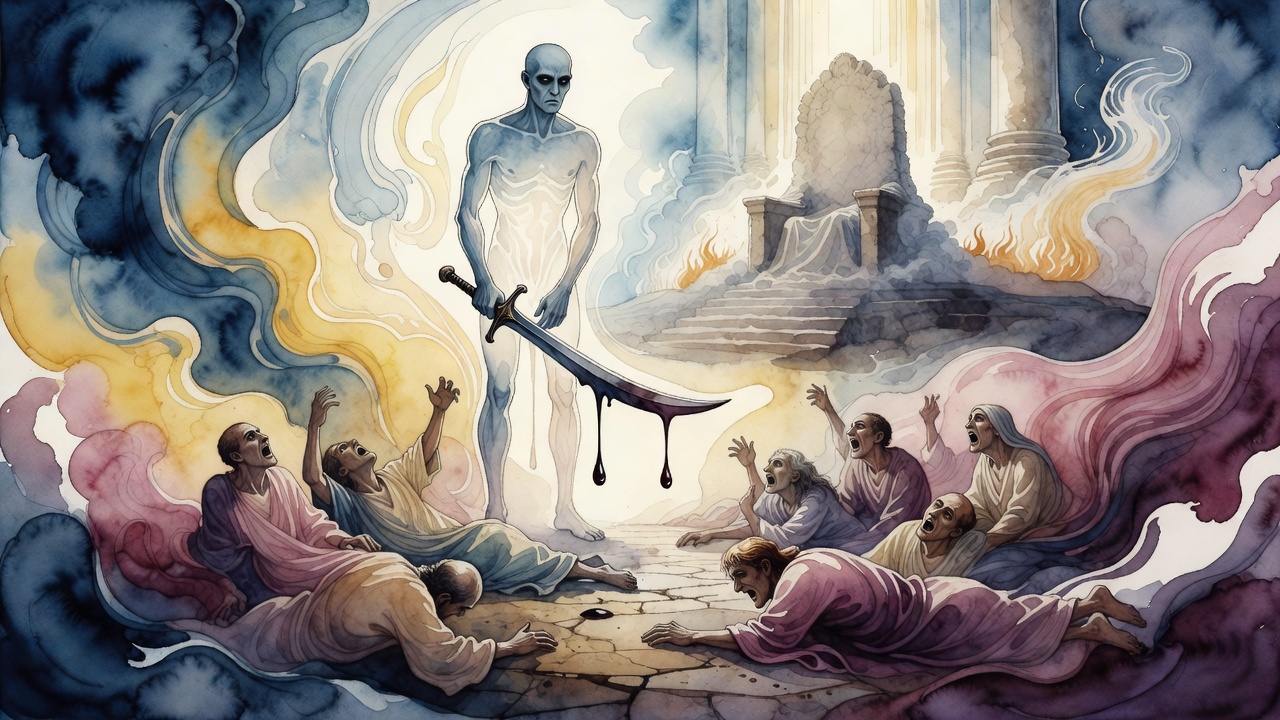
One drop from his sword, and the dying open their mouths. Samael is the angel of death, but he answers to God, not against him.

Curated by Arthur · Told by Maggid ·
Table of Contents
  1. The Name on the Sword
  2. Twelve Wings Above the Throne
  3. The Voice from Abel's Blood
  4. The Accuser at the Sea
  5. The Weight of the Patron

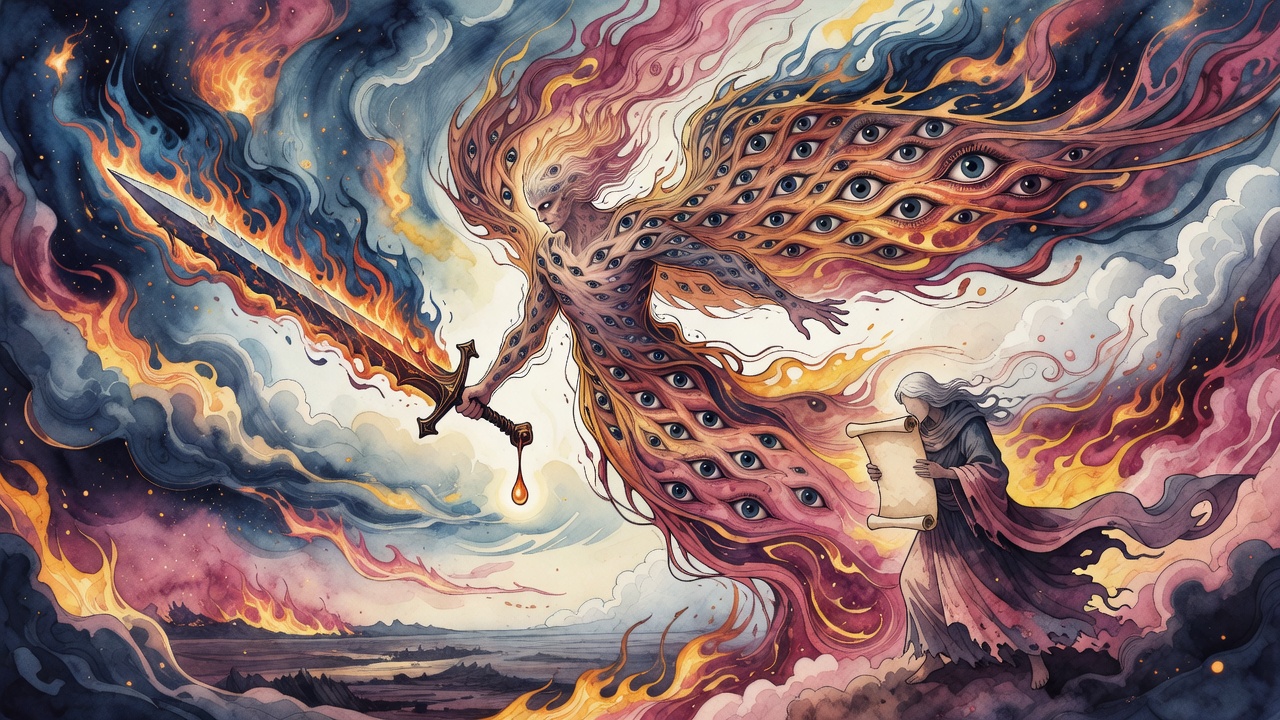
The sword hangs above the mouth of every dying person, and on the blade there is a single drop of poison. When the mouth opens in that last breath, the drop falls. Samael is the one who holds the sword. His name means the venom of God, sam El, because the killing agent is not separate from holiness. It is sanctioned by it. It is administered by a minister.

This is the first thing to understand about him: he is not a rebel. He holds a post.

The Name on the Sword

One tradition says the drop falls into the open mouth (Job 41). Another says it falls directly into the heart. Either way, the effect is identical. The death is real. The instrument is the same. Samael carries the poison the way a physician carries something that can cure or destroy, with complete authority and no sentiment. He is called the chief of accusers, the seducer, the destroyer. He is also called the great prince in heaven. Both designations are accurate. Neither cancels the other.

He is not a figure caught between two masters. He serves one.

Twelve Wings Above the Throne

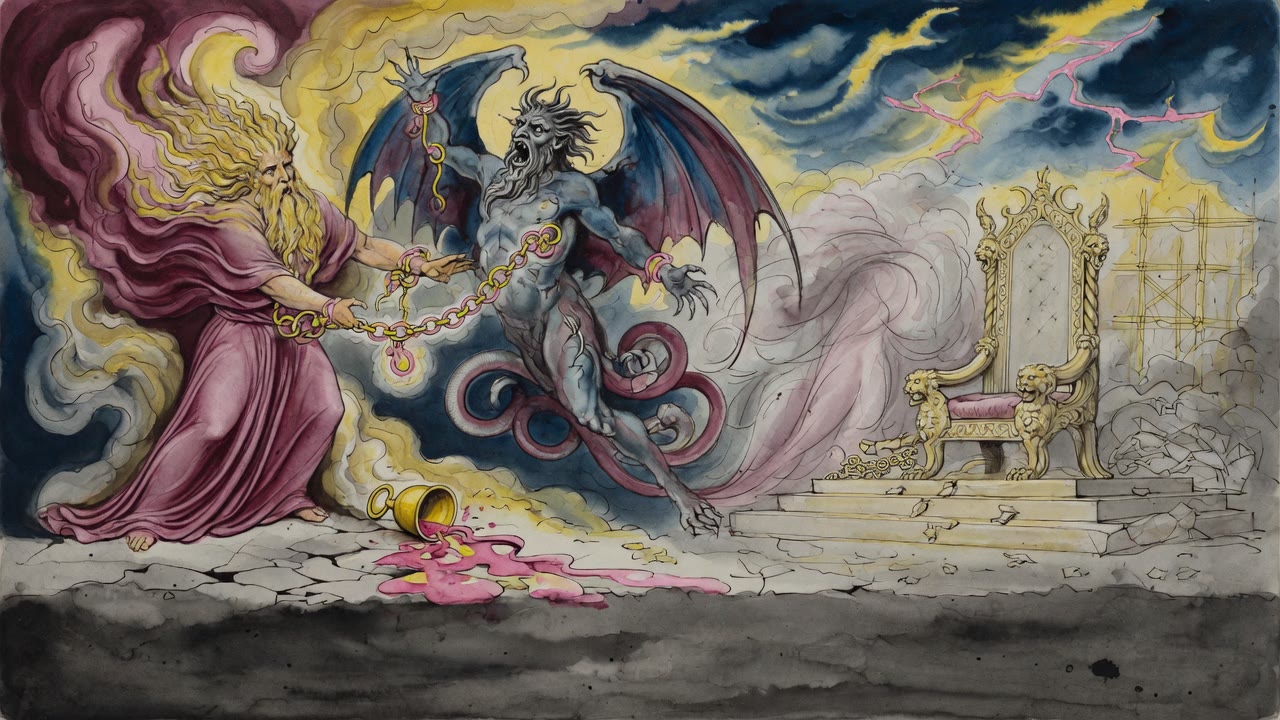
Consider the angelic order in the divine throne room. The hayyot (the living creatures) and the ofanim (the wheels) each have six wings. Samael has twelve. More wings than the creatures who bear the chariot of heaven. More wings than the attendants who stand nearest the fire. The mathematics here are not decorative. They establish rank. Whatever Samael is, he stands higher in the celestial order than the beings who encircle the Throne.

He is also the celestial patron of Rome. Edom. Esau. The empire that leveled the Second Temple and scattered Israel is not simply a political force in the rabbinic imagination. It has a heavenly sponsor, and that sponsor has twelve wings and a sword. When Rome prospers, Samael's hand is in it. When Israel suffers under Rome, there is a voice in heaven arguing for that suffering. Samael provides the voice. He argues with precision and legal standing (Genesis 25:23). He is not rogue. He is exactly where heaven placed him.

The Voice from Abel's Blood

After Cain killed his brother, something moved through the world that had not moved before. Adam and Eve did not know at first what had entered them. They sat in grief, in sackcloth, fasting. Adam wept for days without eating. And in the silence of that grief, a voice spoke. Not from outside. From inside. From the heart.

The voice was Abel's.

It said to Samael: go hence. I have penetrated to the heart of Adam and to the heart of Eve. I will not quit their hearts, nor the hearts of their children, nor their children's children, unto the end of all generations.

Samael did not leave. The death-drop was already there, not hanging on a sword above a mouth but living now in the chest of every parent who would ever bury a child. Adam put on sackcloth. He fasted. He could not move the thing that had taken root inside him. No ritual displaced it. No fasting burned it out.

Finally God appeared to him. "My son," God said, "have no fear of Samael. I will give you a remedy that will help against him."

The remedy is not described in detail. What is described is the promise: that Samael can be endured, even if he cannot be expelled (Genesis 4:10).

The Accuser at the Sea

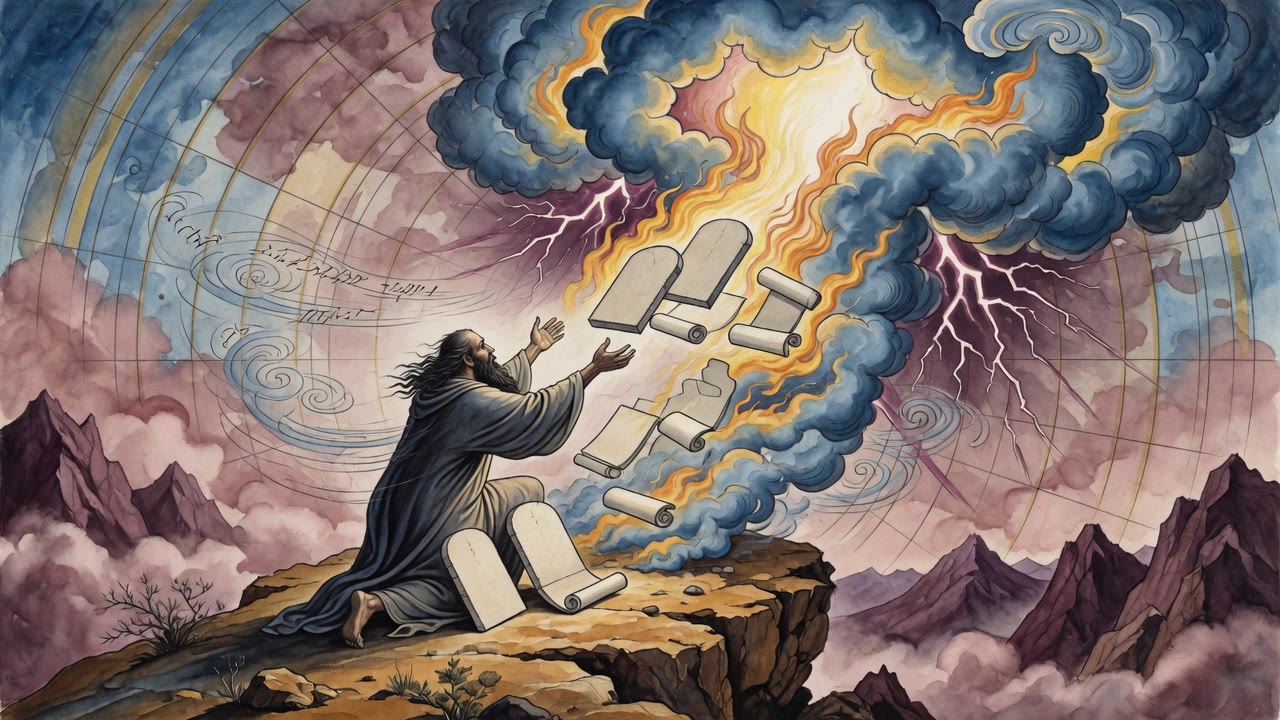
When Moses and Israel stood at the edge of the water with Pharaoh's army behind them, the threat was not only military. In heaven, a case was being made. Samael took his position as accuser, arguing that Israel deserved to be destroyed, that the people who had worshipped idols in Egypt had no more standing before God than the Egyptians pursuing them. One nation fleeing, one nation chasing. Samael's argument was that heaven should let both drown.

Moses cried out. God's answer to Moses at that moment, according to the rabbinic reading of (Exodus 14:15), was essentially: stop calling out and move. The sea would split. The accuser's case would fail. But the case had been made, formally, with the full authority of the chief of accusers, and it very nearly held.

The sea opened not because Israel had nothing to answer for, but because God chose to override the accusation.

Samael lost that argument. He argued it anyway. That is his office.

The Weight of the Patron

Esau's angel wrestles Jacob through the night (Genesis 32:25). The tradition connects that unnamed wrestler to Samael. Jacob walks away with a limp and a new name. Samael walks away having touched the sinew of Jacob's thigh and changed the gait of Israel's patriarch forever. This is not victory and it is not defeat. It is contact. It is what happens when the accuser and the blessed person meet in the dark before dawn.

The empire of Rome is real. The body that limps into morning light is real. The drop of poison on the sword is real. Samael administers all of it, appointed and ranked and winged and precise, and he does not work against the Holy One. He works as an instrument of the Holy One, which is a different kind of terror entirely.

Adam fasted in sackcloth. God promised a remedy. The poison was already in the heart.


← All myths
From the tradition

Sources

3 sources

The texts this telling draws on, in full. Open a card to read inline, or expand it for a wider, quieter read.

Jewish Encyclopedia, "Samael" (1906)Jewish Encyclopedia (1901-1906)

Prince of the demons, and an important figure both in Talmudic and in post-Talmudic literature, where he appears as accuser, seducer, and destroyer. His name is etymologized as = "the venom of God," since he is identical with the angel of death (Targ. Yer. to Gen. iii. 6; see also Death, Angel of), who slays men with a drop of poison ('Ab. Zarah 20b; Kohut, "Angelologie und Dämonologie," pp. 69, 71). It is possible, however, that the name is derived from that of the Syrian god Shemal (Bousset, "Religion," p. 242).

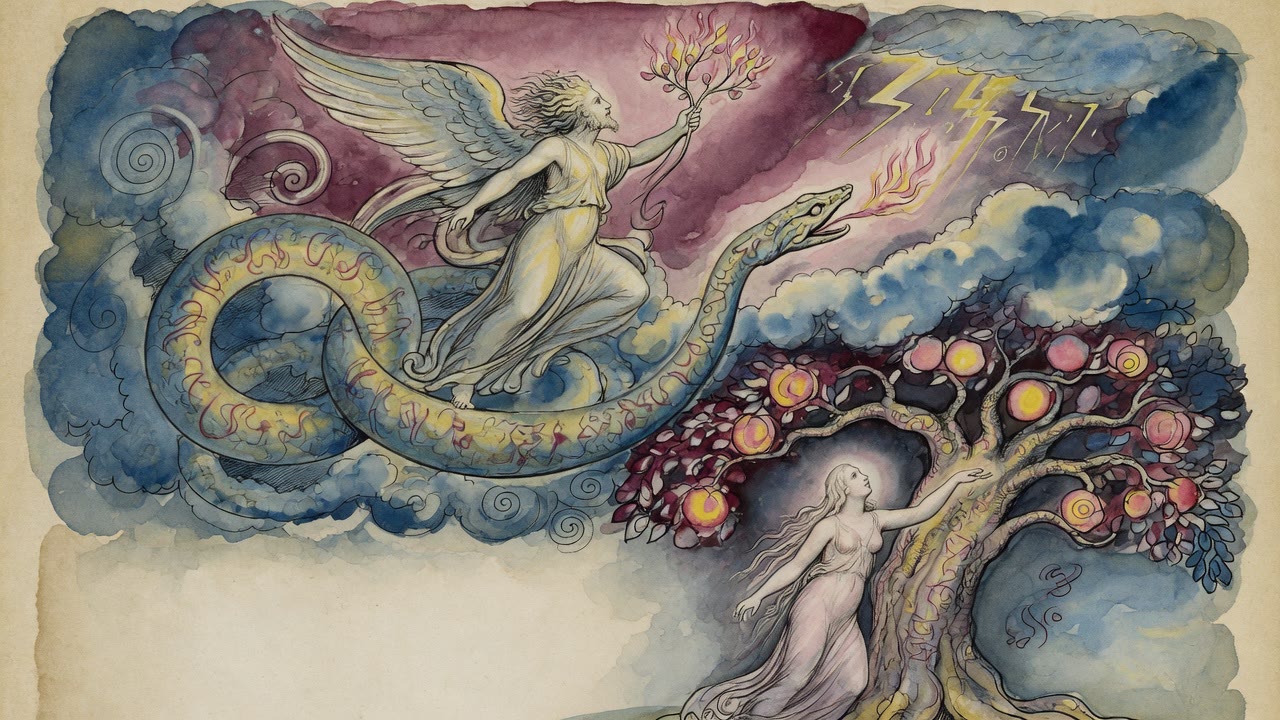
Samael (the angel of death) is the "chief of Satans" (Deut. R. xi. 9; Jellinek, "B. H." i. 125), quite in the sense of "the prince of the demons" mentioned in Matt. ix. 34; but, on the other hand, he is "the great prince in heaven." (Pirḳe R. El. xiii., beginning), who rules over angels and powers (ib.; Martyrdom of Isaiah, ii. 2). As the incarnation of evil he is the celestial patron of the sinful empire of Rome, with which Edom and Esau are identified (Tan. on Gen. xxxii. 35; Jellinek, l.c. vi. 31, 109, etc.). He flies through the air like a bird (Targ. to Job xxviii. 7), and, while the ḥayyot and ofannim have only six wings, he has twelve, and commands a whole army of demons (Pirḳe R. El. xiii.). In so far as he is identified with the serpent ("J. Q. R." vi. 12), with carnal desire (Yeẓer ha-Ra'), and with the angel of death, all legends associated with Satan refer equally to him, while as a miscreant he is compared to Belial ( = "worthless"; see collection of material in Bousset, "Antichrist," pp. 99-101).

All these descriptions of Samael show that he was regarded simply as the principle of evil that brought upon Israel and Judah every misfortune that befell them. Even at the creation of the world he was the Watcher, who ever sought evil and who began his malignant activity with Adam. His opponent is Michael, who represents the beneficent principle, and who frequently comes into conflict with him (comp. Jew. Encyc. viii. 536 et seq.; Lucken, "Michael," pp. 22 et seq.).

The evil nature of Samael may be illustrated by a number of examples. He and his demonic host descended from heaven to seduce the first human pair (Pirḳe R. El. xiii., beginning; Yalḳ. Gen. i. 25), and for this purpose he planted the vine, the forbidden tree of paradise (Greek Apocalypse of Baruch, iv.). He was himself the serpent, whose form he merely assumed (ib. ix.; "J. Q. R." vi. 328), and was one of the leaders of the angels who married the daughters of men (Gen. vi. 1-4), thus being partially responsible for the fall of the angels (Enoch vi., in Kautzsch, "Apokryphen," ii. 238 et seq.; Lucken, l.c. p. 29). His former wife was Lilith (Jellinek, l.c. vi. 109). He endeavored to persuade Abraham not to offer up Isaac, and, failing in his purpose, he caused the death of Sarah by carrying the news of the sacrifice to her (Gen. R. lvi. 4; Sanh. 89a et passim; Pirḳe R. El. xxxii.). He wrestled with Jacob (Gen. R. lxxvii. and parallels), and also took part in the affair of Tamar (Soṭah 10b). He brought accusations against the Israelites when God was about to lead them out of Egypt (Ex. R. xxi. 7; Bacher, "Ag. Pal. Amor." i. 25, 473), and was jubilant at the death of Moses because the latter had brought the Torah (Deut. R. xi. 9; Jellinek, l.c. i. 12 et passim). Entering into King Manasseh, Samael caused the martyrdom of the prophet Isaiah (Martyrdom of Isaiah, i., in Kautzsch, l.c. ii. 124); and he considered himself victorious over Michael when God decided that the ten pious scholars during the reign of Hadrian must suffer death (Jellinek, l.c. ii. 66, iii. 87, vi. 31). On the Day of Atonement, however, Israel has no fear of him (Lev. R. xxi. 4).

In the quotations from the Slavonic Book of Enoch (vi.) Samael is represented as a prince of the demons and a magician. He is, therefore, frequently mentioned in the cabalistic writings of the Middle Ages, from which Eisenmenger compiled a rich collection of passages ("Entdecktes Judenthum," i. 826 et seq.), to which must be added those in Schwab's "Vocabulaire de l'Angélologie" (p. 199). As lord of the demons, Samael is regarded as a magic being, and must be considered in the preparation of amulets, although there is no agreement as to his power and activity. He presides over the second "teḳufah" (solstice) and the west wind of the fourth teḳufah, as well as the third day of the week ("Sefer Raziel," 6a, 40b, 41b; see also Schwab, l.c.). In Hebrew amulets Samael is represented as the angel of death ("Revue de Numismatique," 1892, pp. 246, 251). Eve is supposed to have become pregnant by him (Targ. Yer. to Gen. iv. 1); and the cabalists add many details to this legend (Eisenmenger, l.c. i. 832 et seq.). The spot in the moon is supposed to have been caused by the filth of Samael (Menahem of Recanati, p. 140, c. 2).

Full source
Shemot Rabbah 21:7Shemot Rabbah

In Shemot Rabbah, a compilation of rabbinic commentary on the Book of Exodus, they offer a powerful, if somewhat unsettling, answer.

The verse in question is God's instruction to Moses at the Red Sea: "Why are you crying out to Me?" (Exodus 14:15). But the rabbis at play here see something deeper. They ask, as the text puts it: “Have you composed your prayer [shuakha] with no trouble?” Now, most translations interpret shuakha as "your wealth." But this midrash (rabbinic interpretive commentary), this interpretive story, understands it to mean "your prayer" or "your cry."

So, what does it mean to "compose your prayer"? Rabbi Elazar ben Pedat uses a proverb to explain: "Honor your doctor before you need him." In other words, prepare yourself spiritually before crisis strikes. Rabbi Shimon adds to this, saying: "Compose your prayers before your Creator, so you will not have enemies on high." It’s a preventative measure, a spiritual inoculation against the forces that might come against you.

Who are these "enemies on high?" This is where the story gets really interesting.

Rabbi Ḥama bar Rabbi Ḥanina introduces the angel Samael (the angel of death), often seen as an accuser, an adversary. He says that when Israel was leaving Egypt, Samael rose up to prosecute them. Rabbi Ḥama explains this with a parable: Imagine a shepherd crossing a river with his flock. A wolf appears, threatening the sheep. The clever shepherd throws the wolf a large ram, a distraction. "Let him scuffle with it," he thinks, "until we cross the river, then I will retrieve it."

Similarly, when Israel left Egypt, Samael accused them before God: "Until now, these people were worshipping idols, and you're splitting the sea for them?" So, what did God do? According to this midrash, He gave Samael Job.

Yes, that Job, the one who suffered so much. That Job was one of Pharaoh’s advisors, “a wholehearted upright man” (Job 1:1). God essentially says to Samael: "Here he is, in your control." The idea is that while Samael is preoccupied with Job, Israel can safely cross the sea.

Job, of course, doesn't understand this divine chess game. He cries out: "I was at peace and He crushed me" (Job 16:12). The midrash interprets this as: "I was at peace in the world and He crushed me…in order to render me as protection [matara] for His people." Job becomes a "target [matara]" so that Israel can be saved.

He laments: "He has handed me over to an evil angel" (Job 16:11), handed me into the hand of the accuser so that Israel would not emerge guilty at trial." That is why He cast me into his hands; that is: “He hast cast me into the hands of the wicked” (Job 16:11).

At that moment, God tells Moses: "I handed Job to the accuser. What should you do? 'Speak to the children of Israel and have them set forth.'" In other words, stop praying and start moving.

It's a complex and even unsettling idea, isn't it? The notion that one person might suffer to protect others, that even suffering can have a divine purpose. This midrash from Shemot Rabbah forces us to confront the uncomfortable question of why bad things happen to good people, and how even in the face of immense suffering, there might be a larger, unseen plan unfolding. It reminds us that sometimes, the answer to our prayers isn't a miraculous intervention, but a call to action, a push to "set forth" even when we don't understand the full picture.

Full source
Legends of the Jews 4:32Legends of the Jews

The stories tell us it wasn't just a simple "get out!" It was a complex struggle, a cosmic battle, and a search for redemption.

Samael (the angel of death), often identified as the embodiment of evil, is gloating, perhaps, or still lingering around Adam and Eve. But then, a voice rings out – the voice of the slain Abel himself! According to Legends of the Jews, the voice emanates directly from the hearts of Adam and Eve, declaring to Samael, "Go hence! I have penetrated to the heart of Adam and the heart of Eve, and never again shall I quit their hearts, nor the hearts of their children, or their children's children, unto the end of all generations."

The story doesn't end there. Adam is overcome with grief. He’s heartbroken. He puts on sackcloth and ashes, a sign of mourning, and fasts for days on end. Finally, God appears to him. "My son," God says, "have no fear of Samael. I will give thee a remedy that will help thee against him, for it was at My instance that he went to thee."

Can you imagine Adam's relief? He asks, naturally, "And what is this remedy?"

And God answers, simply: "The Torah."

But wait... the Torah wasn't given yet. So, what does that mean? God then gives him the book of the angel Raziel. This book, filled with divine wisdom and secrets, becomes Adam's lifeline. He studies it day and night.

Now, here’s where things get even more interesting. The angels, seeing Adam's newfound wisdom, become jealous. According to Ginzberg's retelling in Legends of the Jews, they try to trick him, to cunningly destroy him, by calling him a god and prostrating themselves before him. Adam, of course, refuses. "Do not prostrate yourselves before me, but magnify the Lord with me, and let us exalt His Name together," he pleads.

But their envy is too strong. They steal the book of Raziel and throw it into the sea. Adam is devastated. He searches everywhere, but it's gone. He fasts again, grief-stricken.

Once more, God appears. "Fear not!" He says. "I will give the book back to thee."

Then, in a beautiful detail, God calls upon Rahab, the Angel of the Sea. Yes, there's an angel in charge of the sea! God orders Rahab to recover the book and return it to Adam. And Rahab, obedient to the divine will, does just that.

So, what does this story tell us? It's more than just a simple narrative. It's about the struggle against evil, the power of divine wisdom (the Torah), and the importance of humility. It suggests that even after the fall, there is a path to redemption, a way to reconnect with the divine. And sometimes, even angels need a little nudge in the right direction. What do you think? What does this story mean to you?

Full source