Parshat Lech Lecha5 min read

Satan in Black Silk Sent Nimrod's Army

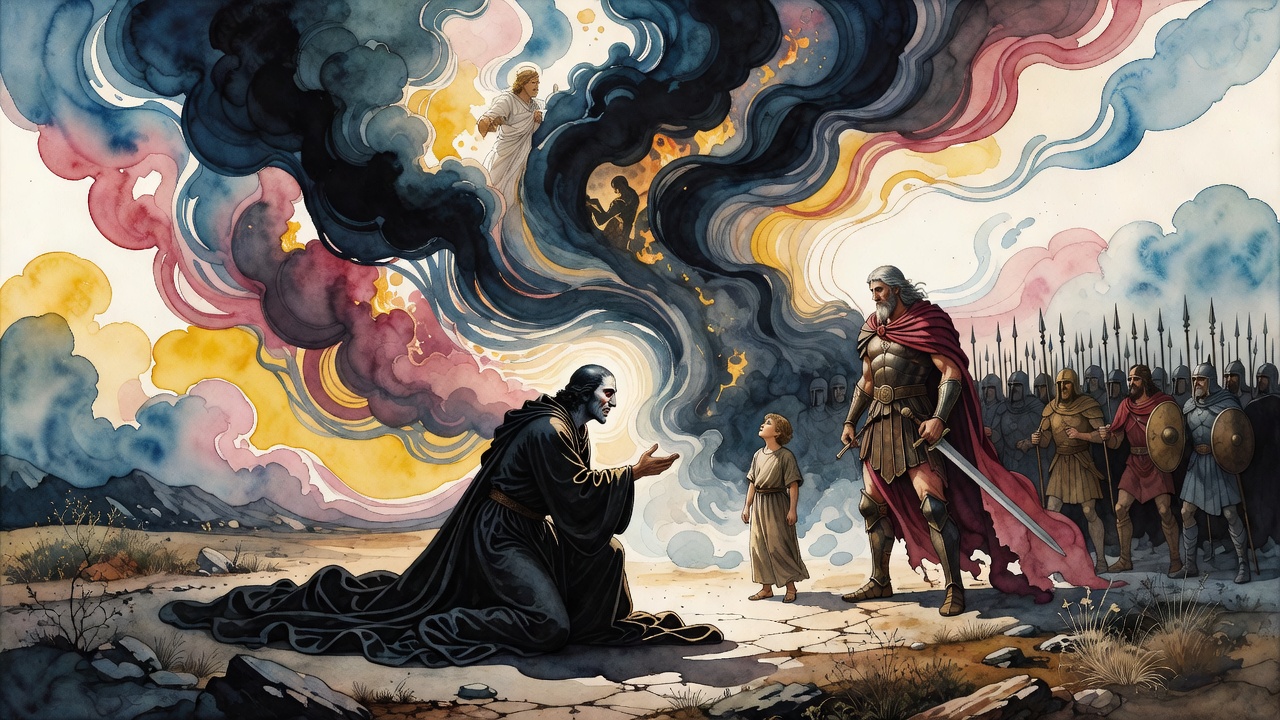
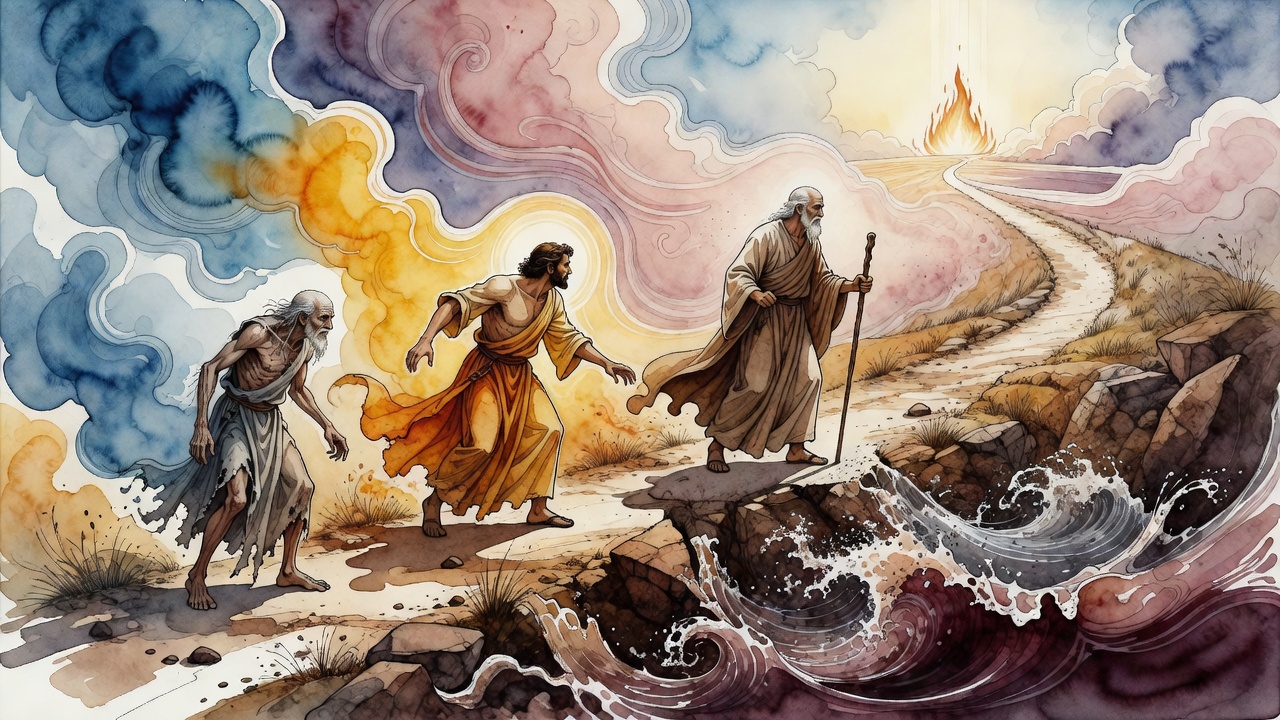
Ha-Satan (the Accuser) knelt before Nimrod in black silk and urged war on the child Abraham until Gabriel threw dark clouds between the boy and the host.

Curated by Arthur · Told by Maggid ·
Table of Contents
  1. Silk on the Throne Room Floor
  2. The Dust Before the Spears
  3. The Dark That Took the Road
  4. What They Told the King
  5. The Plain Afterward
Satan in Black Silk Sent Nimrod's Army Click for full size

Silk on the Throne Room Floor

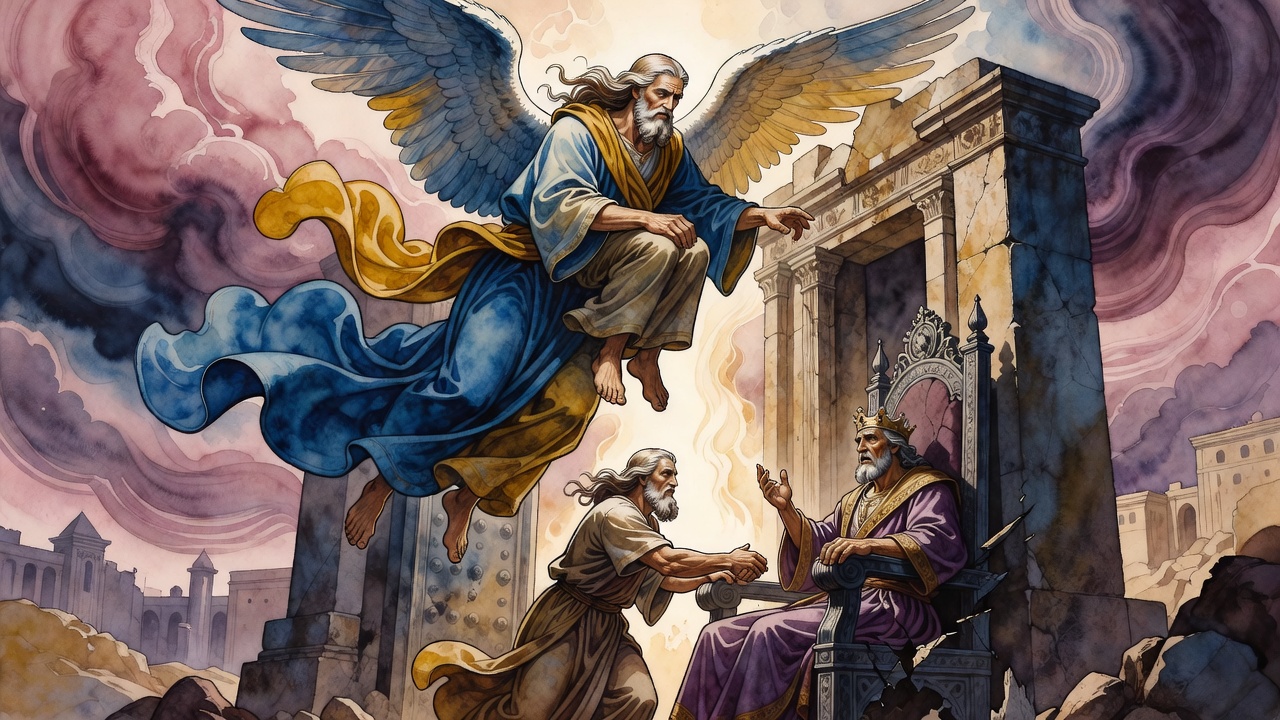
The stranger came the length of the throne room in black silk and went down flat on his face, and no dust came off the cloth when it hit the stone. Nimrod had not slept properly in weeks. The prophecy had been going around his city the way a fever goes around a house, passed from a priest to a steward to a woman selling barley: a child was coming who would break the king's authority. So when the man on the floor asked leave to speak, Nimrod told him to get up and say it.

The stranger did not bring a new fear into the room. He tidied the one already in it. Arm the kingdom, he said. Take the troublesome child into servitude now, while he is small enough to carry. Do not wait for the boy to grow into the size of the prophecy.

Nimrod listened the way a man listens when he has already decided and only wants a witness. His own priests had hedged for months, because priests who guess wrong get buried, but this one asked for nothing and hedged nothing. So the king believed him. He sent out a great armed force, spears and shields and captains with orders, to bring in one boy.

The Dust Before the Spears

Abraham saw the dust before he saw anything that made it. It came up off the plain in a long brown wall, and under it the light kept catching and dropping, catching and dropping, which is what a moving column of iron does at a distance.

He was sore afraid, in the plain sense of it: his mouth went dry and his legs went useless and he started to cry. He had no plan and no second plan and nowhere on that flat ground to put himself. So he turned his face up and asked God for help, out loud, the way a child asks.

God heard him. The answer did not arrive as a voice out of the sky. It arrived as Gabriel, standing on the dirt in front of him, close enough to be heard over the noise coming down the road. "Be not afraid," Gabriel said. "God is with thee. He will rescue thee out of the hands of all thine adversaries."

The Dark That Took the Road

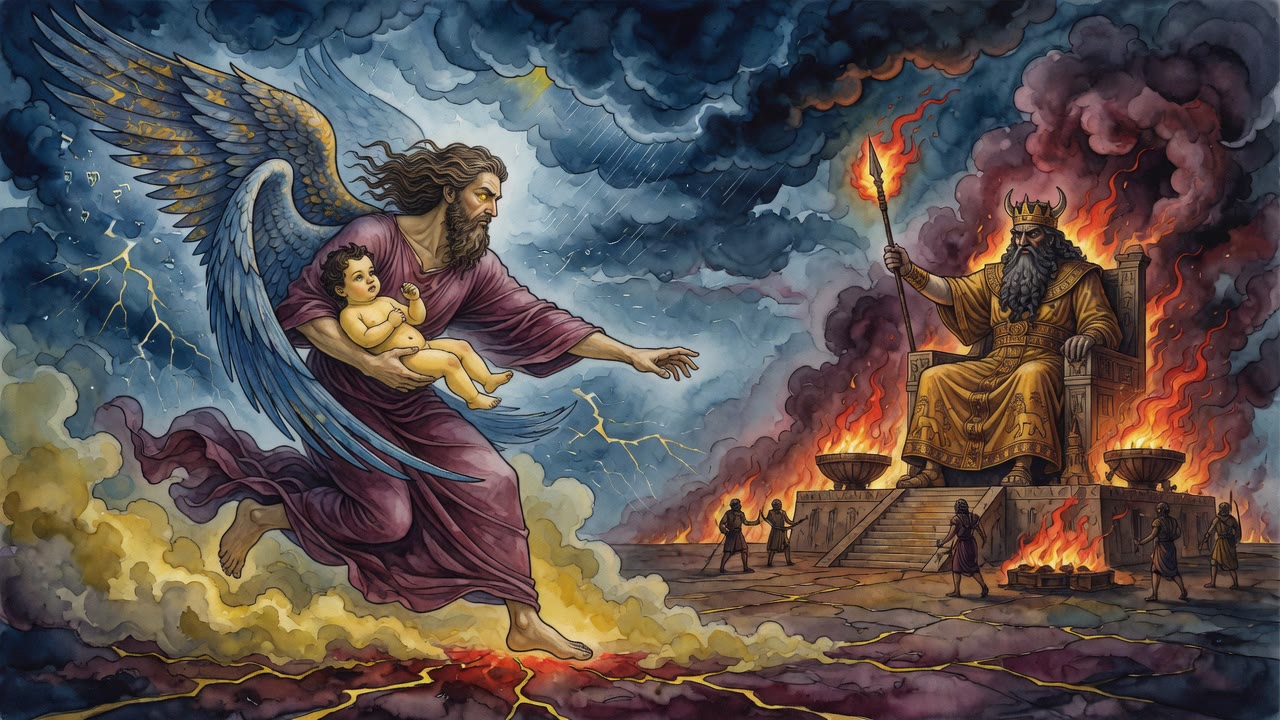
Then God gave the order and Gabriel set thick dark clouds between the boy and the host.

The captain at the front had his arm halfway down for the order to close. He saw the boy standing alone at the end of the field, small, not even running. Then he saw grey where the boy had been, and then he saw nothing: not the field, not the man riding at his knee, not his own hand when he put it up in front of his face. The horses knew first, because horses always know first, and they went sideways into each other while the men were still shouting for a line that had stopped existing.

Nobody argued theology with the weather. The clouds did not push the army back or strike it down. They took away the road, and an army without a road is only a crowd standing in the dark holding sharp things. They turned and ran, and running blind through their own baggage train did more damage than the thing they were running from.

What They Told the King

They came back to Nimrod with the story already going soft in their mouths. Let us depart, they said, and leave this realm. They could not describe what had been behind the darkness, because none of them had seen it, and a captain who cannot name the thing that beat him has nothing to offer a king but his own face.

Nimrod did not argue with them. He agreed, which was the first honest thing he had done since the man in silk stood up off his floor. Then he had the treasury opened and gave money to his princes and to his servants, all of them, because a court that is leaving at short notice has to be paid to leave quietly. Carts were loaded in the dark. The whole household went out of the city with the king in the middle of it, on the road to Babylon.

The Plain Afterward

The clouds thinned the way weather does, without ceremony, and the plain came back. It was scattered with what men drop when they run: a shield, somebody's sandal, a spear standing up out of the ground where it had been thrown down.

The king who had armed a kingdom against him was already half a day gone toward Babylon with his treasury in carts and his princes paid. The boy was still standing where the darkness had left him, in a field, with his face wet.


← All myths
From the tradition

Sources

2 sources

The texts behind this telling. Some cards carry a translation of the source; others are our own retelling of it, and each card says which. Every card links out to the original.

Legends of the Jews 5:25Legends of the Jews

Retold in our words. Read the original at the link below.The Legends of the Jews by Louis Ginzberg (1909) · Public Domain

Nimrod, the king, wasn't exactly thrilled about the prophecies swirling around about a child who would challenge his authority. He wasn’t just a little worried, he was terrified! And who shows up to fuel the fire? None other than Satan himself, disguised in some seriously stylish black silk. I mean, even the adversary knows how to make an entrance. The story, pieced together from various sources like Legends of the Jews (Ginzberg) tells us that Satan, in this human guise, throws himself at Nimrod's feet. Nimrod, all powerful king that he is, tells him to get up and spill the beans. And what advice does Satan offer? To arm the entire kingdom and bring this troublesome kid – Abraham – into servitude. Sounds like a slightly extreme reaction to a baby, if you ask me.

So, Nimrod, clearly not one to dismiss advice from dubious sources, takes Satan's suggestion. He sends out a massive, armed force to capture young Abraham. Can you imagine the sheer terror the boy must have felt, seeing this army bearing down on him?

The legend says that Abraham, understandably "sore afraid," turns to God in tears, begging for help. And God, hearing the boy's desperate plea, sends the angel Gabriel – yes, that Gabriel – to Abraham's rescue.

"Be not afraid," Gabriel tells him, "God is with thee. He will rescue thee out of the hands of all thine adversaries." And how does God do this? Well, he commands Gabriel to create thick, dark clouds between Abraham and his would-be captors.

Imagine this scene: one minute, a massive army is bearing down on you. The next, impenetrable darkness surrounds you. It’s straight out of a movie! The soldiers, understandably freaked out by these sudden, supernatural clouds, do what anyone would do: they turn tail and run!

They flee back to Nimrod, panic-stricken. "Let us depart and leave this realm!" they cry. And Nimrod, now clearly questioning his life choices, agrees. He gives money to all his princes and servants, and together, the entire court, including the king, hightails it to Babylon. I guess even kings know when they're outmatched. for a second. A child's prayer, answered by divine intervention, leading to the downfall of a kingdom. It’s a powerful reminder that even the smallest among us can have a profound impact. What "dark clouds" are obscuring our own paths, and what prayers might summon the help we need to overcome them?

Full source
Legends of the Jews 2:77Legends of the Jews

Retold in our words. Read the original at the link below.The Legends of the Jews by Louis Ginzberg (1909) · Public Domain

He's 125 years old, feeling strong, and ready to impart some wisdom, according to Legends of the Jews.

He calls his sons together, not to Asher's message is surprisingly simple, yet profoundly powerful. He says, "Hearken, ye sons of Asher…I will show you all that is right before God."

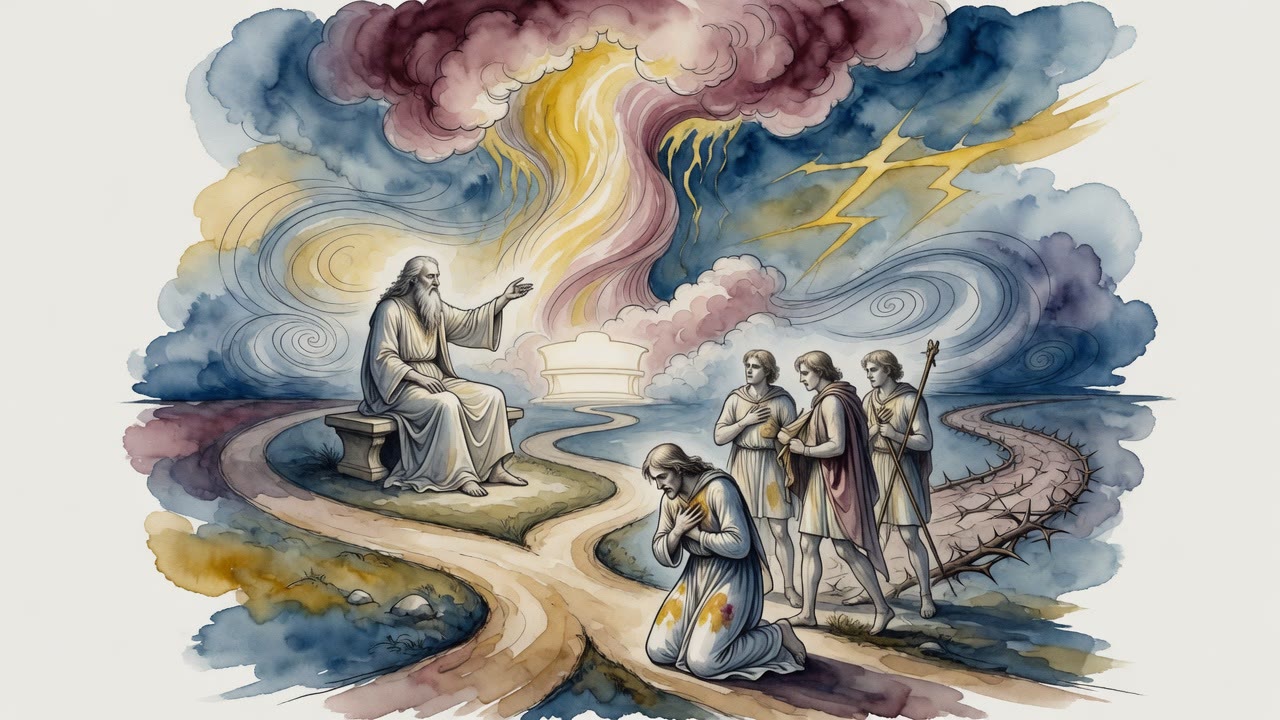
What follows is a lesson in duality. "Two ways hath God put before the children of men," Asher explains, "and two inclinations hath He bestowed upon them, two kinds of actions and two aims. Therefore all things are in twos, the one opposite to the other.” We see it everywhere. Good and evil, light and darkness, joy and sorrow. It's the very fabric of existence.

Here’s the kicker: Asher doesn’t want his sons to straddle the fence. He doesn’t want them dabbling in both good and evil. "Ye shall not be double," he urges, "pursuing both goodness and wickedness. Ye shall cling only to the ways of goodness." It's a powerful call to commit fully to the path of righteousness. Why? Because, Asher says, "the Lord taketh delight in them, and men yearn after them." Goodness resonates. It brings us closer to the Divine and to each other.

And what about the other side of the coin? "Flee from wickedness," Asher warns, "for thus you will destroy the evil inclination." It’s not enough to simply choose good; we must actively reject evil. By doing so, we weaken its hold on us. Think of it like weeding a garden – you can’t just plant flowers; you have to pull out the weeds to let the flowers thrive.

He then emphasizes the importance of focus. "Heed well the commands of the Lord, by following truth with a single mind." Don't get distracted. Don't let your attention wander to things that are ultimately meaningless or harmful. "Observe the law of the Lord, and have not the same care for wicked things as for good things. Rather keep your eyes upon what is truly good, and guard it through all the commands of the Lord."

Asher then paints a vivid picture of what awaits us at the end of our lives. "The end of man, when he meets the messengers of God and of Satan, shows whether he was righteous or unrighteous in his life." It's a dramatic scene, straight out of Jewish tradition!

He describes two very different fates. "If his soul goes out with agitation, she will be plagued by the evil spirit, whom she served with her lusts and her evil deeds; but if she departs tranquilly, the angel of peace will lead her to life eternal." Our choices in this life, Asher suggests, determine the kind of welcome we receive in the next. A soul burdened by evil will face torment, while a soul filled with goodness will find peace.

So, what’s the takeaway from this ancient wisdom? It’s a reminder that life is a constant choice between good and evil. It’s a call to choose goodness wholeheartedly, to reject wickedness, and to keep our eyes fixed on what truly matters. And perhaps, just perhaps, if we heed Asher's words, we too can face our final moments with tranquility, knowing we lived a life worthy of the "angel of peace."

Full source