5 min read

The Shulamite Walked Whole Through Four Empires

She brought two stones to her wedding and the king matched them with two of his own. Then she lost hers, and he quietly took his back off the table.

Curated by Arthur · Told by Maggid ·
Table of Contents
  1. She Brought Two Stones to the Wedding
  2. The Day the King Took His Back
  3. Three Tutors Arguing Over Iron
  4. Return, Return
  5. The Crown Made Out of What She Lost
The Shulamite Walked Whole Through Four Empires Click for full size

She Brought Two Stones to the Wedding

A king married a noblewoman, and she came into his house carrying two gems of her own. He looked at them, went to his treasury, and brought out two that matched. Four stones on the table, two hers and two his, and the marriage started even.

Her two had names. Abraham handed them down to his children, and God said out loud why He had chosen the man: because he will instruct his household after him to keep the way of the LORD, to do righteousness and justice. That was her half of the settlement. Righteousness and justice, carried out of one old man's tent into a whole people.

The two the king matched them with were kindness and mercy.

The Day the King Took His Back

She lost hers.

Not robbed, but lost the way anything is lost, by handling it carelessly for long enough. Amos described what it looked like from the street. They have turned justice into poison and the fruit of righteousness into wormwood. A court that sells its verdicts. A stone weight in the scale that is not the weight stamped on its side.

The king said nothing about it for a long time. Then he came and lifted his own two off the table. "I have withdrawn My peace from this people," He said. "My kindness and My mercy with it."

The house was still standing, but there was nothing left in it.

Three Tutors Arguing Over Iron

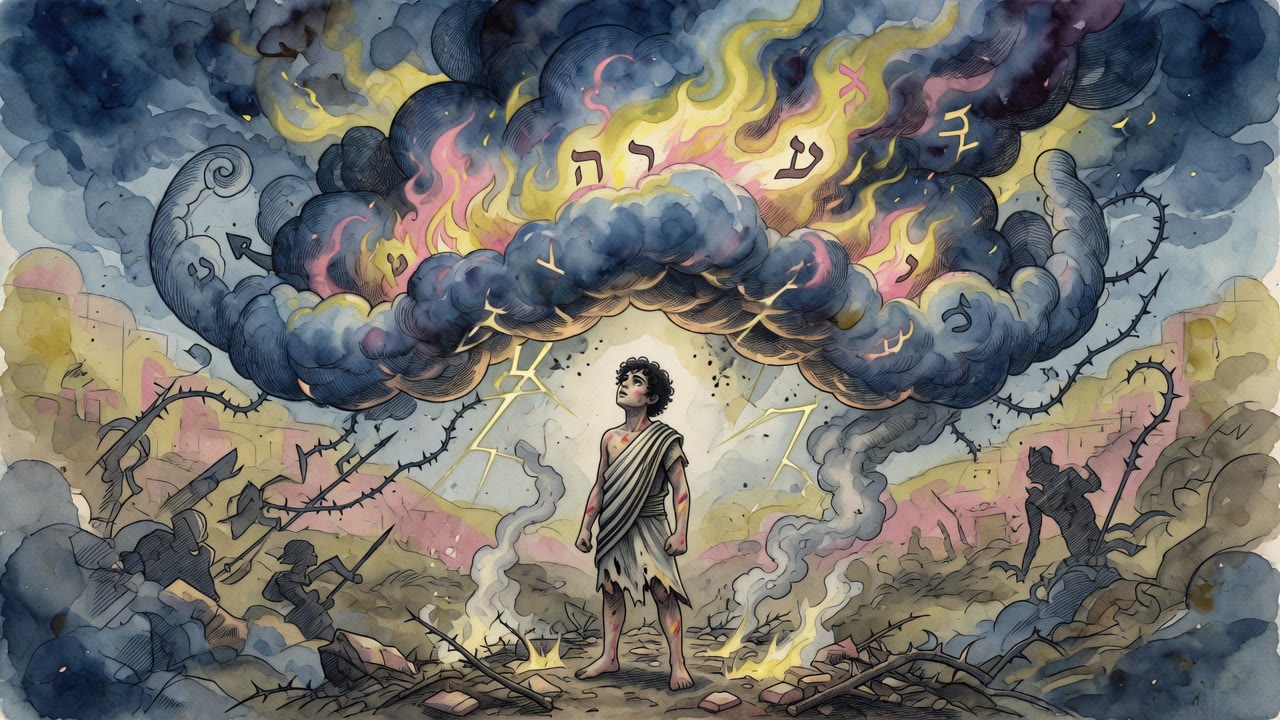
The son of that house had gone bad by then, and three tutors stood in front of the king arguing about how heavy to make his chains.

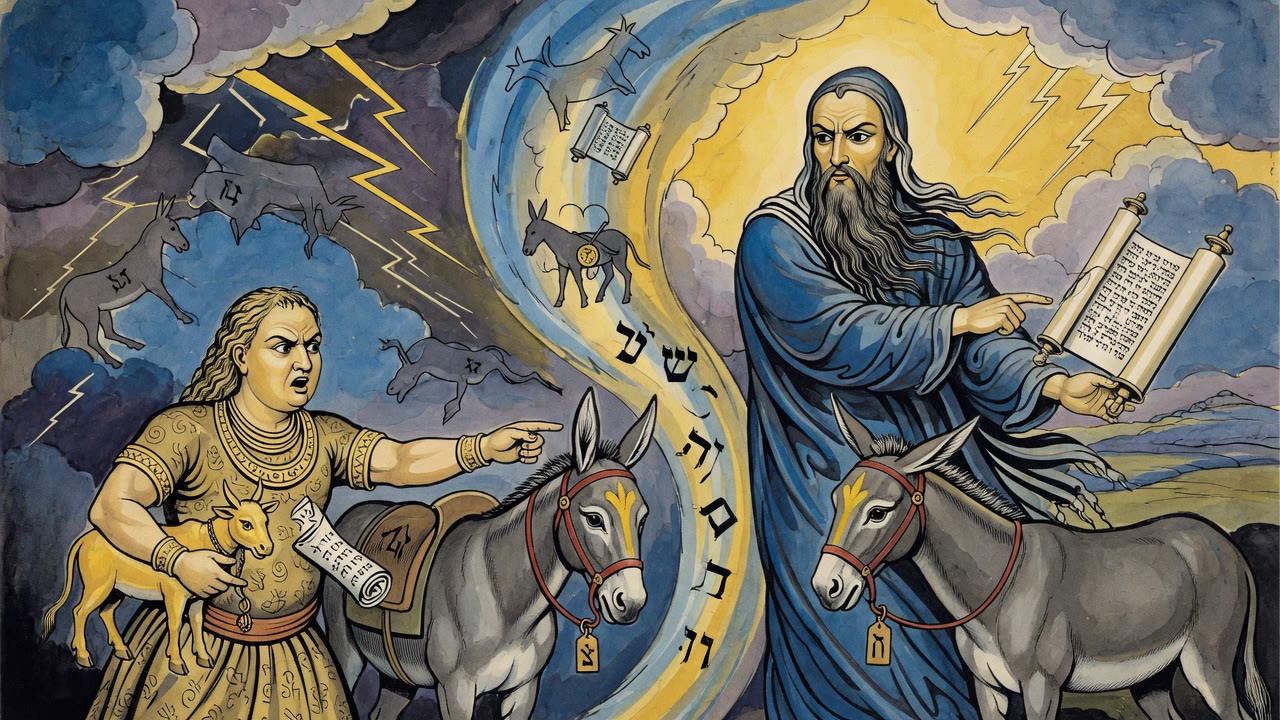
Moses went first and did not flinch. "A hundred litra." He had already written the sentence out in full: many evils and troubles will find them.

But David said a hundred would kill the boy outright. "Twelve." One for each hour of daylight, because his own prayer asked God to answer on the day of trouble, and a day runs twelve hours.

Then Jeremiah stood up, because Jeremiah had seen the boy more recently than either of them, in a burning city, being marched out of it. "He cannot carry twelve. One litra." He had a verse ready that puts the trouble and the way out of it in the same breath. It is a time of trouble for Jacob, and out of it he will be saved.

A hundred, then twelve, then one. The weight came down each time, because every man who spoke had watched the boy more closely than the man before him.

Moses asked for one more thing. "Master of the world. When You see Your children in trouble and there is nobody left standing to ask You for mercy on their behalf, answer them anyway. Answer them right away."

"As you live, Moses. Whenever they call Me, I answer."

Reish Lakish put it the way the women put it in the birthing room, crowding around a girl on the stool who is frightened and too far along to stop. May the One who answered your mother answer you. David said the same thing to Israel. May the One who answered Jacob answer you, and Jacob is the man who built an altar and named it for the God who answered him on the day he was in trouble.

Return, Return

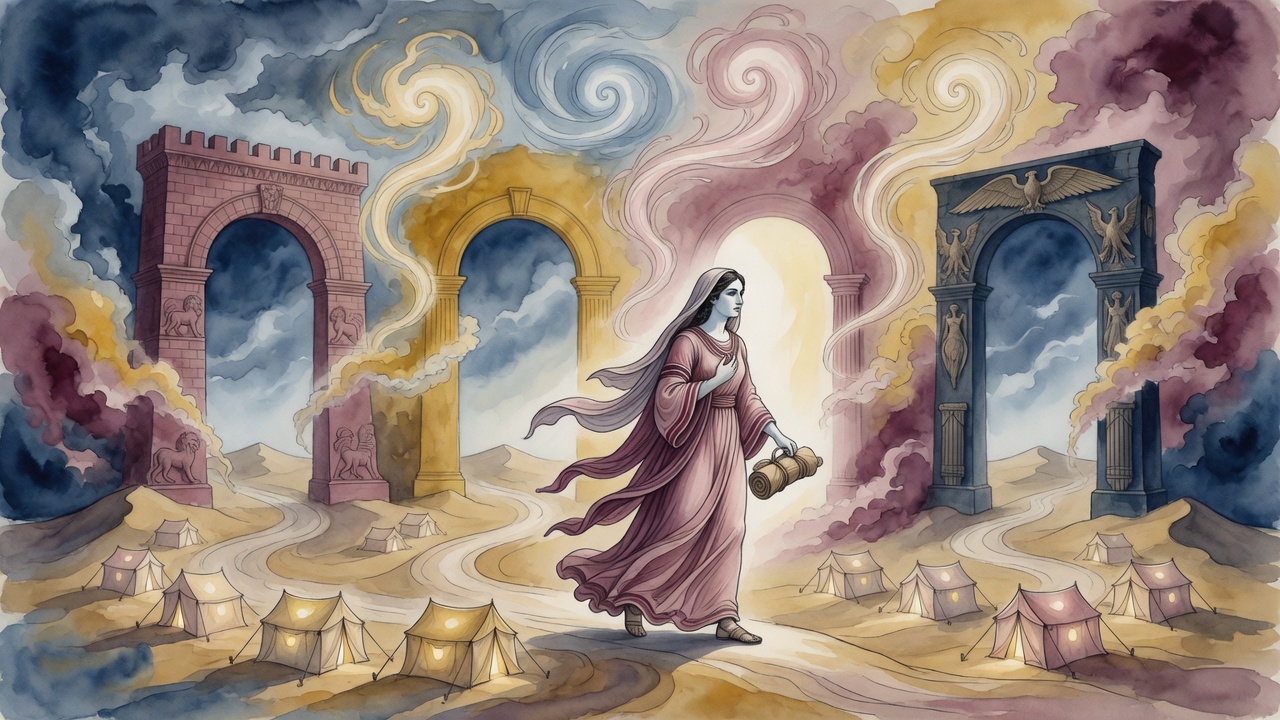
In the Song of Songs a voice calls after a woman who is walking away. Return, return, Shulamite. Return, return, and let us look at you.

The word comes four times. Rabbi Berekhya set the four calls against four kingdoms, four empires Israel walked into and four she walked out of still recognizably herself. Whole going in and whole coming out. Not comfortable. Whole.

Her name carries the word for peace, and the peace travels with her, tent to tent, wherever the tents happen to be pitched that year. The priests lay the Name on her every morning and finish the blessing with that same word. Rabbi Levi said the rain comes down for her sake and so does the dew. Rabbi Elazar ben Maron said she is the reason the ground under everyone else does not turn to liquid.

The Crown Made Out of What She Lost

Then she got up and went looking.

That is the entire turn, and the parable spends one line on it. She rose and applied herself and found her two gems and carried them back. Zion is redeemed by justice, and the ones inside her who turn back are redeemed by righteousness.

The king brought his two out of the treasury again. "The mountains can move and the hills can collapse," He said, "and My kindness will not move away from you, and the covenant of My peace will not collapse."

Then he did the thing nobody in the room expected. So he did not slide her two stones back across the table and lock his own away. He had all four set into a single crown and put it on her head.

"I will betroth you to Me forever. With righteousness and with justice, with kindness and with mercy. I will betroth you to Me in faithfulness."


← All myths
From the tradition

Sources

4 sources

The texts behind this telling. Some cards carry a translation of the source; others are our own retelling of it, and each card says which. Every card links out to the original.

Bereshit Rabbah 66:2Bereshit Rabbah

Retold in our words. Read the original at the link below.The Sefaria Midrash Rabbah, 2022 · CC-BY

Jewish tradition, in its beautiful and often poetic way, offers a compelling answer: the people of Israel. to a fascinating passage from Bereshit Rabbah, a collection of rabbinic interpretations of the Book of Genesis. Here, Rabbi Berekhya opens with a verse from the Song of Songs (7:1): “Return, return, the Shulamite; return, return, and we will gaze upon you.” But what does this seemingly romantic verse have to do with the fate of the world?

Rabbi Berekhya interprets the four-fold "return" as a reference to the four kingdoms into which Israel entered and, crucially, from which they emerged whole. "The Shulamite," he says, represents a nation imbued with the peace – the shalom – of God. It’s a peace that travels with them, from tent to tent, a constant presence.

It gets even more profound. This "Shulamite," this nation of Israel, is the recipient of peace instilled by the priests every day. Remember the priestly blessing? "They shall place My name [upon the children of Israel]," (Numbers 6:27) tells us, "and [I] will grant you peace" (Numbers 6:26). They are a people in whose midst the very Source of peace dwells, as (Exodus 25:8) says: "They shall craft for Me a Sanctuary, and I will dwell in their midst." And ultimately, this is a nation into which God is destined to instill peace, fulfilling the promise in (Leviticus 26:6): "I will grant peace in the Land." That peace, (Isaiah 66:12) tells us, will be like a river, flowing directly towards them.

Rabbi Shmuel bar Tanḥum and Rabbi Ḥana, citing Rabbi Idi, take it a step further. They suggest that Israel actually made peace between God and the world. Can you imagine? That were it not for them, God might have destroyed everything!

Rav Huna, in the name of Rav Aḥa, draws on (Psalms 75:4): “The earth and all its inhabitants melted away.” He connects this to (Exodus 15:15): “All the inhabitants of Canaan have melted away.” But then, "I set firm its pillars, Selah" (Psalms 75:4). Rav Huna explains that God “set firm” the world once Israel accepted "I am the Lord your God" (Exodus 20:2). The world, he says, was filled with joy – venitbasem – or, in another reading, venitbases, the world was firmed.

Rabbi Elazar ben Maron adds that this nation preserves – meshalema – the stability of the world, both in this world and in the World to Come. Finally, Rabbi Levi offers a beautiful summation: all the good that comes into the world comes only due to Israel's merit. Rains fall, dews fall, all because of them, as it says: "And may God give you from the dew of the heavens" – to you, due to your merit, and the matter is dependent upon you.

So, what does it all mean? Are we, the Jewish people, solely responsible for holding up the world? Perhaps not in a literal, physical sense. But this passage suggests a powerful idea: that our commitment to ethical living, to embodying God's presence in the world, to striving for peace – that this is what truly sustains creation. It’s a weighty responsibility, but also an incredible privilege. It's a reminder that even in the face of chaos and uncertainty, we have the power to be a force for stability, for peace, and for good. And maybe, just maybe, that’s enough to keep the world from falling apart.

Full source
Devarim Rabbah 3:7Devarim Rabbah

Retold in our words. Read the original at the link below.The Sefaria Midrash Rabbah, 2022 · CC-BY

Devarim Rabbah, a compilation of rabbinic teachings on the Book of Deuteronomy, offers a powerful parable about just that – the relationship between God and Israel. It's a story of love, loss, redemption, and ultimately, a renewed commitment.

Rabbi Shimon ben Ḥalafta frames it like this: imagine a king marrying a noblewoman. She brings two precious gems to the marriage, and the king, wanting to match her devotion, provides two gems of his own. A balanced exchange. But what happens when things go wrong? The noblewoman loses her gems. And in response, the king withdraws his. Ouch. It sounds like a breakup waiting to happen. But this isn't the end of the story.

Later, the noblewoman works hard, applies herself, and finds her lost gems. The king, seeing her renewed dedication, brings his back too. It’s a moment of reconciliation, a chance for something new. The king then declares: "These and those shall be crafted into a crown and placed on the noblewoman’s head." A symbol of their unified commitment.

So, what do these gems represent? According to this midrash (rabbinic interpretive commentary), Abraham gave his descendants two gems: righteousness and justice. As it says in (Genesis 18:19), "For I love him, that he will command his children and his household after him, [and they will observe the way of the Lord, to perform righteousness and justice]." These qualities are the foundation of a moral and just society.

And what about God's gems? God provides kindness (chesed) and mercy (rachamim), as we find in (Deuteronomy 7:12): “The Lord your God will maintain for you the covenant and the kindness,” and (Deuteronomy 13:18): “He will give you mercy, and He will be merciful to you, and He will multiply you…”. These are divine attributes that offer solace and support.

But, as the story implies, this balance can be disrupted. Israel lost their gems, their commitment to justice and righteousness. The prophet Amos laments in (Amos 6:12): “For you have transformed justice into hemlock and the fruit of righteousness into wormwood.” As a result, God withdrew His: “For I have withdrawn My peace…kindness and mercy” (Jeremiah 16:5). A painful separation.

The good news? Redemption is possible. Israel can, and does, work to restore those lost virtues. The prophet Isaiah offers hope in (Isaiah 1:27): “Zion will be redeemed with justice and its penitents with righteousness.” And when Israel returns to justice and righteousness, God responds in kind, restoring His kindness and mercy. As (Isaiah 54:10) promises: “For the mountains will move and the hills will collapse, [but My kindness will not move from you and the covenant of My peace will not collapse, said the One who has mercy on you, the Lord].”

Once both Israel and God have restored their gems, something beautiful happens. The Holy One says: “These and those will be crafted into a crown and will be placed on Israel’s head.” This is the ultimate symbol of their renewed covenant, a promise of everlasting love and devotion. The prophet Hosea captures this beautifully in (Hosea 2:21)–22: “I will betroth you to Me forever; I will betroth you to Me with righteousness, with justice, with kindness and with mercy. I will betroth you to Me with faithfulness and you will know the Lord.”

So, what does this all mean for us? This midrash isn't just a story about God and Israel. It’s a story about relationships, about responsibility, about the potential for both loss and redemption. And when we lose sight of them, we have the power to find them again, to rebuild and renew our connections with each other and with the Divine. What gems will you bring to the world today?

Full source
Devarim Rabbah 2:11Devarim Rabbah

Retold in our words. Read the original at the link below.The Sefaria Midrash Rabbah, 2022 · CC-BY

Our story comes from Devarim Rabbah, a compilation of rabbinic teachings on the book of Deuteronomy. It begins with the verse from (Psalm 20:2), "May the Lord answer you on a day of trouble." The Rabbis ask, what does this really mean?

They tell a parable: Imagine a king's son who's gone astray. He needs discipline, but how much? The Rabbis describe three tutors, each offering different advice on the severity of the “chains”, the consequences, needed to bring him back on the right path.

The first tutor says, "Let's give him chains weighing one hundred litra" – a significant weight. The second, thinking that's too harsh, suggests twelve litra. Finally, the third tutor proposes a mere one litra.

So, what does this have to do with us? Moses, David, and Jeremiah represent these tutors in a way. Moses, seeing the future, declares, “Let chains of one hundred litra be made for them,” echoing the verse in (Deuteronomy 31:17): “Many evils and troubles will find them.” He forsees intense trials.

But David, with a more compassionate eye, suggests a lesser burden. “May the Lord answer you on a day of trouble,” he prays, linking the answer to the day, which has twelve hours – twelve litra, if you will.

Then comes Jeremiah. He pleads with God, recognizing that even David's “chains” are too heavy for the people to bear. "Master of the universe," he cries, "they do not have the strength to withstand what David said!" Instead, he asks for chains of one litra, reflected in the verse, “It is a time of trouble for Jacob, but from it he will be saved” (Jeremiah 30:7). The trouble is there, but so is the promise of salvation.

Isn't that powerful? The tradition understands that what one generation can endure, another might find crushing. And divine mercy adapts accordingly.

The Devarim Rabbah continues with another analogy, this time from Reish Lakish. It's like a woman in labor, struggling to give birth. Those around her call out, "May He who answered your mother answer you!" David, in (Psalm 20:2), says something similar to Israel: “May He who answered Jacob answer you.” What prayer did Jacob offer? "I will craft there an altar to God who answers me on the day of my trouble" (Genesis 35:3).

And finally, Moses speaks directly to God. He asks that when God sees His children in distress, with no one to intercede, He should answer them immediately. And God responds, promising that whenever they call out, He will answer. As it says: “As is the Lord our God in all of our calling to Him.”

What a beautiful promise! It's a reminder that even in our darkest moments, when we feel like we're carrying those heavy chains, divine help is always available. The weight may feel immense, but we are not alone, and the burden is tailored to what we can, with help, endure. The Holy One hears our cries, just like a mother hears her child, and answers us in our time of need. The ability to call out, to pray, is a strength in itself.

Full source
Baal HaSulam's Introduction to Zohar 67:1Baal HaSulam's Introduction to Zohar

Retold in our words. Read the original at the link below.Sefaria-hosted English translation · CC-BY

When Kabbalah speaks of "Israel," it isn't always pointing at a place on the map. No,

The great Kabbalist Baal HaSulam, in his introduction to the Zohar, that mystical masterpiece of Jewish thought, gives us a powerful insight. He suggests that each of us contains both an "internal aspect" – the "Israel" within – and an "external aspect" – representing, metaphorically, the "other nations."

What does this mean? The "Israel" part of us, pnimiyut, is our soul, our connection to the divine, our higher aspirations. It's the part of us that seeks meaning, purpose, and spiritual growth. The "other nations" aspect, or chizoniyut, represents our physical needs, our ego, our worldly desires – the things that keep us tethered to the material world.

Baal HaSulam isn't saying that these external aspects are inherently bad. They're a part of being human. But he is suggesting that we need to be mindful of the balance. We have a choice. We can prioritize nurturing our inner "Israel," focusing our energy on spiritual growth and acts of kindness. Or, we can become consumed by our external needs and desires.

Think of the famous teaching from the Mishna in Pirkei Avot, the Ethics of the Fathers: "Make your Torah fixed and your work temporary." (Avot 1:15). It’s not telling us to quit our jobs! It's urging us to prioritize the eternal over the fleeting, the spiritual over the material. Torah, in this sense, represents our spiritual practice, our connection to something larger than ourselves. "Work" symbolizes our worldly pursuits.

When we dedicate ourselves to cultivating our inner "Israel," something remarkable happens. According to Baal HaSulam, "…his actions cause the inner, “Israel” aspect of the world to rise and ascend, while the external, “other nations” aspect of the world will recognize and respect the value of Israel."

In other words, when we prioritize our spiritual growth, not only do we elevate ourselves, but we also inspire others. Our actions create a ripple effect, influencing the world around us. When we live with integrity, compassion, and a sense of purpose, we become beacons of light, drawing others towards a more meaningful way of life. Even the more base or "external" parts of ourselves, in a sense, will then come to respect the wisdom of the "Israel" within.

So, what does this mean for you and me, today? Maybe it's a call to carve out a little more time for reflection, for prayer, for acts of kindness. Maybe it’s about being more mindful of how we spend our energy, ensuring that we're nourishing our souls as well as our bodies. It's about making a conscious effort to elevate the "Israel" within, so that it can shine its light on the world.

Because ultimately, the most profound impact we can have on the world begins with the work we do within ourselves.

Full source