Six Hundred Talents to Keep Them in Zion
One family in the holy city was starving. Their neighbors counted out six hundred talents of gold so the family would not have to move away.
Table of Contents
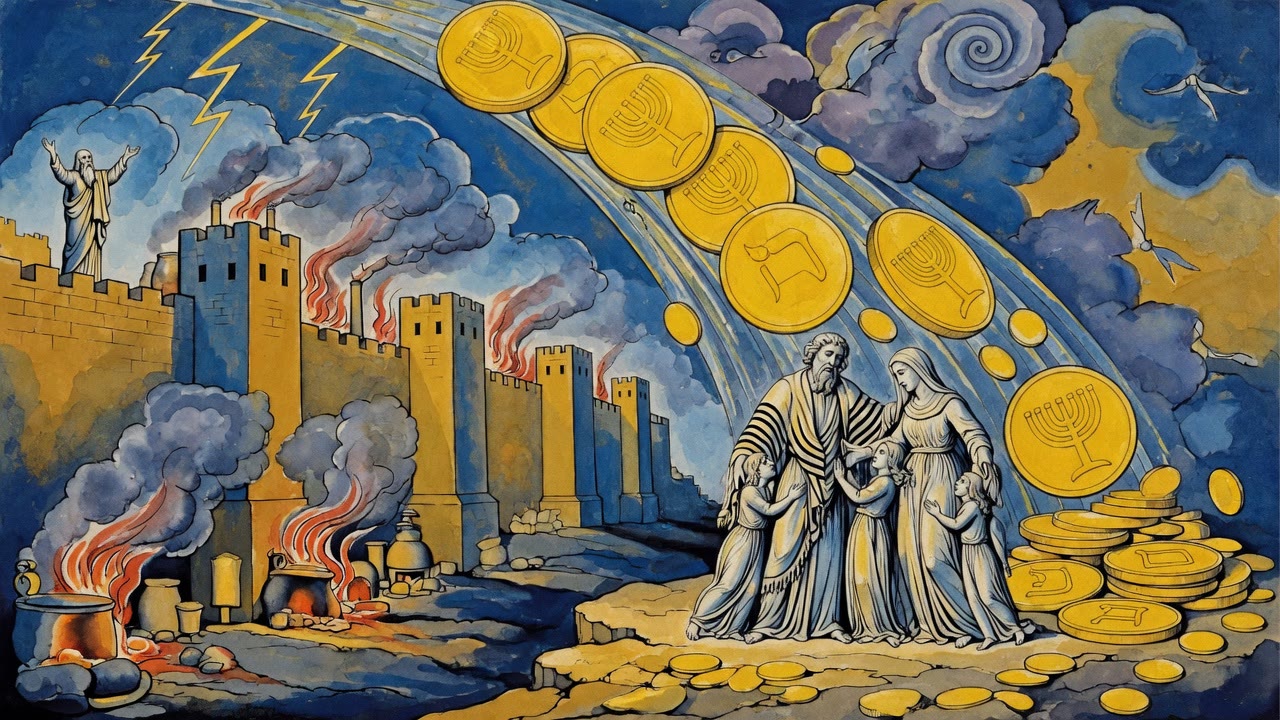
They counted the gold in the courtyard until the light ran out of the stones. Six hundred talents. A weight that could have bought fields far from the walls. The community of Jerusalem did not hand it over so the Nevlatah family could leave. They handed it over so the family would not be forced to leave.
 Click for full size
Poverty at the Gate of the Holy
The Nevlatah were desperately poor inside the city that called itself holy. Hunger does not respect topography. A child can starve within sight of the Temple mount as easily as on a road to Egypt. The city answered with a fortune large enough to look absurd beside empty shelves.
Why so much? The tradition is blunt. They did not want to force the family out of Jerusalem. Communal responsibility meant keeping even the poorest inside the circuit of the walls, the festivals, the shared air of Zion. Gold became a chain of mercy, not a ticket out.
How a family could be so poor while near such a gift is a riddle the text leaves open. Perhaps the gold was held more than spent. The point that survives is the refusal to let poverty become exile while the walls still stood.
Bread That Cannot Return to the Oven
Years later, when exile did come for the many, Israel would invent a bakehouse word for the loss. They cried radnu, "we have broken loose." The sages heard the language of the oven. A baker who lifts a loaf from the oven wall knows it can never be pressed back to bake again.
"We dwelt in Jerusalem as bread within an oven," they said, "for the fire of the Holy One is in Zion and His furnace in Jerusalem" (Isaiah 31:9). Then the loaf was drawn out and sent to Babylon. What more can You ask of bread already removed once from the heat?
Rabbi Joshua still insisted that not one good word the Lord spoke to the house of Israel ever failed. Promise and ruin sat in the same mouth. Late-ripening wheat, the deep gloom Jeremiah named, was read as delay, not as a kindness withheld forever.
May It Not Befall You
On the day of enflamed wrath the congregation of Israel turned to the nations and said, "May it not befall you, all wayfarers. Look and see: is there any pain like my pain?" (Lamentations 1:12). Wayfarers were also heard as violators of the way of Torah. Look and see became a dare and a warning at once.
The midrash stacks sentences the way a mourner stacks years. The Flood's generation, twelve months. Egypt, twelve months. Job, twelve months. The wicked in Gehenna, twelve months. Nebuchadnezzar's siege, three and a half years. Vespasian's, three and a half. Israel's claim is not that others never suffered. It is that this pain has a particular shape.
Gold That Could Not Stop the Later Fire
The six hundred talents kept one family inside the walls for a time. They could not keep the walls standing when the furnace of Jerusalem became more than a metaphor. Still the earlier act remains. A city that pours gold to prevent a private exile teaches what it believed a public exile would cost.
On a quiet afternoon before the catastrophes, a Nevlatah child walked a street he might have lost. The coins were heavy somewhere in a chest. The bread of the city still baked in its oven. No one yet said radnu. The gold still meant stay, not flee.
Two Memories of One City
When the later fire came, memory kept both images: the courtyard of counted talents, and the loaf that could not return to the wall of heat. The Nevlatah elders had signed a stay. Children learned the alleys of Zion by heart instead of a foreign market's prices.
Some of those children lived long enough to carry both gifts into exile: the gold that meant remain, and the oven-word that meant we were pulled out too soon. Memory kept the contradiction without sanding it smooth.
Pressure did not leave the room when the voices softened. It only changed shape, settling into the bones of everyone who had watched the turn and would have to live with what they had seen.
The air after the choice tasted different. Someone swallowed. Someone looked away. The event had finished its visible work and begun its slower work in memory.
The air after the choice tasted different. Someone swallowed. Someone looked away. The event had finished its visible work and begun its slower work in memory.
← All myths