5 min read

The Six Words of Shema Climbing Toward God

In a kitchen before dawn a father whispered the words so as not to wake the baby. The Zohar counts that whisper as six rungs up and six back down.

Curated by Arthur · Told by Maggid ·
Table of Contents
  1. Six Up, Six Down
  2. Beit as a Cord from Beginning to End
  3. When the Presence Stands Far
  4. Fingers on the Wheels
  5. One Cord, Two Directions

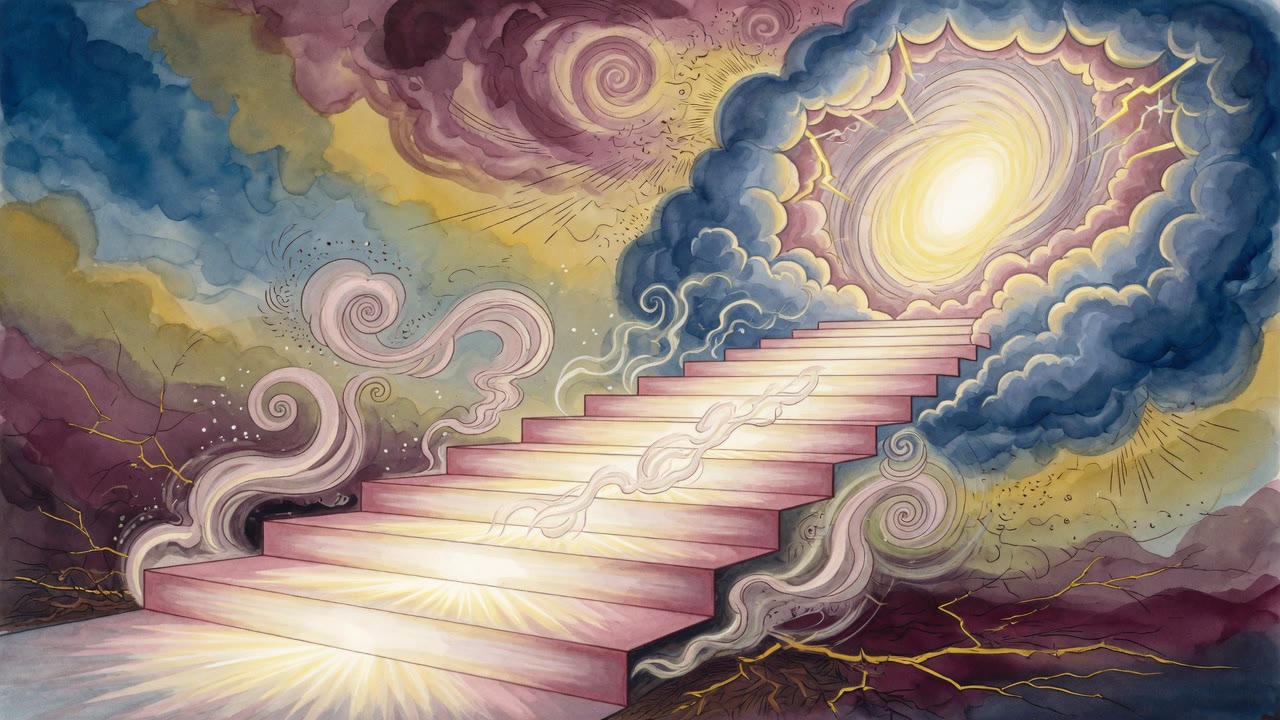
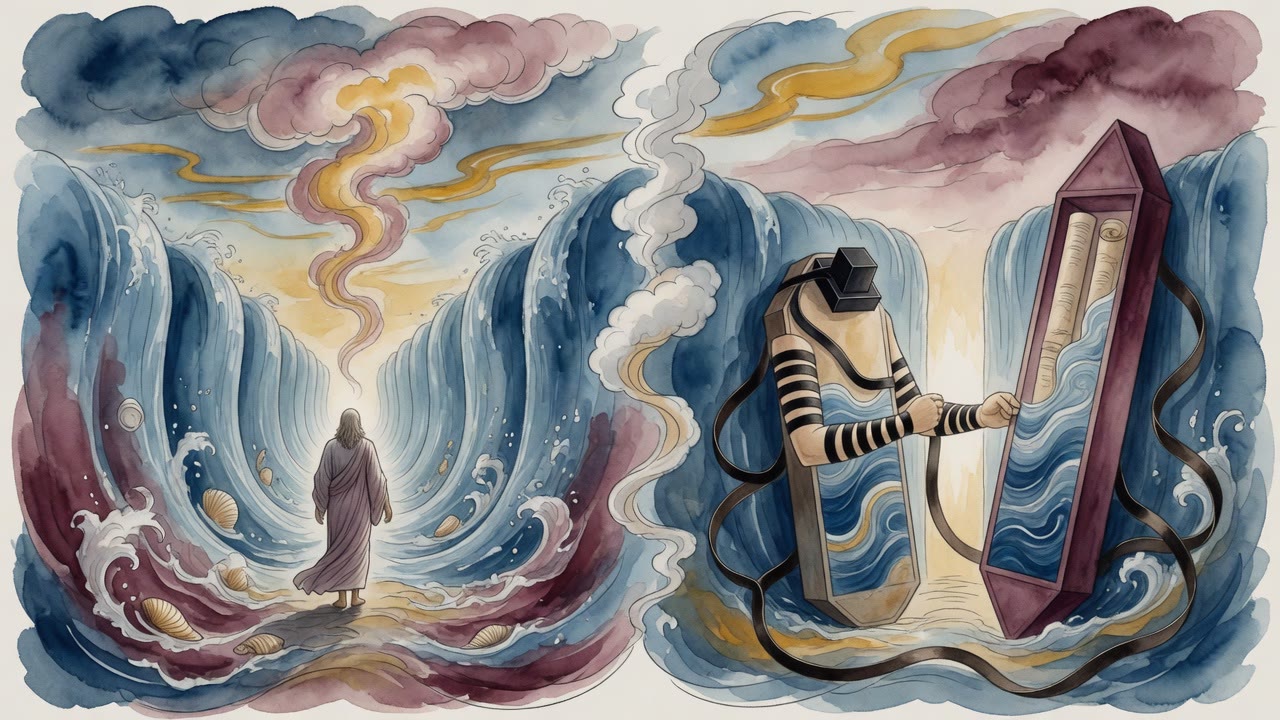
A mouth opened in a dim room and the first word left like a foot on a rung. Shema. Then Yisrael. Then the Name. Six words in all for the climb: Hear, O Israel, the Lord our God, the Lord is One (Deuteronomy 6:4). The Tikkunei Zohar hears a song ascending those six steps, then descending on the six words of "Blessed is the Name of His glorious kingdom forever and ever." Up and down. Breath of a world that will not stay only above or only below.

The Six Words of Shema Climbing Toward God Click for full size

Six Up, Six Down

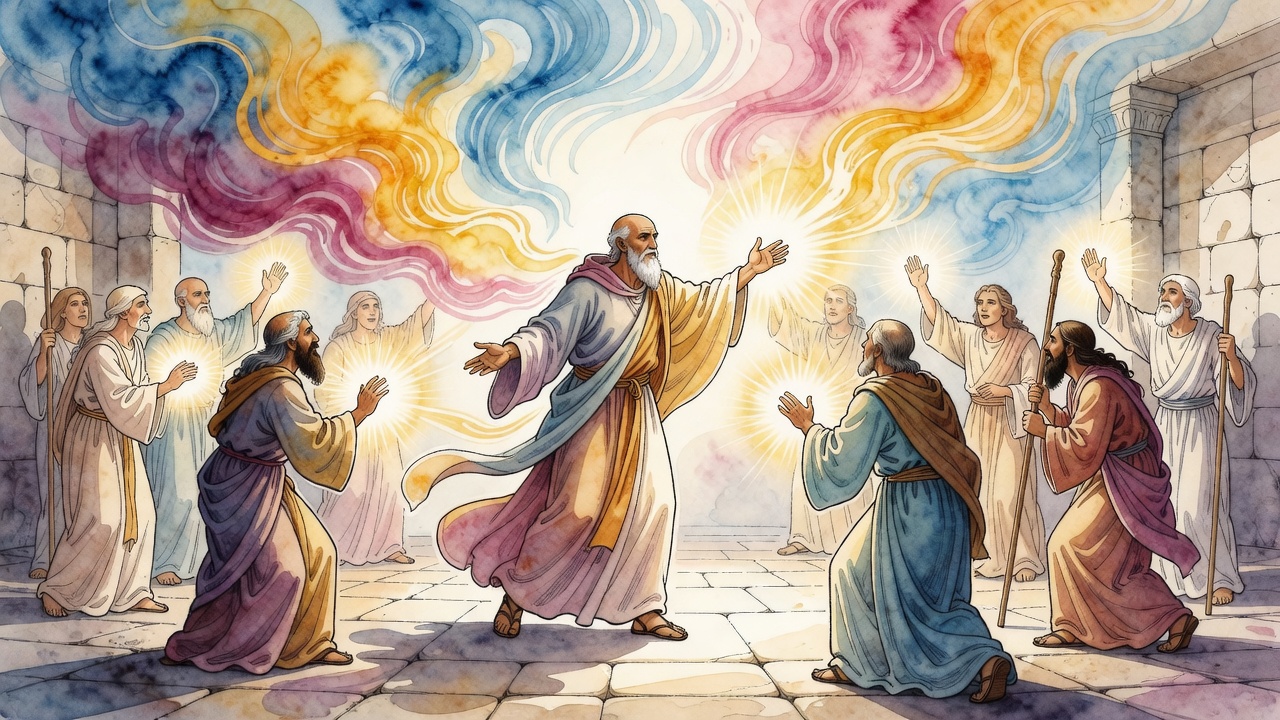
When the melody rises in pitch, it ascends in six. When it lowers, it descends in six. Song of Songs speaks of thighs as pillars of shesh, marble and six at once (Song of Songs 5:15). Body and number share a frame. Ten wheels answer to the letter Yod, value ten, like ten fingers on the strings of the world. Two letters Hei, five and five, the hands. Vav, six, the connector, the bridge the music must cross.

A person who only shouts the Shema (Hear O Israel) as a password misses the architecture. The words are stairs. The whispered "Blessed is the Name" is the return flight. Without the descent, the ascent is a kite with a cut string. Without the ascent, the descent is only muttering.

Beit as a Cord from Beginning to End

The letter Beit has beginning, middle, and end. The Tikkunei Zohar builds it from three Yods, seeds of creation. Three tens and the cord of Beit at two make thirty-two. Add the crownlet Yod and the count climbs toward forty-two, the number tied to creation's utterances and to "My heart," libi, in the prophet's mouth (Isaiah 63:4). Flame in the bush, flame in the Torah, flame in the divine heart: the same heat counted in letters.

Beit opens the Torah, bereshit, in the beginning. A cord that binds start to finish is not a decoration on a scroll. It is the claim that the story is one piece. The six words of the Shema climb inside that same claim. One God. One run of meaning from first letter to last fire.

When the Presence Stands Far

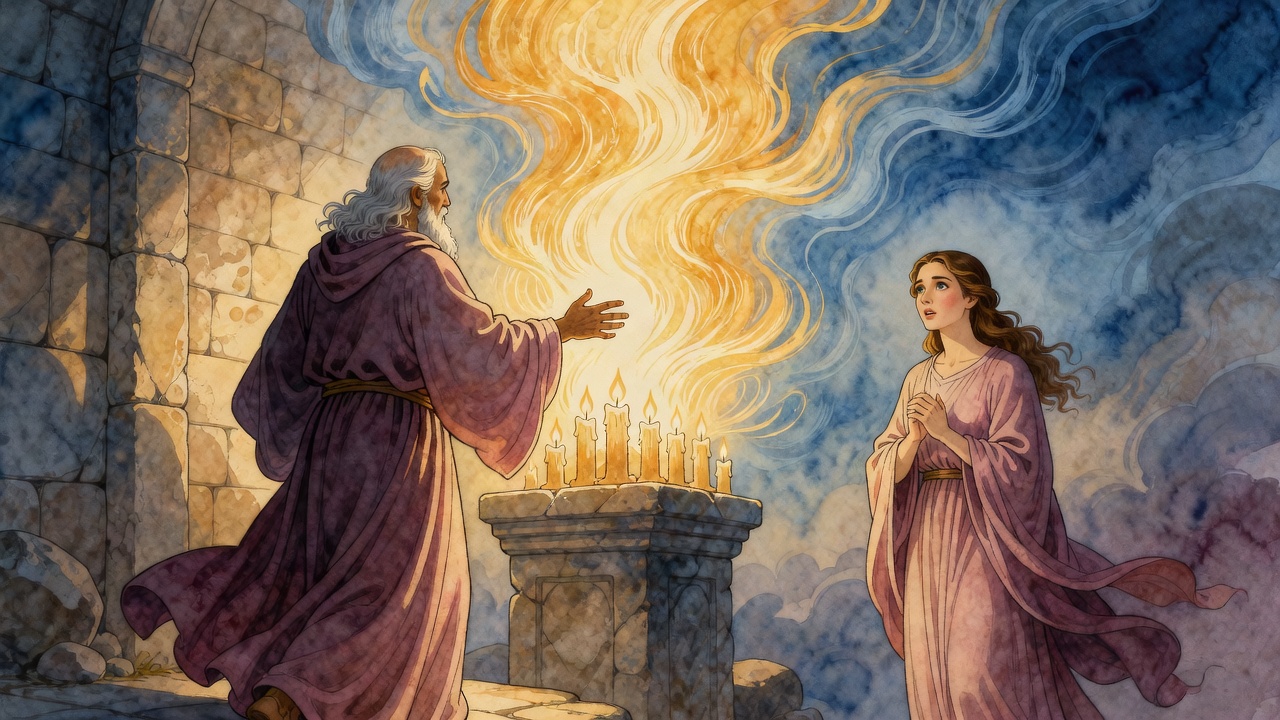
The same family of texts names a rift. The Shekhinah (שכינה), the Divine Presence that dwells with Israel, stands far from the Holy One. Blessing stalls in the gap. The lament is sharp: there is no one who calls them to return, no one who makes the upper and lower face each other again. The distance is not a metaphor for mood. It is a break in the flow that human mouths are asked to mend.

So the Shema is not only theology recited. It is a call across a cracked floor. Six steps up toward unity. Six steps down to plant unity in the kingdom of ordinary hours. The far Presence is waiting for a voice willing to be the bridge the Vav already names.

Fingers on the Wheels

Ten fingers. Ten wheels. A child learning the Shema does not know he is being fitted to a machine of repair older than his town. An old man whispering the descent after the climb may feel only habit. The Zohar's arithmetic does not require their understanding to operate. It requires their speech. Letters want mouths. Cords want tension. Rifts want callers.

When the song sticks in the throat, the gap widens a finger's width. When the six and the six complete their circuit, something on the far side takes a step nearer. The texts will not promise fireworks every morning. They promise structure. Structure is how a people keeps pulling the Presence out of exile without waiting to feel ready.

In a kitchen before dawn a father whispered the six words so as not to wake the baby, and still the climb counted. The whispered descent followed, blessing the Name's kingdom into the leftover dark. Somewhere the Shekhinah (the Divine Presence), far from her Partner, turned a fraction toward the sound. No angel blew a horn. The porridge still needed stirring. The cord of Beit pulled once, gently, as if a house settling on its posts.

One Cord, Two Directions

Beit holds beginning and end. The Shema holds up and down. The rift holds a job for anyone still breathing. None of this is soft. A cord can cut as well as bind if it is jerked without care. The six words must be climbed in order. The return must be spoken, not skipped. The call to the far Presence must be made as if someone is actually far and actually listening.

In the dim room the last word of the ascent lands. One. Then the quiet six of the descent begin. The day can start after that. The day is what the descent is for.


← All myths

From the tradition

Sources

3 sources

The texts behind this telling. Some cards carry a translation of the source; others are our own retelling of it, and each card says which. Every card links out to the original.

Tikkunei Zohar 54:18Tikkunei Zohar

Retold in our words. Read the original at the link below.Sefaria-hosted English translation · CC-BY

Our journey begins with the Sh'ma, that quintessential Jewish declaration: "Hear, O Israel: The Lord our God, the Lord is One" (Deut. 6:4). The Tikkunei (spiritual repair) Zohar tells us that when a song ascends, it does so through the six words of the Sh'ma. Think of it: each word, a step on a ladder reaching towards the divine.

What happens when the song comes back down? It descends, the text says, through the six words of "Blessed is the Name of His Kingdom’s Glory for ever and ever." This phrase, often recited quietly in the synagogue, mirrors the ascent, bringing the divine energy back down into our world, grounding it in the everyday. A constant flow, up and down, a spiritual breath.

The passage continues, saying that when the melody rises in pitch, it ascends in six. And when it lowers, it descends in six. It's all about balance, a constant interplay between rising and falling, inhaling and exhaling. The text then quotes the Song of Songs (5:15): "His thighs are pillars of shesh" – which can mean both "marble" and "six". Isn't that amazing? The physical body, the beauty of the human form, is also connected to this cosmic dance of sixes.

Things get even more interesting. The Tikkunei Zohar mentions ten wheels, which are associated with the Hebrew letter Yod (י), which has a numerical value of 10. These ten wheels correspond to our ten fingers, strumming the music of the universe. Five fingers on each hand, represented by the letters Hei-Hei (ה-ה), each with a numerical value of 5. These ascend through the Yod – the hand – through six levels, represented by the letter Vav (ו), which equals 6.

The Vav, in particular, is crucial. This single letter, often translated as "and," acts as a connector, a bridge. It’s in the Vav that these energies, these musical vibrations, rise and descend. The Vav is the link between the upper and lower realms.

So, what does it all mean? This passage from the Tikkunei Zohar paints a vivid picture of how even the simplest act of singing can be a deeply spiritual experience. It connects us to the divine flow, the constant movement between ascent and descent, creation and return. It suggests that within the music, within the notes, within the very words we utter, lie hidden codes and connections to the cosmos.

Next time you sing – whether it's a prayer, a lullaby, or just humming along to your favorite tune – remember this passage. Remember the six words rising, the six words descending. Remember the ten fingers strumming the music of the universe. And perhaps you'll catch a glimpse of the hidden beauty, the cosmic dance, that lies just beneath the surface.

Full source
Tikkunei Zohar 123:3Tikkunei Zohar

Retold in our words. Read the original at the link below.Sefaria-hosted English translation · CC-BY

Tikkunei Zohar turns to The Letter Beit as a Cord Binding Beginning to End.

This point, Beiyt, has a beginning, a middle, and an end. It’s then described as being composed of "three Yods (י־י־י)." A Yod, the smallest letter, is often seen as the seed of all creation. Three Yods, each with a numerical value of ten, add up to thirty. Add that to the chord of Beiyt, valued at two, and we arrive at thirty-two.

What does this number signify?

The text continues: "The crownlet that is upon the chord is Yod, and thus forty-two..." We're climbing further into the mysteries here! This forty-two is connected to "32 times Elohim (אֱלֹהִים)," one of the Hebrew names for God. It's also tied to the "ten utterances with which were created the heavens and the earth." Remember the story of creation? God spoke, and the universe came into being. These ten utterances, these divine words, are interwoven with the number forty-two.

The passage then quotes verses that, on the surface, may not seem connected. "And Elohim saw everything that He had made" (Genesis 1:31). This is linked to "an angel of Ha-Shem (השם, "The Name," referring to God) appeared to him in a flame of fire" (Exodus 3:2), and then to "For a day of vengeance is in ‘My heart’" (Isaiah 63:4). How do they all connect?

According to the Tikkunei Zohar, they all share a common thread: the "flame" (labat) within the Torah, within God's very being. This flame, this heart, is linked to the numerical value of forty-two. The passage specifically mentions the phrase "LiBiY" (לִבִּי, "My heart"), which also equals 42.

And it doesn't stop there! This number is further associated with the "42 letters of YQV”Q," a powerful, albeit obscure, name of God. Through these letters, through this divine name, the universe operates.

Finally, the text quotes (Psalm 118:19): "Open for me the gates of righteousness, I shall enter ‘into them’ (vam)." Again, the numerical value of "vam" (וָם) is forty-two! These gates, this path to righteousness, is "included in Be-er Sheva (בְּאֵר שֶׁבַע)," a place name that itself is connected to the sequence "A-V-G-Y-T-Tz," another powerful Kabbalistic formula.

So, what are we to make of all this?

This passage from the Tikkunei Zohar isn't just about numbers; it's about the hidden connections within creation. It’s about the way seemingly disparate elements – letters, numbers, verses, names of God – all weave together to form a unified whole. It suggests that everything is interconnected, from the smallest Yod to the vast expanse of the cosmos. It hints that by understanding these connections, by delving into the mysteries of the Hebrew letters, we can glimpse the divine blueprint of the universe.

And that perhaps, the key to understanding the universe lies hidden within the very letters we use to describe it.

Full source
Tikkunei Zohar 43:20Tikkunei Zohar

Retold in our words. Read the original at the link below.Sefaria-hosted English translation · CC-BY

The Tikkunei (spiritual repair) Zohar, a central text of Kabbalah, dives deep into this feeling. It speaks of a separation, a cosmic rift, and our role in mending it. It points to a Shekhinah, the Divine Presence, as being "far" from the Holy One.

What does that even mean?

The Shekhinah, in Kabbalistic thought, is often understood as the feminine aspect of God, the immanent presence that dwells within creation. When the Tikkunei Zohar says she’s "far," it suggests a disconnect between the Divine and the world, a rupture in the flow of blessing.

Here's the kicker: it's up to us to call things back into alignment. The text laments that "there is no-one who calls them to repent, so that the Shekhinah be returned to the blessed Holy One." We have a job to do! Our actions, our intentions, our very prayers can help bridge this gap, reuniting the Divine Presence with its source.

But it also warns us about getting in our own way. The Tikkunei Zohar uses a rather harsh analogy: comparing those who don’t strive for this reunification to dogs who "mingled with the nations, and they learnt their ways" (Psalm 106:35). This "mixed multitude," as the text calls them, only do good for their own benefit. Ginzberg, in his monumental Legends of the Jews, details the complex and often problematic role of the "mixed multitude" who left Egypt with the Israelites. This isn't about judging anyone, but about highlighting the motivation behind our actions.

Are we acting out of genuine compassion, a desire to repair the world – what we call tikkun olam? Or are we just looking to satisfy our own needs?

The text continues, driving the point home. These self-serving individuals, it says, are primarily concerned with "sustenance and clothing and sexual fulfillment." These aren't inherently bad things, of course. We all need these things. The issue, as (Exodus 21:10) reminds us, is that these needs can become all-consuming if not balanced by a higher purpose. The text points to the laws of marriage ( "...her provisions, her covering, and her sexual fulfillment, he shall not diminish...") to show how even fundamental needs must be handled with care and consideration for others.

So, what does this all mean for us today?

Perhaps it's a call to self-reflection. To examine our motivations. To ask ourselves if we are truly striving to bring the Shekhinah closer, to heal the world, or if we're simply chasing after our own desires. It’s a reminder that we have a role to play in the grand cosmic drama, a chance to be agents of healing and reunification. And that, my friends, is a pretty powerful thought.

Full source